
Market Overview
| Study Period | 2021 - 2031 |
|---|---|
| Forecast Data Period | 2026 - 2031 |
| Historical Data Period | 2021 - 2024 |
| Growth Rate | 8.06 % |
| Market Concentration | Medium |
Major Players *Disclaimer: Major Players sorted in no particular order Image © Mordor Intelligence. Reuse requires attribution under CC BY 4.0. | |

Europe High-Voltage Direct Current (HVDC) Transmission Systems Market Analysis by Mordor Intelligence
The Europe High-Voltage Direct Current (HVDC) Transmission Systems Market size is expected to register a CAGR of 8.06% during the forecast period (2026-2031).
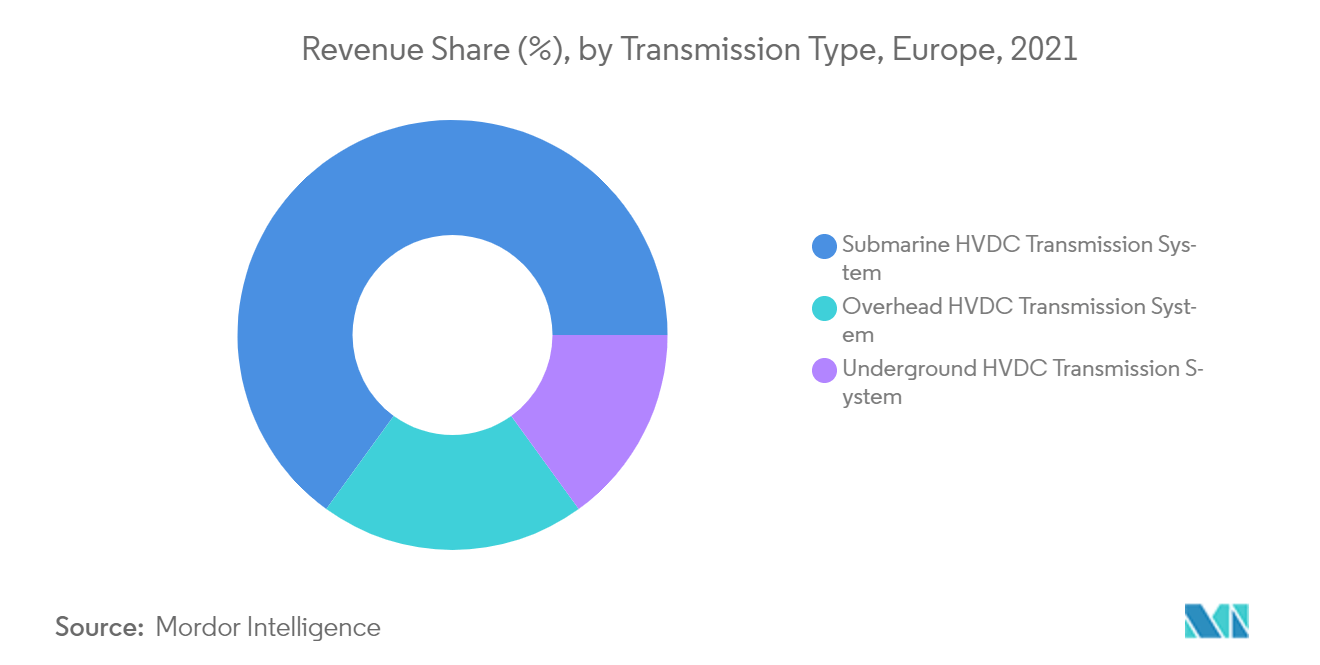
- The submarine HVDC transmission system type is expected to hold the largest share in the market, owing to the increasing development of submarine power transmission systems across the region.
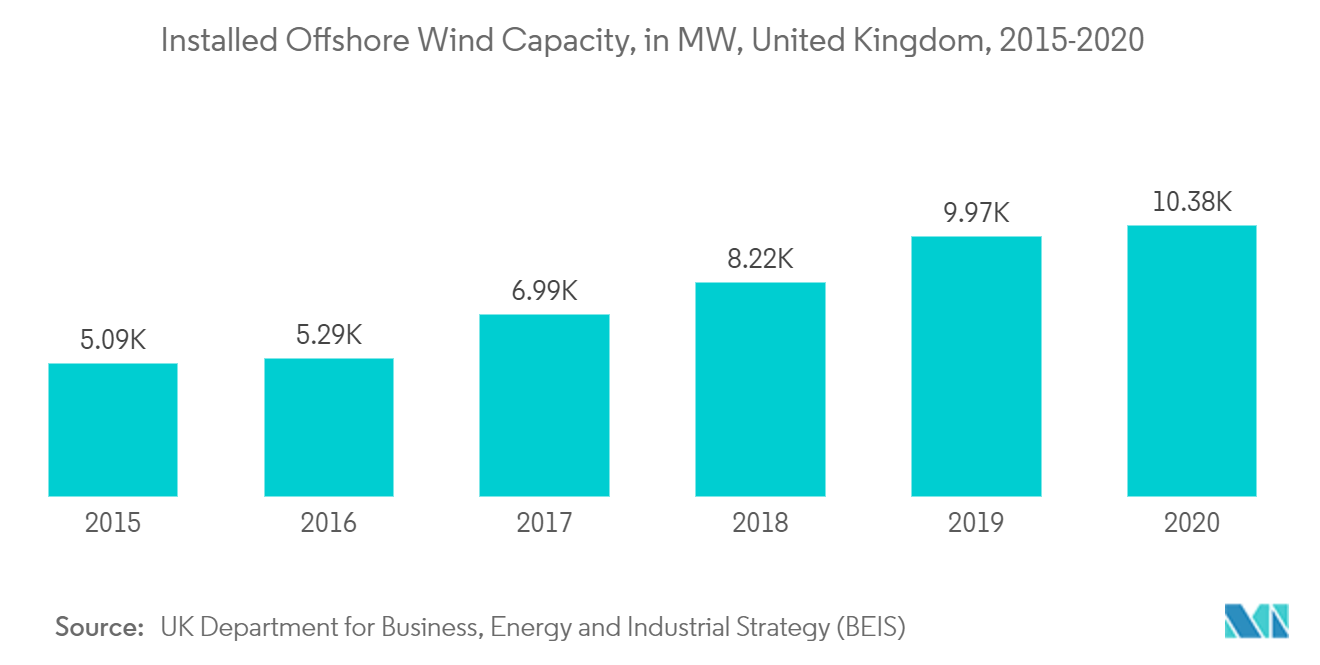
- The offshore region of Europe has significant wind potential, which is evident from the already installed capacity. More offshore wind farms are expected to come up in the future to lower emissions, which is expected to provide immense opportunities to the market players involved in the HVDC transmission systems market.
- The United Kingdom is expected to grow significantly in the European HVDC transmission systems market during the forecast period.
Note: Market size and forecast figures in this report are generated using Mordor Intelligence’s proprietary estimation framework, updated with the latest available data and insights as of 2026.
Europe High-Voltage Direct Current (HVDC) Transmission Systems Market Trends and Insights
Submarine HVDC Transmission System Type to Dominate the Market
- The submarine transmission of electricity is gaining importance on account of the increasing focus on renewable energy such as wind and power trading between the countries in the European region.
- The submarine direct current transmission requires a converter station at each end to make the DC interact with the AC grid network. In an HVDC transmission system, the submarine power cables have a much more complicated structure compared to the overhead transmission lines, which are only composed of conductors.
- These submarine HVDC cables can be used to connect offshore installations, such as production platforms in the oil and gas sector or substation platforms in the offshore wind sector, to the region's mainland grids.
- Moreover, in November 2021, Nexans and Terna announced a major contract of more than EUR 650 million for the first submarine HVDC transmission system between Sardinia and Sicily. Nexans will provide 500 km of 500kV HVDC mass impregnated subsea cable link for the project manufactured at its Halden plant in Norway.
- Also, as of September 2021, Greece and Egypt were in talks about the possibility of laying a 2 GW submarine HVDC transmission system on the bottom of the Mediterranean Sea and linking their respective electricity grids. Greece is also working with Italy on a 1 GW submarine cable link below the Ionian Sea.
- Thus, taking account of the above-mentioned points, the submarine HVDC transmission system type is expected to dominate the HVDC transmission systems market in Europe during the forecast period.


United Kingdom to Witness Significant Growth
- The United Kingdom's power generation mix is expected to change considerably in favor of renewables over the next few years, with the country increasingly moving toward a low-carbon economy. The country also has several policies in place, such as the national renewable energy action plans that support the transition to a low-carbon energy system.
- With the increasing integration of renewable energy sources and the growing need to enhance the security of supply, HVDC grid technology is expected to be evolved in the country. Moreover, investments in the offshore wind industry, solar photovoltaic (PV), grid expansion, and energy storage projects require smart energy infrastructure to balance the fluctuating supply of renewable sources.
- In March 2022, Prysmian was awarded a contract worth GBP 990 million for the turnkey design, manufacturing, installation, testing, and commissioning of the 725km, 1400MW submarine HVDC transmission system, which will directly link the German and UK electricity grids.
- Also, in May 2021, Hecate Independent Power announced to build a GBP 200 million submarine HVDC cable factory in the United Kingdom to support its GBP 21 billion offshore wind power project. The HIP project comes in offshore Iceland but will be connected to the United Kingdom by long, high-capacity, HVDC submarine cable systems.
- Thus, owing to the above-mentioned points, the United Kingdom is likely to experience significant growth during the forecast period.
Regulatory Landscape
HVDC grid connection in the EU is governed primarily by Commission Regulation (EU) 2016/1447, which sets mandatory requirements for HVDC systems and DC-connected power park modules (including performance obligations such as fault ride-through and control capabilities). The European Commission maintains the broader electricity network codes and guidelines framework, while ENTSO-E supports implementation through connection-code workstreams focused on HVDC.
In 2024, ACER advanced updates to the Network Code on HVDC, including proposals to extend the scope toward offshore demand facilities, power-to-gas (electrolysis), and offshore electricity storage, and to tighten technical requirements around RoCoF withstand, voltage phase angle jump withstand, grid-forming capability, and short-circuit contribution during faults. In parallel, the European Commission proposal COM(2025) 1006 targets faster permitting for energy infrastructure, including transmission grids, which directly impacts lead times for cross-border and offshore HVDC projects across Europe.
Value Chain Analysis
The European HVDC value chain spans project origination and planning by TSOs and developers, system design and engineering (converter station and cable system architecture), component manufacturing (power electronics valves, transformers, switchgear, controls, and protection), cable manufacturing (including high-voltage subsea and underground systems such as 525 kV-class XLPE), and EPC delivery with specialized marine installation and commissioning. Key technology and delivery participants across these steps include Hitachi Energy, Siemens Energy, Sumitomo Electric, GE Vernova, and marine contractors for offshore and subsea works.
Recent contracting activity highlights where value concentrates: large converter-station awards and long-lead cable supply and installation packages. Examples include Hitachi Energy securing a EUR 770 million contract (June 2026) for Elmed converter stations and Sumitomo Electric entering long-term supply and installation frameworks in the UK (July 2026) alongside EPC cable awards in Germany. Regulatory and planning frameworks such as TEN-E (Regulation (EU) 2022/869) and ACER work on NC HVDC revisions influence specification harmonization and interoperability, which in turn shapes procurement, testing, and compliance demands across manufacturers, integrators, and grid operators.
Competitive Landscape
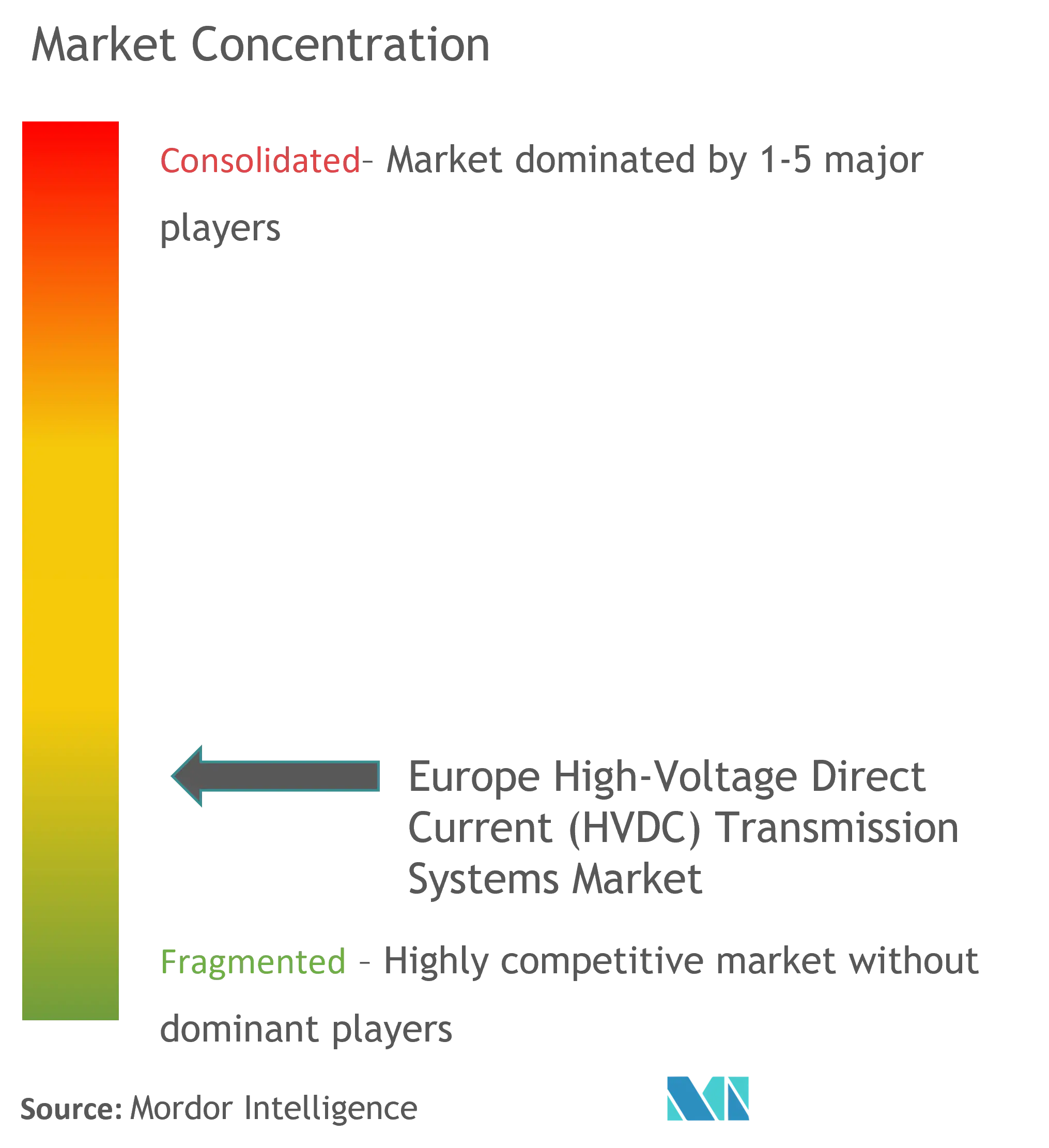
The European high-voltage direct current (HVDC) transmission systems market is partially fragmented. Some of the major players involved in the market include General Electric Company, Hitachi Energy Ltd, Eaton Corporation PLC, Siemens Energy AG, and Toshiba Corporation.
Europe High-Voltage Direct Current (HVDC) Transmission Systems Industry Leaders
General Electric Company
Hitachi Energy Ltd.
Siemens Energy AG
Toshiba Corporation
Eaton Corporation PLC
- *Disclaimer: Major Players sorted in no particular order

Market Opportunities and Future Outlook
Grid investment and cross-border build-out remain the central whitespace for HVDC transmission systems in Europe, with the European Commission citing EUR 1.2 trillion of grid investment needed between 2024 and 2040 to support the energy transition. This translates into sustained demand for long-distance bulk transfer, offshore grid connections, and interconnectors where HVDC offers controllability and reduced losses, especially for subsea routes that dominate many North Sea and Baltic build plans.
A second opportunity area is new HVDC project archetypes moving from point-to-point links toward hybrid and multi-terminal configurations that integrate offshore wind while enabling cross-border trade. Evidence includes ENTSO-E TYNDP 2026 portfolio submissions for hybrid interconnector concepts and TSOs advancing large-scale projects such as the proposed Baltic-German PowerLink (submitted to TYNDP 2026, with a decision process referenced for end-2026) and the Elmed interconnection where Terna and STEG awarded converter-station scope to Hitachi Energy in June 2026. On the supply side, efforts to harmonize HVDC technical specifications (including evolving NC HVDC requirements around grid-forming behavior and stability services) create room for platforms, control software, testing, and interoperability solutions that reduce bespoke engineering across European projects.
Recent Industry Developments
- July 2026: GE Vernova reached a key fabrication milestone for the Ostwind 4 offshore HVDC converter platform with the first steel cut completed. Progress on a 2 GW-class offshore grid connection supports the scaling of HVDC offshore substations and associated balance-of-plant supply in the Baltic Sea buildout.
- June 2026: Hitachi Energy won a EUR 770 million contract from Terna and STEG to deliver the converter stations for the Elmed interconnection between Italy and Tunisia. The award expands European HVDC activity into a Europe-North Africa direct-current link and reinforces demand for large converter-station engineering, controls, and grid-code compliance capabilities.
- September 2024: ENTSO-E and national regulators published early guidance for the 2026 TYNDP cycle, signaling increased emphasis on multi-terminal and hybrid HVDC configurations and cross-border project coordination across Europe.


Research Methodology Framework and Report Scope
Market Definition and Coverage
For this report, the market covers revenue generated from HVDC transmission system supply and project delivery across Europe, including HVDC converter stations and transmission media used to move power over long distances, underground, overhead, or subsea.
Scope exclusions: We exclude AC transmission equipment, low and medium voltage DC systems, and routine grid maintenance services that are not specific to HVDC assets.
Segmentation Overview
- Transmission Type
- Submarine HVDC Transmission System
- HVDC Ovehead Transmission System
- HVDC Underground Transmission System
- Component
- Converter Stations
- Transmission Medium (Cables)
- Geography
- United Kingdom
- Germany
- Italy
- France
- Netherlands
- Rest of Europe
Data Sources, Market Sizing, and Validation
Desk Research
Desk research started by building a clear project and demand context for HVDC in Europe, then mapping where revenue typically sits across converter stations and cable-based transmission media. For source triangulation, we relied on public materials such as ENTSO-E network development updates, Eurostat energy statistics, European Commission policy and funding updates, and national transmission system operator (TSO) planning documents for major corridors.
To ground the sizing assumptions, we also reviewed technical publications and journals on HVDC topology choices, along with station and cable cost drivers for Europe-based projects. Where available, we used company annual reports and investor presentations to corroborate order intake, plus grid project exposure. If additional supplier-financial intelligence was needed, we used a paid subscription for company financial intelligence, and we cross-checked technology direction using a patent database rather than depending on private operational data. These desk research inputs are illustrative only, and we also used other public references to collect, cross-check, and clarify assumptions.
Primary Interviews and Surveys
Primary work focused on confirming what is actually being built and contracted in Europe, and what portion of HVDC value is recognized in the period when equipment is delivered and commissioned. We spoke with stakeholders across the value chain, including utilities, EPC-facing roles, equipment suppliers, and engineering experts, then used these inputs to close gaps on project timing, technology choices, and pricing movements across key European countries.
Distribution of primary research fieldwork respondents
| Company type | Respondent position |
|---|---|
| Top tier: 27% | CXOs: 18% |
| Mid tier: 55% | Functional/Unit leaders: 37% |
| Smaller Players: 18% | Managers: 45% |
Market-Sizing & Forecasting
Sizing used a top-down and bottom-up approach. At the Europe level, we reconstructed demand using the visible pipeline of grid interconnections and reinforcement needs, then checked that against implied revenue realizations based on typical project phasing. The top-down work was anchored to transmission expansion indicators, including cross-border interconnector additions, offshore wind grid connection requirements, HVDC corridor length, route type (subsea, underground, overhead), and an expected split of converter station value versus transmission medium value.
After that, we applied selective bottom-up checks to keep totals realistic, including sampled project values converted into implied USD per MW and USD per km ranges, and roll-ups from a limited set of supplier and contractor disclosures where HVDC revenue exposure could be isolated credibly. When project details were incomplete, we used conservative ranges tied to route type and converter configuration, then adjusted them after interview feedback confirmed local cost and timing differences.
For forecasting, we used scenario analysis because HVDC spending is lumpy and tied to permitting and award schedules. Scenarios were driven by variables practitioners track closely, such as tender flow and award timing, offshore wind build-out pace, grid congestion signals and curtailment pressure, and the rate of policy-backed interconnection approvals. These drivers were then translated into annual revenue recognition profiles.
Data Validation & Update Cycle
Validation was handled in layers so the model does not depend on one data stream. Model outputs were compared against independent signals such as announced capacity additions, interconnector commissioning schedules, and observable shifts in converter technology preference, then the largest variances were reviewed before sign-off.
When an outlier appeared, analysts re-checked assumptions including USD conversion timing, project phasing, and unit cost ranges. If the variance could not be explained through public documentation, we re-contacted relevant experts. Reports were refreshed annually, with interim updates when material events occurred, and a final pre-delivery pass was completed so clients received the latest view based on newly released tenders and project milestones.
Mordor Intelligence's Europe High Voltage Direct Current Hvdc Transmission Systems Market Market Estimate Compared With Other Published Estimates
It is normal to see different market values for Europe HVDC because each publisher draws the line differently on what counts as a system, how revenue is recognized, and whether the scope focuses on equipment supply only or includes broader project work.
In this study, the main gap drivers are usually the treatment of subsea export links and interconnectors, the split between converter stations and cables, and how multi-year projects are allocated into annual market values. By tracking tender awards, commissioning timelines, and EUR to USD conversion points, Mordor Intelligence places recognized HVDC system value into the year when deliveries and project milestones are evidenced, which can shift the stated size versus estimates that smooth values across the full construction period.
Benchmark comparison
| Source | Market Size | Gaps in Research Methodology |
|---|---|---|
| Mordor Intelligence | USD 9.60 B (2024) | |
| Global Consultancy A | USD 10.88 B (2024) | Uses a broader technology boundary that is centered on converter technology shares, and it can pull in adjacent HVDC spending that is not always attributable to Europe-only transmission system deliveries in the year. |
| Research Publisher B | USD 5.80 B (2023) | Anchors the value to a different base year and a wider component list, and it can apply a narrower recognition of project value that understates multi-country interconnector deliveries captured in the current-year view. |
The spread across sources is mainly explained by timing and scope decisions rather than arithmetic. When scope is kept to HVDC transmission systems and the annual value is tied to observable project milestones, the resulting market size becomes easier to reconcile with the real pipeline and year-by-year delivery cadence.


Key Questions Answered in the Report
What is the current Europe High-Voltage Direct Current (HVDC) Transmission Systems Market size?
The Europe High-Voltage Direct Current (HVDC) Transmission Systems Market is projected to register a CAGR of 8.06% during the forecast period (2026-2031)
Who are the key players in Europe High-Voltage Direct Current (HVDC) Transmission Systems Market?
General Electric Company, Hitachi Energy Ltd., Siemens Energy AG, Toshiba Corporation and Eaton Corporation PLC are the major companies operating in the Europe High-Voltage Direct Current (HVDC) Transmission Systems Market.
What years does this Europe High-Voltage Direct Current (HVDC) Transmission Systems Market cover?
The report covers the Europe High-Voltage Direct Current (HVDC) Transmission Systems Market historical market size for years: 2020, 2021, 2022, 2023 and 2024. The report also forecasts the Europe High-Voltage Direct Current (HVDC) Transmission Systems Market size for years: 2026, 2027, 2028, 2029, 2030 and 2031.
Page last updated on:


 Your data is secure and never sold or shared.


