
Market Overview
| Study Period | 2021 - 2031 |
|---|---|
| Forecast Data Period | 2026 - 2031 |
| Historical Data Period | 2021 - 2024 |
| Growth Rate | 8.25 % |
| Market Concentration | High |
Major Players *Disclaimer: Major Players sorted in no particular order Image © Mordor Intelligence. Reuse requires attribution under CC BY 4.0. | |
South Africa High Voltage Direct Current (HVDC) Transmission Systems Market Analysis by Mordor Intelligence
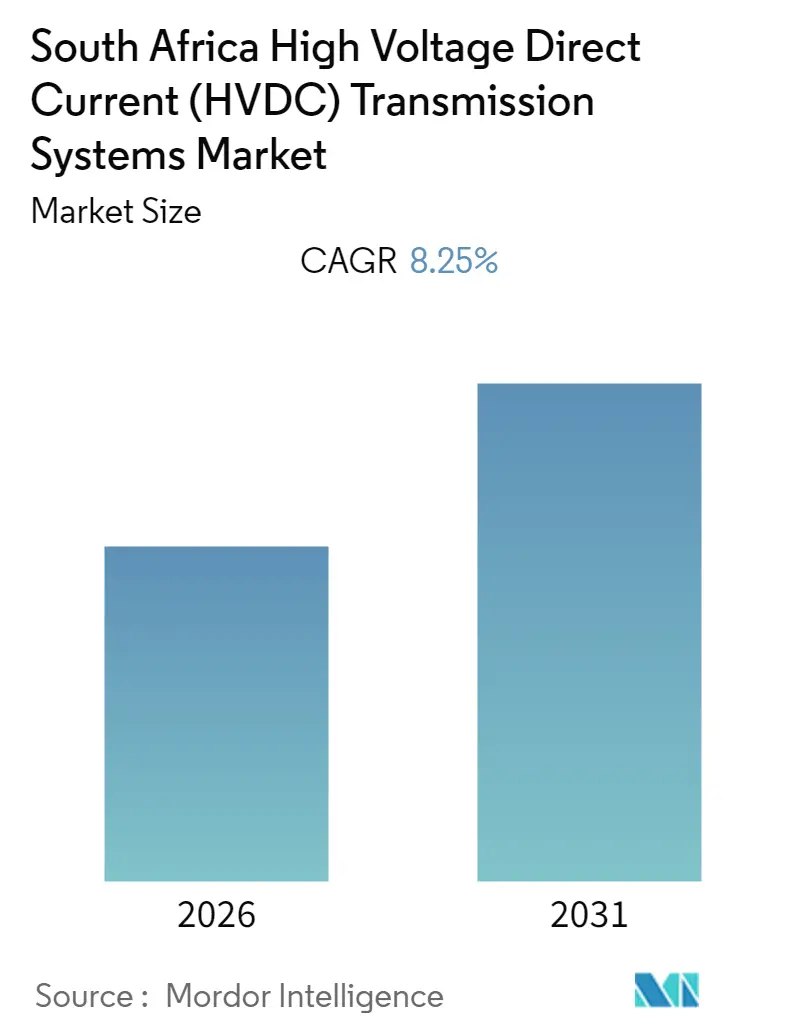
The South Africa High Voltage Direct Current (HVDC) Transmission Systems Market size is expected to register a CAGR of 8.25% during the forecast period.
- Transmission medium (cables) is expected to witness significant growth over the forecast period, as HVDC cables offer many technical advantages such as lower losses, improved system stability, and enhanced reliability.
- The growing energy demand, as well as the growth of the renewable energy sector in the African region, is expected to create significant opportunities for HVDC transmission systems market in the near future
Note: Market size and forecast figures in this report are generated using Mordor Intelligence’s proprietary estimation framework, updated with the latest available data and insights as of 2026.
South Africa High Voltage Direct Current (HVDC) Transmission Systems Market Trends and Insights
Transmission Medium (Cables) to Witness Significant Demand
- HVDC cables play an important role in a growing number of HVDC links. While the fixed costs of terminals at both ends of HVDC links are more expensive than AC, the cost per unit length of the line itself is lower. With all the other things being equal, the longer the distance of the link, the lower the relative cost of the link per unit of energy.
- Over a break-even distance (approximately 600-800 km for current technologies), HVDC becomes the lowest cost option. Also, there are no technical limits to the potential length of an HVDC cable. In a long AC cable transmission, the reactive power flow, due to the large cable capacitance, will limit the maximum possible transmission distance. With HVDC there is no such limitation.
- The power utilities in the South African Development Community (SADC) countries are expected to maximize their reserve margins and trade any surpluses of power using transmission systems connecting the large new power sources with the large load systems, in compliance with the South African Power Pool (SAPP). Due to the large distances between Northern SADC and Cape Town in South Africa, DC strengthening is considered as one of the transmissions strengthening options.
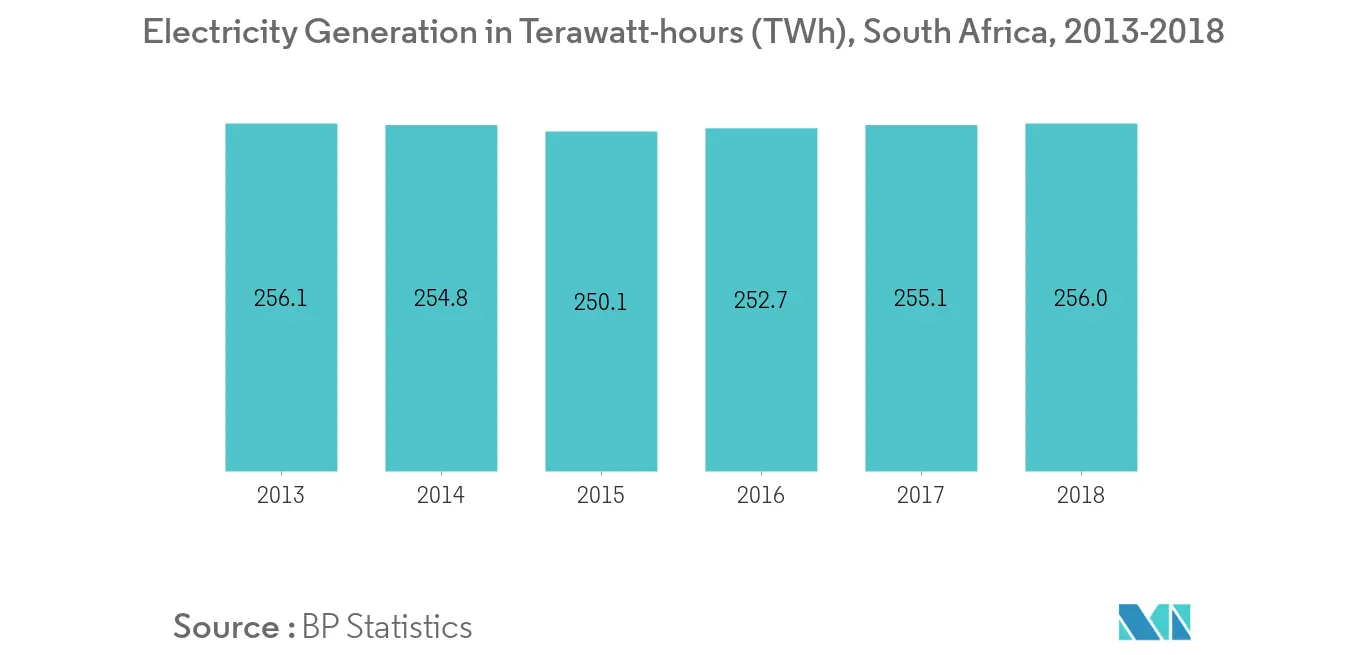
- HVDC cable systems are the most viable solution for the transfer of power between asynchronous networks that cross large water bodies, require longer transmission lines, and usually come in a hybrid configuration. These systems provide controllable bulk power transmission capacity without an increase in short circuit current levels.As of 2018, the electricity generated in 2018 was 256 TWh, a slight increase when compared to 2017.
- Some of the major HVDC lines in this country are Inga - Kolwesi in DRC (580MW, 1700 km, in operation since 1982), Cahora Bassa, connecting Mozambique and South Africa (1920 MW, 1420 km, in operation since 1979), and Caprivi Link, connecting Namibia and Zambia (300 MW, 950 km, in operation since 2010).
- All these projects are ready for an extension, and various new HVDC lines are under consideration in the region. The projects include HVDC transmission lines from DRC hydropower Grand Inga to South Africa, Zambia to Namibia, and CESUL Hydro, Mozambique Project.
- Therefore, the development of HVDC transmission projects is expected to drive the market for HVDC cables in South Africa during the forecast period.
Rural Electrification to Drive HVDC Transmission System
- For HVDC transmission lines, the transmission losses are in inverse relation with the voltage ratings of electricity, i.e. higher the voltage rating of electricity transmitted, lower will be the transmission losses. Also, the HVDC transmission lines can transmit higher voltage current than HVAC lines.
- In places with limited availability of land, HVDC transmission lines are preferred over HVAC, as they have higher power transmission capacity, and hence, can transmit more electricity per unit land usage.
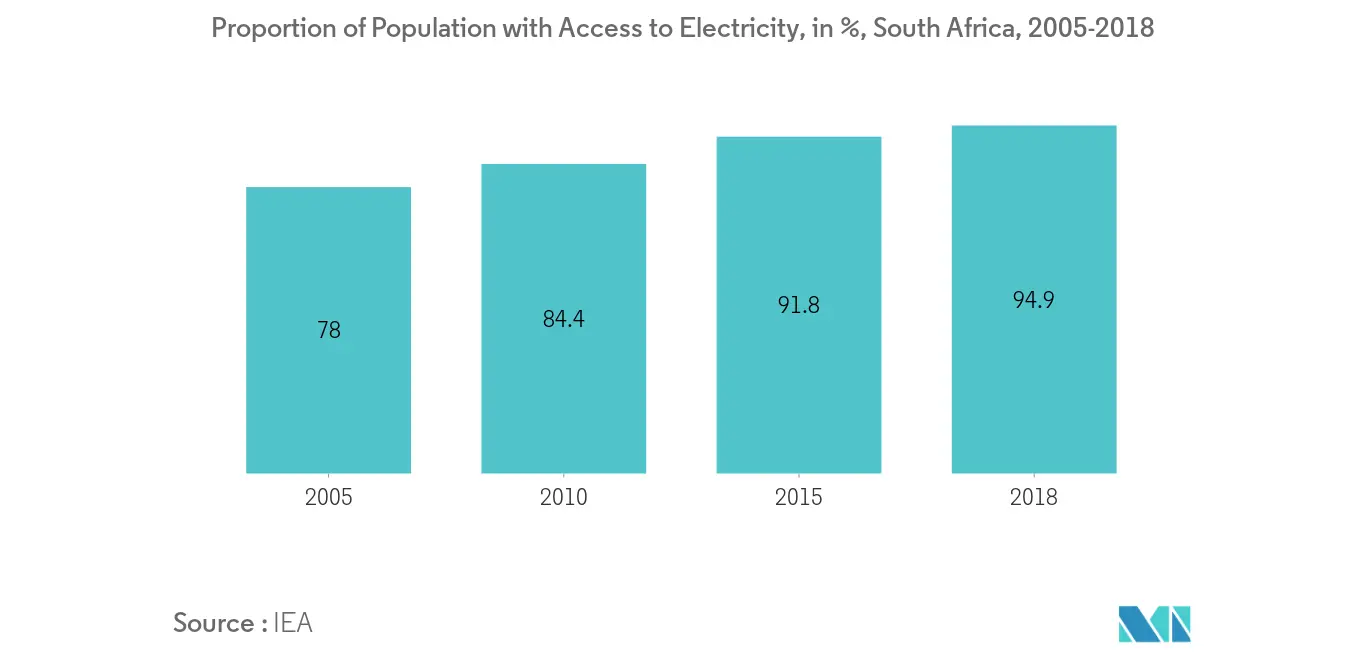
- The number of people without access to electricity, which peaked at 610 million in 2013, declined slowly to around 595 million in 2018. Much of this dynamism has been in East Africa, as Kenya, Ethiopia, and Tanzania accounted for more than 50% of those gaining access.
- According to the African Development Bank, more than 645 million people in Sub-Saharan Africa, roughly 70% of the region's population, do not have access to electricity. Moreover, the number of people without access to electricity in the African region is expected to increase from 588 million in 2016 to about 602 million in 2030.
- The high population density in Africa limits the availability of land. It is observed that higher percentage of the population lacks access to electricity in this region. Hence, most of the population is rural in nature. To connect the rural areas to the national grids, many long-distance transmission line infrastructure projects are being built in these regions.
- Therefore, HVDC transmission lines are well suited for these projects, due to their requirement of lesser land usage, low transmission losses for long distance transmission, and capacity to transmit higher voltage electricity, which, in turn, is expected to drive the high voltage direct current (HVDC) transmission systems market in South Africa.
Regulatory Landscape
South Africa's transmission planning and grid access framework is anchored in the Electricity Regulation Act (2006) and the South African Grid Code, with the National Energy Regulator of South Africa (NERSA) overseeing technical requirements for transmission connections and compliance. The National Transmission Company South Africa (NTCSA) is mandated to publish a 10-year Transmission Development Plan (TDP) on an annual basis, which informs the pipeline of grid reinforcements where long-distance HVDC solutions can be considered.
A major regulatory and procurement shift is the government's Independent Transmission Projects (ITP) programme, created to bring private capital and delivery capacity into new transmission builds. Electricity Transmission Infrastructure Regulations were gazetted and came into effect on 31 October 2025, clarifying roles for buyers, users, and procurers of new transmission infrastructure. Alongside this, approved cost-recovery rules for ITPs are designed to support bankability under an ERA-aligned framework.
Value Chain Analysis
The value chain starts with system design and planning led by NTCSA via the TDP, followed by procurement through two channels: (i) state-led transmission investment executed for the national grid and (ii) the ITP programme, where private project companies and consortia participate in delivery. Core upstream supply includes converter station technology (valves, control and protection, transformers and reactors, switchgear) and transmission medium (HVDC cables and associated accessories), with delivery typically organized through EPC-led models that integrate OEM equipment, civil works, installation, and commissioning.
Downstream activities include grid connection approvals and code compliance, testing and commissioning, and long-term operations and maintenance, where capability depth in protection, control, and HVDC specialist skills becomes critical. In 2026, capacity-building and localization initiatives became more visible across the chain, including a two-year technical cooperation program between Eskom/NTCSA and RTE International supported by Agence Francaise de Developpement (AFD), and an MoU between NTCSA and the Industrial Development Corporation (IDC) to align transmission build with local industrial capacity. This points to execution readiness, skills development, and domestic supply participation alongside the scale of the TDP build-out.
Competitive Landscape
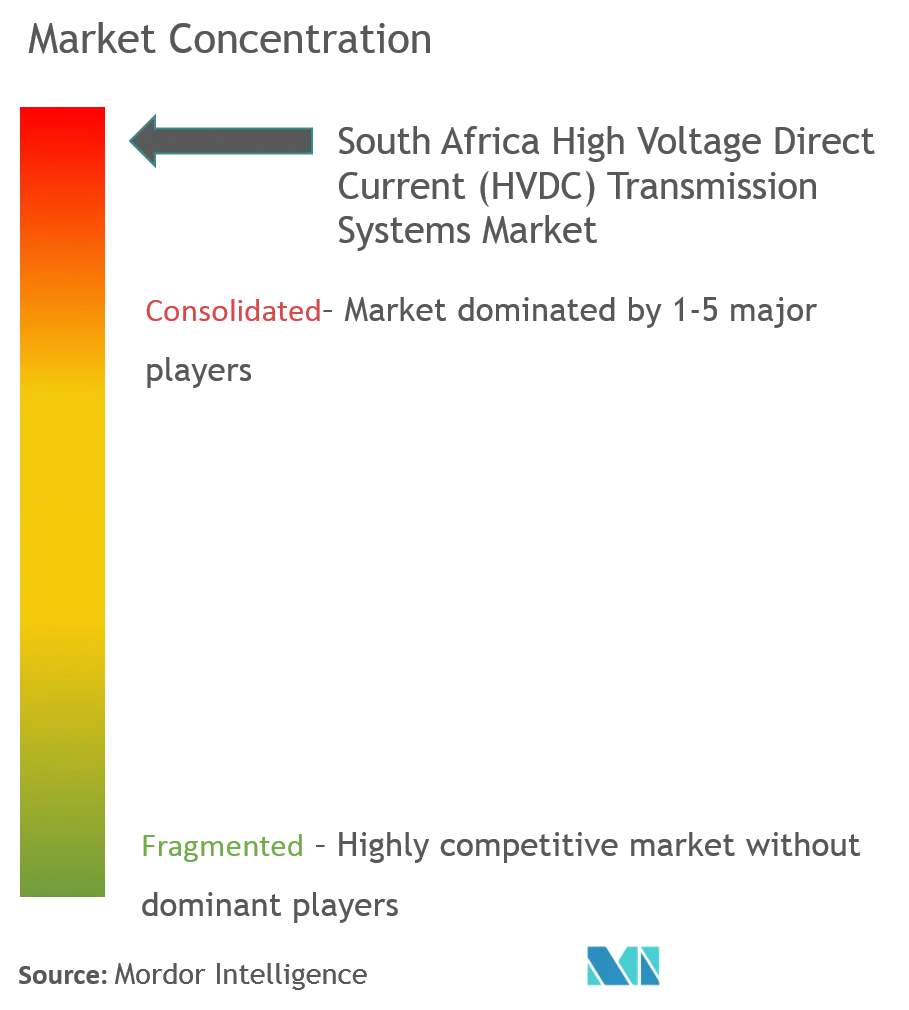
The market for high voltage direct current (HVDC) transmission systems in South Africa is consolidated. Some of the key players in this market include ABB Ltd., Siemens AG, Toshiba Corporation, General Electric Company, and Prysmian SpA.
South Africa High Voltage Direct Current (HVDC) Transmission Systems Industry Leaders
-
ABB Ltd.
-
Siemens AG
-
General Electric Company
-
Toshiba Corporation
-
Prysmian SpA
- *Disclaimer: Major Players sorted in no particular order
Market Opportunities and Future Outlook
A near-term opportunity set is opening around the dual procurement structure of NTCSA's Transmission Development Plan and the government's Independent Transmission Projects (ITP) programme, which together expand addressable bidding pathways for HVDC equipment and EPC capabilities. The TDP 2025-2034 targets about 14,500 km of new transmission lines and 133,000 MVA of transformer capacity to integrate roughly 56 GW of new generation, and the reinforcement agenda supports HVDC-relevant use cases such as bulk transfer corridors and controllability needs during renewable integration.
Market whitespace is also appearing in technology transfer and local capability build-out linked to grid modernization. This is supported by the June 2026 Eskom/NTCSA cooperation agreement with RTE International and AFD, which includes research and development activities related to HVDC technologies and grid stability. At the same time, the ITP channel advanced with prequalification of seven international-led consortia for initial projects (reported in December 2025), broadening the competitive field beyond traditional utility tenders and creating additional entry points for converter station suppliers, cable manufacturers, and engineering partners already active in HVDC (including participants linked to the existing Cahora Bassa/Apollo HVDC scheme).
Recent Industry Developments
- June 2026: Eskom and the National Transmission Company South Africa (NTCSA) signed a two-year technical cooperation agreement with RTE International, supported by a EUR 650,000 grant from Agence Francaise de Developpement (AFD). The program focuses on renewable integration and grid stability and explicitly includes work on HVDC technologies, strengthening local execution for advanced transmission solutions.
- May 2026: NTCSA signed a memorandum of understanding with the Industrial Development Corporation (IDC) to support investment alignment and localization linked to South Africa's transmission expansion agenda. The agreement connects the grid build pipeline to domestic industrial capacity planning, affecting how OEMs and EPCs structure local supply, partnerships, and manufacturing participation.
- January 2024: Hitachi Energy delivered three 90.8 MVA HVDC transformers to the Apollo Converter Substation in Johannesburg as backup units for the Cahora Bassa/Apollo HVDC link. The delivery supports reliability of an existing cross-border HVDC asset and highlights ongoing demand for specialized HVDC converter station equipment and lifecycle support in South Africa.
Research Methodology Framework and Report Scope
Market Definition and Coverage
This market covers HVDC transmission systems deployed in South Africa. The value is measured as system supply and installation for converter stations, plus the associated transmission medium (cables and lines) used to move electricity over long distances.
Scope exclusions: It excludes HVAC transmission equipment, routine O and M services, and generation assets unless they are packaged inside an HVDC project contract.
Segmentation Overview
- Transmission Type
- Submarine HVDC Transmission System
- HVDC Overhead Transmission System
- HVDC Underground Transmission System
- Component
- Converter Stations
- Transmission Medium (Cables)
Data Sources, Market Sizing, and Validation
Desk Research
Desk research was used to build the model structure and set realistic ranges for project timing, cost drivers, and procurement patterns in South Africa. We reviewed public planning and policy documents, Eskom and grid updates, and project announcements, so the demand pool could be tied back to actual transmission expansion intent.
Sources typically included official energy and grid publications such as the South African Department of Mineral Resources and Energy, Eskom transmission planning disclosures, national energy regulator releases, grid code documents, and public tender portals. We also used customs trade statistics and technical papers from IEEE and CIGRE to support equipment and cable import checks. Company filings, investor presentations, and reputable press were used to confirm whether projects were active, delayed, or re-phased, and we supplemented data gaps using paid subscriptions focused on company financials and business intelligence, patent databases, and a global contracts and tenders database for award tracking. This list is not exhaustive, and other references were used to compile the dataset, validate assumptions, and clarify unclear scope items.
Primary Interviews and Surveys
Primary work focused on interviews and structured surveys with utility-side stakeholders, EPC and project teams, cable and converter station ecosystem participants, and grid consultants who track transmission planning. These discussions were used to confirm which HVDC projects are realistically funded and scheduled, how converter station scope is typically priced, and what technical choices (overhead vs underground, and converter configuration) imply for cost per MW and per route km across South Africa.
Distribution of primary research fieldwork respondents
| Company type | Respondent position |
|---|---|
| Top tier: 29% | CXOs: 20% |
| Mid tier: 51% | Functional/Unit leaders: 38% |
| Smaller Players: 20% | Managers: 42% |
Market-Sizing & Forecasting
Sizing combined a top-down and bottom-up approach, where national transmission build plans and project pipelines were translated into an addressable HVDC demand pool, then checked against what suppliers and contractors indicated is being ordered. For the top-down side, published expansion programs and grid integration needs were used to reconstruct likely HVDC additions by route and by converter capacity, then spending was derived using typical cost ranges validated through interviews.
Key inputs included announced and planned HVDC project count and status, converter station capacity additions (MW), route length and the share that is overhead versus underground, cable and equipment import signals where relevant, and timing gaps between award and commissioning that show up in project execution. Forecasts used scenario analysis anchored on execution readiness, where schedules were adjusted for permitting and procurement lead times, and then pricing was trended using a simple escalation curve informed by materials and high-voltage equipment cost direction shared by interviewees. Where bottom-up checks had gaps, we applied conservative unit-cost ranges and sensitivity bands by project maturity so the total did not overstate early-stage plans.
Data Validation & Update Cycle
Model outputs were validated through triangulation across three layers: project pipeline reality checks, unit cost sanity checks, and timing checks against procurement cycles. If a project-level value looked too high or too low, we revisited assumptions, re-checked desk sources, and re-contacted a relevant expert to confirm whether items such as converter stations, cable supply, or civil works were being counted consistently.
Before sign-off, the numbers undergo multi-step analyst reviews, including variance checks versus historical activity and independent indicators such as tender volume and grid expansion milestones. The report is refreshed annually, and interim updates are made when material events occur, such as a major award, cancellation, or a policy-driven shift in transmission investment. Right before delivery, a final review pass is done so the latest view can be supported by visible sources and interview feedback.
Mordor Intelligence's South Africa High Voltage Direct Current Hvdc Transmission Systems Market Size Compared Against Other Published Estimates
Published market sizes for South Africa HVDC transmission systems can differ even when they appear to cover the same topic, because the scope and counting logic are not always aligned. The main differences typically come from whether the estimate is framed as project-spend or as technology-revenue, which years are treated as the base, and how much of the EPC and installation scope is included.
The key gap often comes down to whether regional totals and broader HVDC technologies are allocated into a South Africa number. Mordor Intelligence counts only converter stations and the transmission medium tied to HVDC projects in South Africa, with timing aligned to local project award and commissioning cycles.
Benchmark comparison
| Source | Market Size | Gaps in Research Methodology |
|---|---|---|
| Mordor Intelligence | USD 1.62 B (2024) | |
| Regional Consultancy A | USD 1.20 B (2024) | Uses a narrower technology and application cut that can undercount converter station scope items and applies conservative project realization assumptions for early-stage grid plans. |
| Global Consultancy B | USD 2.52 B (2024) | Reports a regional MEA revenue total and then attributes a portion to South Africa, which can overstate the country figure when cross-border and non-country-specific revenues are blended in. |
Taken together, the spread is mainly explained by scope packing (country-only versus region-allocated) and by how project readiness is treated in the base year. By tying the value build-up to project capacity, route characteristics, and a consistent inclusion list for converter stations and transmission medium, the estimate stays traceable and can be updated when new awards or schedule changes appear.
Key Questions Answered in the Report
What is the current South Africa High Voltage Direct Current (HVDC) Transmission Systems Market size?
The South Africa High Voltage Direct Current (HVDC) Transmission Systems Market is projected to register a CAGR of 8.25% during the forecast period (2026-2031)
Who are the key players in South Africa High Voltage Direct Current (HVDC) Transmission Systems Market?
ABB Ltd., Siemens AG, General Electric Company, Toshiba Corporation and Prysmian SpA are the major companies operating in the South Africa High Voltage Direct Current (HVDC) Transmission Systems Market.
What years does this South Africa High Voltage Direct Current (HVDC) Transmission Systems Market cover?
The report covers the South Africa High Voltage Direct Current (HVDC) Transmission Systems Market historical market size for years: 2020, 2021, 2022, 2023, 2024 and 2025. The report also forecasts the South Africa High Voltage Direct Current (HVDC) Transmission Systems Market size for years: 2026, 2027, 2028, 2029, 2030 and 2031.