
United Arab Emirates Green IT Software Market Size and Share
Market Overview
| Study Period | 2020 - 2031 |
|---|---|
| Forecast Data Period | 2026 - 2031 |
| Base Year Market Size (2025) | USD 248.96 Million |
| Market Size (2026) | USD 295.39 Million |
| Market Size (2031) | USD 768.98 Million |
| Growth Rate (2026 - 2031) | 21.09 % |
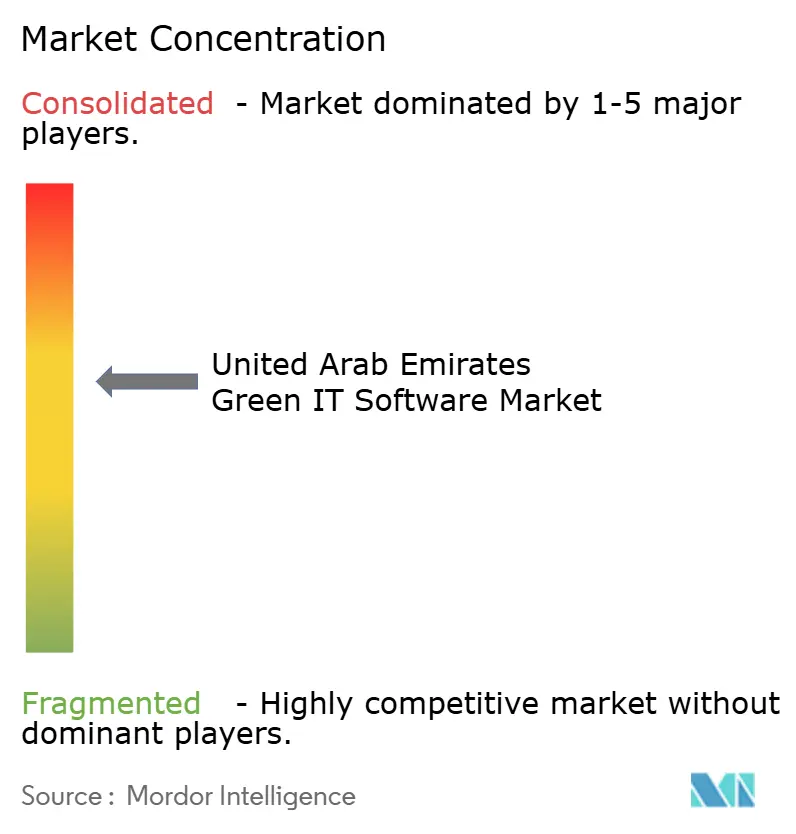
| Market Concentration | Medium |
Major Players *Disclaimer: Major Players sorted in no particular order Image © Mordor Intelligence. Reuse requires attribution under CC BY 4.0. | |
United Arab Emirates Green IT Software Market Analysis by Mordor Intelligence
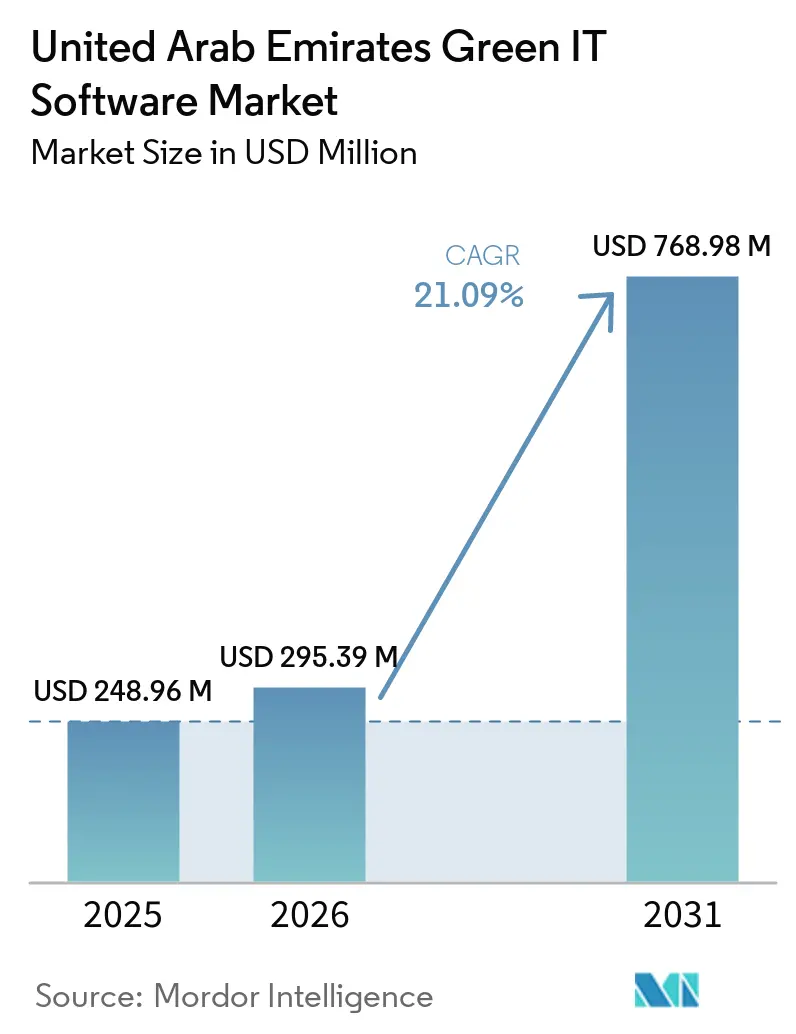
The United Arab Emirates Green IT Software Market size was valued at USD 248.96 million in 2025 and is forecast to reach USD 768.98 million by 2031, advancing at a CAGR of 21.09% from 2026 to 2031. Growth is being shaped by the shift from voluntary sustainability programs to formal reporting and operating requirements nationwide. The expansion of cloud infrastructure, enterprise digital transformation, and closer oversight of emissions data are increasing the need for software that can track, organize, and report IT-related environmental performance. The market is also being shaped by the strong position of packaged software platforms, while hybrid deployment is expanding quickly because many regulated users still need a mix of local control and cloud-based reporting flexibility. Large enterprises remain the main source of current spending, but demand is broadening as supplier reporting, audit readiness, and data governance become more important across the wider economy. Competition is centered on major enterprise platform vendors and specialist sustainability software providers, and the 2026 compliance cycle is bringing forward many buying decisions in the United Arab Emirates Green IT Software Market.
Key Report Takeaways
- By offering, software held 68.23% share in 2025 in the United Arab Emirates Green IT Software Market, while services are projected to expand at a 22.91% CAGR through 2031.
- By deployment, cloud-based delivery held a 56.19% share in the United Arab Emirates Green Information Technology Software Market in 2025, while hybrid is projected to expand at a 22.18% CAGR through 2031.
- By enterprise size, large enterprises held a 70.61% share in the United Arab Emirates Green IT Software Market in 2025, while SMEs are projected to expand at a 22.56% CAGR through 2031.
- By solution type, ESG Reporting and Compliance Software held a 48.67% share in the United Arab Emirates Green Information Technology Software Market in 2025, while Sustainability Data Management Platforms are projected to expand at a 21.88% CAGR through 2031.
- By end user, Information Technology and Telecom held a 21.89% share in the United Arab Emirates Green Information Technology Software Market in 2025, while Healthcare and Life Sciences are projected to expand at a 21.45% CAGR through 2031.
Note: Market size and forecast figures in this report are generated using Mordor Intelligence’s proprietary estimation framework, updated with the latest available data and insights as of January 2026.
United Arab Emirates Green IT Software Market Trends and Insights
Drivers Impact Analysis*
| Driver | (~) % Impact on CAGR Forecast | Geographic Relevance | Impact Timeline |
|---|---|---|---|
| Rising UAE Net Zero and Green Procurement Mandates | +5.0% | UAE-wide, including mainland and free zones | Short term (≤ 2 years) |
| Rising Data Center Energy Optimization Requirements | +4.2% | Strongest in Dubai and Abu Dhabi | Medium term (2-4 years) |
| Cloud Migration Increasing Demand for Sustainability Monitoring | +3.4% | UAE-wide, with earlier gains in major digital hubs | Medium term (2-4 years) |
| ESG Reporting Pressure From Global Supply Chains | +2.7% | Strongest in export-linked and investor-facing sectors | Medium term (2-4 years) |
| Embedded Carbon and FinOps Convergence in Enterprise IT Planning | +2.0% | Large enterprises with mature ERP and cloud estates | Long term (≥ 4 years) |
| AI-Driven Sustainability Analytics For Utility and Facilities Decisions | +1.5% | Strongest in major utility and smart infrastructure programs | Long term (≥ 4 years) |
| Source: Mordor Intelligence | |||
Rising UAE Net Zero and Green Procurement Mandates
The legal framework has become a direct demand driver for the United Arab Emirates Green IT Software Market because sustainability reporting is no longer treated as a voluntary corporate exercise. Federal Decree-Law No. 11 of 2024 requires entities to measure, report, and reduce greenhouse gas emissions, which moves emissions management into routine enterprise operations.[1] This change is important because firms now need governed software records, repeatable workflows, and reliable audit trails, rather than scattered spreadsheet processes. It also affects both public and private organizations, which widens demand beyond the largest listed companies and state-linked groups. In practical terms, the law is pushing procurement teams to treat sustainability software as part of the core reporting infrastructure in the United Arab Emirates Green IT Software Market.
Rising Data Center Energy Optimization Requirements
Data center growth is becoming a strong operating driver for the United Arab Emirates Green IT Software Market because software is needed to link computing activity with energy performance. Microsoft and G42 announced a 200 MW data center expansion in the UAE in November 2025, with new capacity expected to start coming online before the end of 2026. Khazna Data Centers also announced in April 2026 that its DXB8 facility in Dubai became the world’s first data center to achieve Zero Waste Certification, which shows how sustainability targets are moving deeper into operating models. As infrastructure scales, buyers need software that can track resource efficiency, connect facilities data with IT activity, and support regular reporting. This is why energy optimization is shifting from a facilities issue to a software decision across the United Arab Emirates Green IT Software Market.
Cloud Migration Increasing Demand for Sustainability Monitoring
Cloud adoption is expanding the monitoring scope of the United Arab Emirates Green IT Software Market because emissions and resource tracking now need to follow workloads across changing digital environments. Microsoft announced in-country data processing for Microsoft 365 Copilot in the UAE in October 2025, which reduced a major data residency concern for regulated users. ServiceNow launched its UAE Cloud on Microsoft Azure, giving enterprise customers a local option for workflow systems that are increasingly tied to sustainability management. Salesforce also launched Agentforce for Net Zero Cloud in 2025, bringing automated carbon accounting and compliance workflows into a broader data environment. These moves are increasing demand for software that can unify sustainability, IT, and operational records without forcing every organization into a fully public cloud model.
ESG Reporting Pressure From Global Supply Chains
Supply chain and investor reporting needs are widening the use case for the United Arab Emirates Green IT Software Market beyond basic domestic filing. Companies that serve international customers or report to global investors need systems that can map local data into multiple disclosure frameworks. SAP announced the general availability of SAP Green Ledger in December 2024, describing it as a carbon accounting system that integrates directly with financial data and aligns with frameworks such as CSRD, EU ETS, CBAM, and ISSB. Workiva also updated its sustainability reporting solution in May 2026 to support the 2026 CDP Corporate and SME questionnaires and a simplified ESRS intelligence base, reflecting the push toward multi-framework reporting. The result is a market where buyers increasingly prefer platforms that can serve domestic reporting, investor disclosure, and supply chain requests from one governed data structure.
Restraints Impact Analysis*
| Restraint | (~) % Impact on CAGR Forecast | Geographic Relevance | Impact Timeline |
|---|---|---|---|
| High Integration Complexity Across Legacy ERP and ITSM Environments | -2.6% | UAE-wide, with stronger exposure in manufacturing and government | Medium term (2-4 years) |
| Limited Green Software Skills and Sustainability Data Talent Pool | -2.0% | UAE-wide, with greater pressure outside the largest business hubs | Long term (≥ 4 years) |
| Data Quality Gaps in Scope 3 and Asset-Level Emissions Tracking | -1.6% | UAE-wide, especially in fragmented supply chains | Long term (≥ 4 years) |
| Budget Sensitivity Among Mid-Market Buyers Despite Long-Term Savings | -0.9% | SMEs across all emirates | Medium term (2-4 years) |
| Source: Mordor Intelligence | |||
High Integration Complexity Across Legacy ERP and ITSM Environments
Integration remains one of the main adoption barriers in the United Arab Emirates Green IT Software Market, as many organizations still operate on legacy enterprise systems. SAP stated that SAP Green Ledger requires an SAP S/4HANA foundation, meaning firms on SAP ECC need a broader migration path before they can move to transaction-level carbon accounting. This matters because sustainability software rarely works well in isolation and usually needs data from finance, procurement, asset management, facilities, and IT service systems. When those systems are fragmented, implementation becomes longer and more expensive than the license decision first suggests. The slowdown is strongest in organizations that want audit-ready reporting but have not yet modernized the systems that hold their operational records.
Limited Green Software Skills and Sustainability Data Talent Pool
The skills gap is another clear restraint on the United Arab Emirates Green IT Software Market, as software deployment depends on people who understand reporting rules, enterprise systems, and data governance. IBM and the UAE Ministry of Climate Change and Environment signed a cooperation agreement in October 2025 that included capacity-building programs for ministry staff, which shows that capability development is already part of the implementation agenda. The challenge extends beyond public institutions, as many private companies still need support in mapping emissions data to their existing IT and finance systems. This creates a dependence on external implementation partners and can slow the rollout pace, especially for mid-sized organizations. Until internal teams become more comfortable with these systems, adoption speed is likely to remain below underlying demand.
*Our forecasts treat driver/restraint impacts as directional, not additive. The impact forecasts reflect baseline growth, mix effects, and variable interactions.
Segment Analysis
By Offering: Software Platforms Lead While Services Gain From Deployment Complexity
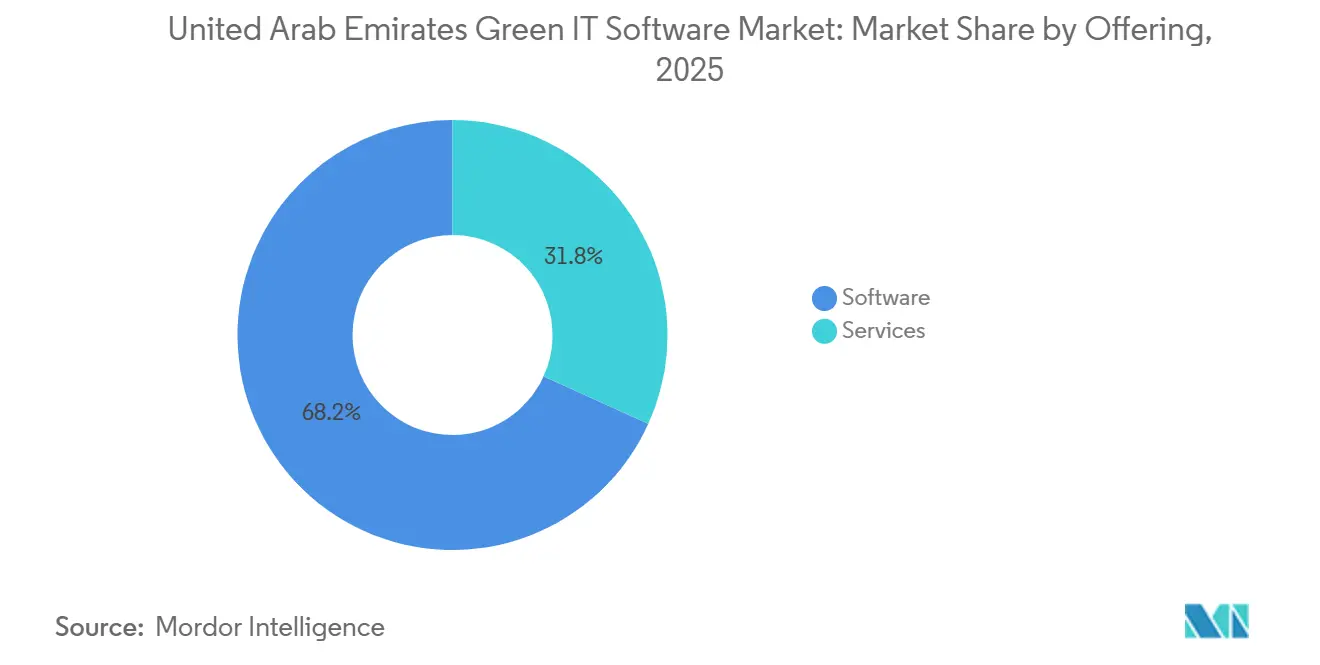
Software accounted for 68.23% of the United Arab Emirates Green IT Software Market share in 2025, which shows that buyers first chose platforms that can store, govern, and report data at scale. This lead reflects a simple buying pattern, as enterprises under regulatory and disclosure pressure usually prefer a lasting system rather than a short advisory engagement. Packaged software also fits better with board-level reporting, internal controls, and recurring audit needs. Services are projected to expand at a 22.91% CAGR from 2026 to 2031 because many organizations still need help with setup, integration, training, and ongoing compliance support.
The service opportunity is growing alongside the platform business rather than replacing it. In the United Arab Emirates Green IT Software industry, implementation work often spans ERP systems, cloud environments, finance tools, and IT operations records, making external support more important after the initial software selection. SAP Green Ledger reached general availability in December 2024, giving SAP-centered enterprises a direct route to carbon accounting within a familiar enterprise stack. Salesforce launched Agentforce for Net Zero Cloud in 2025, demonstrating how leading vendors are integrating workflow automation and high-volume data handling into core sustainability products. This combination supports continued platform dominance as services expand, since the work of connecting, validating, and governing data does not end after the first deployment.
By Deployment: Cloud Delivery Leads While Hybrid Supports Regulated Use Cases
Cloud-based delivery held 56.19% share of the United Arab Emirates Green IT Software Market size in 2025, reflecting strong demand for scalable systems that can be updated quickly as reporting needs change. Cloud models are attractive because they reduce the local infrastructure burden and enable vendors to update disclosure templates, workflows, and data libraries more easily. On-premise deployment still serves a narrower group of users who keep sensitive workloads inside tightly controlled environments. Hybrid deployment is projected to expand at a 22.18% CAGR from 2026 to 2031, as many users continue to want cloud-based analytics and reporting while keeping part of their operational data local.
Ongoing improvements in local digital infrastructure support the hybrid trend. Microsoft announced in-country data processing for Microsoft 365 Copilot in the UAE in October 2025, which eased one of the main objections to broader cloud use in sensitive operating environments. ServiceNow launched its UAE Cloud on Microsoft Azure, which added another local option for workflow-heavy enterprise deployments. Even with these changes, many organizations still hold finance, facilities, and asset data in existing internal systems. That is why hybrid remains structurally important in the United Arab Emirates green information technology software market, even as cloud delivery keeps the largest share and continues to define the direction of new deployments.
By Enterprise Size: Large Enterprises Lead Current Revenue While SMEs Broaden Future Adoption
Large enterprises held a 70.61% share in 2025, giving them the clearest current market share in the United Arab Emirates Green IT Software Market. These organizations usually have stronger budgets, existing ERP estates, formal governance structures, and more direct exposure to investor and compliance expectations. They also tend to operate in sectors where energy use, asset intensity, and disclosure needs are already visible at the executive level. SMEs are projected to expand at a 22.56% CAGR from 2026 to 2031 as reporting obligations and customer expectations increasingly move down the supply chain.
SME growth matters for more than simple customer count. Many smaller firms now need cleaner operational records so that larger buyers can complete supplier reporting and defend the quality of broader emissions disclosures. Cloud delivery and preconfigured tools are making entry easier than custom programs, even though budget discipline remains stronger in this segment. In the United Arab Emirates Green IT Software industry, a two-speed structure emerges, with large accounts anchoring today’s revenue while smaller firms expand future penetration. This dynamic also means that adoption among SMEs supports compliance maturity at larger enterprises, especially when supplier, logistics, and procurement records need to be traced more consistently. The result is a segment mix in which the current revenue base remains concentrated at the top end, but the long-term expansion path depends on much wider adoption.
By Solution Type: Reporting Software Leads First Purchases While Data Platforms Gain Weight
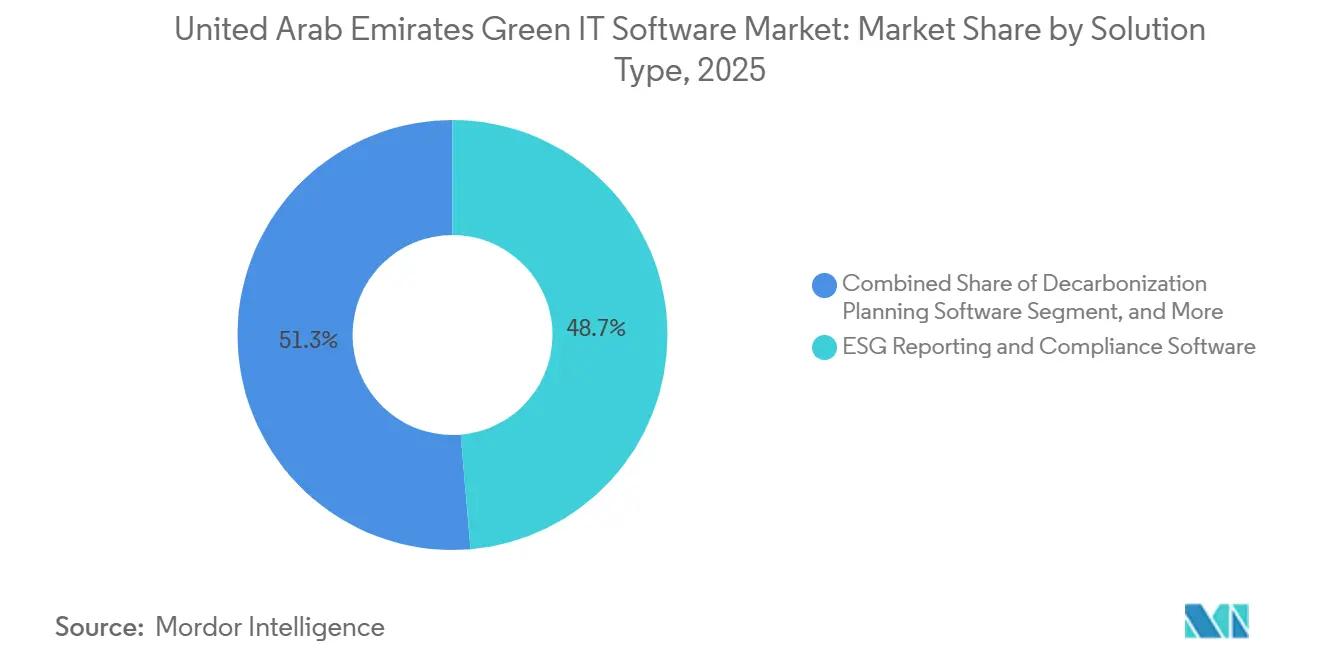
ESG Reporting and Compliance Software accounted for 48.67% of the United Arab Emirates Green IT Software Market in 2025, confirming that current spending still begins with mandatory reporting and disclosure needs. Buyers first want systems that can organize data, apply reporting logic, and produce outputs that are easier to review and submit. That pattern is common in the early stages of compliance because firms typically address filing and governance needs before expanding into broader optimization programs. Sustainability Data Management Platforms are projected to expand at a 21.88% CAGR from 2026 to 2031 because reporting quality depends on how well underlying records are structured, reconciled, and maintained.
This second layer becomes more important after the first reporting cycle is in place. SAP Green Ledger entered general availability in December 2024, with direct carbon and financial linkage, supporting enterprises that want sustainability records tied more closely to business transactions.[2] Workiva updated its sustainability solution in May 2026 to support the 2026 CDP Corporate and SME questionnaires and a simplified ESRS intelligence base, demonstrating how vendors are expanding framework coverage as reporting demands evolve. Carbon management, decarbonization planning, and energy optimization tools are also gaining relevance as enterprises move from first-time disclosure into recurring control and improvement programs. Ahya filed 2 US patents in AI-based emissions management in May 2026, indicating growing domestic innovation in the United Arab Emirates Green IT Software Market.

By End User: IT and Telecom Leads Spending While Healthcare and Life Sciences Rises Quickly
Information Technology and Telecom held 21.89% of the United Arab Emirates Green IT Software Market share in 2025, while Healthcare and Life Sciences are projected to grow at a 21.45% CAGR through 2031. IT and telecom leads because the sector is both a direct buyer of green software and a provider of the infrastructure that supports other sectors’ reporting systems. Network operations, cloud environments, and data center workloads all create visible resource and emissions tracking needs. Healthcare and Life Sciences are growing quickly because global reporting discipline is reaching pharmaceutical chains, hospital systems, and insurance-linked operations that previously had lower software maturity in this area.
The current spending base is still broader than that of a single leading vertical. BFSI, manufacturing, and energy and utilities remain important because they combine reporting pressure with large operating footprints and more complex internal data structures. These sectors usually need records from procurement, finance, facilities, and operations to work together before reporting can become consistent. That raises demand for platforms that can connect multiple systems rather than solving a single, narrow reporting task. Government, retail, construction, and other end users are still earlier in rollout, but their needs are likely to become clearer as reporting cycles become more routine. This keeps demand in the United Arab Emirates Green IT Software Market broad-based, even though the pace of adoption remains uneven across sectors.
Geography Analysis
Abu Dhabi and Dubai remain the two main demand centers in the United Arab Emirates Green IT Software Market, although they do not buy for the same reasons. Abu Dhabi demand is shaped more by government-linked organizations, energy-related enterprises, and large infrastructure operators that need formal data control. These buyers usually prefer enterprise-grade systems that can connect environmental information with finance, procurement, and operations. The policy setting in Abu Dhabi keeps sustainability close to public planning and utility management, which supports demand for software workflows that are governed. This makes the emirate a strong base for compliance tools, data management platforms, and operational optimization software.
Dubai represents the most commercially diverse demand zone in the United Arab Emirates Green IT Software Market. DEWA reported continued construction progress in January 2026 at Moro Hub’s new green data center in Warsan, reinforcing Dubai’s role in linking digital infrastructure with sustainability goals. Microsoft and G42 announced a 200MW data center expansion in the UAE in November 2025, with capacity expected to come online before the end of 2026, supporting Dubai’s role as a major cloud and AI hub.[3] DEWA also explored strategic collaboration with ServiceNow in February 2026 on sustainability, clean energy, AI, and future-ready infrastructure, demonstrating how workflow software is increasingly linked to public utility operations. This mix of listed entities, regional headquarters, and hyperscale infrastructure keeps Dubai at the center of premium software demand.
The Northern Emirates represent an earlier-stage part of the United Arab Emirates Green IT Software Market, with higher SME concentration and a greater proportion of industrial operating profiles. Sharjah, Ras Al Khaimah, Ajman, Fujairah, and Umm Al Quwain include manufacturing, building materials, energy, port, and logistics activities that will face wider reporting discipline as compliance routines deepen. Adoption is still less mature than in Abu Dhabi and Dubai, but the need for structured emissions and asset data is becoming increasingly difficult to defer. Over time, this should widen the customer base across the United Arab Emirates green information technology software market and reduce the current concentration of demand in the 2 largest hubs.
Competitive Landscape
The United Arab Emirates Green IT Software Market has a moderately consolidated structure, with large global enterprise vendors leading the biggest programs. SAP SE, Microsoft Corporation, Salesforce, Inc., Oracle Corporation, and IBM Corporation benefit from installed ERP, cloud, and enterprise workflow relationships that are difficult for newer vendors to displace quickly. SAP strengthened its position through the general availability of SAP Green Ledger in December 2024 and further Q2 2026 enhancements to its analytical dashboard, which added stronger project-level carbon and financial visibility. Microsoft is also improving its competitive position by linking sustainability workloads to local cloud capacity and in-country processing in the UAE. IBM and ServiceNow expanded their collaboration in June 2026 to combine AI, data, and workflow capabilities, underscoring how sustainability controls are increasingly embedded in broader enterprise operating systems.
Specialists still hold an important place because some buyers want deeper climate calculation logic, stronger disclosure tooling, or more focused sustainability workflows than a large ERP suite may provide. Workiva, Sphera, Persefoni, and Position Green are relevant in this part of the market because they address reporting depth and framework complexity more directly. Workiva’s May 2026 release added support for the 2026 CDP Corporate and SME questionnaires and introduced simplified ESRS intelligence, improving its positioning for multi-framework reporting. Salesforce launched Agentforce for Net Zero Cloud in 2025, which pushed automated carbon accounting and compliance tasks closer to everyday enterprise workflows.[4] As a result, competition in the United Arab Emirates Green IT Software Market is not just about who offers reporting templates, but also about who can fit most cleanly into existing finance, cloud, and service management environments.
Local product development remains smaller, but it is becoming more visible in the United Arab Emirates Green IT Software Market. Ahya filed 2 US patents in AI-based emissions management in May 2026, which suggests that domestic capability is beginning to develop in emissions calculation and analytics design. There is still room for more localized offerings in Arabic-language compliance workflows, supplier-level Scope 3 handling, and simpler products for SME buyers. That leaves the market open enough for specialists to win selective accounts, even as the largest enterprise vendors continue to lead the biggest and most complex deployments.
United Arab Emirates Green IT Software Industry Leaders
-
Salesforce, Inc.
-
Oracle Corporation
-
SAP SE
-
Microsoft Corporation
-
IBM Corporation
- *Disclaimer: Major Players sorted in no particular order
Recent Industry Developments
- June 2026: IBM and ServiceNow announced an expanded collaboration to combine IBM's AI, data, and automation capabilities with the ServiceNow AI Platform, with the aim of developing joint solutions to modernize legacy IT systems and enable autonomous IT operations. Joint solutions are expected to be available in the second half of 2026, creating a new category of AI-governed green IT workflows with direct implications for enterprise sustainability monitoring.
- June 2026: Workiva updated its Sustainability Reporting solution to include support for the 2026 CDP Corporate and SME questionnaires in Sustainability Explorer and introduced a new Simplified ESRS Intelligence knowledge base powered by Workiva AI, expanding the platform's multi-framework compliance coverage for enterprise clients.
- May 2026: SAP released Q2 2026 updates to the SAP Green Ledger Analytical Dashboard, version 1.5.1, released May 18, 2026, integrating carbon and financial data at the project level and adding Work Breakdown Structure support. The update enables project-level carbon visibility directly within the dashboard, advancing granular decarbonization planning for enterprise clients.
- April 2026: Khazna Data Centers' DXB8 facility in Dubai was awarded the Zero Waste Certification by SCS Global Services, making it the world's first data center to achieve this certification. The milestone reflects Khazna's ESG strategy of embedding sustainability into data center design, construction, and operations in the UAE.
United Arab Emirates Green IT Software Market Report Scope
The United Arab Emirates Green IT Software Market encompasses platforms that bolster sustainability across IT and cloud ecosystems. These platforms facilitate carbon tracking, ensure Environmental, Social, and Governance (ESG) compliance, and optimize energy use. With a focus on real-time emissions monitoring, efficient resource use, and automated sustainability reporting, the market thrives under the UAE's robust ESG regulations, its smart city initiatives, and its pioneering role in sustainable infrastructure. These tools empower enterprises to harmonize their digital strategies with environmental objectives, all while upholding operational efficiency and regulatory standards.
The United Arab Emirates Green IT Software Market Report is Segmented by Offering (Software, and Services), Deployment (Cloud-Based, On-Premise, and Hybrid), Enterprise Size (Large Enterprises, and Small and Medium Enterprises), Solution Type (Carbon Management and Accounting Software, ESG Reporting and Compliance Software, Sustainability Data Management Platforms, Decarbonization Planning Software, and Energy and Resource Optimization Software), and End User (Information Technology and Telecom, Banking, Financial Services and Insurance, Manufacturing, Energy and Utilities, Retail and E-Commerce, Government, Healthcare and Life Sciences, Construction and Infrastructure, and Other End-User Industries). The Market Forecasts are Provided in Terms of Value (USD).
| Software |
| Services |
| Cloud-Based |
| On-Premise |
| Hybrid |
| Large Enterprises |
| Small and Medium Enterprises |
| Carbon Management and Accounting Software |
| ESG Reporting and Compliance Software |
| Sustainability Data Management Platforms |
| Decarbonization Planning Software |
| Energy and Resource Optimization Software |
| Information Technology and Telecom |
| Banking, Financial Services, and Insurance |
| Manufacturing |
| Energy and Utilities |
| Retail and E-Commerce |
| Government |
| Healthcare and Life Sciences |
| Construction and Infrastructure |
| Other End-User Industries |
| By Offering | Software |
| Services | |
| By Deployment | Cloud-Based |
| On-Premise | |
| Hybrid | |
| By Enterprise Size | Large Enterprises |
| Small and Medium Enterprises | |
| By Solution Type | Carbon Management and Accounting Software |
| ESG Reporting and Compliance Software | |
| Sustainability Data Management Platforms | |
| Decarbonization Planning Software | |
| Energy and Resource Optimization Software | |
| By End User | Information Technology and Telecom |
| Banking, Financial Services, and Insurance | |
| Manufacturing | |
| Energy and Utilities | |
| Retail and E-Commerce | |
| Government | |
| Healthcare and Life Sciences | |
| Construction and Infrastructure | |
| Other End-User Industries |
Key Questions Answered in the Report
What is the projected 2031 value of the United Arab Emirates Green IT Software Market?
The United Arab Emirates Green IT Software Market is projected to reach USD 768.98 million by 2031, up from USD 248.96 million in 2025, at a 21.09% CAGR from 2026 to 2031.
Which offering leads current revenue in the UAE green IT software space?
Software leads current revenue with a 68.23% share in 2025, while services are the faster-growing offering with a projected 22.91% CAGR through 2031.
Why is hybrid deployment growing quickly in the UAE?
Hybrid deployment is projected to grow at a 22.18% CAGR because many regulated users want cloud-based reporting and analytics while still retaining some operational data in controlled local systems.
Which solution type currently holds the largest share?
ESG Reporting and Compliance Software held the largest share at 48.67% in 2025 because buyers are prioritizing reporting, disclosure, and audit readiness first.
Which end-user group is growing the fastest?
Healthcare and Life Sciences is projected to grow at a 21.45% CAGR through 2031, while Information Technology and Telecom held the leading 21.89% share in 2025.
How competitive is the United Arab Emirates Green Information Technology Software Market?
The space is moderately consolidated. Large global vendors lead the biggest accounts, but specialist providers and emerging local firms still have room in reporting depth, workflow localization, and SME-focused tools.