
Saudi Arabia Green IT Software Market Size and Share
Market Overview
| Study Period | 2020 - 2031 |
|---|---|
| Forecast Data Period | 2026 - 2031 |
| Base Year Market Size (2025) | USD 290.67 Million |
| Market Size (2026) | USD 343.87 Million |
| Market Size (2031) | USD 882.30 Million |
| Growth Rate (2026 - 2031) | 20.74 % |
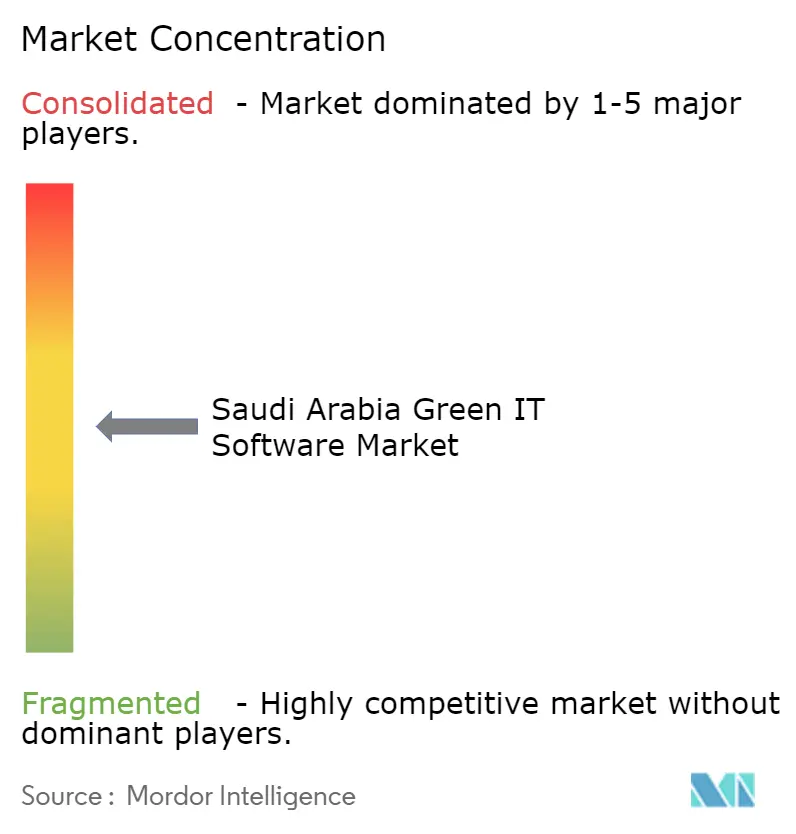
| Market Concentration | Medium |
Major Players *Disclaimer: Major Players sorted in no particular order Image © Mordor Intelligence. Reuse requires attribution under CC BY 4.0. | |
Saudi Arabia Green IT Software Market Analysis by Mordor Intelligence
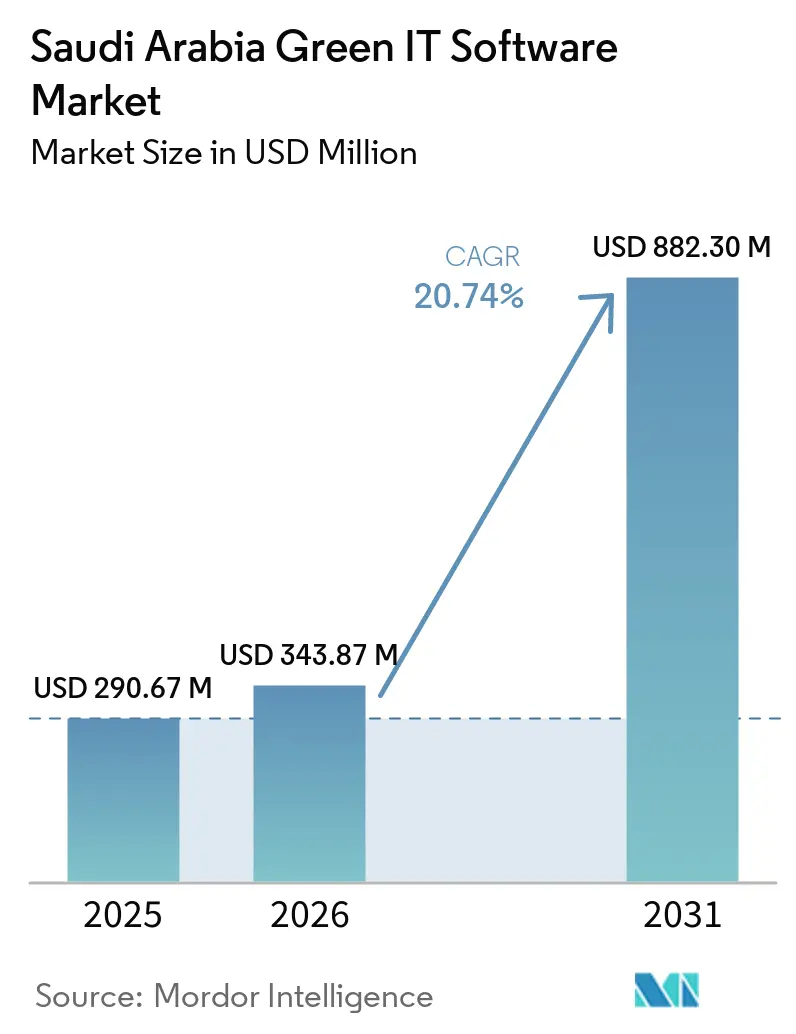
The Saudi Arabia green IT software market size was USD 290.67 million in 2025 and is forecast to reach USD 882.30 million by 2031, at a CAGR of 20.74% from 2026 to 2031. Growth is being sustained by a stronger policy push around environmental performance, a broader shift toward digital operating models, and rising pressure on enterprises to track emissions and resource use in a structured way. Demand is moving beyond early reporting use cases into software that can link finance, operations, procurement, and sustainability data within a single system. Adoption is also supported by local cloud infrastructure expansion and the need to keep data within the Kingdom for regulated users. Competitive activity remains active because large platform vendors can extend sustainability tools into software stacks that Saudi enterprises already use. A near-term risk remains in the timing of formal disclosure mandates, because some buying decisions are still being shaped by investor expectations and supply-chain requirements rather than by a single universal compliance deadline.
Key Report Takeaways
- By offering, software held 67.28% of the Saudi Arabia green IT software market share in 2025, while services are projected to expand at a 22.61% CAGR through 2031.
- By deployment, cloud-based solutions held a 59.18% share in 2025, while hybrid deployment is projected to expand at a 21.91% CAGR through 2031.
- By enterprise size, large enterprises held a 71.44% share in 2025, while small and medium enterprises are projected to expand at a 22.28% CAGR through 2031.
- By solution type, energy and resource optimization software accounted for 45.67% of the Saudi Arabia green IT software market size in 2025, while carbon management and accounting software is projected to expand at a 21.54% CAGR through 2031.
- By end user, government held a 22.39% share in 2025, while information technology and telecom are projected to expand at a 21.15% CAGR through 2031.
Note: Market size and forecast figures in this report are generated using Mordor Intelligence’s proprietary estimation framework, updated with the latest available data and insights as of January 2026.
Saudi Arabia Green IT Software Market Trends and Insights
Drivers Impact Analysis*
| Driver | (~) % Impact on CAGR Forecast | Geographic Relevance | Impact Timeline |
|---|---|---|---|
| Increased Regulatory Pressure on Energy and ESG Disclosure | +4.2% | National, highest intensity in Riyadh listed companies and the Eastern Province energy sector | Short term (≤ 2 years) |
| Rising Enterprise Demand for Audit-Ready Sustainability Reporting | +3.5% | National, concentrated in large enterprises and Tadawul-listed entities | Medium term (2-4 years) |
| Cloud-First Digital Transformation across Saudi Enterprises | +3.0% | National, strongest in government and BFSI, with spillover to SMEs | Medium term (2-4 years) |
| Vision 2030-Led Efficiency Programs in Government and Utilities | +2.7% | National, with early gains in Riyadh, Jeddah, NEOM, and King Abdullah Economic City | Medium term (2-4 years) |
| AI-Based Scope 3 and Utility Data Automation | +2.1% | National, with highest uptake in energy, utilities, and information technology and telecom | Long term (≥ 4 years) |
| Procurement Preference for Measurable Energy Savings in IT Estates | +1.3% | National, with spillover to GCC shared procurement frameworks | Long term (≥ 4 years) |
| Source: Mordor Intelligence | |||
Increased Regulatory Pressure on Energy and ESG Disclosure
The Saudi Arabia green IT software market is benefiting from a shift away from informal sustainability tracking toward more structured disclosure expectations. Enterprises that access green, social, and sustainability-linked instruments need stronger internal control over environmental data, which lifts the value of software that can store evidence, standardize reporting fields, and preserve audit trails. That pressure is extending beyond the issuer because large buyers are asking suppliers for more traceable emissions and efficiency data during procurement and contract review. The result is that sustainability software is moving from a support tool into a core reporting system for both direct users and their wider business networks. Many organizations also face a timing issue because these platforms need time to configure before outputs become dependable across business units. This is why software selection is moving earlier in the planning cycle, especially where environmental goals are already tied to state-backed digital transformation programs.
Rising Enterprise Demand for Audit-Ready Sustainability Reporting
The Saudi Arabia green IT software market is also advancing because enterprises now want sustainability reporting that can withstand review, not just presentation-level disclosure. Boards, finance teams, and internal control functions are placing more weight on workflow management, version control, and framework mapping because manual files are difficult to scale across facilities and subsidiaries. This is pushing demand toward platforms that can connect emissions, energy, and operational data with finance and governance records in a consistent way. SAP’s general availability release of Green Ledger in December 2024 shows how leading vendors are responding by linking carbon accounting directly to the financial ledger. SIRC’s December 2024 deployment of SAP Sustainability Control Tower also shows that Saudi organizations are moving toward systems designed for structured reporting across major ESG frameworks. As a result, buyers are treating sustainability software less as a communications layer and more as part of enterprise control architecture.
Cloud-First Digital Transformation across Saudi Enterprises
Cloud-first digital transformation continues to support adoption across the Saudi Arabia green IT software market. Cloud delivery is attractive because sustainability data must be updated frequently and shared across operations, finance, and reporting teams without manual rework. Local infrastructure matters because regulated buyers have historically been cautious about moving sensitive workloads outside the Kingdom. Microsoft confirmed in February 2026 that its Saudi Arabia East datacenter region will be available to customers from Q4 2026, which directly addresses part of the data residency concern for enterprise and government users. Once those barriers ease, cloud-native sustainability tools become easier to deploy across departments and sites. This shifts decision-making away from simple hosting access and toward integration quality, user adoption, and long-run data governance.
Vision 2030-Led Efficiency Programs in Government and Utilities
Vision 2030-led efficiency programs remain a direct growth base for the Saudi Arabia green IT software market. The Saudi Green Initiative includes more than 85 active initiatives backed by investments above USD 188 billion and tied to a target to reduce 278 million tonnes of carbon emissions each year by 2030. Programs at this scale need software that can measure activities, convert them into environmental indicators, and keep records ready for review across agencies and partner organizations. Saudi government guidance on green technology adoption also encourages the use of AI and digital tools to reduce energy use and emissions in transformation programs. The Communications, Space and Technology Commission was recognized by the International Telecommunication Union in 2025 for using AI to reduce emissions and improve energy efficiency, which strengthens confidence in digital sustainability programs in the Kingdom. This keeps public-sector demand tied not only to compliance needs but also to measurable operating performance.
Restraints Impact Analysis*
| Restraint | (~) % Impact on CAGR Forecast | Geographic Relevance | Impact Timeline |
|---|---|---|---|
| Fragmented Reporting Readiness Across Supplier Networks | -1.8% | National, most acute in manufacturing, retail, and construction supply chains | Medium term (2-4 years) |
| Limited Localized Sustainability Data Talent | -1.4% | National, most pronounced in Tier 2 cities and SME sectors | Medium term (2-4 years) |
| Integration Complexity With Legacy ERP and Utility Systems | -1.1% | National, concentrated in energy and utilities and manufacturing | Long term (≥ 4 years) |
| Data Residency and Cross-Border Cloud Concerns | -0.7% | National, concentrated in BFSI and government | Short term (≤ 2 years) |
| Source: Mordor Intelligence | |||
Fragmented Reporting Readiness Across Supplier Networks
Fragmented reporting readiness across supplier networks is holding back part of the Saudi Arabia green IT software market. Large enterprises can deploy software quickly, but Scope 3 reporting still depends on supplier data that often arrives in inconsistent formats or with weak documentation. The problem is sharper where supply chains depend on smaller firms that lack robust digital reporting processes or established emissions methodologies. SIRC became the first entity in the Kingdom to deploy SAP Sustainability Control Tower in December 2024, which shows that even advanced organizations are still building foundational reporting systems. When upstream data is incomplete, enterprises rely more heavily on estimates, which weakens audit readiness and erodes confidence in the final output. This restraint does not stop adoption, but it makes implementation more iterative than many buyers first expect.
Limited Localized Sustainability Data Talent
Limited localized sustainability data talent is another friction point for the Saudi Arabia green IT software market. Enterprises need people who understand emissions accounting, reporting standards, enterprise software configuration, and internal control practices, and that combination remains scarce. Salesforce said in November 2025 that it would help upskill 30,000 Saudi citizens in AI and digital tools, which supports the wider talent base but does not immediately close specialist sustainability gaps. IBM and Lenovo also expanded their strategic technology partnership in the Kingdom in 2025, adding momentum to training on advanced digital capabilities.[1] Until more local specialists are available, many projects will continue to depend on external advisors for design, integration, and data governance. This keeps costs elevated for mid-sized buyers and can stretch implementation schedules.
*Our forecasts treat driver/restraint impacts as directional, not additive. The impact forecasts reflect baseline growth, mix effects, and variable interactions.
Segment Analysis
By Offering: Software Anchors Revenue, Services Close the Distance
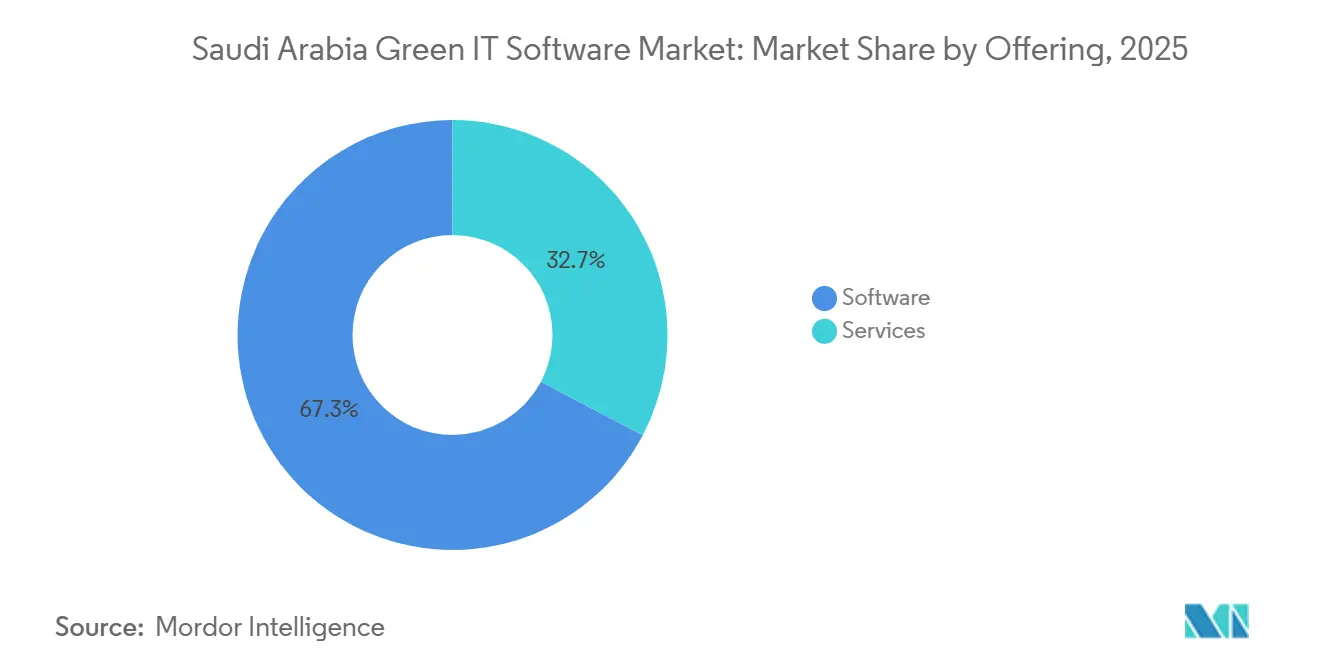
Software held 67.28% of the market in 2025, which kept the Saudi Arabia green IT software market centered on platform subscriptions rather than one-time delivery work. Buyers preferred software that could combine carbon accounting, ESG reporting, and energy analytics inside a single operating environment. That preference suited enterprises that wanted one governance layer across multiple facilities and reporting teams. Software also scaled more easily across ministries and large corporate groups than stand-alone advisory projects. As a result, revenue remained anchored in multi-module platform deployments rather than in narrow single-use applications.
Services are projected to expand at a 22.61% CAGR from 2026 to 2031, making them the fastest-growing segment within this group. Demand is rising because enterprises still need advisory, configuration, assurance, and ongoing data-governance support before reporting outputs become consistent and review-ready. SAP’s sustainability portfolio shows why service work remains attached to software adoption: Green Ledger, Sustainability Control Tower, and related tools deliver more value when mapped into finance, procurement, and operations workflows.[2] The Saudi Arabia green IT software market should therefore see services narrow the revenue gap as more buyers move from installation to continuous reporting support.
By Deployment: Cloud Leads, Hybrid Architecture Accelerates
Cloud-based deployment accounted for 59.18% of the market in 2025, making it the leading model in the Saudi Arabia green IT software market. Buyers leaned toward cloud delivery because it offers faster updates, simpler collaboration, and easier expansion across sites without the need for repeated infrastructure spending. This model also fits sustainability use cases that depend on regular framework updates and coordinated reporting across departments. Public-sector digital modernization reinforced that shift by creating demand for platforms that can be managed consistently at scale. Even so, some regulated organizations still kept critical operational data close to long-established internal systems.
Hybrid deployment is projected to expand at a 21.91% CAGR through 2031, putting it ahead of other deployment models in terms of growth. This approach works well for organizations that want to retain sensitive operating data on site while using cloud layers for aggregation, benchmarking, and disclosure. Microsoft’s confirmation that its Saudi Arabia East datacenter region will be available from Q4 2026 reduces one of the main barriers to wider cloud adoption in more tightly regulated settings. In the Saudi Arabia green information technology software market, hybrid designs are likely to gain traction wherever data residency requirements and enterprise scale must be balanced.
By Enterprise Size: Large Enterprises Set the Pace, SMEs Gain Ground Fast
Large enterprises held 71.44% of the market in 2025, which kept the Saudi Arabia green IT software market concentrated among listed companies, PIF-linked entities, and major government contractors. These organizations were better placed to connect emissions data with finance, procurement, and operations inside broader digital programs. They also had the budgets and internal teams needed to sponsor multi-phase software rollouts. Reference deployments at Saudi Aramco with AVEVA and at SIRC with SAP show how large buyers are using established vendors to connect sustainability reporting with operational systems. Large accounts, therefore, set the pace for vendor credibility and influenced how product road maps were shaped for the Kingdom.
Small and medium enterprises are projected to expand at a 22.28% CAGR through 2031, making them the fastest-growing enterprise cohort. Growth at the smaller end is being lifted by supply-chain disclosure requests and by lower entry costs from cloud-based pricing models. The Saudi Arabia green IT software market broadens as SMEs adopt lighter modules first and add reporting or planning tools later. Over time, this shift can narrow the gap between enterprise tiers, even as large enterprises continue to dominate total revenue.
By Solution Type: Energy Optimization Leads, Carbon Accounting Accelerates
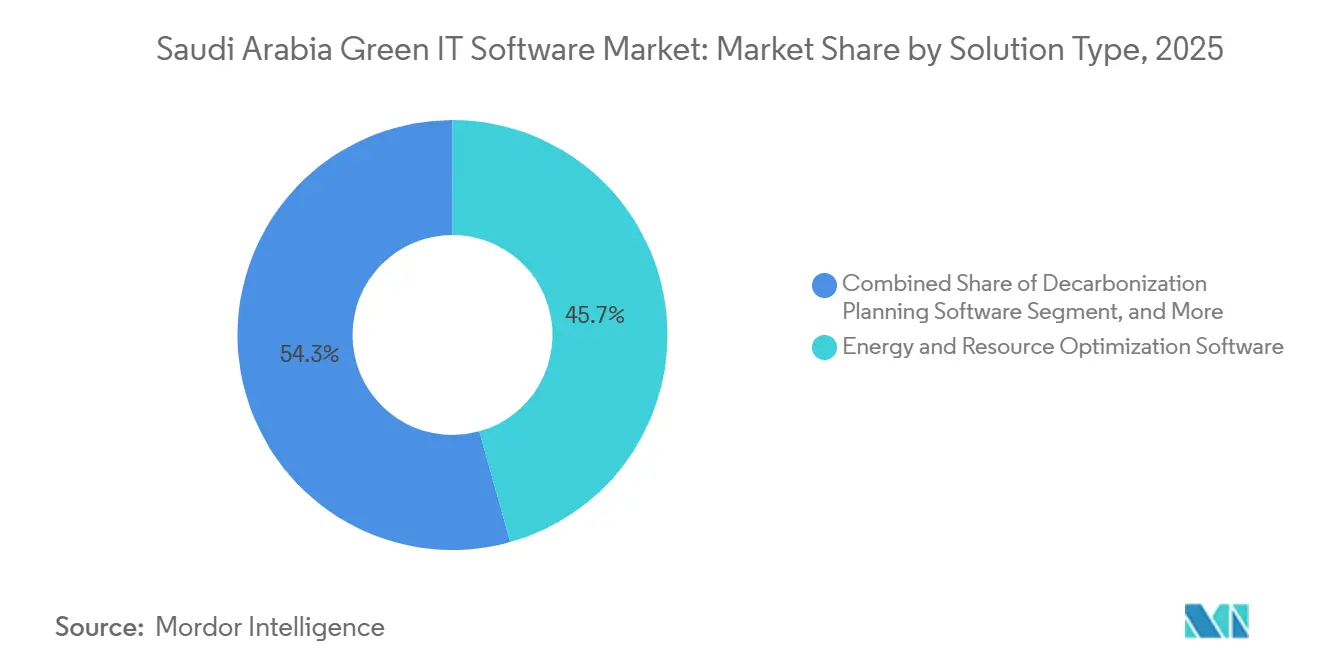
Energy and resource optimization software accounted for 45.67% of the Saudi Arabia green IT software market in 2025, giving it the largest share across solution categories. This lead reflected the close link between sustainability goals and immediate cost control across facilities, utilities, and IT estates. Many buyers started with energy data because it could be integrated more easily into existing operating systems than full-value chain emissions data. That made optimization tools a practical first step for organizations that wanted measurable savings and clearer reporting. The category also fits government-backed transformation efforts that connect digital modernization with environmental performance.
Carbon management and accounting software is projected to expand at a 21.54% CAGR through 2031, which makes it the fastest-growing solution type. As disclosure expectations deepen, enterprises need stronger baselines for Scope 1, Scope 2, and Scope 3 emissions and a clearer audit trail across business units. SAP Green Ledger illustrates how carbon accounting is moving closer to mainstream financial systems, making the data more usable for both reporting and internal control. The Saudi Arabia green IT software market is therefore shifting from savings-led use cases toward platforms that can support both operational optimization and formal disclosure.

By End User: Government Leads, IT and Telecom Grows Fastest
Government held 22.39% of the market in 2025, which made it the largest end-user group in the Saudi Arabia green IT software market. Ministries and public agencies generated strong demand because sustainability targets were tied to broader digital transformation programs and performance-tracking systems. Public buyers also needed systems that could bring together energy, water, waste, and emissions data across multiple sites. This gave government entities an early role in shaping expectations for dashboards, audit trails, and cross-agency reporting. The same policy environment encouraged the use of AI and data tools to improve energy use across public infrastructure.
Information technology and telecom are projected to expand at a 21.15% CAGR through 2031, which makes it the fastest-growing end-user category. The sector sits on both sides of adoption because it buys green IT software for its own networks and enables cloud capacity for other enterprises. Telecom operators in the Kingdom are already combining AI-driven carbon analytics with power management in network operations, which increases demand for continuous measurement and reporting tools. That dual role should keep information technology and telecom among the most active adopters in the Saudi Arabia green information technology software market over the forecast period.
Geography Analysis
The Saudi Arabia green IT software market size was USD 290.67 million in 2025, and the country is forecast to reach USD 882.30 million by 2031 at a 20.74% CAGR, indicating demand is concentrated within a single national market but spread across several distinct buying clusters. Riyadh remains the first and largest cluster because it brings together central ministries, large state-linked entities, and many of the country’s biggest corporate decision centers. This gives the capital the deepest software pipeline to combine disclosure, energy data, and enterprise reporting under one operating model. Government guidance on green technology adoption supports this concentration by linking environmental sustainability with digital transformation across public services. The Saudi Green Initiative adds further weight because its more than 85 active initiatives and investment commitments above USD 188 billion create a long planning horizon for systems that can measure outcomes and maintain consistent records.
The Eastern Province forms the second major demand cluster in the Saudi Arabia green IT software market because it holds many of the Kingdom’s most energy-intensive assets and industrial operators. This area favors platforms that can tie plant-level operating data to enterprise reporting, emissions tracking, and efficiency management. AVEVA’s work with Saudi Aramco at the Khurais Producing Department demonstrates how digital advisory tools are improving real-time power optimization and emissions performance in large industrial settings. Microsoft’s Saudi Arabia East datacenter region, which is set to be available from Q4 2026, should also make cloud-based sustainability deployments more practical for regulated users who need in-country, low-latency services.
Giga-projects form the third demand cluster in the Saudi Arabia green IT software market. These projects buy software earlier in the asset life cycle because sustainability data governance is built into planning, construction, operations, and visitor management from the start. Salesforce said in November 2025 that Red Sea Global is using Agentforce 360, which links customer and sustainability performance data inside a regenerative tourism setting.[3] As a result, the Saudi Arabia green information technology software market combines compliance-led demand in Riyadh, industrial use cases in the Eastern Province, and design-stage adoption in new developments.
Competitive Landscape
The Saudi Arabia green IT software market remained moderately consolidated at the top tier in 2025. SAP, Microsoft, IBM, Salesforce, and Workiva benefited from their installed presence across large enterprise software environments, which gave them an advantage before sustainability budgets fully matured. Their position is strengthened by the fact that buyers can add carbon accounting, reporting, and data governance functions to platforms already used for finance, CRM, and operations. SAP’s release of Green Ledger in December 2024 is a clear example because it moved carbon accounting directly into the S/4HANA financial ledger. That approach raises switching costs and shortens approval cycles for customers who prefer to extend existing systems rather than build a separate software stack.
Salesforce strengthened its position through a USD 500 million investment commitment announced in February 2025 and then reinforced that move with a formal Saudi Arabia launch in November 2025. Microsoft’s Saudi Arabia East datacenter region also changes the competitive field because local cloud availability removes part of the residency barrier that once slowed adoption in sensitive sectors.[4] These moves show that competition in the Saudi Arabia green IT software market now depends on local presence, skills programs, and deployment support as much as on product depth. Vendors that can show a credible Kingdom strategy are therefore better placed than those that offer only remote delivery.
Competition is more open in the SME layer of the Saudi Arabia green IT software market because buyers there need lighter implementation models and clearer pricing. Regional specialists still have room for Arabic workflows, local reporting practices, and faster configuration, where the full breadth of a global suite matters less. SAP’s first-in-Kingdom Sustainability Control Tower deployment at SIRC and AVEVA’s work with Saudi Aramco show that reference projects now influence vendor selection as much as feature lists do. The Saudi Arabia green information technology software market, therefore, favors vendors that can combine local delivery capacity, product integration, and measurable operational outcomes.
Saudi Arabia Green IT Software Industry Leaders
-
Microsoft Corporation
-
SAP SE
-
Salesforce, Inc.
-
Schneider Electric SE
-
IBM Corporation
- *Disclaimer: Major Players sorted in no particular order
Recent Industry Developments
- May 2026: SAP released its Q2 2026 update to the SAP Green Ledger Analytical Dashboard, adding work breakdown structure (WBS, element-level carbon and financial data analysis, enabling Saudi enterprises to conduct project-level emissions performance tracking for the first time within the platform.
- February 2026: Microsoft confirmed its Saudi Arabia East datacenter region will be available for customers from Q4 2026, with three availability zones providing enterprise-grade data residency, resilience, and low-latency cloud infrastructure. Early adopters Acwa and Qiddiya Investment Company had already been using Microsoft Azure AI and the Intelligent Data Platform for sustainability performance monitoring and resource efficiency applications.
- November 2025: Salesforce formally launched Salesforce Saudi Arabia, operationalizing its USD 500 million investment commitment with a regional headquarters in Riyadh, an innovation day showcasing Agentforce 360 deployments at Red Sea Global and Almosafer, and a Princess Nourah University partnership training over 450 women toward Agentblazer certification in AI and sustainability platform skills.
- February 2025: Salesforce announced a USD 500 million investment in Saudi Arabia and a joint AI Innovation Center of Excellence with IBM in Riyadh, combining Salesforce's Agentforce platform with IBM watsonx AI capabilities for sector-specific sustainability and enterprise deployments across government, BFSI, and energy sectors.
Saudi Arabia Green IT Software Market Report Scope
The Saudi Arabia Green IT Software Market encompasses software solutions that help organizations monitor, manage, and reduce the environmental impact of their IT operations. These solutions, which align with national sustainability goals, include carbon accounting, energy optimization, Environmental, Social, and Governance (ESG) reporting, and decarbonization planning. The market, propelled by Vision 2030 goals, smart city initiatives, and increased investments in energy efficiency and renewable integration, supports both enterprises and government entities in curbing emissions, improving resource efficiency, and ensuring regulatory compliance.
The Saudi Arabia Green IT Software Market Report is Segmented by Offering (Software, and Services), Deployment (Cloud-Based, On-Premise, and Hybrid), Enterprise Size (Large Enterprises, and Small and Medium Enterprises), Solution Type (Carbon Management and Accounting Software, ESG Reporting and Compliance Software, Sustainability Data Management Platforms, Decarbonization Planning Software, and Energy and Resource Optimization Software), and End User (Information Technology and Telecom, Banking, Financial Services and Insurance, Manufacturing, Energy and Utilities, Retail and E-Commerce, Government, Healthcare and Life Sciences, Construction and Infrastructure, and Other End-User Industries). The Market Forecasts are Provided in Terms of Value (USD).
| Software |
| Services |
| Cloud-Based |
| On-Premise |
| Hybrid |
| Large Enterprises |
| Small and Medium Enterprises |
| Carbon Management and Accounting Software |
| ESG Reporting and Compliance Software |
| Sustainability Data Management Platforms |
| Decarbonization Planning Software |
| Energy and Resource Optimization Software |
| Information Technology and Telecom |
| Banking, Financial Services, and Insurance |
| Manufacturing |
| Energy and Utilities |
| Retail and E-Commerce |
| Government |
| Healthcare and Life Sciences |
| Construction and Infrastructure |
| Other End-User Industries |
| By Offering | Software |
| Services | |
| By Deployment | Cloud-Based |
| On-Premise | |
| Hybrid | |
| By Enterprise Size | Large Enterprises |
| Small and Medium Enterprises | |
| By Solution Type | Carbon Management and Accounting Software |
| ESG Reporting and Compliance Software | |
| Sustainability Data Management Platforms | |
| Decarbonization Planning Software | |
| Energy and Resource Optimization Software | |
| By End User | Information Technology and Telecom |
| Banking, Financial Services, and Insurance | |
| Manufacturing | |
| Energy and Utilities | |
| Retail and E-Commerce | |
| Government | |
| Healthcare and Life Sciences | |
| Construction and Infrastructure | |
| Other End-User Industries |
Key Questions Answered in the Report
What is the current size of Saudi Arabia green IT software?
The Saudi Arabia green IT software market was valued at USD 290.67 million in 2025 and is forecast to reach USD 882.30 million by 2031 at a 20.74% CAGR.
Which offering leads revenue in Saudi Arabia green IT software?
Software led with a 67.28% share in 2025 because buyers preferred platforms that combine carbon accounting, ESG reporting, and energy analytics in one environment.
Why are services growing faster than software in this space?
Services are projected to grow at a 22.61% CAGR because enterprises still need configuration, advisory, assurance, and data-governance support to make reporting outputs review-ready.
Which deployment model is expanding the fastest across Saudi Arabia?
Hybrid deployment is projected to expand at a 21.91% CAGR through 2031 because many organizations want to balance cloud scalability with local control of sensitive data.
Which user group creates the largest demand today?
Government was the largest end-user group in 2025 with a 22.39% share, supported by digital transformation programs that also include environmental performance goals.
Which companies are most visible in the competitive landscape?
SAP, Microsoft, IBM, Salesforce, and Workiva are the most visible large vendors, supported by existing enterprise software footprints and expanding local delivery activity in the Kingdom.