
Middle East and Africa Green IT Software Market Size and Share
Market Overview
| Study Period | 2020 - 2031 |
|---|---|
| Base Year Market Size (2025) | USD 6.53 Billion |
| Market Size (2026) | USD 7.41 Billion |
| Market Size (2031) | USD 14.01 Billion |
| Growth Rate (2026 - 2031) | 13.58 % |
| Fastest Growing Market | Africa |
| Largest Market | Middle East |
Major Players *Disclaimer: Major Players sorted in no particular order Image © Mordor Intelligence. Reuse requires attribution under CC BY 4.0. | |
Middle East and Africa Green IT Software Market Analysis by Mordor Intelligence
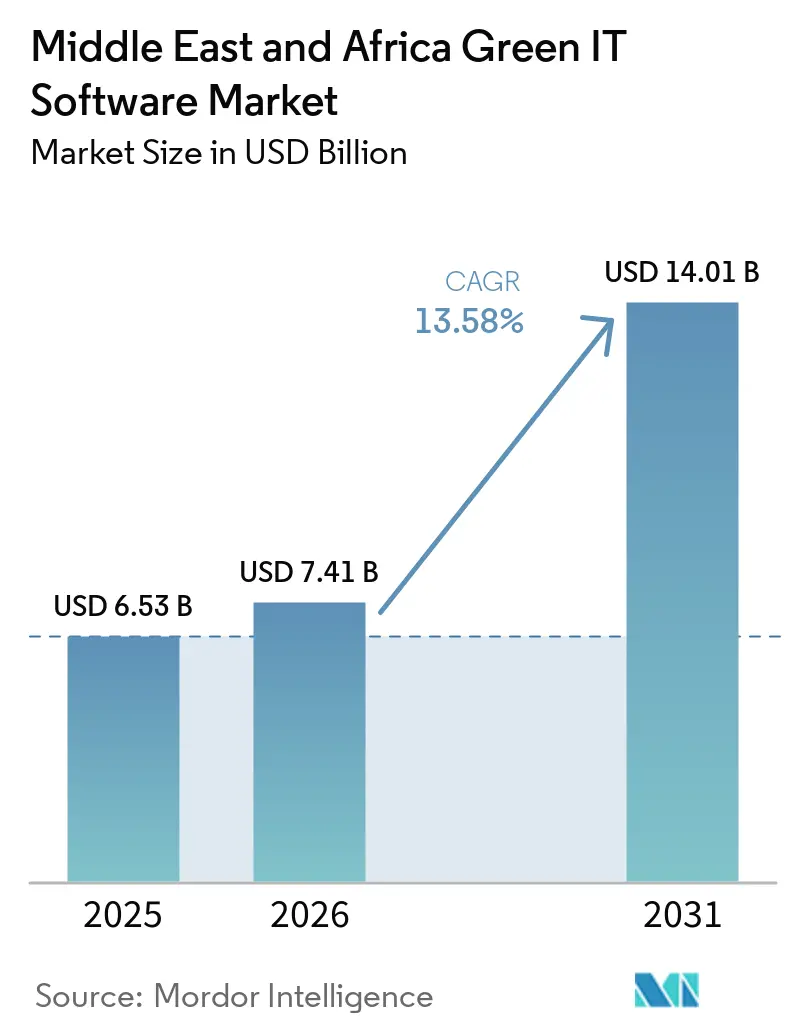
The Middle East and Africa Green IT Software Market size is projected to expand from USD 6.53 billion in 2025 and USD 7.41 billion in 2026 to USD 14.01 billion by 2031, registering a CAGR of 13.58% between 2026 and 2031. The Middle East and Africa Green IT Software Market is being shaped by the overlap of mandatory disclosure rules, enterprise digitization programs, and rising pressure to connect sustainability reporting with routine finance and IT processes. Demand is moving beyond basic reporting because buyers now want tools that support verification, improve data handling, and reduce the effort required to prepare audit-ready files across multiple entities and business functions. Cloud delivery remains central because many organizations in the region entered this category after software-as-a-service had already become the default buying model, thereby shortening deployment cycles and reducing the need for internal infrastructure. Competitive activity is increasingly centered on platform breadth, local regulatory coverage, and the ability to connect sustainability, financial, and operational data without forcing a full replacement of existing systems. The next phase of growth for the Middle East and Africa Green IT Software Market is likely to come from supplier reporting, AI-led automation, and sovereign digital infrastructure projects that widen the set of buyers beyond the first wave of listed companies and regulated institutions.
Key Report Takeaways
- By component, software held 68.29% of the Middle East and Africa Green IT Software Market in 2025, while services are projected to expand at a 15.12% CAGR through 2031.
- By application, ESG reporting and disclosure accounted for 35.23% of the MEA Green Information Technology Software Market in 2025, while carbon accounting and emissions reporting are projected to grow at a 14.09% CAGR through 2031.
- By deployment mode, cloud-based platforms captured 71.33% of the MEA Green IT Software Market share in 2025, and cloud is also expected to record the fastest CAGR at 15.66% through 2031.
- By organization size, large enterprises represented 67.14% of the MEA Green Information Technology Software Market in 2025, while SMEs are projected to expand at a 14.81% CAGR through 2031.
- By end user, IT and telecom held 24.21% of the MEA Green IT Software Market in 2025, while manufacturing is projected to grow at a 13.72% CAGR through 2031.
- By geography, the Middle East held 66.41% of the Middle East and Africa Green IT Software Market share in 2025, while Africa is projected to advance at a 14.36% CAGR through 2031.
Note: Market size and forecast figures in this report are generated using Mordor Intelligence’s proprietary estimation framework, updated with the latest available data and insights as of January 2026.
Market Trends and Insights
Drivers Impact Analysis of Middle East and Africa Green IT Software Market*
| Driver | (~) % Impact on CAGR Forecast | Geographic Relevance | Impact Timeline |
|---|---|---|---|
| Mandatory Reporting and Audit Readiness Pressure | +3.2% | GCC core, spillover to Egypt, Nigeria, and South Africa | Short term (≤ 2 years) |
| Rising Cloud-Native ESG and Energy Analytics Adoption | +2.7% | GCC and South Africa, expanding to Nigeria and Turkey | Short term (≤ 2 years) |
| AI-Enabled Carbon Accounting and Workload Optimization | +2.1% | UAE and Saudi Arabia, with early gains in South Africa | Medium term (2-4 years) |
| Multinational Supplier Traceability Requirements | +1.6% | GCC core, spillover to Nigeria and Kenya | Medium term (2-4 years) |
| Energy Cost Volatility and IT Efficiency Mandates | +1.3% | Region-wide, with stronger relevance in South Africa and Turkey | Short term (≤ 2 years) |
| Digital Sovereignty and Local Data Hosting Buildouts | +1.0% | GCC and South Africa, with early gains in Nigeria | Long term (≥ 4 years) |
| Source: Mordor Intelligence | |||
Mandatory Sustainability Reporting and Audit Readiness Pressure
Mandatory climate disclosure has already become a near-term buying trigger across the Middle East and Africa Green IT Software Market because compliance deadlines now carry direct legal and operational consequences. The UAE climate framework and Egypt’s February 2026 decision for non-banking financial institutions both pushed enterprises toward systems that can organize emissions data, support verification, and produce records that withstand formal review. Egypt’s Financial Regulatory Authority required Scope 1 and Scope 2 disclosures, along with third-party verification, for non-banking financial institutions with capital above EGP 100 million (USD 2.04 million), with compliance due by June 2026.[1] What matters for vendors is that buyers are no longer treating sustainability software as a separate reporting layer, because they increasingly want systems that can fit into audit, finance, and governance routines with less manual rework. This is why the MEA Green Information Technology software market is seeing a stronger preference for platforms that can handle disclosure workflows, evidence trails, and changing reporting obligations in one environment.
Rising Cloud-Native ESG and Energy Analytics Adoption
Cloud-based platforms held 71.33% of the 2025 Middle East and Africa Green IT Software Market, and that lead reflects more than simple subscription economics. Many regional buyers entered the category after mandatory reporting requirements had already been introduced, so they favored delivery models that could go live quickly and connect with existing enterprise systems without a lengthy infrastructure build. This also explains why the Middle East and Africa Green IT Software Market continues to lean toward software-as-a-service tools for first deployments, especially where sustainability teams were created after disclosure requirements had already started to tighten. A second layer of demand is emerging for energy analytics, as cloud-native environments can collect usage data across dispersed operations and turn it into repeatable reports for management teams and external reviewers. As the buyer base widens, the appeal of cloud tools is likely to remain strong because they give organizations a faster path from procurement to operational use, even when internal sustainability data processes are still being built.
AI-Enabled Carbon Accounting and Workload Optimization
AI is changing the value proposition of the Middle East and Africa Green IT Software Market by reducing the manual effort required to collect, classify, and validate sustainability data across large operations. Enterprises in the region are not only using software to report emissions, but they are also looking for tools that can detect anomalies, automate mapping across Scope 1, Scope 2, and Scope 3 categories, and shorten the time needed to prepare files for internal review. SAP’s 2026 Sustainability Control Tower updates added AI-enabled regulatory-readiness functions, automated materiality assessments, and data-mapping features that support this shift from static reporting to more active monitoring and response. This matters in a region where skilled carbon data specialists are limited, because automation can help enterprises move ahead without waiting for large internal teams to be built first. Over time, AI features are likely to become a baseline expectation rather than a premium add-on in the Middle East and Africa Green IT Software Market, especially in asset-heavy sectors and data-intensive cloud environments.
Multinational Supplier Traceability Requirements
Supplier reporting has become a distinct growth path for the Middle East and Africa Green IT Software Market, as multinational buyers are now asking suppliers to provide verifiable emissions data, even when local regulations are still less developed. This changes the buyer profile, since procurement clauses can pull SMEs into adoption years before domestic sustainability rules would have affected them directly. Sphera launched its Supplier Product Carbon Footprint Calculator in April 2025 to improve Scope 3.1 tracking through its managed lifecycle assessment content, which shows how vendors are responding to the need for supplier-level data collection and consistency. For enterprises across manufacturing, logistics, retail, and export-oriented sectors, the issue is not only whether they face local disclosure obligations, but whether they can remain eligible suppliers to customers that need stronger emissions visibility across their value chains. That dynamic gives the Middle East and Africa Green IT Software Market a demand stream that is less dependent on any single national rule and more closely linked to cross-border commercial relationships.
Restraints Impact Analysis of Middle East and Africa Green IT Software Market*
| Restraint | (~) % Impact on CAGR Forecast | Geographic Relevance | Impact Timeline |
|---|---|---|---|
| Limited Sustainability Data Quality Across Legacy IT Estates | -2.0% | Region-wide, concentrated in Africa and parts of the Middle East | Medium term (2-4 years) |
| Shortage of Skilled ESG And Carbon Data Specialists | -1.6% | Africa and emerging GCC markets | Medium term (2-4 years) |
| Integration Complexity Across ERP, Cloud, and IoT Stacks | -1.2% | Region-wide, concentrated in large enterprises with mixed IT environments | Medium term (2-4 years) |
| Budget Prioritization Versus Core Revenue Software | -0.8% | SME segment across Africa and Turkey | Short term (≤ 2 years) |
| Source: Mordor Intelligence | |||
Limited Sustainability Data Quality across Legacy IT Estates
The biggest brake on the Middle East and Africa Green IT Software Market is often not software demand, but the poor condition of the data that new tools are expected to use. Many legacy ERP, facilities, and operations systems were never built to capture electricity use at the asset level or to organize the metadata needed for credible emissions calculations, leaving teams to rely on manual work and fragmented files. That problem is especially important in sectors where sustainability, finance, IT, and operations each control parts of the data chain, because unclear ownership can slow implementation even after software budgets are approved. As a result, the Middle East and Africa Green IT Software Market still carries a meaningful execution gap between procurement and full operational use, particularly in first-time deployments. Vendors that can provide better templates, connectors, governance workflows, and onboarding support are more likely to convert interest into successful use, as buyers increasingly recognize that data readiness determines how quickly compliance benefits can be realized.
Shortage of Skilled ESG and Carbon Data Specialists
A restraint for the Middle East and Africa Green IT Software Market is the shortage of people who can integrate reporting standards, enterprise systems, and internal control requirements into a single implementation plan. The issue affects both sales cycles and delivery because buyers often need outside support to define data boundaries, verification processes, and reporting responsibilities before a system can be configured properly. Egypt’s February 2026 framework identified only 8 accredited verification and validation bodies for a newly covered group of non-banking financial institutions, which highlights how limited support capacity can become a wider market bottleneck. This shortage also favors larger vendors with stronger partner ecosystems and more automated implementation paths, because buyers facing time pressure tend to choose lower execution risk over deeper customization. Until training capacity improves, the Middle East and Africa Green IT Software Market is likely to reward companies that combine product functionality with practical implementation guidance, managed services, and structured onboarding.
*Our forecasts treat driver/restraint impacts as directional, not additive. The impact forecasts reflect baseline growth, mix effects, and variable interactions.
Middle East and Africa Green IT Software Market Segment Analysis
By Component:
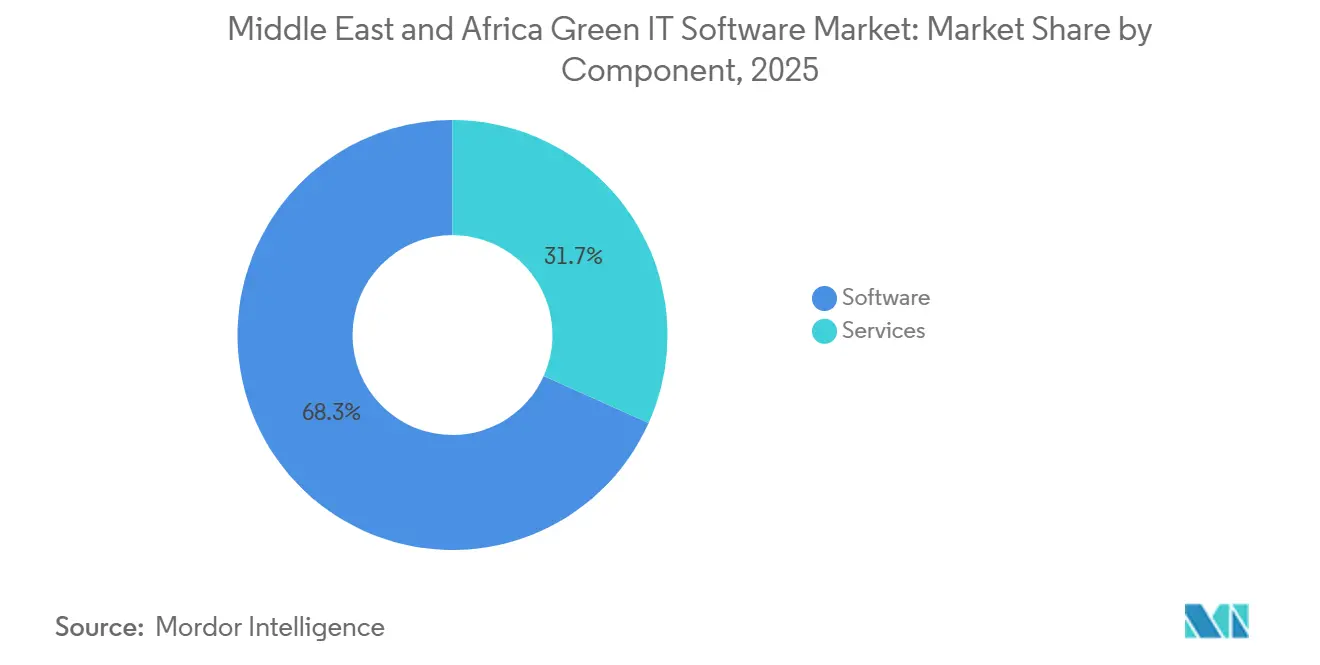
Software Maintains Leadership While Services Expand FasterSoftware accounted for 68.29% of the 2025 component mix, keeping it firmly in the leading position in the Middle East and Africa Green IT Software Market. That lead reflects buyer preference for ESG, carbon accounting, and energy analytics platforms that can sit on top of existing ERP and reporting environments, rather than forcing a broad system replacement. Many enterprises are still in an early deployment phase, so the appeal of software modules that can be integrated into existing workflows remains strong, especially for finance, IT, and sustainability teams that need faster time-to-value. The software segment also benefits from the fact that most organizations first enter this category through disclosure or data management needs, which are usually addressed through platforms rather than hardware or infrastructure spending.
Services are projected to grow at a 15.12% CAGR from 2026 to 2031, making them the fastest-rising component category in the Middle East and Africa Green IT Software Market. This growth comes from implementation, integration, support, and maintenance work that buyers need when data sits across legacy ERP, cloud, and facility systems with different formats and ownership rules. DXC expanded SAP capabilities across the region through a center of excellence in Egypt, a SAP academy in Saudi Arabia, and the recruitment of more than 300 SAP professionals, which illustrates how demand for certified delivery capacity is rising alongside software demand. Even without calculating new values, the Middle East and Africa Green IT Software Market size for services is clearly supported by the need to document data lineage, governance routines, and assurance methods before enterprises can claim audit-ready reporting. The pattern also shows that many buyers still need hands-on support because out-of-the-box functionality alone is not enough for complex, multi-entity deployments.
By Application:
Disclosure Leads Current Revenue While Carbon Accounting Gains GroundESG reporting and disclosure accounted for 35.23% of application revenue in 2025, making it the largest application area across the Middle East and Africa Green IT Software Market. That result is consistent with the current regulatory landscape, since most near-term obligations in the region have focused first on disclosure readiness, evidence handling, and reporting structure rather than on direct emissions-reduction targets. Buyers, therefore, continue to start with platforms that can centralize metrics, standardize outputs, and support internal and external reporting cycles. This keeps disclosure tools at the center of early adoption, particularly among listed firms, regulated institutions, and enterprises with multi-country reporting needs.
Carbon accounting and emissions reporting are forecast to grow at a 14.09% CAGR through 2031, indicating that the Middle East and Africa Green IT Software Market is moving from basic compliance toward more active measurement and planning. SAP’s 2026 Sustainability Control Tower updates strengthened AI support for regulatory readiness and data mapping, which aligns with buyer demand for tools that can turn emissions information into a more usable operational dataset.[2] Energy monitoring and optimization are also becoming more important as enterprises link carbon visibility with electricity cost control, cooling efficiency, and infrastructure performance. Supply chain sustainability management is attracting stronger interest as exporters and suppliers face growing requests for verified upstream data, while waste and water applications are still at an earlier stage across much of the region.
By Deployment Mode:
Cloud Holds the Largest Share and the Fastest Expansion RateCloud-based deployment accounted for 71.33% of 2025 demand, giving it both scale and momentum in the Middle East and Africa Green IT Software Market. It is also projected to post the fastest CAGR of 15.66% through 2031, which is unusual in enterprise software, as the leading delivery model is also extending its advantage. This pattern reflects the regional market’s timing, since many buyers adopted sustainability software after cloud delivery had already become normal and had little reason to build on-premises estates for a relatively new category. The result is that cloud platforms remain the default choice for organizations seeking faster implementation, easier upgrades, and less pressure on internal infrastructure teams.
On-premises deployment still has a role where sovereign hosting, public sector controls, or financial data residency rules remain important, so it is not disappearing from the Middle East and Africa Green IT Software Market. Digital Dubai reported approval for Phase 2 of the solar-powered Warsan data center, which will support sovereignty-compliant infrastructure for public sector and financial services workloads, pointing to a more blended model between private environments and cloud-based services. Even so, the commercial center of gravity remains with cloud, as buyers often prefer scalable deployments that can accommodate regulatory updates and support multiple entities without repeated local configuration. In share terms, cloud already holds the largest share of the Middle East and Africa Green IT Software Market by deployment mode, and its lead is likely to remain intact as more organizations seek quicker rollouts and simpler maintenance.
By Organization Size:
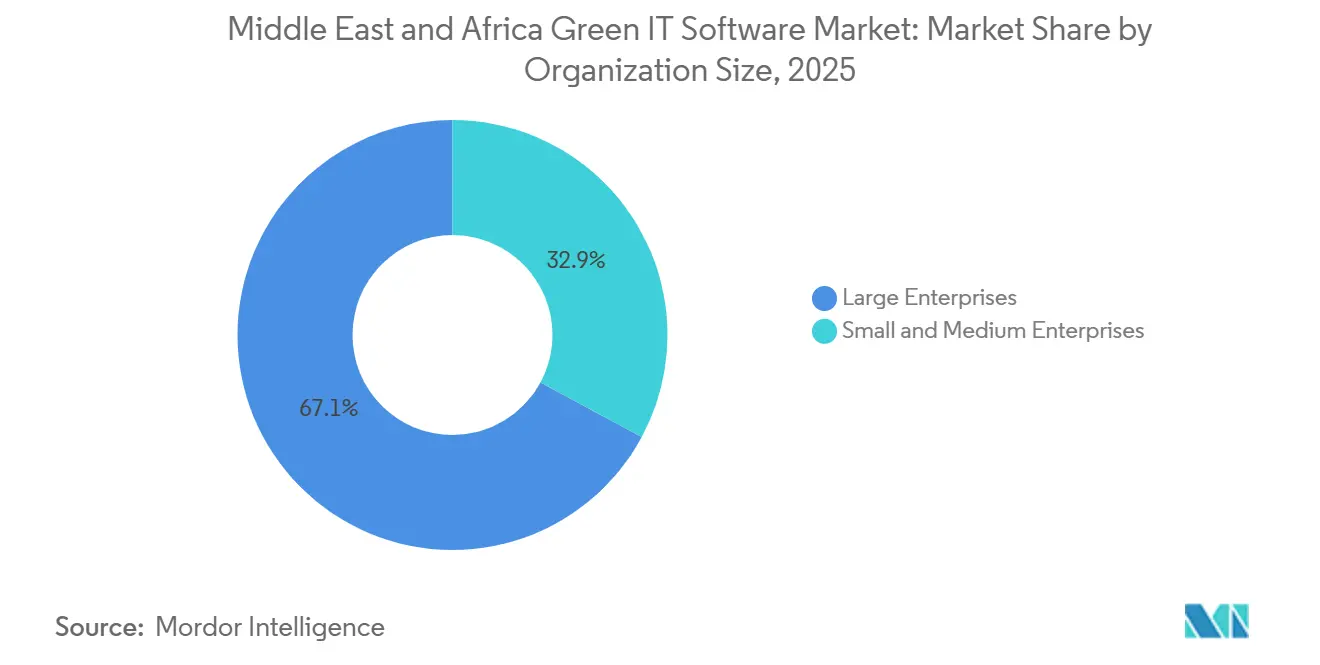
Large Enterprises Lead Today While SMEs Broaden the Buyer BaseLarge enterprises accounted for 67.14% of 2025 revenue by organization size, making them the primary spending group in the Middle East and Africa Green IT Software Market. This outcome reflects the fact that listed companies, regulated institutions, and large corporate groups were the first entities to be brought into stricter disclosure and verification routines. Larger buyers also tend to manage more complex reporting structures, more sites, and a wider range of controlled data, which increases the need for dedicated software. Their current spending is therefore tied not only to regulatory coverage but also to scale, governance needs, and the practical burden of coordinating sustainability information across several business units.
SMEs are forecast to grow at a 14.81% CAGR from 2026 to 2031, making them the fastest-growing buyer cohort in the Middle East and Africa Green IT Software Market. That growth is being driven less by direct local regulation and more by supplier obligations passed through procurement relationships, especially where multinational customers want verified carbon information from their vendors. This has widened the addressable base because smaller manufacturers, logistics firms, retailers, and service providers can face emissions reporting requests even when their domestic rules remain limited. The shift also favors subscription-led buying models because smaller firms usually prefer lower upfront spending, packaged onboarding, and partner-led deployment. Over time, SME adoption should make the MEA Green Information Technology software market less dependent on the first wave of very large corporate buyers and more anchored in value-chain reporting needs.
By End User:
IT and Telecom Leads Revenue While Manufacturing Builds FasterIT and telecom accounted for 24.21% of 2025 end-user revenue, which put the segment in the lead across the Middle East and Africa Green IT Software Market. That position reflects the dual role of telecom and IT firms, as both users of sustainability software and owners of high-energy digital assets that those tools are designed to monitor and improve. These organizations often manage data centers, network assets, and cloud environments that generate the kind of energy and utilization data needed for recurring Scope 2 reporting and broader efficiency tracking. Their early participation also matters because it creates reference cases for other sectors that are still shaping their sustainability technology priorities.
Manufacturing is projected to grow at a 13.72% CAGR through 2031, making it the fastest-rising end-user category within the Middle East and Africa Green IT Software Market. Growth is being pushed by a combination of export-related supply chain pressure, more energy-intensive digital operations, and the need to connect site-level activity with formal sustainability reporting. The BFSI sector remains a structurally important buyer set because disclosure deadlines and verification requirements create clearly defined software purchase windows for banks and non-banking institutions. Government and public sector demand is also gaining weight as digital transformation programs bring sustainability reporting into administrative dashboards and entity performance monitoring. Energy and utilities continue to adopt monitoring and optimization tools to support renewable integration and operational efficiency, while healthcare, retail, and e-commerce remain earlier-stage adopters despite rising interest.
Geography Analysis
GCC Green IT Software Market
The Middle East accounted for 66.41% of 2025 revenue, making it the largest sub-region within the Middle East and Africa Green IT Software Market. The current lead comes from concentrated activity in the GCC, where disclosure rules, digital transformation programs, and enterprise cloud spending are reinforcing one another. Buyers in the UAE and neighboring Gulf markets have been among the earliest to prioritize software that can connect emissions reporting with existing finance and governance processes. This concentration has made the Middle East the near-term demand engine and has also encouraged vendors to pay closer attention to local compliance requirements, Arabic-language workflow needs, and sovereign hosting preferences.
Africa Green IT Software Market
Africa is projected to grow at a 14.36% CAGR from 2026 to 2031, which makes it the fastest-growing geography in the Middle East and Africa Green IT Software Market. South Africa stands out because listed firms there are more familiar with integrated reporting practices, which supports faster adoption of tools that combine sustainability and financial data. Nigeria is also important because regulatory developments in finance are creating a clearer software buying cycle among institutions that need more formal emissions disclosure and control processes. Across the continent, adoption is still shaped by uneven data maturity and skills availability, yet the growth path remains strong because compliance, supplier pressure, and infrastructure localization are widening the number of active buyers. In practical terms, Africa’s current growth profile suggests that vendor success will depend less on generic expansion plans and more on partner networks, onboarding support, and products that can work with mixed legacy environments.
MEA Green IT Software Market
The rest of the region is starting to define the next wave of demand for the Middle East and Africa Green IT Software Market, even where adoption remains earlier in the cycle. Kenya, Morocco, and Ghana are seeing interest that is tied to financing conditions, listed company readiness requirements, and broader governance expectations around sustainability data. In the Middle East, outside the main GCC demand centers, countries such as Oman, Jordan, and Bahrain are moving along a slower but clearer regulatory path, giving vendors visibility into future opportunities even before spending peaks. This means the regional opportunity is broadening in sequence rather than all at once, with the current market led by the Gulf and South Africa, while later demand builds in adjacent markets. From a revenue perspective, the MEA Green IT software market is still heavily dependent on the Gulf today, but the strongest long-term growth case lies in how effectively suppliers, mid-sized enterprises, and second-wave countries are brought into the software base.
Competitive Landscape
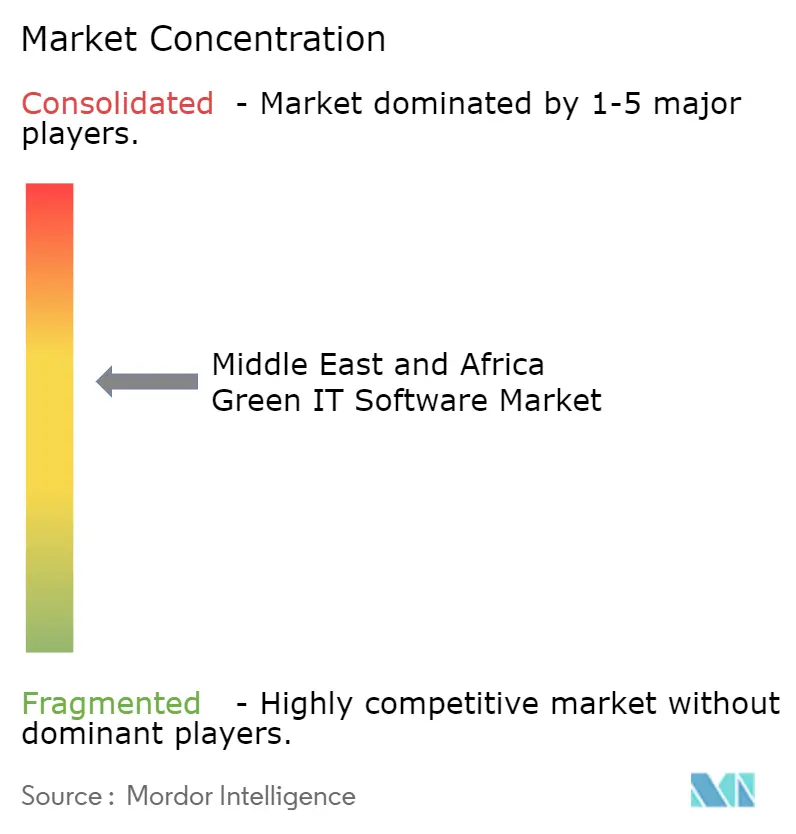
The competitive structure of the Middle East and Africa Green IT Software Market is moderately concentrated, with global enterprise software companies holding an advantage because sustainability modules can be embedded into systems that buyers already use for finance, ERP, cloud operations, and reporting. This gives larger vendors lower switching friction and stronger cross-sell potential, especially when enterprises want to avoid adding another isolated tool to an already crowded software stack. Buyers are increasingly favoring vendors that can combine disclosure, carbon accounting, audit support, and workflow management in one environment, because fragmented tools often increase manual reconciliation work instead of reducing it. As a result, competition is less about simple feature count and more about integration depth, regulatory coverage, and the ability to support implementation across multiple entities and data owners. The Middle East and Africa Green IT Software Market therefore rewards both platform breadth and execution reliability, particularly when deadlines are short and internal sustainability capabilities are still maturing.
SAP remains well positioned because its sustainability tools can connect carbon data with ERP and financial workflows that many large enterprises already operate. Workiva has strengthened its position through the integration of carbon accounting with financial reporting functions, which is especially relevant for buyers that need one process for sustainability data, controls, and external disclosure. Sphera is also gaining traction where supplier emissions, lifecycle content, and Scope 3 reporting matter more, because those capabilities serve a different but expanding buyer need within cross-border value chains. These moves show that competition in the Middle East and Africa Green IT Software Market is no longer limited to broad ESG dashboards, since buyers increasingly expect software to support operational use cases, supplier data collection, and assurance-ready outputs. In effect, the market is separating vendors that can serve only surface-level reporting needs from those that can support deeper enterprise workflows.
Several strategic moves illustrate how vendors are trying to widen their reach across the MEA Green IT software market. SAP’s 2026 Sustainability Control Tower updates expanded AI support for regulatory readiness, materiality assessment, and data mapping, which strengthens its appeal for enterprises that need more automation and clearer compliance workflows. Sphera’s April 2025 launch of the Supplier Product Carbon Footprint Calculator added a more specific supplier traceability capability, which aligns with rising Scope 3 pressure in export-linked sectors.[3] Digital Dubai’s work on sovereignty-compliant infrastructure also supports the competitive case for vendors that can operate effectively in regulated hosting environments rather than relying only on standard global cloud routes. That leaves room for specialist and regional players, but they will need clear differentiation in localization, sovereign deployment support, or supplier data depth if they want to displace platform incumbents at scale.
Middle East and Africa Green IT Software Industry Leaders
-
SAP SE
-
Microsoft Corporation
-
Schneider Electric SE
-
Oracle Corporation
-
Salesforce, Inc.
- *Disclaimer: Major Players sorted in no particular order
Middle East and Africa Green IT Software Market Companies Covered in this Report
- SAP SE
- Microsoft Corporation
- IBM Corporation
- Schneider Electric SE
- Oracle Corporation
- Salesforce, Inc.
- Wolters Kluwer N.V.
- Sphera Solutions, Inc.
- Cority Software Inc.
- Enablon North America Corp.
- Benchmark Gensuite, LLC
- Intelex Technologies ULC
- Diligent Corporation
- Workiva Inc.
- FigBytes Inc.
- Envirosuite Limited
- ESG Book GmbH
- Persefoni AI, Inc.
- Watershed Technology, Inc.
- Plan A Solutions GmbH
- Normative AB
- Sweep SAS
- Eniscope Limited
Recent Industry Developments in Middle East and Africa Green IT Software Market
- June 2026: STC Group and Huawei launched the Green Telco Cloud in Riyadh, Saudi Arabia, a cloud-native telecommunications platform that integrates computing, storage, and networking in a unified environment. Joint lab trials demonstrated 20% less energy consumption and a 40% reduction in physical infrastructure compared to conventional telco architectures, directly advancing Saudi Arabia's Vision 2030 digital sustainability commitments.
- May 2026: Dubai Holding announced a landmark enterprise AI partnership with Microsoft, establishing, as both companies described, the first enterprise-scale AI deployment of its kind in the broader MEA region. The collaboration covers hospitality, real estate, telecommunications, and entertainment, with Microsoft’s sustainability AI tools supporting Dubai Holding’s ESG reporting obligations under UAE Federal Decree-Law No. 11.
- February 2026: Egypt’s Financial Regulatory Authority issued Decision 36/2026, mandating Scope 1 and 2 carbon disclosures for all non-banking financial institutions with capital above EGP 100 million (USD 2.04 million), requiring third-party verification by FRA-registered verification and validation bodies, with a compliance deadline of June 2026; the decision marked Egypt’s first binding emissions mandate for the non-banking financial sector.
- April 2025: Sphera launched the Supplier Product Carbon Footprint Calculator on the SpheraCloud platform, enabling organizations to track Scope 3.1 supplier emissions using Sphera’s proprietary Managed LCA Content database, adding a supply chain sustainability functionality that addresses the growing MEA demand for third-party-verified Scope 3 data.
Middle East and Africa Green IT Software Market Report Scope
The Middle East and Africa Green IT software market comprises solutions that help organizations monitor, manage, and reduce the environmental impact of their IT operations. These software platforms provide tools for managing IT energy use, tracking carbon footprints, optimizing data centers, and generating sustainability reports that meet ESG and regulatory standards. The market's growth is fueled by government-led sustainability initiatives, smart city programs, and a surge in enterprises adopting cloud and digital technologies. As a result, organizations are better equipped to cut energy use, lower carbon emissions, and meet their long-term environmental and operational efficiency targets.
The Middle East and Africa Green IT Software Market Report is Segmented by Component (Software, and Services [Implementation and Integration Services, and Support and Maintenance Services]), Application (Carbon Accounting and Emissions Reporting, Energy Monitoring and Optimization, Environmental, Social, and Governance (ESG) Reporting and Disclosure, Supply Chain Sustainability Management, Green IT Asset and Data Center Optimization, and Other Applications), Deployment Mode (Cloud-Based, and On-Premises), Organization Size (Large Enterprises, and Small and Medium Enterprises), End User (Information Technology and Telecom, Banking, Financial Services, and Insurance, Manufacturing, Government and Public Sector, Energy and Utilities, Healthcare and Life Sciences, Retail and E-Commerce, and Other End Users), and Geography (Middle East, and Africa). The Market Forecasts are Provided in Terms of Value (USD).
Segmentation Overview
| Software | |
| Services | Implementation and Integration Services |
| Support and Maintenance Services |
| Carbon Accounting and Emissions Reporting |
| Energy Monitoring and Optimization |
| Environmental, Social, and Governance (ESG) Reporting and Disclosure |
| Supply Chain Sustainability Management |
| Green IT Asset and Data Center Optimization |
| Other Applications |
| Cloud-Based |
| On-Premises |
| Large Enterprises |
| Small and Medium Enterprises |
| Information Technology and Telecom |
| Banking, Financial Services, and Insurance |
| Manufacturing |
| Government and Public Sector |
| Energy and Utilities |
| Healthcare and Life Sciences |
| Retail and E-Commerce |
| Other End Users |
| Middle East | Gulf Cooperation Council (GCC) |
| Turkey | |
| Rest of Middle East | |
| Africa | South Africa |
| Nigeria | |
| Rest of Africa |
| By Component | Software | |
| Services | Implementation and Integration Services | |
| Support and Maintenance Services | ||
| By Application | Carbon Accounting and Emissions Reporting | |
| Energy Monitoring and Optimization | ||
| Environmental, Social, and Governance (ESG) Reporting and Disclosure | ||
| Supply Chain Sustainability Management | ||
| Green IT Asset and Data Center Optimization | ||
| Other Applications | ||
| By Deployment Mode | Cloud-Based | |
| On-Premises | ||
| By Organization Size | Large Enterprises | |
| Small and Medium Enterprises | ||
| By End User | Information Technology and Telecom | |
| Banking, Financial Services, and Insurance | ||
| Manufacturing | ||
| Government and Public Sector | ||
| Energy and Utilities | ||
| Healthcare and Life Sciences | ||
| Retail and E-Commerce | ||
| Other End Users | ||
| By Geography | Middle East | Gulf Cooperation Council (GCC) |
| Turkey | ||
| Rest of Middle East | ||
| Africa | South Africa | |
| Nigeria | ||
| Rest of Africa | ||
Key Questions Answered in the Report
What is the projected size of the Middle East and Africa Green IT Software Market by 2031?
The Middle East and Africa Green IT Software Market is projected to reach USD 14.01 billion by 2031, rising from USD 7.41 billion in 2026 at a CAGR of 13.58% over 2026 to 2031.
What is driving software demand across the region?
The strongest demand drivers are mandatory reporting rules, audit-readiness needs, cloud adoption, and growing requests for supplier emissions data from multinational customers.
Which application area currently brings in the most revenue?
ESG reporting and disclosure led with 35.23% of application revenue in 2025 because most enterprises first bought tools to meet disclosure and reporting obligations.
Why is cloud deployment so dominant in this space?
Cloud held 71.33% of 2025 demand and is also the fastest-growing deployment model at a 15.66% CAGR because buyers want quicker rollout, easier updates, and lower internal infrastructure burden.
Which buyer group is expanding the fastest?
SMEs are projected to grow at a 14.81% CAGR through 2031 as supplier reporting clauses and subscription-based deployment models bring smaller firms into adoption.
Which geography is leading now, and which one is growing faster?
The Middle East led with 66.41% of 2025 revenue, while Africa is projected to grow faster at a 14.36% CAGR during 2026 to 2031.