
Time-Sensitive Networking Market Size and Share
Market Overview
| Study Period | 2019 - 2030 |
|---|---|
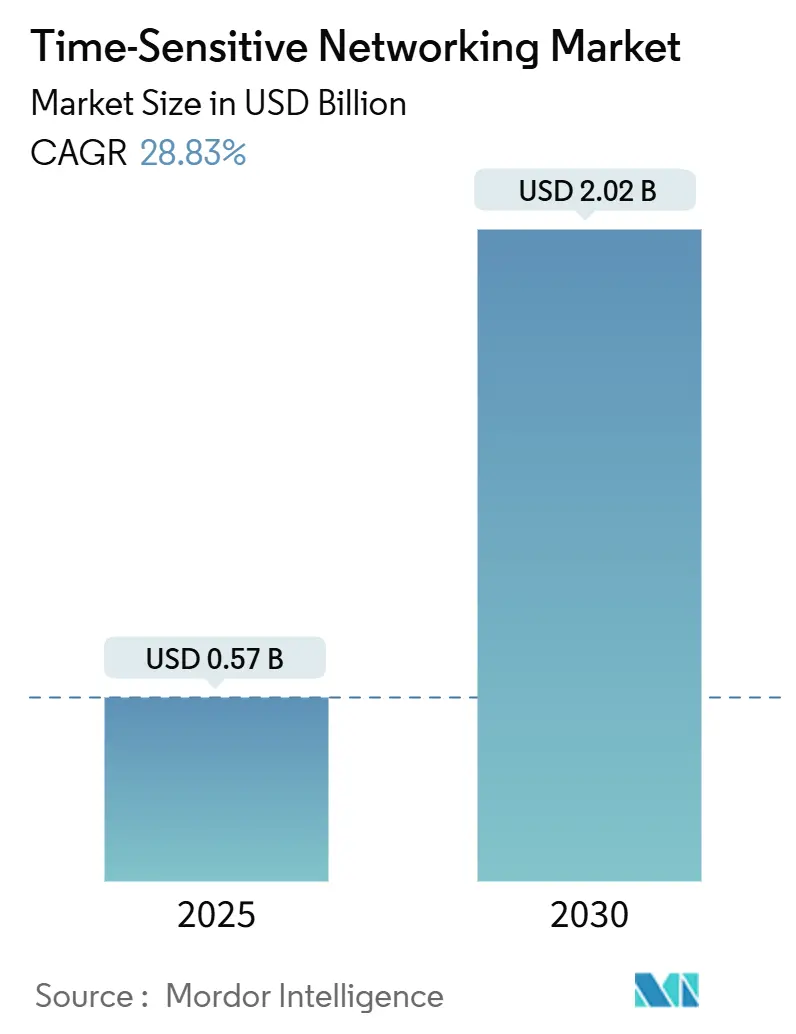
| Market Size (2025) | USD 0.57 Billion |
| Market Size (2030) | USD 2.02 Billion |
| Growth Rate (2025 - 2030) | 28.83 % |
| Fastest Growing Market | Asia Pacific |
| Largest Market | Asia Pacific |
| Market Concentration | Medium |
Major Players
*Disclaimer: Major Players sorted in no particular order Image © Mordor Intelligence. Reuse requires attribution under CC BY 4.0. |
|
Time-Sensitive Networking Market Analysis by Mordor Intelligence
The Time-Sensitive Networking Market size is estimated at USD 0.57 billion in 2025, and is expected to reach USD 2.02 billion by 2030, at a CAGR of 28.83% during the forecast period (2025-2030).
Near-term growth stems from mandatory IEC/IEEE 60802 compliance, while medium-term expansion benefits from the convergence of information-technology and operational-technology systems inside factories, vehicles, and defense platforms. Hardware demand remains solid, yet software-defined traffic management is rising as enterprises look for configuration flexibility. Regional opportunity is most visible in Asia-Pacific, where large-scale Industry 4.0 programs and automotive zonal architectures accelerate adoption. Competitive intensity increases as Ethernet incumbents, semiconductor leaders, and software specialists consolidate portfolios to deliver end-to-end deterministic Ethernet solutions.
Key Report Takeaways
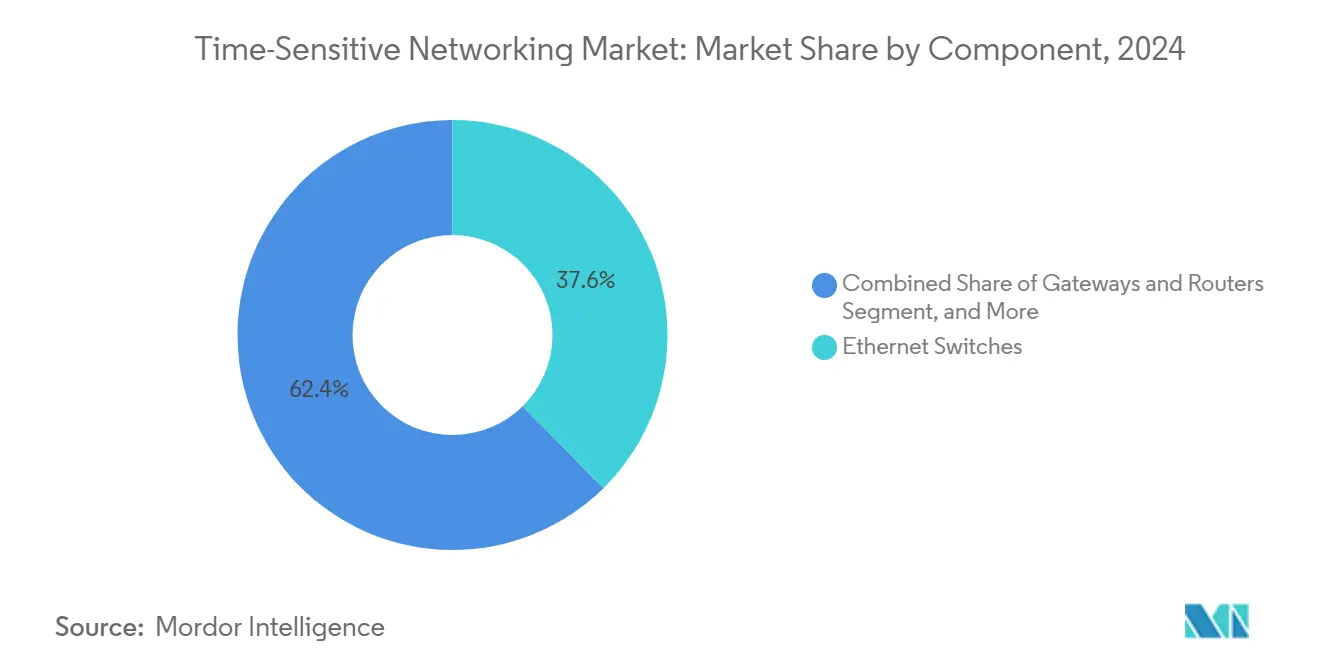
- By component, Ethernet switches led with 37.62% revenue share in 2024 and software solutions are forecast to expand at a 28.97% CAGR through 2030.
- By application, factory automation accounted for 39.81% of the Time-Sensitive Networking market size in 2024, while automotive in-vehicle networking is advancing at a 29.12% CAGR through 2030.
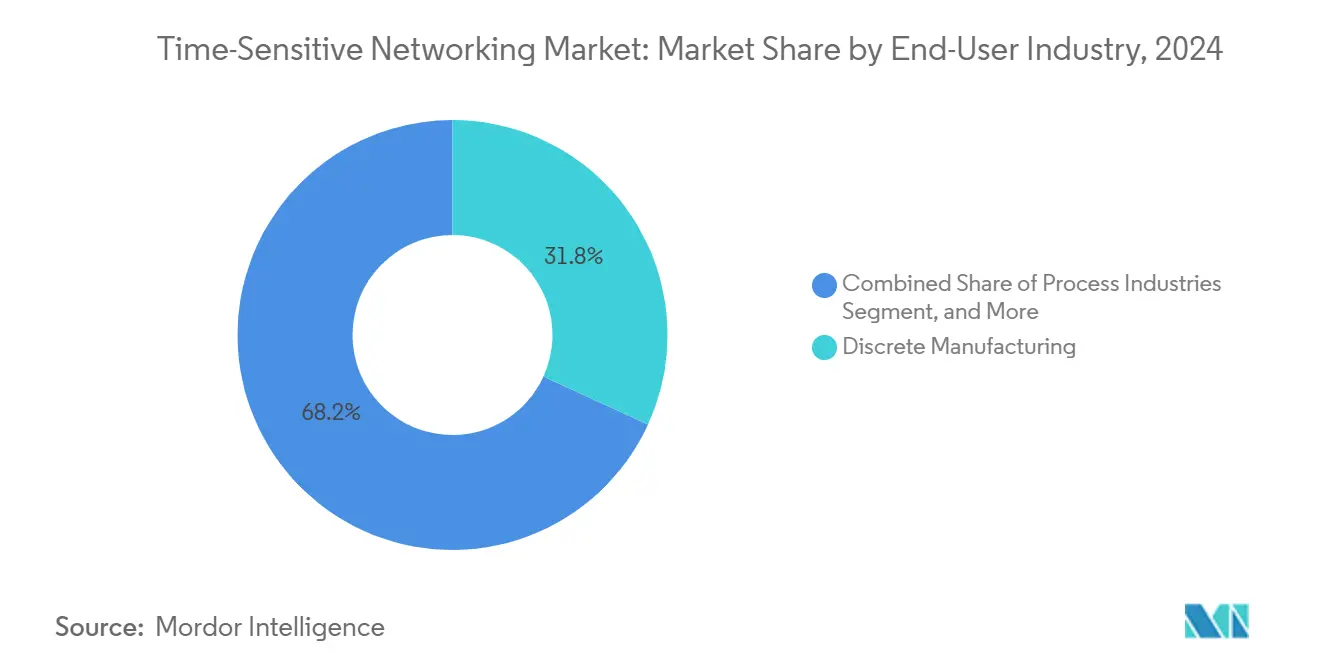
- By end-user industry, discrete manufacturing held 31.83% of the Time-Sensitive Networking market share in 2024 and automotive OEMs are projected to grow at a 28.89% CAGR to 2030.
- By network topology, wired deterministic Ethernet captured 63.48% share of the Time-Sensitive Networking market size in 2024 and time-sensitive wireless LAN is set to rise at a 29.87% CAGR through 2030.
- By geography, Asia-Pacific commanded 33.97% revenue share in 2024 and is forecast to register a 28.91% CAGR to 2030.
Global Time-Sensitive Networking Market Trends and Insights
Drivers Impact Analysis*
| Driver | (~) % Impact on CAGR Forecast | Geographic Relevance | Impact Timeline |
|---|---|---|---|
| Convergence of IT and OT accelerating deterministic Ethernet adoption | +7.2% | Global, with Asia-Pacific and North America leading | Medium term (2-4 years) |
| Mandated TSN compliance in next-gen industrial automation standards (IEC/IEEE) | +6.8% | Global, particularly Europe and North America | Short term (≤ 2 years) |
| Growth of time-critical automotive zonal E/E architectures | +5.9% | Asia-Pacific core, spill-over to North America and Europe | Medium term (2-4 years) |
| Edge-to-Cloud latency guarantees for private 5G and Wi-Fi 7 backhaul | +4.7% | North America and EU, expanding to Asia-Pacific | Long term (≥ 4 years) |
| Ultra-low-latency content production for broadcast and live events | +2.1% | North America and Europe primarily | Short term (≤ 2 years) |
| Military vetronics shift from CAN to TSN-enabled Ethernet backbones | +1.6% | North America, Europe, select Asia-Pacific markets | Long term (≥ 4 years) |
| Source: Mordor Intelligence | |||
Convergence of IT and OT Accelerating Deterministic Ethernet Adoption
Industrial operators see siloed OT and IT networks as barriers to real-time analytics and flexible production. Time-Sensitive Networking market adoption solves this disconnect by allowing time-critical control traffic and high-volume data to share a single Ethernet fabric, cutting cabling and maintenance costs.[1]Jack Lin, “TSN Accelerates Plant Floor Transformative Change,” Automation.com, automation.com Moxa documented a 40% reduction in infrastructure expense after migrating to TSN, while maintaining sub-millisecond latency. IEC/IEEE 60802 profiles ensure industrial-grade reliability, giving operators confidence that multivendor devices will interoperate. Vendors such as Phoenix Contact now ship switches that run PROFINET and OPC UA traffic concurrently without congestion. Growing evidence of cost savings and improved uptime accelerates decision making across Asia-Pacific factories where retrofit budgets are tight yet performance expectations are high.
Convergence of IT and OT Accelerating Deterministic Ethernet Adoption
The 2024 ratification of IEC/IEEE 60802 made TSN functionality compulsory for new industrial control systems in Europe and North America. The rule specifies 1 µs time-sync accuracy and bounded latency for safety loops, forcing equipment makers to embed TSN ports in PLCs, drives, and sensors. Siemens incorporated TSN scheduling into its PROFINET stack so users can mix motion control and standard IP traffic on one cable. Certification bodies such as TIACC provide conformance tests, reducing buyer risk and shortening procurement cycles. The regulatory push also influences cyber-security standards like IEC 62443, which now reference TSN’s traffic isolation and time-aware shaper features. As audit requirements tighten, compliance becomes a prerequisite rather than a differentiator, speeding volume deployments inside greenfield smart factories.
Growth of Time-Critical Automotive Zonal E/E Architectures
Electric and autonomous vehicles need deterministic, high-bandwidth links between zone controllers and central compute units. TSN assures microsecond-level synchronization for camera, lidar, and actuator signals, enabling the shift from domain to zonal topologies. Tesla’s Model 3 cut wiring length by 60% using such an architecture, while NXP added embedded 2.5 Gbps TSN switches to its i.MX 94 processors for zone control. The IEEE P802.1DG project aligns TSN with automotive safety standard ISO 26262, boosting OEM confidence. Aptiv reports 1 µs timing precision across Ethernet links in pre-production platforms, supporting over-the-air updates and battery management. Strong demand from Asian EV makers pushes component suppliers to integrate TSN MACs directly into SoCs, accelerating supply-chain learning curves.
Edge-to-Cloud Latency Guarantees for Private 5G and Wi-Fi 7 Backhaul
Enterprises rolling out private 5G expect deterministic end-to-end latency for robotics and augmented reality. TSN fills the wired backhaul role, extending microsecond timing from radio units to control servers. Testbeds show sub-microsecond synchronization between 5G gNodeBs and industrial end-points when TSN clocking is applied.[2]Zixiao Wang et al., “Time Synchronization for 5G and TSN Integrated Networking,” arXiv, arxiv.org Wi-Fi 7 adds time-aware scheduling that dovetails with wired TSN domains, supporting roaming autonomous vehicles on factory floors. Azure Private 5G Core exposes APIs that map URLLC slices to TSN traffic classes, simplifying orchestration. Certification work by the Avnu Alliance closes gaps between wireless and wired vendors, paving the way for truly converged networks by 2028.
Restraints Impact Analysis*
| Restraint | (~) % Impact on CAGR Forecast | Geographic Relevance | Impact Timeline |
|---|---|---|---|
| Slow refresh cycles of brown-field industrial plants | -4.3% | Global, particularly mature industrial regions | Medium term (2-4 years) |
| Interoperability gaps across early TSN silicon implementations | -3.7% | Global, with higher impact in cost-sensitive markets | Short term (≤ 2 years) |
| Scarcity of TSN-proficient systems integrators in emerging economies | -2.8% | Asia-Pacific emerging markets, MEA, Latin America | Long term (≥ 4 years) |
| High incremental cost of compliance-grade time-sync components <10 ns | -2.1% | Global, particularly price-sensitive applications | Medium term (2-4 years) |
| Source: Mordor Intelligence | |||
Slow Refresh Cycles of Brown-Field Industrial Plants
Many mature factories keep control equipment in service for 15-20 years, making wholesale TSN upgrades difficult. Studies of European sites show 70% of brown-field operators postpone TSN until major rebuilds are funded.[3]Mehrzad Lavassani et al., “From Brown-Field to Future Industrial Networks,” MDPI.com Retrofitting requires protocol gateways that add cost and complexity. Even when funding is available, plant managers worry about downtime during cut-over. Training programs from suppliers like NXP help, yet adoption lags newer facilities. This inertia limits near-term volume, especially in regions with large installed bases of proprietary fieldbus devices.
Interoperability Gaps Across Early TSN Silicon Implementations
Not every chip supports the full TSN feature set, leading to mismatched implementations. Field pilots have uncovered cases where devices certified to different option subsets fail to forward scheduled traffic correctly. Avnu Alliance launched a component level certification in 2024, but variance still exists across silicon generations. Enterprises in cost-sensitive markets lack resources for multi-vendor testing, delaying rollouts until suppliers converge on common baselines. Chipmakers such as Intel now publish reference architectures and open-source drivers to reduce integration risk, yet heterogeneity will remain a hurdle through 2026.
*Our forecasts treat driver/restraint impacts as directional, not additive. The impact forecasts reflect baseline growth, mix effects, and variable interactions.
Segment Analysis
By Component: Software Solutions Drive Configuration Flexibility
Ethernet switches generated the largest share of the Time-Sensitive Networking market size, accounting for 37.62% of 2024 revenue, while software solutions are projected to grow at a 28.97% CAGR to 2030. Demand for managed switches remains high because deterministic scheduling requires hardware time-stamping and traffic shaping functions. Even so, enterprises increasingly value software that automates configuration and monitors performance in real time. Interface cards and embedded controllers integrate TSN media-access functions, supporting automotive zone controllers and industrial robots without external bridges.
The software trajectory reflects the preference for firmware updates over forklift upgrades. Vendors bundle graphical policy editors and AI-based diagnostics that predict congestion before it affects cycle times. Such capabilities cut commissioning hours and simplify cybersecurity audits that now reference TSN traffic classes. Services revenue scales with deployment complexity, covering design, integration, and multi-vendor validation. Cables and connectors remain a stable line as Cat6A and SPE cabling networks expand, yet growth is modest compared with processor-based controllers that embed TSN accelerators.



By Application: Automotive Networking Accelerates Beyond Factory Floors
Factory automation retained 39.81% share of the Time-Sensitive Networking market in 2024, but automotive in-vehicle networking is set to register the fastest 29.12% CAGR to 2030, buoyed by electric vehicle rollouts. Discrete manufacturers deploy TSN to synchronize motion axes and vision systems on a single wire. Meanwhile, EV platforms require deterministic links across battery, infotainment, and drive-by-wire domains, prompting silicon vendors to integrate multi-gigabit TSN ports inside chipsets.
Power utilities apply TSN for distributed energy resource coordination where microsecond timing supports grid stability. Broadcasting studios migrate from SDI to IP using SMPTE ST 2110 combined with TSN timestamping to align multi-camera feeds. Aerospace and defense programs replace older buses with Ethernet backbones, while healthcare equipment suppliers embed TSN to guarantee response times in surgical robots. Each additional use case creates lateral pull that diversifies the revenue base beyond factory lines.
By End-User Industry: Automotive OEMs Lead Digital Transformation
Discrete manufacturing generated 31.83% of 2024 revenue, reflecting continued investment in smart factories, yet automotive OEMs are forecast to grow at a 28.89% CAGR, the fastest within the Time-Sensitive Networking market. Vehicle makers prioritize lightweight wiring and over-the-air software delivery, both enabled by zonal architectures with TSN backbones. Process industries such as chemicals and food integrate TSN into distributed control systems to consolidate data pathways while meeting safety integrity levels.
Utilities adopt TSN as IEC 61850 revisions incorporate bounded-latency profiles for substation automation. Transportation and logistics deploy it for vehicle-to-infrastructure coordination in automated yards. Media companies leverage deterministic Ethernet during live events where single-frame accuracy is mandatory. Each vertical gains from cross-pollination of best practices, accelerating ecosystem maturity.
Software-defined vehicle programs give automotive Tier-1 suppliers leverage to push component makers toward integrated TSN MACs. This influence spills into industrial controllers that share common silicon roadmaps. Utilities and process plants follow, citing long asset life and the need for deterministic cybersecurity partitions. The cascading demand reinforces the case for integrated hardware–software stacks.
By Network Topology: Wireless TSN Emerges as Growth Catalyst
Wired deterministic Ethernet platforms accounted for 63.48% share in 2024. Market growth now pivots to wireless TSN, projected at a 29.87% CAGR as Wi-Fi 7 and 5G URLLC mature. Hybrid networks blend copper, fiber, and wireless links under unified time-aware scheduling, serving mobile robots and handheld inspection devices. Factory engineers value the ability to reconfigure layouts without recabling, shortening changeover times.
The rise of wireless TSN aligns with sustainability goals since reduced cabling saves copper and installation labor. Avnu test results show robot arm control maintained 2 ms command latencies across roaming Wi-Fi 7 access points. Network management consoles visualize both media types on one pane, ensuring deterministic performance regardless of link layer. As chipsets supporting IEEE 802.11be ship in volume, cost differentials narrow, driving widespread adoption by 2027.
Hybrid topologies address brown-field constraints by overlaying wireless for temporary lines while wired segments continue feeding legacy machinery. Edge compute nodes act as translators, mapping scheduled flows across media. Early adopters report smoother migration paths because wireless capacity can absorb traffic during cutovers, minimizing production risk.
Geography Analysis
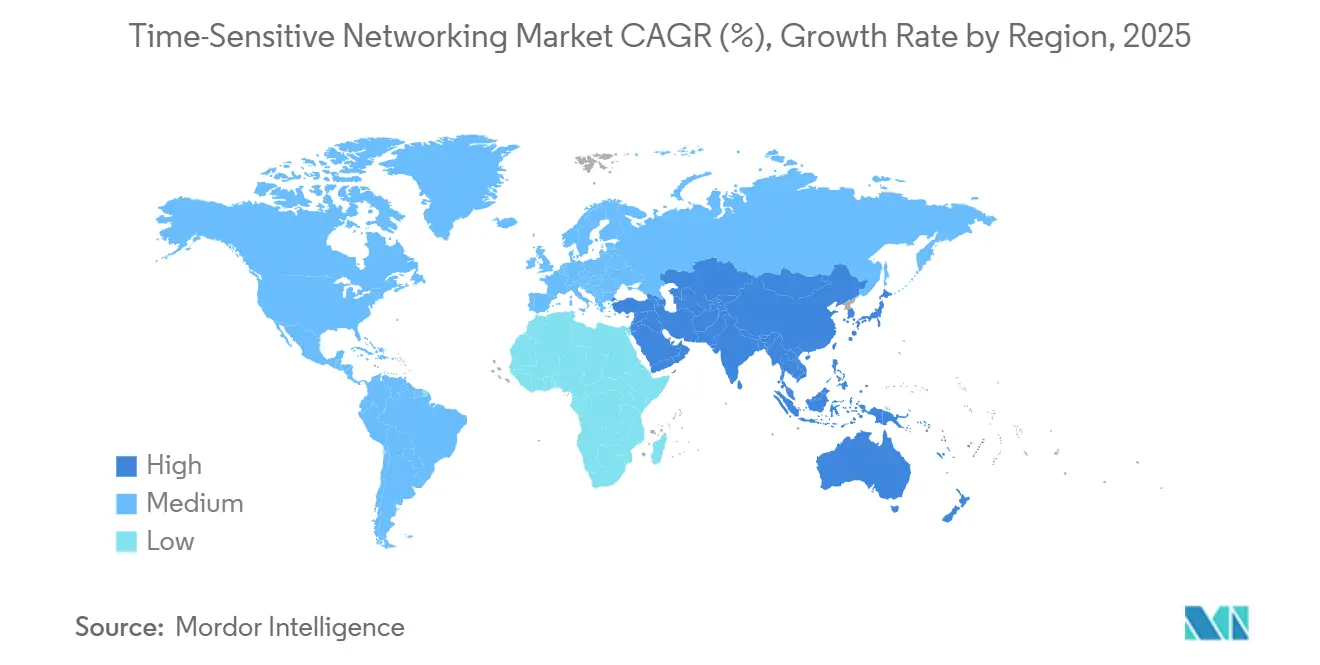
Asia-Pacific held 33.97% of 2024 revenue and is on course for a 28.91% CAGR to 2030, the strongest regional trajectory in the Time-Sensitive Networking market. China funds large-scale Industry 4.0 retrofits, installing TSN gateways that bridge legacy PROFIBUS to deterministic Ethernet inside auto plants. Japanese OEMs roll out zonal vehicle platforms, ordering millions of TSN-enabled switch ports. South Korea backs smart-factory tax incentives that accelerate software defined network pilots. India’s auto cluster in Chennai begins adopting TSN for battery assembly lines, showing spillover to emerging economies. Regional chip fabrication capacity ensures local supply of transceivers, insulating buyers from foreign currency swings.
North America ranks second, driven by defense and hyperscale data-center spending. The Department of Defense’s modular open systems mandate specifies TSN interoperability for future combat vehicles, boosting orders for ruggedized switches. U.S. cloud providers integrate TSN into AI clusters to guarantee predictable job completion, while Canada and Mexico expand automotive plants that embed deterministic Ethernet. Strong integrator ecosystems shorten deployment cycles relative to emerging regions.
Europe remains a mature but growth-oriented market. Germany’s Industrie 4.0 program showcases AI-optimized TSN scheduling that lifts overall equipment effectiveness in pilot lines. France upgrades aerospace assembly sites with hybrid wired-wireless TSN. The United Kingdom’s broadcast studios implement SMPTE ST 2110 over TSN to eliminate legacy SDI. Eastern European utilities modernize substations, applying IEC 61850 TSN profiles to synchronize protection relays. While brown-field challenges persist, government incentives offset retrofit risks, sustaining steady adoption through 2030.

Competitive Landscape
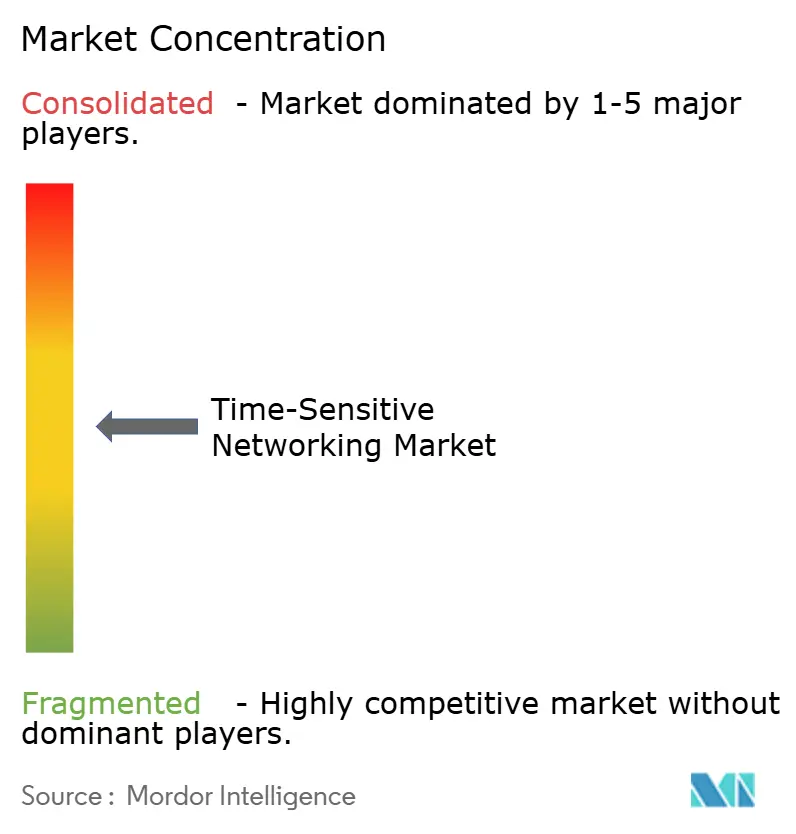
Competition is moderate with a tilt toward consolidation. Cisco, Siemens, and Belden leverage installed bases and robust channel networks. Intel, Marvell, and NXP integrate TSN MACs into processors and NICs, securing design wins in automotive and industrial controllers. Infineon’s USD 2.5 billion purchase of Marvell’s automotive Ethernet unit in 2025 created a vertically integrated roadmap for zone controllers, improving scale economies. Software vendors such as Wind River and Real-Time Innovations deliver protocol stacks and orchestration tools, capturing value as hardware becomes commoditized.
Emerging entrants focus on wireless TSN, leveraging 5G small-cell know-how to bridge radio and Ethernet domains. Avnu Alliance certifications become a badge of interoperability, influencing buyer shortlists. Open-source silicon like Fenglin-I threatens to commoditize basic switch IP, pushing incumbents toward software differentiation. Telco equipment makers collaborate with cloud providers to bundle deterministic connectivity with edge compute services.
Strategic alliances shape the field. Cisco partners with NVIDIA to pair Silicon One ASICs with Spectrum-X, ensuring line-rate TSN for AI clusters. HPE’s Juniper acquisition doubles its networking footprint and adds intent-based automation suited to deterministic traffic. Motorola Solutions buys Silvus Technologies to blend MANET radios with TSN, targeting unmanned defense platforms.
Players able to present integrated hardware, software, and services hold an edge as customers seek one-stop accountability. Certification speed and ecosystem partnerships will define market share shifts over the next five years.
Time-Sensitive Networking Industry Leaders
-
Belden Inc.
-
Cisco Systems, Inc.
-
Moxa Inc.
-
TTTech Computertechnik AG
-
Analog Devices, Inc.
- *Disclaimer: Major Players sorted in no particular order

Recent Industry Developments
- August 2025: Motorola Solutions completed its USD 4.4 billion acquisition of Silvus Technologies, expanding secure MANET capabilities for defense applications.
- July 2025: Hewlett Packard Enterprise closed its USD 14 billion acquisition of Juniper Networks, doubling its networking revenue base and enhancing TSN automation features.
- April 2025: Infineon Technologies acquired Marvell’s automotive Ethernet business for USD 2.5 billion, strengthening TSN silicon for software-defined vehicles.
- March 2025: VIAVI Solutions agreed to acquire Spirent’s high-speed Ethernet and network security testing business for USD 410 million, adding TSN validation tools.


Global Time-Sensitive Networking Market Report Scope
| Ethernet Switches |
| Network Interface Cards (NICs) |
| Gateways and Routers |
| Controllers and Processors |
| Cables and Connectors |
| Software and Services (Configuration and Management) |
| Factory Automation and Control |
| Automotive In-vehicle Networking |
| Power and Energy Systems |
| Oil and Gas |
| Aerospace and Defense |
| Audio/Video Broadcasting |
| Healthcare Equipment |
| Discrete Manufacturing |
| Process Industries |
| Automotive OEMs and Tier-1s |
| Utilities |
| Transportation and Logistics |
| Media and Entertainment |
| Wired Deterministic Ethernet |
| Hybrid Wired-Wireless TSN |
| Time-Sensitive Wireless LAN (IEEE 802.11be) |
| North America | |
| Europe | |
| Asia-Pacific | |
| Middle East and Africa | Middle East |
| Africa | |
| South America |
| By Component | Ethernet Switches | |
| Network Interface Cards (NICs) | ||
| Gateways and Routers | ||
| Controllers and Processors | ||
| Cables and Connectors | ||
| Software and Services (Configuration and Management) | ||
| By Application | Factory Automation and Control | |
| Automotive In-vehicle Networking | ||
| Power and Energy Systems | ||
| Oil and Gas | ||
| Aerospace and Defense | ||
| Audio/Video Broadcasting | ||
| Healthcare Equipment | ||
| By End-User Industry | Discrete Manufacturing | |
| Process Industries | ||
| Automotive OEMs and Tier-1s | ||
| Utilities | ||
| Transportation and Logistics | ||
| Media and Entertainment | ||
| By Network Topology | Wired Deterministic Ethernet | |
| Hybrid Wired-Wireless TSN | ||
| Time-Sensitive Wireless LAN (IEEE 802.11be) | ||
| By Geography | North America | |
| Europe | ||
| Asia-Pacific | ||
| Middle East and Africa | Middle East | |
| Africa | ||
| South America | ||


Key Questions Answered in the Report
What is the projected value of the Time-Sensitive Networking market by 2030?
The market is forecast to reach USD 2.02 billion by 2030, expanding at a 28.83% CAGR.
Which component category grows fastest in Time-Sensitive Networking deployments?
Software solutions register the highest 28.97% CAGR because enterprises favor configuration-driven traffic management.
Why is Asia-Pacific pivotal for Time-Sensitive Networking adoption?
Aggressive Industry 4.0 programs and automotive zonal architectures enable Asia-Pacific to lead with 33.97% share in 2024 and the fastest 28.91% CAGR to 2030.
How does Time-Sensitive Networking benefit electric vehicles?
TSN supplies microsecond-level deterministic Ethernet links that coordinate battery, sensor, and drive systems in zonal vehicle architectures.
What challenge most hampers Time-Sensitive Networking uptake in brown-field plants?
Long equipment lifecycles extend retrofit timelines, and operators hesitate to disrupt running systems without clear return on investment.
How do private 5G and Wi-Fi 7 relate to Time-Sensitive Networking?
Both wireless technologies integrate TSN scheduling to deliver end-to-end deterministic latency for industrial and enterprise applications.
Page last updated on:





