
Sweden Integrated Facility Management Market Size and Share
Market Overview
| Study Period | 2020 - 2031 |
|---|---|
| Forecast Data Period | 2026 - 2031 |
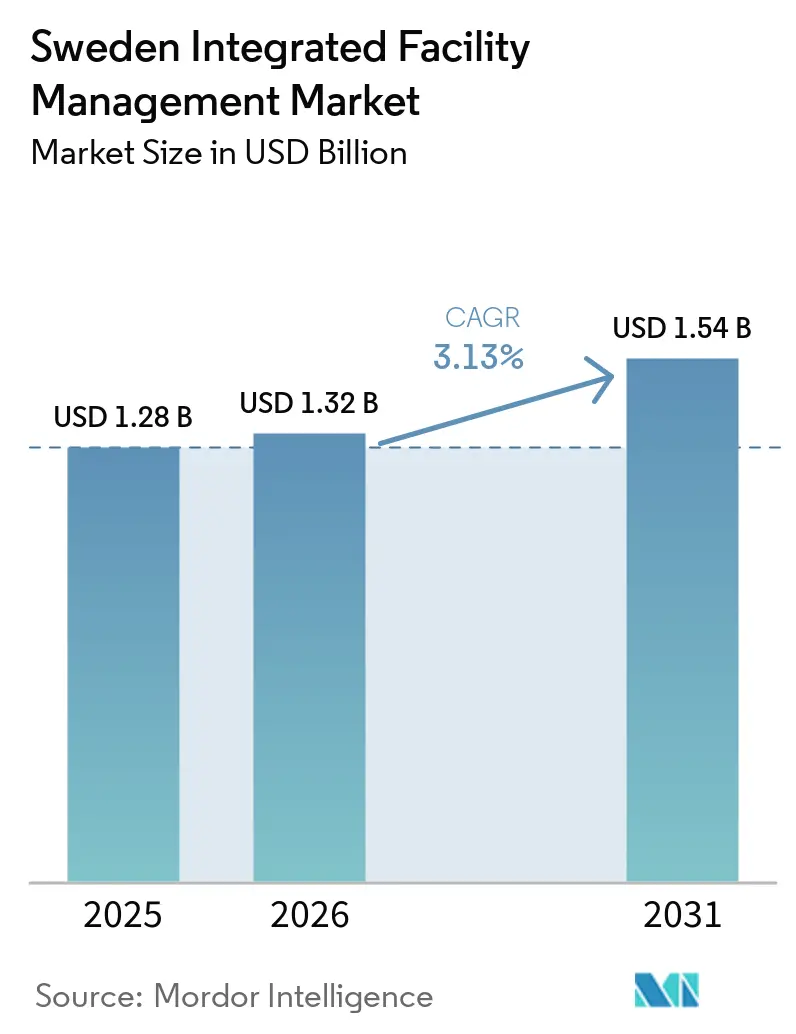
| Base Year Market Size (2025) | USD 1.28 Billion |
| Market Size (2026) | USD 1.32 Billion |
| Market Size (2031) | USD 1.54 Billion |
| Growth Rate (2026 - 2031) | 3.13 % |
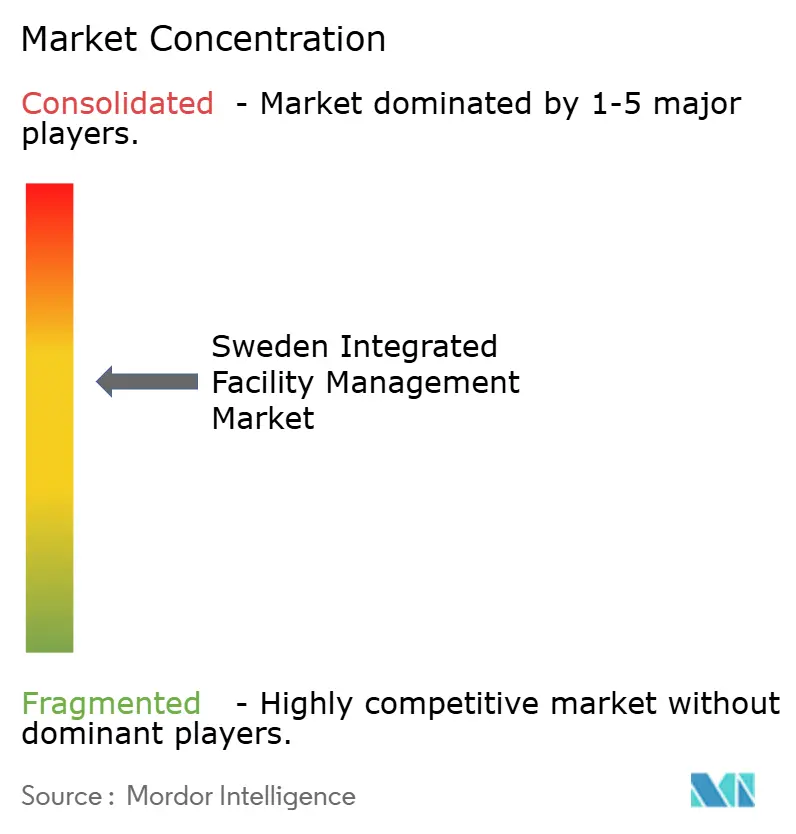
| Market Concentration | Medium |
Major Players *Disclaimer: Major Players sorted in no particular order Image © Mordor Intelligence. Reuse requires attribution under CC BY 4.0. | |
Sweden Integrated Facility Management Market Analysis by Mordor Intelligence
The Sweden integrated facility management market size was valued at USD 1.28 billion in 2025 and estimated to grow from USD 1.32 billion in 2026 to reach USD 1.54 billion by 2031, at a CAGR of 3.13% during the forecast period 2026-2031. The Sweden integrated facility management (IFM) market continues to benefit from Sweden’s mature outsourcing culture, where large organizations increasingly prefer to place cleaning, catering, security, technical maintenance, and workplace support under one contract instead of managing multiple vendors. Regulatory pressure is also strengthening demand because Sweden is moving ahead with the revised EU Energy Performance of Buildings Directive, which raises inspection and energy documentation requirements for buildings and pushes owners toward more structured technical service models. Digital infrastructure is adding a new layer of demand, as large investments in cloud and data center capacity require high-uptime, compliance-led, and technically specialized service delivery that suits integrated operating models. Public infrastructure planning also supports a longer contract pipeline, with Trafikverket’s SEK 1,171 billion (USD 119.3 billion), national plan for 2026-2037 widening the addressable base for lifecycle asset management across transport and civic assets. Even with near-term limits from labor shortages, cost pressure, and slower smart building deployments among smaller operators, the Sweden integrated facility management market remains more resilient than standalone service lines because clients continue to prioritize supplier consolidation, cost control, and measurable operational outcomes.
Key Report Takeaways
- By service type, Soft Facility Management (soft FM) held 66.17% share of the Sweden integrated facility management market in 2025, while Hard Facility Management (hard FM) is forecast to expand at a 3.84% CAGR through 2031.
- By end user, the industrial and process segment held 29.16% share of the Sweden integrated facility management (IFM) market in 2025, while the commercial segment is forecast to expand at a 4.01% CAGR through 2031.
Note: Market size and forecast figures in this report are generated using Mordor Intelligence’s proprietary estimation framework, updated with the latest available data and insights as of January 2026.
Sweden Integrated Facility Management Market Trends and Insights
Drivers Impact Analysis*
| Driver | (~) % Impact on CAGR Forecast | Geographic Relevance | Impact Timeline |
|---|---|---|---|
| Growing Outsourcing Trend Among Swedish Corporates | +0.7% | Sweden-wide, concentrated in Stockholm, Gothenburg, and Malmö corporate hubs | Medium term (2-4 years) |
| Rising Focus on Energy Efficiency and Green Buildings | +0.6% | Sweden-wide, elevated in urban commercial and public-sector building portfolios | Long term (≥ 4 years) |
| Digitalization of FM Through IoT-Enabled Predictive Maintenance | +0.5% | Sweden-wide, led by Stockholm metro and industrial Västra Götaland | Medium term (2-4 years) |
| Expansion of Data Centers Requiring Integrated FM | +0.4% | Northern Sweden, especially Skellefteå and Luleå, and Stockholm metro | Medium term (2-4 years) |
| Aging Public Infrastructure Driving Lifecycle Asset Management | +0.3% | Sweden-wide, concentrated in municipal building stock from the 1960s-1980s | Long term (≥ 4 years) |
| Government Incentives for Carbon-Neutral Facility Operations | +0.2% | Sweden-wide, highest uptake in public-sector real estate and district-heated commercial buildings | Long term (≥ 4 years) |
| Source: Mordor Intelligence | |||
Growing Outsourcing Trend Among Swedish Corporates
The Sweden integrated facility management market is being shaped by a clear move away from single-service procurement toward broader bundled contracts across large corporate portfolios. Coor stated that the outsourced FM market in the Nordics stood at SEK 350 billion (USD 35.7 billion), while the IFM sub-segment stood at SEK 25 billion (USD 2.5 billion), and was growing faster than the wider outsourced market.[1] That gap shows that Swedish clients are not only outsourcing more tasks, they are also restructuring procurement around fewer vendors with wider delivery mandates. The renewal of Coor’s 5-year agreement with Telia from January 2026 reflected this approach because the contract was built around shared performance targets tied to cost, sustainability, and innovation instead of service volume alone. Coor’s May 2025 extension with Volvo Cars, valued at SEK 400 million (USD 40.8 million), per year including variable volumes, also showed that large customers are deepening existing IFM relationships instead of widening supplier lists.[2] In the Sweden integrated facility management (IFM) market, this keeps integrated providers closer to client operations and makes them more important in workplace reporting, compliance, and cost planning.
Rising Focus On Energy Efficiency And Green Buildings
The Sweden integrated facility management market is also gaining support from a building compliance cycle that now links energy performance more closely to ongoing maintenance and inspection work. Sweden submitted its lagrådsremiss in December 2025 to implement the revised EPBD, with mandatory HVAC inspection intervals of 3 to 5 years and wider energy declaration requirements targeted for July 1, 2026. Sweden’s building base includes close to 8 million buildings, with a large share built between 1940 and 1980, and these properties account for a major part of national energy use. This creates lasting demand for HVAC services, controls optimization, retrofit-linked technical support, and energy reporting across both public and private portfolios. ÖrebroBostäder’s AI-based heating optimization program delivered 8% to 18% heat savings, lowered emissions by 1,400 tonnes of CO2 per year, and generated SEK 120 million (USD 12.2 million), in annual savings against average annual investment of SEK 12 million (USD 1.2 million). In the Sweden IFM market, providers with strong hard FM and building automation capability are therefore better placed to win contracts tied to measurable energy outcomes.
Digitalization Of FM Through IoT-Enabled Predictive Maintenance
The Sweden integrated facility management market is moving toward more sensor-led and data-led service delivery, especially in technically complex assets where downtime costs are high. Digital Futures launched an AI-based predictive maintenance and life cycle assessment project for smart buildings in January 2026, using more than 150 sensors to monitor HVAC, piping, and heating systems in a Stockholm student residence through December 2027. That kind of applied testing matters because it shows how predictive tools can shift FM work from reactive repair to planned intervention and better asset planning. ClimaCheck’s PREMA-HEAPS work with Vasakronan at the Triangeln shopping center in Malmö cut energy use sharply and reduced potential system downtime by 90%, with support from the Swedish Energy Agency. The Sweden IFM market is therefore seeing digital capability become part of technical credibility, especially in HVAC-heavy commercial sites and portfolios that need traceable energy data. Providers that can combine monitoring, diagnostics, and field execution have a better chance of defending margins because they can show output improvements instead of selling labor hours alone.
Expansion Of Data Centers Requiring Integrated FM
The Sweden integrated facility management market is drawing new demand from data centers because Sweden offers renewable electricity, land availability, and climate conditions that support efficient cooling. Microsoft announced a USD 3.2 billion expansion of its Swedish cloud and AI infrastructure footprint, while Google Cloud launched its Sweden region in March 2025. EdgeConneX then announced plans in February 2026 for a 1GW campus in Skellefteå, which points to a long runway for highly specialized FM work in northern Sweden.[3] These facilities need 24/7 technical operations, strict physical access control, detailed work documentation, and strong power and cooling system maintenance, which makes them different from ordinary office or retail properties. The Sweden integrated facility management (IFM) market is therefore opening a premium niche where barriers are higher, contract requirements are tighter, and only a limited pool of providers can combine uptime, compliance, and engineering depth. This shifts part of future demand toward technical FM models with stronger skill intensity and higher service value per site.
Restraints Impact Analysis*
| Restraint | (~) % Impact on CAGR Forecast | Geographic Relevance | Impact Timeline |
|---|---|---|---|
| Shortage of Skilled Technical Workforce in Sweden | -0.5% | Sweden-wide, most acute in rural and industrial regions outside major urban centers | Medium term (2-4 years) |
| Cost Inflation in Labor and Materials Eroding Margins | -0.4% | Sweden-wide, pressure highest in labor-intensive soft FM and technical maintenance services | Short term (≤ 2 years) |
| Data Privacy Concerns Limiting Smart FM Adoption | -0.2% | Sweden-wide, affecting IoT-enabled building management deployments across all sectors | Medium term (2-4 years) |
| Consolidation Pressure on Small Local Vendors | -0.1% | Sweden-wide, concentrated in smaller municipalities and rural service geographies | Long term (≥ 4 years) |
| Source: Mordor Intelligence | |||
Shortage Of Skilled Technical Workforce in Sweden
The Sweden integrated facility management (IFFM) market faces a real supply-side limit because technical service growth is running into a shortage of qualified workers. Sweden had an economy-wide worker shortfall of close to 70,000 people in Q3 2024, and 2,500 of those shortages were in construction and civil engineering roles that overlap with hard FM delivery needs. More than half of construction professionals also expected recruiting the right competencies to remain difficult over the next 10 years, which points to a slow improvement path rather than a short labor cycle. This matters most in HVAC, electrical systems, and fire safety, where certification requirements limit how quickly providers can expand field capacity. In the Sweden integrated facility management market, hard FM remains the fastest-growing service type, but labor scarcity keeps providers from fully converting that demand into revenue. As a result, leading firms are under pressure to use remote monitoring, better scheduling, and automation to stretch technician productivity rather than relying on simple headcount growth.
Cost Inflation in Labor and Materials Eroding Margins
The Sweden integrated facility management market is also dealing with margin pressure from wage inflation, materials costs, and tighter client budgets. PHM Group reported that high interest rates and inflation through 2024 weakened demand conditions in property services and kept Swedish like-for-like revenue growth at 3.5% even as volumes expanded.[4] That pattern shows that revenue growth did not fully translate into stronger profitability because price increases were not enough to offset the rise in labor and input costs. Soft FM is exposed through wages in cleaning, reception, and catering, while hard FM also faces added cost volatility in components, refrigerants, and fire safety hardware. The Sweden IFM market therefore rewards providers that can reprice contracts, standardize delivery, or specialize in narrower scopes where cost control is easier to defend. It also gives specialists an opening in tenders where bundled IFM pricing has become too tight to protect margins across both soft and hard service lines.
*Our forecasts treat driver/restraint impacts as directional, not additive. The impact forecasts reflect baseline growth, mix effects, and variable interactions.
Segment Analysis
By Service Type: Hard FM Momentum Is Narrowing Soft FM’s Lead
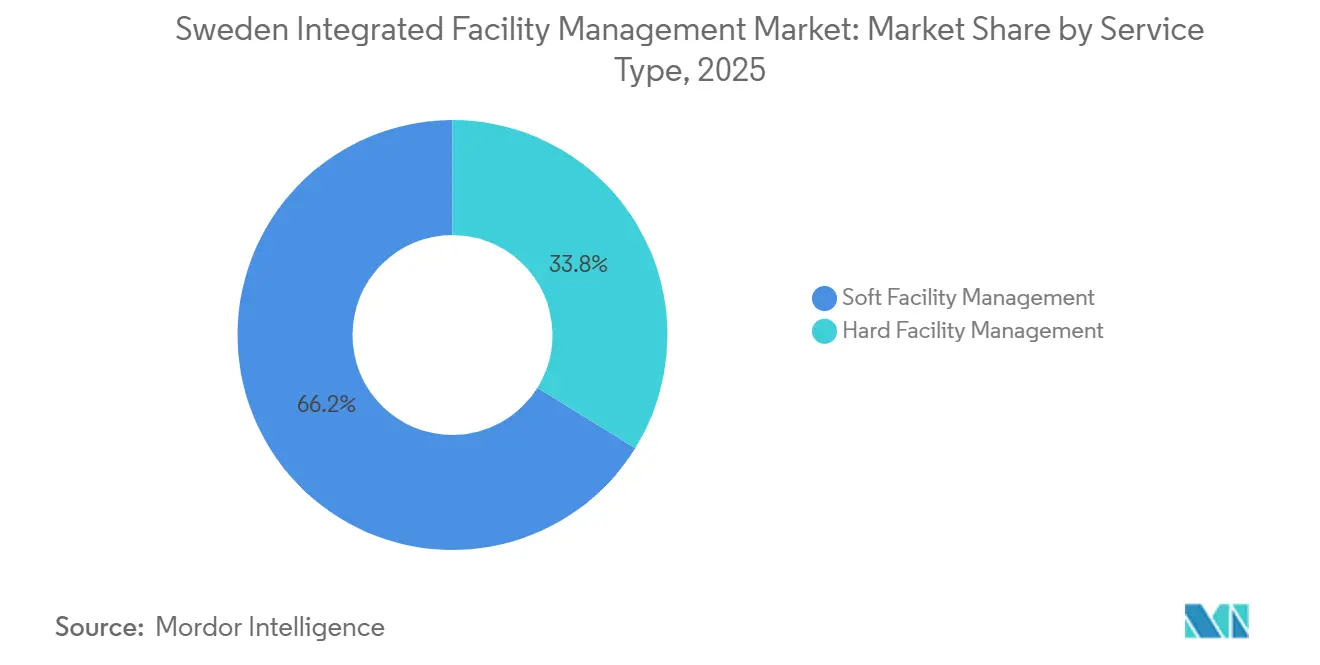
Soft Facility Management (Soft FM) held 66.17% of Sweden integrated facility management market share in 2025, making it the largest service group by revenue within the Sweden integrated facility management market. Cleaning remained the anchor of this segment because hygiene standards stayed high across offices, healthcare sites, schools, and public buildings after the pandemic period. Catering also kept a strong place inside large workplace contracts, and Coor’s network of 250 staff restaurants serving close to 14 million meals a year showed how deeply food service is embedded in major accounts. Office support and security continued to evolve toward a hybrid model that combines reception, mail handling, access control, and visitor management with digital workplace tools. Within the Sweden integrated facility management industry, this keeps soft FM large because many clients still see bundled front-of-house and support services as the simplest operating model across multisite portfolios.
Hard Facility Management (Hard FM) is projected to expand at a 3.8% CAGR, the fastest pace in the Sweden integrated facility management market size outlook through 2031. That growth reflects the combined effect of older building stock, tighter inspection needs, and a wider requirement for energy-linked maintenance across HVAC, MEP, and fire systems. KTH Royal Institute of Technology and Einar Mattsson launched the AIDA-B research project in February 2025 to use AI in maintenance planning for buildings from the 1960s and 1970s, which are common across Swedish residential and institutional stock. Fire systems and safety remain steady because they are tied to compliance, but MEP and HVAC are taking a larger share of technical budgets as owners focus more on energy declarations and system efficiency. In the Sweden integrated facility management industry, providers that can combine energy monitoring, automation support, and field maintenance are strengthening their position because technical scope is becoming more central to contract value. Coor’s SmartEnergy and SmartLighting offers show how hard FM is shifting from routine upkeep toward data-backed performance management.
By End User: Commercial Demand is Growing Faster While Industrial Remains The Largest Base
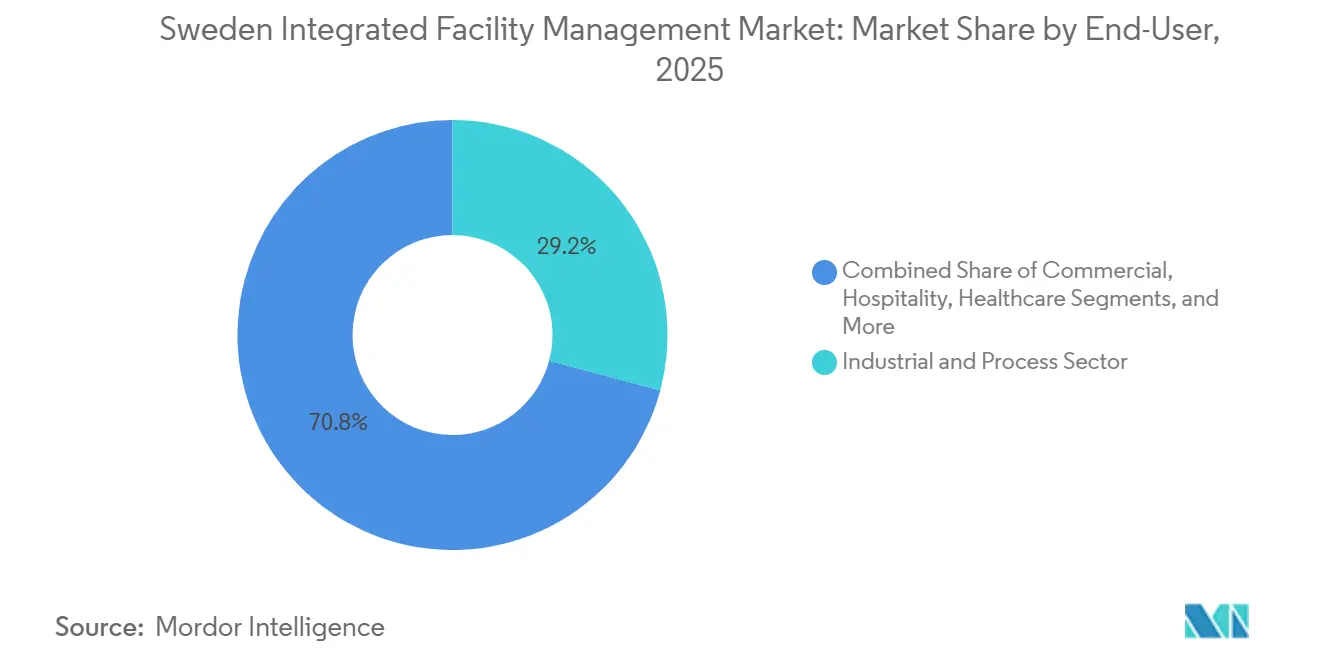
The industrial and process segment held 29.16% of Sweden integrated facility management market share in 2025, which kept it as the largest end-user base in the Sweden IFM market. This reflected Sweden’s strong manufacturing, energy, mining, and process asset base, where facility operations depend on technical maintenance, waste handling, fire safety, and process cleaning. Coor’s extended Volvo Cars agreement at SEK 400 million (USD 40.8 million), per year illustrates the scale of recurring FM spend that can sit inside a single industrial relationship. Industrial sites also tend to favor longer and deeper contracts because operating continuity matters more than short-term procurement savings. That gives the Sweden integrated facility management market a solid demand floor, even when office or retail conditions become less predictable.
The commercial segment is forecast to grow at a 4.01% CAGR, which makes it the fastest-growing part of the Sweden integrated facility management market size outlook through 2031. Offices, BFSI sites, telecom facilities, retail properties, and warehouses are shifting toward more experience-led and sustainability-led space strategies, which increases FM intensity even when total occupied area becomes tighter. Healthcare remains a major opportunity inside this broader demand picture, with ISS starting a 4-year cleaning contract at Karolinska University Hospital in January 2026 and Sodexo beginning its contract with Södersjukhuset in March 2025. Public and institutional demand also stays stable, as shown by Coor’s March 2026 contract covering 127 Helsingborg properties with total area of 350,000 m². Hospitality and multi-house residential are smaller, but outsourcing adoption is improving, which supports a wider client base for the Sweden integrated facility management (IFM) market across urban and secondary municipalities.

Geography Analysis
Stockholm, Gothenburg, and Malmö remained the core demand centers in the Sweden integrated facility management market in 2025 because they concentrate Sweden’s largest office, public, and mixed-use property clusters. Stockholm led commercial contract activity through its dense base of financial services, telecom, technology, and government occupiers. Sodexo launched its integrated workplace services at Vasakronan’s Garnisonen complex in Stockholm in January 2026, and the site serves close to 5,000 daily workers, which highlights the scale of workplace service demand in the capital. Gothenburg and Västra Götaland are supported more by industrial and logistics demand, with automotive operations and related supplier sites keeping technical FM volumes high. Malmö benefits from logistics growth and cross-border business activity around the Öresund corridor, which sustains both soft FM and technical service requirements.
Sweden’s GDP per capita stood at EUR 53,700 (USD 60,609), and that income level supports stronger service expectations and broader adoption of premium workplace and compliance-led FM models in major cities. The EPBD transposition process is raising compliance-related service needs across all urban markets, not only in prime office assets but also in municipal portfolios and older public buildings. This supports the Sweden integrated facility management market through more recurring inspection work, better documentation needs, and higher demand for HVAC and controls expertise. It also narrows the gap between metro and secondary-city demand because public building compliance is becoming a national issue rather than a Stockholm-only one.
Northern Sweden is becoming the most dynamic frontier for the Sweden integrated facility management market because renewable power, cool climate, and land availability are drawing large data center projects. EdgeConneX’s 1GW Skellefteå plan and atNorth’s 30MW Stockholm metro project add a specialized layer of future demand tied to power systems, cooling infrastructure, and secure site operations. At the same time, Trafikverket’s long-term infrastructure plan and the government’s approval of 12 major projects in April 2026 widen the pipeline for public-sector lifecycle management across transport and civic assets. Smaller municipalities such as Umeå, Luleå, Uppsala, and Örebro are therefore becoming more relevant in the Sweden integrated facility management market as outsourcing spreads beyond the largest metropolitan portfolios and older civic assets need more structured upkeep.
Competitive Landscape
The Sweden integrated facility management market has a two-layer competitive structure, with moderate concentration at the integrated contract level and much broader fragmentation underneath. Coor Service Management, ISS Facility Services, and Sodexo set the pace in large multi-service contracts because they combine scale, national coverage, contract management depth, and established public and private client relationships. Coor has the clearest IFM profile in the Sweden integrated facility management market, supported by its disclosed Nordic IFM opportunity and its use of smart service tools such as SmartEnergy, SmartDrone, and SmartLighting. ISS competes through digital workplace integration as well as service breadth, and its April 2026 partnership with Sign In Solutions showed how visitor management is being built more directly into service delivery and retention strategy. Sodexo remains strong where workplace experience, food service, and healthcare cleaning standards matter, which gives it a differentiated position in large urban and institutional contracts.
Below the top tier, the Sweden integrated facility management (IFM) market becomes much more fragmented across cleaning specialists, technical maintenance firms, property service operators, and catering providers. This structure creates a gap between large contract capability and local delivery depth, especially in smaller municipalities and specialized technical scopes. Bravida Sverige AB and CBRE GWS Integrated Facilities Management AB represent relevant capability sets in technical services and real estate-linked operations, but specialist depth still matters in many tenders where response time and local staffing are critical. That fragmentation also means pricing pressure can rise quickly when large IFM providers bundle multiple service lines and smaller firms compete on narrower cost bases.
Several strategic moves show how the Sweden IFM market is evolving. Coor’s renewal with Telia and its extensions with Volvo Cars and PostNord indicate that leading buyers are favoring longer relationships with performance-based structures and embedded innovation funds. ISS’s healthcare expansion in Sweden and its digital partnership model show a push to deepen positions in sectors where compliance and workplace data are becoming more important. Sodexo’s Garnisonen launch and its work in Swedish healthcare and regional transport show how workplace experience and sector specialization can still win share against larger broad-based rivals. The main white-space areas remain mid-market healthcare, sustainability-linked performance contracts, and data center FM, where the Sweden integrated facility management market still has room for providers that can combine technical skill, compliance systems, and measurable outcomes better than generalist operators.
Sweden Integrated Facility Management Industry Leaders
-
Coor Service Management Holding AB
-
ISS Facility Services AB
-
Sodexo AB
-
Compass Group Sverige AB
-
CBRE GWS Integrated Facilities Management AB
- *Disclaimer: Major Players sorted in no particular order
Recent Industry Developments
- April 2026: ISS won a service contract for Region Uppsala covering cleaning, service, and janitorial services for Uppsala University Hospital and other regional healthcare units, effective autumn 2026. The contract strengthens ISS's healthcare FM footprint in Sweden's Uppsala-Stockholm corridor, adding to its January 2026 commencement at Karolinska University Hospital.
- April 2026: ISS secured an integrated FM contract for SBAB's new headquarters on Drottninggatan, Stockholm, commencing spring 2026. Services include cleaning, reception, conference support, mail handling, waste management, and strategic FM management, establishing ISS as the integrated FM provider for a flagship Stockholm financial-sector office.
- March 2026: Coor signed a 4-year contract extension with Equinor for facility management services at Equinor's production sites, valued at approximately SEK 365 million (approximately USD 33 million) per year excluding variable volumes, effective November 1, 2026. The agreement covers approximately 550 on-site staff and reinforces Coor's position as a dominant provider in the energy-sector FM segment across the Nordics.
- March 2026: Coor won a new property management contract with Helsingborgs stad covering 127 public properties spanning approximately 350,000 m², including schools and care homes, valued at approximately SEK 10 million annually with an initial duration of 2 years and an option to extend to 8 years total. The contract deepens Coor's presence in the Skåne region and underlines the institutional sector's continued dependence on outsourced technical FM.
- February 2026: EdgeConneX announced plans to enter the Swedish market with a data center campus in Skellefteå targeting up to 1GW of capacity, projected to be one of Europe's largest primarily renewable-powered facilities. The investment underscores Sweden's position as a hyperscale infrastructure destination and signals a long-term pipeline of specialized FM demand in the region.
- January 2026: atNorth announced a 30MW metro data center (SWE02) in Stockholm, collaborating with Stockholm Exergi for heat reuse, with the site scheduled to go live in Q4 2027. The expansion adds to Sweden's growing data center FM demand and represents atNorth's eleventh Nordic facility.
Sweden Integrated Facility Management Market Report Scope
The Sweden Integrated Facility Management Market Report is Segmented by Service Type (Hard Facility Management [Asset Management, MEP and HVAC Services, Fire Systems and Safety, and Other Hard Facility Management Services], and Soft Facility Management [Office Support and Security, Cleaning Services, Catering Services, and Other Soft Facility Management Services]), End User (Commercial [includes BFSI, IT and Telecom, Retail and Warehouses, etc.], Hospitality [includes Eateries, Restaurants and Large-Scale Hotels], Institutional and Public Infrastructure [includes Government Establishments, Education, Transportation such as Airports and Railways, etc.], Healthcare [includes Public and Private Healthcare Facilities], Industrial and Process Sector [includes Manufacturing, Energy including Oil and Gas Exploration, Mining, etc.], and Other End-User Industries [includes Multi-House Residential, Entertainment, Sports and Leisure]). The Market Forecasts are Provided in Terms of Value (USD).
| Hard Facility Management | Asset Management |
| MEP and HVAC Services | |
| Fire Systems and Safety | |
| Other Hard Facility Management Services | |
| Soft Facility Management | Office Support and Security |
| Cleaning Services | |
| Catering Services | |
| Other Soft Facility Management Services |
| Commercial |
| Hospitality |
| Institutional and Public Infrastructure |
| Healthcare |
| Industrial and Process Sector |
| Other End-user Industries |
| By Service Type | Hard Facility Management | Asset Management |
| MEP and HVAC Services | ||
| Fire Systems and Safety | ||
| Other Hard Facility Management Services | ||
| Soft Facility Management | Office Support and Security | |
| Cleaning Services | ||
| Catering Services | ||
| Other Soft Facility Management Services | ||
| By End User | Commercial | |
| Hospitality | ||
| Institutional and Public Infrastructure | ||
| Healthcare | ||
| Industrial and Process Sector | ||
| Other End-user Industries | ||
Key Questions Answered in the Report
What is the current size of the Sweden integrated facility management market?
The Sweden integrated facility management market size stands at USD 1.28 billion in 2026 and is projected to reach USD 1.54 billion by 2031 at a 3.13% CAGR.
Which service category leads revenue in Sweden integrated facility management?
Soft FM led revenue with 66.17% share in 2025, supported by cleaning, catering, office support, and security services across commercial and institutional sites.
Which end-user group is growing fastest in Sweden?
The commercial segment is the fastest-growing end-user group, with a projected 4.01% CAGR through 2031 as office, BFSI, telecom, retail, and warehouse sites increase service intensity.
Why is hard FM growing faster than soft FM in Sweden?
Hard FM is growing faster because older buildings, tighter HVAC inspection rules, and stronger energy-efficiency requirements are increasing demand for technical maintenance, controls, and fire systems work.
How are data centers affecting facility management demand in Sweden?
Data center investments from Microsoft, Google Cloud, EdgeConneX, and atNorth are raising demand for 24/7 technical operations, cooling system maintenance, secure access management, and power infrastructure support.
What is the main operational risk for providers in Sweden?
The main operational risk is the shortage of skilled technical workers, which limits capacity in HVAC, electrical, and fire safety services even as hard FM demand continues to rise.