
Market Overview
| Study Period | 2020 - 2031 |
|---|---|
| Forecast Data Period | 2026 - 2031 |
| Base Year Market Size (2025) | USD 5.78 Billion |
| Market Size (2026) | USD 5.99 Billion |
| Market Size (2031) | USD 7.16 Billion |
| Growth Rate (2026 - 2031) | 3.64 % |
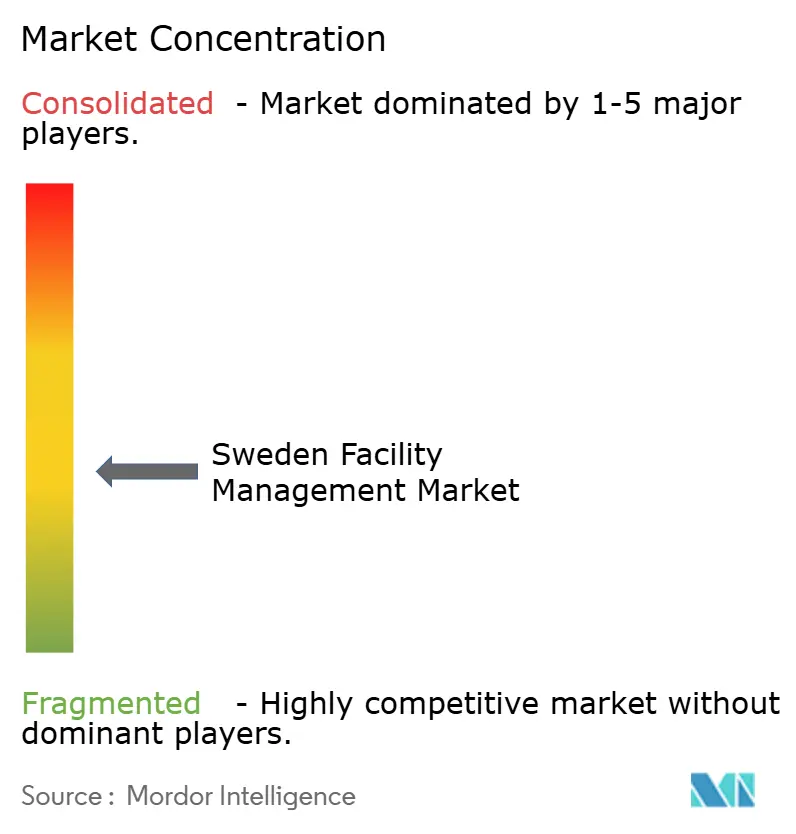
| Market Concentration | Medium |
Major Players *Disclaimer: Major Players sorted in no particular order Image © Mordor Intelligence. Reuse requires attribution under CC BY 4.0. | |
Sweden Facility Management Market Analysis by Mordor Intelligence
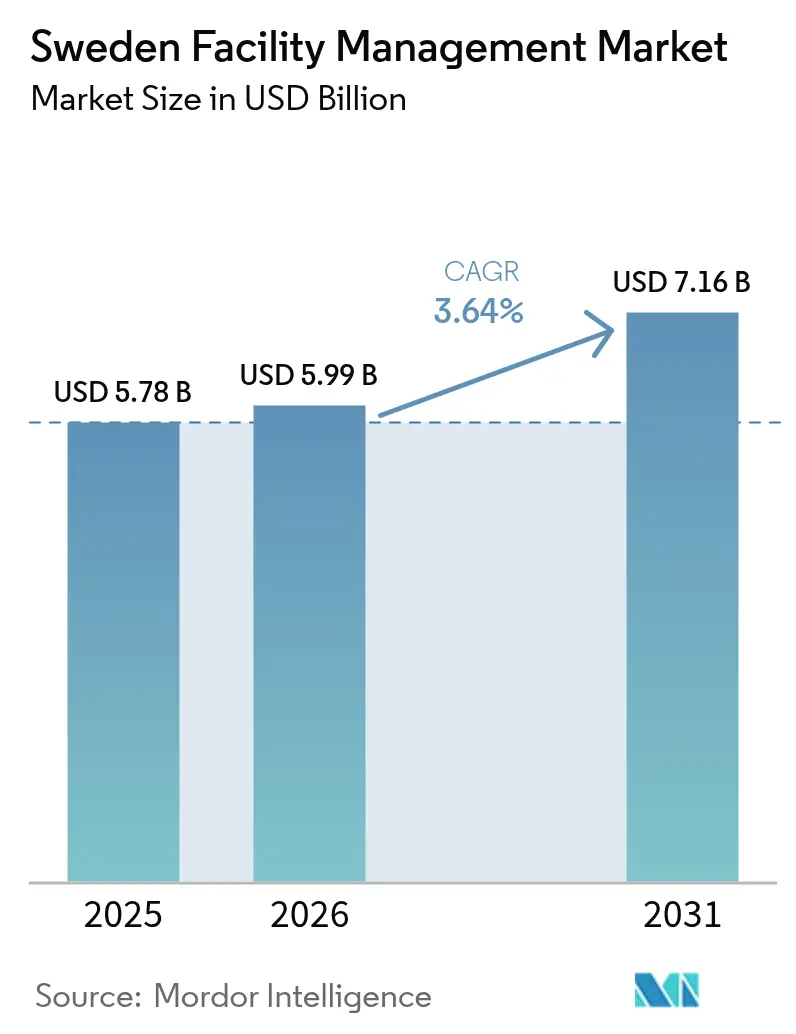
The Sweden facility management market size is expected to grow from USD 5.78 billion in 2025 to USD 5.99 billion in 2026 and is forecast to reach USD 7.16 billion by 2031 at 3.64% CAGR over 2026-2031. Market fundamentals hinge on the country’s strict energy-efficiency rules that require 14,000 commercial assets to stay below the 174 kWh/m²/year threshold, a move that continues to fuel hard-service demand. Workplace-wellness programs, digital twin adoption and Brookfield’s planned hyperscale data-center roll-out broaden the service opportunity set for providers with deep technology benches. Outsourcing momentum remains a central growth lever as organisations seek sharper focus on core activities, while sustainability mandates act as a catalytic driver for bundled energy and asset-performance contracts. Competition is vibrant, with ISS Facility Services, Coor Service Management and Securitas anchoring a field of regional specialists that leverage IoT, video support and AI for service differentiation.
Key Report Takeaways
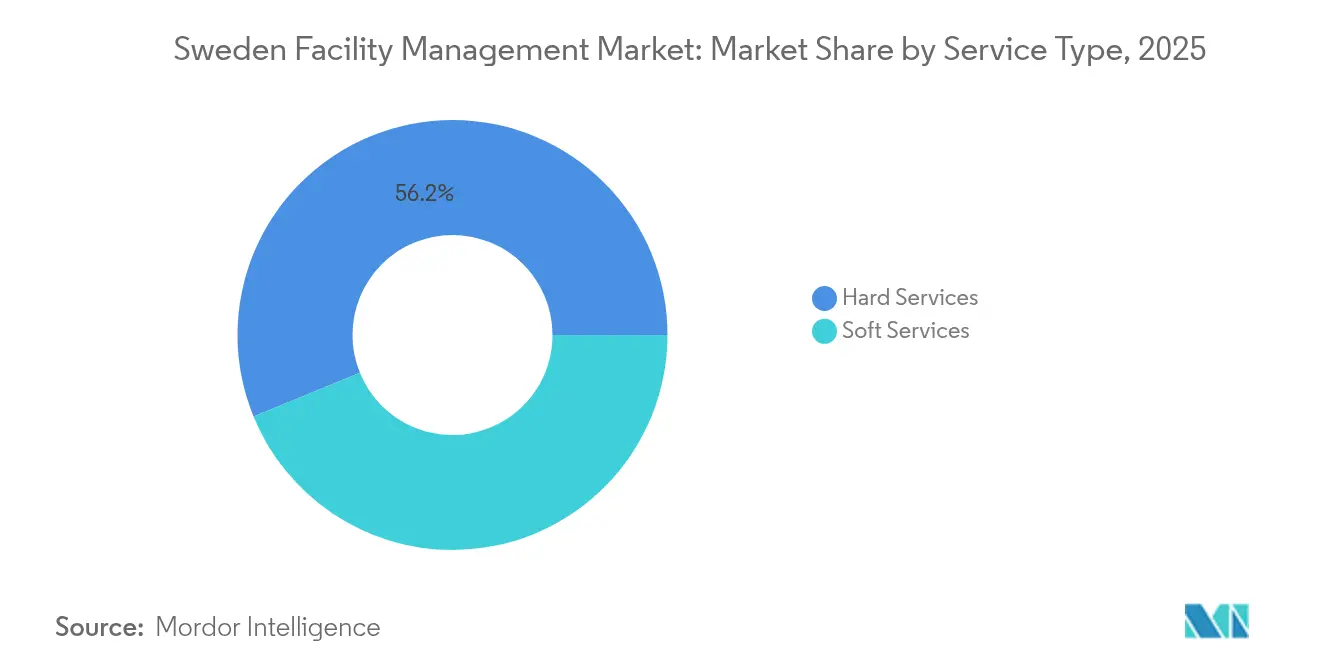
- By service type, hard services commanded 56.18% of Sweden facility management market share in 2025, whereas soft services are projected to advance at a 3.69% CAGR between 2026-2031.
- By offering, outsourced models captured 67.95% of Sweden facility management market size in 2025 and the integrated sub-segment is expected to expand at a 3.82% CAGR through 2031.
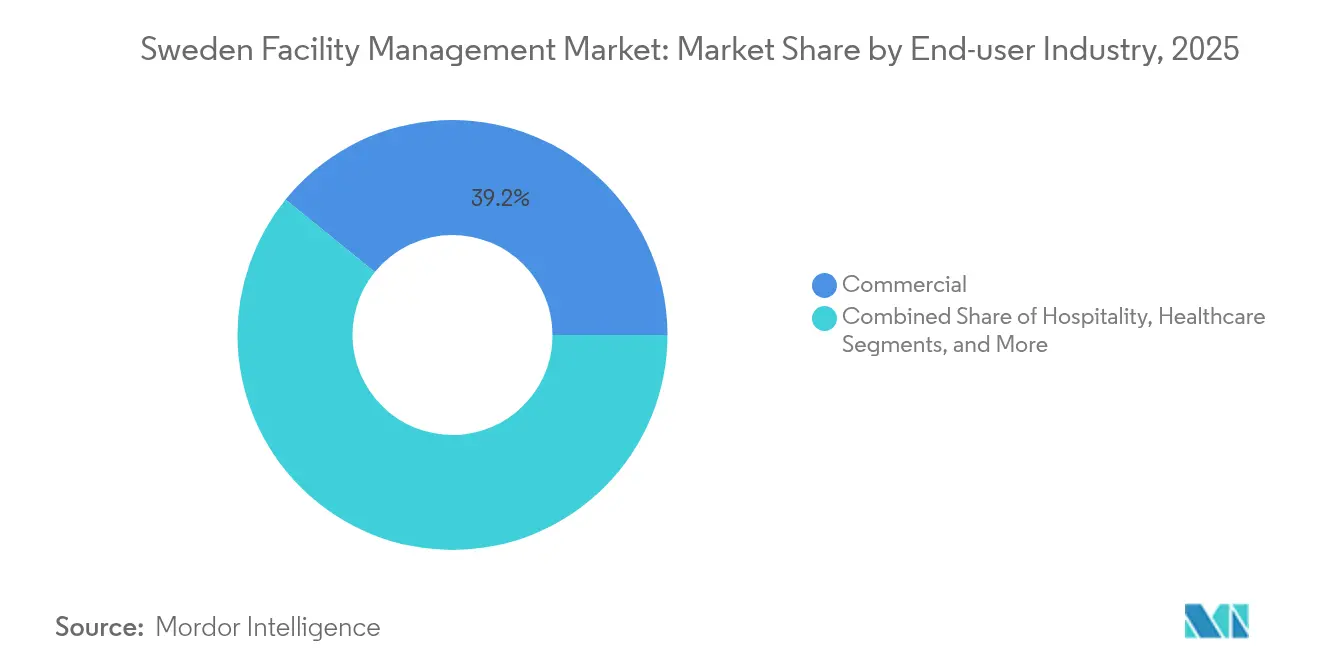
- By end-user, the commercial segment led with 39.15% revenue share in 2025; institutional and public infrastructure is set to grow the fastest at a 3.86% CAGR to 2031.
Note: Market size and forecast figures in this report are generated using Mordor Intelligence’s proprietary estimation framework, updated with the latest available data and insights as of 2026.
Market Trends and Insights
Drivers Impact Analysis of Sweden Facility Management Market*
| Driver | (~) % Impact on CAGR Forecast | Geographic Relevance | Impact Timeline |
|---|---|---|---|
| Increasing Outsourcing of Non-core Functions | +0.8% | National, with concentration in Stockholm, Gothenburg, Malmö | Medium term (2-4 years) |
| Rising Demand for Integrated Facility Management | +0.7% | National, particularly strong in commercial and institutional sectors | Long term (≥ 4 years) |
| Growing Focus on Workplace Experience and Wellness | +0.6% | National, with emphasis on urban centers and knowledge economy hubs | Medium term (2-4 years) |
| Technological Advancements in Building Management | +0.5% | National, with early adoption in major metropolitan areas | Long term (≥ 4 years) |
| Government-backed Energy-Efficiency Performance Contracts | +0.4% | National, with priority on public sector buildings | Short term (≤ 2 years) |
| Digital Twin-Enabled Lifecycle FM Solutions Adoption | +0.3% | National, concentrated in large-scale commercial and industrial facilities | Long term (≥ 4 years) |
| Source: Mordor Intelligence | |||
Increasing outsourcing of non-core functions
Swedish companies view facility services as strategic enablers rather than operating costs, illustrated by Coor’s SEK 155 million (USD 16.02 million) annual PostNord renewal that consolidates cleaning, maintenance and logistical support under one roof. [1] Deep regulation on energy use coupled with mounting ESG disclosures intensifies the need for providers that can guarantee compliance, economies of scale and continuous innovation. Long-term leases such as Atea’s 3,200 m² Stockholm commitment underscore the preference for specialist operators who leverage predictive analytics to maintain uptime and extend asset life. The outsourcing narrative now extends well beyond cost optimisation, integrating risk transfer and data-driven performance outcomes to secure multi-year relationships.
Rising demand for integrated facility management
Clients increasingly fold hard and soft scopes into single contracts to simplify supplier governance and unlock unified data streams. Coor’s multi-service bundles—covering property, catering, cleaning and workplace experience exemplify the depth of value unlocked when one operator commands cross-functional insights. Hospitals provide a clear showcase: Karolinska University Hospital uses automated guided vehicles to handle 1,600 daily deliveries, integrating logistics, waste and sterile-goods flows under one digital command platform. [2] Integrated models empower continuous energy-performance tracking, immediate issue resolution and consolidated KPI dashboards that align with Sweden’s carbon-cut objective of net-zero by 2045.
Growing focus on workplace experience and wellness
Hybrid working makes the physical office a deliberate destination, shifting evaluation criteria from square-metre efficiency to human-centred value. Only 60% of Swedish employees take advantage of existing wellness benefits, prompting facility managers to embed biophilic design, circadian lighting and on-site fitness to foster behaviour change. [3] Sweden also records Europe’s highest share of five-day in-office mandates, amplifying the need for experiential upgrades that raise talent retention thresholds. Air-quality monitoring, sit-stand desks and rapid service response times have become competitive differentiators, raising the bar for soft-service innovation.
Technological advancements in building management
AI, IoT and robotics move from pilot projects to revenue-scale deployments. Volvo Group’s AI-guided transporters reduce human-robot collision risk while maximising internal-logistics throughput at manufacturing plants. Husqvarna’s generative-AI facility companion slashes machine-fault diagnosis times by 60%, directly lowering downtime costs. Digital twins enable condition-based maintenance, decreasing system-failure incidents by up to 70% and curbing maintenance outlays by 30%. Such gains deliver measurable ROI that continues to pull FM budgets from reactive interventions to predictive service contracts.
Restraints Impact Analysis of Sweden Facility Management Market*
| Restraint | (~) % Impact on CAGR Forecast | Geographic Relevance | Impact Timeline |
|---|---|---|---|
| Economic Fluctuations and Cost Pressures | -0.9% | National, with particular impact on cost-sensitive sectors | Short term (≤ 2 years) |
| Workforce Challenges and Skill Gaps | -0.7% | National, with acute shortages in technical specialties | Medium term (2-4 years) |
| Escalating Cybersecurity Compliance Costs for Cloud-Based FM | -0.4% | National, concentrated in digitally advanced facilities | Medium term (2-4 years) |
| Contract Fragmentation from Municipal Procurement Decentralization | -0.3% | Regional and municipal levels, varying by administrative structure | Long term (≥ 4 years) |
| Source: Mordor Intelligence | |||
Economic fluctuations and cost pressures
Inflation and rising energy tariffs are forcing providers to trim overhead while preserving service-level agreements. Coor’s SEK 120 million (USD 12.40 million) cost-containment programme illustrates the magnitude of margin pressure borne even by market leaders. Real-estate landlords pass higher utility and financing costs to occupiers, who respond by delaying non-essential refurbishments, directly stunting discretionary FM spend. Providers must therefore map variable-cost structures, emphasise continuous efficiency and demonstrate direct opex savings to retain contracts during procurement cycles.
Workforce challenges and skill gaps
Digital controls, smart meters and cyber-hardened building systems demand technicians with convergent IT-mechanical skillsets. Yet Sweden’s aging labour pool and acute competition from high-profile tech sectors create a recruitment shortfall that elevates wage bills and churn risk. Decision makers in municipal elder-care facilities report that welfare-technology adoption lags due to limited staff training capacity. Providers invest heavily in apprenticeship schemes, AR-supported troubleshooting and cross-skilling programmes to safeguard service quality despite labour scarcity.
*Our forecasts treat driver/restraint impacts as directional, not additive. The impact forecasts reflect baseline growth, mix effects, and variable interactions.
Sweden Facility Management Market Segment Analysis
By Service Type:
Hard-service dominance amid soft-service velocityHard services captured 56.18% revenue in 2025, propelled by mandatory retrofits and Sweden facility management market share gains from MEP, HVAC and fire-safety upgrades demanded by the new 174 kWh/m²/year ceiling. In value terms, hard services contributed USD 3.25 billion to Sweden facility management market size in 2025. Demand intensifies as asset owners fast-track energy-efficiency performance contracts, securing predictable returns through guarantee-backed savings.
Soft services, though smaller, are slated for a 3.69% CAGR to 2031, outpacing hard services as employers recalibrate offices for wellness, flexible occupancy and heightened hygiene expectations post-pandemic. Catering pivots to low-carbon menus, while cleaning adopts enzymatic, low-chemical processes that align with Swedish Green Building Council requirements. Security services integrate video analytics and mobile access management, underscoring a gradual shift toward outcome-based performance metrics.

By Offering Type:
Outsourced and integrated surgeOutsourced solutions represented 67.95% of 2025 revenue or USD 3.93 billion of Sweden facility management market size, reflecting corporate preference for risk transfer and single-supplier accountability. Integrated facility management leads growth with a 3.82% CAGR, leveraging unified BMS dashboards and comprehensive SLA frameworks to deliver continuous improvement loops.
Single-service outsourcing remains relevant for niche functions such as vertical transport maintenance, yet bundling triggers measurable synergies in energy analytics and vendor coordination. In-house models persist in mission-critical public-safety facilities where security clearance drives make-or-buy decisions, but overall share inches downward as cost transparency and performance benchmarking mature.
By End-user Industry:
Commercial reigns, institutional acceleratesCommercial premises spanning IT parks, retail flagship stores and omni-channel warehouses formed 39.15% of 2025 revenue. High-spec data centres financed by Brookfield and local operators heighten demand for resilient, AI-enabled FM contracts that guarantee 99.999% uptime.
Institutional and public infrastructure, benefitting from Sweden’s SEK 799 billion (USD 82.60 billion) national infrastructure plan, is on track for the fastest 3.86% CAGR as municipalities deploy smart-city street-lighting, energy-positive schools and hospital automation. Healthcare modernisation, highlighted by Karolinska University Hospital’s 1,600 daily AGV deliveries, spotlights the need for cross-disciplinary FM teams versed in clinical logistics and biomedical compliance. Industrial sites integrate IoT sensors to link production targets with facility uptime, while hospitality operators like Scandic pursue zero-waste certifications that pivot FM focus to circular resource flows.
Geography Analysis
Stockholm, Gothenburg and Malmö anchor over two-thirds of total market value thanks to dense commercial activity and the highest concentration of class-A real estate. Stockholm alone houses an expanding cluster of hyperscale data-centre projects that underpin critical-infrastructure FM contracts with stringent redundancy KPIs. Regional manufacturing hubs such as Västra Götaland rely on specialised technical FM to protect precision equipment from thermal drift and air-particle contamination.
Northern municipalities see heightened demand for remote-monitoring solutions as harsh climates shorten maintenance windows; IoT-enabled sensors transmit performance data to central control rooms, overcoming geographic isolation. University cities Uppsala and Umeå invest heavily in energy-renovation projects, pushing FM providers to guarantee stepwise kWh reductions aligned with Akademiska Hus’ 50% energy-delivery cutback target versus 2000 levels. Decentralised procurement means providers must adapt bids to varied contract volumes and service-quality benchmarks, but local governance also offers footholds for agile regional players.
Regulatory Landscape
Sweden's facility management demand is closely tied to building-energy and automation compliance. Non-residential asset owners are pushed toward building automation and control systems (BACS) when technical-system capacity crosses mandated thresholds, including the 290 kW trigger effective from January 1, 2025. Enforcement and guidance across building works and property automation are supported by national bodies such as Boverket, while energy-performance monitoring requirements reinforce the market's emphasis on hard services and interoperable building controls.
Workplace and digital compliance also shape service delivery. Arbetsmiljoverket reorganized its work-environment rule structure on January 1, 2025, consolidating provisions into fewer, clearer rule sets that affect cleaning, safety, and technical maintenance routines at client sites. Sweden also implemented supplementary provisions for the EU Digital Services Act through Lag (2024:954), and the Swedish Post and Telecom Authority (PTS) provides sector infrastructure oversight relevant to IoT-enabled FM deployments. Statens Fastighetsverk updated its building-automation design requirements on January 12, 2026, specifying integration expectations (including SCADA and alarm handling) across parts of the state property portfolio, which raises the bar for technical documentation, commissioning, and lifecycle support.
Value Chain Analysis
The Sweden facility management value chain begins with upstream OEMs and specialist suppliers for HVAC/MEP, fire and safety systems, meters/sensors, building management systems (BMS), SCADA, and connectivity layers used for remote monitoring and optimization. System integrators and automation specialists connect legacy building controls with cloud and edge platforms. FM providers (single service, bundled, and integrated) then deliver on-site execution, service desk support, and performance reporting, often through ABFF/Aff-based procurement frameworks managed by Aff-Forum that standardize scopes, SLAs, and handover requirements.
Downstream, property owners and public bodies, including portfolios influenced by Statens Fastighetsverk requirements updated in January 2026, increasingly specify interoperable automation, alarm handling, and data integration. This cascades into demand for commissioning, cybersecurity-aware operations, and analytics-driven maintenance. Technology enablers such as AI cleaning optimization platforms (for example, Optiqo) and energy control stacks combining AI with established BMS ecosystems (such as Schneider Electric EcoStruxure Building Operation in documented school-building use cases) sit alongside trade associations like Almega Serviceforetagen, which reinforce labor and environmental compliance through authorization programs. Together, these mechanisms shape supplier qualification and subcontractor governance across the chain.
Competitive Landscape
ISS leverages global purchasing power and a USD 12.1 billion 2024 revenue base to standardise processes, winning a five-year Barclays global extension that includes Swedish operations. Coor focuses on Nordic specialisation, expanding its portfolio through the SEK 155 million (USD 16.02 million) PostNord renewal and continuous facility-digitalisation initiatives that provide real-time SLA dashboards. Securitas, now offering converged guarding, remote video and IoT sensors, broadens client reliance on bundled security-FM accords.
Technology disruption breeds new entrants. Vallmo’s video-enabled remote-support model reduces on-site technician call-outs, while Kiona’s AI-driven energy-optimisation platform integrates legacy BMS equipment into a cloud edge that delivers double-digit energy savings. Consolidation remains measured, yet multi-service providers continue to snap up niche technical firms to gain advanced analytics, HVAC optimisation or green-cleaning IP.
Regulation-driven services such as EU Taxonomy reporting create added moat for incumbents with compliance credentials. Nevertheless, low switching costs in soft services keep pricing discipline tight, necessitating relentless innovation and contract-performance transparency to defend margins.
Sweden Facility Management Industry Leaders
-
Krohne Messtechnik GmbH
-
Kurita Water Industries Ltd
-
Durr Systems Inc.
-
Light House World Wide Solutions
-
Itasca Internationl Inc.
- *Disclaimer: Major Players sorted in no particular order
Sweden Facility Management Market Companies Covered in this Report
- Krohne Messtechnik GmbH
- Kurita Water Industries Ltd
- Durr Systems Inc.
- Light House World Wide Solutions
- Itasca Internationl Inc.
- Sierra Instruments Inc.
- Bentley Systems Incorporated
- Veolia Water Technologies
- Lassila & Tikanoja
- Coor Service Management
- Newsec Property Asset Management
- Nordic Facility Management
- Addici Group
- Servicekuben
- ISS Facility Services AB
Market Opportunities and Future Outlook
One opportunity area is portfolio-scale IoT and BMS modernization that connects building data to actionable FM workflows, supported by real deployments in Sweden's commercial real estate. In February 2026, Vasakronan and Hufvudstaden completed migration to KTC's BMS platform across LoRaWAN-connected properties, indicating that large landlords are standardizing connectivity and control layers that FM providers can use for energy analytics, fault detection, and faster response across multiple sites. This also creates whitespace for providers that can package controls integration, cybersecurity-aligned operations, and measurable energy outcomes into integrated contracts, particularly for large non-residential buildings subject to mandatory automation requirements.
A second opportunity is operationalizing AI and digital twins within day-to-day FM delivery rather than treating them as stand-alone pilots. In June 2026, Coor deployed AI agents to automate elements of service-ticket handling and administrative or billing workflows. In the same month, Alfa Laval Sweden agreed with Pythagoras to implement a property management system with digital-twin and technical oversight capabilities, starting with the Flemingsberg construction project. Taken together, these moves point to demand for providers that combine domain technicians with data engineering and systems integration to reduce manual workload, improve uptime tracking, and support ESG and energy-performance reporting across commercial, institutional, and industrial facilities.
Recent Industry Developments in Sweden Facility Management Market
- June 2026: Coor deployed AI agents into operational workflows to automate parts of service-ticket handling and administrative or billing processes. The change indicates a shift in Swedish FM toward more automated back-office and service-desk execution, tightening response loops and reducing manual processing load in integrated contracts.
- February 2026: Vasakronan and Hufvudstaden completed a migration to KTC's building management system platform across their LoRaWAN-connected properties. Standardizing the BMS and connectivity layer across portfolios supports data-driven FM services such as continuous monitoring, fault detection, and energy optimization delivered at scale.
- April 2025: Kurita Europe introduced a service-based model for industrial water reclamation where it designs, installs, operates, and maintains water systems for customers under an OPEX-style arrangement. This broadens outcome-based service contracting for industrial sites and supports longer-duration FM-adjacent agreements tied to performance and reliability rather than one-time equipment delivery.
Sweden Facility Management Market Report Scope and Research Methodology
Market Definition and Coverage
For this study, the market covers the value of facility management services delivered for buildings and sites in Sweden, including day-to-day operations that keep assets safe, compliant, clean, and functioning as expected across end-user sectors.
Scope exclusions: This sizing excludes construction and major refurbishment project work, as these are treated as separate capital works rather than recurring facility operations.
Segments Covered in This Report
- By Service Type
- Hard Services
- Asset Management
- MEP and HVAC Services
- Fire Systems and Safety
- Other Hard FM Services
- Soft Services
- Office Support and Security
- Cleaning Services
- Catering Services
- Other Soft FM Services
- Hard Services
- By Offering Type
- In-house
- Outsourced
- Single FM
- Bundled FM
- Integrated FM
- By End-user Industry
- Commercial (IT and Telecom, Retail and Warehouses, etc.)
- Hospitality (Hotels, Eateries, Large-scale Restaurants)
- Institutional and Public Infrastructure (Govt, Education, Transportation)
- Healthcare (Public and Private Facilities)
- Industrial and Process (Manufacturing, Energy, Mining)
- Other End-user Industries (Multi-housing, Entertainment, Sports and Leisure)
Data Sources, Market Sizing, and Validation
Desk Research
Desk research was used to set the market boundaries and build an initial view of demand signals for facility management in Sweden. We relied on public datasets that are consistently updated and that can be linked to building operations spend, such as Statistics Sweden (SCB), Eurostat, the Swedish Energy Agency, the Swedish Work Environment Authority, and building regulation guidance from the National Board of Housing, Building and Planning (Boverket). Where trade and equipment flows helped explain service intensity for certain assets, we also reviewed Swedish Customs trade statistics as a supporting input.
To complement public data, we reviewed company annual reports, investor presentations, procurement notices, and reputable press coverage to understand service packaging and how outsourcing is typically contracted. Select paid subscriptions were used for company financials and intelligence, news and financials, and public tenders and contracts, mainly to cross-check revenue direction and contract momentum rather than replace public inputs. These desk sources are illustrative and not exhaustive, and we used many other references to collect data, validate figures, and clarify unclear points.
Primary Interviews and Surveys
Primary work was used to pressure-test the desk model and fill gaps where public data is not granular enough, especially on outsourcing share, typical service bundling, and pricing trends. We spoke with facility service providers, in-house FM leaders, procurement teams, and sector specialists across Sweden so assumptions on service scope, staffing intensity, and renewals could be confirmed and adjusted.
Distribution of primary research fieldwork respondents
| Company type | Respondent position |
|---|---|
| Top tier: 31% | CXOs: 12% |
| Mid tier: 47% | Functional/Unit leaders: 28% |
| Smaller Players: 22% | Managers: 60% |
Market-Sizing & Forecasting
The core sizing approach starts with a top-down build using national building activity signals, employment exposure in service-intensive sectors, and outsourcing penetration to reconstruct the addressable spend pool for facility management in Sweden, then allocating it across the major service categories. To keep totals realistic, we corroborated results with selective bottom-up approximations, such as sampled contract values, supplier revenue sanity checks, and volume times average pricing for common service bundles, then adjusted for gaps where coverage is thinner.
Key model inputs include the active floor area mix across facility types, energy-efficiency compliance activity that drives hard-services work, labor cost movement for cleaning and technical roles, outsourcing ratio changes by end-user type, and typical contract length and indexation clauses that affect price progression. For forecasting, scenario analysis was used so a base case could be shaped around agreed macro indicators and sector demand, then checked with primary inputs on how quickly pricing, staffing, and outsourcing are expected to move. When a bottom-up signal was missing for a niche end-user group, we used proxy ratios from similar Swedish sectors and re-tested them using interview feedback.
Data Validation & Update Cycle
Model outputs were triangulated against independent signals such as public employment trends, building and energy policy direction, and observed contract behavior, then reviewed for unusual jumps that do not fit known market patterns. If a variance looked material, we re-checked definitions, re-ran the calculations, and re-contacted relevant respondents to confirm whether a one-off event or a structural shift was being captured.
Before sign-off, the work passes through multi-step analyst review so assumptions, formulas, and conversions stay consistent across sections. Reports are refreshed annually, and interim updates are made when a material event changes demand, pricing, or scope relevance. Before delivery, we perform a final pass so clients receive the latest updated view while keeping the same market boundaries intact.
Mordor Intelligence's Sweden Facility Management Market Size Versus Other Published Estimates
Published market values for facility management in Sweden often vary because each publisher draws the line differently on what counts as facility services, and because pricing and outsourcing assumptions can be set more aggressively or more conservatively. Differences also show up when estimates use different base years, currency timing, or when they rely on limited validation checks.
The table points to a spread that is mostly explained by service scope and by how in-house activity is treated in the value pool. It shows USD 5.78 B (2025) under Mordor Intelligence's scope because it counts both outsourced and in-house facility management across hard and soft services, while leaving out construction and major refurbishment project work.
Benchmark comparison
| Source | Market Size | Gaps in Research Methodology |
|---|---|---|
| Mordor Intelligence | USD 5.78 B (2025) | |
| Industry Association A | USD 4.90 B (2025) | Often reflects outsourced contracts only, with limited visibility into in-house delivery, and may omit smaller bundled agreements that sit inside broader service contracts. |
| Regional Consultancy B | USD 6.60 B (2025) | Tends to expand scope to adjacent building support spend (such as minor project work and fit outs) and can apply stronger price escalation assumptions without consistent cross-checks to wage and contract structures. |
Taken together, the differences mainly come down to what is counted as facility management versus adjacent building spend, plus how outsourcing share and price escalation are set. By tying the model to practical demand signals like building activity, labor costs, and contract behavior, the resulting value stays traceable to steps that can be reviewed and updated over time.
Key Questions Answered in the Report
What is the current value of the Sweden facility management market?
The market is valued at USD 5.99 billion in 2026 and is projected to expand to USD 7.16 billion by 2031, reflecting a 3.64% CAGR.
Which service type generates the most revenue?
Hard services dominate with 56.18% share in 2025 owing to mandatory energy-retrofit and safety-system upgrades.
Why is outsourcing growing so quickly?
Swedish organisations prefer outsourcing to focus on core competence, meet strict energy-efficiency rules and tap provider know-how, pushing outsourced models to 67.95% share in 2025.
Which segment is forecast to grow the fastest?
Institutional and public-infrastructure facilities are poised for a 3.86% CAGR through 2031 on the back of government smart-city and healthcare modernisation spend.
How is technology reshaping facility management in Sweden?
Providers deploy AI, digital twins and robotics for predictive maintenance, energy optimisation and automated logistics, cutting downtime and costs while meeting ESG targets.
Who are the leading companies in the Sweden facility management industry?
ISS Facility Services, Coor Service Management and Securitas headline the competitive landscape, together holding roughly one-fifth of national market revenue.