
Sustainable IT Procurement Software Market Size and Share
Market Overview
| Study Period | 2020 - 2031 |
|---|---|
| Market Size (2026) | USD 1.22 Billion |
| Market Size (2031) | USD 2.84 Billion |
| Growth Rate (2026 - 2031) | 18.41 % |
| Fastest Growing Market | Europe |
| Largest Market | Asia-Pacific |
| Market Concentration | Medium |
Major Players *Disclaimer: Major Players sorted in no particular order Image © Mordor Intelligence. Reuse requires attribution under CC BY 4.0. | |
Sustainable IT Procurement Software Market Analysis by Mordor Intelligence
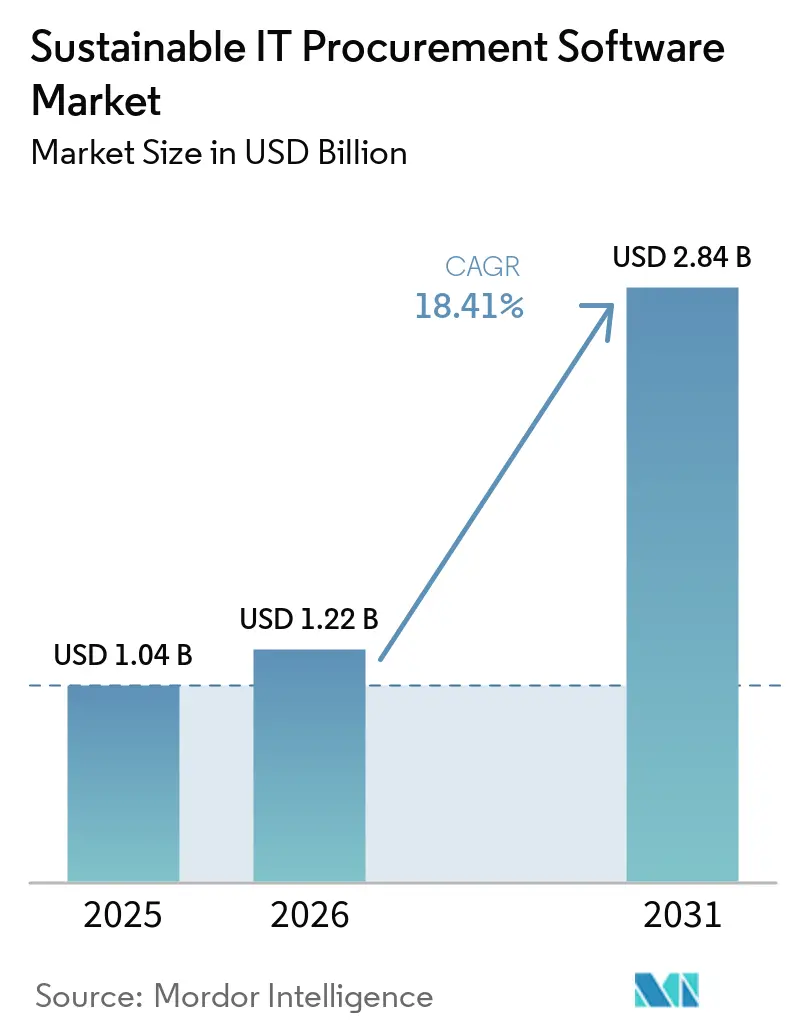
The Sustainable IT Procurement Software Market size was valued at USD 1.04 billion in 2025 and estimated to grow from USD 1.22 billion in 2026 to reach USD 2.84 billion by 2031, at a CAGR of 18.41% during the forecast period (2026-2031). Growth is being shaped by a clear shift from voluntary sustainability programs to formal supplier data obligations, especially as procurement teams now need auditable Scope 3 information across complex IT supply chains. Standard procurement systems that were designed around price, delivery, and contract control are being replaced or extended because they cannot maintain continuous supplier sustainability records at the level now expected by enterprise buyers. Demand is also supported by the need to capture supplier data across multiple tiers, connect it to source-to-pay workflows, and produce reporting that can withstand audit review. Competition is increasingly centered on pre-built integrations, embedded analytics, and supplier network depth, because buyers now want sustainability scoring to sit within live procurement decisions rather than beside them. The Sustainable IT Procurement Software Market is also opening new room for growth in circular procurement, cloud emissions tracking, and mid-market supplier enablement as enterprises widen sustainability requirements across their IT spending base.
Key Report Takeaways
- By component, software held 68.74% share of the Sustainable IT Procurement Software Market in 2025, while services are projected to expand at 18.65% CAGR through 2031.
- By deployment, cloud held 65.12% of the Sustainable IT Procurement Software Market share in 2025, while hybrid is projected to expand at 18.52% CAGR through 2031.
- By enterprise size, large enterprises accounted for 63.45% of the market share in 2025, while small and medium enterprises are expected to grow at a 18.48% CAGR through 2031.
- By application, Supplier ESG Assessment and Scoring accounted for 27.41% share in 2025, while Circular Procurement and Asset Reuse Planning is projected to expand at 18.92% CAGR through 2031.
- By IT procurement category, Servers and Data Center Equipment held 28.63% share in 2025, while Cloud and Digital Services are projected to grow at 19.05% CAGR through 2031.
- By geography, Europe held 34.56% share in 2025, while Asia-Pacific is projected to expand at 19.12% CAGR through 2031.
Note: Market size and forecast figures in this report are generated using Mordor Intelligence’s proprietary estimation framework, updated with the latest available data and insights as of January 2026.
Market Trends and Insights
Drivers Impact Analysis of Sustainable IT Procurement Software Market*
| Driver | (~) % Impact on CAGR Forecast | Geographic Relevance | Impact Timeline |
|---|---|---|---|
| Regulatory Pressure on Scope 3 Data Traceability in IT Procurement | +4.2% | EU, UK, Australia, South Korea, with expansion into North America and Japan | Short term (≤ 2 years) |
| Rising Enterprise Demand for Auditable Supplier ESG Data | +3.5% | Global, strongest in North America and Europe | Short term (≤ 2 years) |
| Shift From Manual Procurement Workflows to Embedded Sustainability Scoring | +2.9% | Global | Medium term (2-4 years) |
| Procurement-Led Cost Avoidance Through Energy and Carbon Attribute Filtering | +2.2% | North America and Europe, with early gains in Japan and South Korea | Medium term (2-4 years) |
| Supplier Digitalization Enabling Automated Sustainability Questionnaires | +1.8% | Asia-Pacific core, with spillover into Middle East and Africa | Medium term (2-4 years) |
| ESG-Linked Sourcing in Hardware Refresh and Device Lifecycle Programs | +1.4% | Europe and North America | Long term (≥ 4 years) |
| Source: Mordor Intelligence | |||
Regulatory Pressure on Scope 3 Data Traceability in IT Procurement
The Sustainable IT Procurement Software Market is being pushed forward by disclosure rules that now require clearer separation between supplier-measured primary data and modeled estimates in Scope 3 reporting, which manual procurement processes cannot handle across layered IT supply chains. The March 2026 Phase 1 progress update from the GHG Protocol also introduced a 95% reporting boundary requirement, reducing the room for de minimis exclusions and increasing the need for direct supplier data collection. The World Business Council for Sustainable Development strengthened this shift when it published the PACT Methodology v3.0 in April 2025, providing trading partners with a clearer framework for exchanging product carbon footprint data across systems. Even after the April 2025 CSRD simplification package narrowed the number of companies in mandatory scope, the value-chain effect continued because large buyers still needed structured ESG data from approved IT suppliers. This combination of regulatory rules, data standards, and supplier reporting pressure is keeping the Sustainable IT Procurement Software Market firmly tied to compliance-led enterprise spending.
Rising Enterprise Demand for Auditable Supplier ESG Data
The Sustainable IT Procurement Software Market is also gaining support from buyers that no longer accept supplier sustainability claims without supporting evidence tied to audits, filings, and outside validation.[1] EcoVadis reported in May 2026 that more than USD 2.5 trillion in global spend was governed through sustainability risk insights on its network, demonstrating both how deeply adoption has become and how much supplier coverage is still missing outside the most connected vendor groups. Enterprises now want platforms that can validate questionnaire responses against audit records and live risk indicators, which moves supplier scoring from a periodic survey exercise into a more permanent procurement control layer. The June 2025 extension of the EcoVadis and Ivalua partnership reflected that need by bringing predictive ESG risk analytics into Ivalua’s Risk Center before sourcing teams launch supplier engagement. As a result, the Sustainable IT Procurement Software Market is moving beyond supplier onboarding and deeper into category planning, risk screening, and supplier development programs.
Shift From Manual Procurement Workflows to Embedded Sustainability Scoring
A major operational shift in the Sustainable IT Procurement Software Market is the move from stand-alone sustainability reporting tools to procurement systems that embed ESG criteria into transactions, sourcing, and contracting steps.[2] SAP stated in May 2026 that its new sustainability AI agents would be generally available by the end of 2026, with expected reductions of more than 50% in manual compliance review hours and more than 20% in packaging compliance assessment errors. Ivalua added to this direction in April 2026, introducing IVA Studio, a no-code environment that lets enterprises build procurement agents across source-to-pay workflows, including sustainability-related steps. SAP also highlighted roadmap progress for Sustainability Control Tower in 2026, showing how cloud-based sustainability analytics can work with on-premise transaction environments in large enterprise settings. That architecture matters because the Sustainable IT Procurement Software Market is increasingly rewarding vendors that can place sustainability scores inside live buying decisions rather than in a separate reporting module.
Procurement-Led Cost Avoidance Through Energy and Carbon Attribute Filtering
The Sustainable IT Procurement Software Market is also benefiting from a cost case that is easier for procurement and finance teams to support, especially when energy use over a system’s operating life can exceed the initial hardware purchase cost.[3] UNEP’s United for Efficiency initiative published sustainable procurement guidelines for data centers and servers in February 2025, formalizing Power Usage Effectiveness, Water Usage Effectiveness, and SERT scores as tender evaluation criteria. That framework allows category managers to connect sustainability filters to lifecycle cost analysis, making software spending easier to justify as a cost-control tool rather than solely a compliance expense. The October 2025 update to the AWS Customer Carbon Footprint Tool added Scope 3 emissions data, strengthening the case for comparing cloud options based on emissions and energy attributes during sourcing. This is widening the appeal of the Sustainable IT Procurement Software Market in regions where disclosure rules are still less developed, as procurement teams can still use sustainability filters to avoid long-term operating costs.
Restraints Impact Analysis of Sustainable IT Procurement Software Market*
| Restraint | (~) % Impact on CAGR Forecast | Geographic Relevance | Impact Timeline |
|---|---|---|---|
| Fragmented Supplier Emissions Data Across Tier 2 and Tier 3 Networks | -2.8% | Global, most acute in Asia-Pacific and South America | Long term (≥ 4 years) |
| Limited Interoperability With Legacy ERP and E-Procurement Stacks | -2.3% | Global, highest impact in North America and Europe | Medium term (2-4 years) |
| Internal Data Ownership Conflicts Between Procurement, Sustainability, and IT Teams | -1.9% | Global, especially large enterprises | Medium term (2-4 years) |
| High Supplier Response Fatigue in Multi-Framework ESG Assessments | -1.5% | Europe and North America, especially multi-framework buyer environments | Short term (≤ 2 years) |
| Source: Mordor Intelligence | |||
Fragmented Supplier Emissions Data Across Tier 2 and Tier 3 Networks
The Sustainable IT Procurement Software Market still faces a fundamental data problem because auditable product and emissions records decline sharply beyond first-tier IT suppliers, especially in component and raw-material networks.[4] PACT-based exchange standards help larger trading partners, but many smaller suppliers in Asia-Pacific and South America do not yet maintain records that can be pulled into procurement platforms at scale. EcoVadis responded in early 2026 with a Product Carbon Footprint Calculator available in 13 languages and across 12 industrial sectors, including electronics and metals, yet adoption across fragmented lower-tier suppliers remains uneven. When primary data is missing, platforms fall back on spend-based models, which weakens buyers' confidence in reported results and leaves them in need of stronger audit trails. The March 2026 EcoVadis and Watershed partnership addressed part of this issue, but the Sustainable IT Procurement Software Market still depends on a much wider digitalization effort across supplier tiers before this restraint meaningfully eases.
Limited Interoperability With Legacy ERP and E-Procurement Stacks
The Sustainable IT Procurement Software Market also faces friction, as large organizations still depend on ERP and e-procurement systems that were not built to support sustainability data as a workflow input. ESG platforms need supplier master data, spend history, and sourcing triggers from those older systems, and integration gaps at both the data layer and workflow layer can slow deployment. The European Commission’s reporting framework materials also show how extensive sustainability documentation requirements can become, which increases the burden on enterprises trying to aggregate information across mixed IT environments. This creates an advantage for vendors with direct ERP access or stronger connector networks, because they can shorten implementation time and reduce manual reconciliation work. Even as connector ecosystems improve, the Sustainable IT Procurement Software Market remains constrained, as enterprise environments are highly customized and difficult to standardize.
*Our forecasts treat driver/restraint impacts as directional, not additive. The impact forecasts reflect baseline growth, mix effects, and variable interactions.
Sustainable IT Procurement Software Market Segment Analysis
By Component:
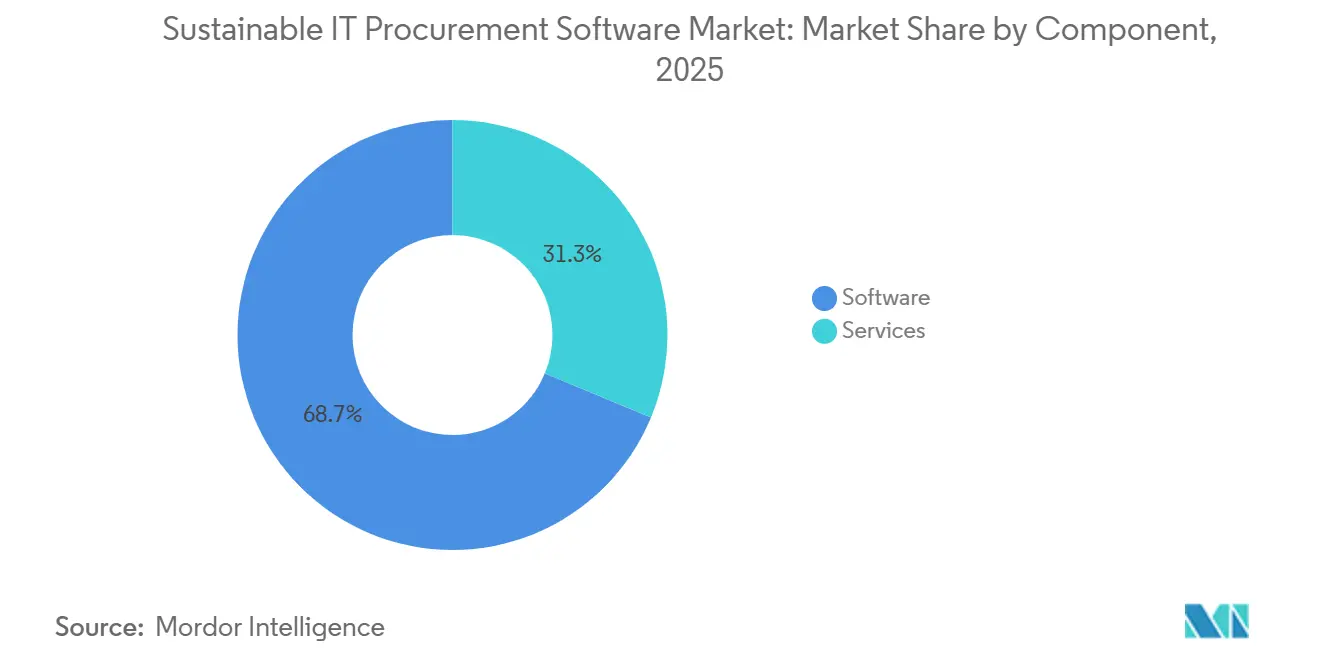
Software Leads Through Platform IntegrationSoftware held 68.74% share in 2025, making it the largest component in the Sustainable IT Procurement Software Market at the segment level. Enterprises favored platform-based tools because they could place ESG scoring, supplier onboarding, reporting dashboards, and sourcing controls inside a connected source-to-pay environment. That preference also reflected the growing value of integration breadth, as buyers increasingly wanted sustainability data to be incorporated into existing procurement events without changing core infrastructure. EcoVadis supported this model with certified integrations across procurement platforms such as SAP Ariba, Coupa, GEP, Jaggaer, and Ivalua, which reduced the need for fully custom builds.
The same segment benefited from supplier-side network effects because shared assessment platforms reduced questionnaire fatigue when multiple buyers relied on the same ecosystem. As a result, software retained the clearest advantage in the Sustainable IT Procurement Software Market because scale, retention, and workflow depth improved together. Services remain important because implementation, data enrichment, consulting, and managed assessment work are necessary in multi-entity procurement environments with different currencies and ERP stacks. Services are also projected to expand at a 18.65% CAGR through 2031, as many enterprises still need help turning platform capabilities into operational compliance processes rather than simply buying licenses. Over time, that services mix is likely to shift away from broad rollout support and toward data quality, audit readiness, and procurement-specific Scope 3 support as the market matures.
By Deployment:
Cloud Retains Scale While Hybrid Gains SpeedCloud accounted for 65.12% of the market in 2025, making it the largest deployment model in the Sustainable IT Procurement Software Market. Buyers favored SaaS delivery because deployment cycles were faster, regulatory content could be updated more easily, and supplier engagement could scale without the need for heavy local infrastructure. Cloud also supported live data sharing with supplier networks, which was important as enterprises sought to gather more primary emissions data from first-tier IT vendors. The model fit broader procurement software buying behavior as well, since subscription delivery reduced the upfront deployment burden compared with fully on-premises systems.
On-premise systems remained relevant in defense, financial services, and public procurement, where supplier commercial data and contract records were often under stricter control. Hybrid is projected to expand at a 18.52% CAGR through 2031, as many enterprises move sustainability analytics and supplier engagement layers to the cloud while keeping sensitive transaction data in on-premises environments. SAP’s 2026 roadmap for Sustainability Control Tower directly reflected this demand by showing how cloud analytics could work with on-premise S/4HANA transaction data in large organizations. That approach fits the current stage of the Sustainable IT Procurement Software Market, where full public cloud migration is not always realistic but selective modernization is already underway. Hybrid momentum is therefore tied less to a rejection of cloud and more to the practical need to connect new sustainability tools with existing procurement infrastructure.
By Enterprise Size:
Large Enterprises Anchor Spend While SMEs AccelerateLarge enterprises held a 63.45% share in 2025, making them the largest segment in the Sustainable IT Procurement Software Market by organization size. Their lead reflected direct exposure to disclosure obligations, larger IT supplier bases, and the budget needed to roll out multi-framework assessment platforms across geographies. These organizations also managed more complex hardware, software, SaaS, and cloud procurement categories, which made manual ESG questionnaire administration difficult to sustain over time. In practice, they needed automation because sustainability data was becoming part of active procurement control rather than an occasional reporting task.
Small and medium enterprises are projected to grow at 18.48% CAGR through 2031 as value-chain pressure spreads outward from large enterprise buyers. As major customers increasingly request structured primary ESG data, smaller IT suppliers face a growing risk of being removed from approved vendor lists if they cannot provide it in a consistent format. EcoVadis lowered part of that barrier in early 2026 through its multilingual Product Carbon Footprint Calculator, which gave smaller suppliers a simpler way to generate primary product-level data. Modular SaaS pricing is also making the Sustainable IT Procurement Software Market more accessible for companies without dedicated ESG technology budgets. Adoption should remain strongest among mid-market suppliers tied to European enterprise buyers, as those supply relationships face the highest near-term reporting pressure.
By Application:
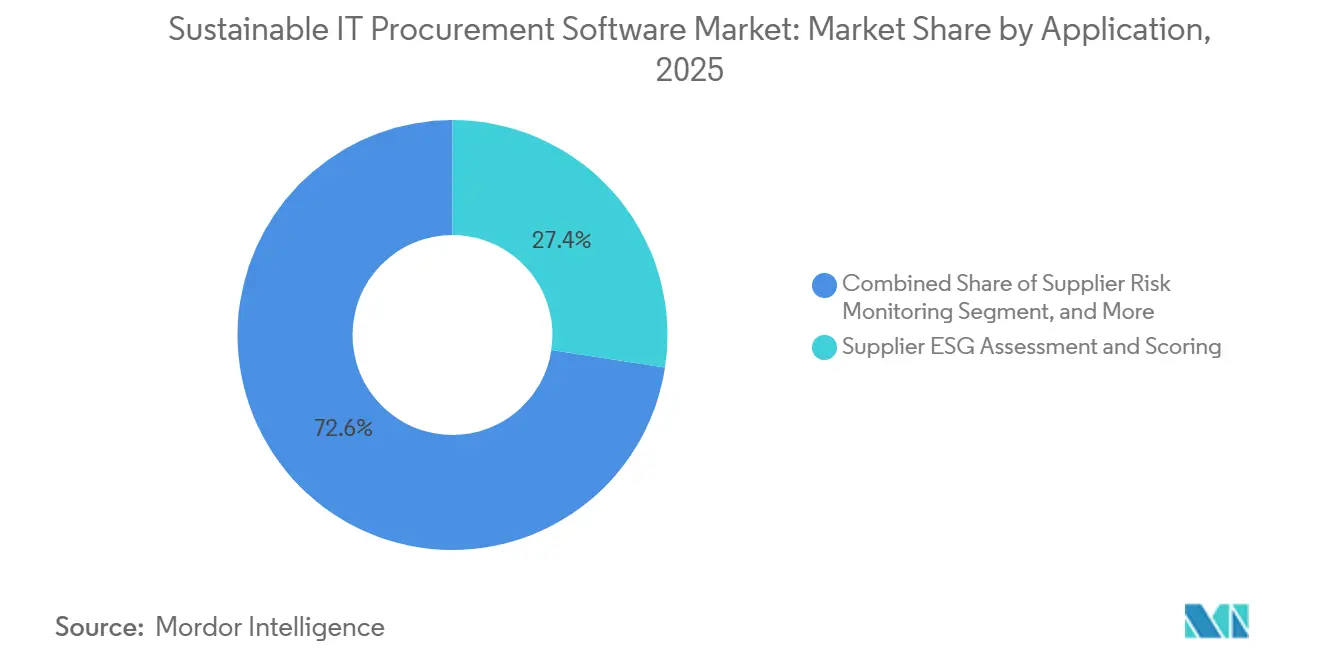
Supplier Scoring Holds The Lead While Circular Reuse Expands FastestSupplier ESG Assessment and Scoring held 27.41% share in 2025, making it the largest application across the Sustainable IT Procurement Software Market by use case. This dominance reflected its role as the first point at which most enterprises introduced sustainability into procurement, as it naturally aligned with supplier qualification and onboarding procedures already in place. Sustainable Sourcing and Procurement Management extended this logic into request-for-proposal evaluation and bid scoring, while Supplier Risk Monitoring applied similar controls once suppliers were already active. Carbon Footprint and Lifecycle Assessment also gained traction as more cloud and hardware vendors published emissions-related data that procurement teams could use in sourcing comparisons.
Reporting, Compliance, and Audit Management remained critical because enterprises needed board-ready sustainability reporting and external audit trails across multiple frameworks. Circular Procurement and Asset Reuse Planning is projected to expand at 18.92% CAGR through 2031, supported by ISO/IEC TS 19770-13:2026, which introduced formal guidance for embedding sustainability considerations into IT asset management systems. The United Kingdom’s IT Reuse for Good Charter reinforced reuse-first thinking in June 2025 and again in March 2026, strengthening the policy case for software that supports refurbishment and extended asset life. Circular tools are becoming increasingly valuable because they connect Scope 3 savings, hardware refresh timing, and asset disposition decisions in a single workflow. This is creating a meaningful adjacency inside the Sustainable IT Procurement Software Market between procurement platforms and IT asset management systems—an area that established vendors are only beginning to address.

By IT Procurement Category:
Data Center Hardware Leads While Cloud Services Grow FastestServers and Data Center Equipment held 28.63% share in 2025, making it the largest category within the Sustainable IT Procurement Software Market. This lead was driven by the scale of data center refresh programs, which involve significant capital outlays, and by the fact that energy efficiency measures such as ENERGY STAR and SERT were already embedded in tender evaluations for these assets. UNEP’s February 2025 guidelines for data centers and servers formalized PUE, WUE, and SERT as objective criteria and provided a methodology for lifecycle cost comparisons that incorporated sustainability attributes. End-user computing devices also remained important because repairability, refurbishment, and energy efficiency were increasingly tied to corporate carbon targets and hardware lifecycle programs.
Network infrastructure, IT peripherals, and software/SaaS procurement were smaller categories but were gaining visibility as enterprises expanded ESG criteria across a broader IT spend base. Cloud and Digital Services are projected to grow at 19.05% CAGR through 2031, making them the fastest-growing category in the market. This growth was supported by the October 2025 AWS update that added Scope 3 data to its customer carbon footprint tools, making workload-related emissions more actionable in procurement discussions. WBCSD’s PACT technical work in 2025 also began addressing data model consistency for carbon footprint exchange, though full interoperability across providers was not yet complete. Procurement teams are increasingly viewing cloud emissions data as both a reporting tool and a sourcing lever, since lower-carbon workload placement can improve emissions performance without necessarily increasing costs.
Geography Analysis
Europe Sustainable IT Procurement Software Market
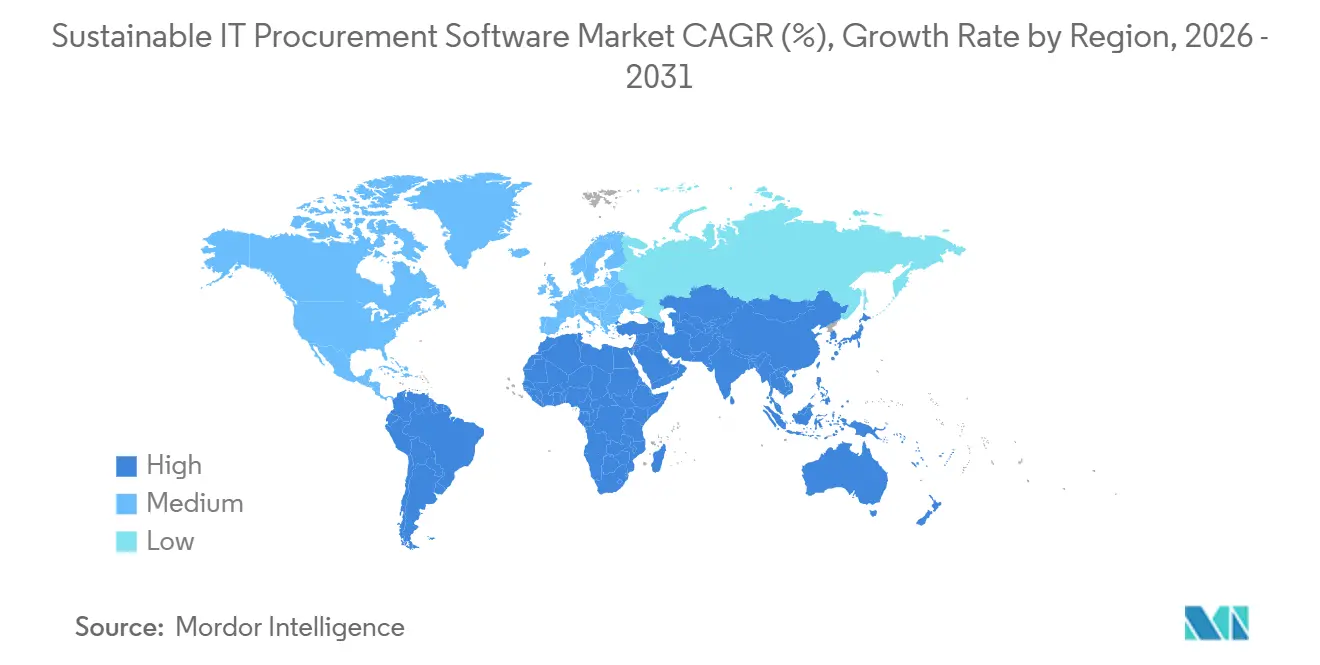
Europe held 34.56% share in 2025, giving the region the largest position in the Sustainable IT Procurement Software Market by geography. Its lead reflected strong enterprise procurement infrastructure, complex multi-tier IT supply chains, and a high concentration of large industrial, financial, and technology companies across Germany, the United Kingdom, France, Italy, and Spain. Germany remained the deepest national market because public IT procurement frameworks already incorporate sustainability as a formal evaluation factor, supporting both public and private demand for structured supplier ESG tools. The European Commission also pointed to a large disclosure base in Germany, where mandatory sustainability reporting requirements sustain enterprise software demand. The United Kingdom reinforced the region’s circular procurement direction through its IT Reuse for Good Charter, which supported reuse-first practices even outside the EU regulatory perimeter.
APAC Sustainable IT Procurement Software Market
Asia-Pacific is projected to expand at a 19.12% CAGR through 2031, making it the fastest-growing regional block in the Sustainable IT Procurement Software Market. Growth is supported by disclosure pressure, export-led supplier demands, and local platform development across Japan, South Korea, Australia, China, and India. Japan stands out because NEC began pilot validation of its Supplier Portal in December 2025 to digitalize sustainability self-assessment questionnaires across supply chains. The region also benefits from its role in electronics and IT manufacturing, requiring supplier engagement tools that can work across many smaller sub-tier vendors and localized workflows. China and India remain high-growth markets because export-oriented manufacturers in both countries are receiving more ESG data requests from European enterprise customers, pulling software adoption forward even where domestic disclosure rules are less mature.
The Americas and MEA Sustainable IT Procurement Software Market
North America held a substantial position in 2025 as large technology companies, financial institutions, and federal contractors were already embedding supplier sustainability requirements into procurement policies. South America remained an emerging region, with large Brazilian exporters being drawn into sustainable IT procurement programs through customer reporting requirements from Europe. Argentina and the rest of South America were still early-stage markets, with adoption concentrated mainly among multinationals and larger exporters. The Middle East and Africa stayed at an earlier adoption stage, though the United Arab Emirates and Saudi Arabia led regional deployments tied to national net-zero and economic transformation agendas.
Competitive Landscape
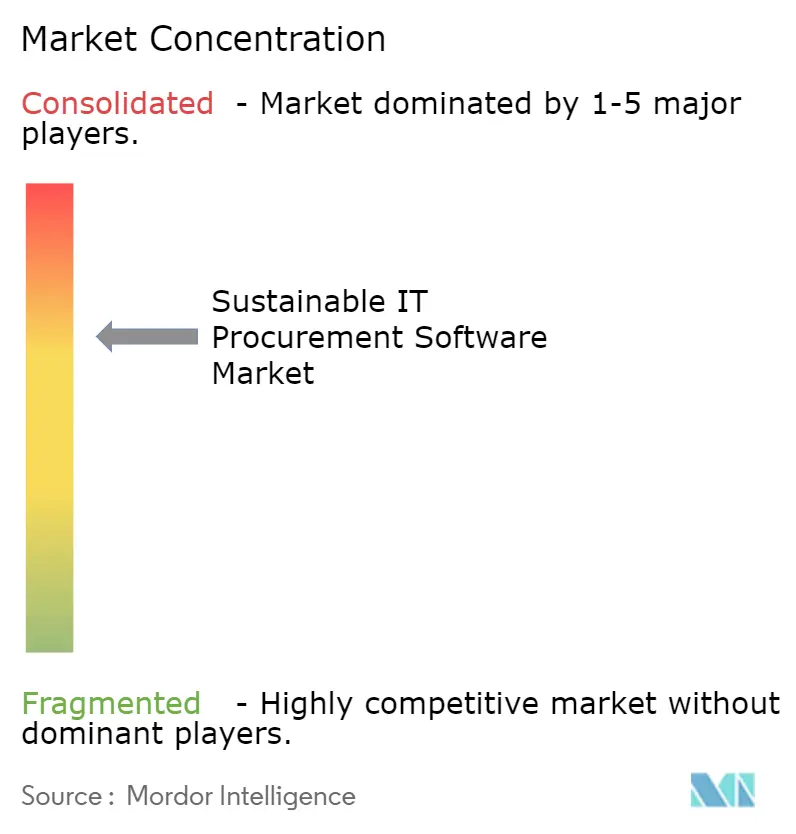
The Sustainable IT Procurement Software Market shows moderate-to-high concentration at the leading tier, with EcoVadis, Ivalua, SAP, Coupa, and GEP holding strong positions through supplier network scale, workflow depth, and source-to-pay integration. Competition is increasingly centered on three areas: connector breadth across procurement stacks, AI-led ESG analytics within workflows, and access to stronger primary supplier emissions data. EcoVadis strengthened its position in May 2026 through a partnership with Workiva that linked supplier carbon data into audit-ready sustainability reporting flows. The company had already extended its partnership with Ivalua in June 2025 to bring predictive ESG risk analytics into sourcing workflows before supplier engagement begins. These moves matter because the market now rewards vendors that can combine network coverage, reporting quality, and workflow timing within a single system.
SAP and Ivalua both demonstrated how quickly procurement platforms are adding embedded automation to defend their positions. SAP announced in May 2026 that its sustainability AI agents would be available by the end of 2026, aiming to reduce compliance review effort and lower packaging compliance errors in sourcing processes. Ivalua introduced IVA Studio in April 2026, enabling organizations to build no-code procurement agents across source-to-pay operations, including sustainability and ESG tasks. ISO/IEC TS 19770-13:2026 also established a new technical anchor for vendors, seeking to differentiate through stronger integration between procurement systems and IT asset lifecycle management. Meanwhile, GEP retained the highest ranking in Spend Matters’ Fall 2025 SolutionMap across 15 categories, showing that platform breadth remains a meaningful buying signal.
Smaller specialists such as IntegrityNext, Sphera Solutions, Assent, and HICX Solutions continue to compete in narrower workflow areas, such as supplier data collection, material compliance, and supplier information governance. Their challenge is that large buyers increasingly prefer fewer tools when ESG controls must connect directly to sourcing, contracting, supplier onboarding, and reporting processes. This leaves room in the mid-market and in less standardized categories such as software and SaaS procurement, where carbon attribute scoring methods are still developing. Even so, the overall direction of the Sustainable IT Procurement Software Market favors vendors that can blend specialized sustainability capability with broad procurement system integration.
Sustainable IT Procurement Software Industry Leaders
-
Ivalua Inc.
-
Coupa Software Incorporated
-
SAP SE
-
Jaggaer, LLC
-
GEP Worldwide
- *Disclaimer: Major Players sorted in no particular order
Sustainable IT Procurement Software Market Companies Covered in this Report
- Ivalua Inc.
- Coupa Software Incorporated
- SAP SE
- Jaggaer, LLC
- GEP Worldwide
- Zycus Infotech Pvt. Ltd.
- Oracle Corporation
- EcoVadis SAS
- IntegrityNext GmbH
- Sphera Solutions, Inc.
- Supplier.io, Inc.
- OneTrust, LLC
- Verdikt
- Sedex Information Exchange Limited
- Assent Inc.
- Asuene Inc.
- HICX Solutions Limited
- IPoint-systems gmbh
- Achilles Information Limited
- Greenly
Recent Industry Developments in Sustainable IT Procurement Software Market
- May 2026: EcoVadis announced a strategic partnership with Workiva to expand its Carbon Data Network (CDN), enabling mutual customers to connect primary supplier carbon emission data directly into Workiva's audit-ready sustainability reports, addressing the Scope 3 primary data gap that has been the primary accuracy limitation in enterprise procurement-linked climate disclosures.
- May 2026: EcoVadis released its 2025 Purpose Report, disclosing that more than USD 2.5 trillion in global spend is now governed through sustainability risk insights across its network, and formalizing 2030 impact ambitions including 300,000 rated companies and 100,000 companies reporting primary greenhouse gas metrics.
- May 2026: SAP announced at Sapphire 2026 that new sustainability AI agents would be generally available by end of 2026, targeting more than 50% reduction in manual compliance review hours and over 20% fewer packaging compliance assessment errors across procurement and sourcing workflows.
- April 2026: Ivalua unveiled IVA Studio at Ivalua NOW 2026, a no-code autonomous procurement agent platform enabling organizations to build, orchestrate, and govern custom AI agents across source-to-pay operations, with sustainability and ESG compliance workflows as key embedded use cases.
Global Sustainable IT Procurement Software Market Report Scope
The Sustainable IT Procurement Software market comprises platforms and services that integrate sustainability principles into IT procurement processes, enabling organizations to evaluate, monitor, and optimize supplier performance and IT asset acquisition, with a focus on ESG compliance and carbon reduction. These solutions provide functionalities such as supplier ESG assessment and scoring, sustainable sourcing and procurement management, supplier risk monitoring, carbon footprint and lifecycle assessment, compliance and audit reporting, and circular procurement planning for asset reuse and redeployment.
The Sustainable IT Procurement Software market report is segmented by Component (Software, and Services), Deployment (Cloud, On-Premise, and Hybrid), Enterprise Size (Large Enterprises, and Small and Medium Enterprises), Application (Supplier ESG Assessment and Scoring, Sustainable Sourcing and Procurement Management, Supplier Risk Monitoring, Carbon Footprint and Lifecycle Assessment, Reporting, Compliance and Audit Management, and Circular Procurement and Asset Reuse Planning), IT Procurement Category (End-User Computing Devices, Servers and Data Center Equipment, Network Infrastructure, Cloud and Digital Services, Software and SaaS Procurement, and IT Peripherals), and Geography (North America, South America, Europe, Asia-Pacific, Middle East, and Africa). The Market Forecasts are Provided in Terms of Value (USD).
Segmentation Overview
| Software |
| Services |
| Cloud |
| On-Premise |
| Hybrid |
| Large Enterprises |
| Small and Medium Enterprises |
| Supplier ESG Assessment and Scoring |
| Sustainable Sourcing and Procurement Management |
| Supplier Risk Monitoring |
| Carbon Footprint and Lifecycle Assessment |
| Reporting, Compliance and Audit Management |
| Circular Procurement and Asset Reuse Planning |
| End-User Computing Devices |
| Servers and Data Center Equipment |
| Network Infrastructure |
| Cloud and Digital Services |
| Software and SaaS Procurement |
| IT Peripherals |
| North America | United States | |
| Canada | ||
| Mexico | ||
| South America | Brazil | |
| Argentina | ||
| Rest of South America | ||
| Europe | Germany | |
| United Kingdom | ||
| France | ||
| Italy | ||
| Spain | ||
| Russia | ||
| Rest of Europe | ||
| Asia-Pacific | China | |
| India | ||
| Japan | ||
| South Korea | ||
| Australia | ||
| Rest of Asia-Pacific | ||
| Middle East and Africa | Middle East | Saudi Arabia |
| United Arab Emirates | ||
| Rest of Middle East | ||
| Africa | South Africa | |
| Nigeria | ||
| Rest of Africa | ||
| By Component | Software | ||
| Services | |||
| By Deployment | Cloud | ||
| On-Premise | |||
| Hybrid | |||
| By Enterprise Size | Large Enterprises | ||
| Small and Medium Enterprises | |||
| By Application | Supplier ESG Assessment and Scoring | ||
| Sustainable Sourcing and Procurement Management | |||
| Supplier Risk Monitoring | |||
| Carbon Footprint and Lifecycle Assessment | |||
| Reporting, Compliance and Audit Management | |||
| Circular Procurement and Asset Reuse Planning | |||
| By IT Procurement Category | End-User Computing Devices | ||
| Servers and Data Center Equipment | |||
| Network Infrastructure | |||
| Cloud and Digital Services | |||
| Software and SaaS Procurement | |||
| IT Peripherals | |||
| By Geography | North America | United States | |
| Canada | |||
| Mexico | |||
| South America | Brazil | ||
| Argentina | |||
| Rest of South America | |||
| Europe | Germany | ||
| United Kingdom | |||
| France | |||
| Italy | |||
| Spain | |||
| Russia | |||
| Rest of Europe | |||
| Asia-Pacific | China | ||
| India | |||
| Japan | |||
| South Korea | |||
| Australia | |||
| Rest of Asia-Pacific | |||
| Middle East and Africa | Middle East | Saudi Arabia | |
| United Arab Emirates | |||
| Rest of Middle East | |||
| Africa | South Africa | ||
| Nigeria | |||
| Rest of Africa | |||
Key Questions Answered in the Report
What is the 2026 value of the Sustainable IT Procurement Software Market?
The Sustainable IT Procurement Software Market stands at USD 1.22 billion in 2026 and is forecast to reach USD 2.84 billion by 2031 at an 18.41% CAGR.
Why are companies investing more in sustainable IT procurement platforms?
The strongest reason is the need for auditable Scope 3 supplier data, especially as procurement teams must connect supplier information to formal reporting and live sourcing decisions.
Which deployment model leads current spending?
Cloud led with 65.12% share in 2025 because it offers faster deployment, easier updates, and broader supplier connectivity. Hybrid is the fastest-growing option at 18.52% CAGR through 2031.
Which application area is expanding the fastest?
Circular Procurement and Asset Reuse Planning is projected to grow at 18.92% CAGR through 2031, supported by stronger reuse policies and ISO guidance for sustainability in IT asset management.
Which region leads demand and which one is growing the fastest?
Europe led with 34.56% share in 2025, while Asia-Pacific is projected to grow the fastest at 19.12% CAGR through 2031.
What category of IT spend is creating the strongest near-term opportunity?
Cloud and Digital Services show the fastest growth at 19.05% CAGR through 2031, while Servers and Data Center Equipment remained the largest category with 28.63% share in 2025.