
Sports Bra Market Size and Share
Market Overview
| Study Period | 2021 - 2031 |
|---|---|
| Market Size (2026) | USD 13.44 Billion |
| Market Size (2031) | USD 19.73 Billion |
| Growth Rate (2026 - 2031) | 7.92 % |
| Fastest Growing Market | Middle East and Africa |
| Largest Market | Asia Pacific |
| Market Concentration | Medium |
Major Players *Disclaimer: Major Players sorted in no particular order Image © Mordor Intelligence. Reuse requires attribution under CC BY 4.0. | |
Sports Bra Market Analysis by Mordor Intelligence
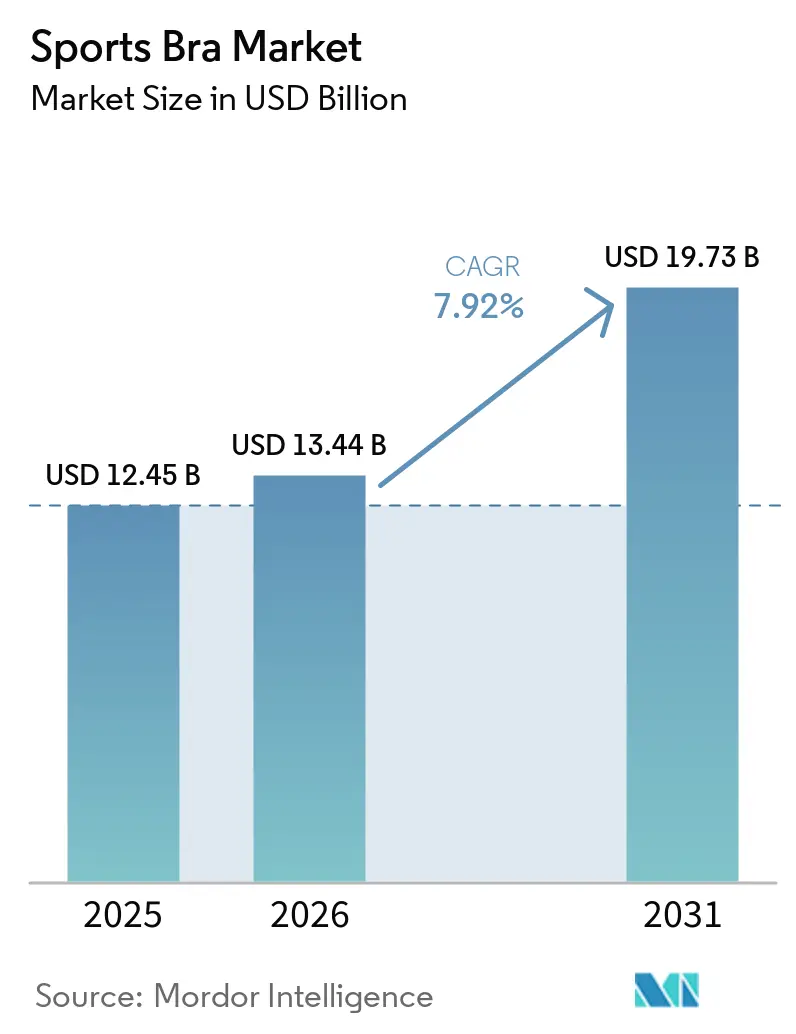
The Sports Bra Market size was valued at USD 12.45 billion in 2025 and is estimated to grow to USD 13.44 billion in 2026, reaching USD 19.73 billion by 2031, at a CAGR of 7.92% during the forecast period (2026–2031). Performance engineering, adaptive sizing, and versatile lifestyles are expanding the customer base. The blend of athleisure and technical activewear allows brands to market the same garment for workouts, commutes, and casual wear. Premium pricing is driven by fabric innovations like directional-wicking channels and recycled-polyester blends that retain quality after multiple washes. High-intensity training formats, such as HIIT and CrossFit, are popularizing premium bras with encapsulation cups and compression panels. Omnichannel retail investments are restoring in-store fitting confidence lost due to high e-commerce return rates. Challenges like counterfeit products, elastane recycling limits, and inconsistent global sizing standards persist. However, advancements in bio-based elastane and AI-powered fit tools offer long-term solutions for cost and return-rate issues.
Key Report Takeaways
- By impact level, medium-impact designs led with 46.02% of the sports bra market share in 2025, while high-impact variants are projected to advance at a 8.89% CAGR through 2031.
- By design type, compression styles accounted for 44.21% share of the Sports bra market size in 2025, whereas hybrid architectures are on track for the fastest growth at an 9.06% CAGR.
- By padding, unpadded bras captured 65.52% of the sports bra market size in 2025; padded designs are forecast to expand at a 8.92% CAGR to 2031.
- By distribution channel, online retail held 51.21% sports bra market share during 2025, and hypermarkets and supermarkets are expected to grow at an 8.59% CAGR over 2026-2031.
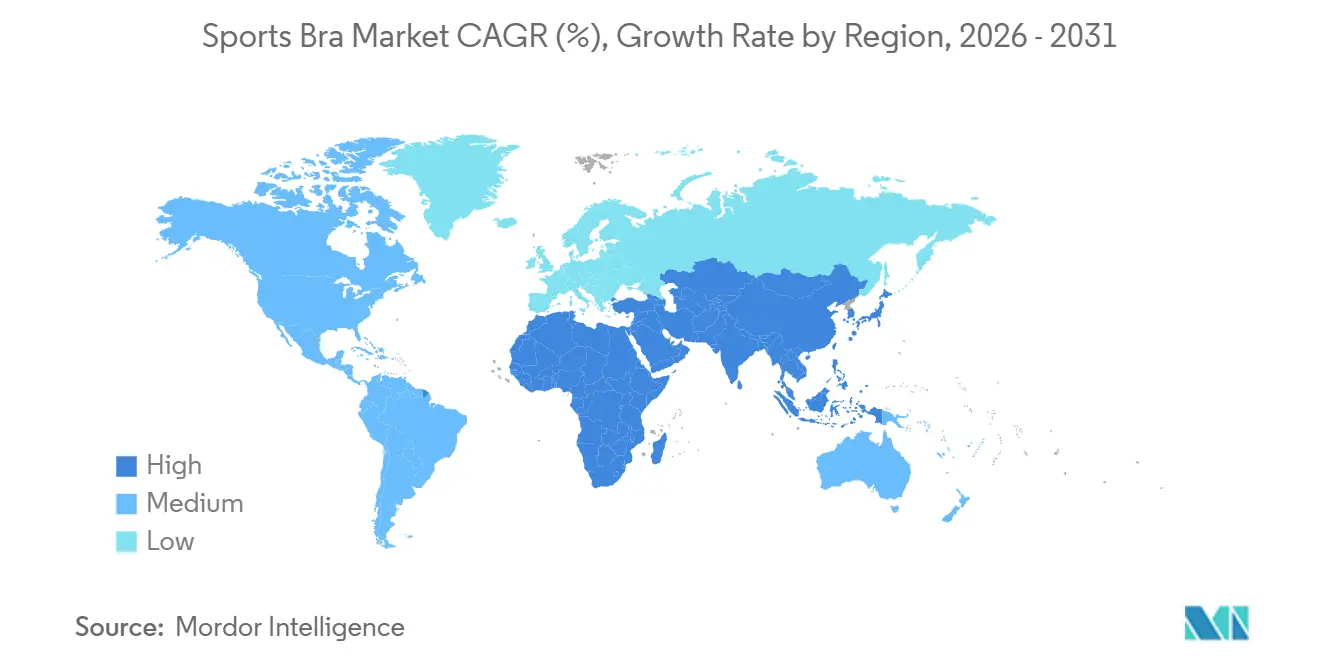
- By geography, North America commanded 37.92% revenue share in 2025, while Asia-Pacific is set to record the highest regional CAGR at 9.22% to 2031.
Note: Market size and forecast figures in this report are generated using Mordor Intelligence’s proprietary estimation framework, updated with the latest available data and insights as of January 2026.
Market Trends and Insights
Drivers Impact Analysis of Sports Bra Market*
| Driver | (~) % Impact on CAGR Forecast | Geographic Relevance | Impact Timeline |
|---|---|---|---|
| Increased women's sports participation | +1.8% | Global, with acceleration in APAC (India, China, Southeast Asia) and North America | Medium term (2-4 years) |
| Athleisure trend integrating bras into everyday wear | +1.5% | Global, led by North America and Europe; urban centers in APAC | Long term (≥ 4 years) |
| Advances in high-performance, moisture-management fabrics | +1.2% | Global, with R&D clusters in North America, Europe, and Japan | Medium term (2-4 years) |
| Inclusive sizing and adaptive designs | +1.0% | North America and Europe; emerging in APAC urban markets | Medium term (2-4 years) |
| Growing awareness of physical well-being boosts demand for supportive apparel during workouts | +1.3% | Global, strongest in North America, Western Europe, and Tier-1 APAC cities | Short term (≤ 2 years) |
| Shift towards sustainability and eco-friendly options | +0.7% | Europe (driven by regulatory frameworks), North America, and select APAC markets | Long term (≥ 4 years) |
| Source: Mordor Intelligence | |||
Increased Women's Sports Participation
Female athletic engagement reached an inflection point, with the National Federation of State High School Associations reporting 3.4 million girls competing in high school sports during 2026, while NCAA institutions fielded over 527,000 female athletes in the 2024-25 academic year[1]. This uptick isn't limited to conventional team sports; women now dominate memberships in individual fitness realms, leading the charge in yoga, Pilates, and boutique studios. The trend is especially evident in the Asia-Pacific region. In India, for instance, women are significantly boosting enrollments in premium fitness formats. In response, brands are crafting sport-specific bras: high-impact versions tailored for running and CrossFit, and low-impact ones designed for barre and yoga. These bras cater to unique biomechanical needs, moving away from the traditional one-size-fits-all approach. Studies indicate that the right sports bras can cut vertical breast displacement by up to 50% and enhance running efficiency by about 7%. Such performance improvements not only underscore the importance of these products but also validate their premium pricing.
Athleisure Trend Integrating Bras into Everyday Wear
The boundary between activewear and casualwear has become increasingly blurred. Sports bras, once limited to gym use, are now commonly worn as standalone tops in everyday life. This change in consumer habits has expanded the market beyond the usual 3-5 hours per week spent exercising. Lululemon, with an expected fiscal 2024 revenue of USD 10.6 billion, is leading this trend. The brand plans to launch the "Go Further Bra" in March 2025, a versatile product designed for both workouts and all-day wear, reflecting the industry's focus on multi-purpose products. In North America and Europe, remote work has made athleisure acceptable as office attire, while in Asia-Pacific cities, younger consumers are embracing comfort and self-expression over formal clothing. The SKIMS-Nike partnership, announced in February 2024, highlights this shift. SKIMS, valued at USD 2.8 billion, is introducing fashion-forward sports bras priced between USD 68-148, significantly higher than traditional price points. Brands are also innovating designs with seamless construction, bonded hems, and tagless finishes to remove visible hardware that signals "workout-only" use. This approach allows them to capture more revenue from consumers who now wear sports bras daily instead of just a few times a week.
Advances in High-Performance, Moisture-Management Fabrics
Fabric innovation is now a key focus for brands, with many filing patents for advanced moisture-wicking technologies. Nike has developed fabrics with directional wicking channels that move sweat from high-perspiration areas to the edges for faster evaporation. Researchers from Stanford University and City University of Hong Kong have created hierarchical-pore textiles that transport moisture 30% faster than traditional polyester. ASICS, in its 2024 sustainability report, stated that 75% of its sports bras use recycled polyester from post-consumer PET bottles, matching virgin synthetics in moisture management while reducing carbon emissions by 20-25%. The challenge lies in maintaining fabric feel and elasticity after multiple washes. Brands solving elastane degradation, where spandex loses 15-20% elasticity after 50 washes, will gain customer loyalty in a market driven by fit consistency. New Balance's 2025 Essential Yoga Bra, made with 77% recycled polyester and 23% elastane, highlights the balance between sustainability and durability.
Inclusive Sizing and Adaptive Designs
Inconsistent sizing standards across brands drive e-commerce apparel return rates of 20-30%, with 55% caused by size, fit, or color mismatches. To address this, Wacoal plans to launch the Ever Flexing Underwire Bra in August 2025. This bra uses a flexible underwire and four-way stretch fabric to adapt to hormonal changes, pregnancy, and weight fluctuations, covering six traditional cup sizes and reducing the need for repurchases. Currently, 70-86% of women wear the wrong bra size, and even a 7-pound weight change can alter fit, damaging brand trust. In China, Aimer has built a 1.58-million-record body-shape database and partnered with the Beijing Institute of Fashion Technology to create region-specific fit algorithms, cutting return rates by 25-30%. Similarly, brands like NeiWai use 3D body-scanning kiosks in flagship stores to gather fit data, improving product development and offering personalized recommendations, turning sizing challenges into a competitive edge.
Restraints Impact Analysis of Sports Bra Market*
| Restraint | (~) % Impact on CAGR Forecast | Geographic Relevance | Impact Timeline |
|---|---|---|---|
| Rising prevalence of counterfeit products | -0.6% | Global, concentrated in North America, Europe, and online marketplaces sourcing from China/Hong Kong | Short term (≤ 2 years) |
| Volatile supply of recycled elastane and specialty yarns | -0.5% | Global, acute in Europe (regulatory pressure) and North America (sustainability commitments) | Medium term (2-4 years) |
| Absence of global sizing standards resulting in high return rates | -0.8% | Global, most severe in e-commerce-heavy markets (North America, Europe, China) | Medium term (2-4 years) |
| Intense price competition and margin pressure | -0.7% | Global, particularly in mass-market and online-retail channels | Long term (≥ 4 years) |
| Source: Mordor Intelligence | |||
Rising Prevalence of Counterfeit Products
Counterfeit sports bras are harming both consumer trust and brand revenue. In January 2025, U.S. Customs and Border Protection seized USD 1.4 million worth of fake sports merchandise, with nearly 90% of intellectual property seizures linked to China and Hong Kong[2]. Since 2013, "Operation Team Player" has confiscated over USD 455 million in counterfeit goods. However, online marketplaces remain a major challenge, as fake products often appear genuine until delivered. The sports bra market is particularly affected due to the importance of fit and fabric performance for safety and comfort. Consumers who buy low-quality fakes often blame the brand, reducing their likelihood of repurchasing. To combat this, brands are using blockchain authentication, serialized QR codes, and working with customs authorities to stop counterfeit shipments. Despite these efforts, counterfeiters are motivated by the high prices of sports bras and the difficulty of identifying fakes in low-quality online images.
Volatile Supply of Recycled Elastane and Specialty Yarns
Material-cost volatility impacts margin predictability as recycled elastane and moisture-wicking yarns cost 15-30% more than virgin synthetics, with prices influenced by feedstock availability and regulations. According to Fashion for Good's February 2026 research, elastane's chemical structure prevents mechanical recycling, requiring expensive chemical processes that are not yet scalable. Sustainability goals, such as ASICS' 75% recycled polyester target by 2024 and adidas' 100% by 2030, face risks if recycled-elastane supply cannot meet demand, leading to delayed launches or lower margins. China's dominance in elastane production adds to the risk, as trade restrictions or quotas could disrupt supply. To mitigate this, brands are diversifying suppliers and forming closed-loop partnerships with textile innovators, but the transition creates cost uncertainties, complicating pricing and inventory planning.
*Our forecasts treat driver/restraint impacts as directional, not additive. The impact forecasts reflect baseline growth, mix effects, and variable interactions.
Sports Bra Market Segment Analysis
By Impact Level:
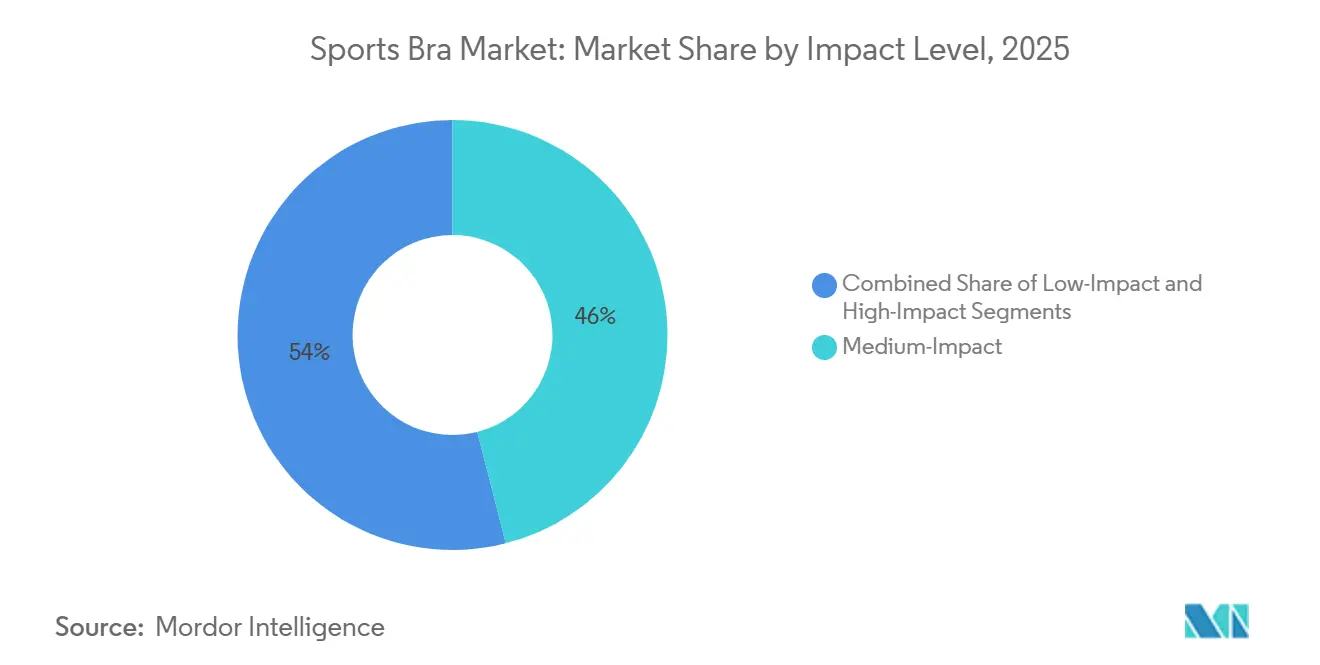
High-Impact Drives InnovationHigh-impact sports bras are expected to grow at a 8.89% CAGR from 2026 to 2031, outpacing the overall market. This growth is fueled by the increasing adoption of HIIT, CrossFit, and hybrid training among women seeking efficient workouts. These bras feature encapsulation cups, reinforced underbands, and adjustable straps to reduce breast movement during high-impact activities like sprints and heavy lifts, which generate forces of 200-550 Newtons, as shown by biomechanical studies. Adidas's Techfit Control Bra, launched in April 2024, highlights this trend with RHEON LABS' impact-sensitive polymer, priced at GBP 65 (USD 82). Proper support has been shown to improve running performance by 7% and reduce stride-length loss by up to 4 centimeters, further driving demand.
In 2025, medium-impact bras accounted for 46.02% of the market, driven by their versatility for activities like yoga, Pilates, and cycling, which dominate studio and home workouts. Low-impact bras cater to niche activities like walking and restorative yoga, focusing on comfort and breathability. The mature medium-impact segment faces margin pressure, with brands emphasizing fabric innovations like seamless designs and moisture-wicking materials. In contrast, high-impact bras command a 20-30% price premium due to patented support systems and sport-specific engineering that meet biomechanical needs.

By Design Type:
Hybrid Architectures Capture Performance and ComfortThe combination/hybrid sports bras market is expected to grow at a CAGR of 9.06% from 2026 to 2031. These bras combine encapsulation's cup support with compression's stabilizing panels, meeting the needs of consumers seeking both lift and chest stabilization. Patents by Lululemon for flat-knit seamless construction and Glamorise for variable-compression designs highlight the competition for innovative fit technologies [Patent databases]. Hybrid bras address the challenges faced by larger-busted women (D-cup and above), who previously had to choose between encapsulation bras with limited compression or compression bras that caused discomfort. By integrating molded cups within a compression shell and offering adjustable straps and closures, hybrid bras provide a customizable fit, justifying prices 15-25% higher than pure-compression bras.
In 2025, compression bras held a 44.21% market share due to their simplicity, lower production costs, and appeal to smaller-busted consumers (A-B cups) who prefer minimalist designs and easy wear. These bras dominate the athleisure segment, offering seamless, wire-free designs suitable for all-day use. Encapsulation bras, while holding a smaller share, are essential for high-impact activities and larger cup sizes, as they effectively reduce breast movement for D-cup and above. The shift to hybrid designs reflects growing consumer awareness of biomechanical needs and a willingness to invest in tailored solutions over one-size-fits-all compression options.
By Padding:
Removable Inserts Balance Modesty and VentilationFrom 2026 to 2031, the padded sports bra market is expected to grow at a CAGR of 8.92%. Brands are introducing removable, moisture-wicking inserts that address modesty concerns while maintaining breathability and comfort. For example, New Balance's Essential Yoga Bra features removable pads made from 77% recycled polyester and 23% elastane, allowing users to customize coverage based on their needs. This flexibility is crucial in the athleisure market, where sports bras often double as tops. Removable padding provides added coverage for casual wear and can be removed during workouts for better ventilation. Additionally, replacing worn padding extends the product's life, supporting sustainability and reducing frequent purchases.
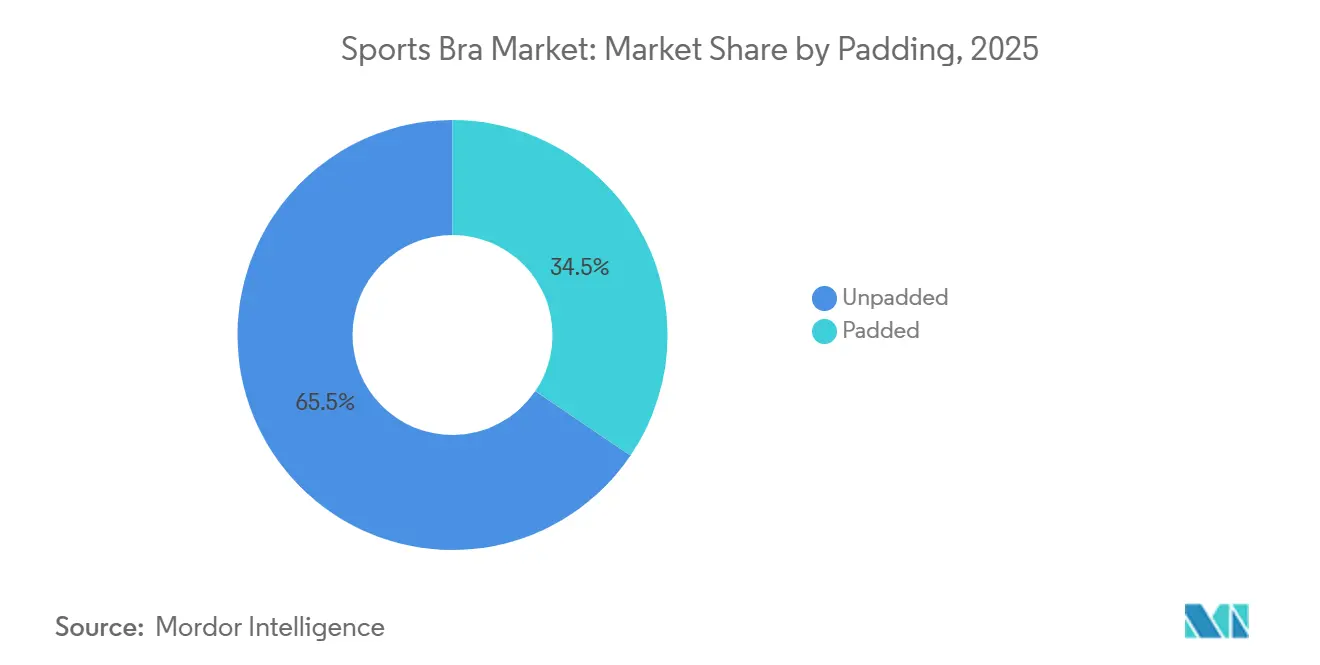
In 2025, unpadded sports bras held 65.52% of the market share due to their lightweight design, breathability, and natural fit. These bras are popular among consumers focused on performance, especially during intense workouts where heat dissipation is key. They also align with body-positivity and minimalist trends, rejecting unnecessary features. However, growth in this segment is limited as fabric innovations have plateaued. In contrast, padded bras continue to evolve with new insert materials like memory foam, gel, and perforated EVA, along with attachment methods such as snap-in, slide-in, and adhesive, offering unique fit options.
By Distribution Channel:
Omnichannel Convergence Reshapes RetailFrom 2026 to 2031, hypermarkets and supermarkets are expected to grow at a CAGR of 8.59%, the fastest among distribution channels. This growth is driven by investments in fit-service infrastructure, exclusive brand partnerships, and private-label innovations to compete with online-first retailers. Consumers prefer these stores for tactile evaluations and instant purchases, especially in categories where fit is crucial. Retailers like Target and Walmart are introducing in-store fit consultants, expanding size ranges (up to G-H cups), and collaborating with brands like Champion and Jockey to offer affordable performance products priced at USD 20-35. Impulse purchases and easy in-store returns, which avoid e-commerce return rates of 20-30%, further boost this channel.
In 2025, online retail stores accounted for 51.21% of the market, led by DTC brands like Lululemon, Girlfriend Collective, and Alo Yoga. These brands bypass wholesale markups, reinvesting in product innovation and digital marketing. Lululemon's fiscal 2024 revenue of USD 10.6 billion, with a significant share from e-commerce, highlights the channel's appeal to premium consumers. However, challenges include high return rates (20% for generic listings, reduced to 5% with AI fit tools) and rising customer-acquisition costs, up 30-40% due to saturated digital advertising [E-commerce research]. Specialty stores target niche groups, such as runners needing gait analysis or plus-size consumers, offering personalized fittings that justify 10-15% higher prices. Other channels, like boutique studios and direct sales, focus on local partnerships and community engagement to capture smaller shares.
Geography Analysis
North America Sports Bra Market
In 2025, North America accounted for 37.92% of the market revenue, driven by its advanced fitness infrastructure, high athleisure spending, and leadership in premium activewear innovation. The U.S. dominates with brands like Nike, Lululemon, and Under Armour, which leverage product innovation and celebrity endorsements to maintain pricing power. Under Armour's FY2025 report highlighted growth in women's bras and bottoms, signaling a strategic focus on this segment. Canada supports growth with its boutique-fitness culture and demand for cold-weather sports bras, while Mexico's growing middle class and increasing female workforce participation boost entry-level and mid-tier segments. The region's premiumization is evident in the February 2024 SKIMS-Nike collaboration, offering sports bras priced at USD 68-148 for fashion-conscious consumers. However, market saturation and competition from direct-to-consumer brands are slowing growth, pushing companies to expand internationally.
APAC Sports Bra Market
Asia-Pacific is the fastest-growing region at a 9.22% CAGR, driven by economic development, increased female workforce participation, and rising health consciousness among young consumers. The region's market leadership stems from its demographic advantages and evolving fitness culture, particularly in China and India, where women's sports participation continues to grow. The region serves as both the primary consumer market and manufacturing hub, benefiting from cost-efficient production capabilities that support domestic consumption and exports. While developed markets like Japan and Australia emphasize premium products and sustainability, emerging economies focus on affordability and essential functionality.
EMEA and South America Sports Bra Market
Europe's market is shaped by strict sustainability regulations, with the European Union's mandates encouraging recycled materials and circular designs. Germany, the U.K., France, and Italy lead in spending, as consumers prioritize eco-friendly and high-performance products. For example, H&M reported in 2024 that 23% of its materials are recycled or sustainably sourced. The Netherlands and Scandinavian countries (Sweden, Denmark) see strong demand for weather-resistant, high-visibility designs due to their cycling and outdoor sports culture. Spain and Poland are emerging markets, supported by rising gym memberships and female workforce participation. South America, the Middle East, and Africa are smaller markets but show localized growth. Brazil and Argentina benefit from fitness and beach cultures, while the UAE and Saudi Arabia invest in women's sports infrastructure as part of social reforms. In South Africa, Nigeria, and Egypt, affordability and distribution challenges persist, but growing smartphone use is enabling e-commerce access to global brands.
Competitive Landscape
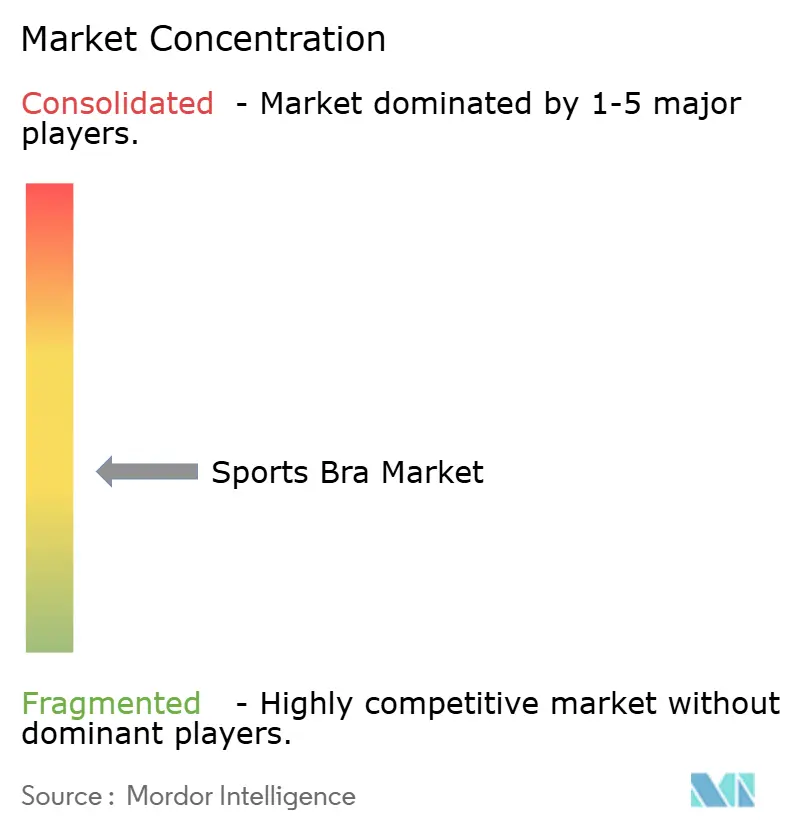
The sports bra market is moderately fragmented, presenting significant opportunities for both established players and emerging disruptors to capture market share through innovation and strategic positioning. Market leaders such as Nike, Lululemon, and Adidas adopt varied strategies: Nike leans on athlete endorsements and a mass-market appeal, Lululemon carves out a niche with premium positioning and community engagement, while Adidas stands out with its focus on technical innovation and a robust global distribution network.
Competition intensifies as companies prioritize biomechanical research and evidence-backed performance claims. For instance, Lululemon has made notable investments in sports bra underband research, while organizations like Hohenstein are pioneering scientific testing methods. Furthermore, technology adoption is emerging as a pivotal differentiator, with firms channeling resources into AI-driven material development, 3D scanning for tailored fits, and the integration of smart textiles for biometric monitoring.
There are untapped opportunities in areas like adaptive designs catering to post-surgical patients, smart sports bras equipped with biometric monitoring, and the use of sustainable materials that don't compromise on performance. The market's fragmented landscape not only opens doors for larger players to make acquisitions and broaden their portfolios or geographic presence but also allows smaller brands to carve out niche positions before scaling up.
Sports Bra Industry Leaders
-
Under Armour, Inc.
-
PVH Corp.
-
Lululemon Athletica Inc.
-
Adidas AG
-
Nike, Inc.
- *Disclaimer: Major Players sorted in no particular order
Sports Bra Market Companies Covered in this Report
- Nike, Inc.
- Adidas AG
- Lululemon Athletica Inc.
- PVH Corp. (Calvin Klein, Tommy Hilfiger)
- Under Armour, Inc.
- Hanesbrands Inc. (Champion)
- Wacoal Holdings Corp.
- Jockey International, Inc.
- Victoria’s Secret & Co.
- Girlfriend Collective
- Decathlon S.A.
- ASICS Corporation
- New Balance Athletics, Inc.
- SheFit, Inc.
- Runderwear Ltd.
- Ciele Athletics
- Ryka (Caleres, Inc.)
- Spanx, LLC
- Oysho (Inditex)
- Sweaty Betty Ltd.
- Alo Yoga
Recent Industry Developments in Sports Bra Market
- March 2026: Gymshark expanded its activewear offering in 2026 with the launch of a new running collection that includes high- and medium-support sports bras engineered with breathable mesh, sweat-wicking fabrics, and performance-focused construction, targeting both amateur and professional runners while reinforcing its positioning in affordable high-performance sportswear.
- January 2026: ThirdLove expanded into performance activewear in 2026 with the launch of its TempSync™ Active Sports Bra, featuring 37.5® temperature-regulating technology designed to manage body heat and moisture, thereby enhancing comfort across different activity levels while strengthening the brand’s positioning in the sports bra segment.
- March 2025: Lululemon introduced the Go Further Bra, a sports bra tested by ultrarunners at the FURTHER women's ultramarathon. The product incorporates technology that delivers maximum support while ensuring comfort. The Go Further Bra combines high-impact performance with lightweight comfort for use during and after workouts.
Global Sports Bra Market Report Scope
A sports bra is a type of undergarment specifically designed to provide support and reduce breast movement during physical activities such as exercise, sports, or fitness training.
The Sports Bra Market Report segments the industry by impact level into low-impact, medium-impact, and high-impact, by design type into compression bras, encapsulation bras, and combination/hybrid bras, by padding into padded and unpadded, by distribution channel into hypermarkets/supermarkets, specialty stores, online retail stores, and other distribution channels, and by geography into North America, Europe, Asia-Pacific, South America, and the Middle East and Africa. For each segment, the market sizing and forecasts have been based on value in USD.
Segmentation Overview
| Low-Impact |
| Medium-Impact |
| High-Impact |
| Compression Bras |
| Encapsulation Bras |
| Combination/Hybrid Bras |
| Padded |
| Unpadded |
| Hypermarkets/Supermarkets |
| Specialty Stores |
| Online Retail Stores |
| Other Distribution Channels |
| North America | United States |
| Canada | |
| Mexico | |
| Rest of North America | |
| Europe | Germany |
| United Kingdom | |
| Italy | |
| France | |
| Spain | |
| Netherlands | |
| Poland | |
| Belgium | |
| Sweden | |
| Rest of Europe | |
| Asia-Pacific | China |
| India | |
| Japan | |
| Australia | |
| Indonesia | |
| South Korea | |
| Thailand | |
| Singapore | |
| Rest of Asia-Pacific | |
| South America | Brazil |
| Argentina | |
| Colombia | |
| Chile | |
| Peru | |
| Rest of South America | |
| Middle East and Africa | South Africa |
| Saudi Arabia | |
| United Arab Emirates | |
| Nigeria | |
| Egypt | |
| Morocco | |
| Turkey | |
| Rest of Middle East and Africa |
| By Impact Level | Low-Impact | |
| Medium-Impact | ||
| High-Impact | ||
| By Design Type | Compression Bras | |
| Encapsulation Bras | ||
| Combination/Hybrid Bras | ||
| By Padding | Padded | |
| Unpadded | ||
| By Distribution Channel | Hypermarkets/Supermarkets | |
| Specialty Stores | ||
| Online Retail Stores | ||
| Other Distribution Channels | ||
| By Geography | North America | United States |
| Canada | ||
| Mexico | ||
| Rest of North America | ||
| Europe | Germany | |
| United Kingdom | ||
| Italy | ||
| France | ||
| Spain | ||
| Netherlands | ||
| Poland | ||
| Belgium | ||
| Sweden | ||
| Rest of Europe | ||
| Asia-Pacific | China | |
| India | ||
| Japan | ||
| Australia | ||
| Indonesia | ||
| South Korea | ||
| Thailand | ||
| Singapore | ||
| Rest of Asia-Pacific | ||
| South America | Brazil | |
| Argentina | ||
| Colombia | ||
| Chile | ||
| Peru | ||
| Rest of South America | ||
| Middle East and Africa | South Africa | |
| Saudi Arabia | ||
| United Arab Emirates | ||
| Nigeria | ||
| Egypt | ||
| Morocco | ||
| Turkey | ||
| Rest of Middle East and Africa | ||
Key Questions Answered in the Report
How large will the Sports bra market be by 2031?
The Sports bra market is projected to reach USD 19.73 billion by 2031 at a 7.92% CAGR.
Which impact category is expanding fastest?
High-impact designs are expected to post the highest growth at a 8.89% CAGR between 2026 and 2031.
What share do online channels hold?
Online retail commanded 51.21% Sports bra market share in 2025, reflecting strong digital adoption.
Which region will lead growth?
Asia-Pacific is forecast to log the fastest regional CAGR at 9.22% through 2031, supported by rising female sports participation.