
Squash Rackets Market Size and Share
Market Overview
| Study Period | 2020 - 2030 |
|---|---|
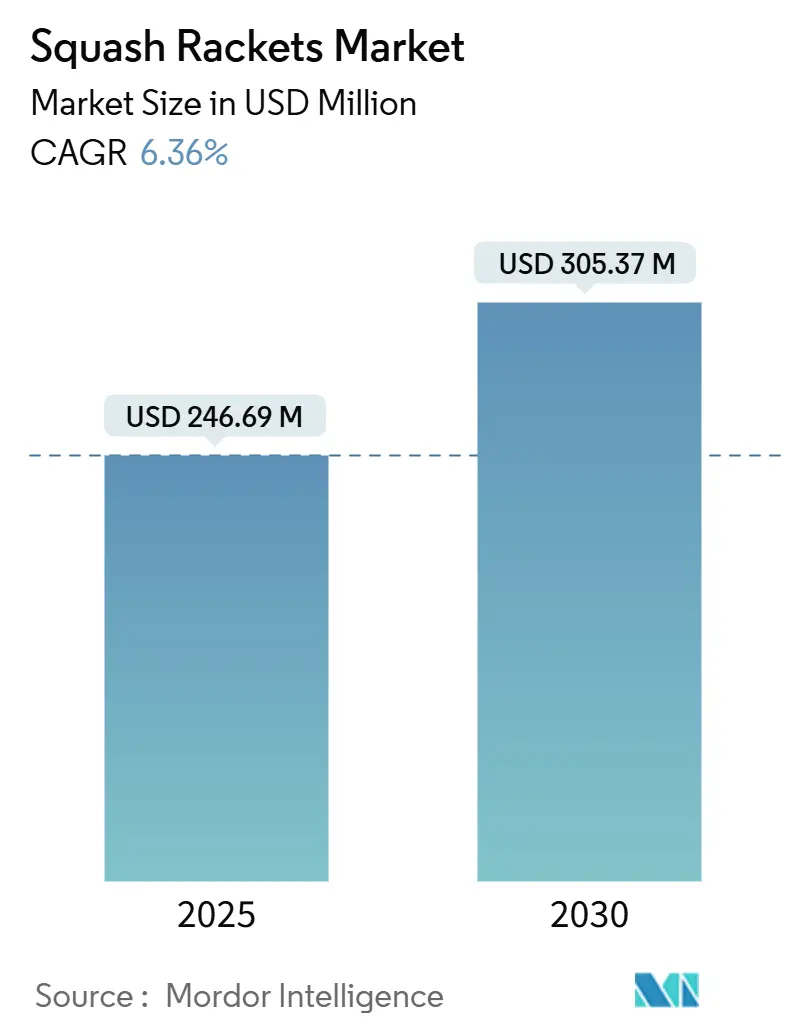
| Market Size (2025) | USD 246.69 Million |
| Market Size (2030) | USD 305.37 Million |
| Growth Rate (2025 - 2030) | 6.36 % |
| Fastest Growing Market | Asia Pacific |
| Largest Market | North America |
| Market Concentration | Medium |
Major Players *Disclaimer: Major Players sorted in no particular order Image © Mordor Intelligence. Reuse requires attribution under CC BY 4.0. | |
Squash Rackets Market Analysis by Mordor Intelligence
The global squash rackets market attained USD 246.69 million in 2025 and demonstrates strong potential for sustained growth through 2030. The market is forecast to expand at a compound annual growth rate (CAGR) of 6.36%, reaching USD 305.37 million by 2030. This growth trajectory is driven by increasing global participation in squash across professional, amateur, and recreational segments, reinforced by heightened awareness of the sport's comprehensive health and fitness advantages. Significant technological advancements in racket manufacturing, particularly the integration of lightweight carbon fiber materials and sophisticated design elements, including vibration-dampening systems and aerodynamic frames, continue to attract players demanding superior precision, enhanced power, and exceptional durability. The substantial expansion of squash infrastructure, encompassing an increasing number of clubs, specialized academies, and modern courts worldwide, creates robust platforms for consistent play and competitive engagement. Furthermore, the market's momentum is amplified by rapidly growing player bases in emerging regions, bolstered by strategic grassroots programs, targeted government sports investments, and systematic development of comprehensive squash facilities.
Key Report Takeaways
- By frame material, carbon fiber held 71.22% of the squash rackets market share in 2024.
- By balance, head-heavy models captured 40.91% share of the squash rackets market size in 2024.
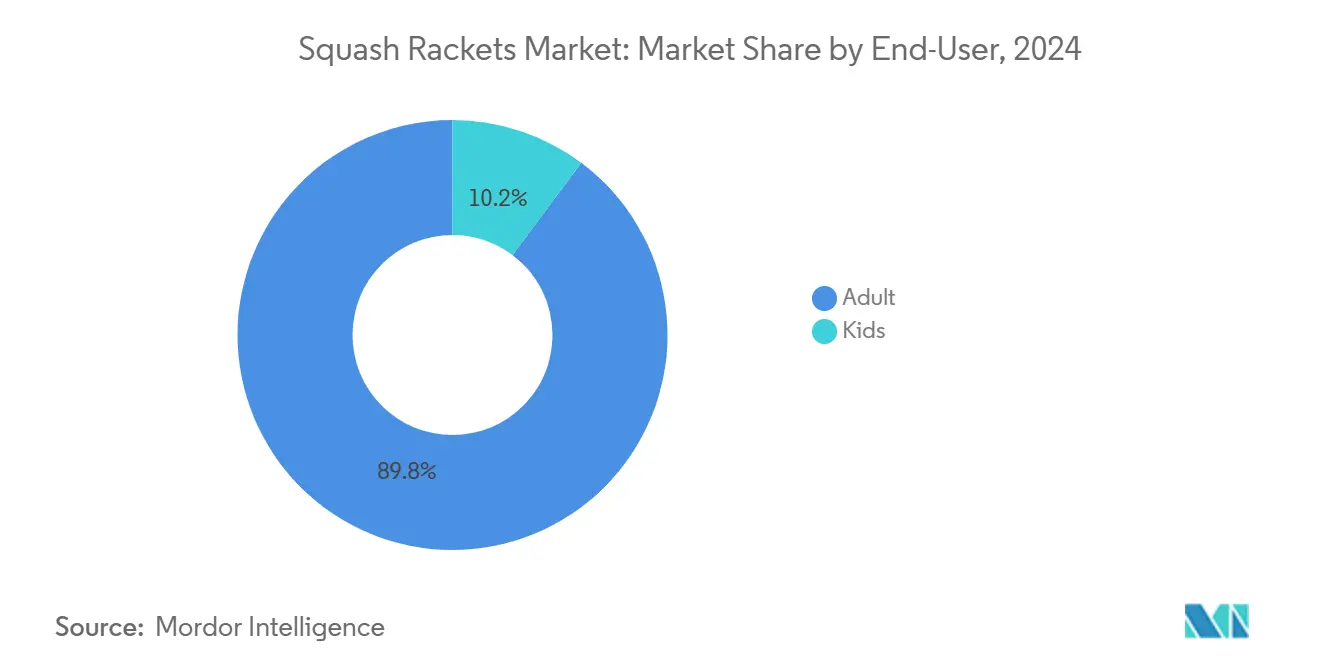
- By end-user, adults accounted for 89.78% of the squash rackets market size in 2024; the kids segment is advancing at a 7.77% CAGR through 2030.
- By distribution channel, offline outlets retained 68.81% revenue share in 2024, while online sales are growing at 8.82% CAGR.
- By geography, North America led with 35.48% of the squash rackets market in 2024; Asia-Pacific is forecast to expand at a 7.89% CAGR between 2025 and 2030.
Note: Market size and forecast figures in this report are generated using Mordor Intelligence’s proprietary estimation framework, updated with the latest available data and insights as of January 2026.
Market Trends and Insights
Drivers Impact Analysis of Squash Rackets Market*
| Driver | (~) % Impact on CAGR Forecast | Geographic Relevance | Impact Timeline |
|---|---|---|---|
| Growing popularity of squash as a fitness sport | +2.1% | Global, with concentration in urban centers | Medium term (2-4 years) |
| Increased participation in indoor sports | +1.8% | North America and Europe, expanding to Asia-Pacific | Short term (≤ 2 years) |
| Expansion of squash clubs and academies | +1.5% | Asia-Pacific core, spill-over to Middle-East and Africa | Long term (≥ 4 years) |
| Advancements in racket technology | +1.2% | Global, led by developed markets | Medium term (2-4 years) |
| Celebrity and athlete endorsements | +0.8% | Global, with regional variations | Short term (≤ 2 years) |
| Growth of recreational sports tourism | +0.6% | Europe and North America, emerging in Asia-Pacific | Long term (≥ 4 years) |
| Source: Mordor Intelligence | |||
Growing Popularity of Squash as a Fitness Sport
The rising adoption of squash as a fitness activity continues to propel growth in the global squash rackets market. The sport's comprehensive benefits, including intense cardiovascular workouts, muscular strength development, and enhanced agility, attract diverse participants across age groups and skill levels. The dynamic, fast-paced nature of squash perfectly aligns with modern fitness trends that emphasize high-intensity activities combined with social interaction. This heightened interest motivates recreational players and fitness enthusiasts to invest in premium equipment, substantially increasing the demand for advanced squash rackets. According to the Singapore Department of Statistics, squash court bookings increased from 66.72 thousand in 2022 to approximately 70.09 thousand in 2023, demonstrating significant market expansion [1]. This growth reflects the widening player base and intensified utilization of squash facilities. The increased frequency of court bookings directly correlates with heightened demand for squash rackets, as individuals ranging from casual players to competitive athletes increasingly integrate the sport into their comprehensive fitness regimens.
Increased Participation in Indoor Sports
The growth of indoor sports participation, especially in squash, drives the global Squash Rackets Market. Indoor sports have become more popular due to their accessibility throughout the year and suitability for urban areas where outdoor space is limited. Squash attracts fitness enthusiasts, professionals, and recreational players through its high-intensity gameplay, creating sustained demand for squash rackets. The market growth is supported by the increasing number of squash courts in clubs, schools, and recreational facilities, along with the sport's integration into fitness programs worldwide. According to Sport England, the number of squash players in England increased from 250,100 in 2023 to 287,000 in 2024 [2]. This growth in participation directly influences equipment sales as both new and existing players purchase rackets, grips, and accessories. The increasing player base also stimulates the development of new facilities and courts, creating additional demand for equipment. This expansion reflects global trends where the rising popularity of squash as both a fitness activity and competitive sport strengthens the market for specialized rackets, encouraging manufacturers and retailers to develop new products.
Expansion of Squash Clubs and Academies
The growth of squash clubs and academies drives the global Squash Rackets Market by increasing participation and demand for quality equipment. These facilities provide essential access for players across skill levels to learn, practice, and compete, expanding the player base. Clubs function as centers for community engagement and coaching, maintaining consistent interest in the sport. Professional training environments encourage players to purchase advanced rackets and accessories that match their developing abilities, increasing market sales. The high standards maintained by these institutions create demand for performance-focused products as players aim to improve their game. In September 2025, World Squash and the World Academy of Sport (WAoS) formed a global partnership to establish the World Squash Academy, an initiative to support squash development worldwide. This partnership aims to improve coaching methods, player development programs, and competitive standards globally. The World Squash Academy initiative is expected to increase investments in club infrastructure, improve training quality, and boost grassroots participation, leading to higher racket demand.
Advancements in Racket Technology
Technological advancements in racket manufacturing drive growth in the global Squash Rackets Market by enhancing player performance and experience across skill levels. Manufacturers focus on research and development to produce rackets that are lighter, stronger, and more durable, using materials such as carbon fiber, graphene, and advanced composites. These materials improve racket stiffness, maneuverability, and power transfer, enabling players to enhance their speed, control, and shot precision. The integration of vibration-damping technologies reduces player fatigue and injury risk, while aerodynamic frame designs improve swing speed and responsiveness during matches. For instance, Head's development of bio-circular carbon fiber prototypes, using ISCC Plus certified materials, demonstrates the industry's movement toward sustainable high-performance composites. This approach combines performance requirements with environmental considerations, reflecting a broader market shift toward sustainable product development. The focus on environmentally conscious manufacturing while maintaining technological advancement appeals to modern consumers and expands market opportunities.
Restraints Impact Analysis of Squash Rackets Market*
| Restraint | (~) % Impact on CAGR Forecast | Geographic Relevance | Impact Timeline |
|---|---|---|---|
| High dependence on court infrastructure | -1.8% | Global, acute in emerging markets | Long term (≥ 4 years) |
| Competition from other racket sports | -1.2% | North America and Europe, spreading globally | Medium term (2-4 years) |
| Niche position and low global visibility | -0.9% | Global, particularly in developing markets | Medium term (2-4 years) |
| High cost of equipment and maintenance | -0.7% | Emerging markets, price-sensitive segments | Short term (≤ 2 years) |
| Source: Mordor Intelligence | |||
High Dependence on Court Infrastructure
The global squash rackets market faces significant constraints due to its heavy reliance on specialized court infrastructure. The construction and maintenance of regulation-compliant squash courts demand substantial investments in space, materials, and specialized construction expertise. Courts require precise specifications for lighting, acoustics, ventilation, and temperature control to ensure optimal playing conditions and player safety. Indoor courts, particularly glass-backed variants used in tournaments, incur high installation and maintenance costs. The infrastructure-intensive nature of squash limits court availability worldwide, especially in urban areas with high population density and limited real estate. This restricted access to courts hampers player participation and, consequently, affects the demand for squash rackets. Additionally, squash facility operators face continuous expenses for court upkeep, including floor refinishing, wall repainting, and lighting system maintenance. The need to comply with evolving safety standards further increases operational costs, potentially deterring new facility development and limiting market expansion.
Competition from Other Racket Sports
The global Squash Rackets Market faces significant constraints from competing racket sports, particularly those with lower entry barriers and broader demographic appeal. Padel and pickleball have gained substantial market share due to their accessibility, simplified rules, and inclusive playing formats that accommodate various age groups and skill levels. According to the International Padel Federation 2024 Report, padel has grown significantly worldwide, with approximately 30 million players, supported by expanding infrastructure and increasing tournament opportunities. These sports offer gentler learning curves and reduced physical demands compared to squash, attracting recreational players, seniors, and social enthusiasts. The substantial financial investments in padel and pickleball facilities, marketing initiatives, and organized competitions redirect consumer interest and expenditure from traditional squash markets. Additionally, these paddle sports require less specialized facilities and involve lower court construction and maintenance costs, enabling rapid expansion, particularly in urban and suburban locations.
*Our forecasts treat driver/restraint impacts as directional, not additive. The impact forecasts reflect baseline growth, mix effects, and variable interactions.
Squash Rackets Market Segment Analysis
By Frame Material:
Carbon Fiber Dominance Drives Performance EvolutionCarbon fiber is expected to command a substantial 71.22% market share in 2024 and is projected to achieve a robust 6.86% CAGR through 2030. This market leadership stems from its exceptional material properties that directly address high-performance sports equipment requirements. The material's outstanding strength-to-weight ratio enables the production of exceptionally powerful yet ultralight rackets, significantly enhancing swing speed and precision for advanced play. Carbon fiber rackets demonstrate superior durability by effectively withstanding mechanical stress, repeated impact, environmental corrosion, and temperature fluctuations, minimizing replacement frequency and maximizing player confidence. These distinctive characteristics deliver superior control, enhanced power output, and exceptional maneuverability, critical performance features valued by both professional and amateur players.
Aluminum maintains a significant market presence in the squash rackets market, particularly dominating entry-level and beginner segments. Its exceptional durability and compelling cost advantages make it the optimal choice for novice players, educational institutions, and training academies operating under strict budget constraints. The competitive pricing of aluminum rackets enables widespread sport adoption by eliminating substantial initial investment barriers, directly supporting increased participation rates. These rackets demonstrate remarkable resilience against the intensive and often imprecise usage characteristic of beginners developing fundamental skills. Furthermore, aluminum rackets offer minimal maintenance requirements while maintaining highly competitive price points across retail channels.


By Balance:
Head Heavy Configuration Leads Traditional PreferencesHead heavy squash rackets captured a 40.91% market share in 2024, driven by their significant popularity among competitive players who prioritize power generation and enhanced stability during intense rallies. These rackets incorporate a strategically shifted balance point toward the head, delivering superior momentum and maximum impact force on each shot. This specialized design proves particularly effective in advanced competitive play where powerful strokes, quick responses, and consistent performance are essential. The exceptional stability of head-heavy rackets minimizes vibration and reduces physical fatigue during extended games, enabling players to maintain optimal endurance and precise shot execution. Players who emphasize offensive strategies with aggressive drives and powerful smashes consistently choose these rackets, making them the preferred equipment among professional athletes and dedicated amateur competitors.
The headlight segment in squash rackets projects a robust CAGR of 6.61% from 2025 to 2030. This substantial growth stems from evolving modern playing styles that prioritize exceptional agility, superior maneuverability, and lightning-quick reactions over raw power. Headlight rackets, engineered with their balance point precisely positioned closer to the handle, enable players to execute faster swings and perform rapid directional changes on the court. This enhanced agility effectively supports advanced defensive techniques and quick volleys essential for maintaining control during extended rallies. The innovative design significantly reduces arm fatigue and minimizes injury risk, attracting a diverse range of players from advanced competitors to intermediate and recreational enthusiasts who value optimal comfort and precise control in their game.
By End-User:
Adult Segment Dominance Masks Youth Market PotentialAdults held an 89.78% share of the global squash rackets market in 2024, reflecting the sport's strong appeal among working-age players in both professional and recreational segments. This dominance stems from adults' greater financial capacity to purchase quality equipment and pay for court access. The sport's integration with fitness goals, competitive opportunities, and social networking particularly resonates with adult players. Their consistent participation in leagues, tournaments, and regular play drives sustained demand for new and replacement rackets. The substantial market share also indicates increased health consciousness among adults seeking alternative fitness activities beyond conventional gym routines.
The kids segment, currently at 10.22% of the global squash rackets market, is expected to grow at a CAGR of 7.77% from 2025 to 2030. This growth trajectory is supported by expanding junior development initiatives and squash's Olympic inclusion, which are increasing youth participation globally. Organizations like England Squash demonstrate effective youth development through programs such as Junior 101, which provides 38 downloadable coaching activities for children aged 5-16 [3]. These structured development programs encourage early participation and skill building, generating demand for junior-specific equipment. The focus on youth development ensures market sustainability by continuously expanding the player base and strengthening squash's global presence.
By Distribution Channel:
Digital Transformation Reshapes Retail DynamicsOffline stores maintained a substantial 68.81% market share in the global squash rackets market in 2024. This dominance stems from the essential advantages physical stores provide during the racket selection. These retail outlets enable players to evaluate products hands-on, assessing the weight, balance, and grip of different rackets, which is vital for selecting precision equipment suited to individual playing styles. Specialized sporting goods stores offer expert consultations, providing personalized recommendations based on skill level, playing preferences, and ergonomic requirements. This combination of physical product testing and knowledgeable staff guidance maintains the strong position of offline stores.
Online channels in the global squash rackets market are projected to grow at a CAGR of 8.82% from 2025 to 2030. This growth stems from expanded e-commerce adoption, offering convenience, extensive product selections, and competitive pricing. Players can access diverse racket options globally, review product specifications, and read user feedback without geographical constraints. Digital marketing strategies, influencer partnerships, and customized shopping experiences enhance consumer engagement. Online retailers benefit from flexible inventory management and targeted promotional capabilities, establishing digital channels as the fastest-growing distribution method in the squash rackets market.
Geography Analysis
North America Squash Rackets Market
North America holds 35.48% market share in the global squash rackets market in 2024, supported by established infrastructure and a strong player base. The region's advanced squash facilities, regular tournaments, and high-quality training academies across the United States, Canada, and Mexico drive market growth. The presence of institutional support from sports organizations and consistent demand for technologically advanced rackets reinforces North America's position as a primary market for manufacturers serving both professional and amateur players.
APAC Squash Rackets Market
Asia-Pacific demonstrates the highest growth rate with a CAGR of 7.89% from 2025 to 2030. This growth stems from expanding middle-class populations, increased sports infrastructure investment, and Olympic preparation programs. China's development is evident through events like the 2024 National Squash Open in Dalian, which featured 400 matches. India, Japan, Australia, and Southeast Asian nations show increased participation through grassroots programs and fitness awareness, contributing to market expansion.
EMEA and South America Squash Rackets Market
Europe continues stable growth through established markets in the United Kingdom, Germany, and France, supported by club-based participation and active squash federations. South America, the Middle East, and Africa present growth opportunities through infrastructure investments and increasing sports participation. Brazil, Argentina, South Africa, and the United Arab Emirates demonstrate growing engagement in squash, offering expansion potential for manufacturers and retailers as these markets develop.

Competitive Landscape
The squash rackets market shows moderate fragmentation, comprising established multinational brands, specialized manufacturers, and new technology-focused entrants. Companies like HEAD Sport GmbH, Tecnifibre SAS, and Amer Sports, Inc. maintain their market positions through global distribution networks, professional player endorsements, and ongoing research and development investments. These companies leverage their brand recognition and customer loyalty through professional tournament sponsorships to strengthen their global presence.
Competition in the market focuses on technological advancement, with manufacturers differentiating their products through material innovation, precision manufacturing, and performance enhancement. Companies develop improvements in racket stiffness, vibration dampening, aerodynamics, and balance to justify premium pricing. These technical enhancements appeal to serious players who seek equipment that offers competitive advantages in power, control, and durability.
The market presents opportunities in smart racket technology, sustainable materials, and direct-to-consumer (D2C) sales channels. Smart rackets with integrated sensors provide performance analytics for players and coaches. Sustainable material options address environmental concerns, while D2C channels enable direct manufacturer-customer relationships and customized products. New market entrants using aerospace manufacturing techniques and precision customization target specific market segments, challenging traditional manufacturing approaches and driving market innovation.
Squash Rackets Industry Leaders
-
HEAD Sport GmbH
-
Sumitomo Rubber Industries
-
Tecnifibre SAS
-
Amer Sports, Inc.
-
Karakal Worldwide
- *Disclaimer: Major Players sorted in no particular order

Squash Rackets Market Companies Covered in this Report
- HEAD Sport GmbH
- Sumitomo Rubber Industries (Dunlop Sport)
- Tecnifibre SAS
- Amer Sports, Inc. (Wilson Sporting Goods)
- Prince Global Sports
- Karakal Worldwide
- Unsquashable
- Harrow Sports
- Black Knight
- Eye Rackets
- Salming Sports
- Babolat
- Ashaway Line & Twine
- Oliver Sport
- One Sports s.r.l. (EYE)
- Ektelon
- Grays of Cambridge (Mantis)
- Artengo (Decathlon)
- VICTOR International
- Pacific Sport
Recent Industry Developments in Squash Rackets Market
- May 2025: Access Courts launched modular squash courts in the United States to address the market demand for affordable, quality court construction. These court designs aim to increase the accessibility and affordability of squash facilities across the country.
- September 2024: Carboflex introduced the X-Top V2 racket, weighing 120 grams, making it the lightest Carboflex model to date. The racket combines minimal weight with power output, designed for players who employ an aggressive playing style.
- August 2024: Dunlop launched new FX rackets on pdhsports.com. The rackets feature a 128g frame weight, head-heavy balance, 500 cm² head size, and a 14x19 stringing pattern.
Global Squash Rackets Market Report Scope
| Carbon Fiber |
| Aluminum |
| Others |
| Head Heavy |
| Head Light |
| Even Balance |
| Adult |
| Kids |
| Offline Stores |
| Online Stores |
| North America | United States |
| Canada | |
| Mexico | |
| Rest of North America | |
| Europe | Germany |
| United Kingdom | |
| France | |
| Spain | |
| Rest of Europe | |
| Asia-Pacific | China |
| Japan | |
| Australia | |
| Indonesia | |
| Rest of Asia-Pacific | |
| South America | |
| Middle East and Africa |
| By Frame Material | Carbon Fiber | |
| Aluminum | ||
| Others | ||
| By Balance | Head Heavy | |
| Head Light | ||
| Even Balance | ||
| By End-User | Adult | |
| Kids | ||
| By Distribution Channel | Offline Stores | |
| Online Stores | ||
| By Geography | North America | United States |
| Canada | ||
| Mexico | ||
| Rest of North America | ||
| Europe | Germany | |
| United Kingdom | ||
| France | ||
| Spain | ||
| Rest of Europe | ||
| Asia-Pacific | China | |
| Japan | ||
| Australia | ||
| Indonesia | ||
| Rest of Asia-Pacific | ||
| South America | ||
| Middle East and Africa | ||
Key Questions Answered in the Report
How large will the squash rackets market be by 2030?
Forecasts indicate revenue of USD 305.37 million by 2030 as the sector compounds at 6.36% CAGR.
Which frame material captures the highest market share?
Carbon fiber accounted for 71.22% of global sales in 2024 owing to its superior strength-to-weight characteristics.
What region is growing fastest for squash rackets?
Asia-Pacific is projected to post a 7.89% CAGR through 2030, propelled by infrastructure investments and Olympic preparation.
Why are online sales of rackets rising?
High-resolution product visuals, expert reviews, and generous return policies reduce purchase risk, driving an 8.82% CAGR for e-commerce channels.