
Market Overview
| Study Period | 2021 - 2031 |
|---|---|
| Market Size (2026) | USD 18.76 Billion |
| Market Size (2031) | USD 24.55 Billion |
| Growth Rate (2026 - 2031) | 5.52 % |
| Fastest Growing Market | Asia-Pacific |
| Largest Market | North America |
| Market Concentration | Medium |
Major Players *Disclaimer: Major Players sorted in no particular order Image © Mordor Intelligence. Reuse requires attribution under CC BY 4.0. | |
Winter Sports Equipment Market Analysis by Mordor Intelligence
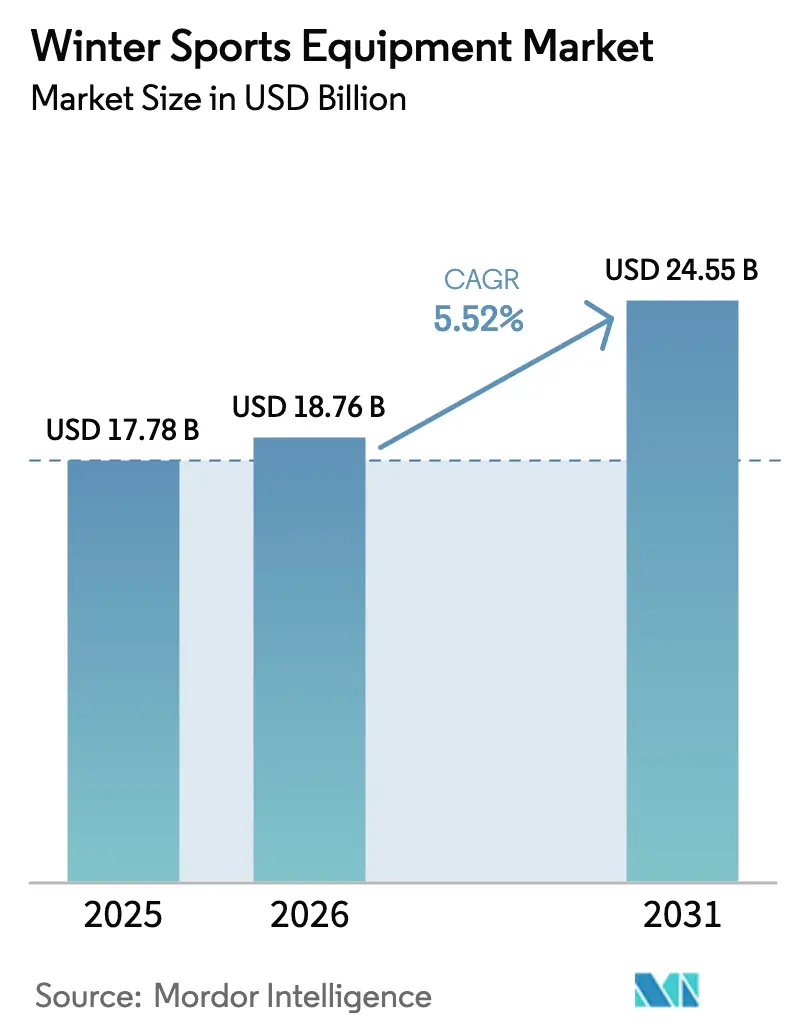
The winter sports equipment market size was valued at USD 17.78 billion in 2025 and estimated to grow from USD 18.76 billion in 2026 to reach USD 24.55 billion by 2031, at a CAGR of 5.52% during the forecast period (2026-2031). China's ice-and-snow economy initiative drives this growth, increased Asian participation following the Olympics, and consistent premium product demand in established markets. Technological advancements in equipment, including carbon-fiber composites and sensor-integrated textiles, contribute to higher average selling prices and enhanced performance capabilities. The market benefits from growing female participation and the shift of fitness enthusiasts toward outdoor activities, particularly boosting sales in apparel and safety equipment. However, market growth faces challenges from weather unpredictability, increasing resort fees, and entry barriers for beginners, leading to higher demand for rental services and second-hand equipment. The competitive landscape maintains equilibrium between large multinational companies with extensive research and development capabilities and specialized manufacturers serving specific segments like freestyle, backcountry, and environmentally conscious consumers.
Key Report Takeaways
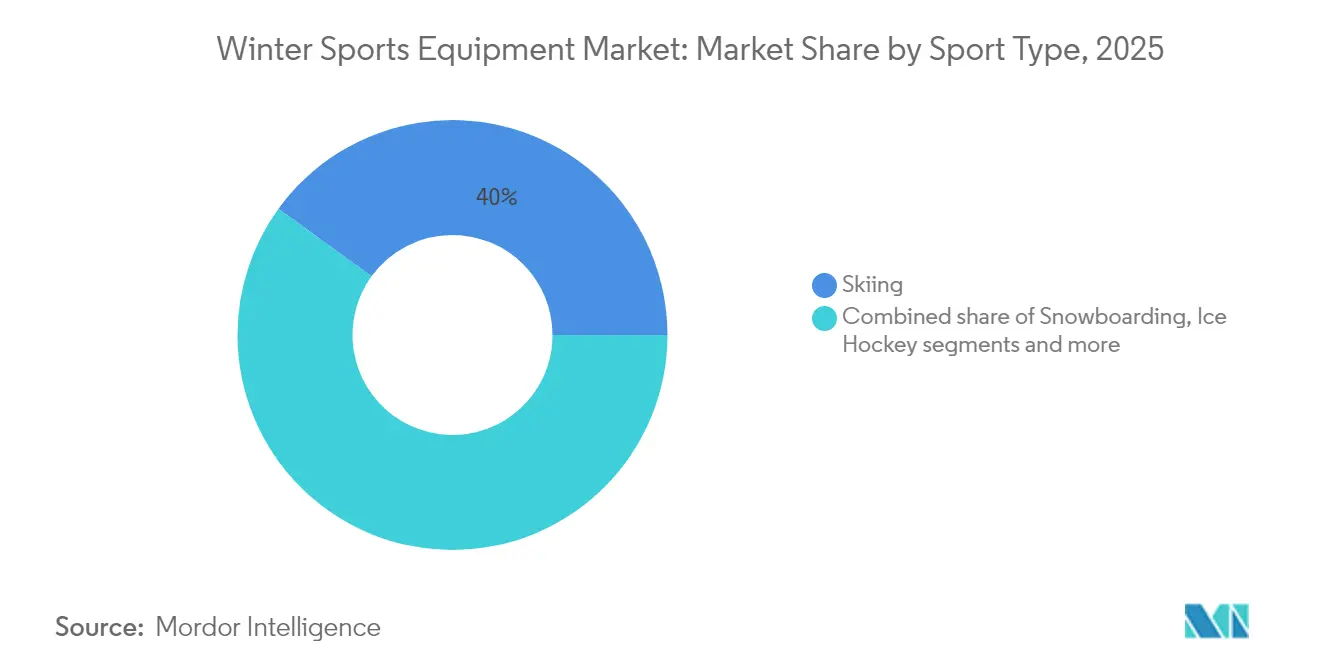
- By sports type, skiing led with 40.02% of the winter sports equipment market share in 2025; snowboarding is forecast to grow at a 6.05% CAGR between 2026-2031.
- By equipment category, skis and snowboards captured 42.10% of 2025 revenue, while apparel and accessories are set to expand at a 6.45% CAGR through 2031.
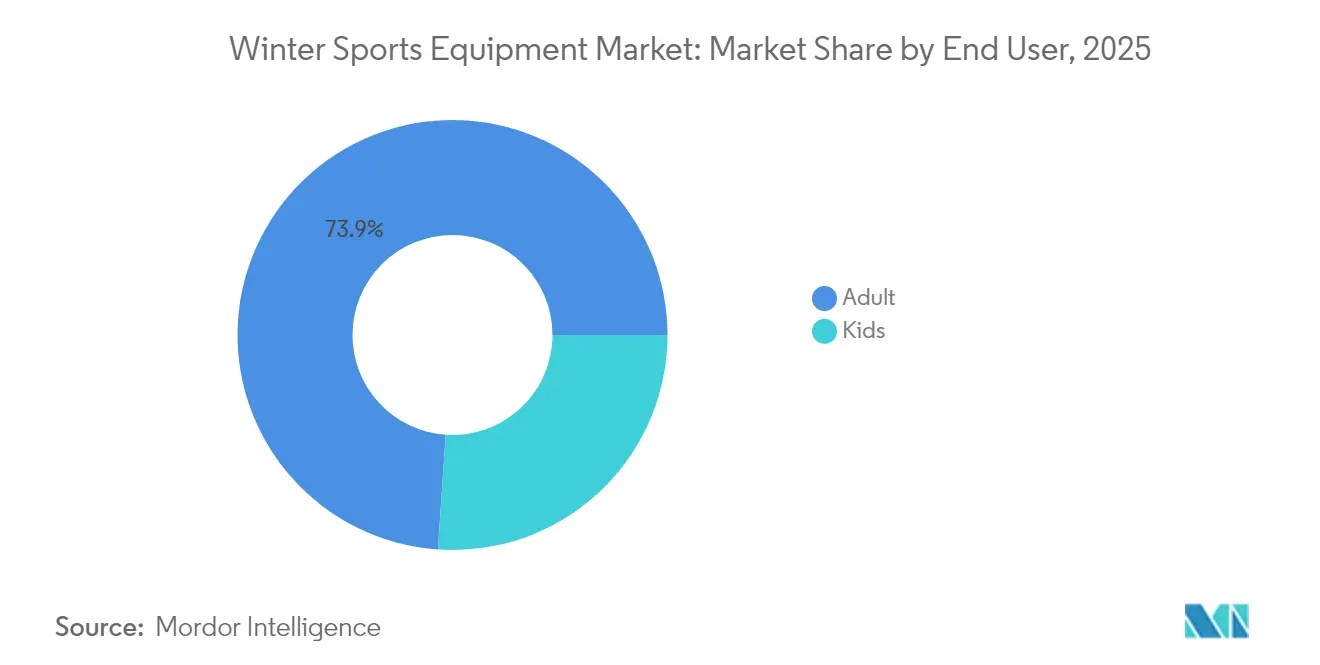
- By end user, adults accounted for 73.92% of the 2025 demand; the kids segment is poised for a 6.75% CAGR to 2031.
- By distribution channel, offline outlets held 68.90% share in 2025; online stores will post a 7.05% CAGR over the forecast period.
- By geography, North America commanded 36.10% of 2025 revenue, whereas Asia-Pacific is projected to lead growth with a 7.30% CAGR to 2031.
Note: Market size and forecast figures in this report are generated using Mordor Intelligence’s proprietary estimation framework, updated with the latest available data and insights as of 2026.
Market Trends and Insights
Drivers Impact Analysis of Winter Sports Equipment Market*
| Driver | (~) % Impact on CAGR Forecast | Geographic Relevance | Impact Timeline |
|---|---|---|---|
| Health and Fitness Awareness | +1.0% | Global, with strongest impact in North America and Europe | Medium term (2-4 years) |
| Influence of Winter Sports Events | +0.7% | APAC core, spill-over to global markets | Short term (≤ 2 years) |
| Technological Advancements in Equipment Production | +0.9% | Global, led by European manufacturing hubs | Long term (≥ 4 years) |
| Growing Popularity of Backcountry and Freestyle Disciplines | +0.6% | North America and Europe, emerging in APAC | Medium term (2-4 years) |
| Expanding Winter Tourism and Infrastructure | +1.0% | APAC leading, followed by North America expansion | Long term (≥ 4 years) |
| Development of Sustainable and Eco-Friendly Winter Sports Equipment | +0.8% | Global, led by Europe and North America | Long term (≥ 4 years) |
| Source: Mordor Intelligence | |||
Health and Fitness Awareness
The growing focus on wellness is transforming winter sports participation patterns, as more people choose outdoor activities over traditional gym workouts for their physical and mental well-being. Consumers increasingly view winter sports equipment as long-term health investments, driving significant demand for premium gear across all categories. This shift particularly benefits the technical apparel and protective equipment segments, where advanced materials and ergonomic designs deliver superior performance and safety features. Equipment manufacturers are integrating sophisticated health monitoring capabilities into their products, with smart textiles and sensors becoming standard features across product lines. Additionally, the rising number of older participants seeking low-impact winter activities continues to drive innovation in comfort-oriented equipment, expanding the market for specialized gear designed for this demographic.
Influence of Winter Sports Events
Major winter sports events significantly influence global equipment demand patterns, creating sustained market opportunities across multiple regions. International brands strategically capitalize on this momentum, exemplified by Bogner's ambitious expansion plan to establish 80 retail stores in China within five years - a direct response to the growing equipment demand stimulated by Olympic exposure. The events' impact transcends geographical boundaries, with global broadcast coverage inspiring equipment purchases in emerging winter sports markets previously untapped. Equipment manufacturers carefully orchestrate product launches to coincide with major competitions, utilizing athlete endorsements and performance achievements to establish premium pricing for advanced technologies. These international competitions generate predictable demand cycles that manufacturers systematically integrate into their long-term production planning and inventory management frameworks, ensuring optimal market responsiveness.
Technological Advancements in Equipment Production
The widespread adoption of carbon fiber materials and AI-based modeling techniques has significantly reduced research and development timelines in the sports equipment industry. This technological advancement has enabled manufacturers to incorporate premium features, previously exclusive to professional athletes, into consumer products at accessible price points [1]. Modern helmets and jackets now integrate smart textiles with sophisticated crash sensors and fall-alert systems, fundamentally transforming traditional safety gear into intelligent protection devices. In response to environmental concerns, companies are increasingly transitioning to recyclable composites in their manufacturing processes. Several European manufacturing facilities have implemented comprehensive product recycling programs, demonstrating a commitment to sustainable production practices.
Growing Popularity of Backcountry and Freestyle Disciplines
The backcountry skiing equipment market has grown significantly due to changes in winter sports participation patterns. The growth has expanded beyond traditional alpine segments into freestyle activities, as younger participants seek adventure through winter sports. According to the Canadian Avalanche Centre, this represents a long-term change in consumer behavior rather than a seasonal trend. Equipment manufacturers have responded by developing versatile gear that incorporates features from multiple disciplines, creating hybrid products for various skiing styles. The increased participation has also driven higher demand for safety equipment as users become more aware of backcountry risks.
Restraints Impact Analysis of Winter Sports Equipment Market*
| Restraint | (~) % Impact on CAGR Forecast | Geographic Relevance | Impact Timeline |
|---|---|---|---|
| High cost of advanced equipment | –0.9% | Global; acute in emerging markets | Short term (≤ 2 years) |
| Learning curve and skill barriers | –0.4% | Emerging APAC and developing regions | Medium term (2-4 years) |
| Competition from alternative recreation | –0.6% | North America and Europe | Medium term (2-4 years) |
| Seasonal and weather dependency | –1.2% | Global; latitude/elevation dependent | Long term (≥ 4 years) |
| Source: Mordor Intelligence | |||
High Cost of Advanced Fitness Equipment
The escalating costs of winter sports equipment significantly restrict participation among middle-class consumers, fundamentally altering market demographics. Increasing lift ticket prices at major resorts during peak seasons, combined with substantial equipment investments ranging from skis to protective gear, create insurmountable financial barriers to entry. Manufacturers face complex challenges in balancing advanced product development costs with market accessibility, particularly in introducing new technology and materials. While the strategic focus on affluent consumers enables premium product development and innovation, it simultaneously constrains overall market growth as price-sensitive consumers increasingly migrate to more affordable recreational alternatives. The equipment rental market continues to expand rapidly as consumers adopt cost-effective participation strategies, transforming traditional retail channels and forcing manufacturers to adapt their direct sales approaches.
Learning Curve and Skill Barriers
The winter sports market faces growth limitations due to participation barriers, particularly in emerging regions where participants lack family traditions or peer support. Equipment technology advancements create performance differences between entry-level and advanced products, which can discourage new participants. The need for professional instruction adds costs and scheduling difficulties, while backcountry activities require specialized safety training. Equipment manufacturers develop simplified products with safety features to address these barriers, though these modifications may reduce performance aspects valued by experienced users. These challenges are especially evident in the Asia-Pacific region, where winter sports are relatively new recreational activities rather than established traditions.
*Our forecasts treat driver/restraint impacts as directional, not additive. The impact forecasts reflect baseline growth, mix effects, and variable interactions.
Winter Sports Equipment Market Segment Analysis
By Sports Type:
Skiing Leads Despite Snowboarding AccelerationSkiing commands 40.02% of the winter sports equipment market revenue in 2025, driven by extensive resort infrastructure, established training programs, and consistent participation across all age demographics. The skiing equipment segment continues its growth trajectory, supported by regular equipment replacement cycles every 3-5 years and technological advancements in material composition. The snowboarding segment, representing a smaller market share, demonstrates robust growth at 6.05% CAGR, fueled by expanding youth participation, significant investments in terrain park facilities, and rising adoption rates across Asian markets, particularly in Japan and South Korea.
The market exhibits significant fragmentation in participation patterns, with backcountry touring and cross-country skiing emerging as key components of the "others" category. These activities, alongside snowshoeing and winter hiking, experience increased popularity due to growing consumer focus on outdoor fitness and adventure sports. Manufacturers have responded by implementing dual-focus product development strategies, allocating resources between high-performance racing skis for competitive segments and versatile, all-terrain boards that accommodate both freestyle maneuvers and powder conditions in a single design.

By Equipment Category:
Technical Innovation Drives Apparel GrowthIn 2025, skis and snowboards made up 42.10% of total sales, buoyed by a demand for high-performance gear and a predictable replacement cycle of three to five years. Innovations like carbon fiber reinforcements, hybrid wood-foam cores, and rocker-camber profiles are captivating both seasoned athletes and casual users. Boots, bindings, and protective gear are witnessing steady volume growth, bolstered by safety regulations and features such as heat-moldable liners, BOA fit systems, and lightweight carbon composites. Furthermore, the shift towards sustainable materials, including bio-based resins and recycled components, is resonating with consumers' growing preference for eco-friendly performance gear.
Meanwhile, the apparel and accessories segment is on an upward trajectory, growing at a 6.45% CAGR. This growth is fueled by consumers' increasing adoption of performance outerwear—ranging from breathable shells to insulated layers—for both winter sports and daily urban activities. Brands are leveraging premium materials like stretch Gore-Tex, Primaloft, and antimicrobial fabrics, allowing them to offer high-margin products that prioritize function, durability, and comfort. The appeal of these products extends beyond the slopes, thanks to their year-round usability. Concurrently, companies are bolstering brand loyalty through circular initiatives, including recycling programs, repair services, and sustainable packaging.
By End User:
Youth Development Programs Drive Kids Segment GrowthThe adult segment dominates the market with a 73.92% share in 2025, driven by established purchasing power and regular equipment replacement cycles. The kids segment is projected to grow at a 6.75% CAGR through 2031, supported by youth development programs, family winter sports initiatives, and partnerships with educational institutions. This growth in youth participation ensures market sustainability, as children often continue winter sports into adulthood, providing consistent demand for equipment manufacturers.
Product development for young users focuses on safety, adjustable sizing, and cost-effective solutions to address growth phases and family budgets. Industry efforts to expand participation beyond traditional winter sports families include investments by ski resorts and equipment manufacturers in youth programs offering equipment access and training. In China, the growth in youth participation is particularly notable, with first-generation winter sports families prioritizing their children's equipment and activities.
By Distribution Channel:
Digital Transformation Accelerates Online GrowthOffline retail stores hold 68.90% of the market share in 2025, as winter sports equipment requires hands-on evaluation and professional fitting services for optimal performance. Online retail stores are expected to grow at a 7.05% CAGR through 2031, supported by enhanced product information, virtual fitting technologies, and manufacturers' direct-to-consumer initiatives. The distribution landscape continues to evolve while addressing the sector's requirements for expert consultation and technical support.
Retailers are adopting hybrid models that integrate online convenience with in-store expertise through omnichannel strategies. Major brands' direct-to-consumer programs affect traditional retail partnerships while creating opportunities for specialized retailers with superior service capabilities. China's developed e-commerce infrastructure particularly benefits this transformation, with online retail reach surpassing physical store coverage in emerging winter sports markets. Equipment manufacturers continue to develop digital sales capabilities while maintaining wholesale partnerships to ensure comprehensive market coverage and customer support.
Geography Analysis
North America Winter Sports Equipment Market
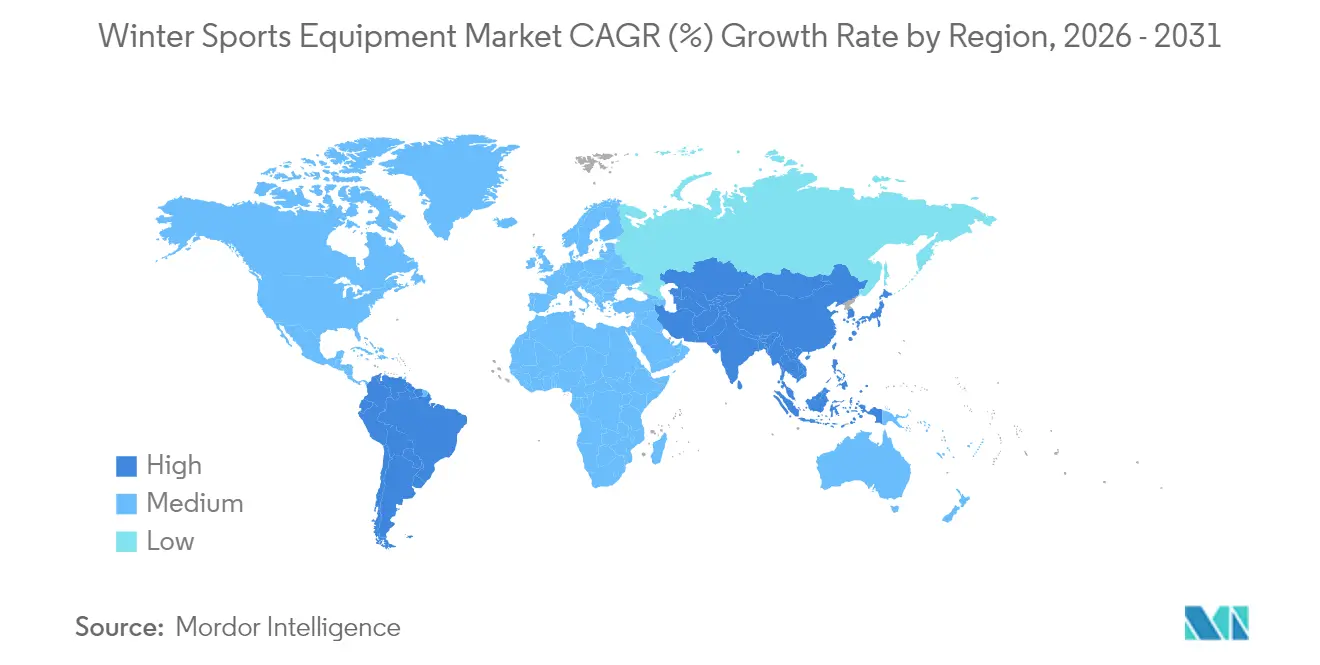
North America maintains a commanding 36.10% market share in 2025, underpinned by decades of strategic winter sports infrastructure development and robust consumer spending on premium equipment. The region's projected 5.60% CAGR through 2031 reflects a mature market characterized by systematic equipment replacement cycles and adoption of advanced technologies. Alterra Mountain Company's substantial USD 300 million capital investment program reinforces market stability by enhancing resort accessibility, modernizing facilities, and elevating the overall visitor experience across multiple destinations.
APAC Winter Sports Equipment Market
The Asia-Pacific region dominates the market with a 7.30% CAGR, driven by China's target to establish a 1 trillion-yuan ice-and-snow economy by 2025. Government initiatives, Bogner's expansion of 80 new retail locations, and increased e-commerce adoption by new winter sports participants fuel this growth. The market expansion continues as more countries embrace winter sports. In January 2024, India's Ministry of Youth Affairs and Sports approved the country's participation in the 9th Asian Winter Games (AWG) 2025, scheduled for February 7-14 in Harbin, China .
Europe Winter Sports Equipment Market
The European winter sports market benefits from a strong sporting culture and ongoing technological advancements, along with sustainability initiatives that encourage equipment upgrades. The European Union's ski and snowboard production has shown growth, with Austria maintaining its position as the leading manufacturer and demonstrating robust export performance to markets outside the EU . Furthermore, Scandinavian nations are seeing a surge in backcountry and cross-country skiing participation, driving up demand for lightweight gear and specialized apparel.
Regulatory Landscape
Compliance and reporting obligations are becoming more visible across the winter sports equipment value chain, particularly around responsible sourcing and sustainability disclosures. For example, Bauer Hockey Canada publishes a Modern Slavery Report aligned with legislative transparency requirements, and this due diligence can influence supplier selection and the documentation practices used for equipment, textiles, and accessories.
Beyond mandatory compliance, voluntary frameworks and standardized sustainability reporting are gaining share as a de facto expectation for premium brands selling into regulation-heavy markets. Fischer Sports has implemented a sustainability strategy with GRI-compliant sustainability reporting, as reflected in its 2026 sustainability communications, while manufacturers such as Stoeckli Swiss Sports AG have set decarbonization and recyclability goals that affect materials choices, product design, and end-of-life programs for skis, boards, and related components.
Competitive Landscape
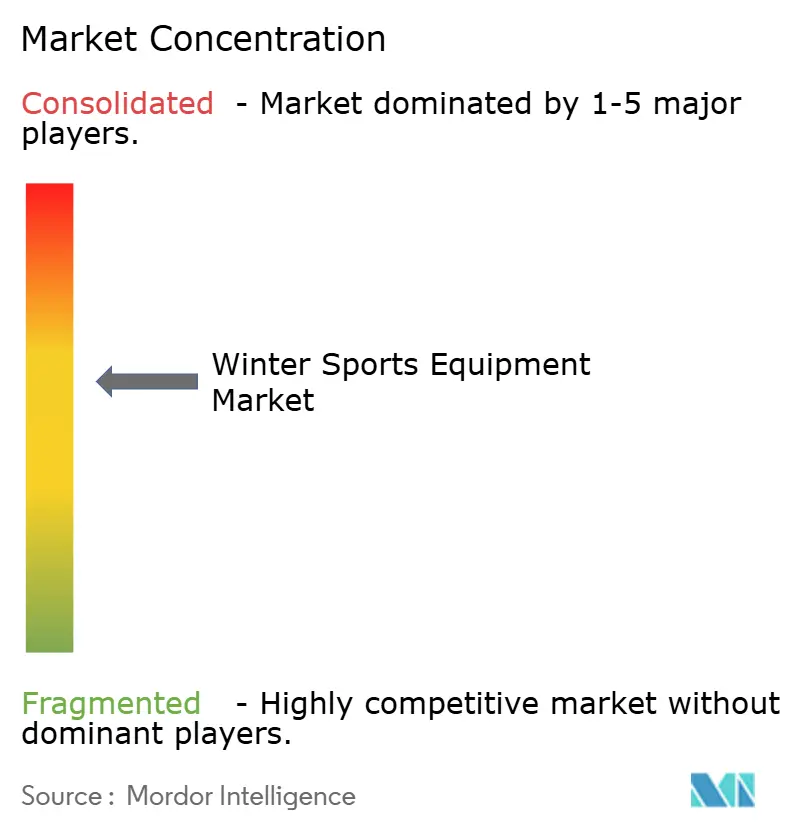
The winter sports equipment market demonstrates moderate consolidation, characterized by a dynamic competitive landscape where established multinational corporations compete with specialized manufacturers and regional players. Major companies such as Stockli Swiss Sports AG, Fischer Sports, Bauer Hockey, LLC, and Amer Sports maintain their market positions through extensive brand portfolios and robust global distribution networks. These companies navigate current market challenges through strategic partnerships, product diversification, and continuous innovation in their manufacturing processes.
Technology integration has emerged as a critical competitive differentiator in the market, with manufacturers making substantial investments in AI-driven materials research, smart textiles, and connected equipment capabilities. These technological advancements enable real-time performance monitoring and enhanced safety features, meeting the growing consumer demand for smart winter sports equipment. Companies that successfully balance innovation with manufacturing efficiency gain significant market advantages, particularly as premium features transition from differentiators to standard offerings across product lines.
The market presents significant growth opportunities across multiple segments, including sustainable product development, direct-to-consumer digital sales platforms, and expansion into emerging markets with first-time winter sports participants. Climate change impacts have reshaped market dynamics, creating advantages for companies developing weather-adaptable products and supporting infrastructure modifications. Organizations that demonstrate adaptability to changing weather patterns and invest in sustainable manufacturing practices position themselves favorably against competitors who remain dependent on traditional seasonal patterns and conventional production methods.
Winter Sports Equipment Industry Leaders
-
Stockli Swiss Sports AG
-
Bauer Hockey, LLC
-
Fischer Sports
-
Graf Skates AG
-
Amer Sports
- *Disclaimer: Major Players sorted in no particular order
Winter Sports Equipment Market Companies Covered in this Report
- Stockli Swiss Sports AG
- Bauer Hockey, LLC
- Fischer Sports
- Graf Skates AG
- Groupe Rossignol
- Amer Sports
- Decathlon SA
- Burton Snowboards
- Head NV
- K2 Sports
- Sport Maska Inc.
- Uvex Group
- Never Summer Industries
- Oakley, Inc.
- POC Sports
- Black Diamond Equipment, Ltd
- DPS Skis
- Capita Snowboards
- Tecnica Group
- Riedell Shoes, Inc.
Market Opportunities and Future Outlook
Materials innovation and measurable footprint reductions are creating opportunities for premium upgrades across both hardgoods and protective gear, while also improving access to sustainability-led tenders and retail programs. Fischer Sports showcased product-level decarbonization with THE CURV GT 85 REDEFINE, citing a 36% lower carbon footprint versus previous models, and it also points to process and material changes in hockey gear such as recycled foams and a continuous carbon fiber injection process, which support higher-performance products with clearer environmental claims.
Circularity and recyclability programs also offer a differentiation route in mature skiing markets where replacement cycles are already established. Stoeckli Swiss Sports AG has articulated targets such as net zero Scope 1 and 2 emissions by 2030 and an ambition for fully recyclable skis by 2035, which is shaping R&D toward recyclable composites and take-back readiness. Collaborative circularity initiatives, including the WINTRUST project involving Fischer Sports and the University of Leoben, point to more practical recycling and material recovery efforts, which can expand aftermarket services (repair, refurbishment, and resale) and help strengthen brand-controlled channels as rental and second-hand participation grows.
Recent Industry Developments in Winter Sports Equipment Market
- July 2026: Fischer Sports GmbH and the German fastening-technology group fischer announce a partnership for international ski jumping through 2030, featuring the fischer DuoPower universal anchor on competition skis. The collaboration broadens brand reach and co developed technical branding in elite ski jumping. It also reinforces premium positioning and differentiates high end equipment.
- July 2026: Bauer Hockey announces an eight year partnership extension with Hockey Canada, effective July 1, 2026, covering official equipment, team apparel, and the launch of a new Team Canada jersey for the 2026-27 season. The arrangement strengthens market access in Canada, expands official product lines, and drives brand prestige through national team exposure.
- April 2026: Stöckli Swiss Sports AG announced its appointment as the official ski partner of the FIS Alpine World Ski Championships Crans Montana 2027. The sponsorship ties product development to a high visibility global event and supports premium ski models and brand loyalty among enthusiasts and participants.
Winter Sports Equipment Market Report Scope and Research Methodology
Market Definition and Coverage
This market covers revenue earned from winter sports equipment sold to consumers and institutional buyers, across skiing, snowboarding, skating, and ice hockey use cases. It includes hardgoods and related gear sold through offline and online channels, measured in value terms in USD.
Scope exclusions: Excludes spend on lift tickets, lessons, resort services, and travel, and it also excludes non-equipment operating costs such as rink time and facility maintenance.
Segments Covered in This Report
- By Sports Type
- Skiing
- Snowboarding
- Ice Hockey
- Figure Skating
- Other Sports Type
- By Equipment Category
- Skis and Snowboards
- Boots and Bindings
- Protective Gear and Helmets
- Apparel and Accessories
- Other Equipment Category
- By End User
- Adult
- Kids
- By Distribution Channel
- Offline Retail Stores
- Online Retail Stores
- By Geography
- North America
- United States
- Canada
- Mexico
- Rest of North America
- Europe
- Germany
- United Kingdom
- Italy
- France
- Spain
- Sweden
- Norway
- Finland
- Switzerland
- Rest of Europe
- Asia-Pacific
- China
- Japan
- Australia
- South Korea
- Rest of Asia-Pacific
- South America
- Middle East and Africa
- North America
Data Sources, Market Sizing, and Validation
Desk Research
Desk research was used to map the participation base, seasonality patterns, and trade flows that typically influence winter sports equipment demand. We reviewed public sources including National Ski Areas Association participation releases, U.S. Census Bureau trade statistics, Eurostat trade data, and Statistics Canada retail and consumer indicators to anchor directional demand and pricing movements.
To translate these signals into revenue, we also screened company annual reports, investor presentations, and reputable press coverage on product launches, supply constraints, and retail inventory patterns. When needed, paid subscriptions were used for company financials and intelligence, patent databases were used to track materials and safety-related filings, and shipment-level import and export views were used to sanity check country-level flows. The desk sources referenced here are illustrative only, and additional public and paid sources were used during collection, validation, and clarification.
Primary Interviews and Surveys
Primary interviews focused on verifying real-world selling prices, replacement cycles, and channel mix, because these can shift by geography and by winter conditions within a season. We spoke with manufacturers, distributors, specialty retailers, and rental operators across APAC, EMEA, and the Americas. We also collected buyer-side input from clubs, academies, and facility operators to understand what drives unit volume versus value.
Distribution of primary research fieldwork respondents
| Company type | Respondent position | Region |
|---|---|---|
| Top tier: 28% | CXOs: 13% | APAC: 43% |
| Mid tier: 56% | Functional/Unit leaders: 42% | EMEA: 33% |
| Smaller Players: 16% | Managers: 45% | Americas: 24% |
Market-Sizing & Forecasting
Market sizing starts from a top-down build where participation and facility signals are translated into an addressable demand pool, and then filtered through equipment replacement and purchasing behavior for each winter sport. We corroborate the totals using targeted bottom-up checks, such as sampled average selling price ranges by category, retail channel checks, and partial supplier roll-ups in countries where disclosures are clearer.
Key inputs used in the model include skier and snowboarder visit trends, ice rink and program activity where it is reported, and the mix shift between purchase and rental fleets. We also track category-level price movement for items such as skis, boards, boots, bindings, helmets, and protective gear. Weather variability and the timing of the winter season were treated as practical demand modifiers, since a short season can push purchases into the next cycle. Where local data is thin, gaps are handled using proxy ratios from comparable markets, followed by a re-check with primary feedback before values are finalized.
For forecasting, we used scenario analysis supported by variable-level expectations gathered from expert calls, so the outlook reflects different season strength and participation outcomes rather than a single straight-line trend. The final forecast also considers safety awareness trends, product refresh cycles, and the gradual shift toward online sales for certain accessories.
Data Validation & Update Cycle
Validation is done through triangulation across independent signals, followed by variance checks at the country and regional levels so outliers are identified early. We compare implied per-participant spend, category splits, and channel shares against ranges described by interviewees, then review anomalies in more than one analyst pass before sign-off.
Reports are refreshed annually, with interim updates when material events occur, such as large demand shocks, major trade disruptions, or sharp price movements that change the value picture. Before delivery, a final analyst review is completed so the client receives the latest updated view based on the most recent data and follow-up calls where needed.
Mordor Intelligence's Winter Sports Equipment Market Size Measured Against Other Published Estimates
Different published numbers for winter sports equipment often reflect what each source counts as equipment revenue, which base years they select, and how they treat pricing that changes within seasonal categories. The mix of sports also matters, since skating, hockey, and alpine equipment can have different price points and replacement patterns.
Apparel and accessories are sometimes included in other estimates, but they are within Mordor Intelligence's scope for this market, which can raise totals versus figures that only count hardgoods such as skis, boards, and boots. Other gaps are driven by how rental fleets are treated (counting purchase of rental inventory versus usage fees), how online discounting is reflected in ASP progression, and how quickly the model is refreshed after a strong or weak winter season.
Benchmark comparison
| Source | Market Size | Gaps in Research Methodology |
|---|---|---|
| Mordor Intelligence | USD 18.76 B (2026) | |
| Global Consultancy A | USD 16.90 B (2026) | Uses a hardgoods-only definition and applies flat average prices across sports, which can understate higher-value categories like protective gear and premium skate and hockey setups. |
| Industry Association B | USD 21.40 B (2026) | Blends equipment with some winter recreation services and uses optimistic season strength assumptions without consistent adjustment for rental purchase cycles and channel discounting. |
The spread across the three figures is mainly explained by scope and how value is constructed from volumes and prices, followed by how seasonal volatility is handled. By tying inputs to participation and purchase behavior, and then cross-checking price and channel assumptions with primary contacts, the resulting market value stays traceable to clear steps that can be repeated when new season data arrives.
Key Questions Answered in the Report
What is the current size of the winter sports equipment market?
The market is valued at USD 18.76 billion in 2026 and is projected to reach USD 24.55 billion by 2031.
Which sports type dominates sales?
Skiing leads with 40.02% of 2025 revenue, although snowboarding is growing the fastest at a 6.05% CAGR.
How is technology changing equipment design?
Carbon-fiber composites, AI-driven flex tuning, and embedded sensors are elevating performance while enabling real-time safety monitoring.
What are the main challenges facing manufacturers?
High retail prices, climate-induced season shortening, and competition from alternative leisure activities restrain mass-market expansion.
Which channel is growing quickest?
Online retail stores are advancing at a 7.05% CAGR as virtual fitting tools and direct-to-consumer models gain acceptance.