
Market Overview
| Study Period | 2021 - 2031 |
|---|---|
| Forecast Data Period | 2026 - 2031 |
| Base Year Market Size (2025) | USD 0.92 Billion |
| Market Size (2026) | USD 1.02 Billion |
| Market Size (2031) | USD 1.69 Billion |
| Growth Rate (2026 - 2031) | 10.64 % |
| Market Concentration | High |
Major Players *Disclaimer: Major Players sorted in no particular order Image © Mordor Intelligence. Reuse requires attribution under CC BY 4.0. | |
South America Dairy Alternatives Market Analysis by Mordor Intelligence
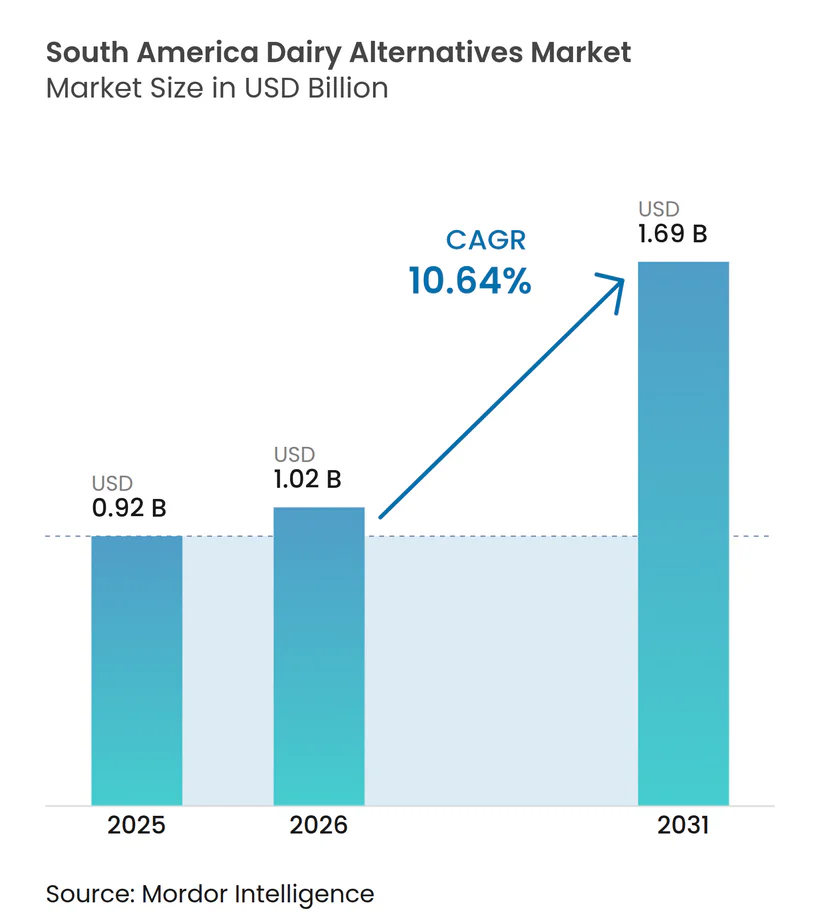
The South America dairy alternatives market size was valued at USD 0.92 billion in 2025 and estimated to grow from USD 1.02 billion in 2026 to reach USD 1.69 billion by 2031, at a CAGR of 10.64% during the forecast period (2026-2031). Demand is moving beyond consumers who avoid lactose and now includes flexitarian households seeking more choice in everyday food and beverage purchases. Retail availability, especially in supermarkets and hypermarkets, gives established brands a route to scale, while cafés create a higher-value setting for barista-grade products. Ambient formats remain important because they can reach areas where refrigerated transport and storage are less reliable, allowing producers to serve stores that may not have enough refrigerator capacity for a broader chilled product range. Product development is also becoming more locally grounded, with beverages made from ingredients such as Brazil nuts, babaçu, and bananas. These factors give the South American dairy alternatives market room to expand while price, distribution, and supply chain concerns continue to shape access to the category.
Key Report Takeaways
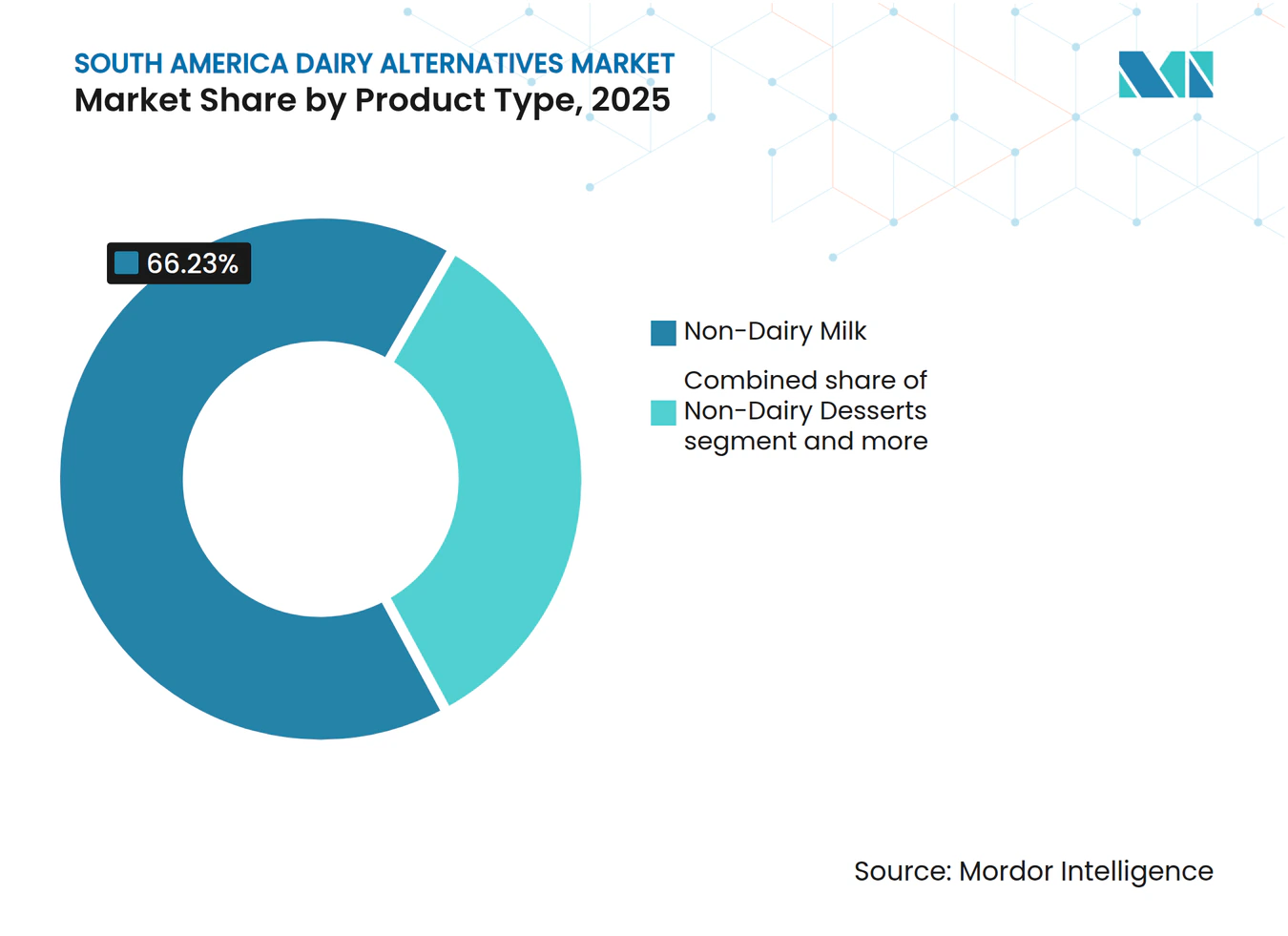
- By product type, non-dairy milk held the largest share of the South America dairy alternatives market, at 66.23% in 2025, while non-dairy yogurt is projected to grow at the fastest CAGR of 11.67% from 2026 to 2031.
- By packaging type, cartons held the largest share of the South America dairy alternatives market, at 57.86% in 2025, while PET bottles are projected to grow at the fastest CAGR of 11.27% from 2026 to 2031.
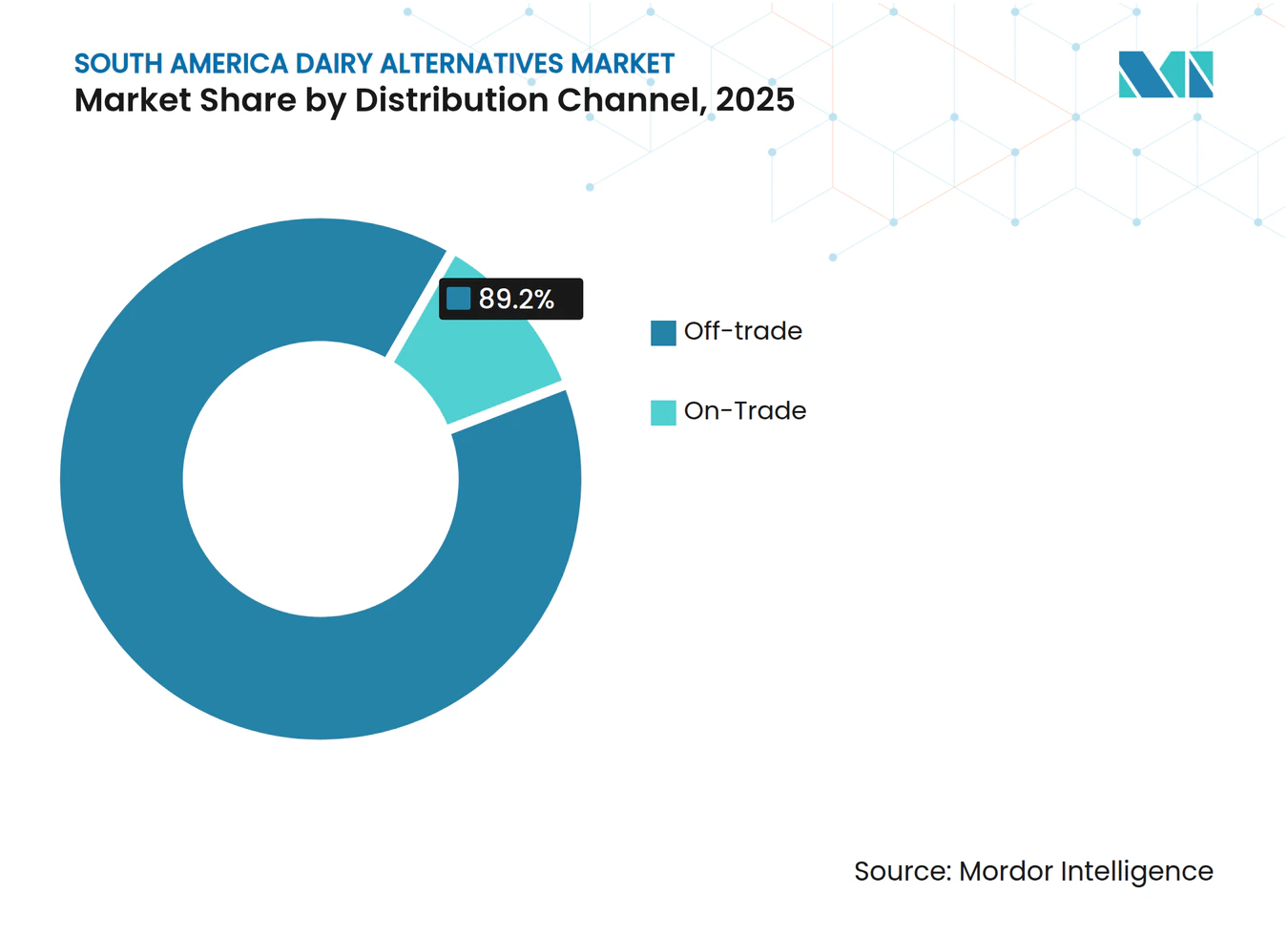
- By distribution channel, off-trade held the largest share of the South America dairy alternatives market, at 89.25% in 2025, while on-trade is projected to grow at the fastest CAGR of 11.49% from 2026 to 2031.
- By geography, Brazil accounted for the largest share of the South America dairy alternatives market, at 67.87% in 2025, while Brazil is projected to grow at the fastest CAGR of 11.06% from 2026 to 2031.
Note: Market size and forecast figures in this report are generated using Mordor Intelligence’s proprietary estimation framework, updated with the latest available data and insights as of January 2026.
Market Trends and Insights
Drivers Impact Analysis of South America Dairy Alternatives Market*
| Driver | (~) % Impact on CAGR Forecast | Geographic Relevance | Impact Timeline |
|---|---|---|---|
| Rising Lactose Intolerance and Dairy Allergy Awareness | +3.2% | Brazil, Argentina, Colombia | Short term (≤ 2 years) |
| Expansion of Vegan and Flexitarian Consumption | +1.8% | Brazil, Chile, Colombia, and younger consumers across the region | Medium term (2-4 years) |
| Premiumization of Oat and Almond Formats | +1.5% | Brazil, Chile, Argentina | Medium term (2-4 years) |
| Functional Fortification With Protein, Calcium, and Fiber | +1.0% | Brazil and Chile, with wider regional relevance | Medium term (2-4 years) |
| Barista and Foodservice Adoption of Plant-Based Milk | +0.8% | Brazil, Chile, Colombia | Short term (≤ 2 years) |
| Local Fermentation and Crop-Adapted Formulation Innovation | +0.6% | Brazil, Bolivia, Peru | Long term (≥ 4 years) |
| Source: Mordor Intelligence | |||
Rising Lactose Intolerance and Dairy Allergy Awareness
Lactose malabsorption affects a large share of the regional population, and the supplied research estimates that it affects 50% of people in South America. The commercial effect is stronger when consumers receive a diagnosis and begin looking for dependable replacements rather than simply reducing dairy intake. That change also makes product availability more important because a consumer who changes a routine purchase needs a suitable option in ordinary neighborhood stores, not only in specialized outlets. This creates repeat demand for milk, yogurt, and other alternatives that meet familiar daily use occasions. Clear product identity and labeling rules can make these choices easier for clinicians, dietitians, retailers, and consumers to understand. Brazil’s proposed framework under MAPA Ordinance SDA/Mapa No. 831/2023 addresses minimum identity and quality requirements for plant-based analogues, helping formalize expectations for products sold in the country. The South American dairy alternatives market therefore benefits when health needs, product communication, and retail availability work together.
Expansion of Vegan and Flexitarian Consumption
The main source of volume growth is not limited to consumers following vegan diets because flexitarian households represent a broader group of potential buyers. A 2025 Good Food Institute Brazil study found that 21% of respondents identified as flexitarians and 34% reported some restriction of animal products in their diets[1]. The same study reported that 27% had reduced red meat consumption in the prior 12 months, with health cited more often than price as the reason. This behavior supports products that fit ordinary breakfasts, coffee occasions, and home cooking rather than items designed only for a specialized audience. It also means that familiar taste, convenient packaging, and a price that can support repeat purchases matter as much as a vegan or environmental label when a household is deciding what to buy. Younger consumers are especially relevant because they are more open to trying plant-based products and comparing nutrition claims. In the South America dairy alternatives market, that wider pool of occasional and regular buyers supports growth across milk, yogurt, and fortified products.
Premium Oat and Almond Products Gain Support From Cafés and Fortification
Oat and almond products have gained visibility through specialty coffee, where texture, foaming performance, and consistency matter to café operators. Brazil’s café base expanded by 8% to 10% annually from 2020 to 2025, according to the supplied research, giving barista-grade products a regular route into consumer routines. Oatly introduced BaristaMatic for automatic coffee machines in 2025, showing how manufacturers are tailoring plant-based beverages to high-throughput foodservice equipment. A well-prepared café drink can reduce hesitation among first-time buyers by providing a familiar experience before the consumer chooses a carton or bottle for home use. Fortification provides another basis for product choice, as calcium, iodine, vitamin B12, protein, and fiber can influence how consumers assess a dairy substitute. A 2025 review by the UK Scientific Advisory Committee on Nutrition and the Committee on Toxicity identified nutritional considerations for plant-based milk alternatives used as dairy replacements[2]. The South America dairy alternatives market can use premium café formats and clear nutrition positioning to broaden interest, although products still need to remain understandable and accessible at retail.
Local Ingredients and Fermented Formats Extend Product Choice
Local formulation can help manufacturers develop products that reflect regional crops and food preferences. Brazil nuts, babaçu, bananas, and other native inputs can support product differentiation while creating a connection to local sourcing. Tetra Pak worked with Brazilian food-tech company Cuíca on an Amazon Brazil nut beverage in 2025, using aseptic packaging intended to support a one-year ambient shelf life and export plans. The Brazilian Packaging Association also documented the development of a long-life babaçu beverage packaged in cartons, indicating continued interest in regionally adapted plant-based drinks. These projects also show how packaging partners, co-packers, ingredient suppliers, and smaller food businesses can work together when a new product requires capabilities that one company may not have in-house. Fermented alternatives, including non-dairy yogurt and kefir-style drinks, can extend the category beyond beverages and respond to interest in gut health. This gives the South America dairy alternatives market opportunities in formats where no company has established a clear regional lead.
Restraints Impact Analysis of South America Dairy Alternatives Market*
| Restraint | (~) % Impact on CAGR Forecast | Geographic Relevance | Impact Timeline |
|---|---|---|---|
| Premium Price Versus Conventional Dairy | -1.8% | All countries, especially lower-income areas in Brazil and Andean markets | Short term (≤ 2 years) |
| Uneven Cold-Chain and Modern-Trade Availability Outside Major Cities | -1.2% | Brazil’s interior, Andean countries, Rest of South America | Medium term (2-4 years) |
| Consumer Perception of Sugar, Protein, and Additive Trade-Offs | -0.7% | Brazil, Chile, Argentina | Medium term (2-4 years) |
| Soy Supply Concentration and Sustainability Scrutiny | -0.6% | Brazil, Argentina, and export-linked supply chains | Long term (≥ 4 years) |
| Source: Mordor Intelligence | |||
Premium Pricing and Consumer Nutrition Concerns
Plant-based dairy alternatives remain more expensive than conventional dairy on comparable retail shelves in many South American countries. The supplied research places the difference at two to three times per liter in Brazil and Argentina, which limits reach among households with tighter food budgets. The issue is particularly material outside larger urban centers, where awareness may be rising but price remains decisive. Price sensitivity can also slow the move from a trial purchase to a regular household purchase, even when consumers are interested in lactose-free or plant-based choices. Brands can partly address this constraint through ambient, shelf-stable products and economy-positioned packages that reduce distribution costs. They also need to address questions about sugar, protein, and additives with simple labeling and credible nutrition information. The South America dairy alternatives market will have difficulty reaching a wider consumer base if its value proposition remains limited to premium health positioning.
Cold-Chain Limits and Soy Supply Scrutiny
Uneven refrigerated logistics limit the availability of temperature-controlled products outside major cities. The Global Cold Chain Alliance identifies infrastructure, storage capacity, and last-mile logistics as continuing constraints in Latin America’s cold-chain development. Aseptic cartons and UHT processing provide a practical response by enabling ambient storage and longer shelf life without reliance on refrigeration. For smaller retailers, these products can also be easier to stock because they do not compete for limited refrigerated space with established dairy brands. Supply concerns also affect soy-based products because sourcing practices are increasingly examined by customers and export markets. The USDA documented the policy and commercial tensions surrounding Brazil’s soy moratorium in 2025, including its relationship with environmental and regulatory measures[3]. The South American dairy alternatives market will need resilient sourcing and packaging choices to broaden geographic access without undermining consumer confidence.
*Our forecasts treat driver/restraint impacts as directional, not additive. The impact forecasts reflect baseline growth, mix effects, and variable interactions.
South America Dairy Alternatives Market Segment Analysis
By Product Type:
Non-Dairy Milk Leads, Yogurt Accelerates Category DiversificationNon-dairy milk commands 66.23% of the South American dairy alternatives market in 2025, a share built on the back of decades of soy milk consumption and, more recently, the surge in oat, almond, coconut, cashew, hazelnut, and hemp-based varieties. Within the non-dairy milk sub-segment, oat milk is the fastest-expanding format, propelled by barista-grade adoption in specialty cafés and its reputation for neutral flavor and sustainability.
Non-dairy yogurt records the steepest overall category growth at a 11.67% CAGR between 2026 and 2031, as fermented plant-based formats benefit from rising consumer familiarity with gut-health messaging and the successful format-extension strategies of established dairy brands. Danone's fortified protein dairy infrastructure in Brazil is expanding capacity by 50% at its Poços de Caldas, Minas Gerais facility, creating cross-category capabilities that will benefit future plant-based yogurt line extensions. Non-dairy cheese and non-dairy desserts remain smaller segments but are gaining traction in urban specialty food retail and in the out-of-home food service channel, where menu diversification is encouraging trial beyond beverage formats.



By Packaging Type:
Cartons Anchor the Category, PET Bottles Capture Convenience DemandCartons hold 57.86% of the packaging segment in 2025, a dominance anchored by the ambient distribution advantage of aseptic carton technology, particularly critical in markets where cold chain coverage is uneven. Tetra Pak's active partnerships with Brazilian food-tech startups Cuíca, Banana Milk, and the Reflyta-led babaçu beverage initiative have reinforced carton adoption as the default format for novel local plant-based milk launches. The launches in 2025 collectively demonstrate that aseptic carton technology is an enabler of export ambitions for small producers: Cuíca has explicitly cited the one-year shelf life and recyclability of the Tetra Pak format as central to its export strategy.
PET bottles are the fastest-growing packaging type, with an 11.27% CAGR for 2026-2031, driven by on-the-go consumption occasions, single-serve convenience, and the visibility advantages of transparent packaging in modern retail refrigerated aisles. Cans play a niche role, primarily in coconut milk-based cooking products. Regulatory compliance for packaging materials falls under ANVISA's general food safety framework, with no packaging-specific certification gaps currently flagged for dairy alternatives.
By Distribution Channel:
Off-trade Retail Anchors Volume, On-Trade Channels Drive ValueOff-trade channels account for 89.25% of the South American dairy alternatives market in 2025, with supermarkets and hypermarkets serving as the primary platforms for discovery and trial of new plant-based dairy products. Within the off-trade, online retail is growing rapidly as e-grocery platforms expand in Brazil, Colombia, and Chile, offering brands a cost-effective route into geographies where physical distribution is limited. Convenience stores are expanding their plant-based dairy shelf space in line with urbanization and impulse-purchase behaviors among younger consumers.
On-trade channels, while representing the smaller share, are the fastest-growing distribution segment at 11.49% CAGR 2026-2031, a dynamic driven by the growing institutionalization of plant-based milk within the café and quick-service restaurant sectors. Foodservice procurement of barista-grade formats commands significant price premiums over retail, making on-trade disproportionately valuable on a per-liter margin basis. A good parallel is the Colombian market, where cashew and soy beverages in café settings are becoming standard offerings even among conventional hospitality operators, according to a 2025 nutritional study of the Colombian plant-based milk market.

Geography Analysis
Brazil: The Largest Country Market
Brazil accounted for 67.87% of the South America dairy alternatives market share in 2025, giving it the largest country position in the region. The country combines a large consumer base with deep modern retail networks and a growing range of local plant-based brands. São Paulo remains particularly important because it concentrates retail activity, café culture, and early adoption of new food products. Brazil also has the manufacturing and distribution scale needed for companies to introduce products more widely once they gain traction in major cities. The proposed MAPA framework for plant-based analogues is relevant because defined product identity and quality requirements can make labeling more consistent. Brazil’s size means that performance in the South America dairy alternatives market is closely tied to whether brands can expand beyond affluent urban neighborhoods while maintaining product availability and acceptable prices.
Brazil: The Fastest-Growing Country Market
Brazil is projected to grow at a CAGR of 11.06% from 2026 to 2031, making it the fastest-growing country in the South America dairy alternatives market. This combination of scale and growth indicates that demand is still developing rather than approaching saturation. Secondary cities offer an important next step because large metropolitan markets alone cannot sustain broad regional expansion. Ambient products can be especially useful in these areas because they reduce dependence on refrigerated logistics. Locally sourced ingredients and familiar formats may also help companies adapt product portfolios to different income levels and food preferences. Brazil’s growth path will depend on whether manufacturers can balance premium innovation with products that are affordable enough for mainstream retail.
Argentina, Colombia, Chile, Peru, and the Rest of South America: Distinct Paths to Adoption
Argentina, Colombia, Chile, Peru, and the Rest of South America account for a smaller share of the South American dairy alternatives market, but their roles vary. Argentina has established food manufacturers and consumer familiarity with dairy brands, which can support plant-based extensions and provide new products with a route through established retail relationships. Colombia benefits from urban café culture in Bogotá and Medellín and from the expansion of online food retail, which can help brands reach consumers before nationwide store coverage is available. Chile has a more developed awareness of plant-based food choices, while NotCo retains its core innovation base in its home market. A 2024 presentation from Germany’s Federal Institute for Risk Assessment reviewed the availability and nutritional characteristics of plant-based alternatives in South America, highlighting the region’s varied retail environments and product profiles. Peru offers opportunities through Lima’s higher-income, health-focused retail base, whereas Bolivia and other Andean markets face greater exposure to agricultural and logistics disruptions that can disrupt product availability. Across these countries, UHT and ambient formats remain the most practical near-term route for the South American dairy alternatives market, where refrigerated networks are inconsistent.
Competitive Landscape
Market Concentration
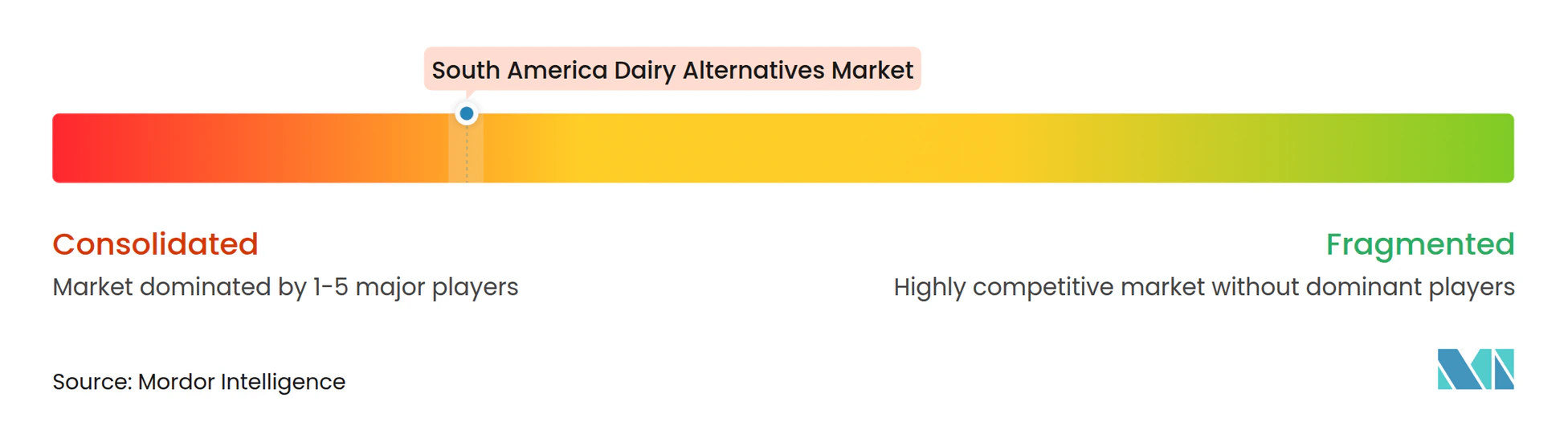
The South American dairy alternatives market is highly concentrated, indicating a market that is meaningfully consolidated at the top but not a duopoly; mid-tier and local players retain sufficient scale to influence product innovation cycles and shelf-space negotiations. Danone, Nestlé, Coca-Cola (through Ades), Positive Brands (through A Tal da Castanha), and the NotCo brand are among the key participants in the South American dairy alternatives market. Larger companies bring recognized brands, established retail relationships, and manufacturing resources that support broad distribution across multiple countries. Danone reported EUR 2.8 billion in net sales in Latin America in 2025, representing a meaningful share of its global business and underscoring the region’s importance to its portfolio. Local producers compete by emphasizing ingredients, clean-label positioning, and a closer fit with regional food preferences. A Tal da Castanha is notable for its nut-based products, which show how a local brand can build relevance in a category often dominated by multinational companies. The competitive picture is therefore not limited to the largest global groups, as local challengers can influence innovation, shelf-space decisions, and the price points available to consumers in Brazil and nearby markets.
Packaging partnerships are a practical competitive tool because they affect product shelf life, route to market, and export potential. Tetra Pak’s work with Cuíca on an Amazon Brazil nut beverage gave the startup access to aseptic-packaging expertise and supported a product designed for ambient distribution. The babaçu beverage project involving Reflyta, Polvo Lab, Do Bem, and Tetra Pak similarly shows how companies are developing products around regional biodiversity and long-life packaging ABRE. These moves matter because regional production and ambient logistics can reduce the disadvantages of importing specialized products. Product development is also moving toward fermented and fortified alternatives, where brand positions remain less settled than in plant-based milk. The South America dairy alternatives market remains competitive because success requires both recognizable products and the ability to deliver them reliably across different retail conditions.
The NotCo brand’s changes in ownership during 2026 point to a broader shift in how plant-based businesses may use regional distribution networks. The supplied research identifies sales of NotCo’s Argentina and Uruguay operations to Molinos Río de la Plata and its Brazil business to Ferrara, with the brand moving away from direct consumer operations in those markets. The transaction pattern gives companies with established local logistics an opportunity to scale plant-based portfolios through existing food distribution systems. Oatly, Califia Farms, and Blue Diamond Growers maintain a more focused presence in premium urban channels, where cafés and modern retailers can support product trial. At the same time, the strongest open spaces remain in non-dairy yogurt, kefir-style beverages, and protein-enriched products. Competition in the South America dairy alternatives market will be shaped by which companies can pair credible nutrition, accessible prices, and dependable regional distribution.
South America Dairy Alternatives Industry Leaders
-
Danone S.A.
-
Nestlé S.A.
-
Blue Diamond Growers
-
Positive Brands Indústria e Comércio de Alimentos Saudáveis SA
-
NotCo
- *Disclaimer: Major Players sorted in no particular order
South America Dairy Alternatives Market Companies Covered in this Report
- The Coca-Cola Company
- Positive Brands Indústria e Comércio de Alimentos Saudáveis SA
- Danone SA
- Nestlé SA
- NotCo
- McCormick & Company, Inc.
- General Mills, Inc.
- SunOpta Inc.
- Blue Diamond Growers
- The Hain Celestial Group, Inc.
- Oatly Group AB
- Califia Farms, LLC
- Daiya Foods Inc.
- Vitasoy International Holdings Limited
- Archer-Daniels-Midland Company
- CP Kelco U.S., Inc.
- A Tal da Castanha
- Vida Veg
- Jasmine Alimentos Ltda.
- Vrimilk
Recent Industry Developments in South America Dairy Alternatives Market
- September 2026: NotCo sells Brazilian operations to Ferrara Group. Chilean food-tech company NotCo announced the sale of its Brazil business to Ferrara, a Brazilian investment group with a portfolio of natural food brands in Brazil and the United States. Ferrara assumes control of the NotMilk, NotShake, NotCreme, and NotMayo portfolios with the stated objective of accelerating national distribution and expanding the brand's reach beyond its previous São Paulo concentration.
- November 2025: Babaçu plant-based beverage pre-launched in aseptic carton at COP30. A partnership between Reflyta, Polvo Lab, Do Bem, and Tetra Pak delivered the first babaçu (Amazonian palm kernel) plant-based drink in a long-life aseptic carton. The pre-launch at the COP30 climate summit in Brazil positioned the product at the intersection of biodiversity conservation and functional food innovation, targeting both domestic retail and export markets.
- May 2025: Cuíca and Tetra Pak launch Amazon Brazil nut milk in an aseptic carton. Brazilian foodtech Cuíca partnered with Tetra Pak to formulate and launch the first plant-based milk made from Amazon Brazil nut (castanha da Amazônia) in a retail aseptic carton. Tetra Pak's pilot plant infrastructure was used for formulation testing, with co-packing partners executing commercial-scale packaging. The product carries a one-year ambient shelf life and is positioned for export.
South America Dairy Alternatives Market Report Scope
Dairy alternatives refer to plant-based products developed as substitutes for conventional dairy products, including milk, cheese, yogurt, desserts, and related offerings. The South American Dairy Alternatives Market is segmented by product type, packaging type, distribution channel, and country. By product type, the market includes Non-Dairy Milk, Non-Dairy Cheese, Non-Dairy Desserts, Non-Dairy Yogurt, and Others. Non-Dairy Milk is further segmented into Oat Milk, Hemp Milk, Hazelnut Milk, Soy Milk, Almond Milk, Coconut Milk, and Cashew Milk. By packaging type, the market is segmented into PET Bottles, Cans, Cartons, and Others. By distribution channel, the market is divided into On-trade and Off-trade, with Off-trade further segmented into Convenience Stores, Supermarkets and Hypermarkets, Online Retail, and Other Distribution Channels. By country, the report covers Brazil, Argentina, Colombia, Chile, Peru, and the rest of South America, with market size and forecasts provided for each country. The market sizing has been done in value terms in USD and volume in metric tons for all the abovementioned segments.
Segmentation Overview
By Product Type
| Non-Dairy Milk | Oat Milk |
| Hemp Milk | |
| Hazelnut Milk | |
| Soy Milk | |
| Almond Milk | |
| Coconut Milk | |
| Cashew Milk | |
| Non-Dairy Cheese | |
| Non-Dairy Desserts | |
| Non-Dairy Yogurt | |
| Others |
Packaging Type
| PET Bottles |
| Cans |
| Cartons |
| Others |
Distribution Channel
| On-trade | |
| Off-trade | Convenience Stores |
| Supermarkets and Hypermarkets | |
| Online Retail | |
| Other Distribution Channel |
Country
| Brazil |
| Argentina |
| Colombia |
| Chile |
| Peru |
| Rest of South America |
| By Product Type | Non-Dairy Milk | Oat Milk |
| Hemp Milk | ||
| Hazelnut Milk | ||
| Soy Milk | ||
| Almond Milk | ||
| Coconut Milk | ||
| Cashew Milk | ||
| Non-Dairy Cheese | ||
| Non-Dairy Desserts | ||
| Non-Dairy Yogurt | ||
| Others | ||
| Packaging Type | PET Bottles | |
| Cans | ||
| Cartons | ||
| Others | ||
| Distribution Channel | On-trade | |
| Off-trade | Convenience Stores | |
| Supermarkets and Hypermarkets | ||
| Online Retail | ||
| Other Distribution Channel | ||
| Country | Brazil | |
| Argentina | ||
| Colombia | ||
| Chile | ||
| Peru | ||
| Rest of South America | ||
Key Questions Answered in the Report
What is the forecast for dairy alternatives in South America?
The category is valued at USD 0.92 billion in 2025 and is forecast to reach USD 1.69 billion by 2031, growing at a CAGR of 10.64% from 2026 to 2031.
Which product category leads dairy alternatives in South America?
Non-dairy milk leads with a 66.23% share in 2025, supported by familiar everyday uses and broad retail availability.
Which dairy alternative product is growing fastest in South America?
Non-dairy yogurt is forecast to grow at 11.67% CAGR from 2026 to 2031, helped by demand for fermented and varied plant-based options.
Why are cartons important for plant-based beverages in South America?
Cartons held 57.86% of packaging demand in 2025 because ambient storage helps producers reach areas with uneven cold-chain coverage.