
Market Overview
| Study Period | 2017 - 2030 |
|---|---|
| Market Size (2025) | USD 35.53 Billion |
| Market Size (2030) | USD 59.80 Billion |
| Growth Rate (2025 - 2030) | 10.97 % |
| Fastest Growing Market | Off-Trade |
| Largest Market | North America |
| Market Concentration | Low |
Major Players *Disclaimer: Major Players sorted in no particular order Image © Mordor Intelligence. Reuse requires attribution under CC BY 4.0. | |
Dairy Alternatives Market Analysis by Mordor Intelligence
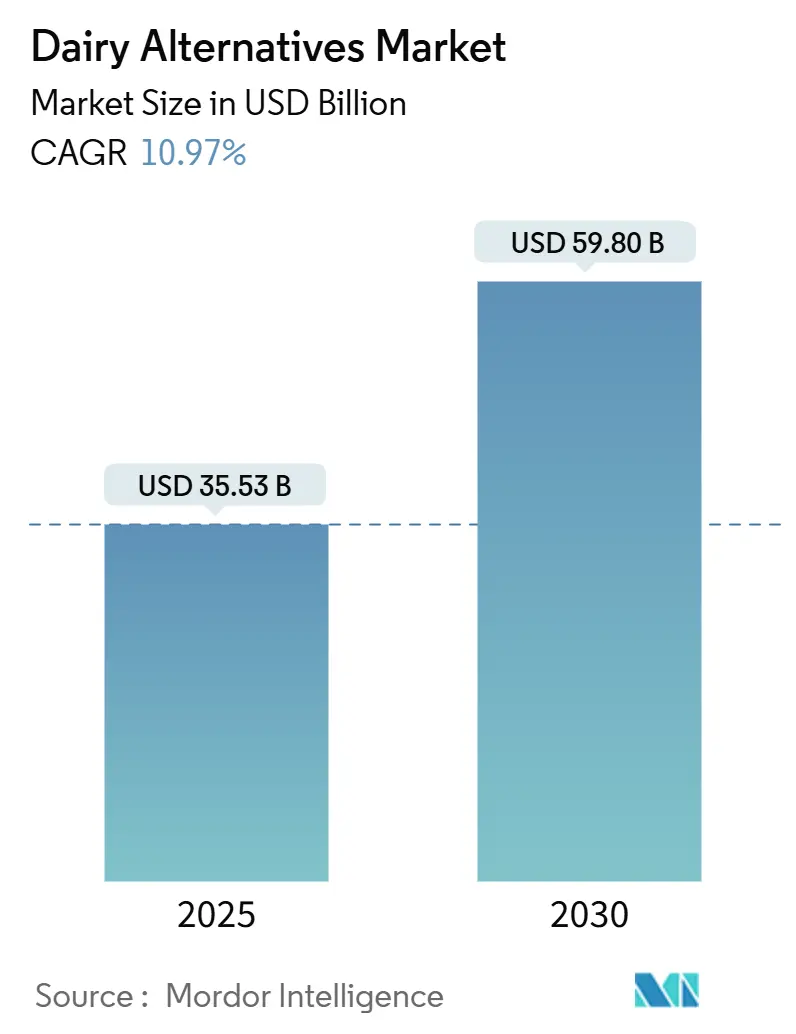
The Dairy Alternatives Market size is estimated at USD 35.53 billion in 2025, and is expected to reach USD 59.80 billion by 2030, at a CAGR of 10.97% during the forecast period (2025-2030).
The dairy alternatives market is experiencing a significant transformation driven by evolving consumer preferences and lifestyle choices. A remarkable shift in consumer behavior is evident as over 65% of global consumers reported consuming dairy alternatives in 2022, indicating a strong mainstream acceptance of these products. This transformation is further supported by the increasing adoption of flexitarian diets, with many consumers incorporating plant-based options into their regular dietary routines. The industry has responded to this demand by expanding product portfolios and improving taste profiles, texture, and nutritional content of dairy alternatives to match or exceed their traditional dairy counterparts.
The distribution landscape for the dairy alternatives market has evolved significantly, with retail channels adapting to changing consumer purchasing patterns. Supermarkets and hypermarkets continue to dominate the sales channels, accounting for more than 60% of overall sales worldwide in 2022, offering consumers the convenience of comparing products and making informed purchasing decisions. The e-commerce sector has emerged as a crucial distribution channel, with retailers increasingly partnering with online platforms to enhance their digital presence. Major retailers are implementing multichannel strategies, with companies like Morrisons, Booths, and Co-op expanding their reach through partnerships with Amazon Fresh and offering same-day delivery services.
Production capabilities and raw material sourcing have become critical factors in meeting the growing demand for dairy alternatives. Japan's significant production capacity is exemplified by its utilization of approximately 67.8 thousand metric tons of soybeans for soy milk production, resulting in 123 thousand kiloliters of soy milk. The United States has established itself as a key player in the raw material supply chain, producing around 2,002,742 tons of almonds annually, which has been instrumental in supporting the growing almond milk segment. This robust supply chain infrastructure has enabled manufacturers to maintain consistent product quality and meet increasing consumer demand.
Innovation in product development continues to drive market expansion, with manufacturers focusing on clean label products and improved nutritional profiles. Companies are investing in research and development to create new formulations that better mimic the taste and texture of traditional dairy products while maintaining their plant-based integrity. The industry has seen a particular focus on developing specialized products for different consumption occasions, from barista-style plant-based milk for coffee shops to protein-enriched varieties for health-conscious consumers. This innovation trend is supported by technological advancements in processing methods and ingredient optimization, leading to improved product stability and sensory characteristics.
Global Dairy Alternatives Market Trends and Insights
The increasing vegan population, lactose intolerance, and growing awareness about the health and environmental benefits of dairy alternatives are driving the consumption of different types of dairy alternative products worldwide.
- The consumption of different types of dairy alternative products is increasing worldwide due to a significant increase in the vegan population, coupled with a growing lactose-intolerant population. Even vegan exhibitions/trade shows and music festivals are being conducted in different countries to promote a vegan lifestyle. For example, Australia has the third-highest percentage of vegans per capita globally. As of 2022, 2.5 million people were vegans and vegetarians in the country.
- Plant-based milk is the largest consumed category among all dairy alternatives worldwide. Soy milk, almond milk, and oat milk were highly popular and collectively registered more than 70% share in the overall plant milk consumption in 2022. This was due to the increasing prevalence of milk allergies driving demand for plant-based milk worldwide. For example, soy milk is a rich source of vitamins, proteins, and potassium, and has a lower calorie content than cow milk. Due to its high nutrient content, it is considered an ideal substitute for dairy products.
- There is a huge demand for non-dairy cheese varieties, such as plant-based cheese, especially sliced cheese, with great sales value in several countries. Spanish and German consumers reveal the highest readiness to eat plant-based cheese instead of conventional ones. For instance, German consumers prefer plant-based cream cheese (32%), sliced cheese (32%), and plant-based mozzarella (31%) available in supermarkets. With the growing demand for new plant-based dairy innovations, the consumption of dairy alternatives is anticipated to increase further during the forecast period.


OTHER KEY INDUSTRY TRENDS COVERED IN THE REPORT
Segment Analysis
Non-Dairy Milk Segment in Global Dairy Alternatives Market
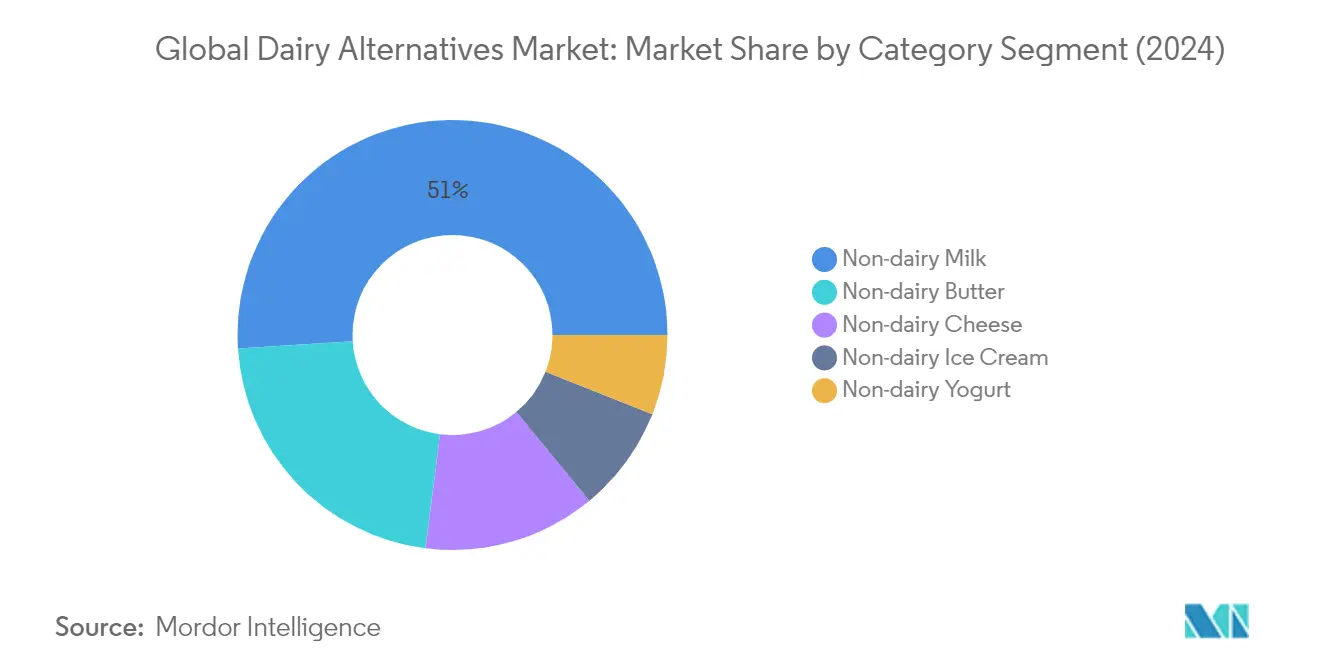
Non-dairy milk dominates the global dairy alternatives market, accounting for approximately 51% of the market share in 2024. The segment's strong position is driven by increasing consumer preference for dairy-free milk alternatives like soy milk, almond milk, and oat milk. Soy milk leads the plant-based milk category due to its high protein content and nutritional benefits, while almond milk and oat milk are gaining popularity due to their taste profiles and sustainability credentials. The growth is particularly notable in the Asia-Pacific and North American regions, where rising health consciousness and lactose intolerance among consumers are driving adoption. Major retailers and coffee chains are expanding their plant-based milk offerings, making these products more accessible to mainstream consumers.

Non-Dairy Cheese Segment in Global Dairy Alternatives Market
The non-dairy cheese segment is emerging as the fastest-growing category in the dairy alternatives products market, projected to grow at approximately 22% annually from 2024 to 2029. This remarkable growth is fueled by continuous product innovations and improvements in taste and texture profiles that more closely mimic traditional dairy cheese. Manufacturers are introducing various formats, including slices, shreds, blocks, and spreads, to cater to different culinary applications. The segment's expansion is particularly strong in Europe and North America, where around 67% of consumers in countries like Belgium and the United Kingdom show high penetration rates for plant-based cheese consumption. The growth is further supported by increasing flexitarian consumers and rising awareness about the environmental impact of traditional dairy production.
Remaining Segments in Dairy Alternatives Market
The dairy alternatives market also encompasses non-dairy butter, non-dairy ice cream, and non-dairy yogurt segments, each serving distinct consumer needs and preferences. Non-dairy butter alternatives are gaining traction due to their lower saturated fat content and environmental benefits compared to traditional dairy butter. The non-dairy ice cream segment is experiencing growth driven by innovative flavors and improved textures, particularly appealing to health-conscious consumers and those with dietary restrictions. Non-dairy yogurt alternatives are expanding their presence through various flavors and formats, including Greek-style variants and probiotic-enriched options, catering to the growing demand for functional food products.
Segment Analysis: Distribution Channel
Off-Trade Segment in Global Dairy Alternatives Market
The off-trade distribution channel dominates the global dairy alternatives market, with supermarkets and hypermarkets being the primary sales channels. In 2024, the off-trade segment is expected to account for approximately 90% of the total market value. This significant market share can be attributed to the widespread network of retail stores, easy accessibility, and the ability to offer a diverse range of dairy substitutes under one roof. Within the off-trade segment, supermarkets and hypermarkets hold the largest share at around 60% of sales, as these stores provide consumers with various benefits, including bulk purchase options, seasonal discounts, and dedicated sections for dairy-free products that enhance the shopping experience.
Online Retail Segment in Global Dairy Alternatives Market
The online retail channel is emerging as the fastest-growing segment in the dairy alternatives market, projected to experience robust growth between 2024 and 2029. This channel's rapid expansion is driven by increasing smartphone penetration, widespread internet accessibility, and evolving consumer preferences for convenient shopping options. The growth is particularly pronounced in regions with high e-commerce adoption rates, such as North America and Europe, where around 68% of individuals ordered food products online in 2024. Online retailers are strengthening their position by offering exclusive deals, subscription services, and enhanced delivery options, while also providing detailed product information and customer reviews that help consumers make informed purchasing decisions.
Remaining Segments in Distribution Channel
The remaining distribution channels include on-trade establishments, convenience stores, and specialist retailers, each serving distinct consumer needs in the dairy alternatives market. The on-trade segment, comprising restaurants, cafes, and food service outlets, plays a crucial role in introducing consumers to dairy-free products through beverages and prepared foods. Convenience stores offer accessibility and quick purchase options for consumers seeking dairy alternatives during non-traditional shopping hours, while specialist retailers provide a curated selection of premium and niche dairy substitutes, often catering to specific dietary requirements and preferences.
Geography Analysis
Dairy Alternatives Market in Africa
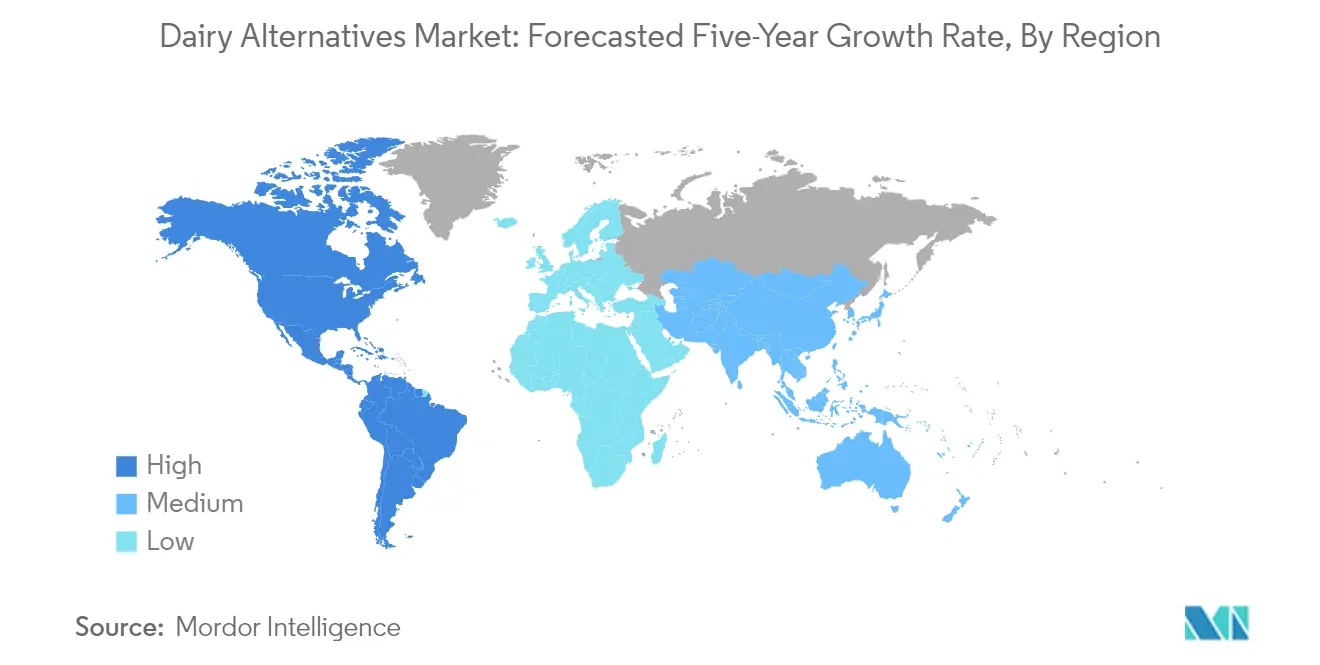
The African dairy alternatives market is experiencing significant growth driven by increasing health consciousness and the rising adoption of plant-based diets. The region's market dynamics are primarily shaped by countries like Egypt, Nigeria, and South Africa, each contributing uniquely to the market's development. The growth is supported by various factors, including the rising prevalence of lactose intolerance, a growing vegan population, and increasing consumer awareness about the health benefits of dairy alternatives.
Dairy Alternatives Market in South Africa
South Africa dominates the African dairy alternatives market, holding approximately 40% market share in 2024. The country's market leadership is driven by strong distribution networks and an increasing consumer preference for plant-based products. The market is characterized by a robust retail infrastructure and growing health consciousness among consumers. South African consumers are increasingly adopting dairy alternatives due to rising awareness about lactose intolerance and the health benefits associated with plant-based products. The country has also seen significant investments in product innovation and marketing campaigns promoting dairy alternatives.
Dairy Alternatives Market in Nigeria
Nigeria represents the fastest-growing market for dairy alternatives in Africa, with an expected growth rate of approximately 8% during 2024-2029. The growth is primarily driven by increasing urbanization and rising disposable income levels. Nigerian consumers are showing increasing interest in plant-based alternatives, particularly among the younger population. The country's market is witnessing the rapid expansion of modern retail formats and improving distribution networks, which is facilitating better access to dairy alternative products. The market is also benefiting from increasing awareness about lactose intolerance and the health benefits associated with plant-based diets.
Dairy Alternatives Market in Asia-Pacific
The Asia-Pacific region represents a significant market for dairy alternatives, with diverse consumer preferences and consumption patterns across different countries. The market encompasses major economies like China, Japan, and South Korea, as well as emerging markets such as India, Indonesia, and Malaysia. The region's growth is driven by factors such as increasing health consciousness, rising disposable incomes, and growing awareness about lactose intolerance. The market is also benefiting from strong distribution networks and innovative product launches.
Dairy Alternatives Market in China
China leads the Asia-Pacific dairy alternatives market, commanding approximately 45% market share in 2024. The country's dominance is attributed to its large consumer base and well-established distribution networks. Chinese consumers are increasingly adopting dairy alternatives due to high lactose intolerance rates and growing health consciousness. The market is characterized by a strong presence of both international and domestic players, offering a wide range of plant-based products. The country's robust e-commerce infrastructure has also played a crucial role in market growth.
Dairy Alternatives Market in India
India emerges as the fastest-growing market in the Asia-Pacific region, with an expected growth rate of approximately 10% during 2024-2029. The growth is driven by increasing urbanization, rising health consciousness, and a growing vegan population. Indian consumers are increasingly adopting dairy alternatives due to rising awareness about health benefits and environmental concerns. The market is witnessing significant investments in product innovation and marketing initiatives. The country's strong traditional vegetarian culture provides a favorable environment for the growth of dairy alternatives.
Dairy Alternatives Market in Europe
The European dairy alternatives market demonstrates strong growth potential, supported by increasing consumer awareness about health and sustainability. The region encompasses major markets including Germany, France, the UK, and Italy, as well as emerging markets like Russia and Turkey. Consumer preferences vary significantly across different countries, influencing product development and marketing strategies. The market is characterized by a strong presence of established players and continuous product innovations.
Dairy Alternatives Market in Germany
Germany maintains its position as the largest market for dairy alternatives in Europe. The country's market leadership is attributed to high consumer awareness about plant-based products and strong retail infrastructure. German consumers show a strong preference for organic and sustainable products, driving market growth. The country has a well-developed distribution network and a strong presence of both domestic and international players.
Dairy Alternatives Market in Russia
Russia emerges as the fastest-growing market for dairy alternatives in Europe. The growth is driven by increasing health consciousness and rising adoption of plant-based diets. Russian consumers are showing increasing interest in dairy alternatives, particularly in urban areas. The market is witnessing significant investments in product development and marketing initiatives. The country's improving retail infrastructure and distribution networks are supporting market growth.
Dairy Alternatives Market in Middle East
The Middle Eastern dairy alternatives market shows promising growth potential, with increasing consumer awareness about health benefits and rising adoption of plant-based diets. The region encompasses various markets including Saudi Arabia, UAE, Iran, Kuwait, Bahrain, Qatar, and Oman. Saudi Arabia leads the market in terms of size, while Iran demonstrates the fastest growth rate. The market is characterized by a strong presence of international brands and growing domestic production capabilities. Consumer preferences are increasingly shifting towards healthier alternatives, supported by rising health consciousness and growing awareness about lactose intolerance.
Dairy Alternatives Market in North America
The North American dairy alternatives market demonstrates robust growth, driven by increasing consumer preference for plant-based products and rising health consciousness. The region, comprising the United States, Canada, and Mexico, shows diverse consumer preferences and consumption patterns. The US dairy alternatives market leads the market in terms of size, while Mexico shows the fastest growth rate. The market is characterized by a strong presence of established players, continuous product innovations, and well-developed distribution networks. Consumer awareness about health benefits and environmental sustainability continues to drive market growth across the region.
Dairy Alternatives Market in South America
The South American dairy alternatives market shows significant growth potential, driven by increasing health consciousness and rising adoption of plant-based diets. The region, primarily represented by Brazil and Argentina, demonstrates evolving consumer preferences and growing awareness about dairy alternatives. Brazil leads the market in terms of size, while Argentina shows the fastest growth rate. The market is characterized by increasing investments in product development and marketing initiatives. Consumer awareness about health benefits and environmental sustainability continues to drive market growth, supported by improving distribution networks and retail infrastructure.

Competitive Landscape
Top Companies in Dairy Alternatives Market
The dairy alternatives market is characterized by continuous product innovation and strategic expansion initiatives by leading players like Danone SA, Hebei Yangyuan Zhihui Beverage Co. Ltd, Blue Diamond Growers, and Oatly Group AB. Companies are focusing on developing new plant-based formulations, particularly in milk alternatives like oat, almond, and soy varieties, while also expanding into adjacent categories like non-dairy cheese and yogurt. Operational agility is demonstrated through investments in dedicated manufacturing facilities and R&D centers to support product development and meet growing consumer demand. Strategic moves include partnerships with foodservice operators and retail chains to enhance distribution networks, while geographical expansion is pursued through both organic growth and acquisitions. Companies are particularly targeting emerging markets in Asia-Pacific and establishing regional production facilities to better serve local markets and optimize supply chains.
Global Leaders Dominate Fragmented Market Structure
The dairy alternatives market exhibits a fragmented competitive structure with a mix of global conglomerates and specialized plant-based manufacturers. Large multinational companies like Danone SA leverage their extensive distribution networks and brand portfolios to maintain market leadership, while regional players such as Hebei Yangyuan focus on dominating specific geographical markets through deep local market understanding and tailored product offerings. The market is witnessing increased participation from both established dairy companies diversifying into plant-based alternatives and pure-play alternative protein companies.
The industry is experiencing active merger and acquisition activity as companies seek to expand their plant-based portfolios and geographical presence. Large players are acquiring innovative start-ups to gain access to new technologies and product formulations, while also establishing strategic partnerships to strengthen their market position. Cross-border acquisitions are becoming more common as companies aim to establish a presence in high-growth markets, particularly in Asia-Pacific and Europe, where consumer demand for dairy alternatives is rapidly growing.
Innovation and Distribution Key to Growth
Success in the dairy and dairy alternatives market increasingly depends on companies' ability to innovate across product formulations, packaging, and marketing strategies. Manufacturers need to focus on improving taste profiles and nutritional content while maintaining clean label credentials to meet evolving consumer preferences. Building strong relationships with retailers and foodservice operators is crucial for market penetration, as is developing efficient cold chain logistics capabilities. Companies must also invest in sustainability initiatives and transparent supply chains to address growing environmental concerns among consumers.
Future market success will require companies to navigate potential regulatory changes regarding labeling and nutritional claims while maintaining product differentiation in an increasingly crowded market. Manufacturers need to develop strategies to address price sensitivity while maintaining margins, particularly as raw material costs fluctuate. Building direct-to-consumer channels and establishing a strong online presence will become increasingly important for market success. Companies must also focus on educational marketing to increase consumer awareness about the benefits of dairy alternatives and expand the overall market size while maintaining their competitive position.
Dairy Alternatives Industry Leaders
Blue Diamond Growers
Danone SA
Hebei Yangyuan Zhihui Beverage Co. Ltd
Oatly Group AB
Saputo Inc.
- *Disclaimer: Major Players sorted in no particular order


Recent Industry Developments
- November 2022: Oatly Group AB announced that it would release a new range of oat-based yogurt. The new range comes in four flavors: strawberry, blueberry, plain, and Greek style.
- October 2022: Sheese launched two new vegan cheese products in the United Kingdom, namely, Sheese Italiano and Sheese Mighty Melter.
- October 2022: Vitasoy International Holdings Ltd planned to expand its dairy alternative business by acquiring the shares from its joint venture Bega Cheese subsidiary National Food Holdings Ltd.


Global Dairy Alternatives Market Report Scope
Non-Dairy Butter, Non-Dairy Cheese, Non-Dairy Ice Cream, Non-Dairy Milk, Non-Dairy Yogurt are covered as segments by Category. Off-Trade, On-Trade are covered as segments by Distribution Channel. Africa, Asia-Pacific, Europe, Middle East, North America, South America are covered as segments by Region.By Product Type
| Non-Dairy Milk | Oat Milk |
| Hemp Milk | |
| Hazelnut Milk | |
| Soy Milk | |
| Almond Milk | |
| Coconut Milk | |
| Cashew Milk | |
| Non-Dairy Cheese | |
| Non-Dairy Desserts | |
| Non-Dairy Yogurt | |
| Others |
By Packaging Type
| PET Bottles |
| Cans |
| Cartons |
| Others |
By Distribution Channel
| On-trade | |
| Off-trade | Convenience Stores |
| Supermarkets/Hypermarkets | |
| Online Retail Channels | |
| Others (Warehouse Clubs, Gas Stations, etc.) |
By Geography
| North America | United States |
| Canada | |
| Mexico | |
| Rest of North America | |
| South America | Brazil |
| Colombia | |
| Chile | |
| Peru | |
| Argentina | |
| Rest of South America | |
| Europe | United Kingdom |
| Germany | |
| France | |
| Italy | |
| Spain | |
| Poland | |
| Belgium | |
| Sweden | |
| Rest of Europe | |
| Asia-Pacific | China |
| Japan | |
| India | |
| Australia | |
| Indonesia | |
| South Korea | |
| Thailand | |
| Singapore | |
| Rest of Asia-Pacific | |
| Middle East and Africa | South Africa |
| Saudi Arabia | |
| United Arab Emirates | |
| Nigeria | |
| Egypt | |
| Morocco | |
| Turkey | |
| Rest of Middle East and Africa |
| By Product Type | Non-Dairy Milk | Oat Milk |
| Hemp Milk | ||
| Hazelnut Milk | ||
| Soy Milk | ||
| Almond Milk | ||
| Coconut Milk | ||
| Cashew Milk | ||
| Non-Dairy Cheese | ||
| Non-Dairy Desserts | ||
| Non-Dairy Yogurt | ||
| Others | ||
| By Packaging Type | PET Bottles | |
| Cans | ||
| Cartons | ||
| Others | ||
| By Distribution Channel | On-trade | |
| Off-trade | Convenience Stores | |
| Supermarkets/Hypermarkets | ||
| Online Retail Channels | ||
| Others (Warehouse Clubs, Gas Stations, etc.) | ||
| By Geography | North America | United States |
| Canada | ||
| Mexico | ||
| Rest of North America | ||
| South America | Brazil | |
| Colombia | ||
| Chile | ||
| Peru | ||
| Argentina | ||
| Rest of South America | ||
| Europe | United Kingdom | |
| Germany | ||
| France | ||
| Italy | ||
| Spain | ||
| Poland | ||
| Belgium | ||
| Sweden | ||
| Rest of Europe | ||
| Asia-Pacific | China | |
| Japan | ||
| India | ||
| Australia | ||
| Indonesia | ||
| South Korea | ||
| Thailand | ||
| Singapore | ||
| Rest of Asia-Pacific | ||
| Middle East and Africa | South Africa | |
| Saudi Arabia | ||
| United Arab Emirates | ||
| Nigeria | ||
| Egypt | ||
| Morocco | ||
| Turkey | ||
| Rest of Middle East and Africa | ||


Market Definition
- Dairy Alternatives - Dairy alternatives are foods that are made from plant-based milk/oils instead of their usual animal products, such as cheese, butter, milk, ice cream, yogurt, etc. Plant-based or non-dairy milk alternative is the fast-growing segment in the newer food product development category of functional and specialty beverage across the globe.
- Non-Dairy Butter - Non dairy butter is a vegan butter alternative that is made from a mixture of plant oils. With an increase in alternative diets like vegetarianism, veganism, and gluten intolerance, plant butter is a healthy non-dairy substitute for normal butter.
- Non-Dairy Ice Cream - Plant based ice cream is a growing category. Non-dairy ice cream is a type of dessert made without any animal ingredients. This is typically considered a substitute for regular ice cream for those who cannot or do not eat animal or animal-derived products, including eggs, milk, cream, or honey.
- Plant-Based Milk - Plant based milks are milk substitutes that are made from nuts (e.g., hazelnuts, hemp seeds), seeds (e.g., sesame, walnuts, coconuts, cashews, almonds, rice, oats, etc.) or legumes (e.g., soy). Plant-based milk such as soy milk and almond milk have been popular in East Asia and the Middle East for centuries.
| Keyword | Definition |
|---|---|
| Cultured Butter | Cultured butter is prepared by having the raw butter go through chemical processing and has been added with certain emulsifiers and foreign ingredients. |
| Uncultured Butter | This type of butter is one which has not been processed in any way |
| Natural Cheese | The type of cheese in its most natural form. It is made from natural and simple products and ingredients, including fresh and natural salts, natural colors, enzymes, and high-quality milk. |
| Processed Cheese | Processed cheese undergoes the same processes as natural cheese; however, it requires more steps and many different forms of ingredients. Making processed cheese involves melting natural cheese, emulsifying it, and adding preservatives and other artificial ingredients or colorings. |
| Single Cream | Single cream contains around 18% fat. It’s a single layer of cream that appears over boiled milk. |
| Double Cream | Double cream contains 48% fat, more than double the amount of fat of single cream. It’s heavier and thicker than single cream |
| Whipping Cream | This has a much higher fat percentage than single cream (36%). Used to top cakes, pies, and puddings and as a thickener for sauces, soups, and fillings. |
| Frozen Desserts | Desserts that are meant to be eaten in frozen condition. E.g., sherbets, sorbets, frozen yogurts |
| UHT Milk (Ultra-high temperature milk) | Milk heated at a very high temperature. Ultra-high-temperature processing (UHT) of milk involves heating for 1–8 sec at 135–154°C. which kills the spore-forming pathogenic microorganism, resulting in a product with a shelf-life of several months. |
| Non-dairy butter/Plant-based butter | Butter made from plant-derived oil such as coconut, palm, etc. |
| Non-dairy Yogurt | Yogurt made from typically made from nuts, like almonds, cashews, coconuts, and even other foods like soybeans, plantains, oats, and peas |
| On-trade | It refers to restaurants, QSRs, and bars. |
| Off-trade | It refers to supermarkets, hypermarkets, on-line channels, etc. |
| Neufchatel cheese | One of the oldest kinds of cheese in France. It is a soft, slightly crumbly, mold-ripened, bloomy-rind cheese made in the Neufchâtel-en-Bray region of Normandy. |
| Flexitarian | It refers to a consumer preferring a semi-vegetarian diet, that is centered on plant foods with limited or occasional inclusion of meat. |
| Lactose Intolerance | Lactose intolerance is a reaction in digestive system to lactose, the sugar in milk. It causes uncomfortable symptoms in response to the consumption of dairy products. |
| Cream Cheese | Cream cheese is a soft and creamy fresh cheese with a tangy taste made from milk and cream. |
| Sorbets | Sorbet is a frozen dessert made using ice combined with fruit juice, fruit purée, or other ingredients, such as wine, liqueur, or honey. |
| Sherbet | Sherbet is a sweetened frozen dessert made with fruit and some sort of dairy product such as milk or cream. |
| Shelf stable | Foods that can be safely stored at room temperature, or "on the shelf," for at least one year and do not have to be cooked or refrigerated to eat safely. |
| DSD | Direct Store Delivery is the process in supply chain management wherein the product is delivered from manufacturing plant directly to the retailer. |
| OU Kosher | Orthodox Union Kosher is a kosher certification agency based in New York City. |
| Gelato | Gelato is a frozen creamy dessert made with milk, heavy cream and sugar. |
| Grass-fed Cows | Grass-fed cows are allowed to graze in pastures, where they eat a variety of grasses and clover. |


Research Methodology
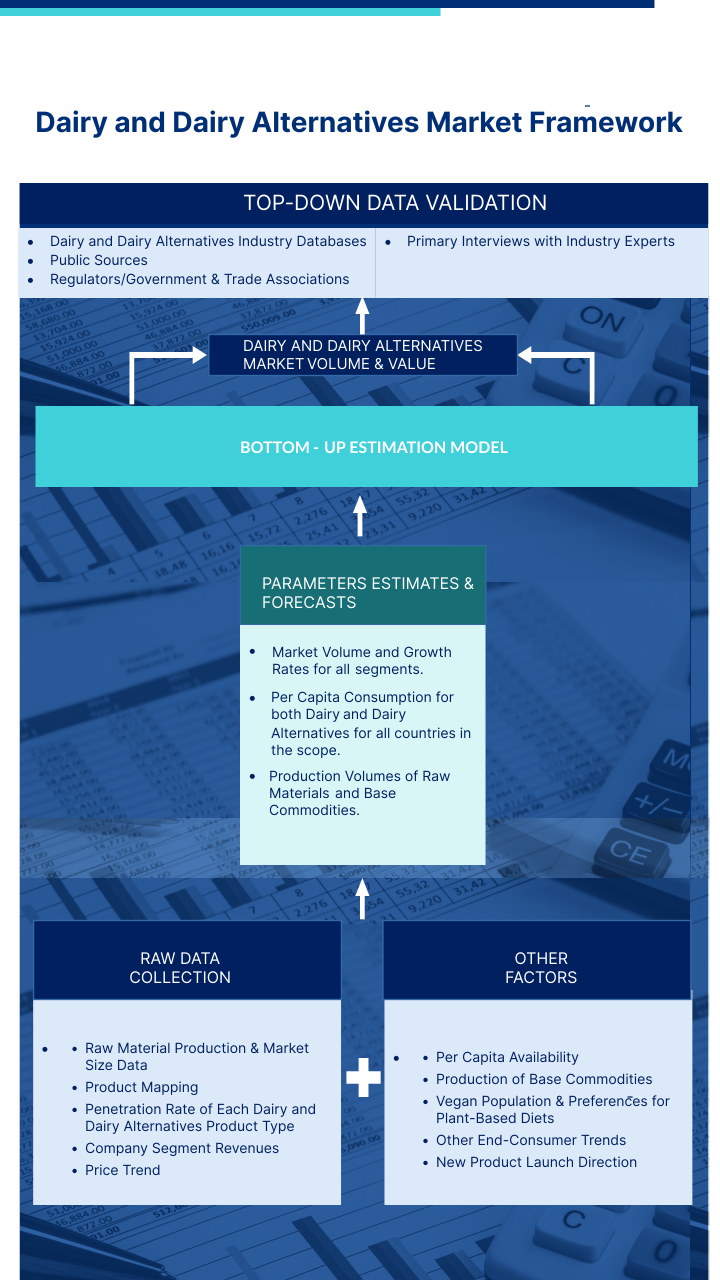
Mordor Intelligence follows a four-step methodology in all our reports.
- Step-1: Identify Key Variables: In order to build a robust forecasting methodology, the variables and factors identified in Step 1 are tested against available historical market numbers. Through an iterative process, the variables required for market forecast are set, and the model is built on the basis of these variables.
- Step-2: Build a Market Model: Market-size estimations for the forecast years are in nominal terms. Inflation is not a part of the pricing, and the average selling price (ASP) is kept constant throughout the forecast period for each country.
- Step-3: Validate and Finalize: In this important step, all market numbers, variables, and analyst calls are validated through an extensive network of primary research experts from the market studied. The respondents are selected across levels and functions to generate a holistic picture of the market studied.
- Step-4: Research Outputs: Syndicated Reports, Custom Consulting Assignments, Databases & Subscription Platforms





 Your data is secure and never sold or shared.


