
Market Overview
| Study Period | 2021 - 2031 |
|---|---|
| Forecast Data Period | 2026 - 2031 |
| Base Year Market Size (2025) | USD 5.89 Billion |
| Market Size (2026) | USD 6.25 Billion |
| Market Size (2031) | USD 8.42 Billion |
| Growth Rate (2026 - 2031) | 6.14 % |
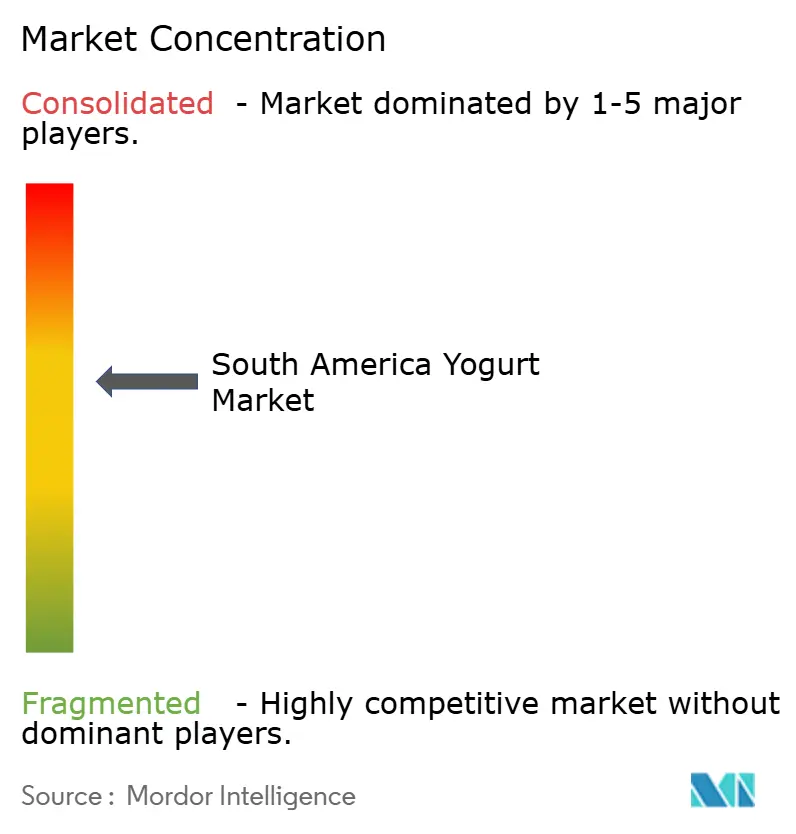
| Market Concentration | Medium |
Major Players *Disclaimer: Major Players sorted in no particular order Image © Mordor Intelligence. Reuse requires attribution under CC BY 4.0. | |
South America Yogurt Market Analysis by Mordor Intelligence
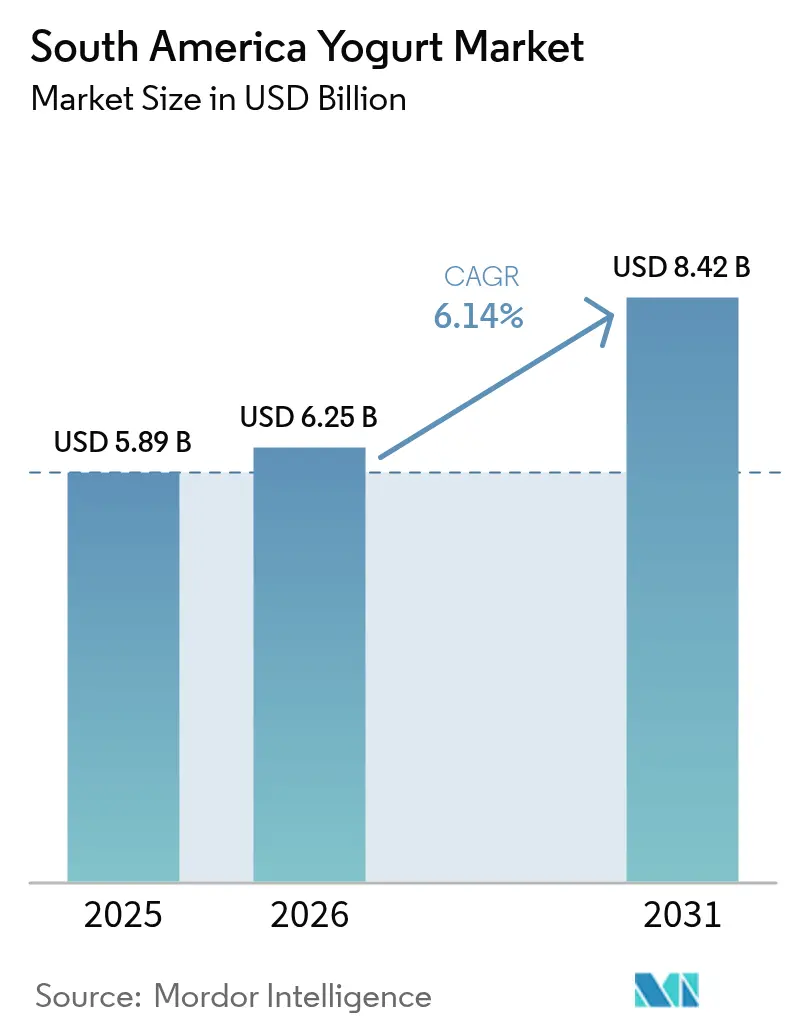
South American Yogurt Market size market size in 2026 is estimated at USD 6.25 billion, growing from 2025 value of USD 5.89 billion with 2031 projections showing USD 8.42 billion, growing at 6.14% CAGR over 2026-2031. The market's expansion is driven by multiple factors, including health-conscious consumer preferences, expanding cold chain infrastructure, and flexitarian dietary shifts. The growing urban population and rising disposable incomes have significantly influenced consumption patterns, while sustainability concerns have created a strategic need for manufacturers to diversify their product portfolios. The market encompasses traditional, Greek-style, and flavored yogurts, with major dairy companies expanding their production capacities to meet demand. While the trend toward natural and organic variants, innovative packaging solutions, and new flavor combinations continues to shape market dynamics, challenges persist in the form of volatile milk prices and import tariffs on probiotic cultures. These challenges particularly affect small and medium enterprises striving to maintain profit margins while meeting consumer demands for premium offerings. The increasing adoption of yogurt as a breakfast option and healthy snack alternative further supports market growth across South America.
Key Report Takeaways
- By category, dairy-based yogurt led with a 91.62% share in 2025 in the South America yogurt market; plant-based yogurt is projected to expand at a 7.05% CAGR through 2031.
- By product form, spoonable/set yogurt held 67.55% of the South America yogurt market; while drinkable yogurt is poised for a 8.05% CAGR to 2031.
- By flavor profile, plain/natural accounted for 41.60% of the South America yogurt market in 2025; flavored posted the fastest 7.58% CAGR.
- By packaging type, cups, containers and tubs led with a 60.74% share in 2025 in the South America yogurt market; tetra packs and pouches posted the fastest 7.63% CAGR.
- By distribution channel, off-trade captured 55.20% revenue in 2025 in the South America yogurt market; on-trade are growing at a 6.44% CAGR.
- By geography, Brazil captured 62.55% of the South America yogurt market share in 2025 and Columbia is projected to record the highest CAGR at 8.55% through 2031.
Note: Market size and forecast figures in this report are generated using Mordor Intelligence’s proprietary estimation framework, updated with the latest available data and insights as of 2026.
Market Trends and Insights
Drivers Impact Analysis of South America Yogurt Market*
| DRIVER | (~) % IMPACT ON CAGR FORECAST | GEOGRAPHIC RELEVANCE | IMPACT TIMELINE |
|---|---|---|---|
| Rising demand for functional probiotic dairy products | +1.8% | Brazil, Colombia, Argentina | Medium term (2-4 years) |
| Flavor innovation using local fruits accelerating yogurt uptake | +1.2% | Brazil, Peru, Colombia | Short term (≤2 years) |
| Growth of convenience-pack drinkable yogurts | +1.5% | Brazil, Colombia, Chile | Medium term (2-4 years) |
| Cold-chain retail expansion enabling premium greek yogurt | +1.7% | Brazil, Colombia, Argentina | Long term (≥4 years) |
| Surge of flexitarians fueling plant-based yogurt | +1.0% | Brazil, Argentina, Chile | Medium term (2-4 years) |
| Growing health consciousness among consumers and increasing awareness of probiotic benefits | +1.4% | Brazil, Colombia, Argentina, Peru | Medium term (2-4 years) |
| Source: Mordor Intelligence | |||
Rising demand for functional probiotic dairy products
The functional probiotic yogurt segment is experiencing significant growth across South America, primarily driven by increasing consumer awareness of gut health benefits and immune system support. This trend is particularly evident where urban middle-class consumers demonstrate willingness to pay premium prices for products with scientifically backed health claims. The market's development is supported by regulatory frameworks, such as ANVISA in Brazil, which has established specific guidelines requiring manufacturers to provide evidence of health benefits and strain viability. This creates a competitive advantage for companies with strong research and development capabilities. In response to growing demand and the rising prevalence of digestive health issues, manufacturers are expanding their product lines and launching innovative offerings. For example, LALA introduced LALA Gold in November 2024, a premium product line featuring high-protein yogurt variants in both drinkable and spoonable formats, containing real fruit, active probiotics, and no added sugar, with protein content ranging from 20 to 25 grams per serving. As consumer interest in functional foods continues to grow and regulatory frameworks evolve, the market is expected to maintain its growth trajectory, offering opportunities for both established manufacturers and new entrants.
Flavor innovation using local fruits accelerating yogurt uptake
The incorporation of indigenous South American fruits into yogurt products is driving market growth while providing manufacturers with competitive advantages. Companies are developing varieties featuring regional fruits like açaí, guaraná, berries and passion fruit to appeal to local taste preferences and meet consumer demand for authentic flavors. The integration of these fruits enables manufacturers to differentiate their products in an increasingly competitive market landscape. Major manufacturers like Danone and Nestlé have launched products combining traditional yogurt with indigenous fruits from the Amazon region. These ingredients not only offer distinct flavors and high antioxidant content but also allow manufacturers to command premium prices while reducing transportation costs and supporting regional agricultural communities. This trend continues to expand, as demonstrated by Yasso's April 2024 launch of new frozen Greek yogurt bars featuring real fruit flavors: Strawberry Chocolate Crunch, Strawberries and Cream, and Creamy Mango. The success of these fruit-based innovations has encouraged other manufacturers to explore similar product developments, leading to increased diversification in the yogurt market.
Cold-chain retail expansion enabling premium Greek yogurt
The expansion of cold-chain retail infrastructure in South America has enabled the distribution and storage of premium Greek yogurt products across major urban centers. Supermarket chains and specialty stores are increasingly allocating dedicated shelf space for Greek yogurt due to growing consumer demand for protein-rich dairy products. The improved cold storage facilities and temperature-controlled transportation networks allow manufacturers to maintain product quality and extend shelf life, benefiting both international Greek yogurt brands entering markets in Brazil, Argentina, and Chile and local dairy companies launching their own Greek yogurt product lines. According to the Global Cold Chain Alliance, in Latin America, 40% of the food demand is driven by exports, 20% by imports for domestic consumption, and 40% by local production and distribution[1]. Countries like Brazil and Mexico are investing in modern cold storage facilities and logistics networks to support this market development. This ongoing investment in cold chain infrastructure positions South America as a significant growth market for premium dairy products, particularly yogurt.
Surge of flexitarians fueling plant-based yogurt
The increasing number of flexitarians in South America is driving the growth of plant-based yogurt consumption. Consumers are adopting semi-vegetarian diets while maintaining occasional meat consumption, influenced by health consciousness, environmental concerns, and lactose intolerance. Major retailers in Brazil and Argentina are expanding their plant-based yogurt offerings, while local manufacturers are developing products using regional ingredients like coconut, almonds, and soy to meet this growing demand. This dietary shift is particularly evident among urban, educated consumers who are reducing their animal product consumption without completely eliminating it. According to World Population Review, Brazil's population includes approximately 14% vegetarians and 2% vegans, indicating significant market potential for plant-based yogurt products[2]. As this dietary trend continues to evolve, the South American plant-based yogurt market is expected to witness sustained growth and innovation in product development.
Restraints Impact Analysis of South America Yogurt Market*
| RESTRAINT | (~) % IMPACT ON CAGR FORECAST | GEOGRAPHIC RELEVANCE | IMPACT TIMELINE |
|---|---|---|---|
| Volatile milk prices compressing dairy-based yogurt margins | –1.2% | Brazil, Argentina, Uruguay | Short term (≤2 years) |
| Import tariffs on probiotic cultures raising SME costs | –0.8% | Brazil, Argentina, Peru | Medium term (2-4 years) |
| Short shelf life and spoilage risk | –0.9% | Higher impact in rural areas region-wide | Short term (≤2 years) |
| High competition from traditional dairy products and local fermented beverages | –0.7% | Colombia, Peru, regional markets | Long term (≥4 years) |
| Source: Mordor Intelligence | |||
Volatile milk prices compressing dairy-based yogurt margins
The South American yogurt market faces significant challenges due to fluctuating milk prices, which directly affect production costs and profit margins. Brazil and Argentina, the region's largest dairy producers, experience frequent price volatility in raw milk due to weather conditions, feed costs, and economic instability. These price variations force yogurt manufacturers to either absorb the increased costs or pass them on to consumers, potentially affecting demand. Additionally, the region's complex dairy supply chain and limited cold storage infrastructure contribute to higher operational costs. The situation is particularly challenging for small and medium-sized yogurt producers who have limited bargaining power with milk suppliers and restricted ability to hedge against price fluctuations.
Short shelf life and spoilage risk
The inherent perishability of yogurt products presents significant challenges across South America, where ambient temperatures and inconsistent cold chain infrastructure accelerate product degradation. Traditional yogurt maintains quality for only 20-30 days under ideal refrigeration conditions, with this window shrinking dramatically when temperature control is compromised. This short shelf life creates substantial logistical challenges, particularly for distribution to rural areas and smaller retail outlets where refrigeration may be intermittent. These constraints increase operational costs for manufacturers, who must invest in preservation technologies and temperature-controlled supply chains to maintain product quality and safety standards. Addressing these cold chain infrastructure gaps remains crucial for expanding market reach and ensuring consistent product quality across the region.
*Our forecasts treat driver/restraint impacts as directional, not additive. The impact forecasts reflect baseline growth, mix effects, and variable interactions.
South America Yogurt Market Segment Analysis
By Category:
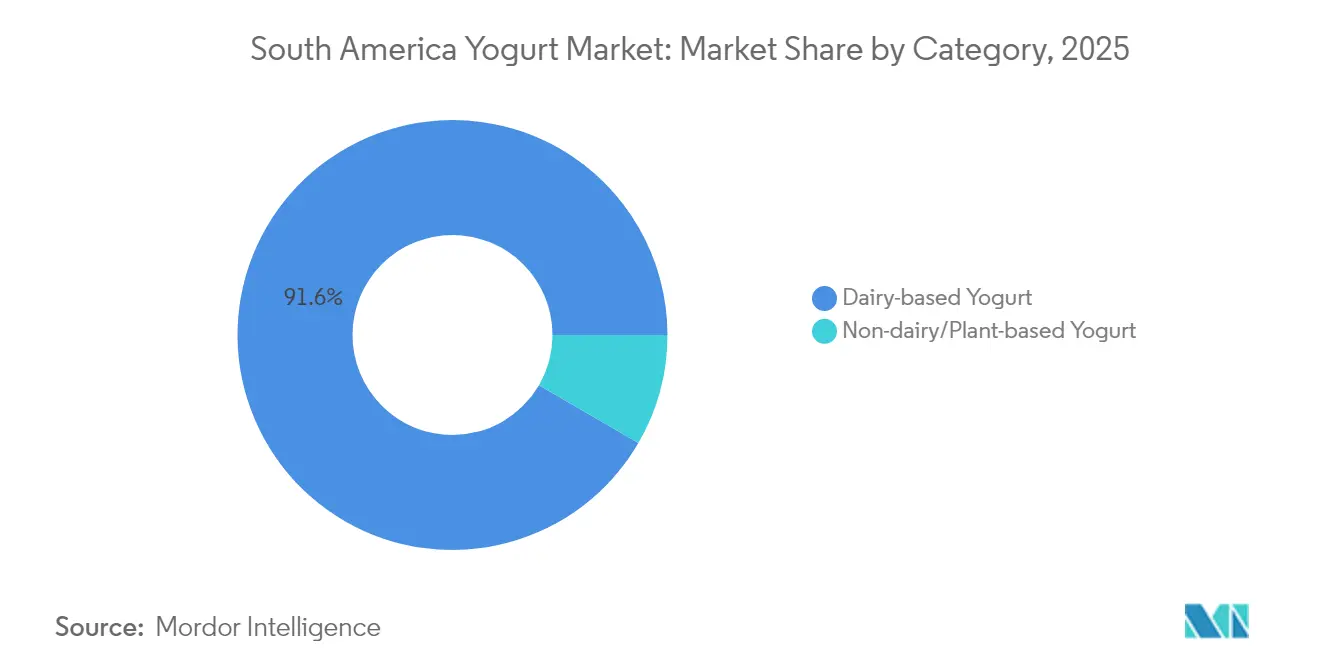
Plant-based disrupts traditional dairy dominanceDairy-based yogurt maintains its commanding position with 91.62% market share in 2025, benefiting from established consumer preferences and cultural traditions across South America. The dairy segment's dominance is reinforced by extensive distribution networks and price advantages, with production costs approximately 30% lower than plant-based alternatives. Brazil's dairy industry, which produces approximately 25.7 billion liters of milk annually, provides a stable supply base for conventional yogurt production despite occasional price volatility as per the U.S. Dairy Export Council.
Plant-based yogurt is experiencing explosive growth at 7.05% CAGR (2026-2031), driven by increasing flexitarian dietary patterns and sustainability concerns. This segment faces persistent challenges in sensory attributes, with research indicating that unexpected sourness and texture issues remain barriers to broader adoption. The Good Food Institute reports that despite challenges in the broader plant-based market, innovations in taste and texture are steadily improving consumer acceptance, with manufacturers increasingly targeting the flexitarian demographic rather than exclusively vegans

By Product form:
Convenience drives drinkable format growthIn the product form segmentation, spoonable/set yogurt maintains market leadership with 67.55% share in 2025, appealing to traditional consumption patterns and versatile usage occasions. This segment benefits from its established position as a breakfast staple and snack option across South American households, supported by innovations in premium offerings, particularly Greek-style products that deliver higher protein content and creamier textures. The segment's dominance is further reinforced by its widespread retail presence and consumer familiarity with traditional yogurt formats.
Drinkable yogurt is emerging as the market's growth driver, expanding at 8.05% CAGR (2026-2031) and steadily increasing its market share. This growth is driven by urbanization and busier lifestyles across South American metropolitan areas, where consumers prioritize on-the-go nutrition. The development of ambient yogurt technology has enhanced market penetration in tropical climates and areas with limited refrigeration infrastructure, particularly benefiting younger demographics and rural regions previously constrained by cold chain limitations.
By Flavor profile:
Local ingredients enhance premium positioningPlain/natural yogurt commands a significant 41.60% market share in 2025, maintaining its position as a market leader in South America. This dominance stems from its dual role as both a standalone product and a versatile ingredient in regional cuisine. The segment particularly resonates with health-conscious consumers who prefer lower sugar options and individuals who choose to personalize their yogurt with fresh ingredients at home. The minimal processing and absence of artificial additives in plain yogurt align with the growing consumer preference for clean-label products.
Flavored yogurt demonstrates stronger growth potential with a projected CAGR of 7.58% during 2026-2031. The segment's expansion is fueled by ongoing innovation in flavor profiles and formulations, particularly through the incorporation of indigenous South American fruits. According to research from the London School of Economics, these native ingredients not only provide unique sensory experiences but also offer enhanced functional benefits through their high antioxidant content. This strategic use of local ingredients enables manufacturers to command premium prices while reinforcing regional identity in their product offerings.
By Packaging type:
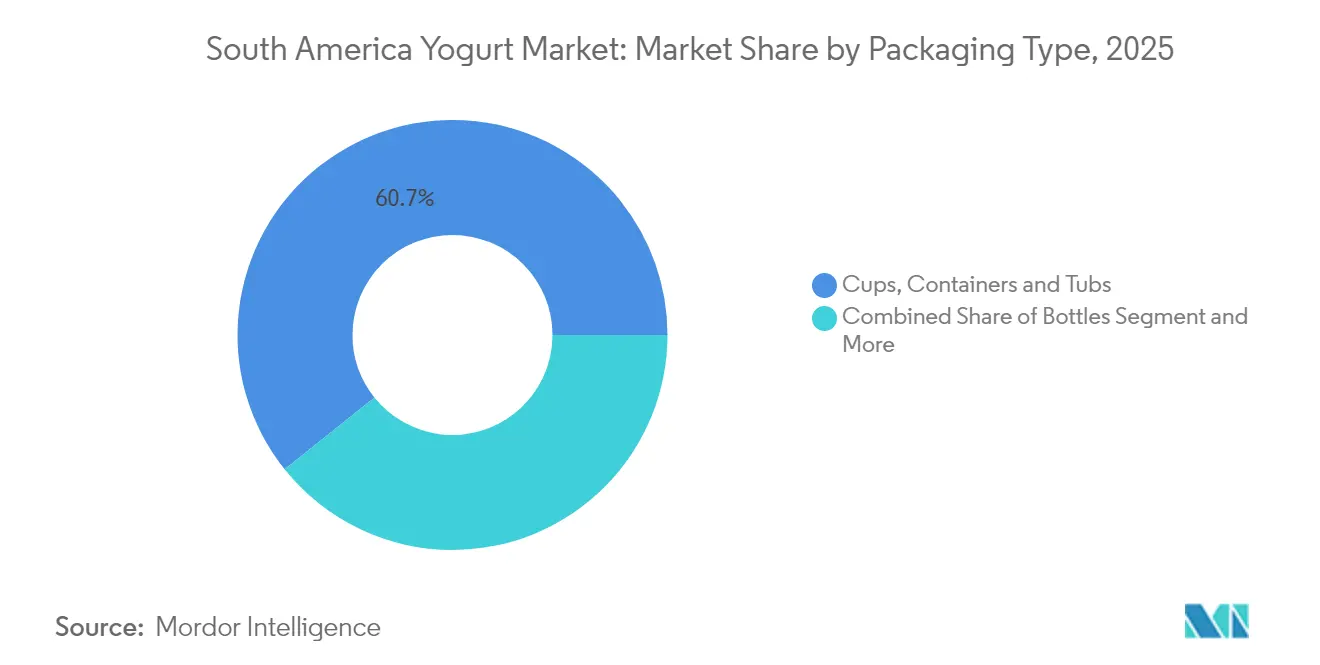
Innovation extends reach beyond urban centersCups, containers, and tubs maintain their dominance in the yogurt packaging market, holding a 60.74% market share in 2025. This traditional format's success stems from consumer familiarity and versatility across yogurt varieties, with ongoing evolution in materials and design, including sustainable alternatives to address environmental concerns. Manufacturers continue to invest in research and development to enhance the functionality and eco-friendliness of these conventional packaging formats.
The market is witnessing a significant shift with tetra packs and pouches growing at 7.63% CAGR (2026-2031). These formats offer advantages in convenience, shelf life, and reduced refrigeration needs, enabling market expansion beyond urban areas. The ambient yogurt technology, featuring 4-6 month shelf life without refrigeration, particularly appeals to younger consumers seeking portable options while addressing distribution challenges in regions with limited cold chain infrastructure. The adoption of these innovative packaging solutions is expected to accelerate as manufacturers focus on meeting evolving consumer preferences and expanding their market reach.
By Distribution channel:
Foodservice momentum challenges retail dominanceOff-trade channels maintain market leadership with 55.20% share in 2025, driven by established consumer shopping habits and home consumption preferences. This segment includes supermarkets, hypermarkets, convenience stores, and online retail platforms. The off-trade segment's dominance stems from its broad product selection, competitive pricing through bulk purchasing, and integrated shopping experiences where consumers can purchase yogurt with other groceries. However, this channel shows moderate growth potential due to market maturity and evolving consumer preferences toward experiential consumption.
The on-trade segment demonstrates robust growth potential with a 6.44% CAGR (2026-2031), exceeding the market's overall growth rate. This expansion stems from the growing foodservice sector, including restaurants, cafes, hotels, and institutional catering services. These establishments increasingly incorporate yogurt into their menus as a healthy option and ingredient for smoothies, desserts, and breakfast items. The on-trade channel serves as a primary platform for introducing new yogurt varieties, reflecting the increasing consumer interest in experiential dining across South America.
Geography Analysis
Brazil Yogurt Market
Brazil commands a 62.55% share of the South American yogurt market in 2025, supported by its large population and established dairy industry. The country's milk production is projected to reach 25.4 MMT in 2025, representing a 1.6% growth according to USDA. While the South Region exhibits above-average dairy product consumption, the North and Central West regions show lower consumption patterns. The Brazilian National School Feeding Programme (PNAE) has become a key market driver by mandating 30% of its budget for family farmer products, creating new yogurt distribution channels in underserved areas.
Colombia Yogurt Market
Colombia emerges as the region's fastest-growing market with an 8.55% CAGR (2026-2031), driven by increasing disposable incomes, urbanization, and health consciousness. However, recent health taxes on high-sugar products have led to a decrease in food processing production during 2024, prompting manufacturers to develop lower-sugar alternatives, particularly in premium segments. The market shows strong demand for high-protein and functional yogurt products.
South America Yogurt Market
Argentina's yogurt market faces challenges from economic instability and currency devaluation, affecting both production costs and consumer purchasing power. Chile benefits from free-trade agreements, enabling efficient import of specialized cultures and packaging materials, which supports the development of premium niche brands and export opportunities. Peru's market growth is primarily sustained by domestic demand and private investment, contributing to the region's diverse yogurt market landscape.
Regulatory Landscape
Yogurt regulation in South America is driven by product identity and safety rules administered by agriculture and sanitary authorities, alongside consumer-facing labeling controls. In MERCOSUR markets such as Brazil and Argentina, RES GMC 47/97 serves as a baseline technical reference for yogurt/fermented milk identity and quality requirements. Brazil also applies Ministry of Agriculture and Livestock (MAPA) inspection requirements for animal-origin dairy establishments (including Instrucao Normativa 46/2007) and ANVISA rules for food labeling and permitted additives.
Country-specific frameworks shape formulation and claims. Peru regulates yogurt under the Reglamento de la Leche y Productos Lacteos (DS 007-2017), with oversight involving SENASA and DIGESA. Chile applies prominent nutrition labeling requirements under Law 20.606 for products exceeding defined thresholds, including added-sugar flavored yogurts, and also requires specific dairy labeling provisions under Ley 21.179. These obligations add traceability-related disclosure requirements that affect packaging and country-of-origin communication.
Value Chain Analysis
The value chain starts with raw milk collection and quality control through farm and cooperative networks, followed by industrial processing (standardization, fermentation, mixing with fruit/prebiotics, and filling). Distribution then depends on cold-chain logistics to reach off-trade and on-trade buyers. Brazil and Argentina act as the primary milk hubs for the regional yogurt supply base, with Brazil recording 27.5 billion liters of formally inspected milk in 2025 and Argentina reporting 11.62 billion liters in 2025, a decade high. This supports large-scale yogurt and fermented milk production across the region.
Processing and distribution are centered on multi-plant operators and expanding regional collectors, while upstream dynamics point to consolidation and productivity gains. In Brazil, the dairy supplier base decreased by 3.2% in 2025 to 43,200 suppliers even as average farm productivity increased by 12.4%. This tightening in procurement for smaller buyers increases the value of stable milk collection footprints. Lactalis Brasil reflects midstream scale with 23 factories and 2.9 billion liters of raw milk intake in 2025, and its expansion through acquisitions such as Piracanjuba's purchase of Natulact (Sergipe) helps widen milk collection and manufacturing in Brazil's Northeast, where logistics and cold-chain constraints can be more acute.
Competitive Landscape
The South American yogurt market demonstrates moderate concentration, featuring a mix of global dairy corporations and established regional players. Multinational companies like Danone, Nestlé, and Lactalis utilize their extensive research and development capabilities and global supply chains to drive innovation, while regional leaders such as Grupo Lala, Alpina, and Gloria maintain strong market positions through their understanding of local preferences and robust distribution networks.
Companies are increasingly investing in premium and functional offerings, particularly in probiotic innovations and plant-based alternatives. Danone has prioritized South America for growth, expanding its Essential Dairy and Plant-Based portfolio with high-protein and children's products. In January 2024, SystemBiotech introduced a yogurt product enriched with psychobiotics, targeting mental health through gut-brain axis modulation.
The market presents significant opportunities in ambient yogurt technologies for rural distribution and affordable functional products targeting the expanding middle class. Emerging companies are differentiating themselves through local ingredient sourcing and sustainability initiatives, addressing evolving consumer preferences while creating new market segments. These market dynamics are expected to drive product innovation and market expansion in the coming years, particularly in underserved regions and consumer segments.
South America Yogurt Industry Leaders
-
Danone SA
-
Nestlé SA
-
Grupo Alpura
-
Schreiber Foods Inc.
-
Fonterra Co-operative Group
- *Disclaimer: Major Players sorted in no particular order
South America Yogurt Market Companies Covered in this Report
- Danone SA
- Nestle SA
- Grupo Alpura
- Schreiber Foods Inc.
- Fonterra Co-operative Group
- Chobani LLC
- General Mills, Inc.
- Groupe Lactalis S.A..
- Yakult Honsha Co. Ltd.
- Emmi Group
- Grupo Lala
- Laticinios Bela Vista
- Alpina Productos Alimenticios
- Sigma Alimentos (Santa Clara)
- FAGE International S.A
- Conaprole
- Tirol Alimentos
- Grupo Gloria
- Colun
- Lacteos Los Andes
Market Opportunities and Future Outlook
A key opportunity is building scale and efficiency in core yogurt categories through consolidation and integrated distribution platforms, particularly in Brazil and Argentina where supply volatility and cost pressures are most evident. In March 2026, Danone and Arcor announced a 50:50 joint venture integrating dairy assets in Argentina, bringing 11 production plants and established logistics into a single operating platform covering yogurt and chilled dairy lines. Integration on this scale can support faster portfolio rationalization across plain, flavored, high-protein, and functional variants, and it broadens route-to-market coverage in a country where macro volatility has increased execution risk for standalone operators.
Another opportunity is expanding regional manufacturing capacity and upgrading ingredient-side capabilities that support product differentiation, including higher-protein formulations and functional variants. Lactalis announced large, multi-site investments in Brazil, including R$285 million in Parana (March 2025) to enhance production lines for dairy including yogurts and fermented milks, and R$400 million (September 2025) to expand facilities in Rio Grande do Sul, reinforcing industrial capacity and procurement networks. On the ingredient side, Arla Foods Ingredients has a scheduled completion and go-live plan in 2026 for a whey permeate powder drying tower at its Portena facility in Argentina. This aligns with demand for higher-protein and texture-optimized yogurt formulations and improves local availability of dairy ingredients used in product standardization.
Recent Industry Developments in South America Yogurt Market
- March 2026: Danone and Grupo Arcor announced a 50:50 joint venture in Argentina integrating Danone Argentina's dairy business with Mastellone Hermanos' operations and the Logistica La Serenisima distribution network. The combined platform spans 11 production plants and manufactures categories including yogurt, strengthening scale and route-to-market coverage in a volatile operating environment.
- April 2025: Danone launched a new line of acai and guarana flavored probiotic yogurts in Brazil using locally sourced ingredients. The rollout supports premiumization through regional flavor cues and reinforces a functional proposition that can help brands defend shelf space as sugar and label scrutiny increases across parts of the region.
- June 2024: FAGE International S.A. entered the Brazilian market with premium Greek yogurt products, initially targeting major urban centers through import distribution channels. The entry increased competitive pressure in higher-protein spoonable segments and highlighted the role of cold-chain capable retail in expanding premium yogurt availability.
South America Yogurt Market Report Scope and Research Methodology
Market Definition and Coverage
For this report, the market is defined as the value of yogurt sold in South America across retail and foodservice, covering spoonable and drinkable fermented yogurt products, including plant-based yogurts, when they are sold as yogurt.
Scope exclusions: We exclude frozen yogurt, kefir, buttermilk, and probiotic drinks positioned mainly as beverages rather than yogurt.
Segments Covered in This Report
- By Category
- Dairy-based Yogurt
- Non-dairy/Plant-based Yogurt
- By Product Form
- Spoonable/Set Yogurt
- Drinkable Yogurt
- By Flavor Profile
- Plain/Natural
- Flavored
- By Packaging Type
- Cups, Containers and Tubs
- Bottles
- Tetra Packs and Pouches
- Others
- By Distribution Channel
- Off-Trade
- Supermarkets/Hypermarkets
- Convenience Stores
- Online Retail
- Other Distribution Channels
- On-trade
- Off-Trade
- By Geography
- Brazil
- Argentina
- Chile
- Colombia
- Peru
- Rest of South America
Data Sources, Market Sizing, and Validation
Desk Research
Desk research helped us set the basic boundaries for what counts as yogurt in South America and where demand is happening by country and channel. We reviewed public statistics and reference material such as FAOSTAT dairy indicators, UN Comtrade import and export series for relevant dairy categories, and consumer price index tables from national statistics offices in Brazil, Argentina, Chile, Colombia, and Peru.
To avoid building assumptions in isolation, we also checked trade association and regulator sources such as Codex Alimentarius standards on fermented milks, agriculture and food ministry publications, and open-access academic papers on fermented dairy consumption and reformulation trends. On the company side, we used investor presentations, annual reports, and press releases to cross-check pricing moves, capacity additions, and portfolio mix shifts. Where helpful, we supplemented this with paid subscriptions focused on company financials and intelligence and patent databases for product development context. This list is illustrative, and many other public sources were also used for collection, validation, and clarification.
Primary Interviews and Surveys
We speak with dairy processors, distributors, retailers, foodservice buyers, and product specialists active in South America. Their input helps test secondary data, clarify channel pricing and product coverage, and fill gaps where country-level yogurt records are limited. Assumptions are then compared across respondents before the final analysis is set.
Distribution of primary research fieldwork respondents
| Company type | Respondent position |
|---|---|
| Top tier: 28% | CXOs: 20% |
| Mid tier: 47% | Functional/Unit leaders: 32% |
| Smaller Players: 25% | Managers: 48% |
Market-Sizing & Forecasting
The sizing starts with a top-down build that reconstructs yogurt demand using country-level consumption signals, trade flows where relevant, and observed price points, which are then adjusted for channel coverage differences across South America. Once that structure is in place, we corroborate totals with selective bottom-up approximations, such as sampling average selling price by pack format and pairing it with estimated volumes for key channels, followed by quick supplier and distributor cross-checks.
A few practical inputs that matter in this market include per capita dairy consumption trends, yogurt price inflation versus overall food CPI, shifts between spoonable and drinkable formats, the pace of plant-based yogurt adoption, and the share moving through supermarkets versus smaller stores and foodservice. Where country data was patchy, we filled gaps using neighboring-market analogs and then revalidated the implied per capita consumption with interview feedback so that the result stayed realistic.
For forecasting, we used scenario analysis supported by trend lines in prices and demand, and then applied country-level adjustments based on what interviewees expect for household budgets, channel expansion, and portfolio changes. The forecast was kept reproducible, so each driver can be traced back to an observable indicator and then refreshed as new annual data becomes available.
Data Validation & Update Cycle
Validation is done through several checks so that one noisy input does not distort the final number. We compare the modeled market totals against independent signals, like implied consumption per person, price movements, and trade patterns, and then investigate any large jumps at the country or channel level before sign-off.
A second analyst reviews key assumptions, calculations, and conversion steps, and follow-up outreach is triggered when the variance cannot be explained by a known event like a price shock or channel reclassification. Reports are refreshed annually, with interim updates when material developments occur, and a final pre-delivery review is completed so clients receive the latest updated view.
Mordor Intelligence's South America Yogurt Market Size Compared Against Other Published Estimates
Published market sizes for South America yogurt can differ even when the same years are shown, because the product boundary and the point in the value chain being measured are not always the same. In practice, differences also come from how pricing is converted to USD, how foodservice is treated, and whether plant-based yogurt is counted inside the same bucket.
By tracking label and category boundaries across countries and refreshing the country price and channel weights, Mordor Intelligence keeps the estimate anchored to yogurt sales value in South America rather than broader fermented milk revenue pools or narrower retail-only views.
Benchmark comparison
| Source | Market Size | Gaps in Research Methodology |
|---|---|---|
| Mordor Intelligence | USD 5.89 B (2025) | |
| Industry Publisher A | USD 8.12 B (2030) | Uses a different horizon and may bundle a wider yogurt definition for 2030, which can lift the total versus a base-year 2025 sales view and can also reflect a more aggressive mix and price progression. |
| Trade Data Publisher B | USD 9.40 B (2024) | Covers Latin America plus the Caribbean and combines yogurt with fermented milk categories, and it also reports producer and importer revenue that excludes retail margins, so scope and value-chain coverage do not match a yogurt sales market total. |
The spread mainly comes from what is included as yogurt, which countries are inside the geography, and whether the value is measured at retail sales or earlier in the chain. When the scope is tightened to South America yogurt sales and the price and channel math is made explicit, decision-makers get a number that is easier to reconcile and update year to year.
Key Questions Answered in the Report
What is the current South American Yogurt market size?
The market stands at USD 6.25 billion in 2026 and is projected to reach USD 8.42 billion by 2031.
Which country holds the largest South American Yogurt market share?
Brazil leads with roughly 62.55% of regional revenue, supported by its large population and dairy base.
What is driving the rapid growth of plant-based yogurt in South America?
Flexitarian dietary shifts and steadily improving taste and texture are propelling plant-based options at an 7.05% CAGR.
Why are drinkable yogurts outpacing spoonable formats in growth?
On-the-go lifestyles and ambient-processing advances make drinkable yogurts more convenient for urban consumers.
How are volatile milk prices affecting the South American Yogurt industry?
Price swings squeeze smaller dairies’ margins, accelerating consolidation and prompting larger players to diversify formats.