
South America Animal Feed Organic Trace Minerals Market Size and Share
Market Overview
| Study Period | 2021 - 2031 |
|---|---|
| Forecast Data Period | 2026 - 2031 |
| Base Year Market Size (2025) | USD 102.36 Million |
| Market Size (2026) | USD 109.38 Million |
| Market Size (2031) | USD 152.41 Million |
| Growth Rate (2026 - 2031) | 6.86 % |
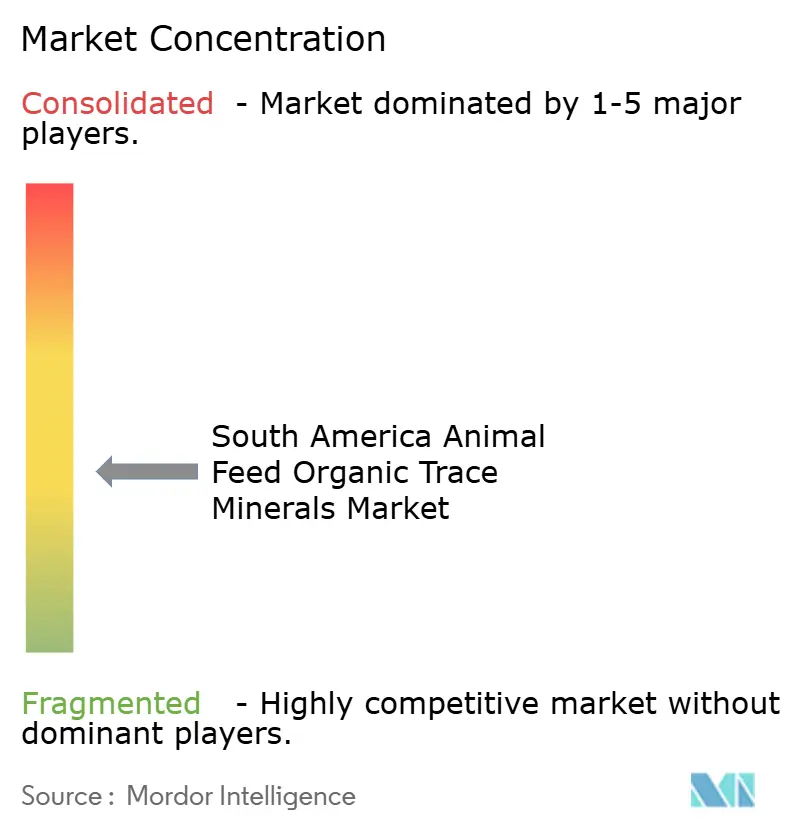
| Market Concentration | Medium |
Major Players *Disclaimer: Major Players sorted in no particular order Image © Mordor Intelligence. Reuse requires attribution under CC BY 4.0. | |
South America Animal Feed Organic Trace Minerals Market Analysis by Mordor Intelligence
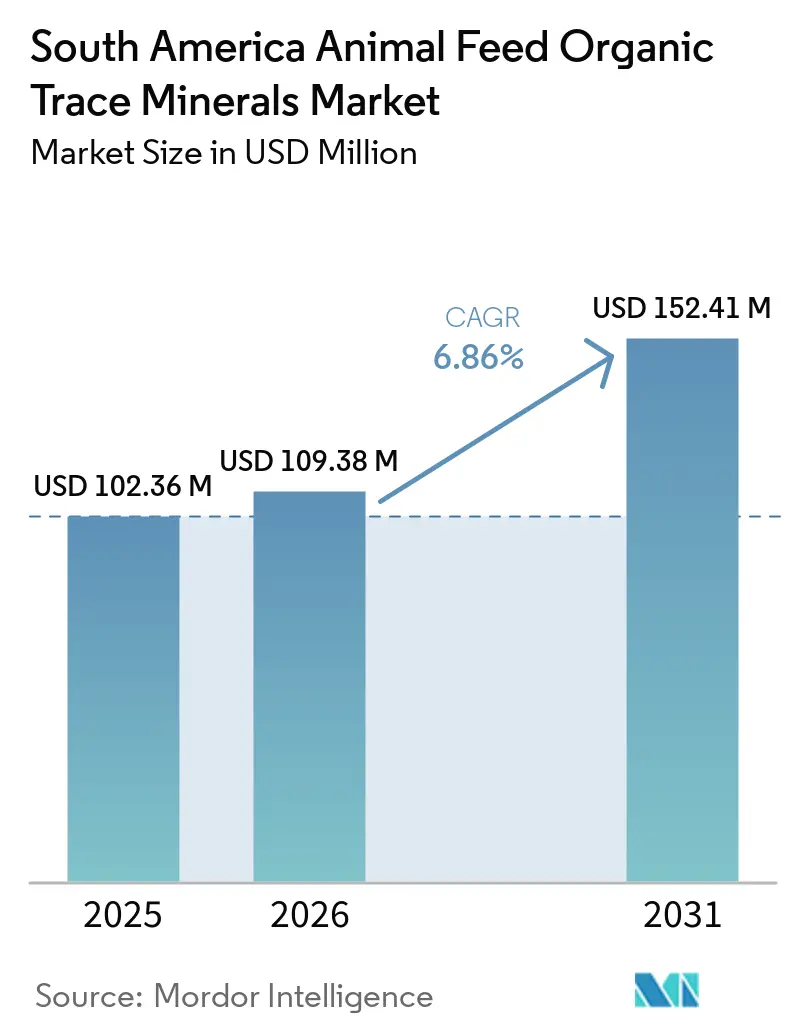
The South America animal feed organic trace minerals market size is projected to grow from USD 102.4 million to USD 109.4 million in 2026 to USD 152.4 million by 2031, registering a CAGR of 6.86% during 2026 to 2031. Growth in the South America animal feed organic trace minerals market is being shaped less by broad protein demand and more by export-grade quality standards and more intensive animal production systems. According to the Brazilian Animal Protein Association (ABPA), Brazil closed 2024 with record meat exports, with beef shipments at 2.89 million metric tons worth USD 12.8 billion and chicken exports at 5.3 million metric tons worth USD 9.9 billion, which raises pressure on integrators to protect feed conversion, carcass quality, and traceability at scale. That pressure supports a steady move in the South America animal feed organic trace minerals market toward organic mineral formats over sulfates and oxides, especially in commercial poultry, swine, and confined cattle systems. Local manufacturing investments by dsm-firmenich and Cargill, Incorporated are also improving product reach in Brazil, which should support wider adoption across key beef corridors. Adoption still faces resistance from premium pricing, uneven formulation discipline, and inconsistent labeling confidence in provincial markets, although Chile’s organic salmon chain shows that these barriers fade when traceability and purity directly affect export value.
Key Report Takeaways
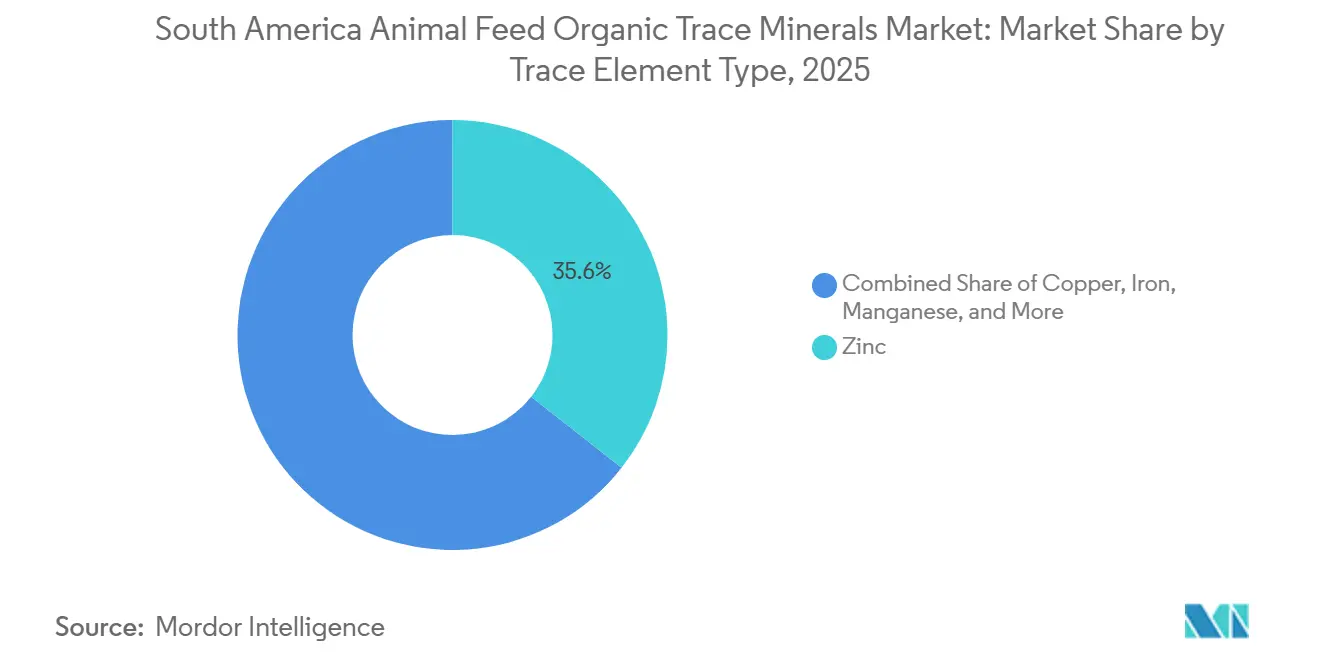
- By trace element type, zinc accounted for the largest South America animal feed organic trace minerals market share, 35.6%, in 2025, while the selenium market size is projected to grow at the fastest CAGR of 7.8% from 2026 to 2031.
- By chelation type, proteinates held the largest South America animal feed organic trace minerals market share, 39.4%, in 2025, whereas the hydroxy trace minerals market size is projected to grow at the fastest CAGR of 9.7% from 2026 to 2031.
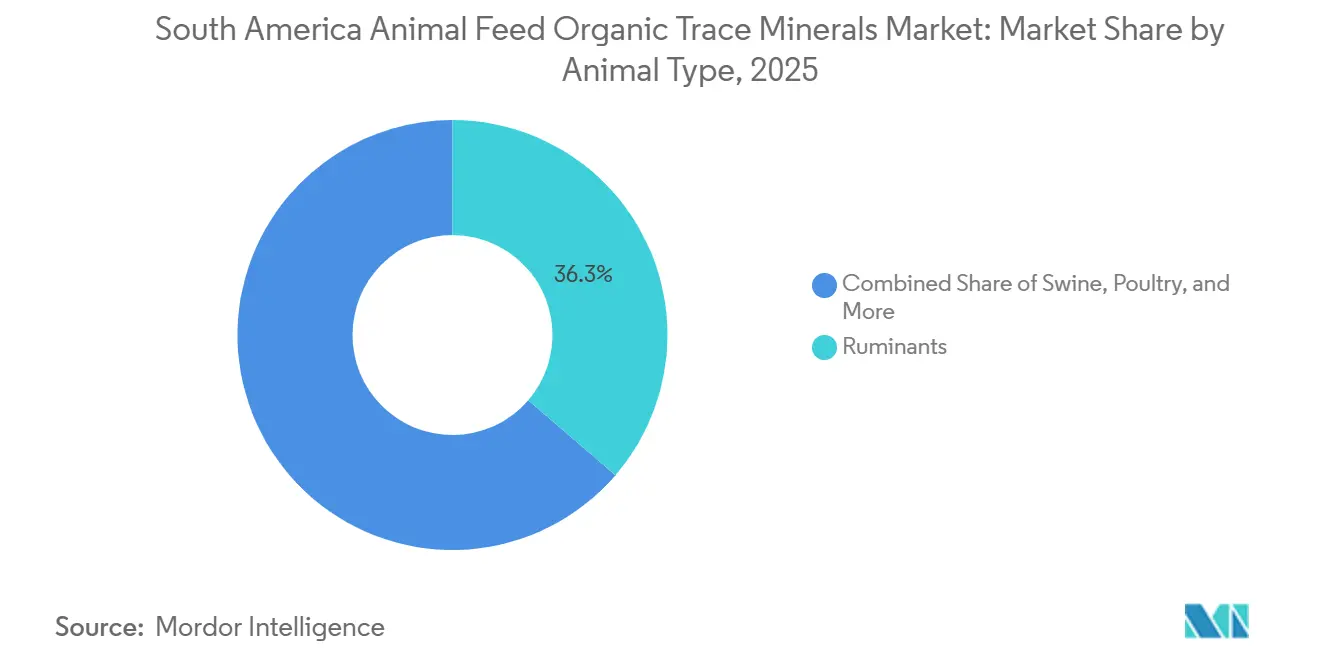
- By animal type, ruminants represented the largest South America animal feed organic trace minerals market size, 36.3%, in 2025, while the aquaculture market size is projected to grow at the fastest CAGR of 8.9% from 2026 to 2031.
- By application, growth promotion accounted for the largest South America animal feed organic trace minerals market size, 40.0%, in 2025, and it is anticipated to grow at the fastest CAGR of 7.4% from 2026 to 2031.
- By geography, Brazil held the largest South America animal feed organic trace minerals market share, 33.8%, in 2025, while the Brazil market size is also projected to grow at the fastest CAGR of 7.8% from 2026 to 2031.
Note: Market size and forecast figures in this report are generated using Mordor Intelligence’s proprietary estimation framework, updated with the latest available data and insights as of January 2026.
Market Trends and Insights
Drivers Impact Analysis of South America Animal Feed Organic Trace Minerals Market*
| Driver | (~) % Impact on CAGR Forecast | Geographic Relevance | Impact Timeline |
|---|---|---|---|
| Poultry and swine export-linked feed fortification demand | +1.80% | South America core, Brazil and Argentina, with spillover into export chains | Short term (≤ 2 years) |
| Beef herd intensification and pasture mineral balancing | +1.50% | South America, strongest in Brazil feedlot corridors and Argentina | Medium term (2-4 years) |
| Shift to higher-bioavailability chelated minerals | +1.60% | Regional, with faster uptake in Brazil, Argentina, and Chile | Medium term (2-4 years) |
| Brazil premix and supplement capacity expansion | +1.20% | Brazil primarily, with supply benefits extending into neighboring markets | Short term (≤ 2 years) |
| Brazil tax relief on feed additives and premixes | +0.90% | Brazil, especially Minas Gerais, Goiás, and Mato Grosso | Short term (≤ 2 years) |
| Chile organic salmon feed localization and traceable-input pull | +0.70% | Chile primarily, with spillover to coastal aquaculture markets | Medium term (2-4 years) |
| Source: Mordor Intelligence | |||
Poultry and Swine Export-Linked Feed Fortification Demand
Brazil’s 2024 export performance is pushing feed mills toward tighter mineral specifications in the South America animal feed organic trace minerals market. Chicken exports reached 5.3 million metric tons in 2024, and pork exports reached 1.4 million metric tons, with year-on-year growth of 3% and 10%, respectively, according to the Brazilian Animal Protein Association (ABPA). Large export destinations increasingly expect feed ingredient traceability, which favors labeled organic mineral sources over generic inorganic inputs in the South America animal feed organic trace minerals market. A September 2025 mini-review found that organically complexed zinc, copper, manganese, and iron in poultry and swine can reduce fecal mineral excretion, helping commercial systems respond to environmental compliance pressures in export-linked supply chains[1]. This means the South America animal feed organic trace minerals market is gaining support from trade compliance needs, even when domestic feed costs remain volatile.
Beef Herd Intensification and Pasture Mineral Balancing
Beef herd intensification provides the South American organic trace minerals market for animal feed with a steady demand base that is less dependent on short-cycle price swings. Brazil’s commercial cattle herd reached 194 million head in 2024, and feedlot confinement hit a record 8.8 million head in the same year[2]. The same ABIEC report showed that confinement finishing accounted for 19.2% of total slaughters, while nutrition spending in Brazil’s beef agro-industrial system reached USD 4,504 million. A 2025 Brazilian feedlot trial showed that organic trace minerals maintained animal performance even at lower inclusion rates, while improving average daily gain and feed efficiency in Nellore finishing bulls. The results reinforce the value of organic trace minerals through superior bioavailability and nutrient utilization compared with inorganic sources. This is supporting wider adoption among South American beef producers seeking greater production efficiency, optimized feed costs, and more effective correction of selenium, copper, and zinc deficiencies common in regions such as the Cerrado and Pampas.
Shift to Higher-Bioavailability Chelated Minerals
The shift from inorganic to chelated formats is becoming more evidence-based across the South America animal feed organic trace minerals market. A 2024 study in the Journal of Animal Science showed that complexed trace minerals in beef cattle improved average daily gain and reduced Bovine Respiratory Disease (BRD) morbidity by 11.5% points compared with inorganic sulfates. A March 2026 broiler study also found that hydroxychloride and organic zinc and copper combinations outperformed zinc sulfate on feed conversion and carcass weight by day 35. For the South America animal feed organic trace minerals market, this changes the buying case because lower total inclusion can still deliver the same biological outcome. That makes organic forms easier to justify in high-performance programs, even when their price per kilogram remains higher than sulfates or oxides.
Brazil Premix and Supplement Capacity Expansion
Capacity expansion in Brazil is improving access and reducing lead times in the South America animal feed organic trace minerals market. For instance, dsm-firmenich inaugurated a new 100,000 metric ton-per-year facility in Sete Lagoas in October 2024, following an investment of BRL 60 million (USD 11.2 million). This facility primarily targets beef and dairy producers in Southeast Brazil, with plans to expand further into the Center-West and Northeast regions. The development of regional production and distribution infrastructure near major livestock corridors is alleviating logistical challenges in interior regions and enhancing supply availability across the market.
Restraints Impact Analysis of South America Animal Feed Organic Trace Minerals Market*
| Restraint | (~) % Impact on CAGR Forecast | Geographic Relevance | Impact Timeline |
|---|---|---|---|
| Premium pricing versus inorganic trace minerals | -0.90% | South America-wide, most acute in Brazil and Argentina smallholder systems | Short term (≤ 2 years) |
| Registration and documentation burden for feed additives | -0.70% | Brazil and Argentina primarily, with moderate impact in Chile | Medium term (2-4 years) |
| Remote ranch logistics beyond core feed corridors | -0.60% | Brazil interior, Argentine Patagonia, and dispersed Andean zones | Long term (≥ 4 years) |
| Smallholder formulation discipline and label-trust gaps | -0.50% | Brazil interior and Argentina provincial markets | Long term (≥ 4 years) |
| Source: Mordor Intelligence | |||
Premium Pricing Versus Inorganic Trace Minerals
Premium pricing remains the clearest adoption barrier in the South America animal feed organic trace minerals market. Organic formats still carry a visible cost gap against sulfates and oxides, and that gap is harder to defend in pasture systems where returns are less visible over short feeding cycles. The pressure is strongest in Argentina’s value-led beef systems and in smaller swine operations that focus on immediate ration cost rather than downstream carcass quality. This has the side effect of favoring research-backed suppliers such as Zinpro, Novus International, Inc., and Alltech because producers who do upgrade tend to choose brands with published dose-response support. The South America animal feed organic trace minerals market consequently splits between advanced commercial users who convert fully and smaller operators who remain on inorganic programs.
Registration and Documentation Burden for Feed Additives
Registration requirements slow product rollout across the South America animal feed organic trace minerals market. In Brazil, Ministério da Agricultura e Pecuária (MAPA) registration, batch traceability, and documentation rules increase the time and cost required to commercialize new organic mineral chemistries. Argentina applies its own Servicio Nacional de Sanidad y Calidad Agroalimentaria (SENASA) approval structure, while Chile maintains separate certification requirements for organic aquafeed chains, which adds another layer for suppliers serving more than one country. These requirements tend to favor multinational companies with established regulatory portfolios and local teams capable of managing approvals across jurisdictions. In the South America animal feed organic trace minerals market, this slows the entry of smaller specialty suppliers and protects incumbent positions.
*Our forecasts treat driver/restraint impacts as directional, not additive. The impact forecasts reflect baseline growth, mix effects, and variable interactions.
South America Animal Feed Organic Trace Minerals Market Segment Analysis
By Trace Element Type:
Zinc and Selenium Define the Growth PolesZinc accounted for the largest South America animal feed organic trace minerals market share, 35.6%, in 2025, making it the baseline trace element across poultry, swine, cattle, and aquaculture nutrition programs. Its role spans immune support, hoof strength, gut epithelial repair, and reproductive performance, so demand is broad rather than species-specific. Brazil’s move toward more confined beef finishing also supports the use of zinc because tighter feeding systems require more consistent performance outcomes. A 2024 broiler study, “Synergistic Effects of Hydroxychloride and Organic Zinc on Performance, Carcass Characteristics, Liver and Tibia Mineral Profiles of Broiler Chickens,” found that combinations of hydroxychloride and organic zinc improved feed conversion and reduced abdominal fat compared with zinc sulfate at equivalent inclusion levels.
Selenium is the fastest-growing trace element, projected to grow at a CAGR of 7.8% during the forecast period (2026-2031) because broiler, layer, breeder, and aquaculture programs increasingly value both bioavailability and support for food safety. A 2025 review in the Journal of Nutrition reported a 25% to 45% bioavailability advantage for organic selenomethionine and selenium yeast over sodium selenite at commercial dose levels[3]. Copper, manganese, iron, and cobalt serve important but narrower functions, often tied to reproductive programs, skeletal health, or herd-specific correction of deficiencies. Chromium is still a small category, but it is gaining interest for stress-management applications in dairy cattle and aquaculture. The broader mix in the South America animal feed organic trace minerals industry also includes niche elements used in forage-deficient areas of the Cerrado and Pampas, where baseline mineral imbalance creates a direct supplementation need.

By Chelation Type:
Hydroxy Minerals Disrupt Established Amino-Acid Chelate DominanceProteinates held the largest share of the South America animal feed organic trace minerals market and accounted for 39.4% of the market in 2025. This dominance is attributed to their widespread commercial acceptance in feed formulations for beef, dairy, poultry, and swine. Their established role in performance-focused livestock nutrition programs, combined with proven bioavailability, mineral stability, and compatibility with commercial premix systems, supports their strong market penetration across the region. Proteinates are particularly prevalent in intensive production systems, where improvements in feed conversion, reproductive efficiency, immune performance, and overall animal productivity are critical factors for commercial feed manufacturers and integrated livestock operations.
Hydroxy trace minerals emerged as the fastest-growing chelation format in the South America animal feed organic trace minerals market, with a projected CAGR of 9.7% from 2026 to 2031. This growth is driven by the industry's increasing emphasis on mineral stability, feed efficiency, and enhanced nutrient utilization in intensive livestock production systems. Other chelation formats, such as amino acid chelates, selenium yeast complexes, and specialty mineral formulations, are gaining traction in premium animal nutrition applications. Meanwhile, emerging nano-mineral technologies remain in the early stages of commercialization within the South America animal feed organic trace minerals industry.
By Animal Type:
Ruminant Scale Anchors Revenue, Aquaculture Accelerates GrowthRuminants are projected to hold the largest share of the South America animal feed organic trace minerals market which accounted for 36.3% in 2025. This dominance is attributed to the region's substantial cattle population and the ongoing intensification of beef and dairy production systems, particularly in Brazil. The increasing adoption of feedlots, commercial herd management practices, and productivity-focused feeding strategies is driving the use of organic trace minerals. These minerals enhance feed efficiency, reproductive performance, hoof health, immunity, weight gain, and overall animal productivity in large-scale ruminant operations.
Aquaculture was the fastest-growing animal segment in the South American organic trace minerals market for animal feed and is projected to grow at a CAGR of 8.9% from 2026 to 2031. Growth is supported by expanding salmon and aquafeed production in Chile and increasing demand for traceable, performance-oriented feed formulations across commercial aquaculture operations. Poultry and swine remain significant volume-consuming segments through large-scale export-oriented animal production systems, while equine and pet nutrition continue to support premium niche demand.
By Application:
Growth Promotion Dominates, but Immune Support Is Narrowing the GapGrowth promotion represented the largest share of the South America animal feed organic trace minerals market and accounted for 40.0% of the market in 2025. This segment is also anticipated to grow at the fastest CAGR of 7.4% from 2026 to 2031. The segment's leading position is driven by a sustained focus on feed efficiency, weight-gain optimization, and livestock productivity in commercial poultry, swine, and beef production systems. Producers in Brazil and Argentina continue to validate the inclusion of premium minerals through measurable improvements in feed conversion rates, growth consistency, reproductive efficiency, and overall production economics. Applications related to feed efficiency and weight gain remain integral to growth-promotion strategies, emphasizing the role of performance-oriented nutrition programs in intensive livestock operations.
Additionally, applications such as disease prevention, immune support, fertility, reproductive performance, hoof health, and stress management are gaining traction in the South America animal feed organic trace minerals market. Producers are increasingly adopting specialized mineral formulations to enhance animal resilience, improve health outcomes, and boost long-term productivity. The growing focus on reducing antibiotic use, meeting export-oriented livestock standards, and implementing precision nutrition practices further supports the expanding use of organic trace mineral supplementation across commercial livestock systems.
Geography Analysis
Brazil Animal Feed Organic Trace Minerals Market
Brazil held the largest share of the South America animal feed organic trace minerals market and accounted for 33.8% of the market in 2025, and is projected to grow at the fastest CAGR of 7.8% from 2026 to 2031. This dominance is attributed to the country's extensive commercial cattle, poultry, and swine industries, expanding feedlot systems, and a robust export-oriented meat production sector. The increasing adoption of performance-focused animal nutrition programs and improvements in domestic feed infrastructure are driving demand for premium organic trace mineral formulations in key livestock-producing regions.
Chile Animal Feed Organic Trace Minerals Market
Chile is emerging as a significant growth market in the South America animal feed organic trace minerals industry, primarily driven by the expansion of its aquaculture and salmon production sectors. The growing demand in Chile is closely tied to the need for high-performance, traceable, and export-compliant feed formulations. This trend is encouraging the adoption of specialized organic mineral supplementation in commercial aquafeed programs. Additionally, the focus on sustainable seafood production, premium export positioning, and advanced feed-efficiency management is bolstering demand for high-bioavailability mineral nutrition solutions in the country's aquaculture sector.
Argentina and Broader South America Animal Feed Organic Trace Minerals Market
Argentina remains a key market in the South America animal feed organic trace minerals industry, supported by its well-established poultry, cattle, and swine production systems. However, purchasing decisions in the country are heavily influenced by feed-cost economics and broader macroeconomic conditions. Meanwhile, the Rest of South America, including countries such as Colombia, Peru, Uruguay, and Ecuador, is experiencing a gradual shift toward premium animal nutrition practices. This shift is driven by the expansion of commercial livestock production, feed formalization, and the adoption of modern nutrition management systems across the region.
Competitive Landscape
The South America animal feed organic trace minerals market is moderately competitive, featuring a mix of multinational nutrition companies, specialty mineral suppliers, integrated feed companies, and regional premix formulators. Key players include Alltech, ADM, Balchem Corporation, Biochem Zusatzstoffe, dsm-firmenich, Adisseo, Cargill, Kemin Industries, Novus International, SHV (Nutreco), Orffa, BASF SE, Phibro Animal Health, and Zinpro. Competition in the market is increasingly driven by factors such as technical support capabilities, product consistency, mineral bioavailability, distribution reach, and localized customer engagement, rather than pricing alone.
Companies like Zinpro, Novus International, and Alltech maintain strong specialist positions through branded mineral platforms, technical validation programs, and performance-focused livestock nutrition solutions. Product differentiation in the South America animal feed organic trace minerals market is increasingly associated with research-backed formulations, traceability standards, feed efficiency, and commercial technical services. These factors are particularly relevant for poultry, dairy, beef, aquaculture, and swine production systems. Suppliers with robust scientific validation and well-established regional distribution networks continue to hold competitive advantages in premium nutrition segments.
Strategic expansion efforts in the South America animal feed organic trace minerals market are increasingly aimed at enhancing local production, improving regional supply access, and expanding technical support infrastructure for commercial livestock operations. Companies are also investing in specialized nutrition platforms tailored to aquaculture, poultry, dairy, and intensive cattle systems, where demand for performance-driven and traceable feed solutions is growing. As regional production capacity increases, competition is projected to intensify, particularly among suppliers offering standardized mineral products without strong technical differentiation or integrated customer support capabilities.
South America Animal Feed Organic Trace Minerals Industry Leaders
-
dsm-firmenich
-
Cargill, Incorporated
-
SHV (Nutreco NV)
-
Zinpro
-
Adisseo (A Bluestar Company)
- *Disclaimer: Major Players sorted in no particular order
South America Animal Feed Organic Trace Minerals Market Companies Covered in this Report
- Alltech
- ADM
- Balchem Corp.
- Biochem Zusatzstoffe Handels
- dsm-firmenich
- Adisseo (A Bluestar Company)
- Cargill, Incorporated
- Kemin Industries, Inc.
- Novus International, Inc.
- SHV (Nutreco NV)
- Orffa
- BASF SE
- Phibro Animal Health Corporation
- Zinpro
Recent Industry Developments in South America Animal Feed Organic Trace Minerals Market
- February 2026: Cargill, Incorporated inaugurated its first mineral supplement facility under the Probeef brand in Primavera do Leste, Mato Grosso, Brazil, with a production capacity of 150,000 metric tons annually and an investment of approximately USD 17 million (BRL 100 million), strengthening organic trace mineral supply access for commercial cattle production regions across Brazil’s expanding beef industry.
- May 2025: Salmofood, a Vitapro brand, partnered with Cooke Aquaculture to launch the RAW organic salmon feed diet in Chile, with Salmofood’s Castro facility becoming the country’s first EU-certified organic salmon feed plant in 2025, strengthening local demand for certified organic trace mineral inputs within South America’s aquaculture feed industry.
- October 2024: DSM-Firmenich inaugurated a new animal nutrition production facility in Sete Lagoas, Minas Gerais, Brazil, with an annual production capacity of 100,000 metric tons and an investment of USD 11.2 million (BRL 60 million), strengthening organic trace mineral and cattle supplement supply across South America’s beef and dairy feed market.
South America Animal Feed Organic Trace Minerals Market Report Scope
The animal feed organic trace minerals market is the industry focused on the production and use of organically bound trace minerals, such as zinc, selenium, copper, iron, and manganese, in animal feed to improve animal nutrition, health, productivity, immunity, and feed efficiency. The South America Animal Feed Organic Trace Minerals Market is segmented by trace element type, (zinc, copper, iron, manganese, selenium, cobalt, and others), by chelation type, (amino-acid chelates, proteinates, hydroxy-trace minerals, yeast-based complexes, and others), by animal type, (poultry, ruminants, swine, aquaculture, and other animals), by application, (growth promotion, disease prevention, feed efficiency, and immune support, and other applications), and by geography, (Brazil, Argentina, Chile, and Rest of South America). Market forecasts are in value, USD.
| Zinc |
| Copper |
| Iron |
| Manganese |
| Selenium |
| Cobalt |
| Chromium |
| Others |
| Amino-Acid Chelates |
| Proteinates |
| Polysaccharide Complexes |
| Hydroxy-Trace Minerals |
| Yeast-Based Complexes |
| Others |
| Poultry | Broilers |
| Layers | |
| Other Poultry Birds | |
| Ruminants | Beef Cattle |
| Dairy Cattle | |
| Other Ruminants | |
| Swine | |
| Aquaculture | Fish |
| Shrimp | |
| Other Aquaculture | |
| Other Animals |
| Growth Promotion |
| Disease Prevention |
| Fertility and Reproductive Performance |
| Feed Efficiency and Weight Gain |
| Hoof and Skeletal Health |
| Immune Support |
| Other Applications |
| Brazil |
| Argentina |
| Chile |
| Rest of South America |
| By Trace Element Type | Zinc | |
| Copper | ||
| Iron | ||
| Manganese | ||
| Selenium | ||
| Cobalt | ||
| Chromium | ||
| Others | ||
| By Chelation Type | Amino-Acid Chelates | |
| Proteinates | ||
| Polysaccharide Complexes | ||
| Hydroxy-Trace Minerals | ||
| Yeast-Based Complexes | ||
| Others | ||
| By Animal Type | Poultry | Broilers |
| Layers | ||
| Other Poultry Birds | ||
| Ruminants | Beef Cattle | |
| Dairy Cattle | ||
| Other Ruminants | ||
| Swine | ||
| Aquaculture | Fish | |
| Shrimp | ||
| Other Aquaculture | ||
| Other Animals | ||
| By Application | Growth Promotion | |
| Disease Prevention | ||
| Fertility and Reproductive Performance | ||
| Feed Efficiency and Weight Gain | ||
| Hoof and Skeletal Health | ||
| Immune Support | ||
| Other Applications | ||
| By Geography | Brazil | |
| Argentina | ||
| Chile | ||
| Rest of South America | ||
Key Questions Answered in the Report
What is driving demand for organic trace minerals in South American feed systems?
Export-linked quality control and more intensive poultry, swine, and cattle systems are the main drivers. Brazil’s record 2024 meat exports increased pressure on integrators to maintain feed conversion, carcass quality, and traceability.
Which country leads regional growth through 2031?
Brazil leads both scale and growth, with a 33.8% regional share in 2025 and a projected 7.8% CAGR through 2031. Local production investments by dsm-firmenich and Cargill strengthen that lead.
Why is Chile growing faster than most neighboring countries?
Chile’s growth is tied to organic salmon rather than land-based livestock. Certified organic feed production now exists locally, which creates steady demand for traceable mineral inputs.
Which trace element has the largest current demand?
Zinc leads current demand with a 35.6% share in 2025 because it supports immune function, hoof integrity, gut health, and reproductive performance across multiple species.