
Europe Animal Feed Organic Trace Minerals Market Size and Share
Market Overview
| Study Period | 2021 - 2031 |
|---|---|
| Forecast Data Period | 2026 - 2031 |
| Base Year Market Size (2025) | USD 420 Million |
| Market Size (2026) | USD 450 Million |
| Market Size (2031) | USD 700 Million |
| Growth Rate (2026 - 2031) | 9.24 % |
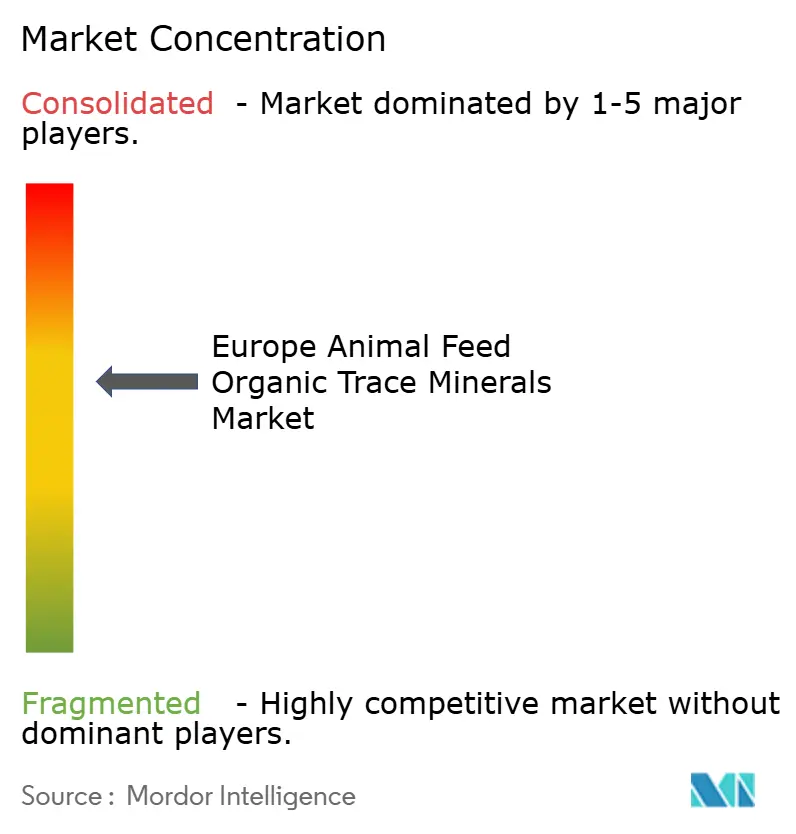
| Market Concentration | Medium |
Major Players *Disclaimer: Major Players sorted in no particular order Image © Mordor Intelligence. Reuse requires attribution under CC BY 4.0. | |
Europe Animal Feed Organic Trace Minerals Market Analysis by Mordor Intelligence
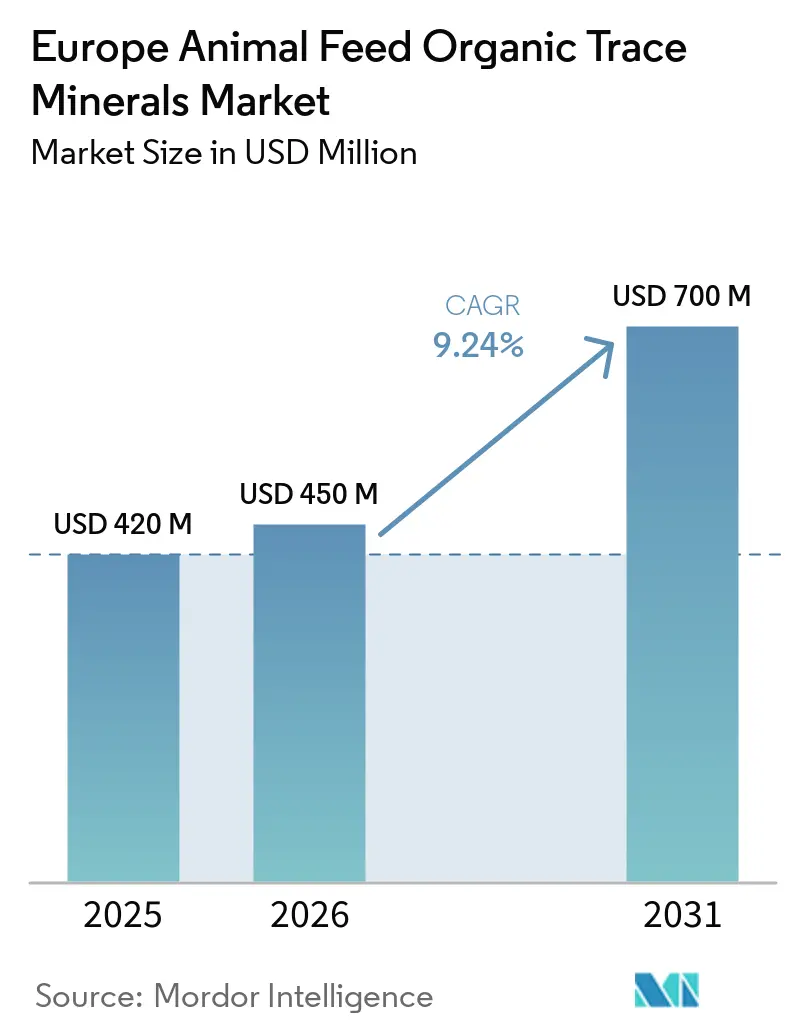
The Europe animal feed organic trace minerals market is projected to grow from USD 420 million in 2025 to USD 450 million in 2026 and USD 700 million by 2031, with a CAGR of 9.24% from 2026 to 2031. Increasing regulatory measures to reduce antibiotic usage, the growing adoption of precision nutrition software, and retailer-driven carbon-labeling initiatives are driving compound-feed formulators toward the use of highly bioavailable chelates. Western Europe benefits from a well-established premix infrastructure, supporting early adoption, while Eastern Europe’s expanding compound-feed production contributes to incremental demand. The continued approval of novel ligands, such as zinc-L-selenomethionine, reduces biological excretion, aligning with the European Green Deal’s nutrient-loss reduction goals. Moderate consolidation among premix manufacturers and the introduction of data-driven advisory tools are projected to further integrate organic trace minerals into standard feed formulations.
Key Report Takeaways
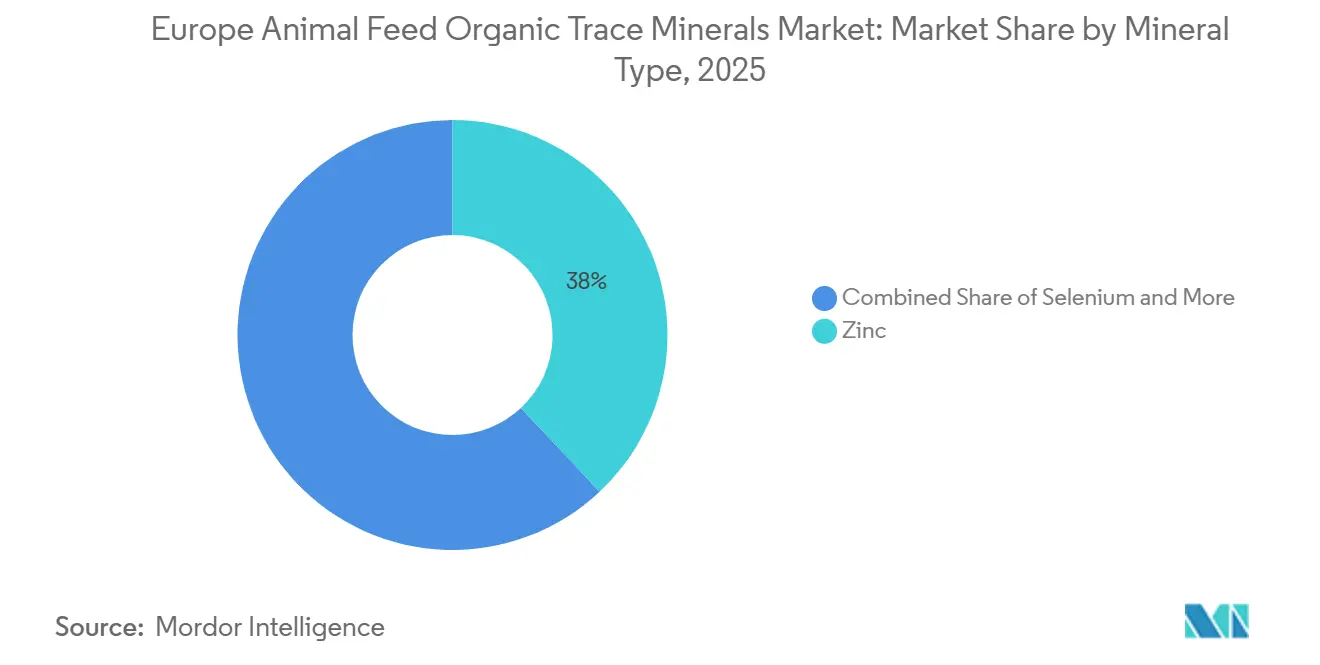
- By mineral type, Europe animal feed organic trace minerals market share for the zinc segment accounted for the largest 38% in 2025, whereas Europe animal feed organic trace minerals market size for selenium segment is projected to grow at the fastest 9.8% CAGR from 2026 to 2031.
- By livestock, poultry captured the largest 45.2% share of the Europe animal feed organic trace minerals market size in 2025, while aquaculture is anticipated to expand at the fastest 10.6% CAGR from 2026 to 2031.
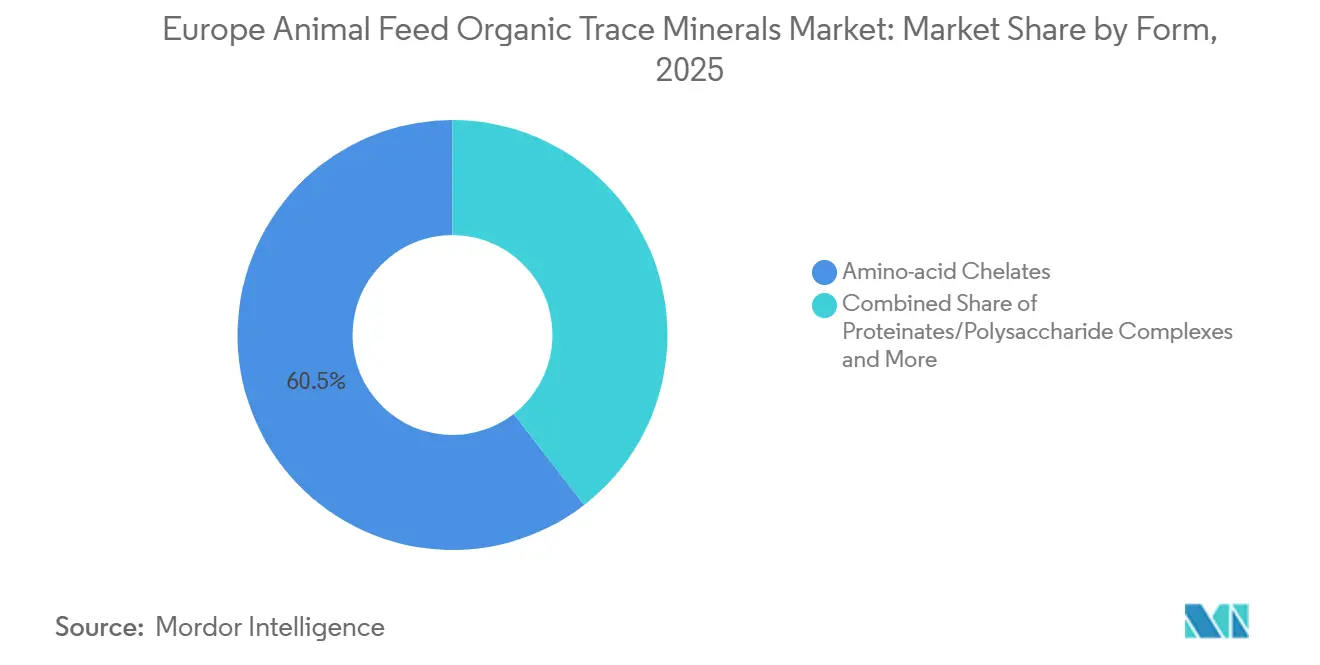
- By form, amino-acid chelates held the largest 60.5% of the Europe animal feed organic trace minerals market in 2025, whereas propionates are projected to register the fastest 11.2% CAGR from 2026 to 2031.
- By geography, Germany commanded the largest 18.6% share of the Europe animal feed organic trace minerals market in 2025, while Poland is projected to grow at the fastest 9.7% CAGR from 2026 to 2031.
Note: Market size and forecast figures in this report are generated using Mordor Intelligence’s proprietary estimation framework, updated with the latest available data and insights as of January 2026.
Market Trends and Insights
Drivers Impact Analysis of Europe Animal Feed Organic Trace Minerals Market*
| Driver | (~) % Impact on CAGR Forecast | Geographic Relevance | Impact Timeline |
|---|---|---|---|
| Shift away from antibiotic growth promoters | +1.8% | Germany, France, and Netherlands | Medium term (2-4 years) |
| Strict bioavailability requirements under European regulations | +1.5% | All member states | Long term (≥ 4 years) |
| Rising demand for organic meat and dairy products | +1.2% | Germany, France, Austria, and Poland | Medium term (2-4 years) |
| Consolidation of premix production among feed mills | +1.0% | Poland, Netherlands, Romania, and Germany | Short term (≤ 2 years) |
| Precision nutrition adoption with chelated trace minerals | +0.9% | Western and Eastern Europe | Medium term (2-4 years) |
| Carbon labeling driving low-excretion mineral use | +0.7% | Netherlands, Denmark, Germany, and France | Long term (≥ 4 years) |
| Source: Mordor Intelligence | |||
Shift Away from Antibiotic Growth Promoters
The European Union's stricter antimicrobial regulations are accelerating the adoption of organic trace minerals in animal feed. According to European Commission Implementing Regulation (EU) 2024/2598, issued in October 2024, stipulates that, effective 3 September 2026, only countries adhering to the European Union's ban on antimicrobial growth promoters will be permitted to export animal products to the region [1]Source: Lexology, “EU Rules on Prohibited Antimicrobials in Animal Products,” lexology.com. Additionally, the regulation mandates official compliance certification for consignments entering the European Union market. These enhanced controls are prompting feed manufacturers and livestock integrators to transition to chelated organic trace minerals, which offer sustainable benefits by supporting gut health, immunity, and productivity without relying on antibiotic growth promoters.
Strict Bioavailability Requirements Under European Regulations
Strict standards set by the European Food Safety Authority (EFSA) regarding the safety, efficacy, and bioavailability of feed additives are driving the adoption of scientifically validated organic trace minerals across Europe. In May 2024, the European Commission reaffirmed the ongoing EFSA reassessment requirements for selenium-based feed additives and trace element compounds used in animal nutrition. These regulatory reviews are prompting feed manufacturers to focus on organic trace minerals with demonstrated absorption efficiency and safety. Consequently, the demand for high-quality chelated trace mineral additives is rising within the European feed industry, particularly for products backed by robust scientific evidence and long-term regulatory approvals.
Rising Demand for Organic Meat and Dairy Products
The increasing demand for organic meat and dairy products across Europe is driving the adoption of organic trace minerals in animal feed formulations. Organic livestock production systems are governed by strict regulations that restrict the use of synthetic additives and routine medications, thereby increasing demand for nutritionally efficient, highly bioavailable mineral sources. For example, feed manufacturers and livestock producers are progressively incorporating chelated trace minerals to enhance animal immunity, productivity, and feed efficiency while adhering to organic certification standards. Furthermore, the rising consumer preference for sustainably produced animal protein is promoting premium livestock nutrition practices, thereby supporting the use of organic trace minerals in Europe’s feed industry.
Consolidation of Premix Production Among Feed Mills
The consolidation of premix production among European feed manufacturers is driving demand for standardized, high-quality organic trace mineral formulations. In October 2025, Vilomix announced plans to invest in a new premix and mineral feed factory in Siedlec, Poland, with an annual production capacity of approximately 35,000–40,000 metric tons [2]Source: Vilomix, “Vilomix Invests in New Premix Factory in Poland,” vilomix.com. Operations are projected to commence by the end of 2026. This facility aims to enhance regional supply efficiency and centralize premix manufacturing across Central and Eastern Europe. Such significant investments by major premix producers are driving the adoption of scientifically validated, standardized organic trace mineral solutions in commercial feed production systems.
Restraints Impact Analysis of Europe Animal Feed Organic Trace Minerals Market*
| Restraint | (~) % Impact on CAGR Forecast | Geographic Relevance | Impact Timeline |
|---|---|---|---|
| Volatile prices of organic mineral chelates | -0.6% | Import-dependent markets | Short term (≤ 2 years) |
| Low awareness among small-scale farmers | -0.5% | Poland, Romania, Bulgaria, and Southern Europe | Medium term (2-4 years) |
| Lengthy approval process for new mineral ligands | -0.4% | All member states | Long term (≥ 4 years) |
| Competition from phytogenic and probiotic products | -0.5% | Germany, France, Netherlands, and Scandinavia | Medium term (2-4 years) |
| Source: Mordor Intelligence | |||
Volatile Prices of Organic Mineral Chelates
Fluctuating freight and logistics costs are causing pricing instability for amino acids used in organic mineral chelates, hindering wider adoption among European feed manufacturers. Essential feed-grade amino acids, including lysine, threonine, tryptophan, and methionine, are critical in producing chelated trace minerals, making transportation and supply chain variations a significant factor in manufacturing costs. This pricing uncertainty is increasing procurement challenges for feed producers, particularly smaller mills with tighter profit margins. Consequently, many manufacturers remain cautious about increasing purchases of premium organic mineral formulations, limiting short-term market penetration in Europe.
Lengthy Approval Process for New Mineral Ligands
Lengthy approval processes for new mineral ligands are hindering innovation in the European organic trace minerals market for animal feed. Organic trace mineral additives must undergo rigorous evaluations by the European Food Safety Authority, which assesses safety, bioavailability, environmental impact, and efficacy before granting authorization or renewal. This process often involves multiple rounds of scientific data submissions and reassessments, leading to extended commercialization timelines for new products. Smaller manufacturers and start-ups face significant challenges in managing the high costs of research, testing, and regulatory compliance required for these approvals. Consequently, the market relies heavily on established suppliers with existing authorizations, thereby limiting the introduction of new, differentiated organic trace mineral formulations in Europe.
*Our forecasts treat driver/restraint impacts as directional, not additive. The impact forecasts reflect baseline growth, mix effects, and variable interactions.
Europe Animal Feed Organic Trace Minerals Market Segment Analysis
By Mineral Type:
Zinc Dominates, Selenium Surges in AquacultureThe Europe animal feed organic trace minerals market share for the zinc segment accounted for the largest 38% in 2025. Zinc-based organic trace minerals are widely adopted in poultry, swine, and ruminant nutrition due to their role in enhancing immunity, supporting skeletal development, and improving feed efficiency. Feed manufacturers increasingly favor zinc amino acid chelates for their higher bioavailability and compatibility with antibiotic-free feeding systems. Copper chelates also exhibit stable demand as livestock producers aim to maintain animal performance while adhering to stricter mineral inclusion regulations.
The European organic trace minerals market for animal feed is projected to grow at the fastest 9.8% CAGR from 2026 to 2031, driven by the selenium segment. This growth is driven by the rising adoption of organic selenium compounds in aquaculture and in premium livestock nutrition programs that focus on improving reproductive performance and reducing oxidative stress. Feed formulators are increasingly incorporating selenium yeast and selenomethionine additives into precision nutrition strategies due to their enhanced retention and metabolic efficiency. Dual-mineral chelates combining zinc and selenium are also attracting industry attention for their ability to simplify premix formulations.



By Livestock:
Poultry Leads, Aquaculture FastestPoultry captured the largest 45.2% share of the European organic trace minerals market for animal feed in 2025. Poultry producers prioritize highly bioavailable organic trace minerals to enhance feed conversion, skeletal strength, eggshell quality, and immune response, particularly in antibiotic-free production systems. Broiler and layer operations increasingly use chelated zinc, copper, and manganese additives to boost productivity while minimizing mineral excretion. Swine producers also maintain consistent use of organic trace minerals to support gut health and manage stress during the weaning stage.
Aquaculture is anticipated to expand at the fastest 10.6% CAGR from 2026 to 2031. The rising demand for nutrient-dense and water-stable feed formulations is driving the increased use of highly bioavailable organic trace minerals in fish nutrition programs. Aquaculture producers are increasingly adopting chelated selenium and zinc additives because they enhance mineral retention, reduce nutrient leaching, and support fish health under intensive farming conditions. Precision nutrition strategies tailored to species-specific growth and reproductive needs are further promoting adoption in commercial aquafeed production.
By Form:
Amino-Acid Chelates Dominate, Propionates EmergeAmino-acid chelates held the largest 60.5% share of the European animal feed organic trace minerals market in 2025. This strong market position is attributed to their superior absorption efficiency, compatibility with organic livestock nutrition systems, and broad regulatory acceptance across Europe. Feed manufacturers increasingly prefer amino-acid chelates due to their ability to enhance nutrient utilization while minimizing mineral waste and environmental discharge. Proteinates and polysaccharide complexes also maintain steady demand in premium livestock feed formulations, which prioritize natural ingredients and improved feed performance.
Propionates are projected to register the fastest 11.2% CAGR from 2026 to 2031. This growth is driven by increasing demand for multifunctional feed additives that provide both mineral nutrition and feed preservation benefits. Feed manufacturers are exploring organic acid-based mineral complexes to enhance feed stability, reduce microbial contamination risks, and streamline ingredient inventories in premix operations. Additionally, hybrid chelate technologies that combine amino acids with organic acids are gaining popularity in precision nutrition programs aimed at improving efficiency and sustainability.
Geography Analysis
Germany and Austria Animal Feed Organic Trace Minerals Market
Germany commanded the largest 18.6% share of the European organic trace minerals market for animal feed in 2025, supported by vertically integrated poultry and pork production systems adopting organic trace minerals within antibiotic-free feeding programs. Advanced premix manufacturing infrastructure across Bavaria and North Rhine-Westphalia continues strengthening the supply of standardized chelated mineral formulations to feed mills across Central Europe. In November 2025, Cargill expanded its Engerwitzdorf micronutrition facility in Austria to 30,000 metric tons annually using 100% renewable energy, reinforcing regional supply capabilities for sustainability-focused feed manufacturers [3]Source: Cargill, “Cargill Expands Micronutrition Production Capacity,” cargill.com.
Eastern Europe Animal Feed Organic Trace Minerals Market
Poland is projected to grow at the fastest 9.7% CAGR from 2026 to 2031, driven by consolidation across the premix manufacturing sector and rising adoption of precision livestock nutrition. Major investments in premix facilities and compound feed operations are strengthening centralized sourcing and increasing demand for standardized organic trace mineral formulations. Eastern European feed manufacturers are increasingly transitioning toward bioavailable chelated minerals as poultry and swine production systems align with Western European feed quality standards. Expanding livestock exports and integration into broader European supply chains continue to support demand for scientifically validated trace mineral additives across Poland, Romania, Bulgaria, and neighboring regional feed markets.
Southern and Northern Europe Animal Feed Organic Trace Minerals Market
Southern Europe accounted for a mid-teen regional share in 2025, supported by expanding aquaculture production and precision nutrition adoption across Mediterranean livestock systems. Spain and Italy continue increasing usage of organic selenium and zinc formulations in poultry, swine, and aquaculture feed applications to improve feed efficiency and product quality. In December 2024, the European Commission confirmed authorization of zinc-L-selenomethionine for all animal species, supporting adoption of dual-mineral chelates among Mediterranean feed formulators. Scandinavian countries also maintain strong demand for low-excretion chelates due to strict environmental sustainability and nutrient management regulations in dairy and aquaculture production systems.
Competitive Landscape
The market is moderately concentrated, with the top five companies including Zinpro Corporation, DSM-Firmenich AG, Cargill, Incorporated, Novus International, Inc., and Alltech, Inc., which are multinational feed additive manufacturers maintaining strong positions due to extensive regulatory approvals, established premix distribution networks, and species-specific nutritional expertise. Companies are increasingly focusing on highly bioavailable organic trace mineral formulations that align with antibiotic-free and sustainability-oriented livestock production systems. Competitive differentiation is primarily driven by technical support services, precision nutrition integration, and customized premix development for poultry, swine, ruminant, and aquaculture producers.
Manufacturers are investing in sustainable production systems, digital nutrition platforms, and automated premix manufacturing technologies to enhance operational efficiency and product traceability. Strategic priorities have shifted toward multifunctional chelate formulations that improve mineral absorption while reducing environmental excretion levels in livestock production systems. Partnerships between feed additive suppliers and precision nutrition software providers are increasing as livestock producers adopt data-driven feeding strategies. Companies with strong technical advisory capabilities and broad authorized product portfolios maintain competitive advantages, particularly among integrated feed mills that prioritize formulation consistency, regulatory compliance, and sustainability-focused nutritional performance in commercial livestock operations.
Competitive intensity is increasing as manufacturers enhance production efficiency, technical nutrition capabilities, and regional distribution networks across Europe. Leading feed additive suppliers are focusing on centralized premix manufacturing, integrating precision nutrition, and adopting sustainability-focused production systems to improve formulation consistency and operational performance. Companies are also expanding species-specific nutritional solutions and technical advisory services to assist livestock producers in transitioning to antibiotic-free and environmentally sustainable feeding programs.
Europe Animal Feed Organic Trace Minerals Industry Leaders
Zinpro Corporation
DSM-Firmenich AG
Cargill, Incorporated
Novus International, Inc.
Alltech, Inc.
- *Disclaimer: Major Players sorted in no particular order
Europe Animal Feed Organic Trace Minerals Market Companies Covered in this Report
- Zinpro Corporation
- DSM-Firmenich AG
- Cargill, Incorporated
- Novus International, Inc. (Mitsui & Co., Ltd. and Nippon Soda Co., Ltd.)
- Alltech, Inc.
- Nutreco N.V.
- ADM
- Kemin Industries, Inc.
- Phibro Animal Health Corporation
- QualiTech, Inc.
- BASF SE
- Bluestar Adisseo Company
- Vilofoss A/S
- Kaesler Nutrition GmbH
- Animine S.A.

Recent Industry Developments in Europe Animal Feed Organic Trace Minerals Market
- November 2025: Cargill, Incorporated expanded its micronutrition facility in Engerwitzdorf, Austria, by 50%, increasing its annual production capacity to 30,000 metric tons. This expansion aims to meet the growing demand for advanced animal nutrition solutions, including organic trace mineral premixes, within the European feed industry.
- October 2025: Vilomix announced an investment in a new premix and mineral feed factory located in Siedlec, Poland. The facility will have an annual production capacity of 35,000–40,000 metric tons, enhancing the supply of standardized premixes and organic trace mineral formulations for livestock feed producers in Central and Eastern Europe.
- May 2025: The European Food Safety Authority has confirmed the safety and efficacy of copper bilysinate for all animal species. This supports the broader adoption of highly bioavailable copper chelates in livestock feed and premix formulations.


Europe Animal Feed Organic Trace Minerals Market Report Scope
Animal feed organic trace minerals are essential micronutrients, including zinc, selenium, iron, copper, and manganese, that are chemically bonded to organic compounds such as amino acids or proteins to improve absorption in livestock and aquaculture animals. The Europe animal feed organic trace minerals market report is segmented by mineral type (zinc, copper, iron, selenium, manganese, and other minerals), by livestock (poultry, ruminants, swine, aquaculture, and other livestock), by form (amino-acid chelates, proteinates/polysaccharide complexes, propionates, and other chelated forms), and by geography (North America, South America, Europe, Asia-Pacific, Middle East and Africa). The market forecasts are provided in terms of value (USD).
| Zinc |
| Copper |
| Iron |
| Selenium |
| Manganese |
| Others |
| Poultry |
| Ruminants |
| Swine |
| Aquaculture |
| Others |
| Amino-acid Chelates |
| Proteinates/Polysaccharide Complexes |
| Propionates |
| Other Chelated Forms |
| Germany |
| France |
| Italy |
| Spain |
| United Kingdom |
| Poland |
| Rest of Europe |
| By Mineral Type | Zinc |
| Copper | |
| Iron | |
| Selenium | |
| Manganese | |
| Others | |
| By Livestock | Poultry |
| Ruminants | |
| Swine | |
| Aquaculture | |
| Others | |
| By Form | Amino-acid Chelates |
| Proteinates/Polysaccharide Complexes | |
| Propionates | |
| Other Chelated Forms | |
| By Geography | Germany |
| France | |
| Italy | |
| Spain | |
| United Kingdom | |
| Poland | |
| Rest of Europe |


Key Questions Answered in the Report
What is the current value of the Europe animal feed organic trace minerals market?
The Europe animal feed organic trace minerals market size is currently valued at USD 450 million in 2026.
Which country represents the largest single market for organic trace minerals in European feed?
Germany accounted for the largest 18.6% of Europe animal feed organic trace minerals market share in 2025.
Where is demand growing fastest within the region?
Poland is forecast to advance at the fastest 9.7% CAGR from 2026 and 2031.
Which livestock segment is expanding fastest?
Aquaculture segment is forecast to grow at the fastest 10.6% CAGR from 2026 to 2031.
Page last updated on:





