
South Africa Pet Veterinary Diets Market Size and Share
Market Overview
| Study Period | 2022 - 2032 |
|---|---|
| Forecast Data Period | 2027 - 2032 |
| Base Year Market Size (2026) | USD 60.93 Million |
| Market Size (2027) | USD 66.52 Million |
| Market Size (2032) | USD 114.12 Million |
| Growth Rate (2027 - 2032) | 11.40 % |
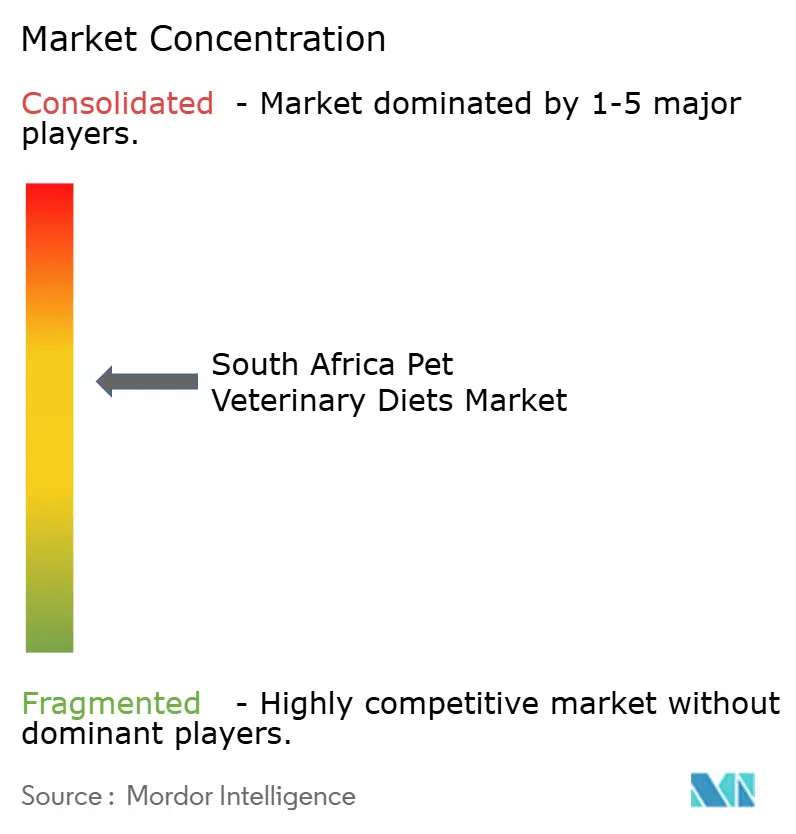
| Market Concentration | Medium |
Major Players *Disclaimer: Major Players sorted in no particular order Image © Mordor Intelligence. Reuse requires attribution under CC BY 4.0. | |
South Africa Pet Veterinary Diets Market Analysis by Mordor Intelligence
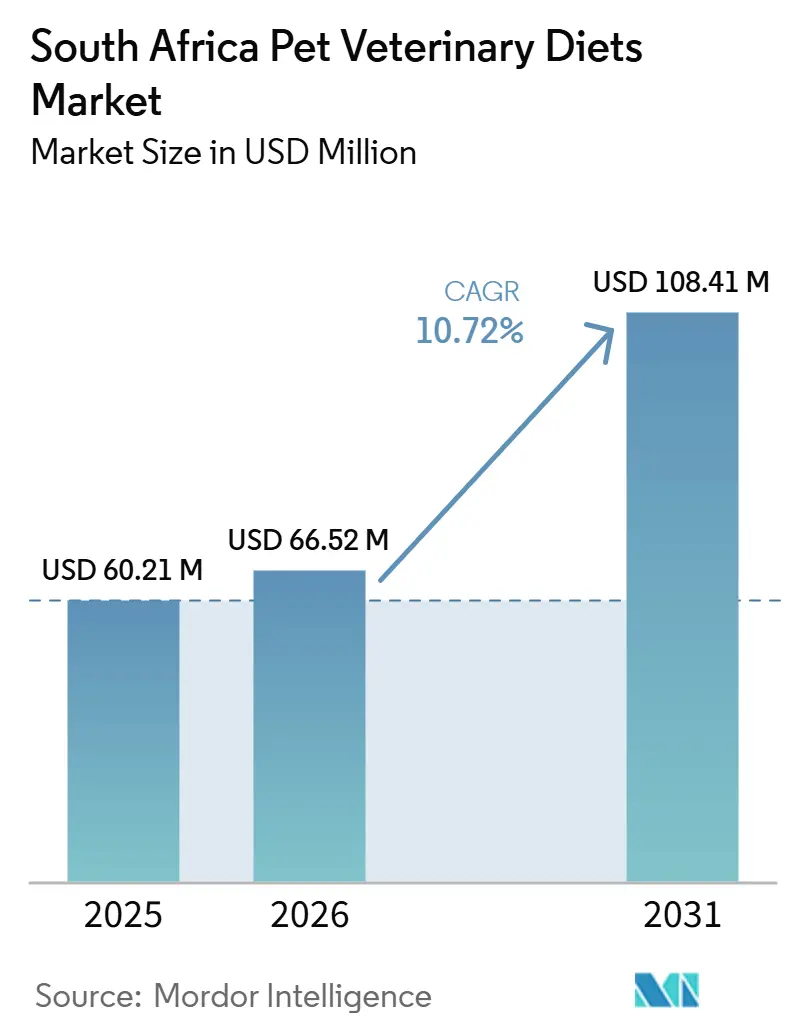
The South Africa pet veterinary diets market was valued at USD 60.93 million in 2026 and is forecast to grow from USD 66.52 million in 2027 to USD 114.12 million by 2032, at a CAGR of 11.40% from 2027 to 2032. The South Africa pet veterinary diets market is gaining support from a larger, verified pet base, following the 2025 General Household Survey, which recorded 7.4 million pet dogs and 2 million cats across South African households, giving suppliers and clinics a firmer view of demand than was available earlier. The South Africa pet veterinary diets market is moving beyond occasional use because chronic digestive, renal, metabolic, and skin conditions increasingly require steady feeding protocols rather than short treatment cycles, and published clinical work continues to support long-term dietary management for these cases. Product quality concerns across the broader pet food category also influenced buying behavior after the November 2025 RCL Foods Limited recall disrupted the mass dry food supply and prompted some owners to seek vet-endorsed alternatives. Competitive pressure remains balanced between global brands with established prescription credentials and local companies that compete on price, local sourcing, and independent distribution reach, keeping the South Africa pet veterinary diets market active in both innovation and channel expansion.
Key Report Takeaways
- By sub-product, digestive sensitivity accounted for 19.6% in 2026 and is projected to grow at the fastest 12.9% CAGR from 2027 to 2032.
- By pet type, dogs held 80.6% of South Africa pet veterinary diets market share in 2026 and are also the fastest-growing pet segment, with a projected 12.5% CAGR from 2027 to 2032.
- By distribution channel, supermarkets/ hypermarkets accounted for 54.1% share of the South Africa pet veterinary diets market size in 2026, while online channels are forecast to grow at a 13.0% CAGR from 2027 to 2032.
Note: Market numbers in this report are based on Mordor Intelligence's proprietary estimation framework, which combines nine months of actuals with Q4 projections for base year 2026.
South Africa Pet Veterinary Diets Market Trends and Insights
Drivers Impact Analysis*
| Driver | (~) % Impact on CAGR Forecast | Geographic Relevance | Impact Timeline |
|---|---|---|---|
| Rising Veterinary Recommendation Rate for Condition-Specific Nutrition | +2.5% | Urban centers including Gauteng, Western Cape, and KwaZulu-Natal | Short term (≤ 2 years) |
| Growth of Chronic Disease Management in Companion Animals | +2.0% | National, with earlier gains in Johannesburg, Cape Town, and Durban | Medium term (2-4 years) |
| Expansion of Premium and Preventive Pet Health Spending | +1.5% | Higher income households nationally | Short term (≤ 2 years) |
| Broader Availability Through Vet Clinics, Specialist Retail, and E-Commerce | +1.8% | Gauteng, Western Cape, and KwaZulu-Natal | Short term (≤ 2 years) |
| Growth of In-Clinic Prescription Fulfillment and Repeat Purchase Programs | +1.2% | Urban veterinary practice clusters nationally | Medium term (2-4 years) |
| Rising Demand for Localized, Palatable, and Breed-Sensitive Formulations | +1.0% | National, with stronger uptake in large-dog regions | Long term (≥ 4 years) |
| Source: Mordor Intelligence | |||
Rising Veterinary Recommendation Rate for Condition-Specific Nutrition
The South Africa pet veterinary diets market depends heavily on the veterinarian because prescription advice still shapes the first trial and the repeat purchase decision. In 2025, the University of Pretoria Faculty of Veterinary Science, working with Royal Canin, opened Gauteng’s first internationally accredited cat-friendly clinic at the Onderstepoort campus, and that project included training support and clinical nutrition learning tools for final-year students[1]. That step matters because it moves nutrition guidance deeper into everyday clinical practice rather than treating it as a side topic. The South Africa pet veterinary diets market is likely to see more consistent prescription behavior as newer practitioners enter clinics with stronger exposure to diet-led disease management. Official household survey data also showed that dog ownership was higher in higher living-standard groups than in lower ones, indicating that households most likely to reach veterinary channels are also those better able to sustain therapeutic feeding.
Growth of Chronic Disease Management in Companion Animals
Market is gaining from a clear shift toward longer-term management of chronic conditions in companion animals. Once a dog or cat is diagnosed with renal disease, digestive disease, diabetes, or persistent skin issues, diet often becomes part of the ongoing care plan rather than a short-course item. This changes buying behavior because the owner moves from occasional spending to steady monthly replenishment. The South Africa pet veterinary diets market, therefore benefits from lower demand volatility in these condition-led categories than in general premium nutrition. The same pattern supports the view that growth in disease detection and nutritional intervention can keep expanding demand even without broad reimbursement support.
Expansion of Premium and Preventive Pet Health Spending
The market is also supported by the fact that premium pet spending held up well amid economic pressure. This pattern matters for the South Africa pet veterinary diets market because prescribed nutrition is less likely to be traded down once a condition has been identified and discussed with a veterinarian. The Shoprite Group (a major South African retailer) reported that its Petshop Science division grew sales by 56.9% during the 26-week interim period ending December 29, 2024. They achieved this rapid growth by democratizing pet care: stocking premium brands like Hill’s Prescription Diet and Royal Canin alongside mainstream nutrition at highly competitive, supermarket prices to challenge traditional specialist vet stores. As a result, more buyers are encountering therapeutic products in premium shopping environments before a severe health event appears.
Broader Availability Through Vet Clinics, Specialist Retail, and E-Commerce
This market is changing quickly as access improves across clinics, specialist stores, and digital channels. Specialist pet retail formats continued to expand in 2025 and 2026, and Petshop Science alone reached 135 stores after opening 42 new locations in the second half of 2024 across all 9 provinces. Shoprite Holdings also launched a same-day Petshop Science partnership with Checkers Sixty60 in June 2025, which shortened the path from recommendation to delivery for premium and veterinary products in covered urban areas[2]. Absolute Pets reported that online basket sizes were double those in in-store transactions, pointing to the heavy repeat-buying pattern common in therapeutic feeding routines. These developments reduce the old dependence on a single clinic shelf as the only path to access. The South Africa pet veterinary diets market should therefore see wider penetration where prescription authorization can be maintained, but purchase friction is reduced.
Restraints Impact Analysis*
| Restraint | (~) % Impact on CAGR Forecast | Geographic Relevance | Impact Timeline |
|---|---|---|---|
| High Price Premium Versus Standard Pet Food | -1.5% | National, with stronger pressure in lower and middle income households | Short term (≤ 2 years) |
| Low Prescription Compliance and Owner Awareness Gaps Outside Major Cities | -1.2% | Peri-urban and semi-rural regions nationally | Medium term (2-4 years) |
| Limited Veterinary Access and Specialist Retail Density in Rural Areas | -1.0% | Rural parts of Northern Cape, Limpopo, Mpumalanga, and Eastern Cape | Long term (≥ 4 years) |
| Import Dependence and Supply Disruption Risk for Premium Formulations | -0.8% | National, with sharper effects on imported premium stock keeping units | Medium term (2-4 years) |
| Source: Mordor Intelligence | |||
High Price Premium Versus Standard Pet Food
The South Africa pet veterinary diets market still faces a clear affordability ceiling because therapeutic diets cost more than standard pet food and are harder for many households to maintain over time. This matters in a country where pet ownership extends well beyond the highest income groups. Reporting on the 2025 General Household Survey showed that lower living standard groups still owned dogs and cats, but their ownership rates remained well below higher income households, which highlights the link between income and the ability to fund sustained clinical feeding. The result is that the South Africa pet veterinary diets market can grow strongly while still serving only a narrow slice of the total pet base. Local alternatives from VetsBrands (Pty) Ltd and Montego Pet Nutrition (Pty) Ltd may ease some of that pressure, but the price gap versus standard food still limits wider conversion. As long as owners must weigh food costs against other treatment needs, premium therapeutic adoption will stay uneven.
Low Prescription Compliance and Owner Awareness Gaps Outside Major Cities
The market also loses potential volume when owners do not follow prescription feeding plans for long enough. Therapeutic diets work best when the pet is fed consistently, yet many owners outside major cities revert to general wellness products or home-prepared options after the first purchase. This behavior reduces realized demand even after a diagnosis has been made. It also affects outcomes, because inconsistent feeding can make the diet appear less effective than it actually is when used properly. The South Africa pet veterinary diets market, therefore, depends not only on diagnosis, but also on the owner's understanding that nutrition is part of treatment rather than just a premium food choice. Until education and follow-up improve outside the main metro areas, compliance gaps will continue to hold back the full potential of the category.
*Our forecasts treat driver/restraint impacts as directional, not additive. The impact forecasts reflect baseline growth, mix effects, and variable interactions.
Segment Analysis
By Sub Product: Digestive Sensitivity Anchors Therapeutic Prescription Volume
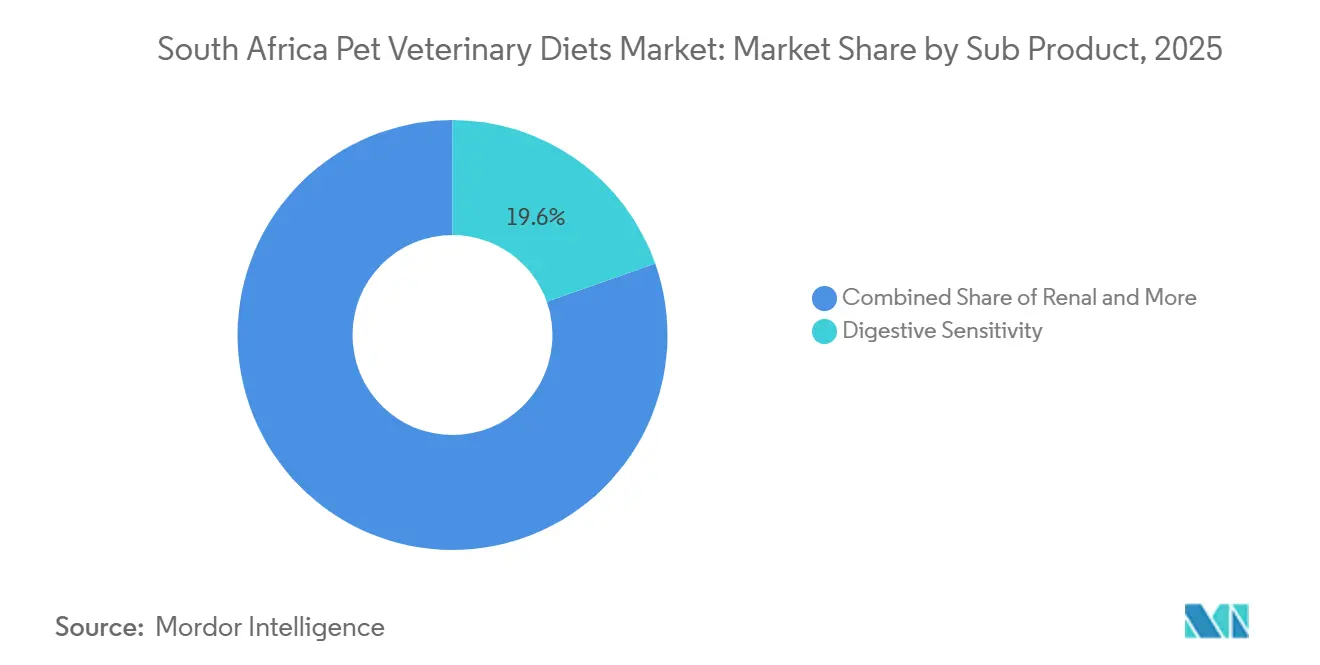
Digestive sensitivity held 19.6% market share in 2026 and is also the fastest-growing sub-product in the South Africa pet veterinary diets market, with a 12.9% CAGR from 2027 to 2032. This position reflects the strong clinical relevance of gastrointestinal management in routine veterinary care. That type of evidence supports a veterinarian's confidence when digestive cases require a specific feeding protocol rather than a simple food switch. In South Africa, Virbac launched its VETERINARY HPM Digestive Support wet diet range in February 2025, expanding its portfolio of veterinary therapeutic nutrition for pets with digestive disorders. Meanwhile, Royal Canin South Africa maintained a strong presence in the gastrointestinal prescription nutrition segment through its dedicated veterinary diet portfolio.
The market size contribution from renal, urinary tract disease, derma, obesity, diabetes, oral care, and recovery diets is smaller, but these categories give the South Africa pet veterinary diets industry broader clinical depth. Renal diets remain important because kidney disease in aging cats often requires long-term dietary control and close monitoring. Obesity and derma diets are gaining relevance as pet owners spend more on managed health and appearance, while urinary and diabetic diets continue to serve distinct clinical needs. The South Africa pet veterinary diets market benefits from this spread because it lowers dependence on one condition alone and creates more touchpoints for repeat prescription use.

By Pets: Canine Dominance Drives Veterinary Diet Volume and Innovation
Dogs accounted for 80.6% market share in 2026, making them the largest animal group in the South Africa pet veterinary diets market by a wide margin. Dogs are also the fastest-growing pet segment, with a 12.5% CAGR from 2027 to 2032. Dogs also tend to appear more often in conditions that bring owners into routine veterinary care, which supports first-time prescription exposure. The South Africa pet veterinary diets market, therefore, relies heavily on canine volume for both sales and product launches. Digestive, joint-supportive, metabolic, and recovery diets all benefit from that concentration because they align with common canine treatment pathways.
The market for the feline segment is smaller, but its role is becoming increasingly important as clinics focus more on cat-specific nutrition and handling protocols. In July 2025, the University of Pretoria and Royal Canin cat-friendly clinic initiative matters here because it gives feline nutrition a more formal place in student training and practice design. Long-term feeding evidence from BMC Veterinary Research also supports the idea that condition-led nutritional management can remain useful over several years when owners stay compliant. Other pets remain a small niche in the source draft, but they are beginning to attract attention in urban areas where owners seek more specialized care.
By Distribution Channel: Online Channel Outpace Traditional Channels
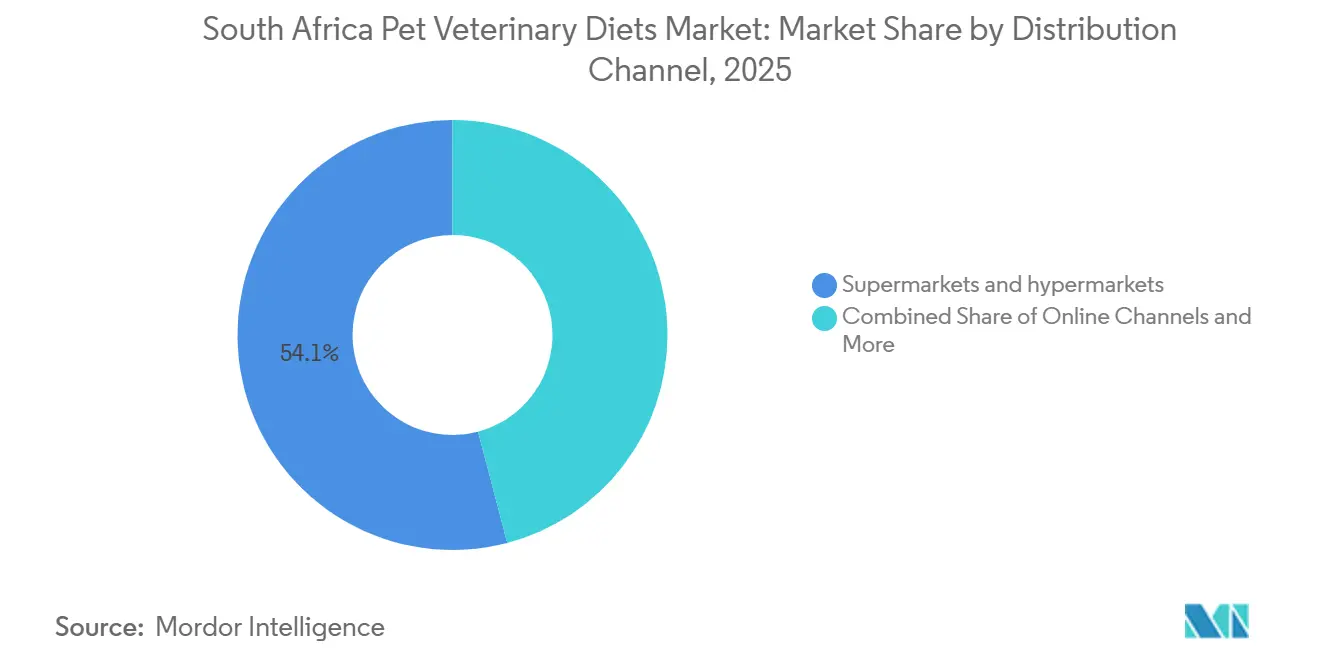
Supermarkets and hypermarkets held a 54.1% market share in 2026, making them the largest distribution channel in the South Africa pet veterinary diets market. This position reflects the long-standing role of mainstream grocery retail in pet food shopping, where wide store networks and high foot traffic provide consistent consumer access to entry- and mid-range premium products. Shoppers benefit from the convenience of purchasing pet veterinary diets alongside regular grocery items, which reinforces the channel's dominance. At the same time, specialist stores are still smaller than those of modern channels, as grocery-backed pet chains expand their product range and improve product visibility. These stores are increasingly stocking a broader selection of veterinary diets, catering to pet owners seeking more targeted nutritional solutions for their pets.
Online channels are projected to grow at a 13.0% CAGR from 2027 to 2032, making them the fastest-growing channel in the market. Their influence on repeat purchasing is also rising quickly. Absolute Pets reported that e-commerce basket sizes were twice those in store transactions, suggesting strong replenishment behavior among buyers who need a regular supply. Convenience stores and other channels still play a limited role in therapeutic diets because they do not usually offer the depth, guidance, or condition-specific assortment the category requires. This means the South Africa pet veterinary diets market should keep moving toward a mixed model where general retail supply reaches more consumers, specialist stores improve conversion rates, and clinics maintain trust.
Geography Analysis
The Western Cape is among the strongest regional demand bases for premium and condition-led pet nutrition in South Africa. Gauteng remained just as important because its dense population, clinic base, specialist retail formats, and delivery networks give the South Africa pet veterinary diets market its broadest commercial infrastructure. The province also serves as an early launch corridor, as new products can reach veterinarians, premium retail buyers, and digital customers within a smaller radius than in most other provinces. Urban practices in these areas are more likely to follow formal prescription processes, which support better product compliance and repeat purchase. The South Africa pet veterinary diets market is therefore strongest where pet ownership, income, and service access overlap rather than where pet ownership alone is high.
KwaZulu-Natal is emerging as a notable growth area, supported by a sizable urban coastal population and increasing specialist retail activity. The province's growing middle class and rising pet ownership rates further strengthen its position as a key market. The launch of SPAR South Africa's Pet Story format in September 2025 adds to this potential by creating an additional route for premium and veterinary-grade products outside the clinic setting, broadening consumer access to specialized pet care products. Mpumalanga remains comparatively weaker, as both pet ownership rates and specialist retail presence are lower, leaving general supermarket trade as the primary point of access. The limited retail infrastructure in the province continues to constrain market development, with little indication of significant specialist retail expansion in the near term.
As urbanization continues, more households in Gauteng and Cape Town are likely to combine pet ownership with the ability to maintain prescription feeding. Expanding urban infrastructure and rising disposable incomes in these regions are expected to support greater access to veterinary services, making it easier for pet owners to adopt and sustain specialized dietary regimens. As a result, the South Africa pet veterinary diets market is likely to grow faster in high-income urban corridors than in provinces where veterinary and specialist access remains limited.
Competitive Landscape
The South Africa pet veterinary diets market is moderately concentrated in 2026, with Mars, Incorporated, Farmina Pet Foods, Nestle S.A. (Purina), Zoetis Inc., and Virbac SA holding the strongest brand standing in established prescription channels. Their advantage comes from long clinical heritage, broad therapeutic portfolios, and close veterinarian familiarity. Virbac SA competes with a more practice-centered model that aims to reduce stocking friction for veterinary clinics while keeping nutrition revenue inside the professional channel. This matters because the South Africa pet veterinary diets market still depends on trust and continuity more than on broad impulse purchase. Companies that make prescribing easier for clinics are often better placed than those that rely only on brand visibility.
Product development is emerging as a key competitive factor in the South Africa pet veterinary diets market. These developments indicate that innovation extends beyond flavor or packaging to include delivery format, compliance, and clinical differentiation. As pet owners become more informed and veterinarians more selective in their recommendations, brands that can demonstrate a clear functional advantage, rather than relying solely on a premium image, are likely to gain ground in this market. Companies that invest in clinically validated formulations and condition-specific product lines are better positioned to build credibility with both veterinary professionals and end consumers.
Local challengers are also becoming more visible in the South Africa pet veterinary diets market. In February 2026, Monic Group completed the acquisition of Marltons following Competition Commission approval, combining Montego Pet Nutrition (Pty) Ltd's food distribution capabilities with Marltons' accessory and channel reach, strengthening the group's position in the South Africa Pet Veterinary Diets Market through expanded distribution networks and broader retail access[3]. VetsBrands (Pty) Ltd, Alpha Pets South Africa (Pty) Ltd, and Canine and Co. were identified in the source draft as a domestic tier that competes through local manufacturing links and veterinary distribution relationships. Farmina Pet Foods and General Mills, Inc. through BLUE Natural Veterinary Diet hold smaller premium positions but still face the same import cost exposure as larger foreign players. This leaves the South Africa pet veterinary diets market open to a local player that can combine clinical credibility, localized formulas, and repeat digital fulfillment at scale.
South Africa Pet Veterinary Diets Industry Leaders
-
Virbac SA
-
Farmina Pet Foods
-
Mars, Incorporated
-
Nestle S.A. (Purina)
-
Zoetis Inc.
- *Disclaimer: Major Players sorted in no particular order
Recent Industry Developments
- February 2026: Monic Group, the parent company of Montego Pet Nutrition (Pty) Ltd, completed its acquisition of Marltons following approval from the Competition Commission. The transaction combines Montego's national food distribution network with Marlton's accessories and bird food presence, creating a vertically integrated domestic pet care company to compete with multinational import-reliant players across veterinary and specialist retail channels.
- November 2025: RCL Foods Limited, in coordination with the National Consumer Commission (Nasionale Verbruikerskommissie), issued a nationwide product recall affecting approximately 55,352 bags of dry dog and cat food manufactured between May and June 2025, including Bobtail, Catmor, Canine Cuisine, Optimizor, Ultra Pet, and Superwoof brands, after detection of abnormally high mycotoxin levels.
- June 2025: Petshop Science, part of the Shoprite Group, launched a same-day delivery partnership with Checkers Sixty60, enabling on-demand fulfillment of premium and veterinary diet products in covered urban areas. The partnership is significant for prescription-compatible distribution, it reduces the time between veterinary recommendation and product fulfillment from days via clinic or specialist store visit to hours.
South Africa Pet Veterinary Diets Market Report Scope
A pet veterinary diet, also known as a therapeutic or prescription diet, is a specialized pet food scientifically formulated to help manage, treat, or prevent specific medical conditions, including kidney disease, allergies, and obesity. The South Africa Pet Veterinary Diets Market Report is Segmented by Sub Product (Diabetes, Digestive Sensitivity, Oral Care Diets, Renal, and More), by Pets (Cats, Dogs, and Other Pets), and by Distribution Channel (Convenience Stores, Online Channel, and More). The Market Forecasts are Provided in Terms of Value (USD) and Volume (Metric Tons).
| Diabetes |
| Renal |
| Urinary Tract Disease |
| Digestive Sensitivity |
| Oral Care Diets |
| Derma Diets |
| Obesity Diets |
| Other Veterinary Diets |
| Cats |
| Dogs |
| Other Pets |
| Convenience Stores |
| Online Channel |
| Specialty Stores |
| Supermarkets/Hypermarkets |
| Other Channels |
| By Sub Product | Diabetes |
| Renal | |
| Urinary Tract Disease | |
| Digestive Sensitivity | |
| Oral Care Diets | |
| Derma Diets | |
| Obesity Diets | |
| Other Veterinary Diets | |
| By Pets | Cats |
| Dogs | |
| Other Pets | |
| By Distribution Channel | Convenience Stores |
| Online Channel | |
| Specialty Stores | |
| Supermarkets/Hypermarkets | |
| Other Channels |
Key Questions Answered in the Report
What is the current size of South Africa pet veterinary diets demand?
The South Africa pet veterinary diets market is estimated at USD 66.52 million in 2027 and is forecast to reach USD 114.12 million by 2032, growing at a CAGR of 11.40% from 2027 to 2032.
Which sub product leads therapeutic pet nutrition sales in South Africa?
Digestive sensitivity accounted for the largest share of the South Africa pet veterinary diets market in 2026, at 19.6%, and is forecast to grow at a CAGR of 12.9% from 2027 to 2032, making it the fastest-growing sub-product segment.
Why are dogs the main revenue base for prescription pet food in South Africa?
Dogs held 80.6% share in 2026, and the national pet base is much larger for dogs than cats, which gives canine care a wider prescription funnel.
What is shaping competition among suppliers of veterinary diets in South Africa?
Competition is centered on clinical credibility, product innovation, local supply strength, and distribution reach across clinics, specialist stores, and e-commerce.