
South Africa Cosmetics And Personal Care Products Market Size and Share
South Africa Cosmetics And Personal Care Products Market Analysis by Mordor Intelligence
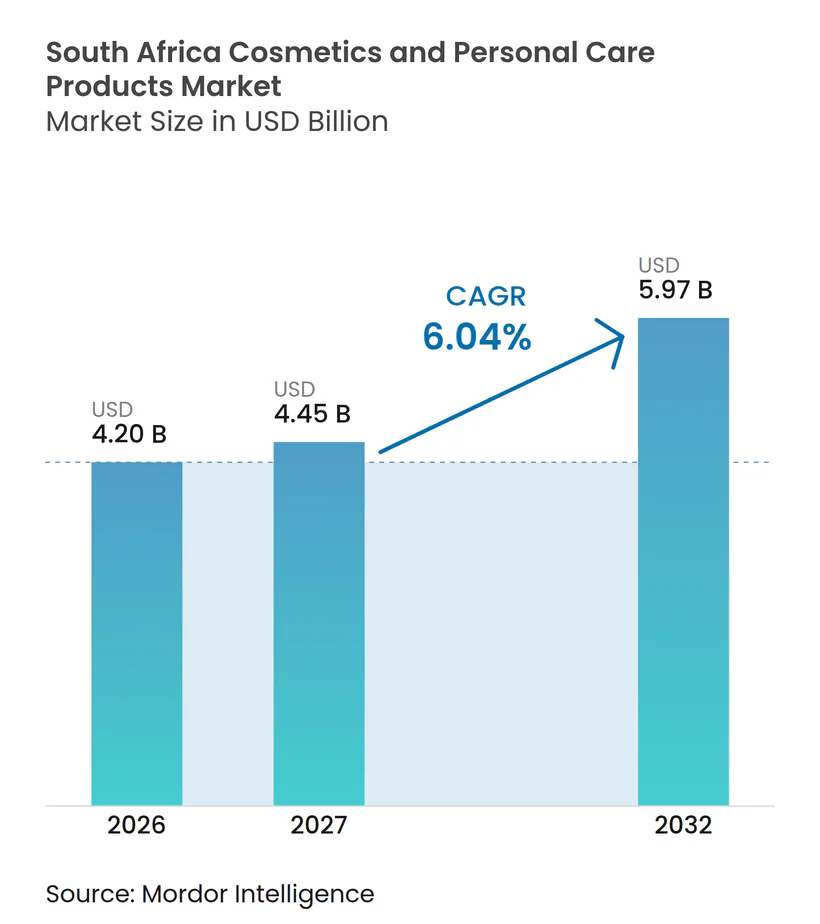
The South Africa cosmetics and personal care products market size was valued at USD 4.2 billion in 2026 and estimated to grow from USD 4.45 billion in 2027 to reach USD 5.97 billion by 2032, at a CAGR of 6.04% during the forecast period (2027-2032).
Ingredient-led differentiation in South Africa gives body lotions and other skincare products a clearer role in defined care routines. Retailers reinforce relevance through focused grooming destinations and specialist beauty assortments, while digital recommendations can shape selection before a transaction. Suppliers consequently need a recognizable product identity across physical and online presentation, making retail relationships part of how differentiation reaches buyers. Counterfeit exposure and formulation requirements add assurance work, increasing the commercial value of product authenticity and defensible ingredient choices.
Key Report Takeaways
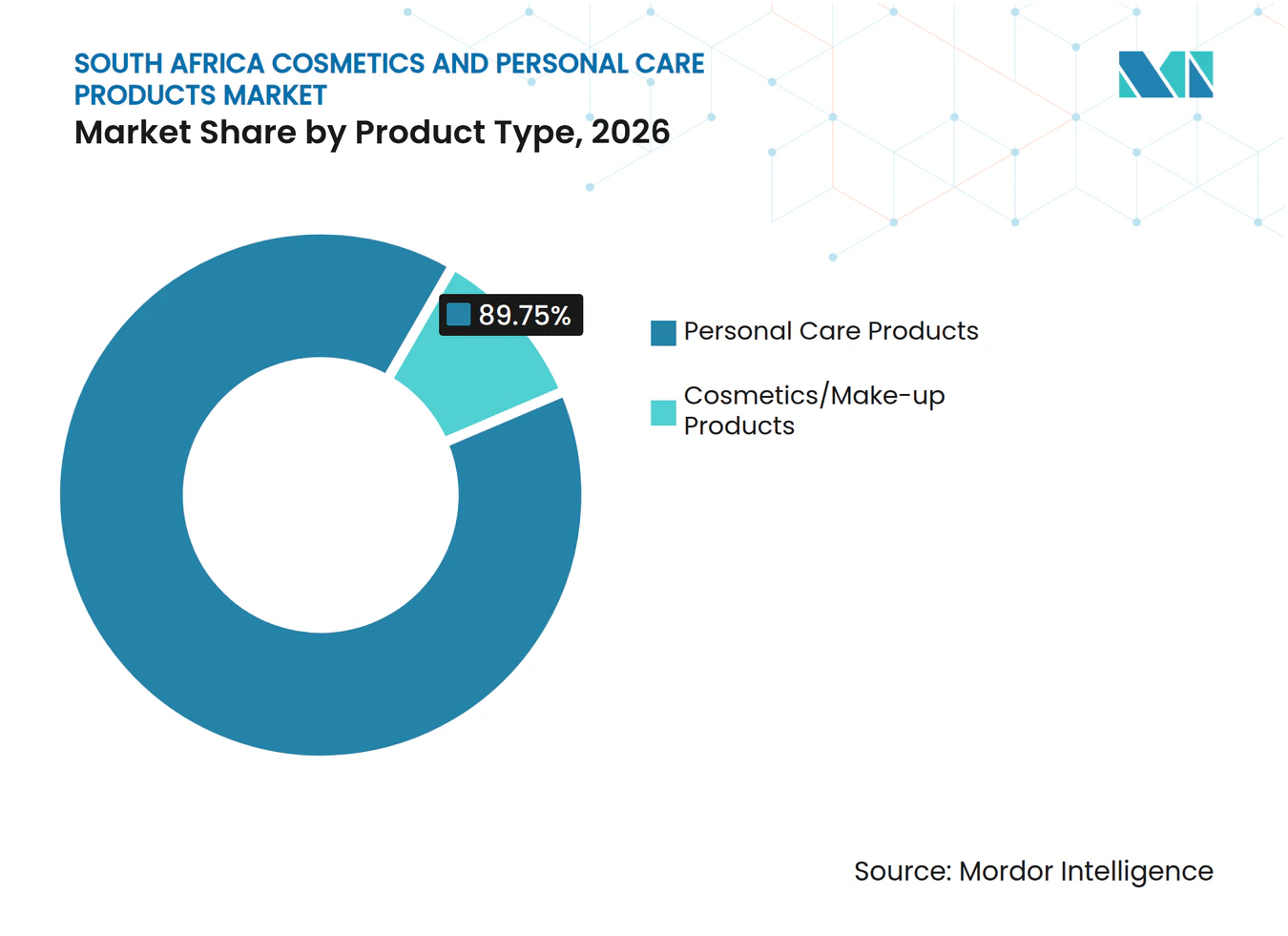
- By product type, personal care products held an 89.75% South Africa cosmetics and personal care products market share in 2026, while cosmetics/make-up products are forecast to grow fastest at a CAGR of 6.4% during 2027-2032.
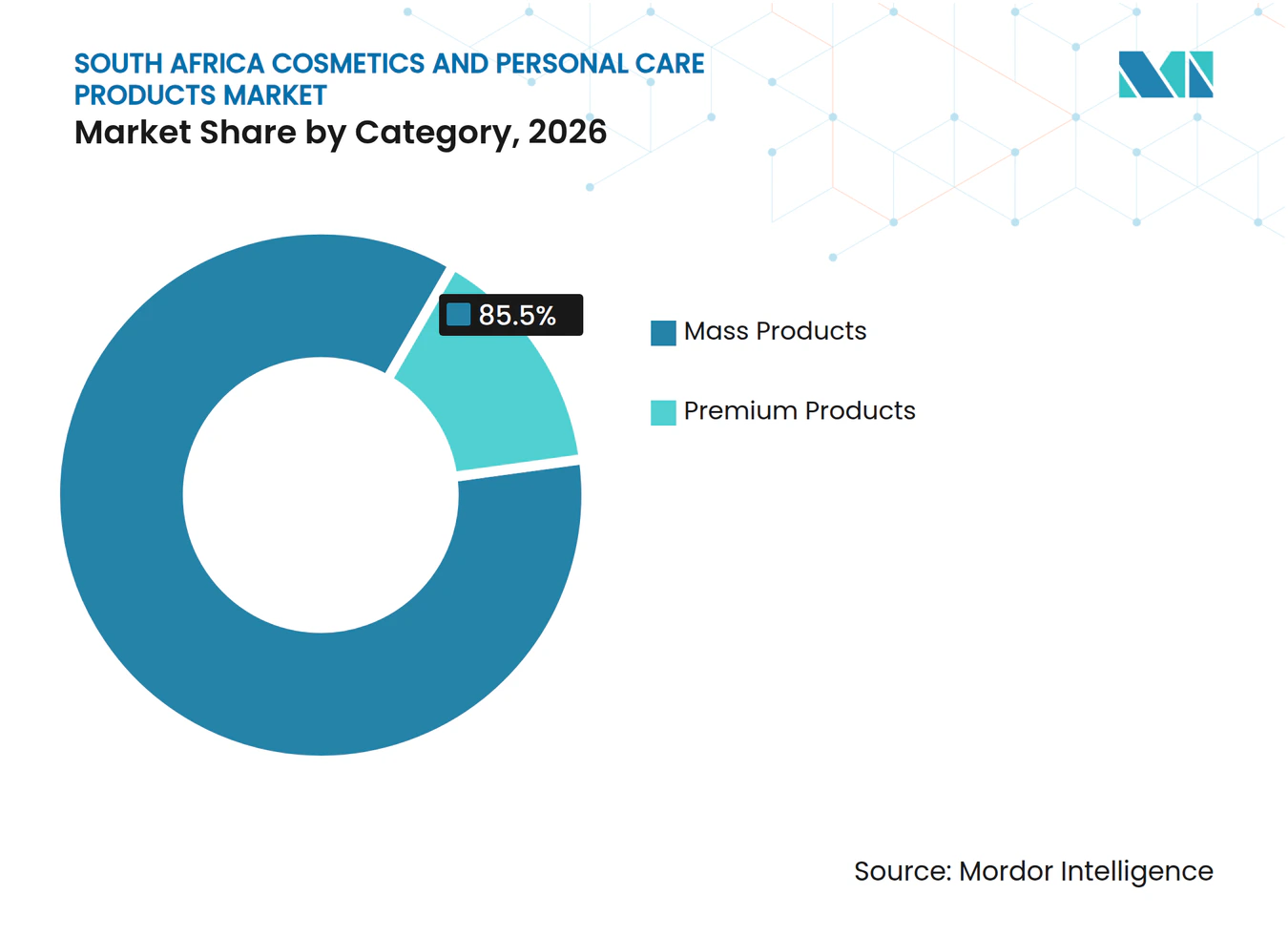
- Mass products led the category mix with an 85.5% share of the South Africa cosmetics and personal care products market size in 2026, whereas premium products are forecast to grow fastest at a CAGR of 6.95% during 2027-2032.
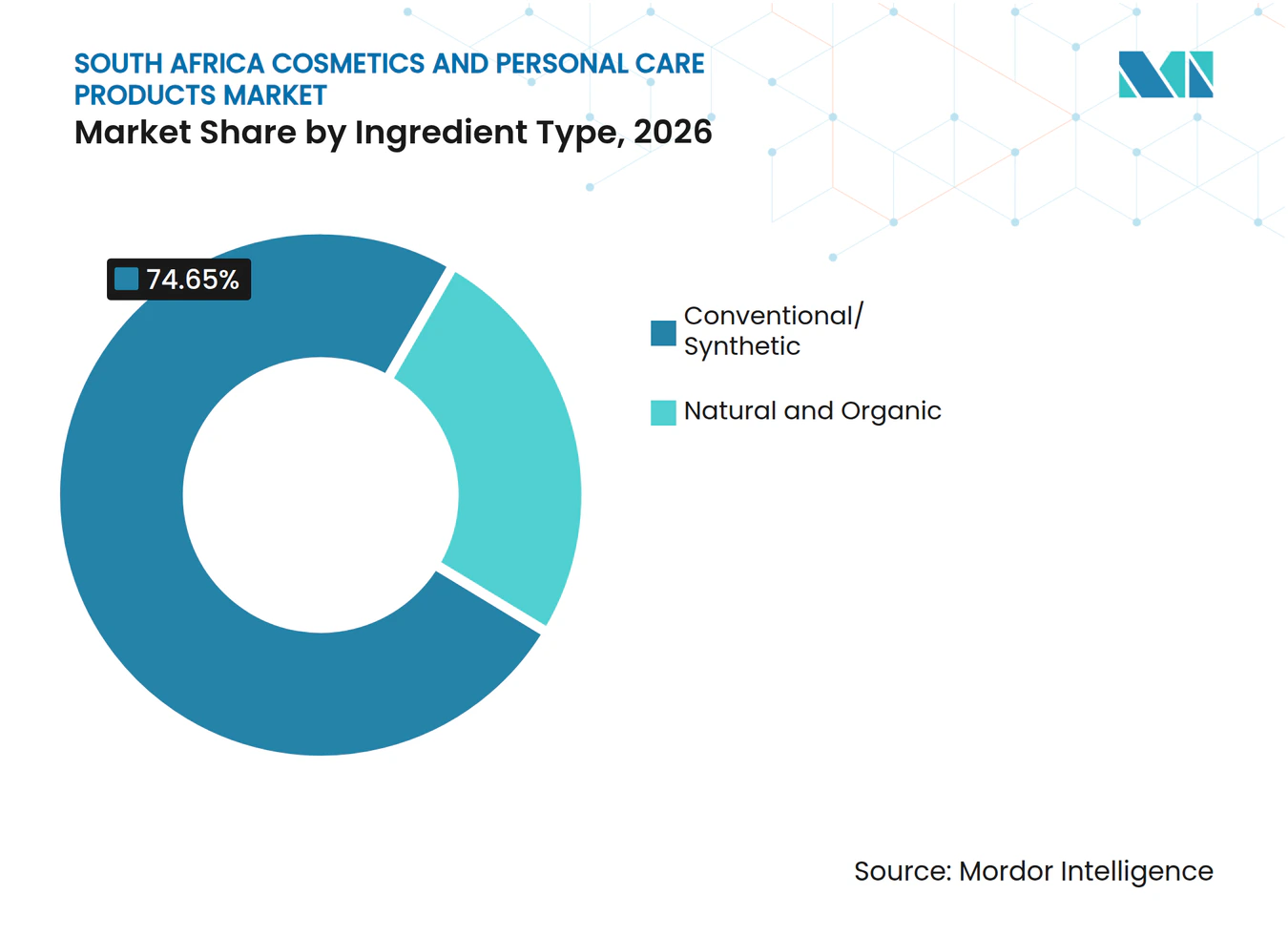
- The ingredient mix was led by conventional/synthetic products with 74.65% of market revenue in 2026, and natural and organic products are forecast to grow fastest at a CAGR of 7.15% during 2027-2032.
- Across distribution channels, supermarkets/hypermarkets led with 39.74% of market revenue in 2026, while online retail stores are forecast to grow fastest at a CAGR of 8.3% during 2027-2032.
Note: Market numbers in this report are based on Mordor Intelligence's proprietary estimation framework, which combines nine months of actuals with Q4 projections for base year 2026.
Market Trends and Insights
Drivers Impact Analysis of South Africa Cosmetics And Personal Care Products Market*
| Driver | (~) % Impact on CAGR Forecast | Geographic Relevance | Impact Timeline |
|---|---|---|---|
| Rising demand for natural and organic products | +2.2% | Nationwide | Medium term (2-4 years) |
| Increasing focus on men’s skincare products | +1.6% | Nationwide | Medium term (2-4 years) |
| Growing concern for oral hygiene | +1.5% | Nationwide | Long term (≥ 4 years) |
| Influence of social media and digital technology | +1.4% | Nationwide | Short term (≤ 2 years) |
| Rapid urbanization and increasing disposable income | +0.8% | Nationwide | Medium term (2-4 years) |
| Growth in e-commerce platforms | +0.7% | Nationwide | Short term (≤ 2 years) |
| Source: Mordor Intelligence | |||
Rising demand for natural and organic products
Retail reach can turn a natural-ingredient proposition into an accessible choice across several personal-care applications. By November 2025, Shanti Natural Care supplied more than 150 stores across South Africa. Its natural-ingredient CBD cosmeceuticals portfolio included body lotion and shampoo. In that model, the brand’s ingredient positioning can travel across skin and hair products while each format addresses a distinct use. The commercial task is to give each format a clear purpose within the range, so shared positioning supports actual product selection.
Increasing focus on men’s skincare products
An underserved male customer base gives retailers a reason to make skincare easier to encounter within a grooming offer. Clicks CEO Bertina Engelbrecht said male customers were underrepresented in its customer profile and men had asked for greater focus on grooming. By April 2026, Clicks had rolled out BroScape in South Africa, combining skincare with beard care, shaving products, haircare and grooming tools. Skincare suppliers can use that combined setting to explain how their products fit a broader grooming routine. Because Clicks identified an underserved male customer group, skincare is likely to form part of a wider grooming visit, tying its volume opportunity to the section’s ability to attract those shoppers.
Growing concern for oral hygiene
Concern about oral hygiene can expand demand when households turn occasional product purchases into a consistent brushing routine. Daily-use toothpaste creates a replenishment need, while toothbrush replacement gives oral-care suppliers a separate repeat-use occasion. Mouthwash can add another product for buyers seeking an additional step within their home oral-care routine. The commercial opportunity is to distinguish those roles, so a rinse complements the brushing offer and gives the buyer a reason for the additional purchase. Because toothpaste is the item a household uses up and rebuys, it is the natural entry point through which a supplier introduces a replacement brush or an optional rinse.
Influence of social media and digital technology
Beauty brands can use informative digital content to influence product selection before consumers choose where to complete their purchases. A cross-sectional study reported in 2026 used a nonprobability online snowball sample of South African beauty-influencer followers aged 18 to 65. Relevance, expertise, trustworthiness, similarity and likability were positively associated with perceived usefulness. Perceived usefulness influenced information adoption, which positively affected purchase intention.[1] That gives brands a reason to prioritize credible product explanations when designing influencer relationships.
Restraints Impact Analysis of South Africa Cosmetics And Personal Care Products Market*
| Restraint | (~) % Impact on CAGR Forecast | Geographic Relevance | Impact Timeline |
|---|---|---|---|
| Consumer awareness of chemical ingredients | -0.7% | Nationwide | Medium term (2-4 years) |
| Presence of counterfeit products | -0.9% | Gauteng, including Marabastad | Short term (≤ 2 years) |
| Price sensitivity among consumers | -0.4% | Nationwide | Short term (≤ 2 years) |
| Concerns about harmful chemical ingredients | -0.2% | Nationwide | Long term (≥ 4 years) |
| Source: Mordor Intelligence | |||
Consumer awareness of chemical ingredients
Ingredient scrutiny can constrain a fragranced body lotion when a skincare buyer questions the formulation and postpones a purchase. In this application, preserving the moisturizer’s care function while changing its fragrance proposition is a more specific problem than altering a label. A supplier considering that change faces formulation work before it can present the lotion as a different choice. Clearer product information may explain the ingredient’s role, but it cannot by itself satisfy a buyer who wants that ingredient removed. The remaining cost falls on a skincare offer whose sale may wait for reformulation, leaving the supplier to recover development costs within the lotion’s price tier.
Presence of counterfeit products
Counterfeit cosmetics place legitimate suppliers’ product assurance and sales relationships under pressure. In September 2026, the South African Police Service (SAPS) reported seizing more than 10,000 mixed counterfeit items, including cosmetics, in Marabastad, Gauteng. Police warned of potential consumer health and safety risks and harm to legitimate businesses from counterfeit goods. Separately, the Consumer Goods Council of South Africa and Econometrix estimated in 2026 that broader illicit cosmetics and personal-care trade displaced formal-sector output and 616 jobs. The combination creates a commercial problem that price competition alone cannot resolve, because product authenticity is also at stake. For legitimate sellers, protecting a sale adds the burden of establishing product provenance alongside competing on price.
*Our forecasts treat driver/restraint impacts as directional, not additive. The impact forecasts reflect baseline growth, mix effects, and variable interactions.
South Africa Cosmetics And Personal Care Products Market Segment Analysis
By Product Type:
Personal Care Scale Meets New Makeup AccessPersonal care products accounted for an 89.75% share of the South Africa cosmetics and personal care products market size in 2026. Clicks Group’s share of South African personal-care retail sales was 23.0% in H1 2026, based on restated NielsenIQ data. That share had been 22.4% in H1 2025 on the same restated series. A retailer gaining category share becomes a larger gatekeeper for manufacturers in this largest segment. Product functionality still matters, but securing shelf space at Clicks becomes a commercial decision separate from the appeal of any single product.
Cosmetics/make-up products are forecast to be the fastest-growing segment, at a CAGR of 6.4% during 2027-2032. In October 2026, Pick n Pay launched its Real Cosmetics own-brand range, developed with a local cosmetics supplier, in more than 100 South African stores and on its asap! app. The company said it was the only on-demand grocery retailer offering a dedicated makeup range for delivery within 60 minutes. That service differentiator lets a grocery retailer frame makeup availability around a short delivery window, extending the commercial role of its shopping platform. The local supplier that developed the range gains a route to shoppers through grocery stores and an app, linking product development to the retailer’s delivery proposition.



By Category:
Mass Affordability and Specialist Premium ReachMass products represented an 85.5% South Africa cosmetics and personal care products market share in 2026. Everyday shampoo and body lotion give supermarket buyers concrete care needs around which a mass-tier supplier can organize an accessible-price offer. Formulation and packaging costs must fit that price tier while keeping the basic care purpose clear. Similar lotions at closely spaced prices can complicate the choice, so an added variant needs a distinct use or pack-size rationale. Mass-tier suppliers can prioritize a recognizable core shampoo or lotion at the shelf price, reserving costlier additions for a clearly different care need.
Premium products are forecast to be the fastest-growing segment, at a CAGR of 6.95% during 2027-2032. At the September 28, 2026 announcement, ARC had 12 stores in major South African shopping malls and an online presence. Clicks Group described ARC as a specialist premium beauty retailer carrying international prestige brands across fragrance, skincare, makeup, haircare and bath and body. That range allows a premium retail destination to serve several beauty uses while maintaining a clearly defined position within one price tier. Premium brands can gain a specialist distribution route, with commercial access depending on how an offer fits the retailer’s chosen prestige portfolio.

By Ingredient Type:
Manufacturing Scale and Ingredient IdentityConventional/synthetic products were the largest segment, with 74.65% of market revenue in 2026. In October 2026, Unilever South Africa invested in a new Vaseline Petroleum Jelly production line at Maydon Wharf in Durban to serve demand across Africa and international markets. The facility’s share of the company’s global production of that product was expected to rise from about 60% to 80%. The investment develops South African manufacturing capacity for an established conventional skincare format. The commercial commitment centers on producing that format at scale, giving local manufacturing execution a role alongside retail brand positioning.
Natural and organic products are forecast to be the fastest-growing segment, at a CAGR of 7.15% during 2027-2032. In March 2026, South African natural skincare brand MomCareCo made most of its sales online through its own store and third-party platforms. Direct selling can let a natural skincare brand explain ingredient choices within its own product presentation. Third-party platforms provide another commercial route, so the formulation proposition needs to stay recognizable when the selling interface changes.
By Distribution Channel:
Supermarket Reach and Digital Retail AccessSupermarkets/hypermarkets were the largest segment, accounting for 39.74% of market revenue in 2026. In GeoPoll’s May 2025 survey of 501 urban South African adults, about 64% of surveyed personal-care buyers reported supermarkets as a primary or frequent purchase channel. That channel use links a broad retail environment to a defined personal-care buying occasion, giving suppliers a way to reach category demand without constructing a specialist retail destination. Supermarket reach becomes commercially useful when the product’s care function stays clear within the mixed assortment, allowing wide channel access to support a specific personal-care choice.
Online retail stores are forecast to be the fastest-growing segment, at a CAGR of 8.3% during 2027-2032. World Wide Worx estimated that online retail across all South African retail categories would grow 22.5% in 2026 and reach 10% of national retail turnover. In FY2026, online sales contributed 6.3% of Woolworths South Africa’s combined Fashion, Beauty and Home sales. Such a retail relationship can give beauty suppliers access to an operating digital channel, with online merchandising becoming part of the same commercial relationship as product supply. The opportunity is to widen online beauty availability through existing retail partners, using a functioning channel to participate in the expected expansion of digital shopping.
Geography Analysis
Johannesburg’s retail development illustrates how beauty can be integrated into a broad value-shopping destination. Jet opened its second flagship store at Sandton City on August 28, 2025, combining fashion, beauty, homeware and cellular products. Its beauty department included a dedicated makeup station, while in-store online ordering connected the physical outlet to digital shopping. This format creates a route for cosmetics suppliers to present products where shoppers can examine them and place an order within the same visit. That positions the retailer as both a merchandising host and an ordering interface, expanding the supplier relationship beyond display space.
At Tygervalley in Cape Town, Woolworths’ 2025 store renovation integrated a full-line offer spanning food, fashion, beauty and home. Its beauty department included treatments and complimentary hair and skin analysis consultations with personalized product recommendations, linking a product display to individual advice. For skincare and haircare brands, that service-led setting can make selection more explicit by connecting a recommendation to the shopper’s discussion at the point of sale. The format makes staff product knowledge a potential competitive asset, so supplier support for consultations can matter when brands seek a place in the beauty department.
Durban’s Pavilion Shopping Centre provided a separate example of dedicated beauty retailing when ARC opened a store there in June 2025. The outlet offered skincare, fragrance and makeup brands within a beauty-focused retail environment. Compared with the multicategory examples, a dedicated beauty destination can concentrate product discovery within a more focused assortment. This creates an opportunity for suppliers to be evaluated alongside other beauty brands through a coherent category presentation within one retail destination. Which brands gain a physical presence among Durban shoppers can depend on a specialist retailer’s assortment choices.
Regulatory Framework and Outlook
The selected jurisdictions comparison considers cosmetics suppliers in South Africa and the Western Cape, with Cape Town illustrating delegated local powers. The perspective is that of a manufacturer or importer placing prepacked cosmetics on sale. National rules combine specified depigmenting-ingredient and skin-lightener restrictions with product and business identification on prepacked cosmetics. Cape Town’s delegated powers apply to specified provisions within its own jurisdiction, making the local comparison about implementation of the national framework.
Regulatory Table of South Africa Cosmetics And Personal Care Products Market
| Decision factor | South Africa | Western Cape (Cape Town) |
|---|---|---|
| Primary authority | Minister of Health and duly authorized local officers | Cape Town Metropolitan Municipality’s duly authorized officers |
| Key instruments or direction | R. 1227 specified depigmenting-ingredient and skin-lightener restrictions; R. 2567 prepacked labeling | National product rules; R. 342 of 2005 local enforcement authorization |
| Commercial effect | Formulation and required label information affect product eligibility for sale | Supplier compliance is subject to specified local enforcement powers |
| Current policy attractiveness | Medium | Medium |
| Future direction of policy attractiveness | No change | No change |
| Source: Mordor Intelligence | ||
The national Medium rating reflects the burden of meeting the specified formulation and label requirements. The Western Cape Medium rating follows those national product duties and Cape Town’s authority to enforce sections 10(3)(b), 11 and 24 through duly authorized officers under the 2005 notice. On August 7, 2025, the environment minister announced draft restrictions on plastic microbeads and products containing them, including cosmetics and personal-care items. The No change judgments reflect those operative duties and delegated enforcement, since the draft’s 24-month stock phaseout, notification to the Director-General and phaseout-plan requirements would apply only if enacted.
Value Chain Stages
The value chain comparison tracks how suppliers earn from ingredients, contracted production, distribution and retail. Serendipity Toiletries manufactures and packs personal-care, cosmetic, toiletry and fragrance products for retailers including Clicks and Woolworths. Those relationships give retailer ranges a route to external production capabilities, allowing manufacturing services to capture value alongside consumer-facing brands. Formulation and batch execution can therefore be commercially important even when another business controls the retail relationship.
Value Chain Analysis Table of South Africa Cosmetics And Personal Care Products Market
| Primary activity | Key participants | Value capture | Bottleneck | Resilience response |
|---|---|---|---|---|
| Ingredient distribution | Specialty raw-material distributors such as Cosmetic Ingredients (Pty) Ltd, serving Southern Africa | Ingredient sales to manufacturers | Qualifying ingredients for different formulations | Validate alternative ingredients before scaling production |
| Formulation, manufacturing and packing | Contract manufacturers such as Serendipity Toiletries and Bright Packaging and Raw Materials | Manufacturing, formulation, filling and packing fees | Maintaining repeatable batches during scale-up | Validate production transfer and retain batch traceability |
| Finished-product distribution | Beauty distributors such as Prestige Cosmetics Group and retail-network distributors such as Dis-Chem | Wholesale product sales and distribution services | Coordinating brand supply with multiple retail destinations | Align brand responsibilities with retail delivery schedules |
| Retail and range management | Health and beauty retailers such as Clicks Group and Dis-Chem | Retail product sales, including private-label ranges | Differentiating branded and retailer-controlled ranges | Give each range a distinct use and price position |
| Source: Mordor Intelligence | ||||
Dis-Chem combines retail with complementary wholesale and distribution operations and private-label and exclusive ranges, primarily in South Africa.[2] Such integration can place several revenue-generating stages under one retail group, increasing the importance of capabilities that remain useful outside that group. Independent manufacturers can serve retailer-controlled ranges, while distributors can justify a separate role through access to additional retail partners. Branding power can move toward the outlet under such integration, while formulation and manufacturing revenue remains available to independent suppliers.
Competitive Landscape
Market Concentration
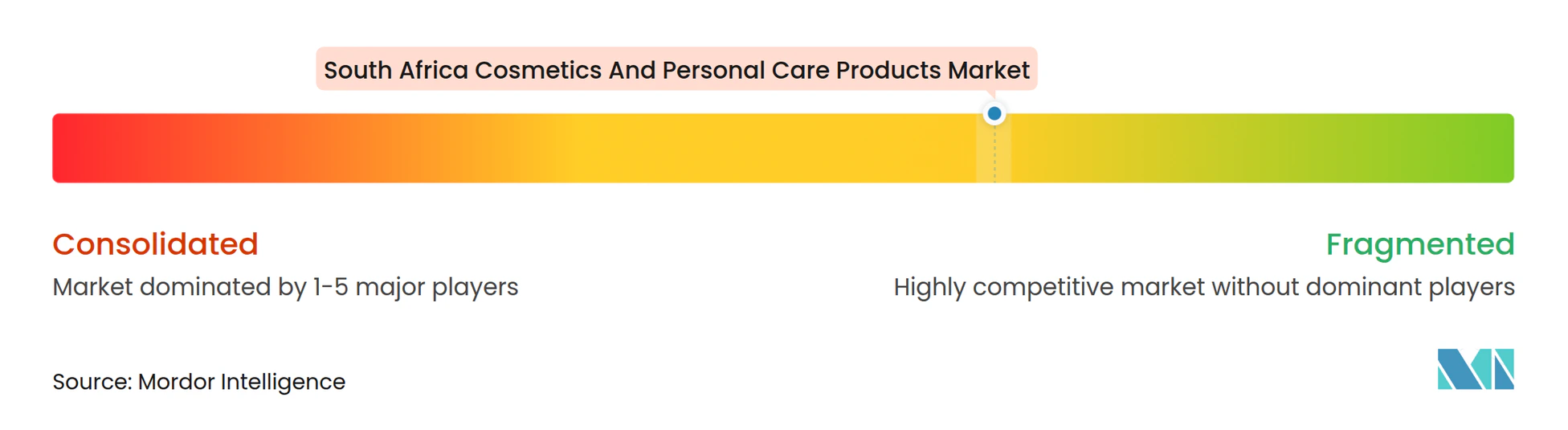
Competition combines large international brand groups with distinct local routes to consumers, leaving room for specialization within a moderately fragmented structure. Beiersdorf AG participates through Beiersdorf Southern Africa, whose brands include NIVEA, NIVEA MEN, Labello and Eucerin. The Estée Lauder Companies identifies Estee Lauder Companies (Pty) Ltd as its South African entity in Kyalami and reported 3% growth in global organic net sales in the fiscal year ended June 30, 2026. The Procter & Gamble Company operates a Johannesburg office and manufacturing site and markets Gillette and Oral-B in South Africa. Local manufacturing and affiliate-led brand portfolios create different competitive commitments, with production capability adding a domestic operating dimension beyond brand representation.
Henkel AG & Co. KGaA participates in South African personal care through Henkel South Africa, which offers textured-hair-care products under its Got2b Glued brand. L'Oréal S.A. reported double-digit sales growth in South Africa in the first half of 2026, ahead of the market.[3] Its local operation markets and distributes brands such as Dark & Lovely, Maybelline and CeraVe across Consumer Products, Professional Products, Luxe and Dermatological Beauty. For buyers, a defined haircare offer and a multidivision beauty portfolio illustrate different ways to combine product relevance and reach, giving retailers options for serving several beauty needs.
Beiersdorf Southern Africa’s NIVEA and Eucerin brands connect its local skincare lineup to different parts of the parent’s portfolio. Beiersdorf’s global Derma business grew organically by 7.8% in the first half of 2026. Over the same period, its global Consumer Business Segment recorded a 4% organic sales decline, driven by NIVEA portfolio challenges. In its global first-half 2026 results, Beiersdorf described Eucerin as a Derma brand continuing multi-year outperformance. For NIVEA and Eucerin prepacked cosmetics sold in South Africa, national labeling rules require manufacturers, importers and sellers to ensure labels give the product name and a responsible business’s name and address.
South Africa Cosmetics And Personal Care Products Industry Leaders
-
Beiersdorf AG
-
The Estée Lauder Companies
-
The Procter & Gamble Company
-
Henkel AG & Co. KGaA
-
L'Oréal S.A.
- *Disclaimer: Major Players sorted in no particular order
South Africa Cosmetics And Personal Care Products Market Companies Covered in this Report
- The Procter & Gamble Company
- L'Oréal S.A.
- The Estée Lauder Companies
- Beiersdorf AG
- Henkel AG & Co. KGaA
- Kenvue Inc.
- Amway Corporation
- Natura Cosméticos S.A.
- The Colgate-Palmolive Company
- Unilever Plc
- Davines Group
- Sodalis Group (Deborah Milano)
- Avroy Shlain Cosmetics
- Revlon Group Holdings LLC
- Coty Inc.
- Reckitt Benckiser Group
- Clarins Group
- SKOON. Skin Care
- Shiseido Company Limited
- LVMH (Moët Hennessy Louis Vuitton)
Read Analysis of South Africa Cosmetics And Personal Care Products Companies
Key Opportunities for Market Participants
The opportunity comparison examines direct skincare sales, first online personal-care purchases and focused men’s grooming ranges. Ask Afrika’s 2025 Target Group Index found that 79.1% of South African adults had internet access and 34.2% shopped online across shopping categories. Naturals Beauty sells through its own online store and other e-commerce platforms in South Africa. The contrast makes established digital buyers and connected first-time shoppers distinct commercial targets for skincare and personal-care suppliers.
Market Opportunities Table of South Africa Cosmetics And Personal Care Products Market
| Opportunity | Why now | Buyer / lead segment | Recommended play | Main barrier | Likely beneficiaries |
|---|---|---|---|---|---|
| Direct online skincare relationships | Established online buying base in the 2025 consumer findings | Skincare buyers already shopping online | Combine a focused brand store with marketplace availability | Winning repeat visits outside established platforms | Naturals Beauty and other skincare sellers |
| First online purchases of routine personal care | Connected non-shopper gap in the same 2025 findings | Connected adults considering online personal-care purchases | Offer a small starter assortment with clear delivered prices and fulfillment commitments | Delivered cost and transaction confidence | Personal-care brands and their retail partners |
| Focused men’s grooming range extensions | Sorbet Man sales rose 29% in the six months to February 2026 | Men’s grooming shoppers | Develop complementary personal-care products for a defined grooming routine | Securing retailer space against established grooming ranges | Clicks Group and men’s personal-care suppliers |
| Source: Mordor Intelligence | |||||
World Wide Worx’s findings from 2025 consumer research identified delivery fees, minimum orders, unreliable last-mile service outside major cities, payment security and delivery concerns as online-retail obstacles. These obstacles make a first order depend on the transaction as well as the care product, especially where last-mile service is unreliable. The strongest opening is converting connected non-shoppers to first online personal-care orders, which depends on delivered cost and fulfillment confidence before a wider product range.
Recent Industry Developments in South Africa Cosmetics And Personal Care Products Market
- Oct 2026: Pick n Pay launched Real Cosmetics in more than 100 South African stores and on its asap! app. The company said it was the only on-demand grocery retailer offering dedicated makeup delivery within 60 minutes.
- Oct 2026: On October 2, the KwaZulu-Natal government confirmed Unilever’s investment in a new Vaseline Petroleum Jelly production line at its Maydon Wharf facility in Durban.
- Sep 2026: Clicks Group announced a proposed acquisition of a further 35.3% interest in ARC Store from its founding shareholders, which would raise its stake to 61%, subject to competition-authority approval.
South Africa Cosmetics And Personal Care Products Market Report Scope and Research Methodology
Market Definition and Coverage
The South Africa cosmetics and personal care products market measures annual consumer spending on finished cosmetics and personal care products sold in South Africa. This spending is classified by product, price tier, ingredient profile, and distribution channel.
Scope exclusions: Salon treatments and other personal care services, aesthetic procedures, separately sold ingredients and other manufacturing inputs, and illegal or unregistered trade are excluded.
Segments Covered in This Report
- By Product Type
- Personal Care Products
- Hair Care
- Shampoo
- Conditioner
- Hair Colourant
- Hair Styling Products
- Others
- Skin Care
- Facial Care Products
- Body Care Products
- Lip and Nail Care Products
- Bath and Shower
- Shower Gels
- Soaps
- Others
- Oral Care
- Toothbrush
- Toothpaste
- Mouthwashes and Rinses
- Others
- Men's Grooming Products
- Deodorants and Antiperspirants
- Perfumes and Fragrances
- Hair Care
- Cosmetics/Make-up Products
- Facial Cosmetics
- Eye Cosmetics
- Lip and Nail Make-up Products
- Personal Care Products
- By Category
- Premium Products
- Mass Products
- By Ingredient Type
- Natural and Organic
- Conventional/Synthetic
- By Distribution Channel
- Specialty Stores
- Supermarkets/Hypermarkets
- Online Retail Stores
- Other Channels
Data Sources, Market Sizing, and Validation
Desk Research
Public sources such as Statistics South Africa's retail trade sales series, the National Department of Health's chemical-safety materials, InvestSA's consumer-goods sector profile, and the Consumer Goods Council of South Africa's industry material can anchor retail trends, product regulation, sector structure, and illicit-trade context in South Africa.
Company annual reports and interim filings, investor materials, retailer announcements, and reputable South African business press can cross-check brand portfolios, store expansion, pricing, and channel developments against those market signals. These sources are not exhaustive, and further sources inform collection, validation and clarification.
Primary Interviews and Surveys
Primary research can be structured as interviews and surveys with South African cosmetics and personal-care manufacturers, importers, brand owners, wholesalers, and retailers, including executives and functional managers responsible for category, pricing, sales, and distribution. Respondents can test desk-derived product boundaries, segment shares, price and volume assumptions, and channel conditions. Analysts can reconcile differing views against independent retail, company, and trade indicators, document gaps, and triangulate findings before forecasting.
Distribution of primary research fieldwork respondents
| Company type | Respondent position | Region |
|---|---|---|
| Top tier: 30% | CXOs: 15% | |
| Mid tier: 50% | Functional/Unit leaders: 35% | |
| Smaller Players: 20% | Managers: 50% |
Market-Sizing & Forecasting
After local retail end-user transactions have been defined and the eligible sales evidence assembled, the top-down model estimates annual South African sales and builds value by product type, price tier, ingredient profile, and channel from category sales evidence, retailer mix, brand and product ranges, and consumer price patterns. Key indicators include Statistics South Africa's current-price sales for relevant retailer groups, household spending and income trends, consumer price movements, finished-product import values, and changes in store and online retail reach. These inform the size and direction of category demand and the retail value captured locally. Scenario analysis carries the historical value series forward under alternative household-spending, price, and channel-growth paths, while selective bottom-up checks compare sampled retail prices and observed product volumes or retailer category sales with the top-down totals. Where a direct segment observation is missing, analysts can use the nearest relevant public category or retailer indicator, state the assumption, and test whether adjacent segments and the overall market remain consistent. South African respondents can review the variable-level assumptions and explain product, pricing, or channel changes that warrant adjustment.
Data Validation & Update Cycle
Analysts triangulate retail sales, company filings, trade indicators, retailer observations, and respondent evidence, then check category shares, annual changes, price movements, and forecasts for anomalies against independent signals. A second review checks source dates, definitions, calculations, boundary treatment, and outlier movements, with analysts resolving anomalies before sign-off. When an input conflicts with independent evidence or material changes in product availability, prices, regulation, or channels alter an assumption, analysts re-contact relevant respondents. The model is refreshed annually, updated between cycles for material events, and reviewed again immediately before delivery.
Mordor Intelligence's South Africa Cosmetics and Personal Care Products Market Sizing Compared With Other Published Estimates
Published estimates can differ in the transactions and products they count and the inputs used to model demand. The South Africa cosmetics and personal care products market measures annual consumer spending on finished cosmetics and personal care products sold in South Africa.
Key Gap Drivers include the study's defined coverage and market-specific modeling choices. Key indicators include Statistics South Africa's current-price sales for relevant retailer groups, household spending and income trends, consumer price movements, finished-product import values, and changes in store and online retail reach.
Benchmark comparison
| Source | Market Size | Gaps in Research Methodology |
|---|---|---|
| Mordor Intelligence | USD 4.45 B (2027) | |
| Global Consultancy A | USD 1.6 B (2025) | At its 2025 base, this estimate is 64.0% below this report's 2027 value of USD 4.45 B, 2 years later. The page frames the estimate as the cosmetics market and lists skin and sun care, hair care, deodorants and fragrances, makeup, and other product types, while the report also counts finished personal-care lines. |
| Global Consultancy B | USD 2.3 M (2025) | At its 2025 base, this estimate is 99.9% below this report's 2027 value of USD 4.45 B, 2 years later. The page frames the estimate as the cosmetics market and identifies skin care, hair care, makeup, and fragrance segments, while the report also counts finished oral-care, bath-and-shower, and men's-grooming products. |
Mordor Intelligence's analysts triangulate retail sales, company filings, trade indicators, retailer observations, and respondent evidence, then check category shares, annual changes, price movements, and forecasts for anomalies against independent signals.
Key Questions Answered in the Report
What is the South Africa cosmetics and personal care products market size and growth outlook?
The market is estimated at USD 4.45 billion in 2027 and is forecast to reach USD 5.97 billion by 2032, at a 6.04% CAGR during 2027-2032.
Which factors support cosmetics and personal-care demand in South Africa?
Natural-ingredient positioning, men’s skincare and digital recommendations can support demand. By April 2026, Clicks had rolled out BroScape, which grouped skincare with beard care, shaving products, haircare and tools.
Which product type leads South African cosmetics and personal-care sales?
Personal care products were the largest product type, with 89.75% of market revenue in 2026.
Which companies are major cosmetics and personal-care competitors in South Africa?
Beiersdorf AG, The Estée Lauder Companies, The Procter & Gamble Company, Henkel AG & Co. KGaA and L'Oréal S.A. are major competitors.
What challenges affect South African cosmetics and personal-care suppliers?
Counterfeits and formulation compliance create verification and product-eligibility burdens. In September 2026, SAPS reported seizing more than 10,000 mixed counterfeit items, including cosmetics, in Marabastad, Gauteng.
How do cosmetics and personal-care retail formats differ across South African cities?
Jet’s 2025 multicategory store opening at Sandton City in Johannesburg included beauty and in-store online ordering. Woolworths’ Tygervalley full-line store renovation in Cape Town included beauty treatments and consultations in 2025.