
Market Overview
| Study Period | 2021 - 2031 |
|---|---|
| Forecast Data Period | 2026 - 2031 |
| Base Year Market Size (2025) | USD 31.11 Billion |
| Market Size (2026) | USD 32.77 Billion |
| Market Size (2031) | USD 42.5 Billion |
| Growth Rate (2026 - 2031) | 5.34 % |
| Market Concentration | Medium |
Major Players *Disclaimer: Major Players sorted in no particular order Image © Mordor Intelligence. Reuse requires attribution under CC BY 4.0. | |
Middle East And Africa Beauty And Personal Care Products Market Analysis by Mordor Intelligence
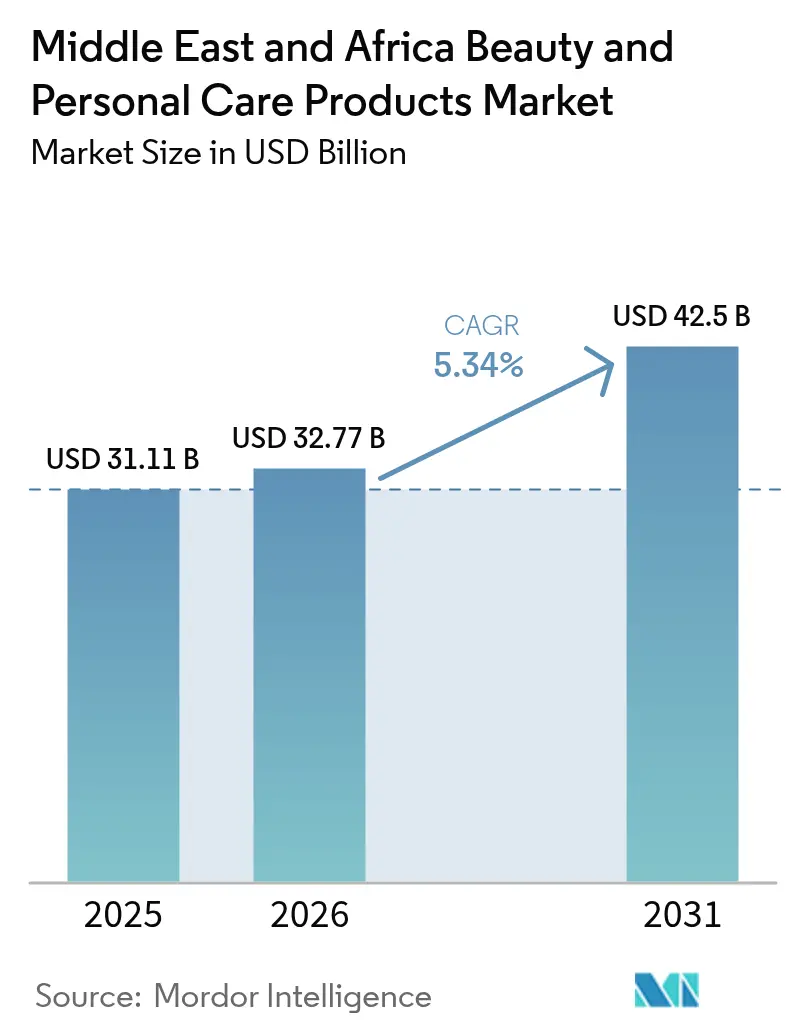
The Middle East and Africa beauty and personal care products market size in 2026 is estimated at USD 32.77 billion, growing from 2025 value of USD 31.11 billion with 2031 projections showing USD 42.5 billion, growing at 5.34% CAGR over 2026-2031. This growth is driven by evolving consumer preferences toward halal-certified and clean beauty formulations that align with regional cultural values and religious requirements. The market's momentum stems from the intersection of traditional beauty practices with modern digital commerce, where social media influence accelerates product discovery and purchase decisions across diverse demographic segments.
Key Report Takeaways
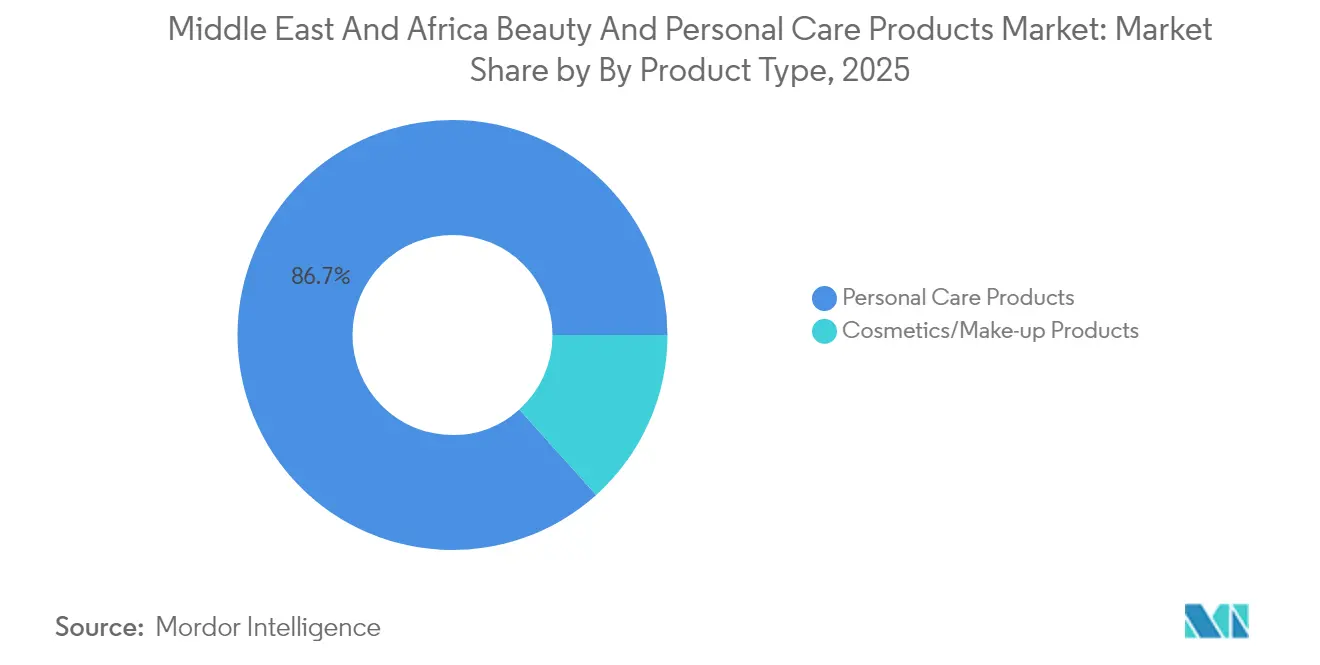
- By product type, personal care products commanded 86.65% of the 2025 revenue, whereas the cosmetics/make-up segment is expected to grow at a 6.62% CAGR from 2026 to 2031.
- By category, the mass tier held 57.10% share in 2025; premium/luxury offerings are forecast to grow at 7.05% through 2031.
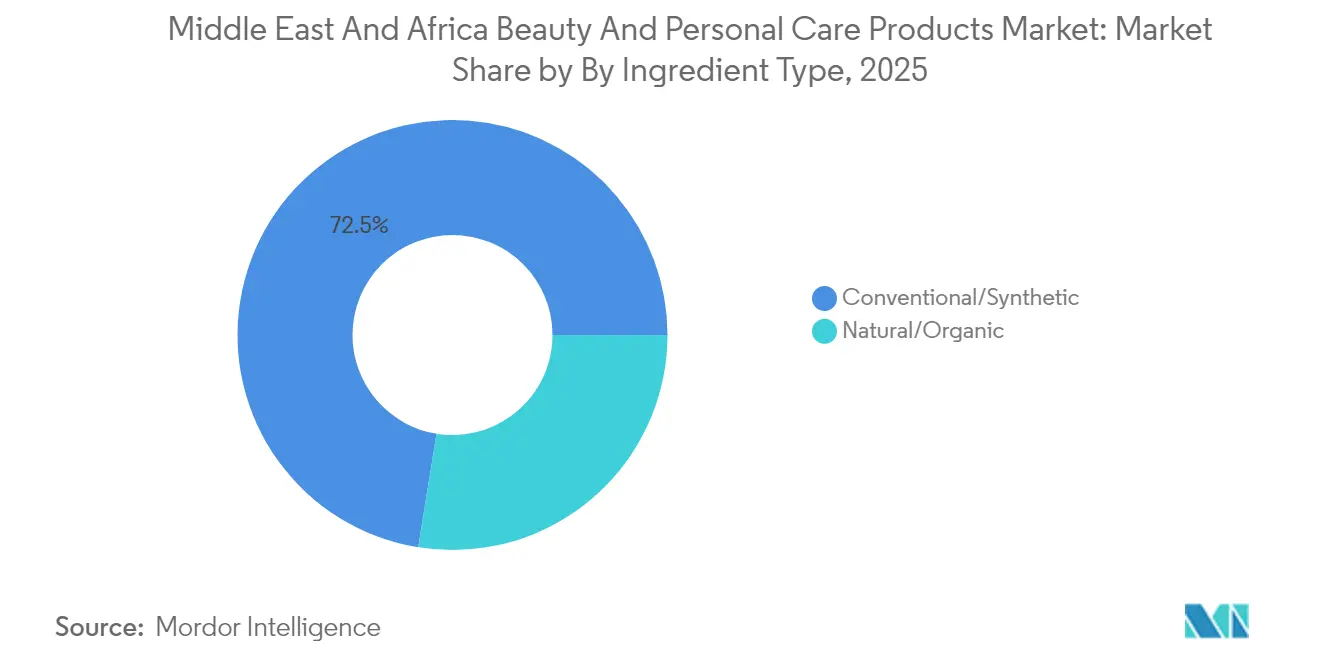
- By ingredient type, conventional/synthetic formulations held 72.45% of sales in 2025, yet natural/organic ranges are expanding at a 7.42% CAGR to 2031 owing to increasing clean-beauty adoption.
- By distribution channel, specialty stores led with 47.00% share in 2025, while online retail is advancing at an 7.78% CAGR to 2031, spearheading digital disruption across the region.
- By geography, Saudi Arabia accounted for the largest 25.20% share in 2025, whereas South Africa is poised to be the fastest-growing market, rising at 6.60% CAGR during the forcast period.
Note: Market size and forecast figures in this report are generated using Mordor Intelligence’s proprietary estimation framework, updated with the latest available data and insights as of 2026.
Middle East And Africa Beauty And Personal Care Products Market Trends and Insights
Drivers Impact Analysis*
| Driver | (~) % Impact on CAGR Forecast | Geographic Relevance | Impact Timeline |
|---|---|---|---|
| Preference for clean/halal products | +1.2% | GCC, North Africa, with spillover to Nigeria, Egypt | Medium term (2-4 years) |
| Shift toward organic and natural products | +0.9% | United Arab Emirates, Saudi Arabia, South Africa | Long term (≥ 4 years) |
| Rising male grooming trends | +0.8% | Saudi Arabia, United Arab Emirates, Turkey, with expansion to Egypt, Morocco | Medium term (2-4 years) |
| Increasing social media and influencer marketing | +1.1% | Concentrated in Gulf states, urban South Africa | Short term (≤ 2 years) |
| Growing investments in advertisement, research and development, and marketing | +0.7% | Regional hubs: United Arab Emirates, Saudi Arabia, Egypt, South Africa | Long term (≥ 4 years) |
| Rising innovative and new product launches | +0.6% | Concentration in premium markets United Arab Emirates, Saudi Arabia | Medium term (2-4 years) |
| Source: Mordor Intelligence | |||
Preference for clean/halal products
The convergence of religious compliance and clean beauty positioning creates a unique value proposition that commands premium pricing across Muslim-majority markets. Halal certification requirements, governed by standards bodies like SMIIC (Standards and Metrology Institute for Islamic Countries), extend beyond ingredient sourcing to encompass entire manufacturing processes, creating barriers to entry that benefit established players with compliant facilities[1]Source: Standards and Metrology Institute for Islamic Countries, “Halal Product Certification,” smiic.org. This driver particularly influences the United Arab Emirates market, where Dubai Municipality's halal certification program has streamlined approval processes for international brands seeking regional distribution. The clean beauty intersection with halal requirements enables brands to capture both religious compliance and wellness-oriented consumer segments simultaneously. SGS and Cotecna provide third-party halal verification services, indicating institutional support for market expansion. The premium pricing power of halal-certified clean beauty products creates sustainable competitive advantages for brands that invest in compliant manufacturing and certification processes.
Shift toward organic and natural products
Consumer migration toward organic and natural formulations drives ingredient sourcing strategies that leverage Africa's biodiversity advantages, particularly shea butter from West Africa, argan oil from Morocco, and marula oil from Southern Africa. This trend creates vertical integration opportunities for brands seeking to control supply chains while building authentic storytelling around indigenous ingredients. Consumer willingness to pay premiums for perceived safety and efficacy benefits continues to drive growth in the organic segment, especially among educated urban populations throughout the region. Natural ingredient sourcing also aligns with sustainability narratives that resonate with younger demographics, creating brand differentiation opportunities in increasingly crowded market segments. The challenge lies in scaling organic ingredient supply chains while maintaining quality consistency and cost competitiveness against synthetic alternatives.
Rising male grooming trends
Male grooming market expansion reflects changing social attitudes and increased disposable income among young male demographics across oil-rich economies and urban centers. The trend gains momentum through social media influence and celebrity endorsements that normalize male beauty routines, particularly in traditionally conservative societies where such behaviors were previously discouraged. Pert Plus's relaunch of enhanced men's grooming ranges in the GCC, including 4-in-1 products, demonstrates how established brands adapt product portfolios to capture emerging male consumer segments. This demographic shift creates opportunities for specialized male grooming brands and forces traditional female-focused companies to develop gender-specific product lines and marketing strategies. The male grooming trend particularly benefits online retail channels, where privacy concerns about purchasing beauty products are minimized through discreet delivery options.
Increasing social media and influencer marketing
Social media platforms serve as primary product discovery and purchase decision channels, particularly among Gen Z consumers who represent 60% of Africa's population under 25 years old. Influencer marketing effectiveness stems from authentic cultural connections and local language content that resonates with diverse regional audiences across Arabic, French, and English-speaking markets. The Gulf states lead social media beauty engagement, with high smartphone penetration and disposable income creating ideal conditions for influencer-driven commerce. Digital marketing strategies must navigate cultural sensitivities while building authentic brand connections, requiring localized content creation and influencer partnerships that respect religious and social norms. The acceleration of social commerce creates direct-to-consumer opportunities that bypass traditional retail intermediaries while building deeper customer relationships through personalized engagement strategies.
Restraints Impact Analysis*
| Restraint | (~) % Impact on CAGR Forecast | Geographic Relevance | Impact Timeline |
|---|---|---|---|
| Prevalence of counterfeit and grey-market proliferation | -0.8% | Concentrated in Nigeria, Egypt, Morocco | Short term (≤ 2 years) |
| Stringent and fragmented regulation | -0.6% | United Arab Emirates, Saudi Arabia having streamlined processes | Medium term (2-4 years) |
| Cultural and religious sensitivities | -0.4% | Muslim-majority countries, conservative regions | Long term (≥ 4 years) |
| Underdeveloped local manufacturing ecosystem | -0.7% | Sub-Saharan Africa, with exceptions in South Africa, Egypt | Long term (≥ 4 years) |
| Source: Mordor Intelligence | |||
Prevalence of counterfeit and grey-market proliferation
Counterfeit product circulation across porous regional borders creates revenue leakage and brand reputation risks that particularly impact premium and luxury segments where authenticity commands significant price premiums. The UAE's enforcement initiatives through ESMA (Emirates Authority for Standardisation and Metrology) demonstrate regulatory responses to counterfeit proliferation, yet cross-border coordination remains limited across the broader region[2]Source: Emirates Authority for Standardization and Metrology, “Anti-Counterfeit Enforcement Updates,” esma.gov.ae. South African authorities have intensified anti-counterfeiting efforts, with customs seizures increasing in 2024, indicating both the scale of the problem and institutional responses to address it. Grey market distribution through unauthorized channels undermines official distributor networks and pricing strategies, forcing brands to invest heavily in supply chain monitoring and legal enforcement. The counterfeit challenge particularly affects online marketplaces, where consumer education about authentic product identification becomes critical for brand protection strategies.
Stringent and fragmented regulation
Regulatory complexity across diverse national frameworks requires significant compliance investments and delays market entry timelines for international brands seeking regional expansion. Saudi Arabia's SFDA streamlined cosmetic import procedures through the new GHAD system in 2024, requiring prior approval for shipments, demonstrating both regulatory evolution and ongoing complexity[3]Source: Saudi Food and Drug Authority, “SFDA Issues Certificates of Conformity for Beauty Sector Consignments via FASEH,” sfda.gov.sa. The fragmentation creates competitive advantages for established players with regulatory expertise while disadvantaging smaller brands lacking compliance resources. Different countries maintain varying standards for product registration, labeling requirements, and ingredient approvals, necessitating market-specific formulations and packaging adaptations. Regulatory compliance costs disproportionately impact emerging brands and local manufacturers, potentially limiting market competition and innovation while favoring multinational corporations with established regulatory affairs capabilities.
*Our forecasts treat driver/restraint impacts as directional, not additive. The impact forecasts reflect baseline growth, mix effects, and variable interactions.
Segment Analysis
By Product Type: Personal Care Dominance Faces Cosmetics Acceleration
Personal care products command 86.65% market share in 2025, reflecting fundamental consumer priorities around hygiene, skincare, and hair care across diverse climate conditions and cultural preferences throughout the Middle East and Africa region. The segment's dominance stems from essential product categories, including shampoos, body care, oral care, and deodorants that represent non-discretionary spending patterns regardless of economic conditions. Within Personal Care, hair care products benefit from climate-specific formulations addressing humidity and sun exposure challenges.
The cosmetics/make-up segment's superior 6.62% CAGR through 2031 signals evolving consumer behavior toward self-expression and social media-driven beauty standards, particularly among younger demographics in urban centers. The structural shift toward cosmetics reflects income growth and cultural liberalization, particularly in Gulf states, where expatriate populations introduce diverse beauty practices and product preferences. Facial cosmetics lead the makeup category, driven by social media influence and professional makeup application trends, while eye cosmetics gain traction through tutorial-driven learning and cultural acceptance of decorative products.



By Category: Mass Market Stability Enables Premium Acceleration
The mass market category holds a 57.10% share in 2025, providing market stability and volume growth. This segment serves price-conscious consumers in emerging economies, where limited disposable income is affected by economic volatility and currency fluctuations. Mass market dominance reflects the importance of accessible pricing strategies that accommodate diverse income levels while maintaining product quality and brand recognition across traditional retail channels.
The premium/luxury segment is expected to grow at a CAGR of 7.05% through 2031, driven by increasing consumer income in oil-rich economies and urban centers, where affluent consumers demand premium products and exclusive brand experiences. The premium segment benefits from aspirational purchasing behavior and social media influence that elevates luxury beauty consumption as status signaling among emerging middle-class populations. Premium segment growth particularly concentrates in Gulf states where high per-capita income and expatriate populations create demand for international luxury brands and exclusive product launches. The category segmentation creates opportunities for multi-tier brand strategies that capture both volume through mass market offerings and margin through premium positioning.
By Ingredient Type: Synthetic Dominance Challenged by Natural Innovation
Conventional/Synthetic ingredients hold a 72.45% market share in 2025, driven by their cost advantages, reliable supply chains, and established effectiveness in mass market production. These ingredients provide manufacturers with significant benefits, including lower production costs, standardized quality control processes, and proven performance metrics. The widespread use of synthetic ingredients enables manufacturers to maintain consistent product quality and shelf stability across their product lines. Additionally, synthetic ingredients support extended supply chain operations by offering predictable degradation rates, stable chemical compositions, and resistance to environmental factors that could compromise product integrity during storage and transportation in the region.
Natural/Organic ingredients' accelerated 7.42% CAGR through 2031 demonstrates consumer migration toward clean beauty propositions that align with health consciousness and environmental awareness, particularly among educated urban demographics willing to pay premiums for perceived safety benefits. The natural segment benefits from Africa's biodiversity advantages, including indigenous ingredients like shea butter, argan oil, and marula oil that create authentic storytelling opportunities and supply chain differentiation.
By Distribution Channel: Specialty Stores Leadership Faces Digital Disruption
Specialty Stores command 47.00% market share in 2025, leveraging product expertise, personalized service, and brand partnerships that create differentiated shopping experiences, particularly valued for premium and luxury beauty products. The channel's strength stems from trained staff capabilities, product demonstration opportunities, and brand storytelling that support complex purchase decisions and customer education across diverse product categories. Moreover, supermarkets/hypermarkets provide mass market accessibility and convenience purchasing that supports routine replenishment of essential personal care products, while their limited beauty expertise constrains premium product sales and brand differentiation opportunities.
Online Retail Channels' superior 7.78% CAGR through 2031 reflects digital transformation accelerated by COVID-19 behavioral changes and younger consumer preferences for convenience, privacy, and competitive pricing across traditional retail boundaries. The digital acceleration creates opportunities for direct-to-consumer strategies that bypass traditional retail intermediaries while building deeper customer relationships through personalized engagement and data-driven marketing.
Geography Analysis
Saudi Arabia leads the regional market share at 25.20% in 2025, driven by Vision 2030 economic diversification initiatives that promote local manufacturing and reduce import dependence while fostering a vibrant consumer economy. The kingdom's market leadership stems from high disposable income levels, a young demographic profile, and government support for beauty and personal care sector development through industrial investment incentives and regulatory streamlining. The Saudi market benefits from cultural acceptance of beauty products aligned with Islamic values, creating opportunities for halal-certified brands and clean beauty positioning.
South Africa exhibits the fastest regional growth at 6.60% CAGR through 2031, driven by expanding retail infrastructure, e-commerce penetration, and diverse population demographics that create demand for inclusive beauty products addressing varied skin tones and hair textures. The market benefits from established manufacturing capabilities and regulatory frameworks that support both local production and international brand entry strategies. Nigeria's market potential stems from Africa's largest population and growing urban middle class, yet infrastructure challenges and currency volatility create operational complexities for international brands seeking market entry.
The United Arab Emirates represents the region's premium beauty hub, leveraging Dubai's status as a regional commercial center and multicultural population that drives demand for diverse international brands and luxury products. The United Arab Emirates' market strength stems from a high expatriate population, tourism industry, and established retail infrastructure that supports both traditional and digital commerce channels. Egypt's market potential reflects its large population base and growing middle class, yet economic volatility and currency fluctuations create challenges for premium product positioning and import-dependent supply chains.
Regulatory Landscape
Beauty and personal care products regulation across the Middle East and Africa remains fragmented, with country-specific product notification or registration, labeling, and ingredient restrictions affecting time-to-market. In Saudi Arabia, the Saudi Food and Drug Authority (SFDA) oversees cosmetic product notification and clearance requirements, and it maintains prohibited or restricted ingredient lists that are updated periodically (including updates in July 2026). This raises the need for ongoing compliance monitoring for both finished goods and raw materials.
In the UAE, cosmetics compliance is aligned to Gulf standard requirements (including GSO 1943:2021) under the Ministry of Industry and Advanced Technology (MoIAT). Market access is commonly routed through conformity schemes such as ECAS or the Emirates Quality Mark, alongside Dubai Municipality technical guidelines that influence formulation and labeling practices for products sold in Dubai. In North and Sub-Saharan Africa, authorities such as Egypts Egyptian Drug Authority (EDA) run electronic cosmetic notification workflows (with defined fast or normal processing tracks and multiyear validity), while Nigerias NAFDAC requires registration and marketing authorization via its Drug Registration and Regulatory Affairs function. Ethiopia has strengthened oversight through EFDA mandates under Regulation No. 531/2023.
Competitive Landscape
The Middle East and Africa beauty and personal care products market exhibits moderate fragmentation with a concentration index of 5 out of 10, creating space for both multinational corporations and emerging local players to capture market share through differentiated positioning strategies. Established global players like Procter & Gamble, Unilever, and L'Oréal pursue localization strategies that combine international brand recognition with regional manufacturing capabilities and cultural adaptation, while emerging local brands leverage indigenous ingredients and authentic cultural connections to build competitive advantages.
The competitive intensity reflects strategic tensions between scale advantages that favor multinational corporations and cultural authenticity that benefits regional players with deep local market understanding. Technology adoption patterns reveal digital transformation as a key competitive differentiator, with brands investing in e-commerce capabilities, social media marketing, and data analytics to capture younger consumer segments and build direct customer relationships.
White-space opportunities emerge in male grooming, natural/organic formulations, and halal-certified products where consumer demand outpaces current market supply, creating entry points for specialized brands and product line extensions. The competitive landscape benefits from regulatory modernization initiatives, such as Saudi Arabia's SFDA streamlined approval processes, that reduce barriers to entry while maintaining quality standards that protect consumer interests and brand investments.
Middle East And Africa Beauty And Personal Care Products Industry Leaders
Unilever PLC
L’Oréal Group
Estée Lauder Companies
Beiersdorf AG
The Procter & Gamble Company
- *Disclaimer: Major Players sorted in no particular order


Market Opportunities and Future Outlook
Opportunities cluster where brands can turn regulatory-compliant claims into differentiated propositions and scale through modern channels. Halal-aligned clean beauty continues to be a key whitespace across Muslim-majority markets, supported by recognized standards and verification ecosystems (for example, SMIIC-aligned halal frameworks and Dubai Municipality-linked programs referenced in the market drivers). Ingredient-led positioning also supports regional value creation tied to Africas biodiversity narrative (shea butter, argan oil, marula oil) in skin care, hair care, and hybrid color cosmetics, pairing local sourcing stories with premiumization in GCC retail hubs such as the UAE and Saudi Arabia.
Company actions in 2026 highlight where brands are placing bets that can translate into distribution, talent, and product development advantages. LOréal opened a new office in Jeddah (May 2026) and partnered with Saudi universities to expand professional hairdressing academy capacity, which can deepen salon influence, education, and professional product pull-through. In East Africa, LOréal extended hygiene-format innovation with a Nice and Lovely roll-on deodorant launch in Kenya (March 2026), signaling continued category development beyond core GCC markets. With online retail already the fastest-growing channel in the report context, brands that combine compliant claims (halal or clean), locally resonant ingredient storytelling, and social commerce activation have a route to expand beyond specialty-store-led growth, while also improving authentication and traceability against grey-market pressure.
Recent Industry Developments
- June 2026: LOréal Middle East signed the UAE Climate-Responsible Companies Pledge with the Ministry of Climate Change and Environment and linked the commitment to expanding refillable beauty packaging across brands such as Kiehls and La Roche-Posay. The agreement strengthens sustainability-led differentiation in a premium-heavy UAE market where packaging, refill formats, and compliance signaling affect brand choice and retailer partnerships.
- September 2025: Unilever inaugurated deodorant stick production lines at its Binzagr Unilever Limited factory in Jeddah, Saudi Arabia. The added capability supports faster replenishment for high-velocity personal care categories and reinforces Saudi Arabias role as a manufacturing hub serving wider Middle East and Africa demand.
- April 2024: Kay Beauty expanded into the United Arab Emirates through an omnichannel partnership with retailer Nysaa. The entry increases competitive intensity in cosmetics and supports the markets shift toward inclusive shade ranges and social-media-led discovery in the GCC.


Research Methodology Framework and Report Scope
Market Definition and Coverage
This market covers the value of beauty and personal care products sold across the Middle East and Africa, counted at the point of retail or distributor sales in USD for the study years.
Scope exclusions: It excludes salon and in-clinic services, medical procedures, and devices that are not sold as packaged consumer products.
Segmentation Overview
- By Product Type
- Personal Care Products
- Hair Care Products
- Shampoo
- Conditioners
- Hair Colors
- Hair Styling Products
- Other Hair Care Products
- Skin Care Products
- Facial Care Products
- Body Care Products
- Lip Care Products
- Bath and Shower
- Soaps
- Shower Gels
- Other Bath and Shower Products
- Oral Care
- Toothbrushes and Replacements
- Toothpaste
- Mouthwashes and Rinses
- Other Oral Care Products
- Men’s Grooming
- Deodorants and Antiperspirants
- Perfumes and Fragrances
- Hair Care Products
- Cosmetics/Make-up Products
- Facial Make-up
- Eye Make-up
- Lip and Nail Make-up Products
- Personal Care Products
- By Category
- Mass
- Premium/Luxury
- By Ingredient Type
- Conventional/Synthetic
- Natural/Organic
- By Distribution Channel
- Supermarkets/Hypermarkets
- Specialty Stores
- Online Retail Channels
- Other Distribution Channels
- By Geography
- South Africa
- Saudi Arabia
- United Arab Emirates
- Nigeria
- Egypt
- Morocco
- Turkey
- Rest of Middle East and Africa
Data Sources, Market Sizing, and Validation
Desk Research
To shape the market boundaries and build the first cut of the model, we start with public sources that explain consumer spend, trade flows, and category definitions. Common inputs come from sources such as national statistics offices and central bank releases, customs and tariff portals, UN Comtrade, World Bank indicators, and publications from cosmetics or retail associations.
Once the demand context is clear, the model is anchored using company annual reports, investor presentations, and audited filings where available, followed by reputable press coverage for launches, pricing shifts, and channel changes. In parallel, a paid subscription for company financials and news intelligence is used to standardize revenue splits, and an import and export shipment-level database is referenced to sanity check cross-border inflows for selected product groups. These desk sources are not exhaustive, and we also reviewed additional public documents to collect, validate, and clarify assumptions.
Primary Interviews and Surveys
Primary work is used to pressure-test what we saw in desk research, especially around price ladders (mass versus premium), channel mix (modern trade versus online), and how fast categories are expanding in each sub-region of the Middle East and Africa. We speak with a mix of manufacturers, distributors, retailers, and category specialists across the region so that assumptions on volumes, average selling prices, and promotion intensity can be adjusted before finalizing the model.
Distribution of primary research fieldwork respondents
| Company type | Respondent position |
|---|---|
| Top tier: 25% | CXOs: 13% |
| Mid tier: 57% | Functional/Unit leaders: 30% |
| Smaller Players: 18% | Managers: 57% |
Market-Sizing & Forecasting
Sizing starts with a top-down build where country-level beauty and personal care consumption is reconstructed using macro indicators and retail signals, and then split into product groups and price tiers using observed category weights. The totals are then corroborated with selective bottom-up approximations, such as sampled brand and retailer price checks, distributor throughput discussions, and a limited roll-up of disclosed regional revenues to ensure totals stay realistic.
Key inputs we track include population and urbanization trends, per capita income and inflation, modern trade expansion, online beauty penetration, and import dependency by product type (which helps explain availability and pricing changes). Because promotion intensity and FX movements can distort value growth, average selling price progression is modeled separately from underlying volume where evidence supports it.
For forecasting, scenario analysis is used so our base case reflects a practical path for discretionary spend, and then upside and downside cases are set around currency pressure, channel shifts, and premiumization speed. Where bottom-up signals are incomplete in smaller African markets, gaps are handled by applying peer-market ratios that are rechecked with interviews before they are finalized.
Data Validation & Update Cycle
Results are triangulated across the demand build, trade and import signals, and the supply-side checks gathered from interviews, and then variances are investigated until the drivers are explainable. Outliers are reviewed through step-by-step analyst checks, and if a key assumption shifts, respondents are re-contacted so the change is validated rather than simply assumed.
The study is refreshed annually, and interim updates are made when there is a material event that can move pricing, availability, or channel mix. Before delivery, a final review pass is completed so clients receive an up-to-date view for the latest year used in the model.
Mordor Intelligence's Middle East and Africa Beauty and Personal Care Products Market Market Size Compared With Other Published Estimates
Published numbers for MEA beauty and personal care often vary, even when they look like they cover the same region, because the category list, pricing basis, and the year used for currency translation are not always aligned. Differences also come from whether estimates lean on consumer spend proxies or on product-level category builds, which can change how premiumization shows up in value terms.
In our work, the largest gap drivers usually sit in what is counted as packaged product versus adjacent services, how mass and premium tiers are priced over time, and whether the scope is truly MEA or closer to a Middle East-heavy view. When the market is reconstructed from product types and channels first, and then checked against income, trade, and retailer signals, the final value is less sensitive to one single assumption, a discipline applied by Mordor Intelligence.
Benchmark comparison
| Source | Market Size | Gaps in Research Methodology |
|---|---|---|
| Mordor Intelligence | USD 31.11 B (2025) | |
| Global Data Publisher A | USD 44.00 B (2025) | Uses a broader beauty and personal care framing that can lean heavily on consumer spend narratives and premium growth, and it may not consistently separate packaged products from adjacent retail and service value across MEA. |
| Regional Publisher B | USD 67.38 B (2024) | Uses a different base year and a longer horizon, and the much higher starting value suggests a wider product basket and pricing basis that can inflate totals when premium tiers and currency timing are not normalized year by year. |
Across the three figures, the spread is best explained by scope breadth, base-year selection, and how pricing and currency are handled for a mixed-import region. By tying the build to clear product coverage, channel splits, and practical checks from trade and interview inputs, the final number stays traceable and repeatable for planning.


Key Questions Answered in the Report
How fast is the Middle East and Africa beauty and personal care products market expected to grow to 2031?
It is forecast to expand at a 5.34% CAGR, moving from USD 32.77 billion in 2026 to USD 42.5 billion by 2031.
Which product category shows the quickest growth momentum?
Cosmetics/make-up lines are climbing at 6.62% CAGR as social-media-driven self-expression gains regional traction.
Which country is poised for the fastest growth through 2031?
South Africa leads with a projected 6.60% CAGR owing to inclusive shade ranges and maturing e-commerce infrastructure.
What distribution channel is disrupting traditional retail most?
The online retail market is growing at a CAGR of 7.78%, driven by increased smartphone adoption and social media commerce through influencer marketing, especially in GCC countries.
Page last updated on:


 Your data is secure and never sold or shared.


