
Sodium Lauroyl Isethionate Market Size and Share
Market Overview
| Study Period | 2021 - 2031 |
|---|---|
| Market Size (2026) | USD 129.76 Million |
| Market Size (2031) | USD 166.48 Million |
| Growth Rate (2026 - 2031) | 5.11 % |
| Fastest Growing Market | Asia Pacific |
| Largest Market | Asia Pacific |
| Market Concentration | Medium |
Major Players *Disclaimer: Major Players sorted in no particular order Image © Mordor Intelligence. Reuse requires attribution under CC BY 4.0. | |
Sodium Lauroyl Isethionate Market Analysis by Mordor Intelligence
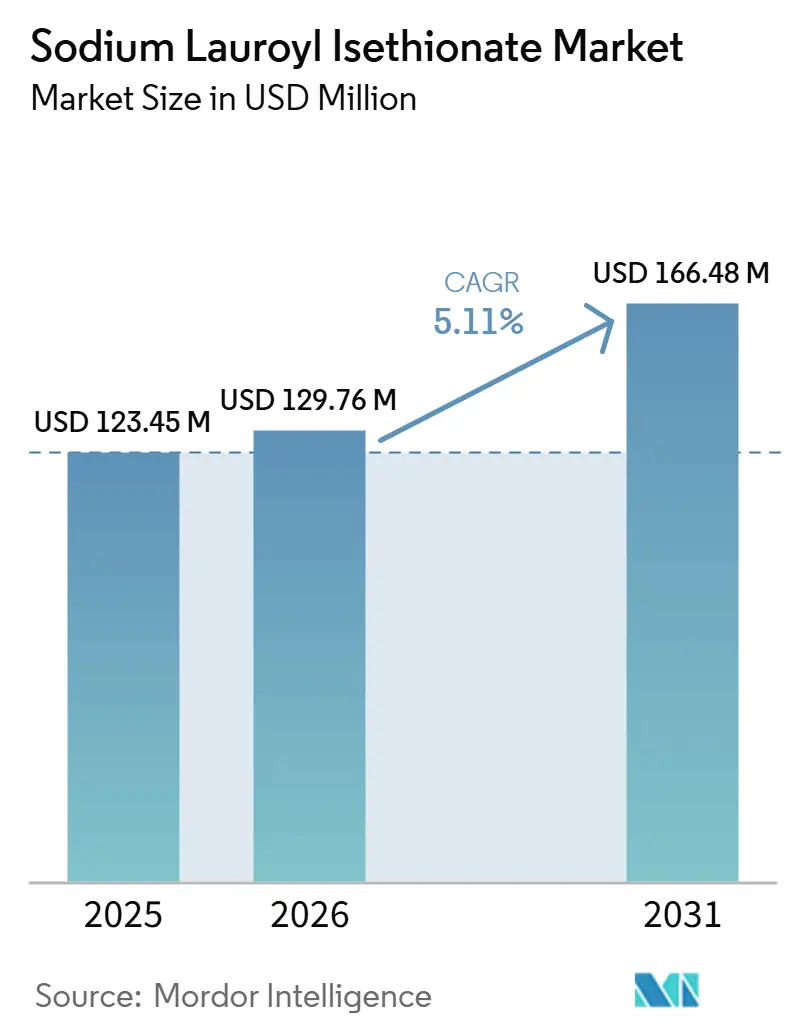
The Sodium Lauroyl Isethionate Market size is expected to grow from USD 123.45 million in 2025 to USD 129.76 million in 2026 and is forecast to reach USD 166.48 million by 2031 at 5.11% CAGR over 2026-2031. A structural shift away from sulfates is steering formulators toward this mild anionic surfactant because it meets tightening 1,4-dioxane limits in New York and the European Union while enabling high-active solid shampoo, syndet, and conditioner bars. Integrated oleochemical producers now use captive lauric-acid and ethylene-oxide infrastructure to insulate margins, while premium beauty and baby-care brands pay 30-50% price premiums to secure sulfate-free claims. Asia-Pacific dominates current volume and is scaling fastest on the back of Chinese and Indian capacity additions, whereas North America dictates regulatory momentum. The sodium lauroyl isethionate market is therefore expanding on both cost-base rationalization in Asia and demand-side pull from premium personal-care channels in the West.
Key Report Takeaways
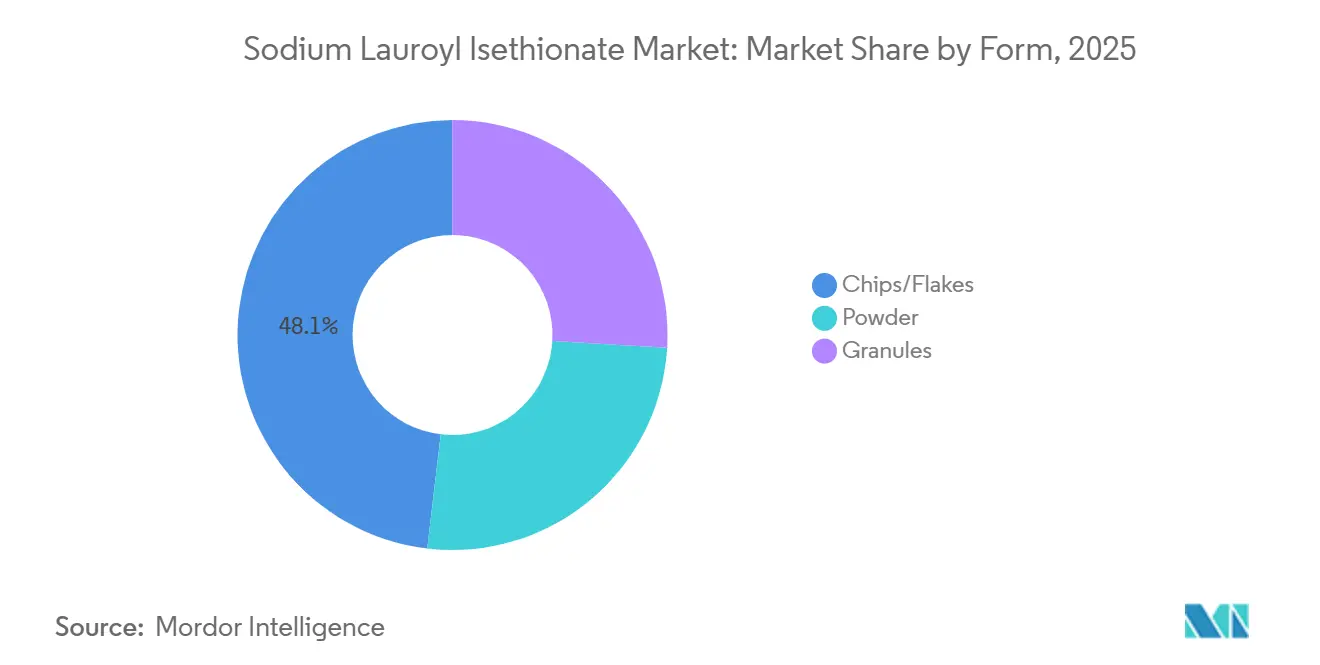
- By form, chips/flakes accounted for 48.12% of the Sodium Lauroyl Isethionate market share in 2025, while granules are projected to expand at a 5.66% CAGR through 2031.
- By application, skin-care products commanded 58.23% of the Sodium Lauroyl Isethionate market size in 2025 and are forecast to grow at a 6.22% CAGR to 2031.
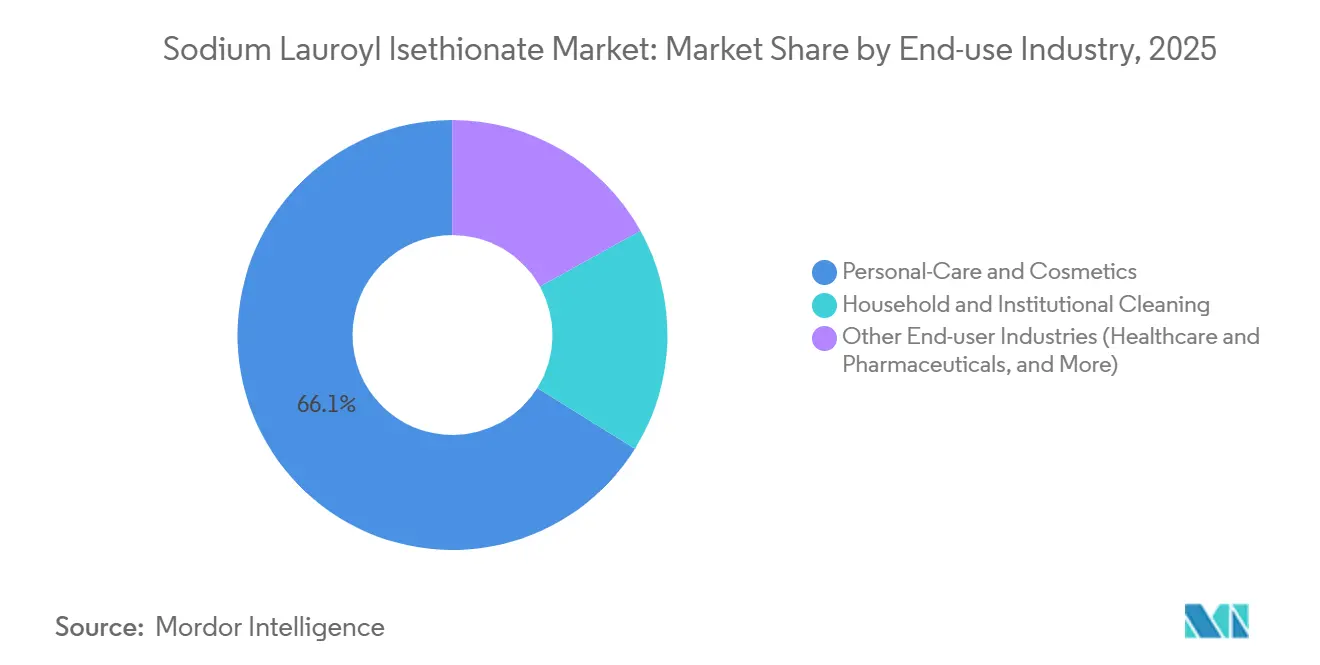
- By end-use industry, personal care and cosmetics represented 66.13% revenue share in 2025, with the segment advancing at a 6.13% CAGR during the outlook period (2026-2031).
- By geography, Asia-Pacific led with 43.45% share of the Sodium Lauroyl Isethionate market in 2025 and is anticipated to post a 5.86% CAGR through 2031.
Note: Market size and forecast figures in this report are generated using Mordor Intelligence’s proprietary estimation framework, updated with the latest available data and insights as of January 2026.
Market Trends and Insights
Drivers Impact Analysis of Sodium Lauroyl Isethionate Market*
| Driver | (~) % Impact on CAGR Forecast | Geographic Relevance | Impact Timeline |
|---|---|---|---|
| Rising penetration in personal-care and cosmetics | +1.2% | Global, led by North America & Europe | Medium term (2-4 years) |
| Rapid adoption in baby-care cleansing bars | +0.8% | APAC core, spill-over to North America | Short term (≤ 2 years) |
| Shift toward water-less "solid beauty" formats | +1.5% | Global, premium channels in North America, Europe, APAC | Medium term (2-4 years) |
| Premium pet-grooming formulations uptake | +0.4% | North America & Europe | Long term (≥ 4 years) |
| Bio-based isethionate synthesis lowering carbon footprint | +0.9% | Europe & North America, early adoption in Japan | Long term (≥ 4 years) |
| Source: Mordor Intelligence | |||
Rising Penetration in Personal-Care and Cosmetics
Solid shampoos, body-wash bars, and facial cleansers are migrating from niche to mainstream retail shelves, and the surfactant’s 40-60% active loading capacity allows brands to press compact bars without brittleness. Premium outlets such as Sephora and Ulta stock syndet bars priced USD 12-18, versus USD 8-12 for bottled equivalents, reinforcing value expansion. Clariant’s CHF 80 million (USD 100.91 million) Daya Bay expansion in November 2025 specifically targets mild-surfactant supply for solid-format beauty[1]Clariant AG, “Daya Bay Expansion Press Release,” clariant.com. These developments confirm that the sodium lauroyl isethionate market is riding durable sustainability and premiumization waves rather than a passing trend.
Rapid Adoption in Baby-Care Cleansing Bars
Dermatologists increasingly direct parents toward sulfate-free cleansers, making mild solid bars the default for infant care across China, India, and the United States. Hard-water regions in Asia favor sodium lauroyl isethionate for its dense foam and easy rinse, attributes that cocoyl isethionate cannot fully match. Kao’s Bio IOS launch positions the firm to capture zero-dioxane baby shampoos, aligning with emerging Food and Drug Administration (FDA) modernization efforts. Short product-development cycles in baby-care accelerate this driver’s impact on the overall sodium lauroyl isethionate market.
Shift Toward Water-Less “Solid Beauty” Formats
Large consumer-goods companies have pledged aggressive plastic-reduction targets, and concentrate bars eliminate up to 80% of packaging weight. Brands like Lush and Ethique built portfolios around syndet bars, while Unilever and Procter & Gamble now test solid variants of legacy lines. Sodium lauroyl isethionate allows cold-process bar pressing and delivers creamy lather even in cold water, enabling mass-market scale-up. The medium-term impact reflects required retail planogram changes and consumer education. Steady roll-outs across pharmacies and grocery retailers indicate momentum for the sodium lauroyl isethionate market.
Premium Pet-Grooming Formulations Uptake
Pet-owners pay USD 15-25 for gentle, sulfate-free dog shampoos, accepting 20-30% higher raw-material costs. Isethionate’s compatibility with botanical actives and anti-itch additives supports hypoallergenic positioning. Although volumes remain small, specialty pet-care acts as a pilot field where suppliers test novel surfactant blends before human-care adoption. The segment, therefore, sustains pricing power within the sodium lauroyl isethionate industry.
Restraints Impact Analysis of Sodium Lauroyl Isethionate Market*
| Restraint | (~) % Impact on CAGR Forecast | Geographic Relevance | Impact Timeline |
|---|---|---|---|
| Tight supply of high-purity fatty-acid feedstocks | -0.6% | Global, acute in APAC | Short term (≤ 2 years) |
| Foaming and viscosity limitations in high-pH systems | -0.3% | North America & Europe industrial segments | Medium term (2-4 years) |
| Potential re-classification risk under micro-plastics rules | -0.4% | Europe, potential spill-over to North America | Long term (≥ 4 years) |
| Source: Mordor Intelligence | |||
Tight Supply of High-Purity Fatty-Acid Feedstocks
Coconut and RSPO-certified palm kernel oil face weather disruptions and competing biodiesel demand. Galaxy Surfactants highlighted fatty-alcohol inflation in its FY2026 results, a signal of near-term margin pressure[2]Galaxy Surfactants Ltd., “Q3 FY2026 Investor Presentation,” galaxysurfactants.com. Chinese capacity expansions from Guangzhou Tinci will ease constraints, yet plantation lead times of 5-7 years imply that volatility persists.
Foaming and Viscosity Limitations in High-pH Systems
Above pH 9, the surfactant loses foam stability, curbing penetration in oven cleaners and degreasers. Industrial formulators instead choose alpha olefin sulfonates; Stepan lifted AOS capacity 25% across three U.S. plants in 2025. Efforts to engineer pH-stable isethionate derivatives are ongoing, but commercialization will require 3-5 years.
*Our forecasts treat driver/restraint impacts as directional, not additive. The impact forecasts reflect baseline growth, mix effects, and variable interactions.
Sodium Lauroyl Isethionate Market Segment Analysis
By Form:
Solid Formats Drive Formulation InnovationChips/flakes captured 48.12% of the Sodium Lauroyl Isethionate market share in 2025 because they dissolve quickly and compress cleanly into bars without dusting. Syndet manufacturers value low-moisture, uniform particle size to reduce bar cracking during storage, reinforcing chips/flakes as the dominant form. Powder demand is improving inside dry shampoo bases, where micronized grades mix with starches for rinse-free scalp refreshment. Pilot Chemical is debottlenecking U.S. sulfonation to supply flexible particle-size grades, indicating producer responsiveness.
Granules, while currently smaller, are projected to post the highest 5.66% CAGR during the forecast period (2026-2031) as beauty brands launch refill powders that consumers rehydrate at home, leveraging granules’ flowability in automated filling lines. The Sodium Lauroyl Isethionate market thus shifts toward formats that balance processing ease with downstream consumer experience. Clariant’s acquisition of Lucas Meyer Cosmetics in 2024 accelerates the development of granule-compatible emulsifier systems, showing how form factor strategy has become a competitive lever.



By Application:
Skin-Care Leads on Clean-Beauty MomentumSkin-care represented 58.23% of the Sodium Lauroyl Isethionate market size in 2025 and is forecast to expand at a 6.22% CAGR during the forecast period (2026-2031) as dermatologists endorse pH-balanced cleansing bars. Ingredient-transparent facial bars resonate with consumers who perceive bar formats as both sustainable and gentle. Intimate-care and body-wash bars follow, supported by syndet’s ability to maintain mildness across diverse pH targets.
Hair-care grows more slowly because conditioning and slip attributes are harder to deliver in a solid bar. Yet two-in-one formulations that pair isethionate with Polyquaternium-10 are gaining retail trials. Cleaning products remain cost-constrained; however, tablet-based dish and surface cleaners tap the surfactant’s mildness to support “wellness cleaning” narratives in the sodium lauroyl isethionate market.
By End-use Industry:
Personal Care Dominates Premium ChannelsPersonal care and cosmetics absorbed 66.13% of demand in 2025, rising at a 6.13% CAGR for the forecast period (2026-2031) as beauty manufacturers chase sulfate-free, solid formulas. Premium channels command healthy margins, enabling suppliers to recover higher feedstock costs. Household and institutional cleaning lags because laundry and dishwashing remain price sensitive, still leaning on SLES (Sodium Laureth Sulfate) and LAS (Linear Alkylbenzene Sulfonate).
Nevertheless, concentrate refills are narrowing the cost gap. Barentz notes that cleaning-tablet adoption is scaling in the United States and Europe, and sodium lauroyl isethionate’s compatibility with high-solid tablets positions it as a favored anionic surfactant for the next wave of refill formats. Healthcare and pharmaceutical niches, requiring USP-grade surfactants, are small but strategically valuable, offering suppliers differentiation through GMP (good manufacturing practice) compliance.
Geography Analysis
APAC Sodium Lauroyl Isethionate Market
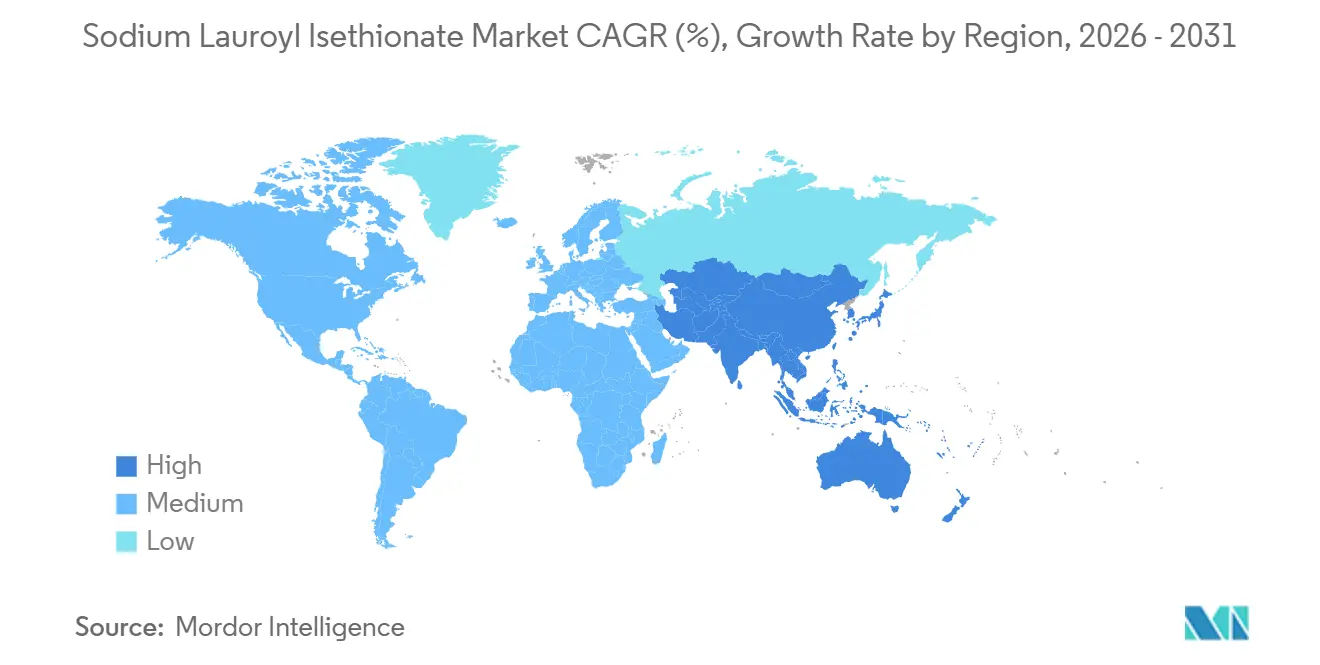
Asia-Pacific generated 43.45% of 2025 revenue and will rise at a 5.86% CAGR through 2031. Chinese producers benefit from cost-effective lauric-acid chains and captive ethylene oxide, while India scales alkoxylate capacity to serve both domestic and export markets. Guangzhou Tinci recorded a 181.4% profit surge in 2025, underscoring regional momentum. Japan and South Korea push early adoption of bio-based isethionates, encouraged by Kao’s Bio IOS platform that eliminates dioxane and cuts carbon footprint.
North America Sodium Lauroyl Isethionate Market
North America is the regulatory bellwether. New York’s 1 ppm dioxane cap and the U.S. EPA’s PFAS restrictions propel surfactant reformulation, directing formulators to isethionate’s inherently low contaminant profile. The U.S. home and laundry sector is on track to reach USD 60.9 billion by 2030, and solid formats are taking an outsized slice as retailers rearrange shelf space. Pilot Chemical’s Middletown expansion, which more than doubles AOS output, shows how U.S. suppliers hedge with multiple sulfate-free chemistries.
EMEA and South America Sodium Lauroyl Isethionate Market
Europe follows strict REACH and RSPO-linked procurement. German, French, and U.K. beauty houses require full-supply-chain traceability, favoring producers with COSMOS certification. Clariant’s Daya Bay lines meet these criteria and ship annular quantities to European brands. South America and the Middle East and Africa remain smaller but attractive; Brazilian oleochemical projects and Saudi incentives for downstream surfactants promise incremental opportunities for the sodium lauroyl isethionate market.

Competitive Landscape
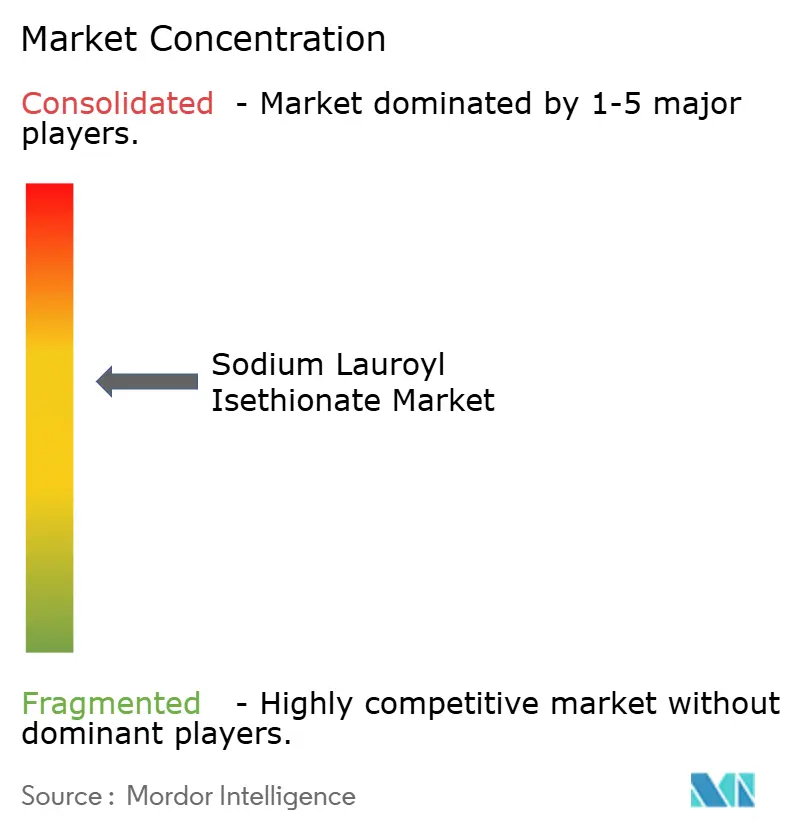
The Sodium Lauroyl Isethionate market is moderately concentrated. Emerging Chinese and Indian players target price-sensitive tiers, but the gap in ESG disclosures and proprietary chemistry keeps premium personal-care accounts anchored to multinationals. Overall, suppliers able to guarantee RSPO traceability, zero-dioxane compliance, and flexible particle-size offerings hold bargaining power in the sodium lauroyl isethionate industry.
Sodium Lauroyl Isethionate Industry Leaders
Clariant
BASF
Galaxy Surfactants
Innospec
Guangzhou Tinci Materials Technology Co., Ltd.
- *Disclaimer: Major Players sorted in no particular order
Sodium Lauroyl Isethionate Market Companies Covered in this Report
- BASF
- Clariant
- Galaxy
- Guangzhou Tinci Materials Technology Co., Ltd.
- Innospec
- Jilin Aegis Chemical Co., Ltd.
- Taiwan NJC Corp.
- Kao Corporation
- Indroma Ventures
- Lamberti S.p.A.

Recent Industry Developments in Sodium Lauroyl Isethionate Market
- November 2025: Clariant inaugurated its expanded facilities in Daya Bay, China, following an investment to enhance manufacturing capabilities in pharmaceutical excipients and specialty chemicals for personal and home care applications, such as sodium lauroyl isethionate.
- March 2025: Galaxy Surfactants Ltd., a prominent manufacturer of Sodium Lauroyl Isethionate and other surfactants, through its group companies, teamed up with a global client to deliver engineering, procurement, and construction (EPC) services. This partnership focuses on establishing a manufacturing plant for surfactants and specialty ingredients at an international site.


Global Sodium Lauroyl Isethionate Market Report Scope
Sodium Lauroyl Isethionate (SLI) is a mild, coconut-derived anionic surfactant popular in personal care products like body washes, shampoos, and syndet bars. Known for producing a dense, creamy lather, it acts as a gentle cleansing agent that is ideal for sensitive skin and often used to create sulfate-free, high-performance formulations.
The Sodium Lauroyl Isethionate market is segmented by form, application, end-use industry, and geography. By form, the market is segmented into powder, granules, and chips/flakes. By application, the market is segmented into hair-care, skin-care, cleaning products, and other applications (baby care, pet grooming, and more). By end-use industry, the market is segmented into personal-care and cosmetics, household and institutional cleaning, and other end-user industries (healthcare and pharmaceuticals, and more). The report also covers the market size and forecasts for sodium lauroyl isethionate in 15 countries across major regions. The market sizes and forecasts are provided in terms of value (USD).
| Powder |
| Granules |
| Chips/Flakes |
| Hair-Care |
| Skin-Care |
| Cleaning Products |
| Other Applications (Baby Care, Pet Grooming, and More) |
| Personal-Care and Cosmetics |
| Household and Institutional Cleaning |
| Other End-user Industries (Healthcare and Pharmaceuticals, and More) |
| Asia-Pacific | China |
| Japan | |
| India | |
| South Korea | |
| Rest of Asia-Pacific | |
| North America | United States |
| Canada | |
| Mexico | |
| Europe | Germany |
| United Kingdom | |
| France | |
| Italy | |
| Rest of Europe | |
| South America | Brazil |
| Argentina | |
| Rest of South America | |
| Middle-East and Africa | Saudi Arabia |
| South Africa | |
| Rest of Middle-East and Africa |
| By Form | Powder | |
| Granules | ||
| Chips/Flakes | ||
| By Application | Hair-Care | |
| Skin-Care | ||
| Cleaning Products | ||
| Other Applications (Baby Care, Pet Grooming, and More) | ||
| By End-use Industry | Personal-Care and Cosmetics | |
| Household and Institutional Cleaning | ||
| Other End-user Industries (Healthcare and Pharmaceuticals, and More) | ||
| By Geography | Asia-Pacific | China |
| Japan | ||
| India | ||
| South Korea | ||
| Rest of Asia-Pacific | ||
| North America | United States | |
| Canada | ||
| Mexico | ||
| Europe | Germany | |
| United Kingdom | ||
| France | ||
| Italy | ||
| Rest of Europe | ||
| South America | Brazil | |
| Argentina | ||
| Rest of South America | ||
| Middle-East and Africa | Saudi Arabia | |
| South Africa | ||
| Rest of Middle-East and Africa | ||


Key Questions Answered in the Report
How large will global demand be for Sodium Lauroyl Isethionate by 2031?
The Sodium Lauroyl Isethionate market size is projected to reach USD 166.48 million by 2031, reflecting a 5.11% CAGR from 2026.
Which form factors are gaining most traction?
Granules are forecast to register a 5.66% CAGR during the forecast period (2026-2031) because they suit refill powders and automated dosing lines, although chips/flakes remain the largest form today.
Why is Asia-Pacific the fastest-growing region?
Integrated oleochemical capacity in China and India, coupled with rising middle-class demand for premium solid beauty bars, drives a regional 5.86% CAGR during the forecast period (2026-2031).
What keeps Sodium Lauroyl Isethionate out of high-pH industrial cleaners?
The surfactant’s foam stability declines above pH 9, limiting effectiveness in alkaline degreasers where alpha olefin sulfonates remain preferred.
Page last updated on:


 Your data is secure and never sold or shared.


