
Methyl Ester Ethoxylate Market Size and Share
Market Overview
| Study Period | 2021 - 2031 |
|---|---|
| Market Size (2026) | USD 151.90 Million |
| Market Size (2031) | USD 181.98 Million |
| Growth Rate (2026 - 2031) | 3.68 % |
| Fastest Growing Market | Europe |
| Largest Market | Europe |
| Market Concentration | Medium |
Major Players *Disclaimer: Major Players sorted in no particular order Image © Mordor Intelligence. Reuse requires attribution under CC BY 4.0. | |
Methyl Ester Ethoxylate Market Analysis by Mordor Intelligence
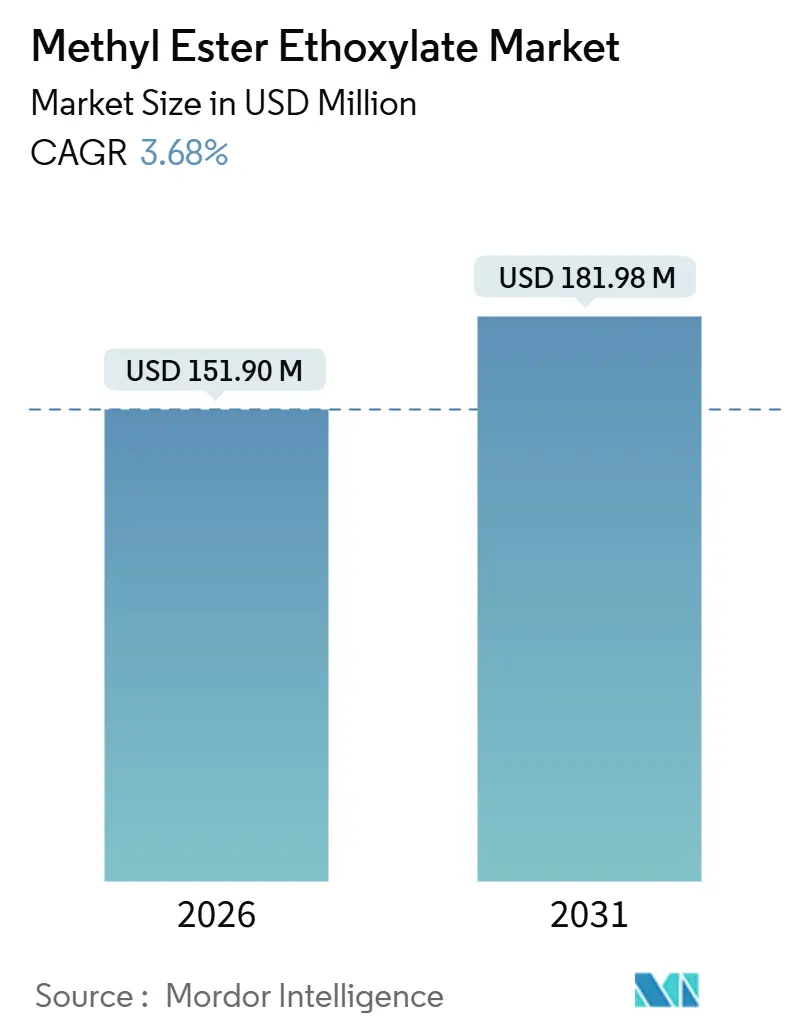
The Methyl Ester Ethoxylate Market size is estimated at USD 151.90 million in 2026, and is expected to reach USD 181.98 million by 2031, at a CAGR of 3.68% during the forecast period (2026-2031). This trajectory captures the sector’s shift away from commoditized tonnage toward higher-margin grades that satisfy stricter biodegradability rules and address mounting Scope 3 emissions targets set by global brand owners. Growth remains closely tied to detergent and industrial-cleaning consumption in Asia-Pacific, where institutional buyers favor low-foam, rapid-rinse formats that cut water and energy use. Europe is emerging as the fastest-growing geography, buoyed by proposed detergent-regulation amendments that encourage formulators to swap linear alkylbenzene sulfonates for readily biodegradable nonionics. Meanwhile, enzymatic ethoxylation is beginning to reshape production economics by trimming energy demand and carbon footprints, thereby differentiating suppliers competing with a wave of bio-based alternatives. Oleochemical feedstock volatility and certification costs remain the primary near-term headwinds, but strategic moves into coconut- and rapeseed-derived fatty acids coupled with backward integration are moderating margin pressure.
Key Report Takeaways
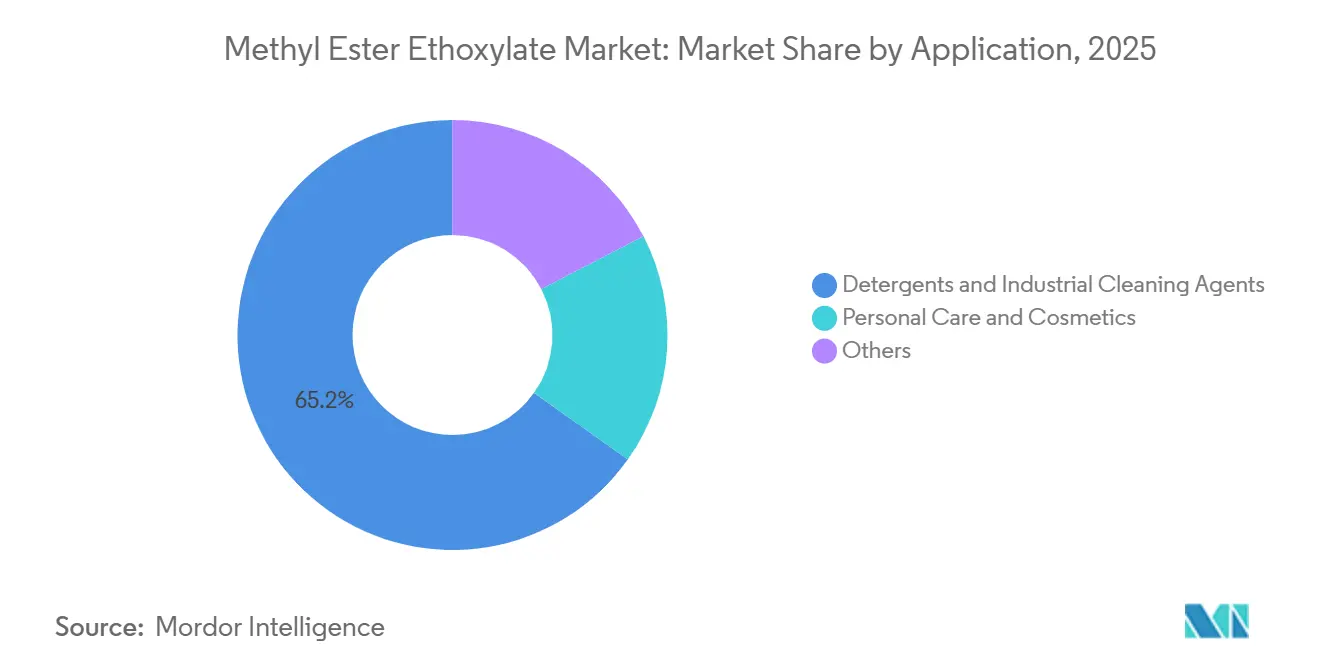
- By application, detergents and industrial cleaning agents led with 65.18% of the methyl ester ethoxylate market share in 2025, and will record the highest projected 3.98% CAGR through 2031.
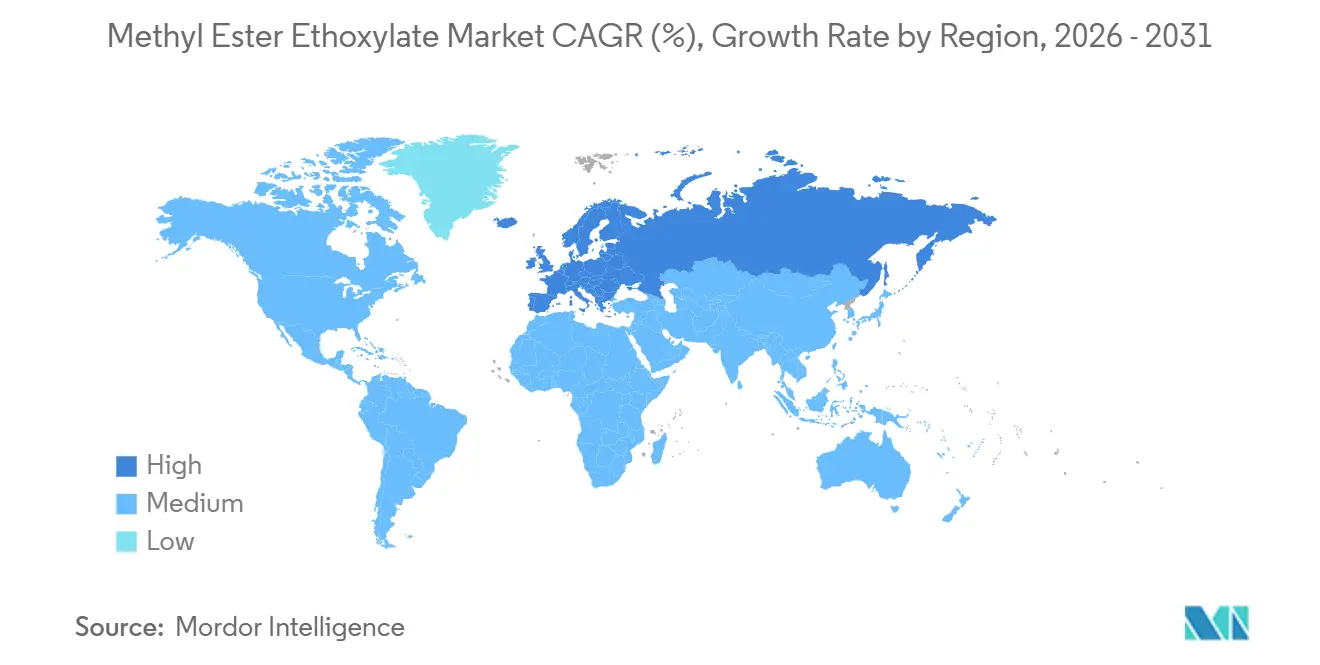
- By geography, Europe held 37.53% of the methyl ester ethoxylate market share in 2025 and is forecast to expand at a 4.39% CAGR through 2031, the fastest regional pace.
Note: Market size and forecast figures in this report are generated using Mordor Intelligence’s proprietary estimation framework, updated with the latest available data and insights as of January 2026.
Market Trends and Insights
Drivers Impact Analysis of Methyl Ester Ethoxylate Market*
| Drivers | (~) % Impact on CAGR Forecast | Geographic Relevance | Impact Timeline |
|---|---|---|---|
| Rising demand from personal care and cosmetics | +0.6% | North America, Europe | Medium term (2-4 years) |
| Growth of low-foam, single-wash detergent formats | +0.9% | Asia-Pacific core, spill-over to Middle East and Africa | Short term (≤ 2 years) |
| Regulatory push for biodegradable surfactants | +1.1% | Europe, North America, emerging in China | Long term (≥ 4 years) |
| Expansion of industrial and institutional cleaning in Asia-Pacific | +0.8% | China, India, ASEAN, secondary Middle East | Medium term (2-4 years) |
| Enzymatic ethoxylation lowering carbon footprint | +0.5% | Global, early adoption in Europe and North America | Long term (≥ 4 years) |
| Source: Mordor Intelligence | |||
Rising Demand from Personal Care and Cosmetics
Methyl ester ethoxylates provide foam stability without the irritation often associated with anionic surfactants. This quality makes them a preferred choice for sulfate-free shampoos, body washes, and leave-on treatments, especially among clean-beauty consumers. The medium-term influence of this trend can be attributed to formulators striving to balance cost, sensory attributes, and eco-label compliance. While methyl ester ethoxylates are cost-competitive in mass-market hair-care and body-wash products, they find themselves in competition with amino-acid surfactants and alkyl polyglucoside (APG) blends in ultra-luxury skincare lines.
Growth of Low-Foam, Single-Wash Detergent Formats
Across Southeast Asia, institutional laundries and conveyor dishwashers are increasingly adopting single-wash, low-foam systems, leading to reduced water consumption and shorter cycle times. Kao reported a surge in sales of institutional detergents in the region, attributing the boost to their new formulation[1]Kao Corporation, “Annual Report 2024,” kao.com. This formulation, enhanced with methyl ester ethoxylates, enzymes, and chelants, ensures effective one-pass soil removal. In water-scarce nations like India, the introduction of appliance-efficiency labels is indirectly incentivizing the use of low-foam surfactant packages, hastening their adoption. This rapid embrace of low-foam systems is now making waves in the Middle East's hospitality sector, where soaring water tariffs are pushing hotel operators to overhaul their laundry practices.
Regulatory Push for Biodegradable Surfactants
Under the OECD 301 standard, the European Commission's 2024 proposal mandates that ultimate surfactants must biodegrade within 28 days. This move effectively sidelines certain poorly degradable linear alkylbenzene sulfonates from specific consumer and institutional products. While methyl ester ethoxylates meet the new standards, heightened ceilings for aquatic toxicity and stricter thresholds for anaerobic digestion are narrowing the formulation options. In the U.S., the EPA's 2025 Safer Choice update is placing a similar emphasis on biodegradability[2]U.S. Environmental Protection Agency, “Safer Choice Criteria,” epa.gov. Likewise, China's 2025 draft standards are aligning with this trend. In response, producers are not only expanding their analytical laboratories but also reformulating their blends, all in a bid to secure the coveted ISO 14024 eco-labels. This underscores the long-term global significance of these regulatory drivers.
Expansion of Industrial and Institutional Cleaning in Asia-Pacific
In China, India, and ASEAN states, urbanization, increased healthcare investments, and a resurgence in tourism are fueling a surge in demand for institutional cleaning. In 2024, India Glycols reported an increase in surfactant shipments to cleaning distributors, a move spurred by government hygiene mandates in public hospitals and schools. China's commercial cleaning services market experienced growth in 2025, driven by a trend of outsourcing to professional custodial firms that emphasize standardized low-residue products. Methyl ester ethoxylates, known for their compatibility with alkaline builders and chlorine sanitizers, are becoming essential in floor care, hard surfaces, and on-premise laundry solutions in these rapidly growing economies.
Restraints Impact Analysis of Methyl Ester Ethoxylate Market*
| Restraints | (~) % Impact on CAGR Forecast | Geographic Relevance | Impact Timeline |
|---|---|---|---|
| Competition from more efficient alternative surfactants | −0.7% | Europe and North America, spreading globally | Medium term (2-4 years) |
| Oleochemical feedstock price volatility | −0.5% | Global, most severe in Asia-Pacific and South America | Short term (≤ 2 years) |
| Supply-chain certification (RSPO, traceability) costs | −0.3% | Europe and North America | Long term (≥ 4 years) |
| Source: Mordor Intelligence | |||
Competition from More Efficient Alternative Surfactants
In 2024, Evonik launched a rhamnolipid plant in Slovakia. The biosurfactant produced there biodegrades faster than traditional methyl ester ethoxylates in anaerobic conditions and achieves the same wetting effect at reduced dosage. Also in 2024, BASF boosted its APG capacity, promoting a glucose-based nonionic that surpasses methyl ester ethoxylates in both cold-water detergency and foam control. Producers like Elevance, specializing in sophorolipids, achieve lower surface tensions, allowing for a reduction in total surfactant load. Despite price advantages for methyl ester ethoxylates in volume-driven institutional markets, rising fermentation yields and decreasing capital costs are heightening competitive pressures in Europe and North America.
Oleochemical Feedstock Price Volatility
Producers face volatility as palm and coconut oils, which constitute a significant portion of the methyl ester feedstock, are influenced by weather events, biofuel mandates, and geopolitical disruptions. Palm oil prices surged, tightening margins for producers without plantation integration or hedge contracts. Coconut oil prices jumped due to drought-induced yield reductions in Southeast Asia. While some manufacturers experiment with rapeseed and sunflower methyl esters, the complexities arise from performance trade-offs and distinct price cycles. The financial strain is most pronounced in Asia-Pacific and Latin America, regions where oleochemical supply chains are prevalent.
*Our forecasts treat driver/restraint impacts as directional, not additive. The impact forecasts reflect baseline growth, mix effects, and variable interactions.
Methyl Ester Ethoxylate Market Segment Analysis
By Application:
Detergents Dominate, Personal Care Commands PremiumThe detergents and industrial-cleaning segment captured 65.18% of 2025 revenue, and its share of the methyl ester ethoxylate market size is projected to expand at a 3.98% CAGR through 2031. Growth rests on institutional laundries and conveyor dishwashers that prize low-foam, hard-water-tolerant surfactant systems capable of one-pass soil removal in high-throughput tunnels. Methyl ester ethoxylates pair well with alkaline builders, enzymes, and chlorine sanitizers, sustaining their role as drop-in workhorses for commercial dishwashing, hospitality laundering, and food-service floor cleaning across Asia-Pacific and the Middle East.
Demand in household laundry remains sizable yet moderating in mature markets as concentrated pods and unit-dose sachets favor higher-activity blends of APG and linear alkylbenzene sulfonates. Nevertheless, value-added formats such as ultra-low-dose powders for mechanized laundries are opening margin-rich niches where methyl ester ethoxylates’ foam control provides cycle-time advantages. Adoption of enzymatic pre-treatment concentrates further integrates the surfactant into broader cleaning packages that cut chemical load without sacrificing whiteness.
While personal care and cosmetics lag in volume, they consistently command premium margins, often pricing above their detergent-grade counterparts. The methyl ester ethoxylate market for this segment is projected to grow, buoyed by sulfate-free and mild-surfactant claims that appeal to consumers with sensitive skin. Nonionic backbones not only stabilize foam and maintain viscosity in clear shampoos and body washes, but they also mitigate irritation concerns commonly associated with anionic surfactants. Prestige beauty houses are securing COSMOS-certified supply chains, yet they grapple with competition from amino-acid surfactants and APG blends, which boast even milder dermatological profiles and a higher bio-based content.



Geography Analysis
Europe Methyl Ester Ethoxylate Market
Europe, accounting for 37.53% of 2025 revenue, leads the methyl ester ethoxylate market share and is forecast to grow at a 4.39% CAGR, the highest regional rate. Demand is anchored in Germany, the United Kingdom, and France, where Blue Angel and Nordic Swan eco-labels steer formulators toward readily biodegradable nonionics. Southern European hospitality booms are elevating low-residue cleaning requisites, notably in Spain and Italy. Eastern Europe remains underpenetrated, yet rising hygiene standards and the gradual rollout of EU-aligned regulations signal medium-term upside for suppliers prepared to navigate fragmented distributors.
APAC Methyl Ester Ethoxylate Market
By 2025, the Asia-Pacific region is set to account for a significant share of global revenue, boasting a projected growth. In 2025, China's commercial cleaning services saw robust growth, driven by retailers and hotels opting for outsourced custodial services, with a shift towards standardized, surface-friendly, low-foam cleansers. Meanwhile, India is testing energy-efficiency labels that prioritize water-saving laundry cycles, inadvertently promoting the use of methyl ester ethoxylate. Japan and South Korea are witnessing steady growth, focusing on cleaning products for personal care and electronics. The hospitality sector in ASEAN is rebounding from the pandemic, leading to increased demand for floor-care and hard-surface cleaners. Simultaneously, government hygiene mandates in educational and healthcare institutions are driving up demand.
The Americas and MEA Methyl Ester Ethoxylate Market
North America is projected to account for a significant share of the 2025 revenue, with steady growth. The EPA’s Safer Choice initiative is steering formulators towards biodegradable surfactants. However, the growth potential is tempered by the maturity of the household detergent market. In Canada and Mexico, there's a swift adoption of eco-labeled cleaners in institutions, bolstered by cross-border supply chains that simplify compliance. South America, along with the Middle East and Africa, is expected to capture a notable portion of the 2025 turnover. Key players include Brazil and Argentina in South America, and Saudi Arabia and South Africa in the Middle East and Africa. While currency fluctuations, tariff changes, and underdeveloped regulations introduce volatility, the trends of urbanization and heightened hygiene standards suggest a long-term alignment with the demands of more developed markets.

Regulatory Landscape
In the United States, ethoxylated fatty acid methyl esters (C6-C18, 3-13 moles oxyethylene) have an established regulatory pathway for certain downstream uses, including an EPA tolerance exemption under 40 CFR 180.910 for use as inert ingredients in pesticide formulations applied to crops at concentrations up to 25% by weight. On the chemicals-management side, TSCA compliance remains important for ethoxylation value chains, as EPA continues to use Significant New Use Rules (SNURs) under TSCA Section 5(a)(2), including a Federal Register update published May 29, 2026, reinforcing notification requirements ahead of new or changed manufacturing, processing, or use activities.
In Europe, methyl ester ethoxylates placed on the market above 1 tonne per year must meet REACH registration obligations, and companies track evolving constraints through ECHA tools such as the REACH dossier listings and the restriction list. These frameworks interact with product stewardship demands from eco-label and procurement programs highlighted in the report context, where biodegradability and aquatic-toxicity screening, including against OECD-type biodegradation expectations referenced in the report narrative, influences formulation choices and the supplier documentation required.
Value Chain Analysis
The methyl ester ethoxylate value chain starts with oleochemical feedstocks, primarily vegetable oils such as palm, coconut, soy, and other regionally available oils that are converted into fatty acid methyl esters (FAME). Producers then ethoxylate FAME using ethylene oxide (EO) in the presence of alkaline catalysts to deliver methyl ester ethoxylates with targeted degrees of ethoxylation and performance profiles, including low foam and rapid rinse behavior for institutional cleaning. The chain is exposed to both upstream volatility in oil markets and midstream access to EO, which is energy intensive and tightly governed in many jurisdictions due to safety and handling requirements.
Downstream, methyl ester ethoxylates are supplied either as neat surfactants or as part of formulated packages into detergents and industrial and institutional cleaning products, personal care formulations, textile auxiliaries, and certain agrochemical adjuvants. Distribution typically runs through specialty chemical distributors and direct supply to detergent and personal care manufacturers, with value-added in technical support, consistent homologue distribution (narrow-range performance), and sustainability documentation such as traceability and certification that supports customer eco-label and procurement needs. Named participants across manufacturing and supply include Venus Ethoxyethers (India) and Lion Corporation (Japan), alongside global surfactant portfolios from major chemical companies reflected in the competitive landscape.
Competitive Landscape
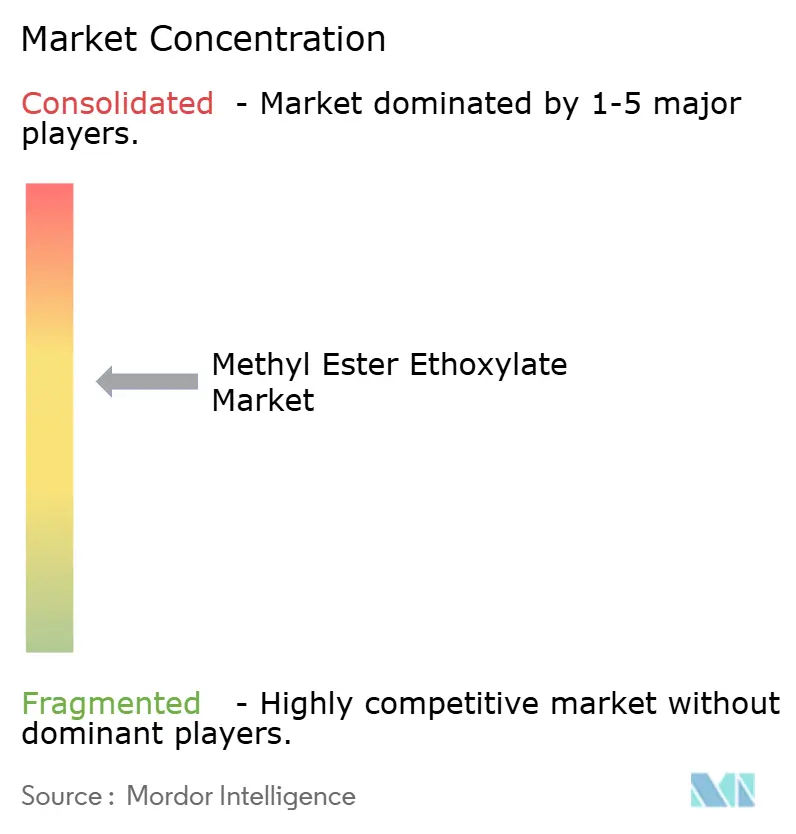
The global methyl ester ethoxylate market is moderately consolidated in nature. Strategic focus converges on backward integration into oleochemical feedstocks, geographic expansion across ASEAN and India, and co-development pacts with detergent majors to secure multi-year offtake. Mid-tier players are carving niches in personal-care and industrial adjacencies. Start-ups are exploring enzymatic ethoxylation scale-up and rapeseed-based feedstock diversification, aiming to combine carbon-footprint benefits with price stability. Patent filings on lipase-catalyzed ethoxylation and solvent-free routes have accelerated. Compliance with ISO 14024 eco-labels and RSPO certification is solidifying as a baseline requirement in Europe and North America, favoring players with capital to absorb audit and documentation costs. Competitive intensity is therefore migrating from purely price-based battles toward sustainability credentials, supply-chain transparency, and formulation-support services.
Methyl Ester Ethoxylate Industry Leaders
KLK OLEO
Lion Specialty Chemicals Co. Ltd
INEOS
Huntsman Corporation
BASF SE
- *Disclaimer: Major Players sorted in no particular order
Methyl Ester Ethoxylate Market Companies Covered in this Report
- BASF SE
- Clariant AG
- Croda International
- Dow
- Elevance Renewable Sciences Inc.
- Evonik Industries
- Galaxy Surfactants
- Huntsman Corporation
- India Glycols Ltd
- INEOS
- Jet Technologies
- Kao Corporation
- KLK OLEO
- Lion Specialty Chemicals Co. Ltd
- Sasol Ltd
- Shell Chemicals
- Sino-Japan Chemical Co. Ltd
- Solvay SA
- Stepan Company
- Venus Ethoxyethers Pvt Ltd

Market Opportunities and Future Outlook
Capacity additions and supply-chain regionalization create whitespace for methyl ester ethoxylates in industrial and institutional cleaning and adjacent specialty ethoxylate applications where low-foam and rapid-rinse characteristics translate into operational benefits. A concrete indicator is Rossari Biotech commissioning a 15,000 mtpa ethoxylation production unit at Dahej, India (March 2026), which increases local availability of ethoxylated products and supports faster qualification cycles for regional formulators serving institutional laundries, dishwashing, and hard-surface cleaning.
Feedstock integration and verifiable bio-based sourcing remain key routes to differentiate against alternative biosurfactants and to buffer oleochemical volatility highlighted in the report context. Integrated groups such as Malaysia-based Carotino, which operates palm oil-linked oleochemical chains including methyl ester ethoxylates, illustrate how backward integration can stabilize cost and documentation for traceability-driven buyers. On the demand side, tightening biodegradability expectations and eco-label procurement programs referenced in the report context keep formulation work centered on readily biodegradable nonionics, creating opportunities for suppliers that can provide consistent aquatic-toxicity and biodegradation data packages alongside product performance support.
Recent Industry Developments in Methyl Ester Ethoxylate Market
- May 2026: EPA published a Federal Register update reinforcing the use of Significant New Use Rules (SNURs) under TSCA Section 5(a)(2), sustaining the requirement for advance notification ahead of specified new manufacturing, processing, or use activities. For ethoxylation value chains supplying surfactant intermediates and derivatives, this keeps compliance readiness and dossier discipline central when expanding into new end-use profiles or process conditions.
- October 2025: Bhageria Industries Limited launched a new Plasticizers and Ethoxylates product line following Consent to Operate granted by the Maharashtra Pollution Control Board (MPCB) on October 7, 2025. The move supports local Indian supply optionality for ethoxylated chemistries used in cleaning and formulation value chains, helping domestic customers reduce lead times.
- July 2024: Clariant signed an agreement with OMV to supply renewable, low-carbon ethylene, supporting lower-carbon ethylene oxide derivatives and low-carbon ethoxylates in Europe. This upstream decarbonized feedstock linkage aligns with customer demands for improved Scope 3 profiles and can influence supplier selection for bio-based or reduced-carbon nonionic surfactant systems.


Methyl Ester Ethoxylate Market Report Scope and Research Methodology
Market Definition and Coverage
For this study, the market covers methyl ester ethoxylate used as a nonionic surfactant ingredient in cleaning, personal care, and related formulations, measured as revenues generated from sales of the material across end users and regions.
Scope exclusions: We exclude finished product retail values (such as detergents and shampoos) and only count the methyl ester ethoxylate material value when it is sold into downstream formulations.
Segments Covered in This Report
- By Application
- Detergents and Industrial Cleaning Agents
- Personal Care and Cosmetics
- Others
- By Geography
- Asia-Pacific
- China
- India
- Japan
- South Korea
- ASEAN Countries
- Rest of Asia-Pacific
- North America
- United States
- Canada
- Mexico
- Europe
- Germany
- United Kingdom
- France
- Italy
- Spain
- Rest of Europe
- South America
- Brazil
- Argentina
- Rest of South America
- Middle-East and Africa
- Saudi Arabia
- South Africa
- Rest of Middle-East and Africa
- Asia-Pacific
Data Sources, Market Sizing, and Validation
Desk Research
Desk work starts with building the demand context for surfactants that are marketed as biodegradable and low foaming, then mapping where methyl ester ethoxylate is practically specified in formulations. Public references used to shape the initial assumptions include sources such as the US Environmental Protection Agency Safer Choice program, ECHA substance information pages, Eurostat chemical production and trade tables, UN Comtrade trade statistics, and published papers in journals such as the Journal of Surfactants and Detergents.
We then cross-check the supply side using company annual reports, investor decks, product technical datasheets, and reputable chemical industry news. Where available, patent databases are used to understand process and product directions (for example, changes in ethoxylation routes). For a selective reality check on flows, we use shipment-level import and export data, focused on key ports. These desk research sources are illustrative, and many other public sources were also reviewed to collect, validate, and clarify specific data points.
Primary Interviews and Surveys
Primary work was used to stress-test the desk assumptions on where methyl ester ethoxylate is actually specified, how pricing behaves across contracts, and what share shifts between cleaning and personal care uses. Interviews included raw material suppliers, formulators, distributors, and procurement and technical teams. We also checked views across APAC, EMEA, and the Americas to avoid over-weighting one regulation-driven substitution pattern or one customer profile.
Distribution of primary research fieldwork respondents
| Company type | Respondent position | Region |
|---|---|---|
| Top tier: 39% | CXOs: 15% | APAC: 51% |
| Mid tier: 45% | Functional/Unit leaders: 30% | EMEA: 30% |
| Smaller Players: 16% | Managers: 55% | Americas: 19% |
Market-Sizing & Forecasting
Sizing begins with a top-down build where production and trade signals are used to reconstruct the addressable surfactant demand pool by region, then narrowed to methyl ester ethoxylate using application share checks from interviews. Once that demand pool is set, values are calculated using region-level average selling prices anchored to feedstock and ethoxylation cost movement, and adjusted for typical contract lags.
To keep totals realistic, we corroborate with selective bottom-up approximations, such as sampled volume by application multiplied by an observed price range, and distributor channel checks where the market is fragmented. Inputs that mattered most in the model include cleaning and institutional hygiene activity, substitution of alcohol ethoxylates in low-foam formulations, bio-based feedstock availability (methyl esters), ethylene oxide related cost pressure, and regional regulatory preference for biodegradable ingredients.
For forecasting, scenario analysis is used so the model can reflect different adoption speeds in detergents and industrial cleaning, followed by a smoother price path assumption once near-term volatility reduces. Where gaps appear in smaller countries, we fill them with ratio-based proxies from similar formulation markets. We then re-check the implied per-capita usage with expert feedback before locking the series.
Data Validation & Update Cycle
Validation is done by triangulating the final value series against independent signals such as trade direction, expected formulation demand, and the capacity and utilization narratives shared by industry contacts. Outliers are flagged for re-work, and when a number moves sharply, we revisit the linked assumptions (price, application share, or regional growth). If the variance still looks unusual, we re-contact sources to confirm inputs.
Each model is reviewed in more than one step so the calculation logic, units, and currency timing are consistent. We also check the storyline against the numbers before sign-off. Reports are refreshed annually, and interim updates are triggered when material events occur, such as policy changes affecting surfactant selection or a major supply shift. Before delivery, a fresh analyst pass is performed so clients receive the latest updated view.
Mordor Intelligence's Methyl Ester Ethoxylate Market Size Measured Against Other Published Estimates
Published market sizes for methyl ester ethoxylate can differ even when the topic name looks the same, because the counted product scope and the conversion from volumes to value are not handled uniformly across studies. Differences also show up when one study locks a base year earlier, or when assumed growth is built off a single end use rather than the full cleaning and personal care mix.
The biggest gap usually comes from whether adjacent nonionic surfactants or finished formulation values are quietly included. In this series, Mordor Intelligence counts only methyl ester ethoxylate material revenues and keeps ASP progression tied to feedstock-linked checks that are refreshed during annual updates.
Benchmark comparison
| Source | Market Size | Gaps in Research Methodology |
|---|---|---|
| Mordor Intelligence | USD 151.90 M (2026) | |
| Industry Publisher A | USD 167.70 M (2025) | Uses a different base year and forecast window, and its type-based build can roll up broader ethoxylated surfactant volumes, which increases the counted value versus a strict methyl ester ethoxylate-only total. |
| Industry Publisher B | USD 140.00 M (2025) | Assumes lower near-term penetration in institutional cleaning and applies a flatter price path in the base year, which reduces the total when cross-region substitution and contract-lag pricing are not fully reflected. |
The spread in the table is mainly explained by what gets counted and how pricing is carried forward across regions and years. When the scope is kept at the material level and the price path is checked against observable cost and usage signals, the resulting series stays easier to trace and repeat from one update to the next.


Key Questions Answered in the Report
How large is the methyl ester ethoxylate market?
The methyl ester ethoxylate market size stands at USD 151.90 million in 2026, growing with a CAGR of 3.68% reaching USD 181.98 million, supported by institutional cleaning demand and regulatory shifts toward biodegradable surfactants.
Which application contributes the biggest revenue share?
Detergents and industrial cleaning agents dominate with 65.18% of 2025 revenue, expanding at a 3.98% CAGR as low-foam, rapid-rinse formulations gain traction.
Why is Europe the fastest-growing region?
Europe’s 4.39% CAGR stems from draft detergent regulations that phase out poorly degradable surfactants and from stringent eco-label programs that favor methyl ester ethoxylates.
What is driving methyl ester ethoxylate use in personal care?
Sulfate-free, mild-surfactant claims in shampoos and body washes allow methyl ester ethoxylates to command price premiums among COSMOS-certified prestige brands.
Which emerging biosurfactants pose the biggest threat?
Rhamnolipids, alkyl polyglucosides, and sophorolipids are narrowing the cost-performance gap by offering faster biodegradation and lower use rates, particularly in Europe and North America.
Page last updated on:


 Your data is secure and never sold or shared.


