
Smart Diaper Market Size and Share
Market Overview
| Study Period | 2020 - 2031 |
|---|---|
| Market Size (2026) | USD 1.68 Billion |
| Market Size (2031) | USD 2.54 Billion |
| Growth Rate (2026 - 2031) | 8.62 % |
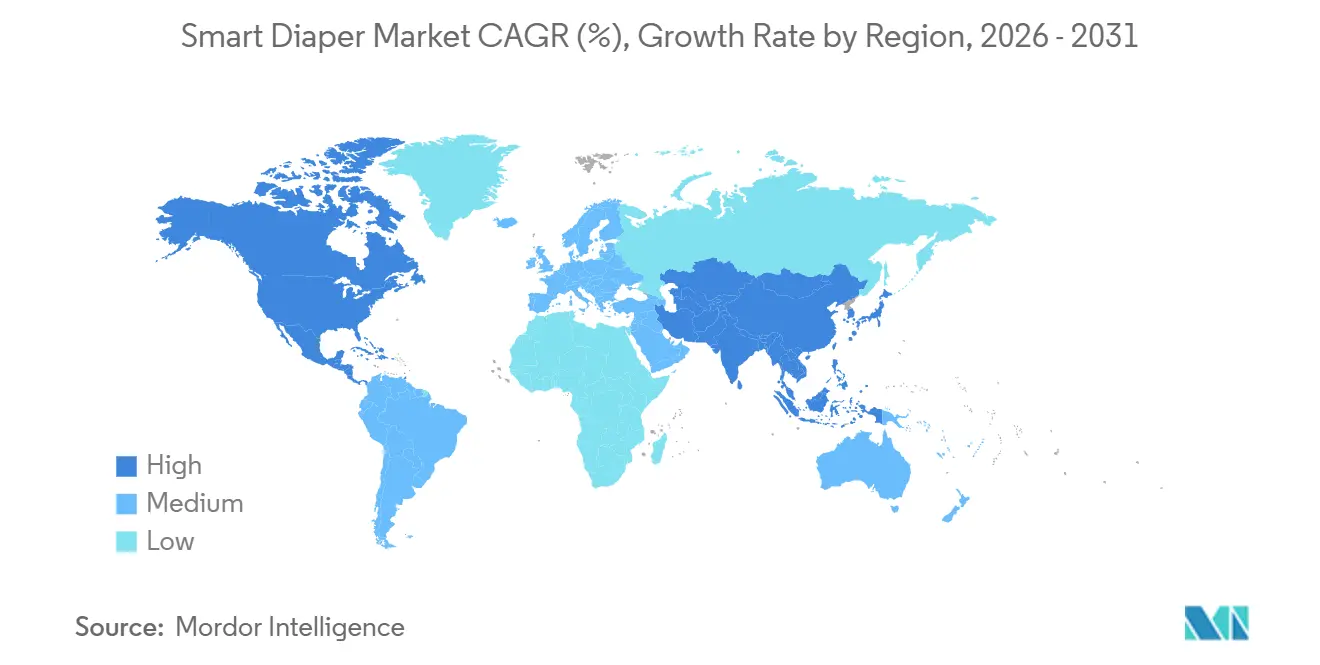
| Fastest Growing Market | Asia-Pacific |
| Largest Market | North America |
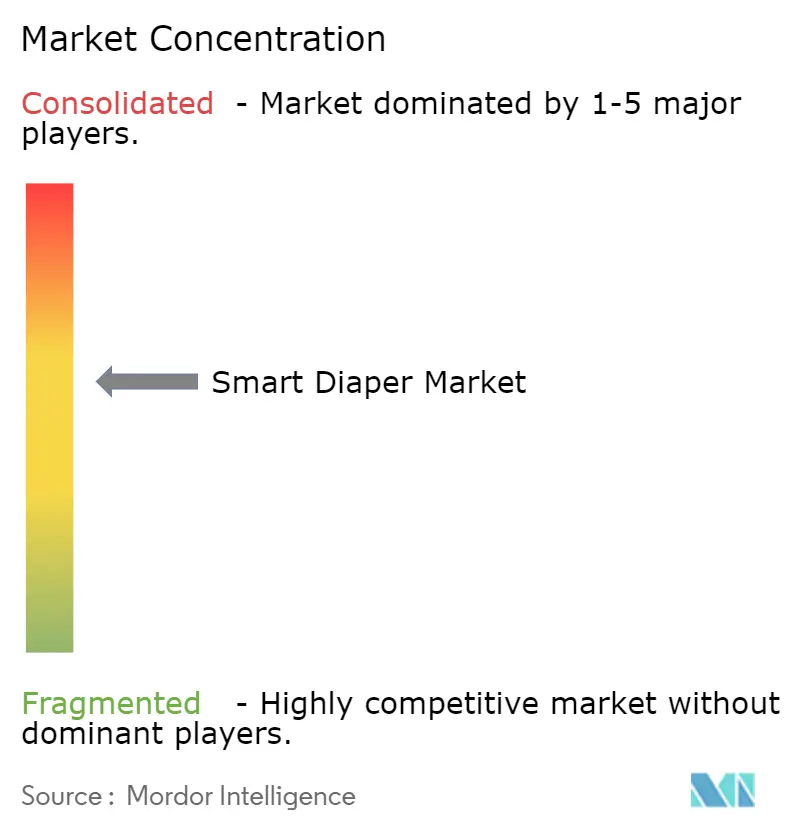
| Market Concentration | Medium |
Major Players *Disclaimer: Major Players sorted in no particular order Image © Mordor Intelligence. Reuse requires attribution under CC BY 4.0. | |
Smart Diaper Market Analysis by Mordor Intelligence
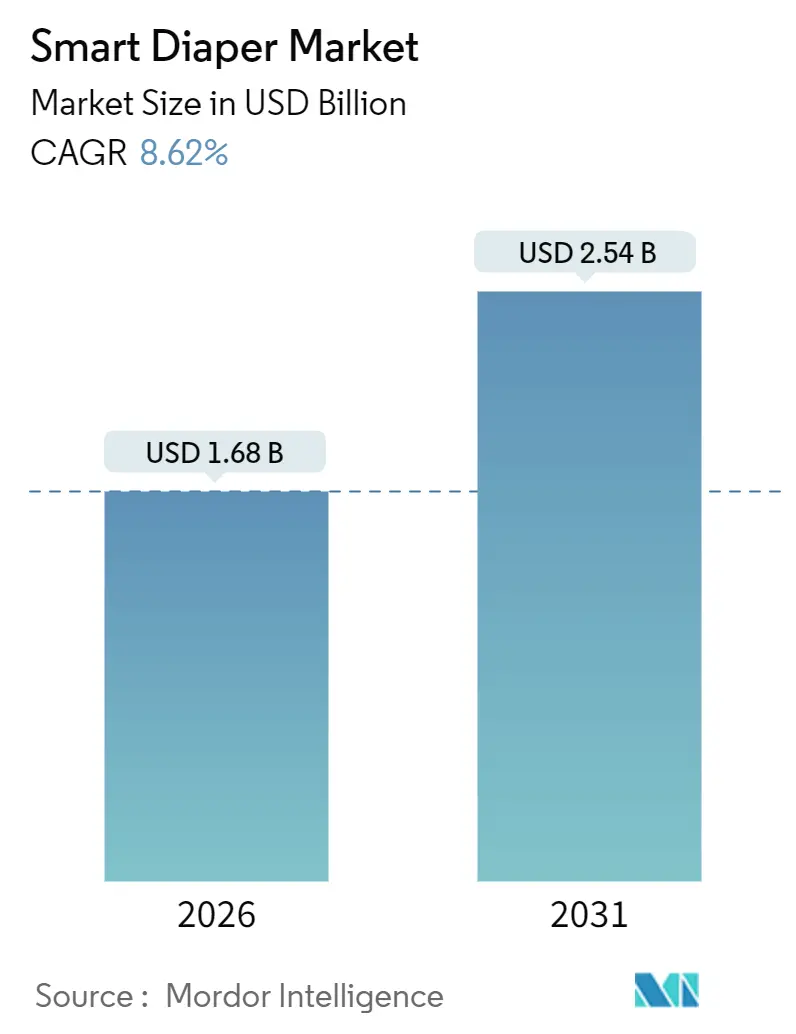
The Smart Diaper Market size is estimated at USD 1.68 billion in 2026, and is expected to reach USD 2.54 billion by 2031, at a CAGR of 8.62% during the forecast period (2026-2031).
Continued reimbursement expansion, sensor-cost deflation, and institutional labor shortages are prompting facilities to replace manual checks with predictive, connected briefs that lower nursing workload and pressure ulcer incidence. Japan’s fiscal-2025 subsidies for sensor-equipped continence products and the 2024 Centers for Medicare and Medicaid Services decision to reimburse continuous wetness monitoring have removed two of the largest adoption barriers. Vendors are therefore shifting from hardware-only sales to subscription bundles that combine diapers, analytics dashboards, and replenishment logistics, a move that secures recurring revenue and strengthens buyer lock-in. At the same time, long-term-care insurers in North America and Europe are piloting bundled-payment models that reward facilities for reductions in skin-integrity events, driving incremental demand for clinical-grade accuracy. On the supply side, polymer-sensor breakthroughs have cut inline integration costs by 30%, allowing incumbents to embed Bluetooth modules without re-tooling high-speed diaper lines.
Key Report Takeaways
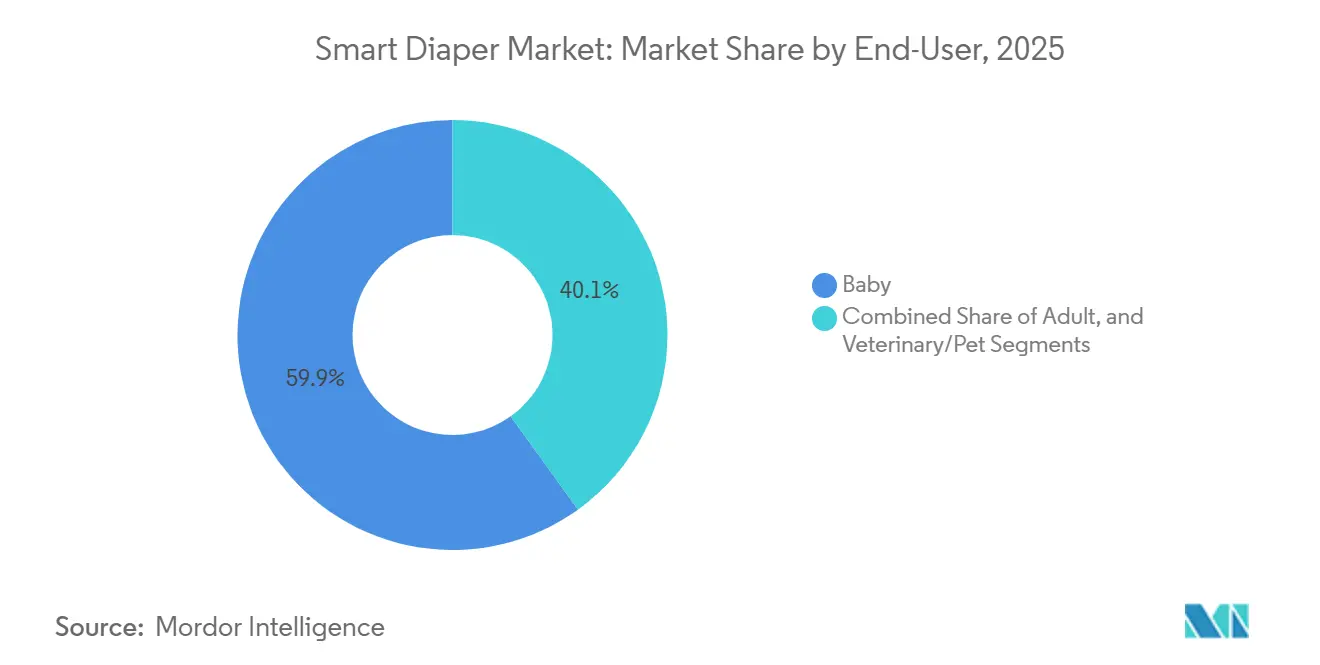
- By end-user, baby products led with 59.91% of smart diaper market share in 2025, while adult applications are forecast to advance at a 9.34% CAGR through 2031.
- By product type, disposable formats captured 74.22% of the smart diaper market size in 2025; reusable sensor patches are poised to grow at a 10.57% CAGR between 2026 and 2031.
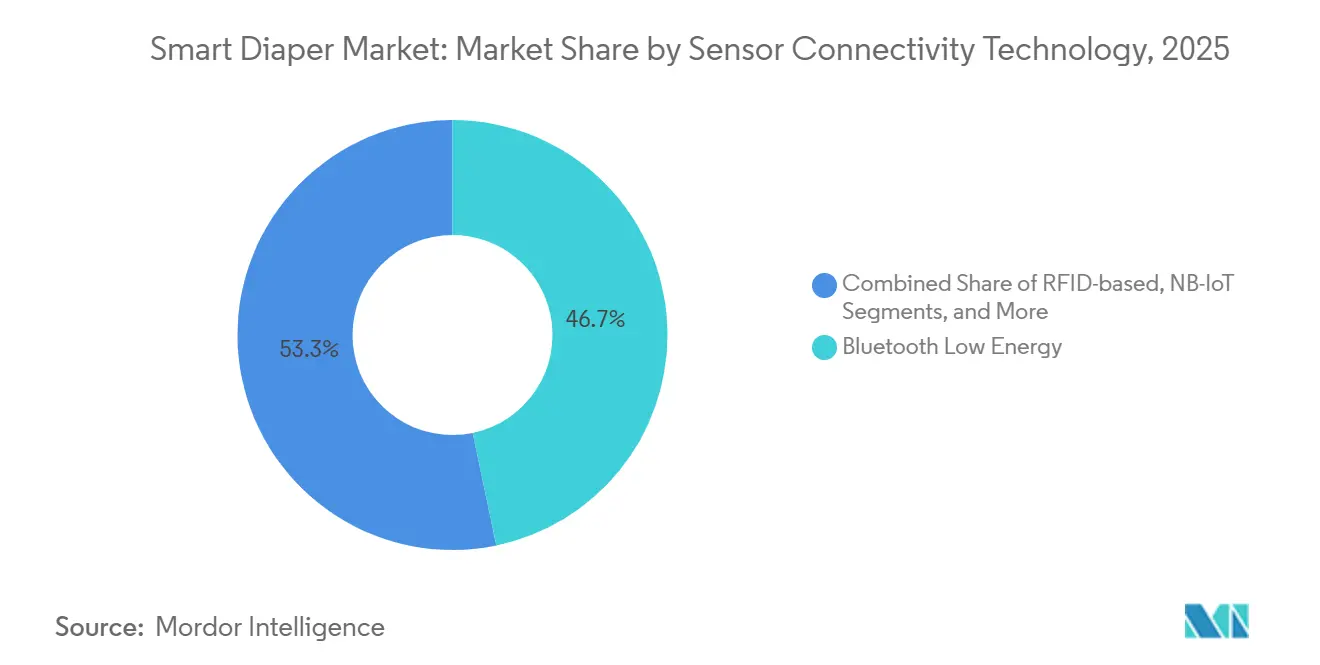
- By sensor connectivity, Bluetooth Low Energy commanded 46.74% revenue share in 2025, whereas NB-IoT and LTE-M are projected to register a 9.02% CAGR to 2031.
- By distribution channel, institutional purchasing represented 51.64% of the smart diaper market in 2025, whereas e-commerce platforms are expanding at a 10.88% CAGR over the forecast horizon.
- By geography, North America accounted for a 35.83% smart diaper market share in 2025, but Asia-Pacific is anticipated to record the fastest 11.07% CAGR through 2031.
Note: Market size and forecast figures in this report are generated using Mordor Intelligence’s proprietary estimation framework, updated with the latest available data and insights as of January 2026.
Global Smart Diaper Market Trends and Insights
Drivers Impact Analysis*
| Driver | (~) % Impact on CAGR Forecast | Geographic Relevance | Impact Timeline |
|---|---|---|---|
| Large geriatric population in developed countries | +2.1% | North America, Europe, Japan | Long term (≥ 4 years) |
| Rising birth rates and higher disposable income in emerging markets | +1.3% | Asia-Pacific (India, ASEAN), South America | Medium term (2-4 years) |
| Digital-health push by long-term-care insurers | +1.8% | North America, Europe | Short term (≤ 2 years) |
| IoT-enabled elderly-home platforms seeking integrated continence sensors | +1.6% | Global, with concentration in Japan, North America | Medium term (2-4 years) |
| AI-driven predictive analytics for urinary incontinence events | +1.2% | North America, Europe, Japan | Medium term (2-4 years) |
| Post-pandemic tele-nursing adoption accelerating smart diaper usage | +1.4% | Global | Short term (≤ 2 years) |
| Source: Mordor Intelligence | |||
Large Geriatric Population in Developed Countries
Population aging is shifting diaper demand from infants to seniors. Japan surpassed a 30% share of the 65-plus market in 2024, and adult briefs now outsell baby equivalents domestically.[1]Ministry of Health, Labour and Welfare, “Long-Term Care Insurance System,” mhlw.go.jp The United States expects more than 80 million seniors by 2040, magnifying labor pressure inside skilled-nursing facilities where turnover already exceeds 60%. Smart diapers reduce manual checks, cutting 15–20 minutes of staff time per resident each shift. National subsidy programs such as Japan’s Care Robot Support Office reimburse as much as 50% of device expenditure, further accelerating the smart diaper market.
Digital-Health Push by Long-Term-Care Insurers
CMS expanded Remote Patient Monitoring codes in 2024 to include continuous moisture sensing, opening a USD 50–100 monthly reimbursement stream for nursing-home operators. German and U.S. insurers have since piloted value-based contracts that bundle ulcer prevention, incentivizing facilities to deploy connected briefs. Early trials indicate a 40% decline in stage-1–2 pressure ulcers after implementing predictive change protocols. These financial incentives are reshaping capital budgets, allowing administrators to justify the premium smart diaper market price relative to conventional products.
IoT-Enabled Elderly-Home Platforms Seeking Integrated Continence Sensors
Long-term-care operators increasingly consolidate fall detection, bed-exit monitoring, and continence data on unified dashboards. Bluetooth Low Energy devices cover residential ranges, but campus-wide deployments favor NB-IoT, which offers direct-to-cloud transmission and 10-year battery life on AA cells.[2]STMicroelectronics, “NB-IoT and LTE-M Modules for Healthcare IoT,” st.com Essity’s TENA SmartCare integrates with electronic health records, automating supply orders and compliance reporting. Interoperability advantages therefore steer procurement toward manufacturers that publish standardized APIs, raising the competitive stakes in the smart diaper market.
AI-Driven Predictive Analytics for Urinary Incontinence Events
Algorithms that learn individual void patterns now forecast events 30-60 minutes ahead, enabling scheduled toileting and reducing resident discomfort. Verily Life Sciences filed multiple 2024 patents that separate urine from feces using impedance spectroscopy, bringing diagnostic potential to the smart diapers industry. A 2024 Korean nursing-home study showed 97.1% concordance between sensor alerts and physical checks, validating clinical reliability. Predictive accuracy grants access to higher reimbursement classes and differentiates premium platforms.
Restraints Impact Analysis*
| Restraint | (~) % Impact on CAGR Forecast | Geographic Relevance | Impact Timeline |
|---|---|---|---|
| High unit cost versus conventional diapers | -1.9% | Global, acute in price-sensitive emerging markets | Short term (≤ 2 years) |
| Infection and dermatitis risk from prolonged wear | -0.8% | Global | Medium term (2-4 years) |
| Data-privacy and cybersecurity concerns in connected devices | -0.7% | North America, Europe (GDPR jurisdictions) | Short term (≤ 2 years) |
| Short battery and adhesive sensor life limiting reuse cycles | -0.6% | Global | Medium term (2-4 years) |
| Source: Mordor Intelligence | |||
High Unit Cost Versus Conventional Diapers
Sensor-equipped briefs cost USD 1-3 each, three to five times more than basic disposables, and reusable patches run USD 50-150. While institutions can amortize these expenses over labor savings, out-of-pocket payers in emerging economies view the premium as prohibitive. Subscription bundles that spread hardware charges across monthly deliveries have entered the smart diaper market, but uptake remains limited.
Infection and Dermatitis Risk From Prolonged Wear
Dermatitis affects up to half of nursing home residents, and delayed treatment may worsen skin integrity. Although sensors prompt timely replacement, staff may defer action until they are alerted, prolonging moisture exposure. The Wound, Ostomy and Continence Nurses Society recommends two-hour intervals independent of saturation, a guideline that partially offsets the labor-saving promise of the smart diapers industry.[3]Wound, Ostomy and Continence Nurses Society, “Clinical Practice Guidelines for Incontinence-Associated Dermatitis,” wocn.org Adhesive placement also introduces new allergen concerns, prompting stringent ISO and CE biocompatibility testing.
*Our forecasts treat driver/restraint impacts as directional, not additive. The impact forecasts reflect baseline growth, mix effects, and variable interactions.
Segment Analysis
By End-User: Adult Care Surges Despite Baby Leadership
The baby category controlled 59.91% of the smart diaper market in 2025, buoyed by real-time sleep analytics embraced by affluent parents. Neonatal intensive-care units adopted preemie versions to track hydration, extending clinical credibility. Meanwhile, the adult segment is projected to register a 9.34% CAGR, the highest among all groups, as skilled-nursing operators combat projected caregiver shortages and rising ulcer-related litigation. The smart diaper market size for geriatric applications is therefore on a steeper expansion path than its pediatric counterpart.
Adult adoption is strongest in Japan, where adult briefs surpassed infant volume in 2024. Facilities there pair sensor alerts with staffing algorithms, freeing nurses for higher-acuity tasks. In the United States, CMS reimbursement is spurring trial programs across multistate chains. Special-needs adults and a nascent pet-care niche add incremental volume, hinting at diversification possibilities for the smart diapers industry.



By Product Type: Disposables Dominate but Reusables Gain Ground
Disposable formats held 74.22% of the smart diaper market share in 2025 as brands embedded low-cost printed circuitry directly into high-speed lines. Sensor integration costs fell after Toray’s 2024 polymer breakthrough, preserving incumbents’ scale advantages. Convenience and simple waste handling sustain household demand despite higher per-use cost.
Reusable patches, however, are expanding at a 10.57% CAGR. A USD 200 starter kit that survives 50 wash cycles lowers lifetime costs to USD 4 per use, undercutting disposables in high-volume institutional settings. Sustainability mandates in Europe elevate the appeal of reusables, aligning with circular-economy targets and reshaping procurement criteria in the smart diaper market.
By Sensor Connectivity Technology: Bluetooth Leads, Cellular IoT Accelerates
Bluetooth Low Energy accounted for 46.74% of 2025 revenue, thanks to its sub-USD 5 module cost and compatibility with caregiver smartphones. Retail-oriented offerings like Huggies Special Delivery exploit this ubiquitous connectivity, enriching the smart diaper market with app-based sleep dashboards.
Campus-scale deployments prefer NB-IoT and LTE-M, which are poised for a 9.02% CAGR. New modules support 10-year battery life and under USD 10 bill-of-materials pricing, enabling direct cloud uploads without gateways. RFID has receded to inventory tracking, while Wi-Fi and ultra-wideband remain niche.
By Distribution Channel: Institutional Contracts Lead as E-Commerce Climbs
Institutional buyers commanded 51.64% of 2025 sales, bundling connected diapers with facility-wide hygiene and analytics services. Multi-year contracts that fold in software support and staff training give established manufacturers a stronghold in the smart diaper market.
E-commerce is rising at a 10.88% CAGR as aging-in-place seniors value discreet home delivery and subscription replenishment. Amazon listings for reusable patches grew double digits in 2024, revealing latent consumer appetite. Brick-and-mortar pharmacies still satisfy urgent needs but lose ground to online variety and pricing transparency.
Geography Analysis
North America accounted for the largest regional share, at 35.83% of the smart diaper market in 2025. CMS reimbursement, high caregiver wages, and a 25 million adult-incontinence population underpin demand. Pilot studies showing 40% ulcer-reduction cement administrative confidence, and multistate operators are standardizing connected briefs across portfolios. Canada progresses cautiously under budget constraints, while Mexico’s uptake remains confined to private urban facilities.
Asia-Pacific is the fastest-growing territory with an 11.07% CAGR forecast through 2031. Japan’s demographic inversion and 50% government subsidy catalyze institutional rollouts. China’s CNY 73,000 crore (USD 10 billion) elderly-care allocation finances pilot deployments in Tier-1 cities, even as broad market penetration lags due to price sensitivity. India’s looming 230 million elder cohort offers strategic upside, but family-centric caregiving and limited insurance coverage curb near-term volumes. South Korea and select ASEAN nations show niche growth tied to middle-class expansion.
Europe, at 20% of the 2025 value, benefits from CE-certified products and long-term-care insurance schemes that reimburse assistive devices. Scandinavian facilities pioneered Essity’s integrated SmartCare platform, aligning with stringent GDPR data safeguards. German insurers now test outcome-based payments, while the United Kingdom’s budget pressures slow National Health Service adoption. Southern Europe and emerging Middle East and Africa markets remain nascent because of lower institutional capacity and high out-of-pocket costs.

Regulatory Landscape
Smart diapers span consumer absorbent hygiene and regulated medical or connected-device regimes, and requirements change with intended use (protection vs clinical monitoring). In the United States, adult protective incontinence garments fall under FDA Class I medical devices (21 CFR 876.5920), while sensor-enabled variants used for monitoring in clinical workflows face tighter expectations around software and cybersecurity, in line with FDA direction on connected medical device security that was finalized in June 2025.
In the European Union, products positioned for medical monitoring fall under Regulation (EU) 2017/745 (MDR), driving CE marking and evidence requirements, with connected-device obligations creating a second compliance track. The EU Data Act sets a design deadline after September 12, 2026 for newly placed connected products to provide users direct, machine-readable access to generated data, while emerging standards work (for example, ETSI draft EN 304 634 dated April 2026 for personal wearables) points to the direction of cybersecurity baselines for wearable health monitoring devices. Ingredient transparency is also tightening in specific jurisdictions, such as California AB-1901 (2025-2026 session), which sets a January 1, 2029 disclosure requirement for intentionally added ingredients in childrens diapers.
Value Chain Analysis
The smart diaper value chain combines the conventional absorbent hygiene stack (nonwovens, cores, superabsorbent materials, converting lines, packaging) with electronics and software layers (printed conductive sensor films, low-power modules such as BLE or cellular IoT, adhesives/encapsulation, firmware, cloud analytics, and caregiver dashboards). Integration typically follows either embedded-disposable architectures, where sensors are incorporated into the diaper on high-speed lines, or hybrid models where a reusable sensing module or patch attaches to standard briefs, shifting more value toward connectivity, device lifecycle management, and data services.
Upstream leverage tends to concentrate in materials and electronics suppliers (printed inks/films, semiconductor modules, and specialty polymers), while midstream value is created by diaper converters that integrate sensors without large retooling and by platform providers that deliver alerts, analytics, and interoperability with care workflows. Recent collaboration and regionalization include GreenCore Solutions launching a European TreeFree Diaper production facility and introducing PATH+ traceability (May 2025), then issuing a supply MOU with Merkas Tekstil (September 2025) to scale nonwoven supply, and Synthomer partnering with Woosh on circular diaper solutions (2026). Downstream, institutional purchasing runs through multi-year contracts and group purchasing structures, while retail and e-commerce channels increasingly use subscriptions that bundle replenishment logistics with app-based monitoring.
Competitive Landscape
Global diaper incumbents - Kimberly-Clark, Procter & Gamble, Essity, and Unicharm - control supply chains and retail shelf space, allowing them to introduce sensor-enabled variants without overhauling distribution. Their collective scale amortizes the added cost of electronics at a fractional level, sustaining margins even in price-sensitive channels. Specialized entrants such as Simavita, Pixie Scientific, and Monit focus on software analytics and clinical validation, winning hospital pilots that demand granular predictive accuracy.
Partnerships are multiplying. Start-ups license firmware or data algorithms, while incumbents handle mass production and global logistics. Verily’s 2024 spectroscopy patents attracted interest from medical device majors eyeing diagnostic-grade expansion.[4]Alphabet Inc. (Verily Life Sciences), “Patent Application: Impedance Spectroscopy for Incontinence Monitoring,” patents.google.com Regulatory rigor is rising; the FDA now mandates cybersecurity bills of materials for connected devices, elevating compliance costs and raising entry barriers. As platform interoperability becomes a purchase criterion, vendors with open APIs and EHR integration strengthen their positioning in the smart diaper market.
Despite moderate concentration, white-space opportunities persist in direct-to-consumer aging-in-place segments and in hybrid institutional-home care models. Subscription logistics, remote-monitoring dashboards, and end-to-end supply automation represent differentiators beyond absorbency or sensor accuracy alone, suggesting that software sophistication will increasingly dictate competitive advantage.
Smart Diaper Industry Leaders
Abena Holding A/S
Kimberly-Clark Corporation
Essity Aktiebolag (publ)
First Quality Enterprises, Inc.
Monit Corp
- *Disclaimer: Major Players sorted in no particular order

Market Opportunities and Future Outlook
Institutional care adoption remains a primary monetization pathway because it ties smart diapers to measurable labor and skin-integrity outcomes. A concrete example is Khoo Teck Puat Hospital in Singapore, which began a two-month trial in July 2025 using Monit sensor-equipped smart diapers for adult patients with AI-driven alerts to reduce manual checks and mitigate incontinence-associated dermatitis, extending clinical validation activity beyond nursing homes and into acute-care wards.
The most visible technology whitespace is lowering sensor and integration costs while improving clinical usefulness beyond binary wetness detection. Recent R&D outputs point to work on more accurate volume quantification and alternative modalities such as RFID-textile and contactless sensing, including a March 2026 Materials and Design publication reporting 94.6% urine-volume prediction accuracy with a conductive fiber-based RFID approach. Innovation continues across sensing architectures, including the European Patent Office publication of EP 4657054 A2 (December 2025) around automated exudate detection, while upcoming connected-device obligations in the EU (Data Act design requirements applying after September 12, 2026) create an opportunity for vendors to build data-access, interoperability, and governance features into product and platform designs rather than treating them as add-ons.
Recent Industry Developments
- July 2026: Woddle Baby announced a USD 5 million seed round and a strategic partnership with Capital Q Ventures to scale its AI-powered infant health monitoring platform built around a Class I FDA-registered smart changing pad. While not a diaper SKU, the move expands adjacent infant monitoring ecosystems that can influence smart diaper platform expectations around data capture, alerts, and caregiver apps.
- July 2025: Khoo Teck Puat Hospital (KTPH) in Singapore started a two-month trial of Monit smart diaper sensors for adult patients, using AI-driven real-time analysis to alert nurses and help prevent incontinence-associated dermatitis. The hospital-based pilot broadens clinical proof points for connected continence monitoring and supports procurement conversations centered on reduced manual checks.
- April 2024: Soft N Dry launched the ecoFlexCore.com B2B Partner Portal to streamline ordering and supply chain coordination for OEM baby diaper manufacturers in North and Latin America. The portal approach strengthens supplier-to-converter coordination and supports faster rollout cycles for diaper programs that add electronics or specialized materials to conventional lines.


Research Methodology Framework and Report Scope
Market Definition and Coverage
For this study, the smart diaper market includes diapers and add-on sensor solutions that detect wetness or health-related signals and then share alerts through a connected device or reader, to support monitoring in baby and adult care settings.
Scope exclusions: We exclude standard diapers without sensing or connectivity features, along with standalone baby monitors and general health wearables not designed for diaper use.
Segmentation Overview
- By End-User
- Baby
- Adult (Geriatric and Special-needs)
- Veterinary / Pet
- BY Product Type
- Disposable Smart Diapers
- Reusable Smart Diapers and Sensor Patches
- By Sensor Connectivity Technology
- RFID-based
- Bluetooth Low Energy (BLE)
- NB-IoT / LTE-M
- Others (Wi-Fi, Ultra-Wideband)
- By Distribution Channel
- Institutional (B2B Hospitals, Nursing Homes)
- Retail (B&M Pharmacies, Supermarkets)
- E-commerce / Direct-to-Consumer
- By Geography
- North America
- United States
- Canada
- Mexico
- South America
- Brazil
- Argentina
- Rest of South America
- Europe
- Germany
- United Kingdom
- France
- Italy
- Spain
- Rest of Europe
- Asia-Pacific
- China
- Japan
- India
- South Korea
- ASEAN
- Rest of Asia-Pacific
- Middle East
- Saudi Arabia
- United Arab Emirates
- Rest of Middle East
- Africa
- South Africa
- Nigeria
- Rest of Africa
- North America
Data Sources, Market Sizing, and Validation
Desk Research
We start by mapping how smart diaper products reach end users and how pricing typically works, then we collect reference data that can be checked against multiple points. Public sources such as the US Census Bureau, Eurostat, UN Comtrade, and the World Bank help us use parent indicators like birth trends, aging population metrics, and trade flows that can influence demand.
We also review regulatory and standards signals and technical direction using sources such as the US FDA public databases for medical device context, and WIPO for patent activity to see where sensing and connectivity are moving. Company filings, investor presentations, credible press releases, and association websites are used to cross-check product launches, channel focus, and broad pricing bands. In some cases, we use paid subscriptions for company financials and news, patent databases, and shipment-level import and export visibility to validate directionally. The list above is illustrative rather than exhaustive, since we referenced additional sources for data collection and clarification.
Primary Interviews and Surveys
To confirm what desk research cannot show clearly, we speak with manufacturers, sensor and connectivity solution providers, distributors, institutional buyers, and clinicians and caregivers that influence adoption. Since demand patterns vary by care setting and region, we validate inputs across Americas, EMEA, and APAC, and we use these discussions to tighten assumptions on attach rates, replacement cycles, and realistic pricing over time.
Distribution of primary research fieldwork respondents
| Company type | Respondent position | Region |
|---|---|---|
| Top tier: 31% | CXOs: 12% | APAC: 52% |
| Mid tier: 53% | Functional/Unit leaders: 40% | EMEA: 30% |
| Smaller Players: 16% | Managers: 48% | Americas: 18% |
Market-Sizing & Forecasting
The core build uses a top-down approach where demand pools are reconstructed from care setting adoption and penetration, then translated into value using typical units per user and average selling prices. We estimate addressable users across baby, adult, and pet use cases, and for each we apply realistic adoption rates for connected sensing, followed by expected replacement frequency for the diaper or sensor patch.
To keep totals grounded, the model is checked with selective bottom-up approximations such as sampled price points across retail and e-commerce, channel checks on institutional ordering patterns, and supplier and distributor feedback on shipment mix. Inputs that matter most include penetration of incontinence care programs, birth and aging indicators, sensor patch attach rates versus full smart diapers, connectivity mix (RFID, BLE, NB-IoT/LTE-M), and how quickly ASPs decline as volumes rise. For forecasting, scenario analysis is used, where adoption and ASP paths are stress tested with interview-based ranges before a base case is finalized. Where evidence is thin, gaps are handled by using proxy indicators from the closest comparable care setting or region, then re-validating with experts.
Data Validation & Update Cycle
We validate the final market numbers through multiple checks, rather than relying on one data series. Outputs are compared against independent signals such as trade direction, patent intensity, public regulatory context, and channel feedback, and then any large variances are reviewed in a second analyst pass.
If an assumption shifts materially, such as pricing changes, reimbursement behavior, or a step-up in institutional adoption, we trigger re-contact with relevant respondents and adjust the model before sign-off. Reports are refreshed annually, with interim updates when major product launches, policy changes, or supply shifts occur. Before delivery, an analyst performs a fresh review so the published view reflects the latest available information.
Mordor Intelligence's Smart Diaper Market Size Compared Against Other Published Estimates
Published estimates for smart diapers often differ because the market boundary is handled differently, and because adoption timing assumptions can move the curve quickly. We also see differences driven by what is counted as a smart diaper product versus an add-on patch, and by how pricing is converted and updated.
By tracking attach rates, replacement cycles, and connectivity mix, Mordor Intelligence keeps the smart diaper market tied to counted units and realistic ASP paths, which reduces inflation from adjacent baby care products or broad IoT device buckets. Gaps also come from base year choices, whether institutional channels are included fully, and whether forecasts are built as aggressive upside cases without re-checking penetration with caregivers and care facilities.
Benchmark comparison
| Source | Market Size | Gaps in Research Methodology |
|---|---|---|
| Mordor Intelligence | USD 1.68 B (2026) | |
| Global Consultancy A | USD 1.81 B (2031) | Uses a later-year snapshot and appears to center on a narrower smart diaper definition that leans on baby use cases, which can undercount adult care adoption and shift comparability versus a full market build. |
| Industry Publisher B | USD 7.10 B (2024) | Likely applies a much wider scope that can blend traditional diapers, broader connected baby products, or multi-category revenues, and the step from units to value is less transparent on ASP and penetration assumptions. |
The spread in values is mostly explained by what is included in scope, which year is being quoted, and how adoption and pricing are updated. In our approach, the model is anchored to practical demand signals and then cross-checked through channel and expert inputs, making the final number easier to trace and repeat as the market evolves.


Key Questions Answered in the Report
What is the current size and growth trajectory of the smart diapers market?
The market stands at USD 1.68 billion in 2026 and is forecast to reach USD 2.54 billion by 2031, expanding at an 8.62% CAGR.
Which end-user segment offers the highest growth potential?
The adult segment (geriatric and special-needs) is growing at a 9.34% CAGR through 2031.
Why are reusable smart diapers gaining traction despite disposables' market dominance?
Reusable systems and sensor patches are expanding at a 10.57% CAGR as institutional buyers' total-cost-of-ownership analyses favor washable platforms that achieve USD 4 per-use costs after 50 cycles versus USD 1 to USD 3 per disposable unit.
Which geographic region presents the fastest growth opportunity?
Asia-Pacific is forecast to grow at an 11.07% CAGR through 2031.
What connectivity technology is displacing Bluetooth Low Energy in institutional settings?
NB-IoT and LTE-M cellular protocols are growing at a 9.02% CAGR as nursing homes deploy campus-wide networks that enable direct-to-cloud transmission.
How are reimbursement policies accelerating institutional adoption?
The Centers for Medicare and Medicaid Services' 2024 expansion of Remote Patient Monitoring billing codes permits USD 50 to USD 100 per patient per month reimbursement for continuous wetness monitoring.
Page last updated on:


 Your data is secure and never sold or shared.


