
Smart Fabrics Market Size and Share
Market Overview
| Study Period | 2020 - 2031 |
|---|---|
| Market Volume (2026) | 8.58 Million units |
| Market Volume (2031) | 14.25 Million units |
| Growth Rate (2026 - 2031) | 10.68 % |
| Fastest Growing Market | Asia Pacific |
| Largest Market | North America |
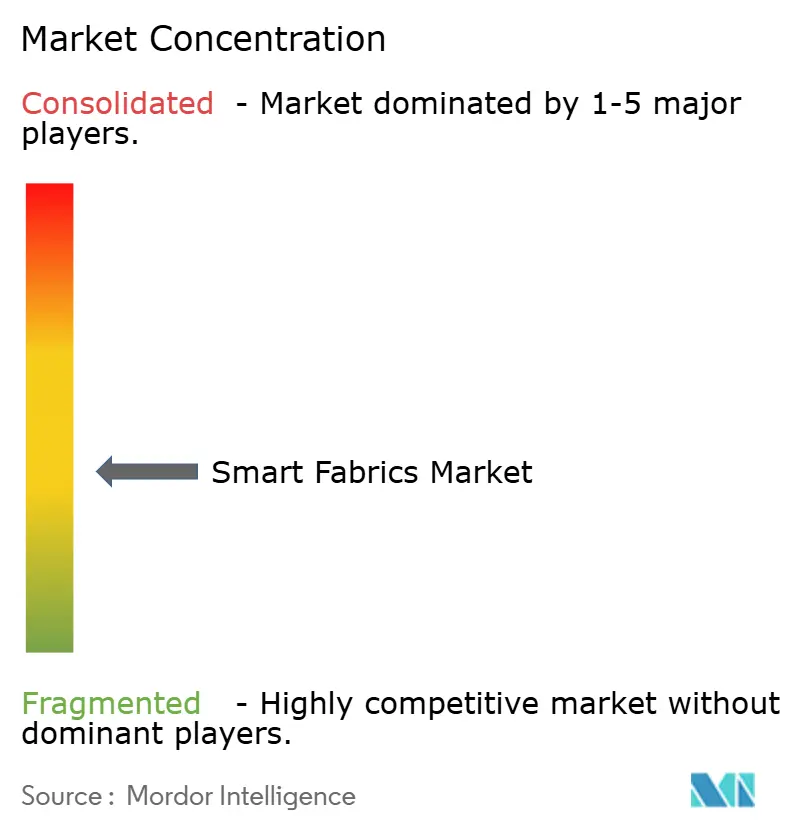
| Market Concentration | Medium |
Major Players *Disclaimer: Major Players sorted in no particular order Image © Mordor Intelligence. Reuse requires attribution under CC BY 4.0. | |
Smart Fabrics Market Analysis by Mordor Intelligence
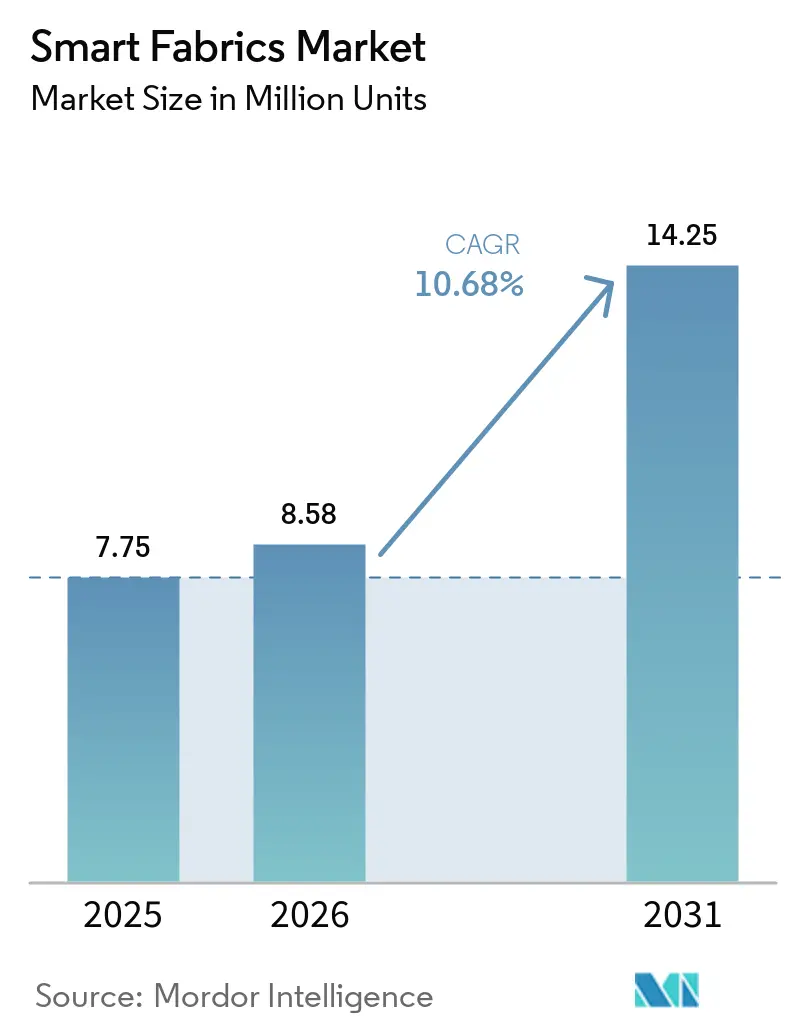
The smart fabrics market size was valued at 7.75 million units in 2025 and estimated to grow from 8.58 million units in 2026 to reach 14.25 million units by 2031, at a CAGR of 10.68% during the forecast period (2026-2031). Rising adoption across defense, healthcare, and sports segments is accelerating the transition from conventional textiles to intelligent fabrics that sense, harvest energy, and communicate. Military contracts that specify cognitive-load monitoring garments, healthcare pilots that use fiber computers for real-time diagnostics, and consumer demand for performance apparel are broadening commercial opportunities. Investor confidence remains solid as patent activity in conductive yarns and flexible integrated circuits continues to grow, while partnerships between textile groups and electronics suppliers scale manufacturing. The interplay of sustainability pressures, miniaturized components, and autonomous power systems keeps the smart fabrics market on a transformative trajectory.
Key Report Takeaways
- By type, passive smart fabrics maintained 44.62% of the smart fabrics market share in 2025, whereas ultra-smart fabrics are projected to expand at an 11.06% CAGR through 2031.
- By functionality, sensing accounted for 55.42% of the smart fabrics market size in 2025; energy harvesting is forecast to accelerate at a 13.28% CAGR between 2026-2031.
- By material, polyester and nylon held 42.15% revenue share in 2025, while cotton-based variants are expected to grow at a 11.88% CAGR to 2031.
- By application, sports and fitness captured 32.15% of the smart fabrics market size in 2025 and is advancing at a 13.56% CAGR through 2031.
- By geography, North America led with 28.12% market share in 2025; Asia Pacific shows the fastest regional CAGR at 12.05% through 2031.
Note: Market size and forecast figures in this report are generated using Mordor Intelligence’s proprietary estimation framework, updated with the latest available data and insights as of 2026.
Global Smart Fabrics Market Trends and Insights
Drivers Impact Analysis*
| Driver | (~) % Impact on CAGR Forecast | Geographic Relevance | Impact Timeline |
|---|---|---|---|
| Growth in wearable-electronics ecosystem | +2.1% | Global, with concentration in North America and Asia-Pacific | Medium term (2-4 years) |
| Rapid miniaturization and flexible-IC integration | +1.8% | Global, led by Asia-Pacific manufacturing hubs | Short term (≤ 2 years) |
| Surge in conductive-yarn patent filings (post-2025) | +1.4% | Global, with IP concentration in North America and EU | Long term (≥ 4 years) |
| Textile-embedded energy-harvesting supercapacitors | +1.6% | Global, early adoption in North America and EU | Medium term (2-4 years) |
| Military mandates for cognitive-load monitoring gear | +1.2% | North America, EU, with spillover to allied nations | Short term (≤ 2 years) |
| Sustainability premiums from circular-textile brands | +0.9% | EU, North America, expanding to Asia-Pacific | Long term (≥ 4 years) |
| Source: Mordor Intelligence | |||
Growth in Wearable-Electronics Ecosystem
Demand for smart garments has surged in tandem with the wider wearable device boom. Researchers at the University of Waterloo demonstrated fabrics that harvest solar and body-heat energy, removing the need for external batteries. Cornell University’s SeamFit shirts classified exercises with 93.4% accuracy using conductive threads stitched into everyday tees.[1]Cornell University, “SeamFit boosts exercise tracking accuracy,” cornell.edu Healthcare prototypes are progressing quickly, including smart bandages from the California Institute of Technology that predict wound-healing timelines at expert-level precision. The Guardian reported fiber-based electronics that draw ambient electromagnetic energy, turning the human body into part of the circuit and fueling ultra-low-power sensors embedded inside clothing. Collectively, these advances blur the line between attire and electronics, expanding the smart fabrics market into lifestyle, medical, and industrial realms.
Rapid Miniaturization and Flexible-IC Integration
The threshold at which integrated electronics compromise fabric comfort has shifted. MIT engineers produced elastic fiber computers containing micro-devices, sensors, and Bluetooth modules that survive machine washes, enabling Arctic mission wearables that monitor vital signs without bulk.[2]MIT News, “Elastic fiber with microdevices makes clothes compute,” news.mit.eduEmbroidered triboelectric nanogenerators yielded 307.5 µJ per sliding cycle, showcasing viable energy capture through regular garment motion. Organic electrochemical transistors developed at the University of Hong Kong now process data locally on the fabric, lowering transmission loads and boosting privacy. These breakthroughs place sophisticated processing power inside textiles while preserving drape and flexibility, enhancing consumer acceptance.
Textile-Embedded Energy-Harvesting Supercapacitors
Power autonomy is no longer a limiting factor. Moisture-powered supercapacitors retained 96.6% of voltage over 120 hours while flexing, pointing to long-life self-charging garments suitable for humid climates. Hexagonal Distributed Embedded Energy Converters from the National Renewable Energy Laboratory harvest motion and wind energy through flexible nodes that can be woven into jackets or tents.[3]National Renewable Energy Laboratory, “Patent on hexDEEC energy converters,” nrel.gov MXene-coated yarns stitched into sleeves supplied up to 6 V, enough for Arduino-class modules during field tests, and maintained output after repeated bending. North Carolina State University set optimal yarn-supercapacitor lengths at 40-60 cm, balancing resistance and capacity for clothing integration. Together, these developments shift the smart fabrics market toward self-sustaining systems that cut the maintenance cycle and raise user confidence.
Military Mandates for Cognitive-Load Monitoring Gear
Defense agencies are high-value early adopters. The U.S. Navy’s SBIR program prioritizes passive cooling layers for aircrew who experience extreme cockpit temperatures, an initiative that seeds dual-use civilian products. Department of Defense field trials deployed physiological status headbands and heated sleeves to cut cold-weather injury risk among paratroopers. Hierarchically engineered camouflage fabrics under study in the Journal of Materials Science combine UV, visible, and infrared masking properties to thwart modern surveillance. Dartmouth College researchers designed SOFT e-textiles that detect and neutralize toxic chemicals in real time, heightening soldier safety and offering clear technology transfer to industrial hazmat gear. Military procurement establishes stringent reliability baselines that cascade into commercial specifications, lifting quality norms across the smart fabrics market.
Restraints Impact Analysis*
| Restraint | (~) % Impact on CAGR Forecast | Geographic Relevance | Impact Timeline |
|---|---|---|---|
| High fabrication cost and cybersecurity risks | -1.9% | Global, with higher impact in cost-sensitive markets | Short term (≤ 2 years) |
| Absence of global e-textile interoperability standards | -1.4% | Global, with fragmentation across regions | Medium term (2-4 years) |
| Emerging toxicity rules on nano-coatings | -1.1% | EU, North America, expanding globally | Medium term (2-4 years) |
| End-of-life recycling complexity of e-textile waste | -0.8% | EU leading, North America following | Long term (≥ 4 years) |
| Source: Mordor Intelligence | |||
High Fabrication Cost and Cybersecurity Risks
Production lines require specialized equipment for embedding conductors, sensors, and microcontrollers, pushing unit costs above those of regular textiles. Inflation and supply chain disruptions in 2024 further squeezed margins for U.S. textile mills, many of which diverted capex away from automation upgrades. Data security remains a parallel concern because garments collect biometrics that fall under health-data regulations. Encryption adds component expense and mandates software updates throughout a product’s life, increasing total cost of ownership. Smaller brands face hurdles securing capital for compliant design, slowing penetration in low-income markets.
Absence of Global E-Textile Interoperability Standards
Today’s smart shirt may not pair seamlessly with tomorrow’s rehabilitation platform if communication protocols differ. IPC-8921 gives baseline definitions for woven and knitted electronic fabrics but stops short of guaranteeing cross-vendor compatibility. Specialty Fabrics Review notes that testing frameworks are in flux, leaving buyers unclear about wash cycles, fire resistance, and electromagnetic safety. Divergent regional policies, such as the EU’s tighter PFAS rulings, oblige manufacturers to engineer variants for different markets, lifting certification costs and elongating time-to-market.
*Our forecasts treat driver/restraint impacts as directional, not additive. The impact forecasts reflect baseline growth, mix effects, and variable interactions.
Segment Analysis
By Type: Ultra-Smart Fabrics Redefine Capability
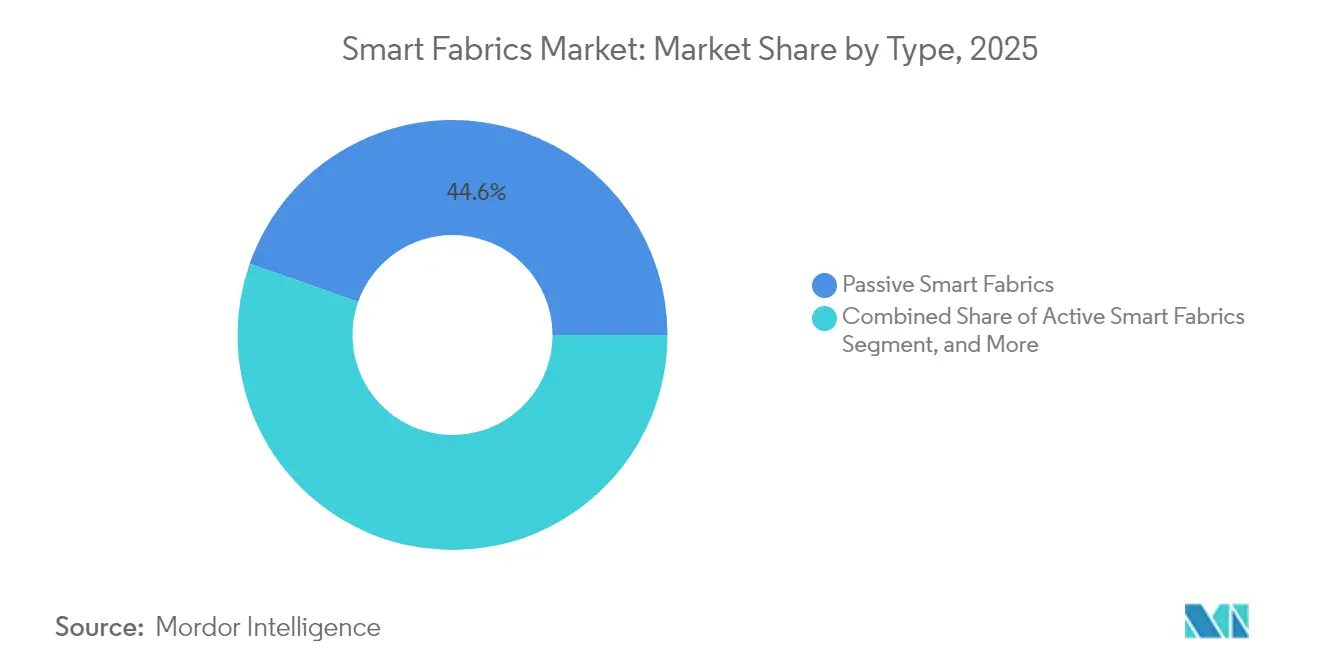
Ultra-smart variants are forecast to post the segment-leading 11.06% CAGR to 2031 as predictive analytics and automated adaptation move from labs into volume production. Passive formats still command 44.62% of the smart fabrics market due to proven durability across basic sensing tasks. Active fabrics, which modify properties like breathability in response to stimuli, bridge the gap but must overcome power and durability trade-offs. Smart acoustic cloth using piezoelectric threads translates bending and touch into precise electrical signals, maintaining airflow and thermal stability for day-long wear. R&D pipelines are embedding on-textile neural networks that learn wearer patterns and predict anomalies, unlocking proactive wellness alerts. These capabilities give Ultra-smart fabrics a clear value premium, propelling their share of the smart fabrics market in high-performance sportswear, defense, and chronic-care monitoring.
Smart acoustics also benefit Passive and Active categories. Tailored layering schemes now boost signal-to-noise ratios, enhancing entry-level balance monitoring belts and low-cost posture trainers. Builders of Passive goods leverage established looms, so they scale faster than Ultra-smart newcomers. As manufacturing lines converge, patent sharing between loom makers and chip vendors will compress yields, balancing growth across tiers.



By Functionality: Energy Harvesting Momentum Builds
Energy Harvesting functions show the highest forecast CAGR of 13.28%, though Sensing retained a 55.42% share of the smart fabrics market in 2025. Thermoregulation sweaters that heat or cool through phase-change inks and microfluidic channels fulfill niche performance needs, while luminescent fabrics enrich aesthetic footwear and event costumes. Efficient triboelectric nanogenerators woven into arm bands now deliver over 3 mW cm⁻² during intense motion, enabling continuous Bluetooth beacons without external power arxiv.org. Moisture-enabled supercapacitors pair with those generators to retain charge for days, removing the daily charging chore. These power systems make autonomous field jackets viable for rescue crews and enable hospital gowns that track vitals even when patients lack mobility.
Sensing retains leadership through ubiquitous heart-rate and temperature modules in workout tees. Textile-based inductive coils measure muscle oxygenation, expanding the role of sports gear in injury prevention. As manufacturers integrate multi-functional yarns, product families combine sensing with micro-energy cells, making the categories mutually reinforcing rather than mutually exclusive.
By Material: Cotton Gains Sustainable Traction
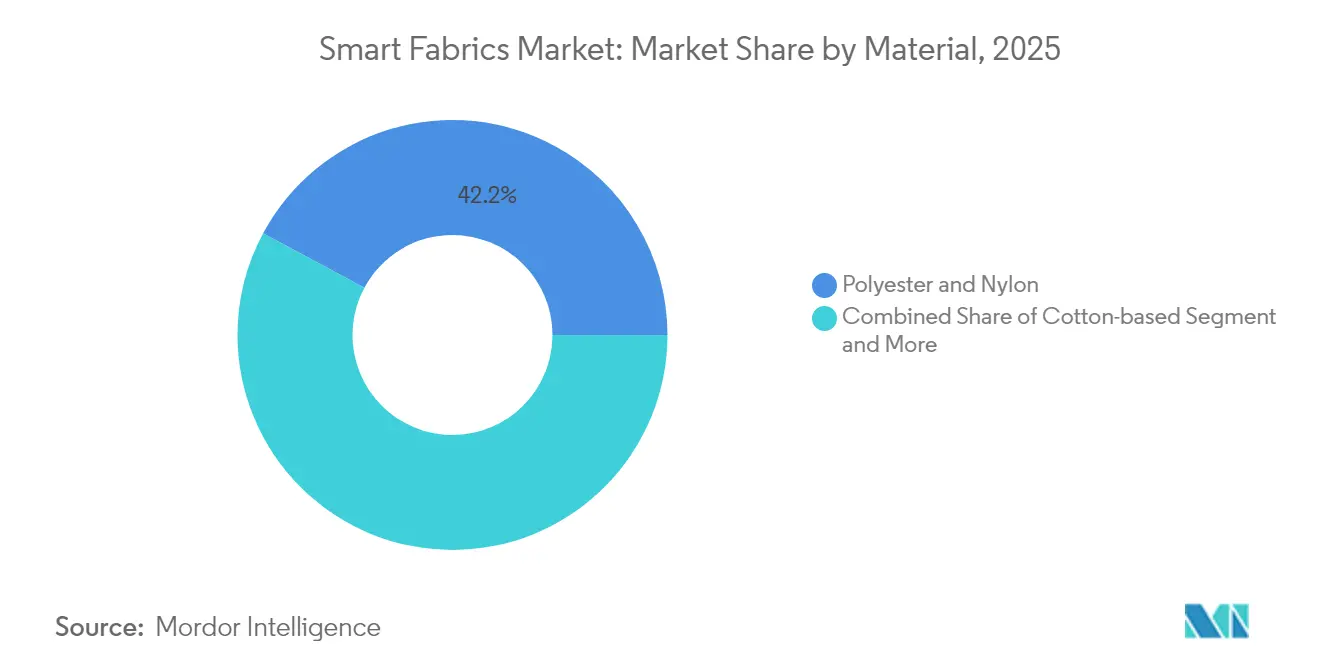
Polyester and Nylon continued to capture 42.15% revenue in 2025, supported by mature supply chains and mechanical resilience. Yet Cotton-based products are gaining momentum at a 11.88% CAGR, reflecting consumer preference for natural fibers and brand commitments to circular economy principles. High-performance synthetics such as Kevlar and Dyneema remain indispensable for ballistic and cut-resistant uniforms. RSC publications highlight cotton supercapacitors that maintain 90% capacitance after 5,000 flex cycles while preserving softness. Enzymatic treatment steps allow conductive polymers to bond to cotton without harsh solvents, appealing to eco-conscious consumers. Apparel brands increasingly position cotton smart hoodies as carbon-reduced alternatives, giving the segment new visibility and aiding its contribution to the smart fabrics market.
Polyester and Nylon continue to evolve via bio-based monomers and recycled feedstocks. Toray Industries announced pilot lines using enzymatic recycling loops, giving synthetics a greener image without sacrificing tensile strength. Blended yarns that mix recycled PET with conductive graphene threads balance durability and conductivity, supporting hybrid designs across price tiers.
By Application: Sports and Fitness Maintain Dual Leadership
Sports and Fitness retained 32.15% share in 2025 and carries the highest 13.56% CAGR among applications. Medical and Healthcare follows, driven by early clinical validation of continuous monitoring garments. Military and Defense preserves a strong pipeline, while smart fabrics for transportation, Fashion and Entertainment, and Industrial and Safety add diversification to the smart fabrics market.
Cornell’s SeamFit garments track movement form and repetition count, syncing to cloud dashboards that coach amateur athletes. Elite teams adopt pressure-mapping suits to analyze joint loading, cutting injury downtime. Consumer fitness developers integrate workout shirts with smartphone apps that gamify exercise, spurring repeat purchases. Medical pilots use the same sensing fabrics to monitor post-surgery recovery, foreshadowing crossover scale economies.
The application breadth reduces dependency on single-sector cycles. During seasonal sports lulls, healthcare orders for rehabilitation sleeves fill factory capacity. Military contracts, though cyclical, support advanced R&D that later migrates into civilian skiwear. This redundancy stabilizes revenue streams and sustains steady expansion of the smart fabrics market.
Geography Analysis
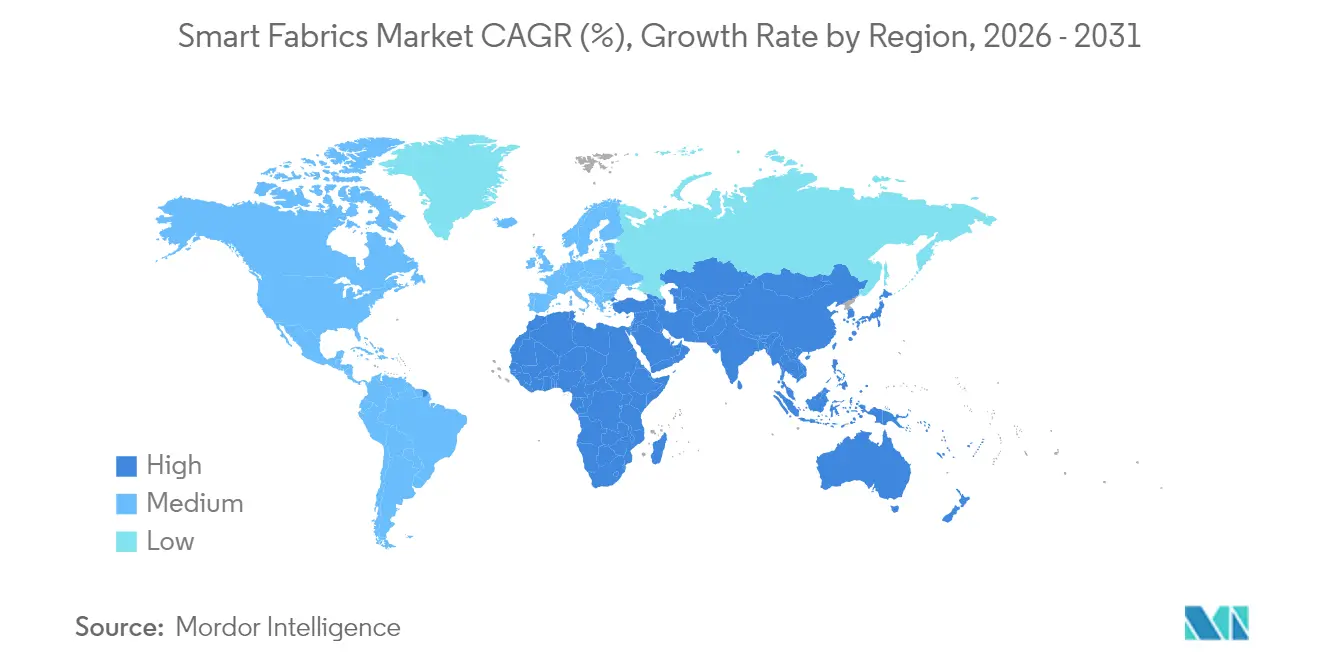
North America led with 28.12% market share in 2025 on the back of strong defense budgets, vibrant health-tech ecosystems, and consumer enthusiasm for innovative sportswear. The Department of Defense funds fiber computers and climate-adaptive uniforms, ensuring domestic demand for high-spec fabrics. MIT, University of Waterloo, and Caltech spin out start-ups that license their textile platforms, keeping regional innovation pipelines full. Several mills moved to near-shore production to mitigate supply shocks, unlocking government incentives aimed at rebuilding local manufacturing.
Asia Pacific is the growth engine, projected at a 12.05% CAGR through 2031. China’s technical textile segment already forms over 20% of its broader textile industry, posting 9-13% annual growth in medical, filtration, and protective categories. Beijing MatrixTech’s Y-Warm insulation delivers superior thermal retention and antimicrobial properties, offering export potential to cold-weather sportswear brands. Japanese suppliers refine ultrafine conductive filaments, while Korean groups commercialize washable OLED thread patterns for interactive apparel. India nurtures start-ups that craft price-competitive smart bandages for rural clinics, demonstrating the region’s wide application spread. Europe sits at the convergence of sustainability mandates and advanced engineering. The bloc’s progressive PFAS restrictions drive research into alternative coatings that cut toxic risk yet retain conductivity. Lenzing’s minority stake in TreeToTextile fast-tracks cellulose fibers that lower water and energy footprints. Germany, France, and Spain foster textile recycling clusters, but consumer surveys reveal price sensitivity to sustainability premiums. Universities collaborate with automotive suppliers on seat fabrics that detect driver fatigue, broadening industrial uptake and reinforcing Europe’s role as an innovation hub in the smart fabrics market.

Regulatory Landscape
Smart fabrics regulation remains fragmented because products can fall under textiles, electronics, PPE, or medical-device rules depending on end use, which complicates global commercialization. In the European Union, Ecodesign for Sustainable Products Regulation (EU) 2024/1781 has been in force since 18 July 2024 and sets the framework for Digital Product Passports (DPP). Textiles are prioritized for the 2027 wave, so apparel supply chains face near-term requirements around product data, materials traceability, and circularity claims.
For e-textiles, compliance is also being shaped by standards and cybersecurity requirements. Durability and test-method harmonization is progressing through EN IEC 63203-201-4:2025/A1:2026 (sheet resistance after abrasion), alongside terminology work such as prEN IEC 63203-101-1:2026. ETSI circulated a mature draft of EN 304-634 for personal wearables in April 2026 to support the EU Cyber Resilience Act. At the product-design level, the EU also exempted wearables from specific battery removability requirements as of 15 July 2026, affecting how power modules can be integrated into garments and accessories.
Competitive Landscape
The competitive arena is moderately concentrated, with a blend of heritage textile majors and technology powerhouses. DuPont leverages its material science portfolio to deliver Kevlar-based sensing substrates for defense jackets. Toray Industries partners with micro-electronics firms to mass-produce graphene-coated nylon threads that support both power and data lines. VF Corporation pilots smart workwear under its Timberland Pro line, enabling real-time ergonomics feedback for industrial users.
Consumer-electronics leaders intensify convergence. Google’s Jacquard platform embeds capacitive sensor grids into denim jackets that gesture-control smartphones. Apple patents stretchable textile circuits that manage electrostatic discharge and hold structural integrity during device flex. Meta explores haptic feedback gloves that deliver immersive VR experiences, widening the addressable smart fabrics market across entertainment and enterprise training.
Specialist firms amplify application depth. Myant’s SKIIN underwear tracks heart activity and sleep stages, producing medical-grade data that feeds telehealth dashboards. Xenoma’s e-Skin sports shirt reads motion from printed stretch sensors without extra straps. Sensoria focuses on washable sensor socks that correct running gait. Supply-chain enablers like Jabil supply flexible hybrid electronics, while Laird offers low-impedance shielding films. Patent trends illustrate intensified filings in conductive yarns and energy storage post-2025, signaling escalating R&D stakes across all tiers.
Smart Fabrics Industry Leaders
AIQ Smart Clothing Inc.
Adidas AG
NIKE Inc.
ThermoSoft International Corporation
Kolon Industries Inc.
- *Disclaimer: Major Players sorted in no particular order

Market Opportunities and Future Outlook
Two near-term whitespace areas stand out: interoperability and repairability of garment electronics, and industrialization pathways that make e-textiles durable enough for routine wear and laundering. Standardization work is moving from general definitions toward implementable interfaces, with the Smart Textile Alliance launching an E-textile Connectivity taskforce in March 2026 to develop a common interconnection approach (T-USB), and the Global Electronics Association publishing a June 2026 guideline on e-textile system development for scaling reliable prototypes into manufacturable products. These efforts target a bottleneck across multi-vendor stacks spanning yarns, connectors, power, sensing, and software.
Programs and investments also provide clearer commercialization routes across regions and applications. In India, the Ministry of Textiles approved 24 startup projects under the GREAT scheme in February 2026, including work on functional fabrics, graphene-based smart textiles, and energy-harvesting materials. Epic Group announced plans in May 2026 to invest USD 150 million in a technical textiles ecosystem in Odisha. In Europe, Textilfabrik 7.0 launched in March 2026 in Monchengladbach as a real-world lab for circular, digitally enabled textile production, and Covestro, FILK Freiberg, and OUT e.V. reported a flexible conductive-polymer smart textile system platform in April 2026 with medical-use targets such as neonatal phototherapy, supporting medical and healthcare adoption pathways where validation and standardized testing are central.
Recent Industry Developments
- June 2026: Adidas AG unveiled the CLIMACOOL SYSTEM, including a cooling vest, insulating jacket, and cooling overshoe positioned for football player use around the FIFA World Cup 2026. The launch shows how thermoregulation apparel is being engineered as an integrated system rather than a single garment, adding competitive pressure on performance apparel brands to combine materials, design, and functional layers.
- February 2026: NIKE Inc. introduced the Therma-FIT Air Milano jacket using A.I.R. (adapt, inflate and regulate) technology built around computational algorithms and digital 3D modeling for dynamic warmth management. The product points to a shift toward algorithm-informed garment design and structured air-management features, reinforcing the link between digital design toolchains and scalable smart-textile differentiation.
- December 2024: NIKE Inc. and Hyperice announced a collaboration on smart shoes and a vest. The partnership signaled continued cross-industry convergence between athletic apparel and recovery and therapy technology, expanding the range of sensor-enabled and active-function garments moving through sports performance channels.


Research Methodology Framework and Report Scope
Market Definition and Coverage
For this study, the smart fabrics market covers textiles and fabric structures that are engineered with sensing, actuation, conductivity, or other embedded functional performance so they can respond to body or environmental conditions in real use.
Scope exclusions: We exclude conventional performance textiles that do not have an embedded smart function, even if they are marketed as high-tech or advanced.
Segmentation Overview
- By Type
- Passive Smart Fabrics
- Active Smart Fabrics
- Ultra-smart Fabrics
- By Functionality
- Sensing
- Thermoregulation
- Energy Harvesting
- Luminescent and Aesthetic
- By Material
- Cotton-based
- Polyester and Nylon
- High-performance (Kevlar, Dyneema, etc.)
- By Application
- Fashion and Entertainment
- Sports and Fitness
- Medical and Healthcare
- Transportation - Automotive and Aerospace
- Military and Defense
- Industrial and Safety
- By Geography
- North America
- United States
- Canada
- Mexico
- South America
- Brazil
- Argentina
- Rest of South America
- Europe
- Germany
- United Kingdom
- France
- Italy
- Spain
- Netherlands
- Rest of Europe
- Asia-Pacific
- China
- Japan
- South Korea
- India
- Rest of Asia-Pacific
- Middle East and Africa
- Middle East
- Saudi Arabia
- United Arab Emirates
- Rest of Middle East
- Africa
- South Africa
- Nigeria
- Rest of Africa
- Middle East
- North America
Data Sources, Market Sizing, and Validation
Desk Research
To set the foundation, we start with public references that describe what is being manufactured, adopted, and regulated across key end uses. Typical sources include US Census Bureau and USITC trade statistics for textiles and related inputs, Eurostat production and trade tables, and UN Comtrade for cross-country import and export patterns that help sanity check demand direction.
We also review publications from standards and research bodies such as NIST, IEEE, and peer-reviewed journals that discuss conductive yarns, sensor integration, and durability testing, since these factors shape how quickly smart fabric volumes can scale. Company annual reports, investor presentations, and reputable press releases are used to track capacity moves and application pipelines. Then we use a few paid subscriptions selectively for company financials and patent databases to confirm commercialization activity. This list is not exhaustive, and many other sources were consulted for data collection, cross-checking, and clarification.
Primary Interviews and Surveys
Primary work is used to pressure-test adoption rates and pricing logic across apparel, medical, industrial, defense, and transport-related demand pools. We speak with a mix of material suppliers, textile manufacturers, integrators, brand-side product teams, and downstream users, so gaps from public information can be filled and assumptions can be triangulated across regions.
Distribution of primary research fieldwork respondents
| Company type | Respondent position | Region |
|---|---|---|
| Top tier: 25% | CXOs: 17% | APAC: 41% |
| Mid tier: 57% | Functional/Unit leaders: 32% | EMEA: 34% |
| Smaller Players: 18% | Managers: 51% | Americas: 25% |
Market-Sizing & Forecasting
Market sizing is built with a top-down model where the global demand pool is reconstructed from end-use industries that most consistently buy smart fabrics, then filtered using penetration rates discussed by industry participants. To keep it practical, the results are corroborated with selective bottom-up approximations, such as sampled supplier revenue splits, application-level volume checks, and average selling price (ASP) ranges by fabric type.
Key inputs in the model include the mix shift between passive, active, and ultra-smart fabrics, the share of sensing versus energy-harvesting and thermoregulation functions, adoption pace in sports and fitness and medical wearables, and realistic ASP progression as production scales and wash-cycle performance improves. When product-level gaps appear in the bottom-up views, we fill them using conservative ranges from interviews, then re-check totals against trade and patent activity signals.
For forecasting, we use scenario analysis tied to measurable drivers, such as wearable device attachment rates, regulatory and procurement cycles in medical and defense use cases, and expected material cost easing for conductive components. Assumptions are reviewed with experts so the outlook stays aligned with what is technically feasible and commercially procurable.
Data Validation & Update Cycle
Validation is done through stepwise checks that compare the model output with independent signals, and then outliers are investigated before final sign-off. Where regional growth looks too steep or too weak, we re-check adoption assumptions, currency timing, and the implied unit volumes versus known production capacity indicators.
The work is reviewed by another analyst, and follow-up calls are triggered if a key variable moves beyond a reasonable band, such as a sudden ASP jump or a sharp end-use slowdown. Reports are refreshed annually, and interim updates are made when material events occur, after which a final pre-delivery pass is completed so clients receive the most current view.
Mordor Intelligence's Smart Fabrics Market Size Versus Other Published Estimates
Published market sizes for smart fabrics often vary because the scope lines are drawn differently and the underlying demand indicators are not always the same across studies. Differences usually show up around what is counted as a smart fabric, whether pricing is modeled from fabric ASPs or from downstream device value, and how quickly adoption is assumed to spread across end uses.
Non-smart performance fabrics marketed for moisture control or compression sit outside Mordor Intelligence's scope, which reduces inflation from adjacent athletic textile categories that do not have sensing, actuation, or embedded communication. The remaining gaps typically come from how aggressive the adoption curve is set for medical and defense programs, whether forecasts assume rapid ASP expansion or gradual price normalization, and the currency conversion timing used for multi-region rollups.
Benchmark comparison
| Source | Market Size | Gaps in Research Methodology |
|---|---|---|
| Mordor Intelligence | USD 8.58 M (2026) | |
| Trade Journal A | USD 4.77 B (2024) | Uses an earlier base year and appears to frame the market in broader value terms, which can blend smart fabric value with adjacent smart textile and integration services rather than fabric-level revenue only. |
| Global Consultancy B | USD 8.11 B (2025) | Applies a faster adoption and pricing expansion path across multiple end users, which can lift the near-term value if the model assumes higher embedded electronics value inside the fabric ASP. |
The spread across the three figures is mainly explained by year selection and what gets priced inside the market value, not by a disagreement that smart fabrics are growing. By keeping the inputs tied to fabric functions, end-use penetration, and practical ASP ranges that can be re-checked, the resulting total stays traceable to repeatable steps and clear variables.


Key Questions Answered in the Report
What is the current size of the smart fabrics market?
The market shipped 8.58 million units in 2026 and is forecast to reach 14.25 million units by 2031 at a 10.68% CAGR.
Which smart fabric segment is growing the fastest?
Energy Harvesting functionality shows the highest projected CAGR of 13.28%, thanks to advances in textile-integrated supercapacitors and nanogenerators.
Why are Ultra-smart fabrics important?
They integrate sensing, processing, and adaptive responses, enabling predictive health monitoring and automated thermal regulation that passive fabrics cannot deliver.
Which region will lead growth through 2031?
Asia Pacific is expected to post a 12.05% CAGR, fueled by strong manufacturing capability and rising domestic adoption across healthcare and sports.
What are key challenges for manufacturers?
High production costs, cybersecurity obligations, and the lack of unified interoperability standards drive up development expense and slow mass adoption.
How concentrated is the competitive landscape?
The market is moderately concentrated; the top five firms hold just over 60% of volume, leaving space for start-ups that specialize in niche applications.
Page last updated on:


 Your data is secure and never sold or shared.


