
Smart City Platform Market Size and Share
Market Overview
| Study Period | 2020 - 2031 |
|---|---|
| Market Size (2026) | USD 30.20 Billion |
| Market Size (2031) | USD 54.05 Billion |
| Growth Rate (2026 - 2031) | 12.34 % |
| Fastest Growing Market | Asia Pacific |
| Largest Market | North America |
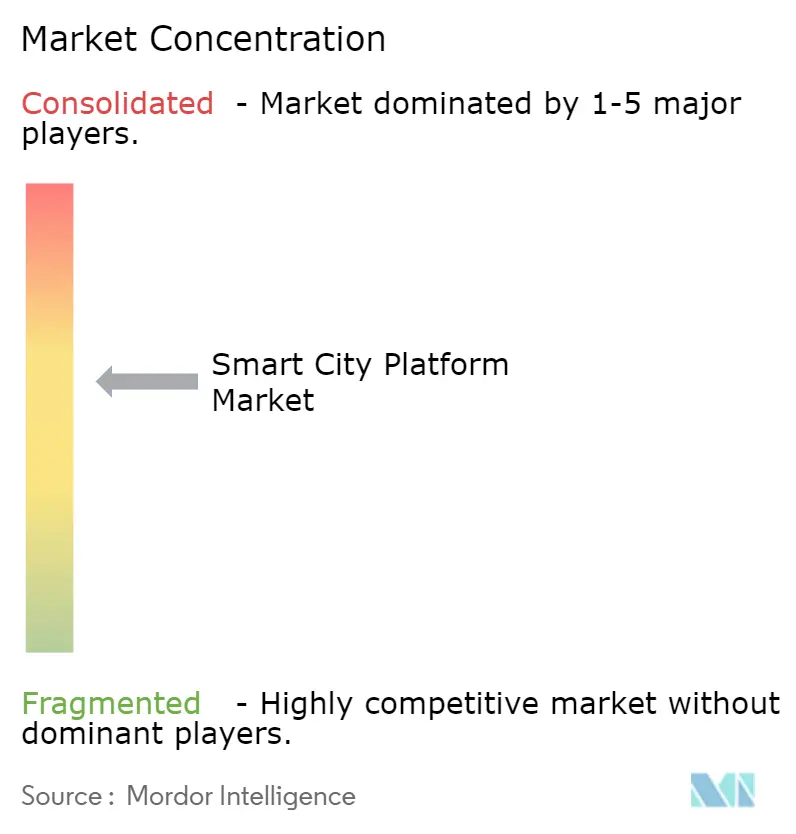
| Market Concentration | Medium |
Major Players *Disclaimer: Major Players sorted in no particular order Image © Mordor Intelligence. Reuse requires attribution under CC BY 4.0. | |
Smart City Platform Market Analysis by Mordor Intelligence
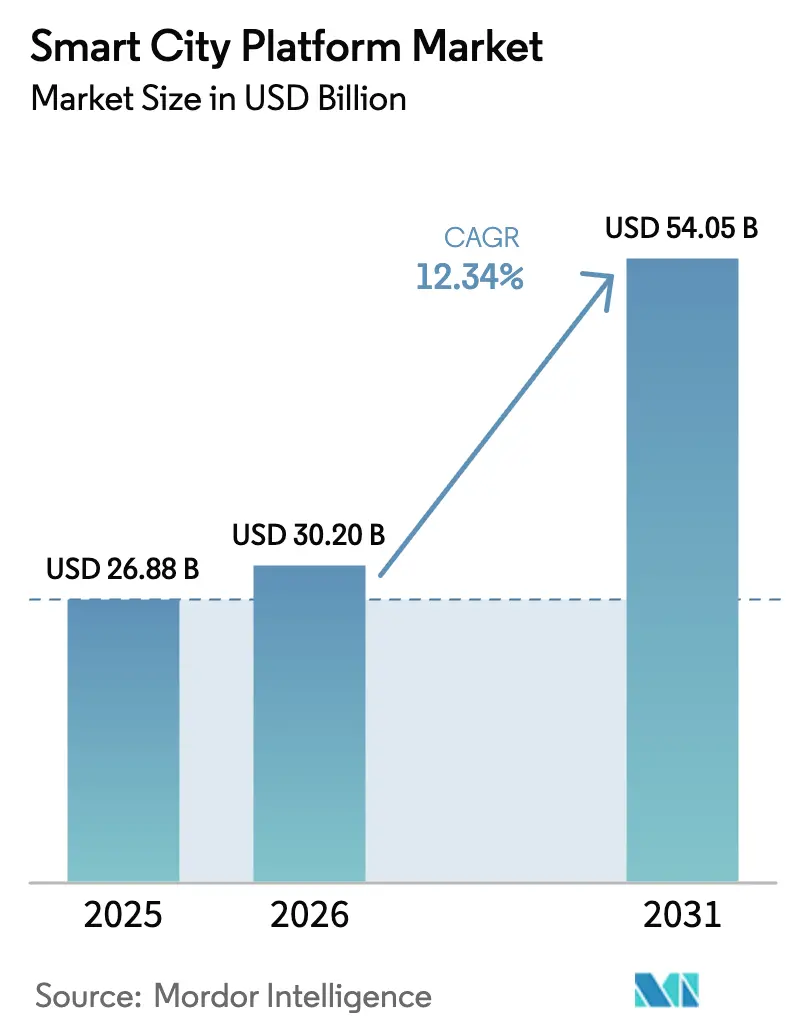
The smart city platform market size reached USD 30.20 billion in 2026 and is projected to climb to USD 54.05 billion by 2031, delivering a compelling 12.34% CAGR across the forecast horizon. Interoperability mandates, sovereign data rules, and the declining cost of edge inference are reshaping procurement, prompting cities to favor open architectures and hybrid deployment models for latency-sensitive analytics. Cyber-resilience has become a budget equalizer, complemented by network orchestration, while data monetization pilots in Europe and North America validate new revenue streams for municipalities. Funding momentum is strong, with public outlays surpassing USD 38.4 billion in 2025. China, India, and South Korea are utilizing national programs to accelerate the adoption of second-tier cities. At the same time, 5G densification and 420 million LPWAN connections have created a tiered connectivity fabric that lowers per-endpoint costs and broadens the addressable device base.
Key Report Takeaways
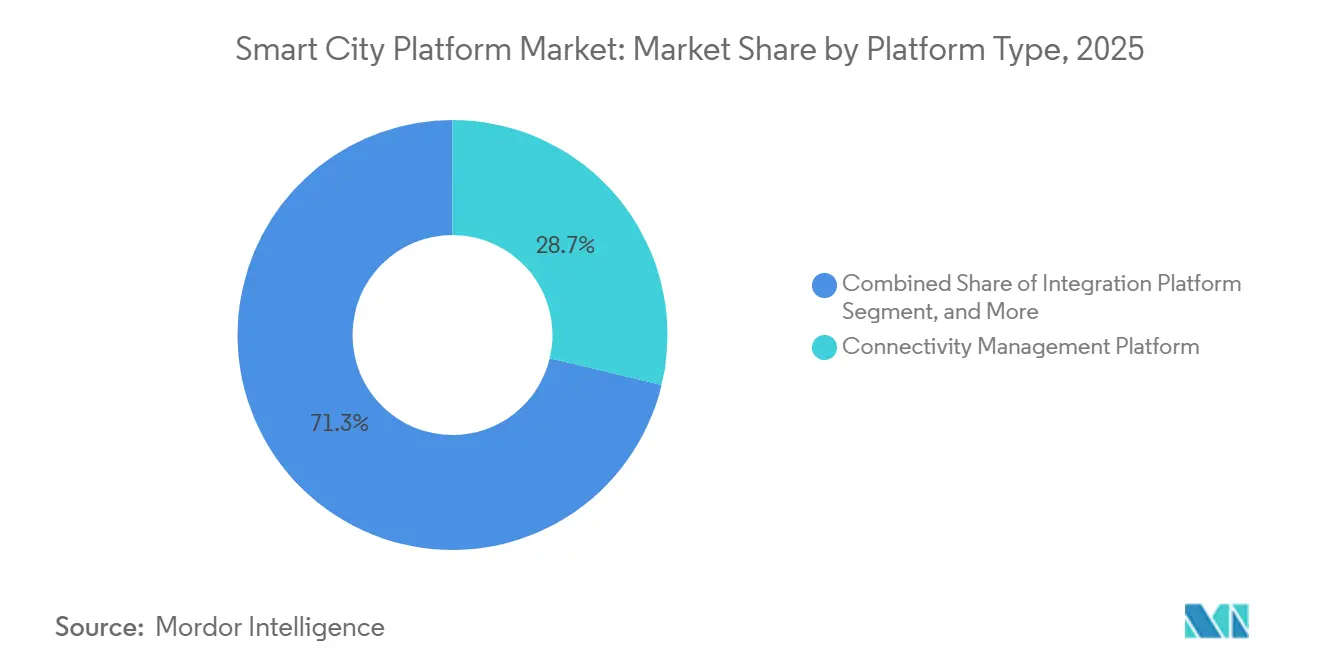
- By platform type, connectivity management platforms led with 28.73% share in 2025, while security platforms are set to post a 13.02% CAGR through 2031.
- By application, smart infrastructure commanded 31.84% of the smart city platform market share in 2025, and smart healthcare is forecast to expand at a 13.55% CAGR through 2031.
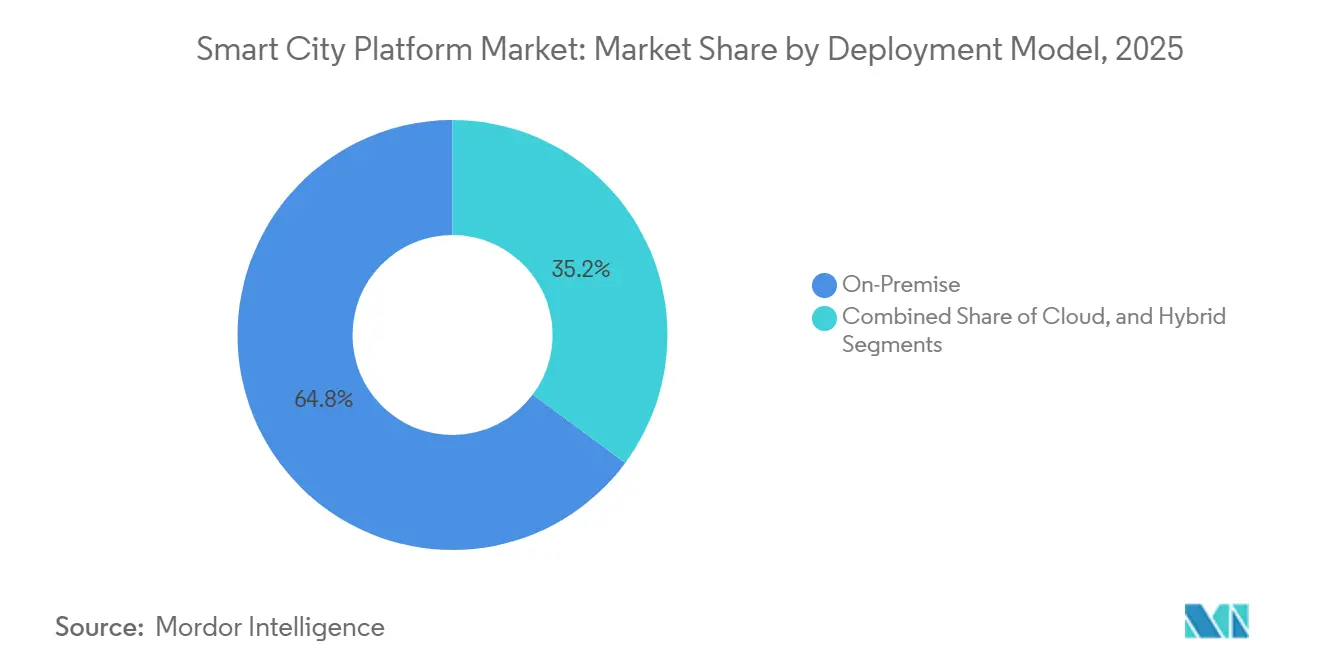
- By deployment model, on-premise installations accounted for 64.84% of the smart city platform market size in 2025, whereas cloud deployments are projected to advance at a 14.05% CAGR to 2031.
- By end user, government and municipalities held 53.84% spending share in 2025, and healthcare providers show the fastest trajectory with a 13.89% CAGR to 2031.
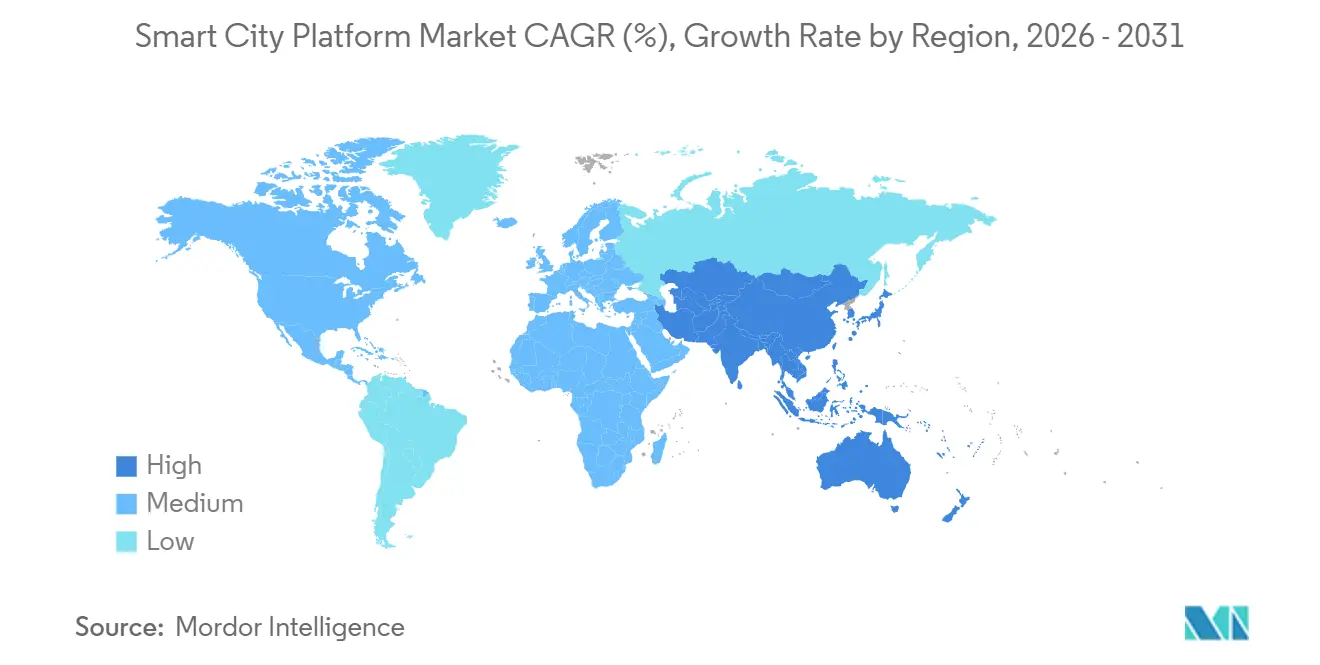
- By geography, North America captured a 38.74% share in 2025, while Asia-Pacific is predicted to grow at a 13.78% CAGR during the forecast window.
Note: Market size and forecast figures in this report are generated using Mordor Intelligence’s proprietary estimation framework, updated with the latest available data and insights as of January 2026.
Market Trends and Insights
Drivers Impact Analysis of Smart City Platform Market*
| Driver | (~) % Impact on CAGR Forecast | Geographic Relevance | Impact Timeline |
|---|---|---|---|
| IoT-Device Proliferation Across Urban Infrastructure | +2.8% | Global, with early density in North America and Asia-Pacific core cities | Medium term (2-4 years) |
| Expanding Government Smart-City Funding Programs | +2.5% | North America, Europe, Asia-Pacific (China, India, South Korea) | Short term (≤ 2 years) |
| AI- and Cloud-Enabled Real-Time Analytics Adoption | +2.3% | Global, led by North America and Europe | Medium term (2-4 years) |
| Rapid Roll-Out of 5G and LPWAN Connectivity | +1.9% | Asia-Pacific, North America, Middle East (UAE, Saudi Arabia) | Long term (≥ 4 years) |
| Interoperability Mandates (NGSI-LD, OASC MIMs) | +1.4% | Europe (EU-wide), spillover to South America (Brazil, Argentina) | Long term (≥ 4 years) |
| Monetisation of Municipal Data Marketplaces | +0.9% | Europe, North America (pilot cities), emerging in Asia-Pacific | Long term (≥ 4 years) |
| Source: Mordor Intelligence | |||


IoT-Device Proliferation Across Urban Infrastructure
Global municipal IoT endpoints reached 1.2 billion in 2025, a 41% increase from 2024, as utilities, environmental agencies, and public works departments scaled up connected devices.[1]Cisco Systems, “Cisco Annual Internet Report, 2025,” CISCO.COM Density remains uneven, with tier-one cities averaging 18 devices per capita, while tier-two municipalities average six, obliging platform vendors to support both high-volume, low-latency workloads and battery-constrained networks. Edge inference is now a design prerequisite, for instance, Intel’s OpenVINO toolkit trimmed video-analytics latency by 62% in 47 deployments, freeing bandwidth budgets for additional sensors.[2]Intel Corporation, “OpenVINO Toolkit Deployment Report,” INTEL.COM This distributed pattern reduces backhaul costs, which still exceed USD 0.08 per gigabyte in fiber-poor markets. Vendor strategies, therefore, emphasize auto-scaling data pipelines and plug-and-play device onboarding to address the bifurcated demand profile.
Expanding Government Smart-City Funding Programs
Public investment increased 29% year-over-year to USD 38.4 billion in 2025, creating a vital flywheel for the smart city platform market.[3]National Development and Reform Commission, “New Infrastructure Initiative 2024-2025,” NDRC.GOV.CN The Infrastructure Investment and Jobs Act allocated USD 1.2 billion for U.S. digital infrastructure, while the European Union’s Digital Europe Programme committed EUR 1.8 billion (USD 2.0 billion) through 2027. China, India, and South Korea are channeling funds toward tier-two cities to bridge urban-rural gaps, often stipulating NGSI-LD compliance that benefits vendors with open APIs. Grants speed adoption but simultaneously heighten scrutiny of cybersecurity posture and data governance, prompting cities to incorporate interoperability and zero-trust provisions into RFPs from the outset.
AI and Cloud-Enabled Real-Time Analytics Adoption
Streaming analytics platforms processed 4.7 exabytes of city data monthly in 2025, 53% above 2024 volumes. Microsoft Azure IoT Hub deployments in 312 municipalities demonstrate the demand for event-driven automation that circumvents human latency in areas such as dynamic traffic rerouting. Amazon introduced IoT TwinMaker, allowing planners to stress-test infrastructure virtually;, for instance, Singapore’s transport authority used it to reduce bus commute times by 14%. Data-residency laws in Russia, China, and Gulf states necessitate a coexistence of cloud ramp-up with sovereign-cloud zones, prompting a multi-cloud stance that mitigates vendor lock-in and encourages platform providers to adopt container-based portability.
Rapid Roll-Out of 5G and LPWAN Connectivity
5G sites reached 8.2 million in 2025, while LPWAN connections hit 420 million, enabling a tiered architecture in which latency-critical tasks use 5G and low-data-rate sensors rely on LoRaWAN or NB-IoT. Verizon’s ThingSpace managed 34 million endpoints, generating USD 620 million in recurring revenue, a 41% increase over 2024. The United Arab Emirates now mandates 5G-ready IoT modules in all public projects, a directive echoed across the Gulf. For vendors, the connectivity upshift means platform scalability must accommodate millions of low-cost devices while guaranteeing millisecond-level performance for autonomous mobility and public-safety use cases.
Restraints Impact Analysis of Smart City Platform Market*
| Restraint | (~) % Impact on CAGR Forecast | Geographic Relevance | Impact Timeline |
|---|---|---|---|
| Data-Privacy and Cyber-security Concerns | -1.2% | Global, acute in Europe (GDPR), North America (state-level laws) | Short term (≤ 2 years) |
| High Up-Front Capital Expenditure | -1.0% | South America, Africa, Southeast Asia (budget-constrained municipalities) | Medium term (2-4 years) |
| Legacy-System Vendor Lock-In | -0.9% | North America, Europe (cities with 10+ year contracts) | Long term (≥ 4 years) |
| Shortage of City-Level Data-Governance Talent | -0.6% | Global, most severe in tier-two and tier-three cities | Medium term (2-4 years) |
| Source: Mordor Intelligence | |||
Data-Privacy and Cyber-Security Concerns
Municipal ransomware incidents rose 34% in 2025, pushing average remediation costs to USD 4.2 million. Europe’s Network and Information Security Directive 2 now requires 24-hour breach disclosure and penalties of up to 2% of annual revenue for non-compliance. Stricter rules strain vendor economics by increasing compliance overhead by 18% and compel cities to anonymize data, a step that can erode AI accuracy by as much as 19%, according to IEEE researchers. Zero-trust architectures mitigate exposure but necessitate network segmentation and continuous authentication, often delaying deployments by nine months. The policy headwind is particularly acute in privacy-sensitive applications such as healthcare and public-safety video, where citizen opposition can stall project approvals.
High Up-Front Capital Expenditure
A mid-size city needs USD 25-45 million to launch an integrated platform, a hurdle magnified in regions where per-capita IT spend averages only USD 12. Public-private partnerships help shift CapEx to vendors, such as São Paulo’s 2025 concession awarded Telefónica Brasil a 40% data monetization revenue share in exchange for a citywide IoT rollout. Blended finance could unlock USD 18 billion for emerging markets by 2028, yet complex risk-sharing terms lengthen contract cycles. Modular deployments that start with high-ROI use cases such as smart parking, which can fetch USD 1.8 million in annual revenue in a 200,000-population city, are gaining favor. Even so, lingering fears of vendor lock-in and unpredictable maintenance costs remain a brake on rapid scaling outside capital-rich regions.
*Our forecasts treat driver/restraint impacts as directional, not additive. The impact forecasts reflect baseline growth, mix effects, and variable interactions.
Smart City Platform Market Segment Analysis
By Platform Type:
Security Platforms Accelerate Amid Rising ThreatsSecurity management platforms are on track for a 13.02% CAGR from 2026 to 2031, reflecting municipal urgency to contain escalating cyber incidents. The segment’s surge contrasts with connectivity management’s 28.73% market-leading share in 2025, where revenue growth is moderating under pricing pressure. Integration platforms, which hold a 22% share in 2025, benefit from cities migrating to microservices that enable them to integrate legacy SCADA systems with contemporary analytics. Device-management products, at roughly 18% share, ride the wave of edge-AI node growth that requires continuous firmware updates. Data-management layers round out the landscape by leveraging NGSI-LD context models to ensure semantic portability across city silos, cementing their role in the smart city platform market.
Competition is intensifying. Cisco’s USD 28 billion acquisition of Splunk illustrated how network observability is converging with security analytics in an integrated stack. NGSI-LD-driven procurement favors open-source solutions with a pedigree, such as FIWARE, which is now active in 89 European municipalities. Vendors embed zero-trust modules, including Palo Alto Networks’ Prisma SASE features, in 23 city deployments to limit IoT attack surfaces. RFP language mirrors the shift as 68% of 2025 tenders mandate built-in threat response integration. As cities ask suppliers to assume cyber-risk, recurring service revenue from managed detection and response is emerging as a future profit pool within the smart city platform industry.


By Application:
Healthcare Emerges as the Growth LeaderSmart healthcare is projected to register a 13.55% CAGR to 2031, outpacing every other use case as telemedicine, ambulance routing, and air-quality-linked care become staples of post-pandemic municipal health strategies. Smart infrastructure retained 31.84% of the smart city platform market share in 2025, reflecting the legacy outcome of early LED retrofits that have now been retrofitted with occupancy and daylight sensors. Mobility and transportation applications held roughly 24% share, aided by connected-vehicle pilots, while public-safety analytics contributed about 19%. Utilities and energy management captured 16%, mainly from advanced metering, and citizen-service portals comprise the remainder, with multilingual chatbots gaining traction.
Healthcare synergies illustrate cross-domain value, such as Seoul’s U-Healthcare initiative, which combines wearable and air-quality datasets to alert asthma patients in real-time. Singapore’s IoT fitness stations raised park usage 22% in 2025. Lighting vendors, such as Signify, embed acoustic sensors in luminaires for anomaly detection, resulting in an 18% reduction in police response times in pilot studies. Cybersecurity controls added to IEC 62386 lighting interfaces increase fixture costs by USD 8-12 per unit, but de-risk citywide rollouts, further proving that resilience premiums are now accepted as an overhead in the smart city platform market.
By Deployment Model:
Cloud Momentum Outruns Sovereignty HurdlesCloud deployments are on pace for a 14.05% CAGR, even as sovereign-cloud rules keep on-premise share high at 64.84% in 2025. Hybrid architectures partition sensitive workloads locally while tapping the cloud for compute-intensive analytics, aided by offerings such as Microsoft Azure Stack in 29 municipalities and AWS Outposts in 18. Oracle’s Cloud@Customer addresses residency hurdles by installing a full region inside client data centers, an approach Dubai adopted for its Smart Dubai initiative. Kubernetes orchestration is mainstream, with 54% of platforms utilizing it for workload portability. Cities weigh the total cost of ownership carefully, as the GAO analysis shows that five-year spending can fall by 23% for compute-heavy tasks but rise by 14% in storage-intensive workloads.
Data governance may slow the ascent of the cloud. The European Data Governance Act imposes constraints on cross-border data transfers, which complicate multi-region architectures. Nevertheless, elasticity and pay-as-you-go economics resonate with mid-size cities that lack capital budgets yet need rapid deployment. Vendors that supply policy-compliant sovereign instances while maintaining API parity with the public cloud will likely secure an outsized share of the growth in the smart city platform market in heavily regulated geographies.
By End User:
Healthcare Providers Drive the Fastest UptakeHealthcare providers are forecast to expand platform spending at 13.89% CAGR to 2031, eclipsing even utilities. The government and municipalities bankroll most projects, accounting for 53.84% of the 2025 expenditure, but their dominance will taper as hospitals, transport agencies, and energy utilities establish independent platforms. Utilities accounted for 21% in 2025, while transit operators accounted for 14%, driven by predictive maintenance that reduced downtime by 28%. Commercial entities, such as property developers, round out the remainder by tapping into foot-traffic analytics to refine site selection.
Joint city-hospital projects underscore convergence. The Cleveland Clinic embedded air-quality sensors throughout its campus, resulting in an 11% reduction in hospital-acquired infection rates. Kaiser Permanente joined Oakland’s smart grid to earn USD 340,000 in annual demand-response incentives. Outcome-based contracts, exemplified by Barcelona’s smart-lighting tender, which ties vendor payments to energy-saving targets, signal a shift toward service-level guarantees expected to spread across every vertical participating in the smart city platform market.
Geography Analysis
North America Smart City Platform Market
North America accounted for 38.74% of the revenue in 2025, driven by federal and provincial grant programs and a growing utility modernization market. Chicago’s Azure Digital Twins rollout across 2,400 buildings exemplifies the region’s tilt toward energy-efficiency use cases, with projected annual savings of USD 14 million. Yet procurement fragmentation persists because the United States lacks a national smart-city mandate, forcing vendors to navigate disparate state rules. Canada’s CAD 75 million (USD 55 million) Smart Cities Challenge funds illustrate how smaller economies catalyze projects through competitive grants. Mexico’s MXN 8.5 billion (USD 500 million) mobility effort demonstrates rising Latin American interest, although budget reallocations after a 2025 cyber breach slowed implementation.
APAC Smart City Platform Market
Asia-Pacific is the fastest-growing region, forecast at a 13.78% CAGR as China’s CNY 120 billion (USD 16.8 billion) New Infrastructure Initiative and India’s INR 48,000 crore (USD 5.8 billion) Smart Cities Mission phase two pull tier-two cities into the digital fold. Domestic champions such as Huawei and Alibaba Cloud leverage data-localization policies to capture share, while Japan’s JPY 120 billion (USD 820 million) digital-twin program signals renewed momentum in mature economies. South Korea’s KRW 2.1 trillion (USD 1.6 billion) fund positions the nation as a testing ground for autonomous mobility platforms. Australia’s open-data exchanges appear small in budget terms but generate outsized developer engagement that broadens ecosystem depth.
Europe Smart City Platform Market
Europe’s trajectory pivots on interoperability mandates. The EU directive to adopt NGSI-LD by 2026 forces vendors to open proprietary schemas or forfeit access to one of the world’s largest smart city platform markets. National programs in the United Kingdom, Germany, France, Italy, and Spain collectively exceed USD 1.9 billion for 2025 alone. Germany’s EUR 500 million (USD 565 million) connected-vehicle retrofit illustrates how transport applications integrate with broader city platforms. Southern Europe receives targeted allocations to narrow digital divides, evidenced by Italy’s EUR 410 million (USD 464 million) resiliency budget. Spain’s Red.es backs municipal IoT frameworks with EUR 290 million (USD 328 million), employing Barcelona’s Sentilo architecture as a blueprint.
MEA and South America Smart City Platform Market
South America, the Middle East, and Africa remain in early adoption mode yet supply landmark projects. Brazil earmarked BRL 1.8 billion (USD 360 million) for mobility upgrades in major cities, although federal negotiations have delayed disbursement. Saudi Arabia’s USD 500 billion NEOM integrates Siemens MindSphere for greenfield infrastructure. South Africa secured African Development Bank financing for a ZAR 480 million (USD 26 million) smart-water platform that slashes non-revenue water by 18%. Nigeria’s NGN 15 billion (USD 10 million) pilot in Lagos and Abuja test-beds traffic management and waste-collection platforms. Limited fiber backbones and power instability still curtail rapid expansion, yet blended finance and modular deployments create footholds for future scaling of the smart city platform market.

Regulatory Landscape
Interoperability and data-governance requirements are tightening across major smart-city funding regions, which is shaping platform architecture and how procurement language is drafted. In the European Union, the Interoperable Europe Act (Regulation (EU) 2024/903) formalizes legal, organizational, semantic, and technical interoperability expectations for public sector digital services. It reinforces the European Interoperability Framework in city tenders and accelerates adoption of mechanisms such as NGSI-LD and related semantic models.
Standards bodies and national frameworks are also adding guidance that cities and prime contractors can cite in RFPs. ISO/IEC 17917:2024 provides a decision framework for sharing data and information services in smart cities, while ISO 37187 (published May 2026) sets out guidance for data exchange and sharing for city information modelling platforms. China also strengthened its national standardization backdrop with CNIS publishing T/CA 027-2026 (effective April 13, 2026) on general technical requirements for constructing smart city management information platforms, increasing the emphasis on documented technical baselines and compliance evidence in large municipal deployments.
Value Chain Analysis
The smart city platform value chain begins with enabling infrastructure and components (sensors, cameras, meters, edge compute, and connectivity such as 5G and LPWAN). It then moves into platform software layers delivered by hyperscalers and industrial software providers, including device and connectivity management, integration and API management, data management, digital twins, analytics, and security. Systems integrators and telecom operators typically aggregate multi-vendor stacks into outcome-based city programs, along with managed services that cover onboarding, observability, incident response, and lifecycle upgrades for heterogeneous assets.
Standards and public-sector coordination increasingly influence where value is captured along the chain, pushing buyers away from monolithic deployments toward modular ecosystems. In this model, interoperability brokers and governance tooling become practical differentiators. ITU-T Recommendation Y.4505 (adopted August 2024) defines Minimal Interoperability Mechanisms, while the European Commission elevated Local Digital Twins and Smart Cities (Action 17) within the 2025 Union work programme for European standardisation, strengthening demand for standardized interfaces that let SMEs plug into city data layers. In China, GB/T 45845.1-2025 (released June 2025) provides a framework for smart city infrastructure business collaboration (aligned with ISO 37155-1), reinforcing multi-actor operating models across telecom providers and infrastructure stakeholders, and highlighting integration and data-governance bottlenecks as execution risks.
Competitive Landscape
The smart city platform market exhibits moderate concentration, with no single supplier controlling more share. However, the top five suppliers hold most of share, leaving space for agile entrants. Infrastructure incumbents, such as Siemens and Schneider Electric, leverage decades-old relationships in utilities and transportation to upsell software. Hyperscalers like Microsoft and Amazon compete on pay-as-you-go economics, easing budget strain for mid-sized cities. Regional specialists, including Quantela and Alibaba Cloud, win business by tailoring solutions to local regulations and payment frameworks.
Patent activity confirms strategic focus on edge intelligence. The USPTO granted 1,240 smart-city-related patents in 2025, with 38% centered on edge-AI inference and 22% on energy-harvesting modules. Standards evolution is also a competitive lever as 127 cities endorse OASC Minimal Interoperability Mechanisms, and 54% of European RFPs now require NGSI-LD compliance. Vendors slow to open APIs risk exclusion from EU-funded projects and fast-growing South American tenders modeled on European rules.
Strategic moves underscore consolidation and capability gaps. Siemens earmarked EUR 450 million (USD 495 million) for edge-node expansion to meet EU data-residency mandates. Schneider Electric purchased Planon for EUR 680 million (USD 748 million) to merge energy and space optimization. Huawei’s CNY 3.2 billion (USD 448 million) Shenzhen contract will connect 8 million endpoints, cementing its domestic lead amid export restrictions. Amazon’s FleetWise for Smart Cities piloted in Seattle and Austin, slicing commute times 11% and proving hyperscaler credibility in traffic management. Start-ups differentiate through modular Kubernetes-native stacks such as QuantelaOS enables incremental rollouts in India, winning 12 city deals without full-platform lock-in.
Market dynamics suggest a continuing tug-of-war between open and proprietary ecosystems. Cities prioritize cyber-resilience and data sovereignty, nudging vendors toward zero-trust frameworks and sovereign-cloud configurations. Consumption-based pricing and outcome-linked contracts will likely intensify as municipalities seek to shift risk to suppliers while ensuring measurable service levels, pushing the smart city platform market toward deeper specialization and service-driven revenue models.
Smart City Platform Industry Leaders
Nokia Corporation
Microsoft Corporation
Hitachi Ltd.
Huawei Technologies Co., Ltd.
Schneider Electric SE
- *Disclaimer: Major Players sorted in no particular order
Smart City Platform Market Companies Covered in this Report
- Siemens Aktiengesellschaft
- Schneider Electric SE
- Microsoft Corporation
- Hitachi, Ltd.
- Huawei Technologies Co., Ltd.
- Cisco Systems, Inc.
- General Electric Company
- International Business Machines Corporation
- Alibaba Group Holding Limited
- Amazon Web Services, Inc.
- Oracle Corporation
- SAP SE
- Telefonaktiebolaget LM Ericsson
- Fujitsu Limited
- NEC Corporation
- Itron, Inc.
- Atos SE
- Nokia Corporation
- Quantela, Inc.
- Intel Corporation
- PTC Inc.
- Bosch.IO GmbH

Market Opportunities and Future Outlook
Standardized interoperability and measurement frameworks are creating room for platforms that operationalize cross-domain data sharing, KPI reporting, and audit-ready governance in municipal programs. The EU push on interoperability, anchored by Regulation (EU) 2024/903, and the mainstreaming of Minimal Interoperability Mechanisms such as ITU-T Y.4505 are reflected in procurement language that favors open APIs, semantic portability, and simpler integration of legacy systems into modern data and digital-twin layers. Vendors that combine NGSI-LD-aligned context management, policy-based data access, and security-by-design capabilities into deployable reference stacks are seeing a clearer fit in EU-funded and standards-driven tenders where lock-in concerns remain a key barrier.
Urban mobility and AI-enabled physical infrastructure are also shaping near-term demand patterns, because platforms link real-time telemetry, digital twins, and decision automation. On July 9, 2026, the European Commission adopted an implementing regulation establishing harmonised urban mobility indicators under the revised TEN-T Regulation (EU) 2024/1679, which increases the need for platforms that can collect, normalize, and report comparable mobility datasets across urban nodes. In parallel, ITU-T work on AI for Smart and Sustainable Cities and Communities (FG-AI4SSC, established June 2026) points to a growing market for city-grade AI governance and deployable AI frameworks. Investments such as the July 2026 groundbreaking for Malaysia's first smart AI container port in Pasir Panjang also underline demand for platform providers able to integrate logistics, energy, and security workflows across operational technology environments.
Recent Industry Developments in Smart City Platform Market
- June 2026: Johor state government partnered with Huawei and Agibot to develop the RM80 billion Johor Tech Smart City project, with a focus on AgTech and knowledge/AI campus models. The initiative expands demand for integrated city platforms that combine connectivity, edge compute, and application orchestration across multiple development zones, strengthening Huawei-centric ecosystems in Southeast Asia.
- July 2025: Memphis Light, Gas and Water selected Nokia to deploy a standalone private 5G network for grid modernization across Memphis and Shelby County, Tennessee. The program links utility modernization with smart-city platform needs around secure connectivity management, device onboarding, and low-latency operations for critical infrastructure.
- June 2024: Hitachi and Microsoft entered an agreement to accelerate business and social innovation with generative AI, targeting combined solutions across data platforms, cloud infrastructure, and operational technology domains. The collaboration supports smart-city use cases where municipalities and operators want reusable AI capabilities embedded into digital twins and real-time analytics stacks while maintaining governance and security controls.


Smart City Platform Market Report Scope and Research Methodology
Market Definition and Coverage
For this study, the smart city platform market covers software platforms that connect, integrate, secure, and manage city data and devices so digital city services can be delivered across multiple departments.
Scope exclusions: We exclude standalone smart city hardware, civil infrastructure construction spend, and pure connectivity services when they are not sold as part of a city platform layer.
Segments Covered in This Report
- By Platform Type
- Connectivity Management Platform
- Integration Platform
- Device Management Platform
- Data Management Platform
- Security Management Platform
- By Application
- Smart Mobility / Transportation
- Smart Security and Public Safety
- Smart Utilities (Energy / Water)
- Smart Governance and Citizen Services
- Smart Infrastructure (Buildings / Street Lighting)
- Smart Healthcare
- By Deployment Model
- On-Premise
- Cloud
- Hybrid
- By End-User
- Government and Municipalities
- Utilities and Energy Providers
- Transportation and Logistics Operators
- Healthcare Providers
- Other Commercial Enterprises
- By Geography
- North America
- United States
- Canada
- Mexico
- South America
- Brazil
- Argentina
- Rest of South America
- Europe
- United Kingdom
- Germany
- France
- Italy
- Spain
- Rest of Europe
- Asia-Pacific
- China
- Japan
- India
- South Korea
- Australia and New Zealand
- Rest of Asia Pacific
- Middle East and Africa
- Middle East
- Saudi Arabia
- United Arab Emirates
- Turkey
- Rest of Middle East
- Africa
- South Africa
- Nigeria
- Rest of Africa
- Middle East
- North America
Data Sources, Market Sizing, and Validation
Desk Research
Desk research is used to set the outer limits of what counts as a platform, and to build reality checks around city digitization spend and project pipelines. Public sources such as the United Nations urbanization statistics, World Bank development indicators, OECD digital government publications, NIST smart city and cybersecurity guidance, and the European Commission data and smart communities programs were referenced as starting points.
We also review supplier filings and investor presentations, municipal open data portals, procurement notices, and reputable tech and infrastructure press to track deployments and common platform feature sets. Where needed, a paid subscription for company financials and intelligence, patent lookups, and global contracts and tenders is used to validate product positioning and the timing of major awards. These desk sources are illustrative only, and many other public references were also used for data collection, cross-checks, and clarification.
Primary Interviews and Surveys
Primary work focuses on checking which revenues are genuinely platform-related versus adjacent IT services, and how pricing is structured across cloud, hybrid, and on-premises deployments. We speak with platform providers, system integrators, city IT leaders, utilities and transport operators, and solution owners across major regions so assumptions on adoption timing, renewal cycles, and typical deal sizes can be checked against how projects run in practice.
Distribution of primary research fieldwork respondents
| Company type | Respondent position | Region |
|---|---|---|
| Top tier: 35% | CXOs: 15% | APAC: 39% |
| Mid tier: 43% | Functional/Unit leaders: 28% | EMEA: 36% |
| Smaller Players: 22% | Managers: 57% | Americas: 25% |
Market-Sizing & Forecasting
Sizing starts with a top-down build where public smart city program activity and government digital service modernization signals are translated into an addressable demand pool for platform spending, then allocated across regions. The totals are corroborated with selective bottom-up approximations, such as sampled deal values from tenders, channel checks on platform subscription pricing, and a limited roll-up of disclosed smart city platform revenues where separation is possible.
Inputs that typically move the model include the number of active smart city projects by region, the cloud versus hybrid preference in municipal IT, the prevalence of multi-department use cases (mobility, utilities, governance, public safety), renewal and managed service attachment rates, and the pace of cybersecurity and data governance mandates that force platform upgrades. Where revenue splits are not cleanly reported, gaps are handled through interview-based allocation keys tied to platform modules and project scope, followed by consistency checks against procurement values.
For forecasting, scenario analysis is used. The base case is shaped by how quickly cities scale from pilots to citywide rollouts and how budgets shift between capital purchases and subscriptions. Growth paths are stress-tested by adjusting project conversion rates, module penetration, and pricing progression assumptions, and then rechecked with expert feedback before finalizing the time series.
Data Validation & Update Cycle
Validation is done by triangulating the modeled totals against independent signals, including procurement award patterns, public smart city funding announcements, and regional digital government readiness indicators. Large variances are investigated through source re-reads, assumption resets, and follow-up outreach when a module mix, deployment model, or currency timing looks inconsistent.
Before sign-off, a multi-step internal review is completed so the logic, calculations, and definitions remain consistent across regions and years. The report is refreshed annually, and interim updates are added when material events occur, such as major policy shifts, unusually large city platform awards, or visible changes in cloud adoption. Right before delivery, a final pass is done to ensure the newest public and interview inputs are reflected in the numbers clients receive.
Mordor Intelligence's Smart City Platform Market Size Compared With Other Published Estimates
Published market numbers for smart city platforms can look far apart because each publisher draws the line differently between platform software and the larger smart city solution stack, and then uses its own timing and pricing assumptions.
The main gap comes from whether adjacent spend like smart city hardware, connectivity services, and broad smart city solution revenues are bundled into the same total, where Mordor Intelligence counts only platform-layer revenues tied to connectivity, integration, device management, data management, and security management across smart city use cases.
Benchmark comparison
| Source | Market Size | Gaps in Research Methodology |
|---|---|---|
| Mordor Intelligence | USD 30.20 B (2026) | |
| Global Consultancy A | USD 76.15 B (2026) | Uses a broader interpretation that can extend into smart city solutions and services beyond the core platform layer, and the higher growth curve suggests more aggressive adoption and pricing progression assumptions. |
| Industry Research Group B | USD 24.51 B (2025) | Uses an earlier base year and a shorter forecast window, and the scope language emphasizes middleware and integration, which may undercount multi-module platforms and longer-term managed platform subscriptions. |
Taken together, the spread mainly reflects scope breadth, base-year choice, and how platform revenue is separated from wider smart city delivery. Our approach stays traceable to clear platform functions, a repeatable demand-pool build, and practical checks from tenders and interview feedback, which helps keep the market total balanced and explainable.


Key Questions Answered in the Report
What is the current value of the smart city platform market?
The smart city platform market size reached USD 30.20 billion in 2026 and is projected to reach USD 54.05 billion by 2031.
Which application is growing the fastest within city platforms?
Smart healthcare is the fastest-growing application, forecast to post a 13.55% CAGR through 2031 on the back of telemedicine and integrated patient-monitoring rollouts.
How significant is cybersecurity spending in new municipal projects?
Security platforms are expected to rise at a 13.02% CAGR as cities allocate up to 22% of their platform budgets to cyber-resilience measures.
Which region will add the most incremental revenue by 2031?
Asia-Pacific is poised for the largest absolute gain, fueled by substantial national programs in China, India, Japan, and South Korea and a forecast regional CAGR of 13.78%.
Do sovereign-cloud rules hinder cloud platform growth?
Despite strict data-localization mandates in multiple jurisdictions, cloud deployments are still set to grow at 14.05% CAGR as hybrid and sovereign variants satisfy compliance requirements.
Page last updated on:


 Your data is secure and never sold or shared.


