
Middle East Biodegradable Plastics Market Size and Share
Market Overview
| Study Period | 2020 - 2031 |
|---|---|
| Forecast Data Period | 2026 - 2031 |
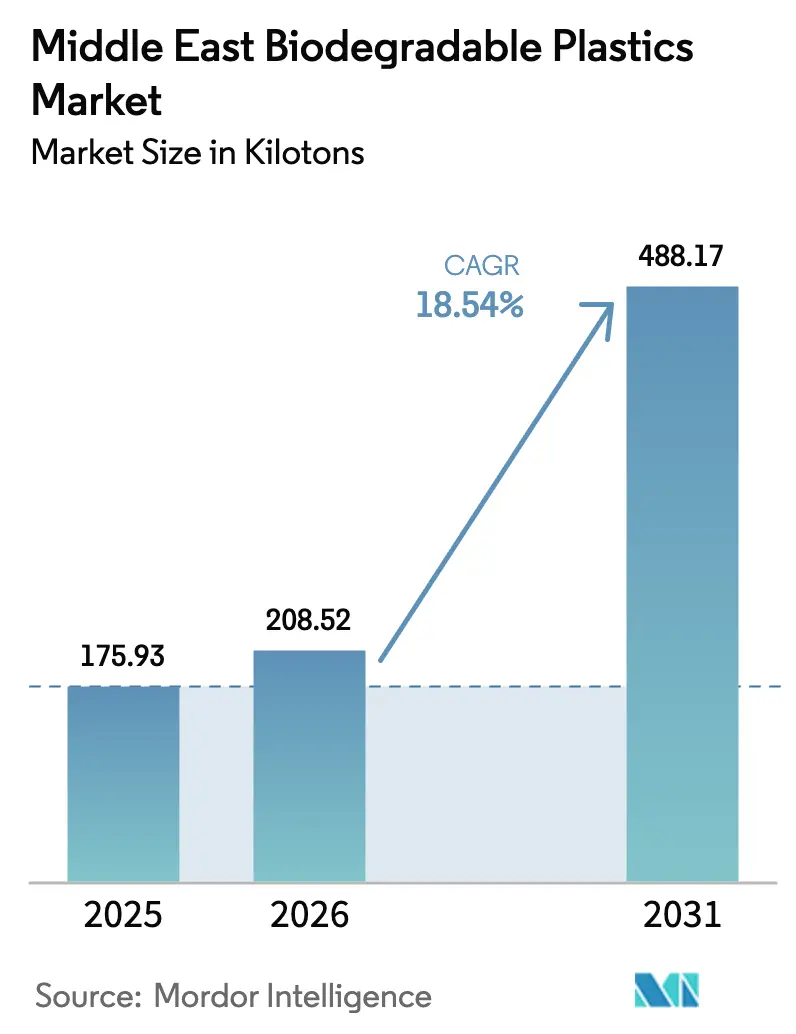
| Base Year Market Size (2025) | 175.93 kilotons |
| Market Volume (2026) | 208.52 kilotons |
| Market Volume (2031) | 488.17 kilotons |
| Growth Rate (2026 - 2031) | 18.54 % |
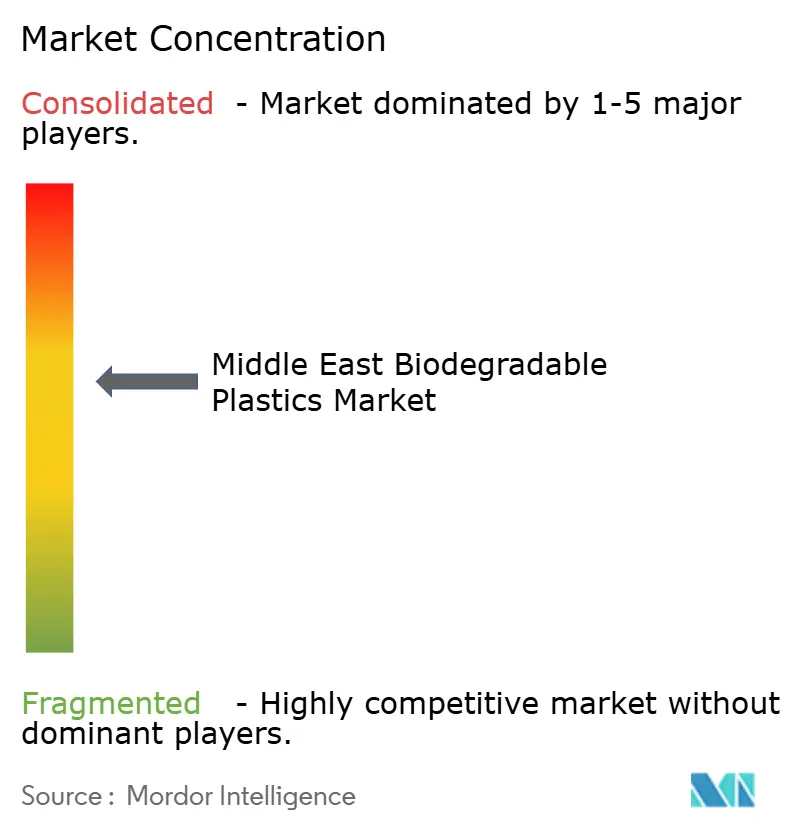
| Market Concentration | Medium |
Major Players *Disclaimer: Major Players sorted in no particular order Image © Mordor Intelligence. Reuse requires attribution under CC BY 4.0. | |
Middle East Biodegradable Plastics Market Analysis by Mordor Intelligence
The Middle East biodegradable plastics market size was valued at 175.93 kilotons in 2025 and estimated to grow from 208.52 kilotons in 2026 to reach 488.17 kilotons by 2031, at a CAGR of 18.54% during the forecast period (2026-2031). Legislated bans on single-use petroleum plastics, sovereign circular economy mandates, and retail procurement standards drive demand, while local bio-refinery investments shorten supply lead times and mitigate currency-linked freight risk. Corporate sustainability scorecards from hypermarket chains accelerate substitution, and consumer surveys show widening willingness to pay a premium for eco-labeled packs in urban GCC centers. Converter margins hinge on resin cost parity: biodegradable polyesters still command a 20–50% premium to commodity polyethylene, yet imports from Asia face voyage delays and freight surcharges that erode the gap. Infrastructure readiness remains the wild card; only a handful of industrial composting projects in Dubai and Riyadh operate at pilot scale, so end-of-life certainty varies by city and by polymer grade.
Key Report Takeaways
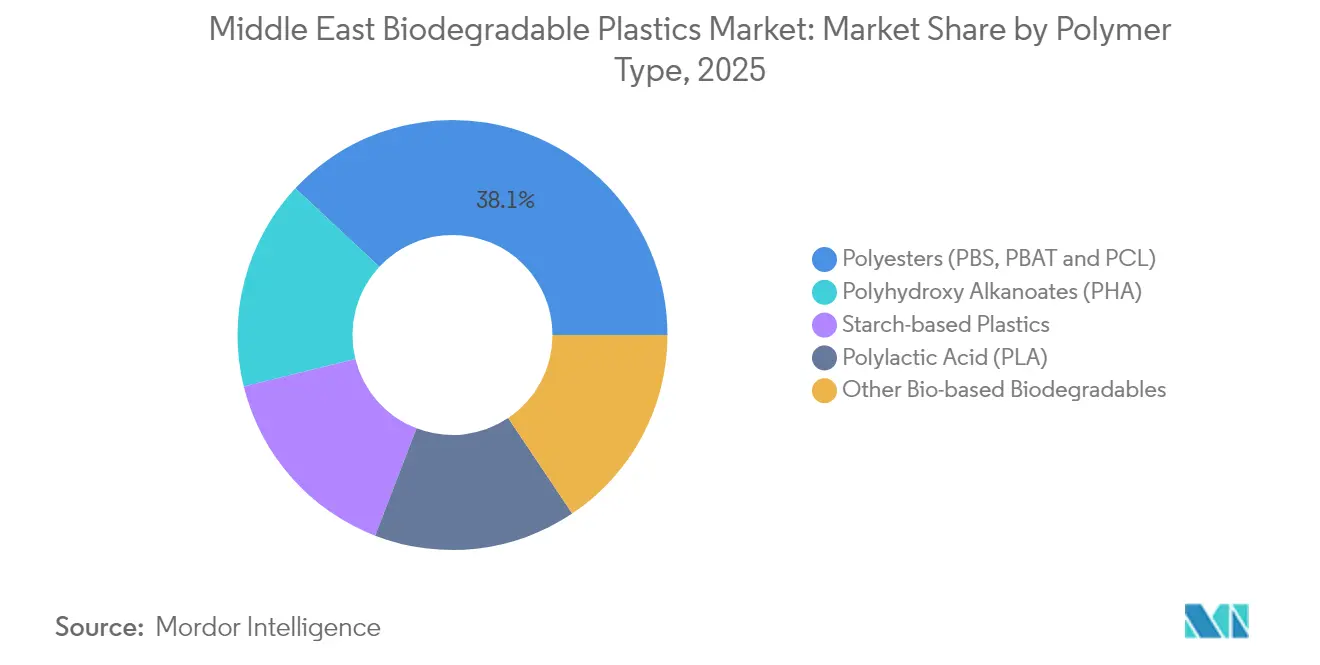
- By polymer type, polyesters captured 38.05% of the Middle East biodegradable plastics market share in 2025, while Polyhydroxyalkanoates (PHAs) are forecast to expand at a 19.34% CAGR through 2031.
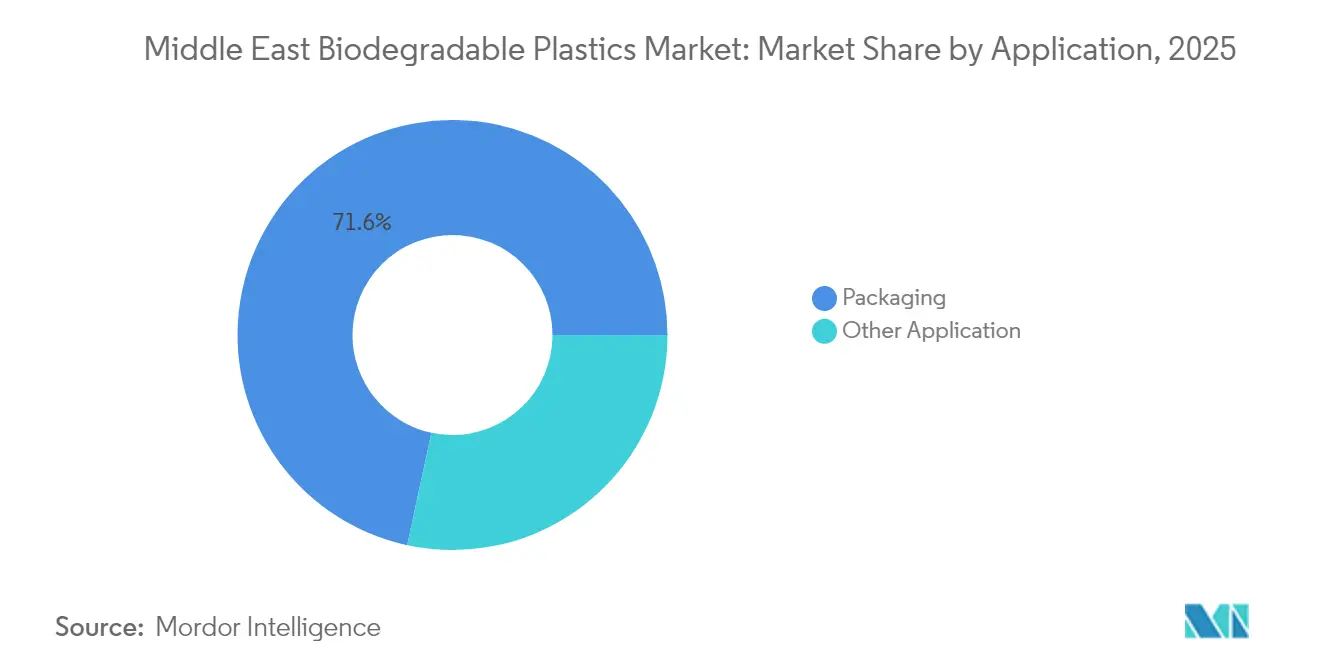
- By application, packaging accounted for 71.62% of the Middle East biodegradable plastics market size in 2025, while other applications are projected to rise at a 19.01% CAGR between 2026 and 2031.
- By geography, Saudi Arabia accounted for 41.10% of regional volume in 2025, while the UAE is projected to grow at a 19.43% CAGR through 2031.
Note: Market size and forecast figures in this report are generated using Mordor Intelligence’s proprietary estimation framework, updated with the latest available data and insights as of 2026.
Market Trends and Insights
Drivers Impact Analysis of Middle East Biodegradable Plastics Market*
| Drivers | (~) % Impact on CAGR Forecast | Geographic Relevance | Impact Timeline |
|---|---|---|---|
| Government bans on single-use plastics (UAE, KSA) | +4.5% | UAE (Dubai, Abu Dhabi), Saudi Arabia (Riyadh, Jeddah), with spillover to Qatar, Oman | Short term (≤ 2 years) |
| Corporate sustainability targets from FMCG and retail | +3.2% | GCC-wide, concentrated in the UAE and Saudi Arabia retail hubs | Medium term (2-4 years) |
| Rising consumer demand for eco-friendly packaging | +2.8% | Urban centers across GCC (Dubai, Riyadh, Doha), expanding to secondary cities | Medium term (2-4 years) |
| Industrial composting projects in GCC | +2.5% | UAE (Dubai, Abu Dhabi), Saudi Arabia (Riyadh cluster), pilot sites in Qatar | Long term (≥ 4 years) |
| Saudi Vision 2030 funding bio-refineries | +3.0% | Saudi Arabia (industrial clusters in Eastern Province, Jubail), with regional technology spillover | Long term (≥ 4 years) |
| Source: Mordor Intelligence | |||
Government Bans on Single-Use Plastics Drive Substitution Demand
Dubai enforced its single-use plastic ban in June 2024, and Carrefour UAE reported a 70% drop in carrier bag usage during the first quarter of compliance[1]. Saudi Arabia is introducing mirror regulations through the National Center for Waste Management, which aims to achieve 90% landfill diversion by 2040 and allocates capital for expanding composting capacity in the five largest urban clusters. Retail audits and import checkpoints, rather than producer levies, ensure compliance, so cost pressure shifts downstream to converters. Larger FMCG brand owners absorb the resin premium in exchange for label differentiation, but small converters struggle with cash-flow lockups. The policy trajectory hints at future bans on rigid containers and food-service ware once composting throughput ramps.
Corporate Sustainability Targets Reshape Procurement Specifications
Majid Al Futtaim phased out single-use plastics in its Lifestyle division in 2024 and intends to extend this policy across its owned properties by 2025, requiring suppliers to source resins certified to ISO 14855 or EN 13432. Lulu Group is piloting edible film wraps that disintegrate in hot water, a marketing play that doubles as a compliance hedge. TotalEnergies Corbion’s Luminy PLA boasts an 85% lower cradle-to-gate carbon footprint compared to petroleum plastics, and its 100% recycled-content grade features a negative footprint, providing procurement officers with a ready-made lifecycle narrative. Retail Green Star leases link tenant ratings to sustainable materials, pushing ecological metrics deep into mall supply chains and signaling that sustainability clauses will soon be standard in GCC commercial property.
Rising Consumer Willingness to Pay for Eco-Labeled Products
An Ipsos study found that 82% of UAE consumers are willing to compromise for environmental benefits, yet many remain uncertain about the actionable steps they can take. Retail promotions close the knowledge gap: Plastic-Free July discounts on juco bags at Carrefour boosted reusable-bag adoption, and loyalty-card tie-ins convert eco-intent into measurable sales. Performance parity is critical; early starch blends failed moisture tests, but next-gen PLA-PBS blends keep barrier integrity in desert logistics. Premium health-food categories now feature fully compostable pouches without volume loss, demonstrating that urban consumers will accept a 5–7% price differential as performance concerns subside.
Industrial Composting Infrastructure Determines End-of-Life Viability
Saudi Arabia has earmarked more than 840 waste-treatment facilities by 2040; yet, only a fraction will be composting plants with the residence time required for PLA or PBAT conversion. Dubai malls operate food digesters that convert kitchen waste into gray water and fertilizer, but they do not reach the 58 °C threshold required for ISO-grade polymer breakdown. Without fit-for-purpose sites, biodegradable films may either enter landfill methane pathways or contaminate PET recycling streams, undercutting the green narrative. The policy debate now centers on extended producer responsibility schemes that would shift capital expenditures from municipalities to resin sellers, but petrochemical lobbyists argue for technology-neutral frameworks that give chemical recycling equal weight.
Restraints Impact Analysis of Middle East Biodegradable Plastics Market*
| Restraints | (~) % Impact on CAGR Forecast | Geographic Relevance | Impact Timeline |
|---|---|---|---|
| Cost premium over petroleum plastics | -2.5% | GCC-wide, most acute in price-sensitive segments (commodity packaging, agricultural films) | Short term (≤ 2 years) |
| Limited regional composting / recycling infrastructure | -2.0% | All Middle East geographies, with infrastructure gaps most severe outside UAE and Saudi Arabia urban centers | Medium term (2-4 years) |
| Petrochemical lobby influence on policy | -1.5% | Saudi Arabia, UAE (where petrochemical sector represents significant GDP share and employment) | Long term (≥ 4 years) |
| Source: Mordor Intelligence | |||
Cost Premium Constrains Adoption in Price-Sensitive Segments
Biodegradable resins sell at a 20–50% markup to virgin polyethylene and polypropylene due to high feedstock costs and lower line throughput. FMCG giants absorb the delta to meet ESG targets, but commodity packagers that serve low-margin staples cannot. In the absence of EPR subsidies, the market tends to skew toward premium categories and pilot hospitality programs rather than mass retail. Distributors attempt to mitigate freight costs by transshipping from Asia in break-bulk lots; however, spot rates on the Far East-Gulf lane remain volatile. Local PLA capacity, once operational, will narrow the premium by saving on freight and duties; until then, price remains the primary barrier.
Limited Composting Infrastructure Creates End-of-Life Uncertainty
Pilot composting tunnels in Riyadh and Dubai handle mixed food waste but lack polymer certifications, so most compostable packs still exist in retail, often mixed with black-bag streams. Discover Applied Sciences reports that enzymatic depolymerization pilots struggle with feedstock contamination and skilled-operator shortages. If packs fail to degrade, consumer trust erodes, and recyclers complain about cross-polymer contamination, lobbying regulators to slow biodegradable mandates. Saudi municipal tenders for composting plants list 2028–2030 commissioning windows, indicating a multi-year lag between policy and infrastructure implementation.
*Our forecasts treat driver/restraint impacts as directional, not additive. The impact forecasts reflect baseline growth, mix effects, and variable interactions.
Middle East Biodegradable Plastics Market Segment Analysis
By Polymer Type:
Polyester Dominance, PHA RisingPolyesters secured 38.05% of the Middle East biodegradable plastics market share in 2025 because PBS and PBAT drop seamlessly into existing film lines, and converters appreciate their toughness in extreme Gulf summer logistics. The segment also benefits from ASEAN supply chains that deliver ready-compounded grades with food-contact status. Local poly-butylene succinate synthesis remains limited, but PET resin majors contemplate debottlenecking to run bio-succinate.
PHA is projected to enjoy the fastest growth at a 19.34% CAGR. Its marine biodegradability suits coastal tourism zones under pressure to curb plastic litter. Emirates Biotech has signaled interest in PHA copolymer expansion once its PLA trains are settled, reflecting the converter's appetite for resins that degrade in seawater. Still, fermentation yields lag PLA, keeping PHA price points at a premium. Technology partnerships with enzyme specialists aim to increase yields and make PHA viable for high-volume items, such as straw wraps and snack films, by the late 2020s.

By Application:
Packaging Dominates, Other Uses AcceleratePackaging accounted for 71.62% of the Middle East biodegradable plastics market size in 2025, driven by carrier bag bans and retailer scorecards. Barrier-improved PLA–PBAT blends are now replacing PET trays for salads and cold cuts, while heat-stable stereocomplex PLA trials are proceeding for dairy tubs. Consumers reward these shifts with measurable basket lifts in organic aisles. Most user awareness campaigns continue to link bag charges to mangrove replanting, reinforcing behavioral change.
Other Applications grow at a 19.01% CAGR, influenced by greenhouse horticulture. Soil-degradable mulch films spare farmers the USD 150–200 per hectare retrieval cost of PE films. Saudi date growers are trialing PHA-coated fertilizer pellets that release micronutrients as the coating decomposes. The adoption of disposable serviceware rose in premium hotels catering to sustainability-conscious tourists; however, coffee-cup lids remained dominated by PLA-coated paper imports until local thermoformers mastered high-flow PCL blends.
Geography Analysis
Saudi Arabia Biodegradable Plastics Market
Saudi Arabia accounted for a 41.10% share of the Middle East biodegradable plastics market in 2025, benefiting from Vision 2030’s USD 20 billion allocation to the waste sector, a population of 35 million, and policy targets aiming for 90% landfill diversion. Riyadh alone produces 25.8 million tons of waste annually and plans to establish 80 treatment centers, six of which will include composting tunnels. Procurement frameworks reward domestic content, so resin makers with local presence secure early offtake. Municipal tenders, however, bundle composters with anaerobic digesters, slowing award cycles.
United Arab Emirates Biodegradable Plastics Market
The UAE is the fastest-growing geography at a 19.43% CAGR. Dubai’s June 2024 carrier-bag ban cut single-use volumes by 70% within a quarter at Carrefour and set the reference model for Abu Dhabi’s follow-on regulation. Kezad has attracted USD 40 million in pledges for biodegradable polymers, including a 30,000 tons per year PLA line from Emirates Biotech, which is scheduled to be commissioned in early 2028. Retail chains, such as Majid Al Futtaim, incorporate sustainability clauses into leases, ensuring that packaging substitution cascades to tenants.
Broader Middle East Markets
Rest-of-Middle-East markets remain fragmented. Qatar’s hospitality drives niche demand, but its small population limits volume. Oman positions itself as a maleic anhydride hub with a 50,000 tons per year plant in Salalah that feeds polyester roots. Sanctions curb Iran’s access to Western fermentation technology, although academic labs are piloting starch-blend mulch for pistachio orchards. Kuwait and Bahrain follow GCC norms before acting, so adoption spikes will likely lag behind those of Saudi and the UAE by several years.
Regulatory Landscape
Biodegradable plastics adoption in the Middle East is being shaped by a combination of country-level single-use plastic restrictions and region-wide conformity expectations. In the UAE, Dubai enforced a carrier-bag restriction in June 2024 and has been adding additional phases that expand the scope of covered items, which increases demand for certified compostable or degradable alternatives from both converters and retailers. In Saudi Arabia, the Saudi Standards, Metrology and Quality Organization (SASO) has issued a technical regulation for degradable plastic products, including restrictions on oxo-degradable plastics, while the National Center for Waste Management is advancing waste diversion targets that influence procurement and packaging specifications.
At the GCC level, the GCC Standardization Organization (GSO) approved GSO ISO 17088:2023 (May 2023), which provides an industrial-composting aligned framework for compostable plastics and supports cross-border product qualification and tender requirements. Across the GCC, buyers and import checkpoints increasingly request third-party compostability certifications, commonly aligned with EN 13432 or ASTM D6400, alongside food-contact compliance documentation and PFAS-free declarations for certain packaging categories. Industry groups including the Gulf Petrochemicals and Chemicals Association (GPCA) have also pressed for harmonized waste classification and mutual recognition of certification schemes, pointing toward a policy direction that rewards traceability and end-of-life clarity alongside material substitution.
Value Chain Analysis
The regional value chain remains import-led upstream, with resin supply for PLA and other biodegradable grades commonly sourced from established global producers and brought in through local distributors and compounding partners. A concrete example is TotalEnergies Corbion, which supplies Luminy PLA from its 75,000 tons-per-year facility in Rayong, Thailand, and supports regional access through distribution partners such as Multi Trade Group. Technical service and application development are typically provided by global materials suppliers, including BASF, which maintains technical hubs in key GCC cities, helping converters qualify film and thermoforming grades under local compliance and retailer specifications.
Midstream, regional converters (films, bags, and food-service items) adapt existing lines for biodegradable polyesters and PLA blends, and adoption depends on performance in hot-climate logistics as well as certification readiness. Downstream demand is concentrated in retail and FMCG packaging, where procurement mandates increasingly pair compostability claims with documentation. At the same time, recycled-content requirements, notably rPET, are rising as circularity targets broaden beyond biodegradables. End-of-life pathways remain uneven, with industrial composting limited to pilot-scale projects in hubs such as Dubai and Riyadh, while chemical recycling initiatives are in early development stages in the UAE involving entities such as DUBAL Holding, Quantafuel, and BASF. This creates a parallel circularity route that can compete with, or complement, compostability-based value propositions depending on local infrastructure and collection systems.
Competitive Landscape
The Middle East biodegradable plastic market is moderately consolidated. Global incumbents dominate the upstream resin. Global majors such as BASF offer technical service hubs in Dubai and Riyadh. Downstream, over 70 small converters compete in contract film tolling, facing working capital stress as resin lead times lengthen. Import distributors face thinner margins once regional plants start, prompting strategic pivots: some sign multi-year offtake agreements to lock in volumes, while others diversify into PHA or biomass coatings. Local converters hedge by securing dual-source supply contracts that cover both biodegradable and recycled PET feedstocks, thereby maintaining agility against policy fluctuations.
Middle East Biodegradable Plastics Industry Leaders
-
BASF
-
TotalEnergies Corbion
-
Al Bayader International
-
ECOWAY GLOBAL L.L.C.
-
Avani Eco
- *Disclaimer: Major Players sorted in no particular order
Middle East Biodegradable Plastics Market Companies Covered in this Report
- BASF
- Al Bayader International
- Al-Habib Polymers
- Avani Eco
- Avient Corporation
- Cargill Incorporated
- Eastman Chemical Company
- EcoPlast Solutions
- ECOWAY GLOBAL L.L.C.
- Green Packaging Industries
- KiSabz (Maadiran)
- NatureWorks LLC
- Planet Green
- Plastcom Middle East FZC
- TotalEnergies Corbion
Read Analysis of Middle East Biodegradable Plastics Companies
Market Opportunities and Future Outlook
A key whitespace in the region is the build-out of verifiable end-of-life systems that can translate compostable packaging specifications into measurable diversion outcomes. Pilot industrial composting in Dubai and Riyadh underscores demand for certified compostable formats, but the gap between product availability and certified processing capacity still varies city-by-city, limiting confidence in end-of-life outcomes and creating openings for integrated offerings that bundle compliant materials with collection logistics and processor qualification. Regional efforts to scale waste management capacity, including the Alliance to End Plastic Waste (AEPW) launching a country program across the GCC, further support projects that can demonstrate traceable sorting, treatment, and reporting for compostable streams.
Another opportunity centers on localizing downstream manufacturing and material conversion capabilities to reduce reliance on imported finished goods and shorten lead times for mandated packaging categories. Oman is building its polymer-to-products ecosystem through OQ commissioning the Ladayn Polymer Programme in Suhar Industrial City, including an OMR 40 million investment across nine downstream manufacturing projects, a model that can be applied to biodegradable and compostable formats as buyer specifications tighten. In Saudi Arabia, the commissioning of the Kingdoms first rPET facility in Jeddah (Creative Recycling by Bariq) indicates brand owners are procuring both compostable and recycled-content solutions in parallel, creating room for hybrid packaging strategies and dual-material portfolios among converters and distributors. Distribution and technical-service platforms also remain a practical scaling route, as shown by TotalEnergies Corbion partnering with Multi Trade Group (September 2025) to widen access to Luminy PLA across the UAE, Saudi Arabia, and the wider Middle East.
Recent Industry Developments in Middle East Biodegradable Plastics Market
- June 2026: Al Bayader International announced a $50 million (AED 180 million) investment to develop an integrated 678,000 sq ft manufacturing and logistics hub at the National Industries Park (NIP) in Dubai, with construction starting in 2026 and operations targeted for early 2028. The expansion strengthens the companys regional distribution and enhances its capacity to supply biodegradable packaging materials to GCC markets. The project signals a strategic push to localize end to end logistics for sustainable plastics.
- November 2025: Emirates Biotech launched the Embio PLA biopolymer product range in the UAE. The introduction broadens the UAEs bioplastics offerings and positions Emirates Biotech as a regional supplier of PLA grades for packaging applications. This move supports substitution away from conventional plastics in key GCC segments.
- September 2025: RA International signed a distribution agreement with Sweden based Gaia Biomaterials to bring Biodolomer, a compostable material, to the GCC region, effective 1 September 2025. The partnership expands available compostable polymers for local manufacturers and accelerates market access across the Gulf. It strengthens RA Internationals role as a regional distributor for sustainable plastics solutions.
Middle East Biodegradable Plastics Market Report Scope and Research Methodology
Market Definition and Coverage
For this methodology, the market covers biodegradable plastic resins and compounds consumed across the Middle East for making end products that are designed to biodegrade under suitable conditions, mainly in packaging and related uses.
Scope exclusions: We exclude conventional fossil-based plastics that are only recyclable, and we also exclude products that are bio-based but not biodegradable.
Segments Covered in This Report
- By Polymer Type
- Starch-based Plastics
- Polylactic Acid (PLA)
- Polyhydroxy Alkanoates (PHA)
- Polyesters (PBS, PBAT and PCL)
- Other Bio-based Biodegradables
- By Application
- Packaging
- Other Applications
- By Geography
- United Arab Emirates
- Saudi Arabia
- Qatar
- Iran
- Rest of Middle-East
Data Sources, Market Sizing, and Validation
Desk Research
Desk work starts by mapping the supply and demand signals that can be checked in public data before any modeling is locked. We rely on sources such as national statistics offices in the Gulf, UN Comtrade trade flows, customs and tariff schedules, and regulators or municipal circular economy publications that reference single use plastics restrictions and composting targets.
To make the data usable, the above signals are read alongside company filings and investor presentations, industry association releases, and trusted press coverage on capacity additions and packaging policy changes. Where a gap exists in private company financial visibility, we also use paid subscriptions focused on company financials and intelligence, and an import and export shipment-level database for directional checks on resin and compound movements. These desk sources are illustrative, and many other public and paid references were also used for cross-checking and clarification.
Primary Interviews and Surveys
Primary interviews and surveys are used to pressure-test the desk picture and to convert policy and trade signals into realistic adoption and pricing assumptions. We typically speak with resin and compound suppliers, converters, packaging buyers, distributors, and waste management stakeholders across key Middle East markets so the model reflects what is actually being purchased and substituted.
These discussions help validate where demand is concentrated (for example, food service packaging versus other uses), how buyers interpret compostable and biodegradable claims, and how quickly price premiums are expected to narrow under local sourcing and policy enforcement.
Distribution of primary research fieldwork respondents
| Company type | Respondent position |
|---|---|
| Top tier: 39% | CXOs: 14% |
| Mid tier: 44% | Functional/Unit leaders: 31% |
| Smaller Players: 17% | Managers: 55% |
Market-Sizing & Forecasting
Sizing is built mainly through a top-down approach where packaging and other end use demand pools are reconstructed using regional consumption indicators, trade patterns, and observed substitution rates for biodegradable materials. The totals are then corroborated with selective bottom-up approximations, such as sampled converter throughput checks and an ASP times volume logic for the most visible resin families, which helps us adjust for over-counting and uncovered pockets.
A few inputs carry the model in this market. Policy timing for single use plastic restrictions and enforcement intensity matters because it shifts adoption faster than awareness campaigns. Import dependence versus local or nearby compounding capacity is tracked because it changes landed costs and availability. Application mix is also important since film and flexible packaging volumes move differently from rigid formats, and end-of-life readiness (industrial composting and collection pilots) influences what grades buyers accept.
For forecasting, we use scenario analysis guided by expert views on three items, policy execution pace, expected resin premium movement, and converter qualification cycles. When a bottom-up check cannot cover smaller converters or informal trade, the gap is handled through penetration assumptions that are bounded by import flows and buyer procurement feedback, and then reviewed again before finalizing the time series.
Data Validation & Update Cycle
Validation is done through triangulation across independent signals so one data series does not drive the result on its own. We compare modeled volumes and implied pricing against trade data direction, reported capacity movements, and interview feedback, and then re-check any sharp step changes that do not align with known policy milestones or procurement cycles.
Before sign-off, the numbers go through multi-step analyst reviews where assumptions are challenged and revised if the sensitivity looks unrealistic. If large variances show up by country or by application, respondents are re-contacted to confirm what changed, and the model is recalibrated. Reports are refreshed annually, with interim updates when material events occur, and a final pre-delivery pass is completed so clients receive the latest updated view.
Mordor Intelligence's Middle East Biodegradable Plastics Market Size Compared With Other Published Estimates
Published estimates for this market often differ because the scope is not consistent, and because some studies report value and others report volume. Differences also come from how quickly policy-driven adoption is assumed to spread across packaging, how resin price premiums are projected to change, and how trade-heavy supply chains are treated in the base year.
Some external numbers fold biodegradable plastics into a wider bioplastics or Middle East and Africa revenue pool, which naturally increases the headline figure. In Mordor Intelligence estimates, the sizing is reported in volume for the Middle East only, and the counts stay tied to biodegradable resin consumption rather than mixing in broader bio-based, non-biodegradable categories.
Benchmark comparison
| Source | Market Size | Gaps in Research Methodology |
|---|---|---|
| Mordor Intelligence | USD 175.93 M (2025) | |
| Industry Publisher A | USD 5.60 B (2025) | Reported as a revenue market for a broader scope, with additional applications and price build-ups that can include non-comparable product definitions, which makes it much larger than a consumption-volume view. |
| Regional Publisher B | USD 1.71 B (2024) | Covers Middle East and Africa together and uses a revenue lens with its own base year and price assumptions, so geography expansion and currency or ASP choices can shift the outcome. |
The spread in the table is mainly explained by two items, scope and unit of measurement. When the market is kept as Middle East consumption of biodegradable resins and checked against adoption and trade signals, the resulting size is easier to trace back to clear steps and to update as policies, prices, and end use demand shift.
Key Questions Answered in the Report
What volume does the Middle East biodegradable plastics market reach by 2031?
The market is projected to reach 488.17 kilotons by 2031, driven by sustained policy and retail demand.
Which polymer type grows fastest through 2031?
Polyhydroxyalkanoates (PHA) are forecast to post a 19.34% CAGR, driven by their marine biodegradability credentials.
Why is UAE growth outpacing the region?
Dubai’s carrier-bag ban, Kezad’s local resin capacity, and retail procurement mandates push UAE volume at a 19.43% CAGR.
How does infrastructure readiness affect adoption?
Limited industrial composting capacity delays end-of-life validation, restraining mass adoption despite strong policy signals.
What is the key cost barrier?
Biodegradable resins carry a 20–50% premium over petroleum-based plastics, challenging converters in low-margin packaging applications.