
Saudi Arabia Cloud Services Market Size and Share
Market Overview
| Study Period | 2020 - 2031 |
|---|---|
| Forecast Data Period | 2026 - 2031 |
| Base Year Market Size (2025) | USD 4.77 Billion |
| Market Size (2026) | USD 5.52 Billion |
| Market Size (2031) | USD 11.47 Billion |
| Growth Rate (2026 - 2031) | 15.74 % |
| Market Concentration | Medium |
Major Players *Disclaimer: Major Players sorted in no particular order Image © Mordor Intelligence. Reuse requires attribution under CC BY 4.0. | |
Saudi Arabia Cloud Services Market Analysis by Mordor Intelligence
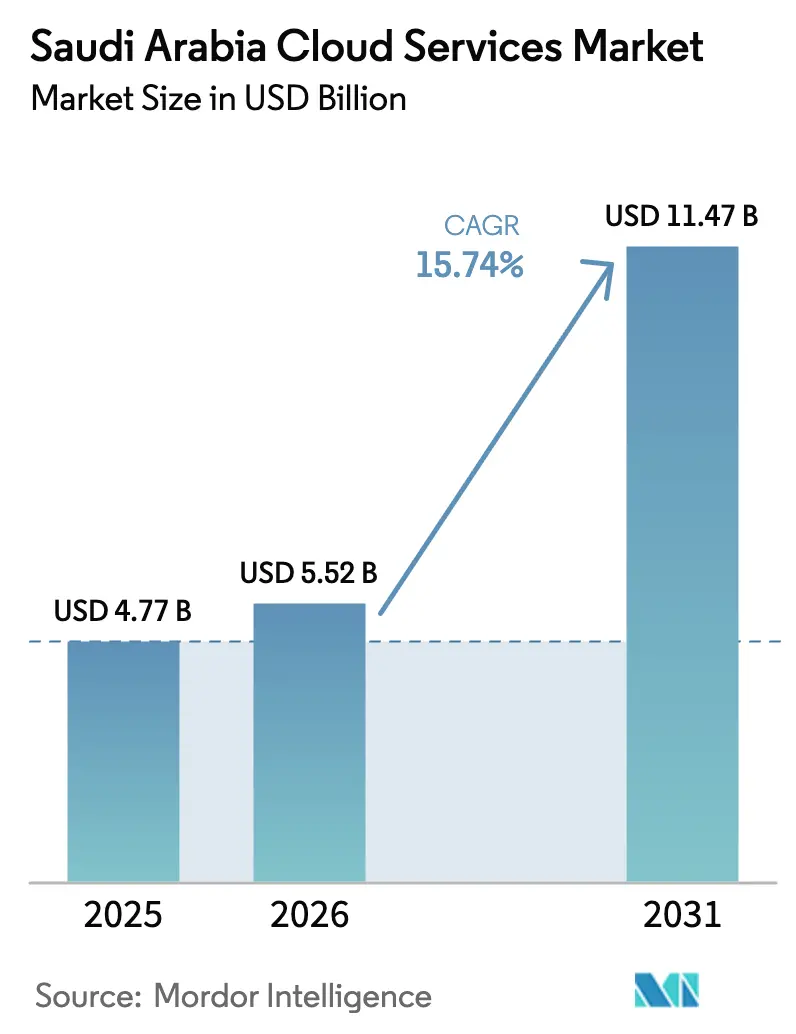
The Saudi Arabia cloud services market size was valued at USD 4.77 billion in 2025 and estimated to grow from USD 5.52 billion in 2026 to reach USD 11.47 billion by 2031, at a CAGR of 15.74% during the forecast period (2026-2031). Heightened digital-first mandates under Vision 2030, the Communications and Information Technology Commission’s Cloud-First Policy, and accelerating hyperscaler capital expenditure have created a strong foundation for sustained expansion. Software-as-a-Service (SaaS) continues to resonate with enterprises that want rapid deployment and minimal infrastructure upkeep, while Platform-as-a-Service (PaaS) is scaling quickly as developers prioritize modern application frameworks. Robust foreign direct investment totaling more than USD 21 billion in data center campuses keeps pricing competitive and latency low, widening adoption across regulated industries. Growing artificial-intelligence workloads, evidenced by large-scale NVIDIA GPU purchases and sovereign chip alliances, are catalyzing demand for GPU-rich cloud instances. Finally, rising edge-cloud deployments in NEOM and Riyadh enable gaming, streaming, and industrial IoT use cases to run close to end users for improved performance and compliance.
Key Report Takeaways
- By cloud service model, Software-as-a-Service led with 44.02% revenue share of the Saudi Arabia cloud services market in 2025; Platform-as-a-Service is projected to expand at a 16.64% CAGR through 2031.
- By deployment type, public cloud accounted for 65.72% of the Saudi Arabia cloud services market share in 2025, while hybrid cloud adoption is advancing at a 16.41% CAGR to 2031.
- By organisation size, large enterprises captured 73.65% of the 2025 spending of the Saudi Arabia cloud services market; SMEs are forecast to grow the fastest at 16.18% CAGR, due to Monsha’at programs.
- By end-user industry, Banking, Financial Services, and Insurance (BFSI) held a 27.06% share of the Saudi Arabia cloud services market in 2025; healthcare applications are set to record a 16.88% CAGR through 2031.
Note: Market size and forecast figures in this report are generated using Mordor Intelligence’s proprietary estimation framework, updated with the latest available data and insights as of 2026.
Saudi Arabia Cloud Services Market Trends and Insights
Drivers Impact Analysis*
| Driver | (~) % Impact on CAGR Forecast | Geographic Relevance | Impact Timeline |
|---|---|---|---|
| Vision-2030 digital-first mandates | +2.8% | Global | Medium term (2-4 years) |
| Cloud-First Policy (CITC) | +2.1% | Global | Short term (≤ 2 years) |
| Cost-optimization amid oil diversification | +1.9% | Global | Long term (≥ 4 years) |
| Hyperscaler DC investments (AWS, Azure, GCP) | +3.2% | Riyadh Province, Eastern Province | Medium term (2-4 years) |
| Gen-AI and GPU workload momentum | +2.4% | Riyadh Province, NEOM | Short term (≤ 2 years) |
| Edge cloud for gaming and streaming | +1.1% | NEOM, Riyadh Province | Long term (≥ 4 years) |
| Source: Mordor Intelligence | |||


Vision-2030 Digital-First Mandates Drive Systematic Cloud Migration
Vision 2030 obliges government entities to prioritize cloud procurement, triggering consistent demand that spills into private-sector decision making. The Digital Government Authority’s Emerging Technology Adoption Readiness Index delivers assessment tools that streamline migration planning, while a USD 24.8 billion national digital-infrastructure program has driven 99% internet penetration and broad 5G coverage. Eighty-five percent of surveyed public-sector leaders now earmark budgets for cloud-enabled emerging technologies, and 45% actively evaluate AI-driven workloads. [1]KPMG, “Unlocking Government’s Technology Future,” kpmg.com National cloud infrastructure coordinated by the Saudi Data and Artificial Intelligence Authority joins more than 200 government systems, reinforcing secure data interchange standards that private firms subsequently mirror.
Hyperscaler Data Center Investments Create Infrastructure Foundation
Aggregated commitments from AWS, Microsoft, and Oracle surpass USD 21 billion, adding multiple availability zones by 2026. [2]Capacity Media, “What Is Driving Saudi Arabia’s $21bn Data Centre Investment Surge?,” capacitymedia.com AWS alone will invest USD 5.3 billion to deploy three zones accompanied by two innovation centers targeting 30,000 local trainees, 4,000 of whom are women. Oracle opened its second Riyadh region after outlaying USD 1.5 billion to offer more than 100 cloud services under strict data residency rules. Project MGX, a USD 30 billion Microsoft-Temasek-BlackRock alliance, plans an AI-centric campus in Riyadh to serve quantum and generative-AI workloads. These facilities reduce network latency, introduce next-generation accelerators, and intensify price competition, broadening adoption among cost-sensitive sectors such as education and retail.
Gen-AI Workload Momentum Drives GPU Infrastructure Demand
HUMAIN procured 18,000 NVIDIA GB300 chips and may order hundreds of thousands more to back a 500-megawatt compute roadmap that completes in early 2026. Groq secured USD 1.5 billion to deploy the region’s largest inference cluster, and AMD joined HUMAIN in a USD 10 billion five-year collaboration for accelerator supply. Saudi Aramco’s Dammam 7 supercomputer showcases industrial use of AI models for seismic data, while SDAIA aims to train 20,000 AI professionals by 2030. Demand for GPU-rich cloud instances, therefore, outpaces generic compute growth.
Cost-Optimization Imperatives Accelerate Cloud Migration
Non-oil activities composed 49.9% of GDP growth in 2024, heightening the focus on operational efficiency that cloud billing models address through pay-per-use pricing. Dell found that 90% of Saudi organizations accelerated digital transformation, exceeding the global 80% average, partly to curb capital outlays. SMEs gain particular relief from up-front infrastructure costs, accessing hyperscaler platforms via Monsha’at programs and benefiting from a 72% surge in venture funding.
Restraints Impact Analysis*
| Restraint | (~) % Impact on CAGR Forecast | Geographic Relevance | Impact Timeline |
|---|---|---|---|
| Enterprise skill deficit and expat reliance | -1.8% | Global, concentrated in technical roles | Medium term (2-4 years) |
| Vendor lock-in concerns | -1.2% | Large enterprises, government entities | Long term (≥ 4 years) |
| Legacy migration complexity | -1.5% | Oil and Gas, BFSI sectors | Medium term (2-4 years) |
| Data-center water/energy sustainability risk | -0.9% | Riyadh Province, Eastern Province | Long term (≥ 4 years) |
| Source: Mordor Intelligence | |||
Enterprise Skill Deficit Constrains Cloud Adoption Velocity
Rapid scaling of digital projects outstrips local talent supply, forcing reliance on expatriate professionals and elevating costs. Fifty-six percent of Saudi tech leaders identify skills shortages as the top barrier to AI deployment. Government programs such as One Million Arab Coders and SDAIA’s Elevate aim to upscale 25,000 women, while AWS pledges to train 30,000 citizens. Nevertheless, workforce development timelines keep the skills gap material for the medium term.
Legacy Migration Complexity Creates Implementation Barriers
Mission-critical workloads in oil, gas, and BFSI run on decades-old platforms that require phased re-engineering. A University of Hail case study cut server footprints by 50% only after a comprehensive redesign. Saudi Aramco phases data ingestion to safeguard drilling operations. The Saudi Central Bank highlights stringent security assessments before approving cloud migrations, extending timelines, and constraining near-term cloud velocity.
*Our forecasts treat driver/restraint impacts as directional, not additive. The impact forecasts reflect baseline growth, mix effects, and variable interactions.
Segment Analysis
By Cloud Service Model: Platform Services Accelerate Application Modernization
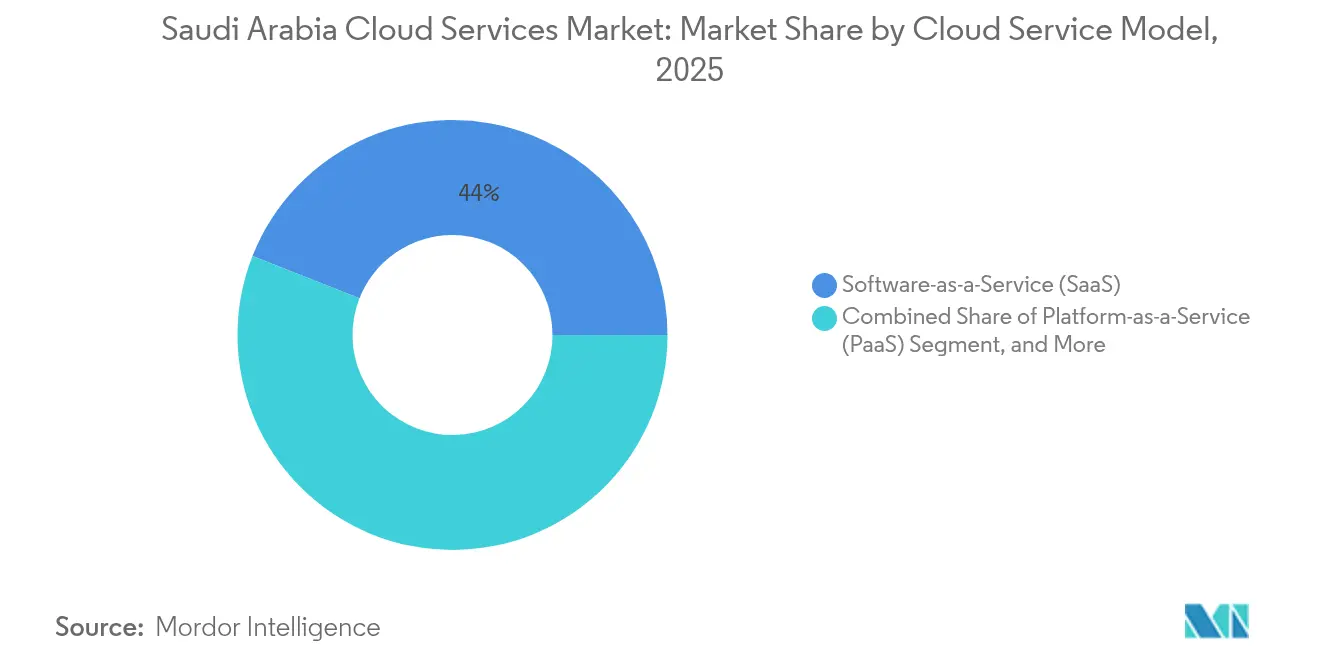
SaaS commanded 44.02% of 2025 revenue as enterprises embraced turnkey software to bypass legacy hardware management. PaaS adoption, projected at a 16.64% CAGR, aligns with developer demand for integrated toolchains and container orchestration that facilitate rapid releases. The Saudi Arabia cloud services market size allocated to PaaS is therefore positioned to outpace other models through 2031. IaaS persists among large firms that need granular control over compute resources, especially for security-sensitive oil-and-gas applications. Function-as-a-Service gains traction within startups seeking operational agility.
From 2019-2024, PaaS shifted from exploratory pilots to mainstream deployments. Saudi Aramco pilots industrial Large Language Models via managed PaaS offerings to avoid infrastructure overhead. Regulatory clarity from CITC’s Cloud Computing Regulatory Framework standardizes compliance, further reinforcing PaaS uptake.


By Deployment Type: Hybrid Strategies Balance Sovereignty and Cost
Public cloud captured 65.72% of the Saudi Arabia cloud services market share in 2025, leveraging economies of scale and on-demand scalability. Hybrid deployments are forecast to rise at a 16.41% CAGR as enterprises combine on-premise controls with off-premise elasticity. The Saudi Arabia cloud services market size aligned to hybrid solutions is expected to rise sharply as compliance frameworks mandate local data residency.
Financial institutions illustrate the pattern: STCPay runs Temenos on private infrastructure while connecting to public services for overflow capacity. Edarat Group’s IBM Cloud Satellite deployment in three domestic sites meets sovereignty requirements while offering multi-cloud provisioning.
By Organisation Size: SMEs Propel Future Expansion
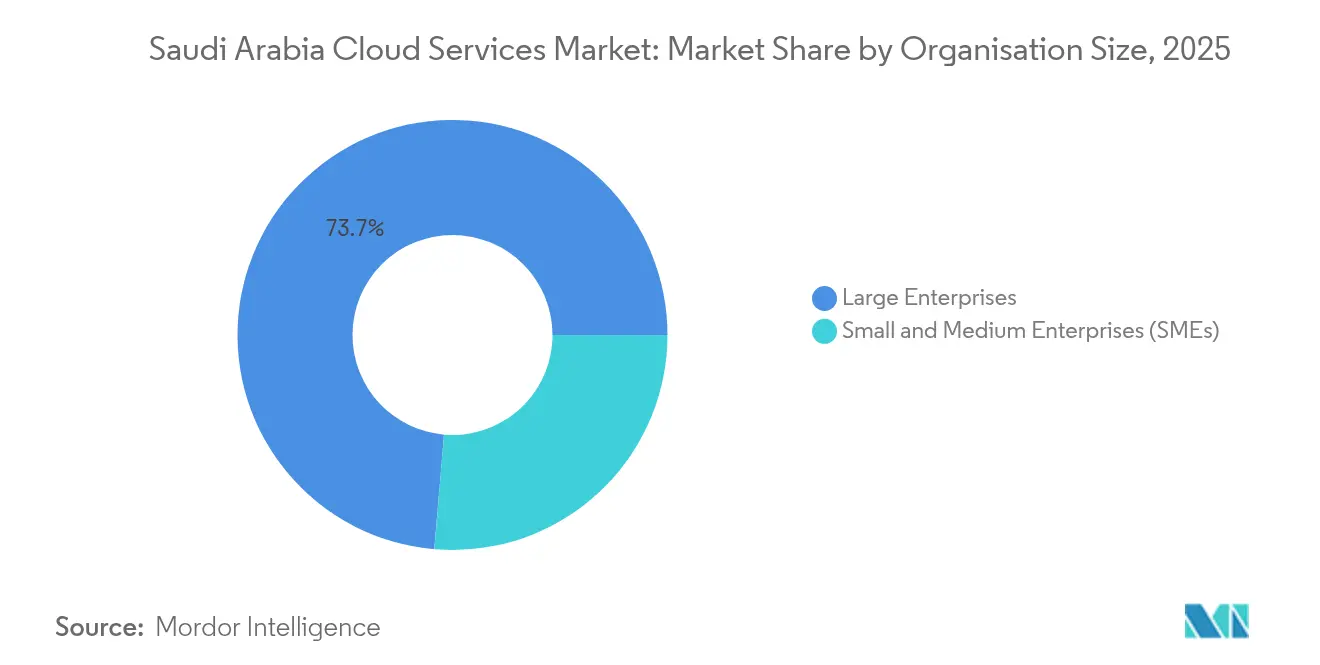
Large enterprises controlled 73.65% of 2025 revenue due to established IT budgets and multi-site rollouts. However, SMEs will grow the fastest at 16.18% CAGR, attracted by low entry costs and supportive financing. Monsha’at programs lifted SME counts to 1.3 million and injected greater venture backing, driving wider cloud adoption.
Cloud offers SMEs enterprise-grade capabilities without capital burdens, facilitating rapid international scaling. Fintech start-ups rose 14.7-fold since 2018, with 147 regulated entities securing SAR 1.5 billion in investments that fund cloud-native platforms. Mobile-commerce research confirms leadership commitment and perceived benefits as crucial adoption triggers.
By End-User Industry: Healthcare Shows Rapid Uptake
BFSI led with 27.06% share in 2025, spurred by Saudi Central Bank sandbox programs and blockchain-based interbank platforms. Healthcare exhibits the highest CAGR at 16.88% as the government raised the health budget to USD 68.2 billion in 2023 and targets a USD 66.6 billion GDP contribution from digital health by 2030. The Saudi Arabia cloud services market size attributable to healthcare workloads is primed for strong upside.
Oil, Gas, and Utilities maintain large cloud budgets for predictive maintenance and seismic analytics. Manufacturing and construction leverage robotics; Samsung C&T’s SAR 1.3 billion automation project at NEOM cut manual labor by 80%. Retail and e-commerce enjoyed a 57% jump in April 2024 sales to SAR 23.27 billion, driving cloud needs for peak-season elasticity.
Geography Analysis
Riyadh Province houses the densest cluster of hyperscaler zones, including Oracle’s second region and AWS’s forthcoming sites. LEAP 2025 announcements added USD 14.85 billion to local tech commitments, underscoring persistent demand from government ministries and conglomerates. IBM’s USD 200 million Software Lab employs 70% Saudi nationals to support AI R&D, and ServiceNow plans data-center launches by 2026 for localized support.
Eastern Province, the energy capital, leverages Saudi Aramco’s Dammam 7 supercomputer and Groq’s inference cluster to run industry-specific analytics. The location also benefits petrochemical and logistics operators, and Invest Saudi incentives promote data-center investments.
Makkah and Western corridors tap Saudi Telecom Company’s Jeddah mega-centers that improve latency for trade hubs and pilgrims. NEOM in the northwest leads edge-cloud innovation via a USD 5 billion DataVolt partnership for a 1.5-gigawatt net-zero campus powered by renewables and liquid cooling. These developments expand geographic resiliency for the Saudi Arabia cloud services market.
Regulatory Landscape
Saudi Arabia regulates cloud services through the Communications, Space and Technology Commission (CST), notably via the Cloud Computing Services Provisioning Regulations (Version 4), effective October 10, 2023. Under this regime, cloud service providers must register with CST and obtain a class designation (Class A/B/C). The class determines which data classifications and regulated sectors they can serve, and compliance expectations commonly cover security and facility standards such as ISO/IEC 27001 and tiered data center requirements.
Data governance and privacy obligations run alongside CST rules through the Saudi Data and AI Authority (SDAIA) and the National Data Management Office (NDMO) under the National Data Governance Framework. This framework incorporates the Personal Data Protection Law and related standards for data classification, sharing, and privacy. Government entity data faces strict localization requirements within Saudi Arabia (with limited lawful exceptions), which shapes cloud architecture, contracting terms, and the feasibility of cross-border processing for both hyperscalers and local providers.
Value Chain Analysis
The Saudi Arabia cloud services value chain begins with enabling inputs and infrastructure, including land and power development for data centers, network backbones, and the supply of servers, storage, and accelerators required for high-performance and AI workloads. Hyperscalers and cloud platforms (AWS, Microsoft, Google, Oracle, Alibaba Cloud) anchor the core service layer, while government-linked entities and ecosystem builders support localization and capacity build-out. The MCIT and SDAIA National Data Center Strategy (unveiled June 2025) sets a national target of 1.5 GW of data center capacity by 2030, reinforcing multi-year demand for facilities, cooling, and power solutions.
Downstream, systems integrators, managed service providers, and telecom-led cloud businesses package migration, security, and operations for regulated customers (government, BFSI, oil and gas). These providers then translate workloads into CST registration classes and align with NDMO data classification rules. Distribution follows direct hyperscaler contracting, partner-led procurement, and government procurement channels aligned to the Cloud First Policy, while governance, cybersecurity compliance, and data residency enforcement feed back into provider selection and multi-cloud or hybrid designs.
Competitive Landscape
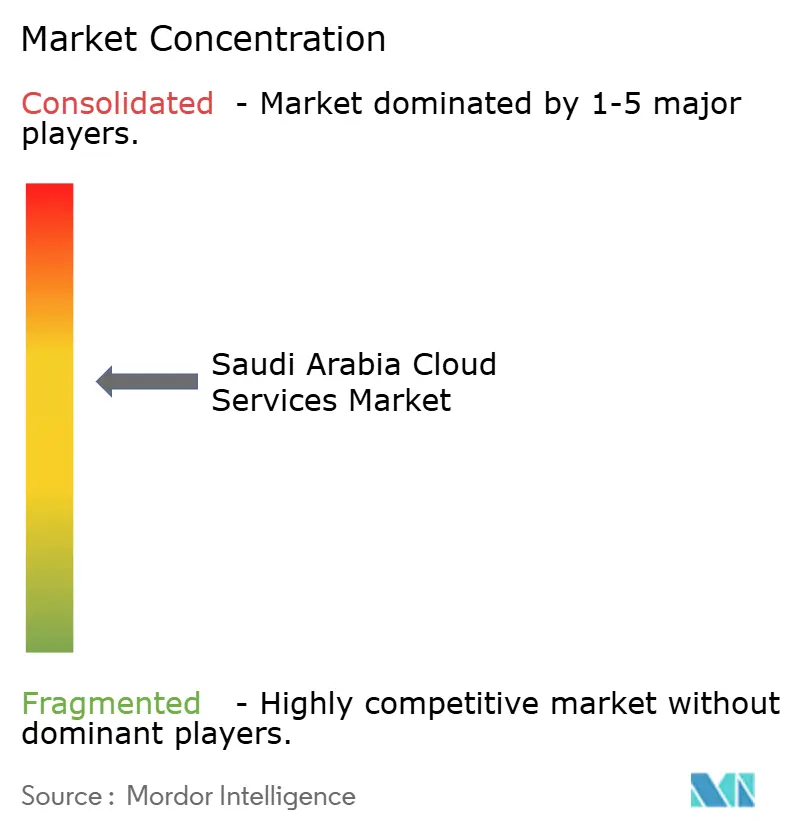
Market concentration is moderate as U.S. and Chinese hyperscalers vie for share. AWS retains leadership with a USD 5.3 billion region and expansive workforce skilling, while Microsoft positions an AI-oriented campus under Project MGX. Oracle strengthens its local value proposition through multi-cloud compliance offerings. Huawei and Alibaba, operating via the Saudi Cloud Computing Company, promote data sovereignty at competitive price points. [4]Rest of World, “How China Is Gaining Ground in the Middle East Cloud Computing Race,” restofworld.org
Local incumbents, Saudi Telecom Company and Solutions by stc, leverage regulatory rapport but face price pressure from hyperscalers. Solutions by stc maintains sovereign hosting zones in three cities and partners with IBM and VMware to deliver hybrid solutions. Niche players such as OmniOps raised SAR 30 million to create energy-efficient GPU farms, capturing sustainability-minded customers.
Geopolitical dynamics shape vendor selection as U.S. chip contracts exceeding USD 20 billion compete with Chinese alternatives, and CITC security rules favor providers with documented compliance architectures.
Saudi Arabia Cloud Services Industry Leaders
Amazon Web Services, Inc.
Microsoft Corporation
Google LLC
Alibaba Cloud (Alibaba Group Holding Ltd.)
Oracle Corporation
- *Disclaimer: Major Players sorted in no particular order

Market Opportunities and Future Outlook
Data residency and government procurement rules keep creating whitespace for in-country hosting, sovereign and hybrid architectures, and compliance tooling that maps customer data classifications to CST cloud classes and NDMO governance requirements. This demand aligns with facility build-outs already in motion: STC Group inaugurated the Riyadh 5 data center at King Salman Energy Park in April 2026 with an initial 40 MW capacity (expandable to 80 MW). The rollout adds carrier-neutral infrastructure options for enterprises and service providers seeking domestic processing and connectivity flexibility.
AI-focused cloud infrastructure is another opportunity area as hyperscalers deepen local footprints and tie delivery to Saudi AI programs through dedicated zones and partnerships. Microsoft confirmed its Saudi Arabia East datacenter region will be available for customers to run cloud workloads from Q4 2026, and AWS and HUMAIN announced a USD 5 billion-plus AI Zone (May 2025) to bring dedicated AI infrastructure and services into the Kingdom. Together, these steps raise the bar for local ecosystems across GPU-rich instances, managed AI platforms, data engineering services, and localized SaaS support that can operate within Saudi data governance constraints.
Recent Industry Developments
- April 2026: STC Group inaugurated Riyadh 5 data center at King Salman Energy Park with an initial 40 MW capacity, expandable to 80 MW. The project enhances domestic processing and connectivity for enterprise and public sector workloads. It reshapes the regional data center footprint and advances sovereign cloud capabilities.
- May 2025: AWS and HUMAIN announced a USD 5 billion-plus strategic partnership to build an AI Zone in Saudi Arabia with dedicated AWS AI infrastructure. The initiative focuses on high-density AI compute and managed services, expanding GPU-class resources for local customers. The announcement also emphasizes how local partners support Saudi-hosted AI platform delivery.
- March 2024: AWS announced plans to launch an infrastructure region in Saudi Arabia in 2026 with an investment exceeding USD 5.3 billion. The announcement signals additional domestic availability zones that support data residency and performance requirements. It also increases competitive pressure on other global and local providers to match region-scale offerings and partner ecosystems.


Research Methodology Framework and Report Scope
Market Definition and Coverage
For this study, the market is defined as revenue earned from cloud services delivered to customers in Saudi Arabia, where computing resources, platforms, and software are provided over networks on a subscription or usage basis.
Scope exclusions: We exclude on-premise software licenses, on-premise hardware and data center construction, and pure telecom connectivity that is not bundled as a cloud service.
Segmentation Overview
- By Cloud Service Model
- Infrastructure-as-a-Service (IaaS)
- Platform-as-a-Service (PaaS)
- Software-as-a-Service (SaaS)
- Function-as-a-Service (FaaS)
- By Deployment Type
- Public Cloud
- Private Cloud
- Hybrid Cloud
- By Organisation Size
- Large Enterprises
- Small and Medium Enterprises (SMEs)
- By End-User Industry
- Oil, Gas and Utilities
- Government and Defense
- BFSI
- Healthcare
- Manufacturing and Construction
- Retail and E-commerce
- IT and Telecommunications
- Education
- Other End-User Industries
- By Province
- Riyadh Province
- Eastern Province
- Makkah Province
- Madinah Province
- Qassim Province
- Rest of Saudi Arabia
Data Sources, Market Sizing, and Validation
Desk Research
Desk research was used to set the boundaries of the market and to ground early assumptions on demand, regulation, and investment cycles in Saudi Arabia. We relied on public policy and digital transformation signals, along with country-level ICT indicators that help explain cloud adoption and workload migration patterns over time.
Sources reviewed included official and non-paywalled references such as Saudi Vision 2030 and related government program updates, CITC communications, Saudi Data and AI Authority releases, the National Cybersecurity Authority guidance, and publications from bodies such as the World Bank and the International Telecommunication Union. We also used company annual reports, investor presentations, reputable press coverage, and paid database subscriptions for company financials and news tracking to validate timelines and revenue exposure to the country. This list is illustrative, and additional sources were consulted during the study for data collection, validation, and clarification.
Primary Interviews and Surveys
Primary work focused on confirming what buyers are actually adopting and how spending is split across common cloud service types in Saudi Arabia. We spoke with a mix of enterprise IT leaders, cloud architects, channel partners, and local ecosystem participants across regulated and non-regulated sectors. Respondent input was used to close gaps from public data and to stress-test key assumptions before finalizing the model.
Distribution of primary research fieldwork respondents
| Company type | Respondent position |
|---|---|
| Top tier: 34% | CXOs: 19% |
| Mid tier: 46% | Functional/Unit leaders: 24% |
| Smaller Players: 20% | Managers: 57% |
Market-Sizing & Forecasting
Sizing starts with a top-down build that reconstructs Saudi Arabia cloud services demand from the addressable enterprise and public-sector IT spend pool, then allocates it into cloud service consumption using adoption and migration indicators. The outputs are then corroborated with selective bottom-up checks, such as sampled pricing benchmarks applied to estimated workload volumes, plus channel feedback on typical contract sizes, so totals can be adjusted when the two views drift.
Key inputs used in the model include public and private cloud adoption pace in large enterprises and SMEs, government cloud-first execution intensity, local data residency and cybersecurity compliance readiness, data center capacity ramp and utilization signals, and sector-specific digitalization momentum in industries such as BFSI, government, healthcare, and energy. Where direct volume signals are patchy, we use proxy variables like announced cloud region capacity additions, major program rollouts, and enterprise migration sequencing gathered from interviews, then apply conservative gap-fill rules to avoid overstating demand.
For forecasting, scenario analysis is used because the market can move quickly based on policy changes, large program awards, and new capacity coming online. The base case is set using consensus ranges shared by primary respondents, and then the forecast is stress-tested by shifting the adoption curve, pricing progression, and regulated-sector uptake assumptions within realistic bounds.
Data Validation & Update Cycle
Validation is done through cross-checks that compare model outputs with independent market signals, and the largest variances are reviewed before sign-off. Outliers are investigated by going back to the underlying drivers, such as adoption assumptions, average revenue per workload, and timing of large public-sector migrations, and then corrections are made only when the evidence is consistent across more than one input.
We refresh the report annually. Interim updates are triggered when material events occur, such as policy shifts, major contract announcements, or step-changes in local cloud capacity. Before delivery, an analyst performs a final pass on the latest news and key assumptions so clients receive the most current view possible.
Mordor Intelligence's Saudi Arabia Cloud Services Market Estimate Compared With Other Published Estimates
Published market numbers for Saudi Arabia cloud services often do not match because the underlying scope boundaries are not the same, and the year used as the starting point can also shift. Differences also come from how each study treats private cloud, bundled managed services, and how fast it assumes pricing and consumption expand.
Data center capacity additions, government cloud program rollout signals, and enterprise migration timelines are the checks that keep Mordor Intelligence's estimate tied to what can be absorbed in-country during the base year. When those signals are applied consistently, the spread in published values is usually explained by whether a study counts only infrastructure services, or it also includes broader cloud software subscriptions and adjacent services.
Benchmark comparison
| Source | Market Size | Gaps in Research Methodology |
|---|---|---|
| Mordor Intelligence | USD 4.77 B (2025) | |
| Trade Journal A | USD 4.00 B (2024) | Reported value is typically presented as a cloud services headline number, but the year is different and the coverage is not clearly aligned to the same inclusion rules for private cloud and enterprise SaaS subscriptions. |
| Global Consultancy B | USD 3.46 B (2023) | This figure is for cloud infrastructure services, which usually focuses on IaaS-like infrastructure layers and can exclude sizable SaaS and PaaS revenues, thereby producing a smaller total for the same country. |
Across the three figures, the key driver is not math but definitions, since infrastructure-only views will naturally land below a full cloud services scope, and a different base year will also move the number. By keeping the scope tied to specific service models and by checking the result against observable rollout and capacity signals, our estimate stays traceable to inputs that can be reviewed and repeated.


Key Questions Answered in the Report
How large is the Saudi Arabia cloud services market in 2026?
The market is valued at USD 5.52 billion in 2026 and is projected to reach USD 11.47 billion by 2031.
Which cloud service model leads spending in Saudi Arabia?
Software-as-a-Service leads with 44.02% revenue share in 2025, driven by ease of deployment.
What growth rate is expected for hybrid cloud adoption?
Hybrid deployments are forecast to expand at a 16.41% CAGR between 2026-2031 as firms balance sovereignty and cost.
Which end-user vertical is growing the fastest?
Healthcare workloads are set to grow at 16.88% CAGR through 2031 due to digital-health initiatives.
How are hyperscalers investing in Saudi Arabia?
AWS, Microsoft, and Oracle have collectively committed more than USD 21 billion for new regions and AI-centric campuses.
What is the outlook for SME cloud adoption?
SMEs will post a 16.18% CAGR as Monsha’at programs and venture funding lower entry barriers to advanced cloud services.
Page last updated on:




