
Public Cloud Market Size and Share
Market Overview
| Study Period | 2020 - 2031 |
|---|---|
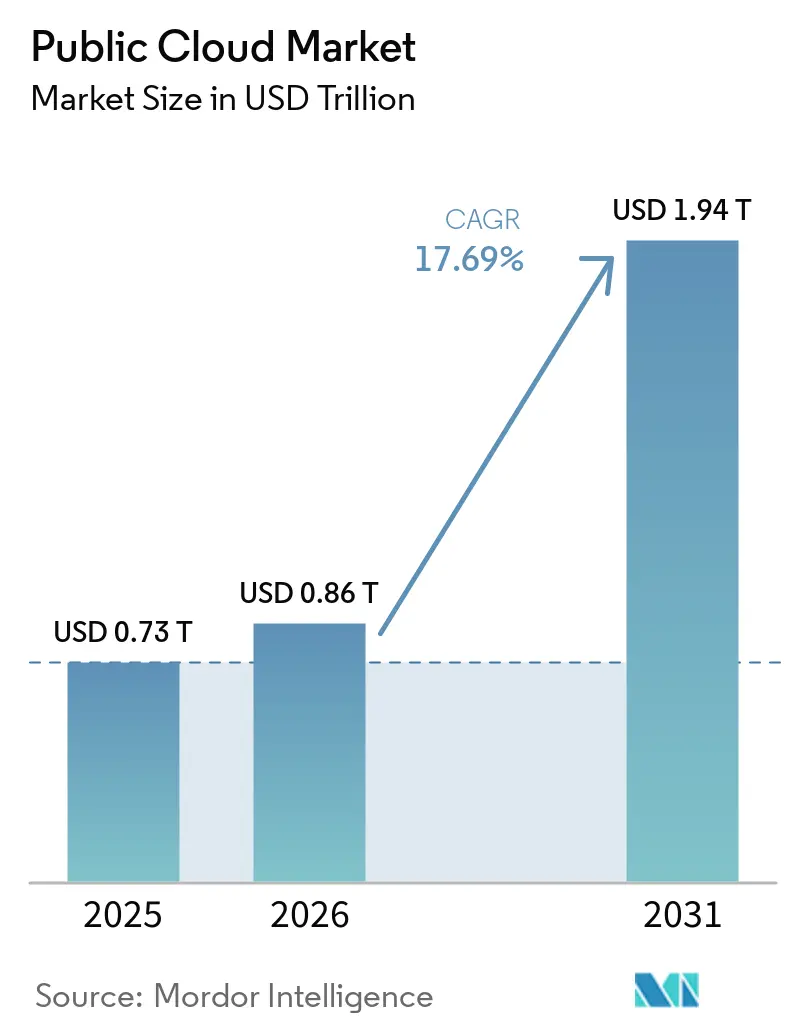
| Market Size (2026) | USD 0.86 Trillion |
| Market Size (2031) | USD 1.94 Trillion |
| Growth Rate (2026 - 2031) | 17.69 % |
| Fastest Growing Market | Asia Pacific |
| Largest Market | North America |
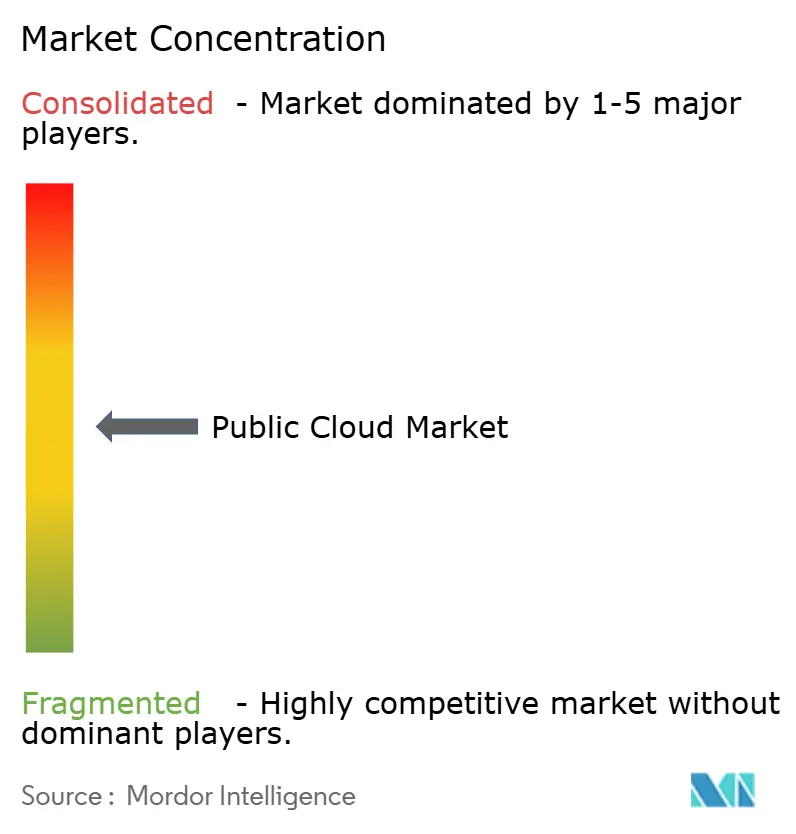
| Market Concentration | Medium |
Major Players *Disclaimer: Major Players sorted in no particular order Image © Mordor Intelligence. Reuse requires attribution under CC BY 4.0. | |
Public Cloud Market Analysis by Mordor Intelligence
Public Cloud Market size in 2026 is estimated at USD 0.86 trillion, growing from 2025 value of USD 0.73 trillion with 2031 projections showing USD 1.94 trillion, growing at 17.69% CAGR over 2026-2031. This expansion reflects enterprises’ wholesale transition from legacy IT stacks to AI-ready infrastructure that treats the cloud as a competitive differentiator rather than a cost-saving utility. Intensifying demand for generative-AI workloads, green-datacenter incentives, and sovereign-cloud mandates underpin the sector’s growth. Hyperscale providers are investing in localized availability zones to satisfy regulatory requirements, while chip manufacturers ramp up supply to ease bottlenecks that constrained 2024 capacity. Competitive dynamics are shifting toward ecosystem partnerships that bundle infrastructure, platforms, and application-layer intelligence, allowing enterprises to accelerate time-to-value and de-risk AI adoption.
Key Report Takeaways
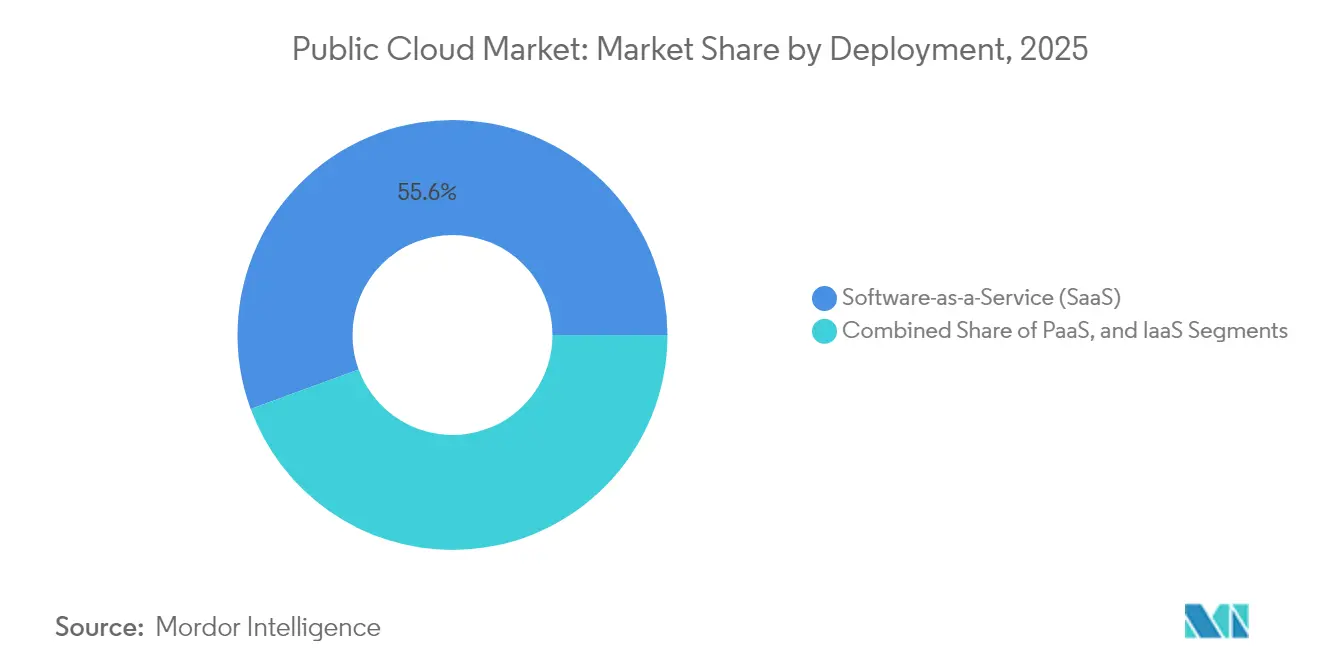
- By deployment model, Software-as-a-Service (SaaS) led with 55.60% of the public cloud market share in 2025, whereas Platform-as-a-Service (PaaS) is on track to post a 19.08% CAGR through 2031.
- By organization size, large enterprises held 67.40% of the public cloud market share in 2025; small and medium enterprises (SMEs) represent the fastest trajectory at a 17.92% CAGR.
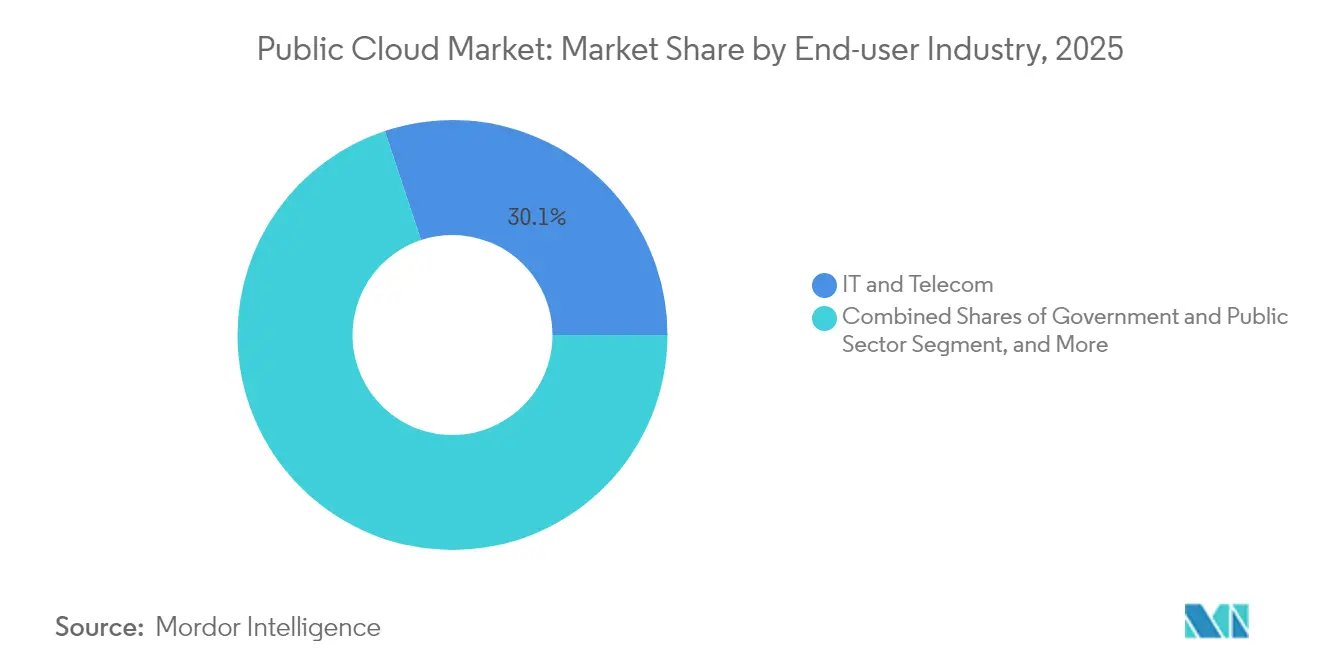
- By end-user industry, IT and Telecom commanded 30.10% revenue share of the public cloud market size in 2025, while manufacturing is projected to grow at 20.94% CAGR between 2026-2031.
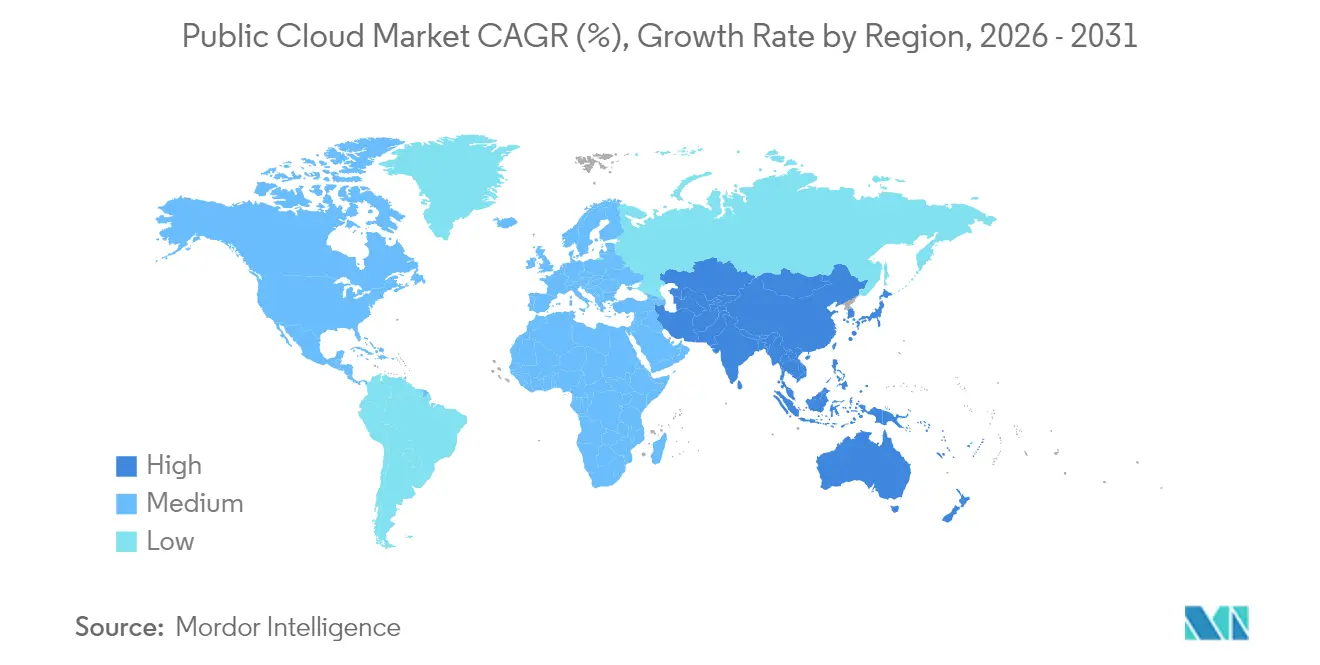
- By geography, North America retained 43.75% of the public cloud market in 2025; Asia-Pacific is projected to expand at 18.12% CAGR through 2031.
Note: Market size and forecast figures in this report are generated using Mordor Intelligence’s proprietary estimation framework, updated with the latest available data and insights as of 2026.
Market Trends and Insights
Drivers Impact Analysis of Public Cloud Market*
| Driver | (~) % Impact on CAGR Forecast | Geographic Relevance | Impact Timeline |
|---|---|---|---|
| AI-led workload migration boom | +4.2% | Global; strong in North America and APAC | Medium term (2-4 years) |
| GenAI-optimized chip supply ramp-up | +3.1% | Global; led by North America and Europe | Short term (≤ 2 years) |
| Hyperscale price-performance wars | +2.8% | Global | Short term (≤ 2 years) |
| Sovereign-cloud mandates | +2.4% | APAC core; spill-over to Europe and MEA | Long term (≥ 4 years) |
| Green datacenter tax credits | +1.7% | North America and Europe; emerging in APAC | Medium term (2-4 years) |
| Cloud-adjacent AI accelerators demand | +1.3% | Global; developed markets | Medium term (2-4 years) |
| Source: Mordor Intelligence | |||
AI-led workload migration boom
Manufacturing, banking, and healthcare organizations have moved beyond pilots to production-scale AI, propelling wholesale shifts into the public cloud market. BMW migrated 6,000 applications to SAP S/4HANA on cloud infrastructure,[1]“BMW Moves 6,000 Apps to SAP S/4HANA,” sap.com and JPMorgan Chase transferred 1 exabyte of data to AWS under a USD 17 billion annual technology budget. Ninety-three percent of manufacturers launched fresh AI projects in 2024, confirming that cloud-hosted AI is now a strategic imperative rather than an experiment.
GenAI-optimized chip supply ramp-up
NVIDIA, SoftBank, and the Japanese government are co-funding domestic AI datacenters to counter global component shortages, while U.S. hyperscale’s commit double-digit-billion capital to secure motherboard and processor supply. In the government cloud market, Generative AI supports mission tasks such as terrain-image labeling and threat-signal triage while remaining inside national security perimeters. AWS acknowledged chip scarcity as a drag on Q4 2024 revenue yet expects new fabs and packaging facilities to ease constraints by 2026.[2]“AWS Faces Component Constraints,” cnbc.com
Hyperscale price-performance wars
Google Cloud recorded 28-30% YoY growth in 2024-2025 and now markets “training-hour cost” rather than raw compute, signaling a pivot from commodity pricing to AI-specific value metrics crn.com. Microsoft’s integration of Azure OpenAI services into core SaaS offerings lifted Q1 2025 cloud revenue 21%. Strategic Collaboration Agreements such as AWS–NetApp bundle storage efficiency with inference optimization, illustrating that ecosystem integration has become the battlefield for wallet share.
Sovereign-cloud mandates
One-third of governments will adopt sovereign cloud services by 2026, incentivizing regional providers to tailor compliance-ready solutions. Japan’s “Sakura Cloud” and the EU’s Digital Operational Resilience Act channel demand to localized zones that meet stringent residency and audit provisions.
Restraints Impact Analysis of Public Cloud Market*
| Restraint | (~) % Impact on CAGR Forecast | Geographic Relevance | Impact Timeline |
|---|---|---|---|
| Data-sovereignty patchwork | -2.1% | Global; acute in APAC and Europe | Long term (≥ 4 years) |
| GPU/optics supply bottlenecks | -1.8% | Global; AI workloads | Short term (≤ 2 years) |
| Tariff-driven cost inflation | -1.5% | North America; spill-over to global buildouts | Short term (≤ 2 years) |
| Evolving compliance complexity | -1.2% | Europe and APAC | Medium term (2-4 years) |
| Source: Mordor Intelligence | |||
Data-sovereignty patchwork
Conflicting statutes such as the EU GDPR and U.S. CLOUD Act force multinationals to duplicate storage across regions, hiking operational costs and slowing cross-border analytics pipelines. China’s Cybersecurity Law similarly raises compliance friction for foreign firms that must isolate “important data” locally.
GPU/optics supply bottlenecks
Motherboard, transceiver, and advanced GPU shortages delay capacity ramps; Microsoft paused several datacenter builds after tariffs threatened to lift project costs by 25-34% on steel, aluminum, and electronics.[3]“Tariffs Raise Datacenter Costs,” costar.com Operators respond by optimizing chip utilization and adopting composable architectures that stretch scarce accelerators.
*Our forecasts treat driver/restraint impacts as directional, not additive. The impact forecasts reflect baseline growth, mix effects, and variable interactions.
Public Cloud Market Segment Analysis
By Deployment:
Platform-as-a-Service accelerates AI application creationPaaS will grow at 19.08% CAGR through 2031, even as SaaS held 55.60% public cloud market share in 2025. Enterprises graduate from a SaaS-first phase into PaaS to build proprietary AI services without managing underlying infrastructure. In Europe, developer demand for integrated environments has pushed PaaS ahead of Infrastructure-as-a-Service. Siemens’ pairing of Teamcenter PLM with Microsoft Azure underscores PaaS’s role in embedding AI into manufacturing workflows. The public cloud market size for PaaS is expected to surge as low-code platforms shrink development cycles, while SaaS continues to experience expansive albeit slower growth through domain-specific applications.
Infrastructure-as-a-Service retains steady relevance for lift-and-shift migrations, serving legacy workloads that cannot yet be containerized. Over the forecast, PaaS may erode SaaS’ share where firms favor custom ML models over packaged software. Yet SaaS’ ubiquity in CRM, HCM, and collaboration ensures it remains the revenue anchor of the public cloud market.



By Organization Size:
SMEs democratize advanced capabilitiesLarge enterprises captured 67.40% public cloud market share in 2025, benefiting from deep IT budgets and early cloud adoption curves. However, SMEs exhibit the briskest 17.92% CAGR as simplified onboarding and consumption-based pricing dismantle entry barriers. Research covering 99% of U.S. businesses shows cloud adoption boosts SME productivity and innovation.
The public cloud market size attached to SME demand is poised to climb because GenAI APIs now abstract away the need for data-science teams. Conversely, large enterprises will continue to unlock value via complex multi-cloud strategies, exemplified by JPMorgan’s migration of 1 exabyte.to AWS. The twin-speed expansion underscores a convergence in which firm size no longer dictates access to cutting-edge computing.
By End-user Industry:
Manufacturing overtakes pilot phaseManufacturing represented the fastest-growing vertical at 20.94% CAGR, even though IT and Telecom retained 30.10% share of public cloud revenues in 2025. Predictive maintenance, digital twins, and AI-backed quality control are propelling plant-floor workloads into the public cloud market. Yet firms exploit less than half of their prepaid capacity, suggesting headroom for optimization.
Financial services continue migrating core banking stacks, as seen in the Federal Home Loan Bank of Chicago’s 30% infrastructure cost reduction post-migration. Healthcare cloud spending accelerates under telehealth adoption, while government demand is set to triple to USD 70 billion by 2025, signaling that public sector digitalization complements commercial uptake
Geography Analysis
North America Public Cloud Market
North America remains the largest region with 43.75% share in 2025, anchored by hyperscale headquarters, venture ecosystems, and mature enterprise spending patterns. However, pending tariffs of up to 34% on electronics risk inflating build costs, pushing operators like Microsoft to delay expansion talks. Federal cloud budgets are climbing, USD 8.3 billion earmarked for FY 2025, offsetting some inflationary drag. Treasury alone lifted its cloud allocation fourfold year-over-year, underscoring unwavering public-sector appetite.
APAC Public Cloud Market
Asia-Pacific is the velocity story, projected to grow 18.12% CAGR through 2031. AWS pledged JPY 2.26 trillion (USD 15.1 billion) for Japanese buildouts, while Microsoft is spending USD 2.9 billion on AI datacenters. Tokyo’s Economic Security Promotion Act subsidizes half of a USD 100 million GenAI supercomputer, reflecting sovereign determination to secure compute. The Asian Development Bank finds cloud contributes up to 2.23% of GDP, with policy reform able to add 0.7 percentage-point growth by 2028.
EMEA and South America Public Cloud Market
Europe navigates stricter data-residency statutes such as DORA, complicating multinational rollouts but offering clarity for regional players adept at compliance. Despite regulation, continental cloud services are set for 23.1% CAGR to reach EUR 110.4 billion by 2028, although U.S. vendors still hold 72% share. South America, the Middle East, and Africa remain nascent yet strategic, attracting first-mover builds to capture unmet digital transformation demand.

Regulatory Landscape
Regulation shaping public cloud adoption is tightening around systemic ICT risk, sovereignty, and cross-border data transfer controls, particularly in Europe and the United Kingdom. Under EU Digital Operational Resilience Act (DORA) oversight, large ICT providers face increased scrutiny as critical third-party providers, reinforcing due diligence, auditability, and concentration-risk controls for regulated financial entities. In the UK, HM Treasury enacted The Critical Third Parties (Designation) Regulations 2026 (No. 777), effective 2026-07-13, designating AWS, Google Cloud, Microsoft, and Oracle as critical third parties and raising compliance expectations around resilience testing and incident management.
The EU is also moving to strengthen cloud and AI sovereignty through the European Commission's proposal for the Cloud and AI Development Act (CADA) on 2026-06-03, alongside broader regulatory pressure on hyperscalers, including discussions on whether cloud services fall under EU tech rules. At the same time, the global data-sovereignty patchwork persists. EU GDPR transfer requirements (including post-Schrems II mechanisms), the US CLOUD Act, and China data-localization obligations continue to shape region-by-region cloud architecture choices, localized availability zones, and customer demand for sovereign-cloud operating models.
Competitive Landscape
AWS, Microsoft Azure, and Google Cloud controlled 63% public cloud market share in Q1 2025. AWS keeps a 29% slice despite three quarters of revenue softness, while Microsoft lifts share to 22% via embedded AI in every layer of its stack. Google maintains 12% after sustaining 28-30% growth. The battlefront has migrated toward ecosystem alliances: AWS inked multi-year agreements with NetApp, CrowdStrike, Rackspace, Hitachi, and Lumen to deliver end-to-end solutions that keep workloads sticky.
Regional challengers leverage sovereign compliance know-how to win government and public-sector workloads. Patent filings show Meta building VR-centric cloud ecosystems and Sony designing platforms for game streaming, hinting at fresh consumer revenue pools. M&A persists: IBM agreed to acquire HashiCorp at a 43% premium to fortify hybrid-cloud automation, while CDW bought Mission Cloud Services to target mid-market managed services.
Public Cloud Industry Leaders
Amazon Web Services Inc. (AMAZON.COM, Inc.)
Alibaba Cloud (Alibaba Group Holding Limited)
Google LLC (Alphabet Inc.)
Microsoft Corporation
Oracle Corporation
- *Disclaimer: Major Players sorted in no particular order
Public Cloud Market Companies Covered in this Report
- Amazon Web Services Inc.
- Microsoft Corporation (Azure)
- Google LLC (Google Cloud)
- Alibaba Cloud
- Oracle Corporation
- IBM Corporation
- Tencent Cloud
- Salesforce Inc.
- SAP SE
- Adobe Inc.
- VMware Inc.
- Huawei Cloud
- OVHcloud
- DigitalOcean Holdings Inc.
- Rackspace Technology Inc.
- Linode (Akamai)
- Hetzner Online GmbH
- Snowflake Inc.
- Workday Inc.
- ServiceNow Inc.

Market Opportunities and Future Outlook
Sovereign-cloud procurement and regulated-industry compliance are creating whitespace for providers that can package residency, audit evidence, and operational resilience into standardized offerings, rather than handling them as bespoke projects. The UK's 2026 designation of AWS, Google Cloud, Microsoft, and Oracle as critical third parties and the EU's DORA focus on systemic ICT suppliers are pushing buyers toward more formalized third-party risk management, continuous controls monitoring, and contractual visibility into sub-processors. This, in turn, increases demand for compliance-ready architectures, managed security services, and data-governance tooling delivered through public cloud platforms.
Public sector capacity programs and AI industrialization initiatives are opening another opportunity lane. The European Commission's 2026 proposal for the Cloud and AI Development Act (CADA) anchors a framework that includes concepts such as AI factories and a EuroCloud Federation for sharing public-sector cloud services. In parallel, enterprise use cases are shifting from basic migration to workflow redesign with agentic AI and simulation-driven operations, as reflected in Microsoft's March 2026 supply-chain architecture narrative and AWS Supply Chain's productized multi-tier collaboration features (for example, shared purchase orders and partner onboarding for N-tier visibility). These changes favor cloud providers and ecosystems that pair compute with domain platforms (supply chain, manufacturing, BFSI) and deliver end-to-end reference architectures aimed at shortening time-to-production for AI workloads.
Recent Industry Developments in Public Cloud Market
- May 2026: Amazon Web Services updates its NIST CMP IUT list to include the Amazon Linux Kernel Cryptographic Module, reinforcing the cloud security and cryptographic validation status for sensitive workloads. This adds to AWS crypto stack credibility and compliance posture as enterprises pursue higher assurance for AI and data protection in the cloud.
- April 2026: Amazon Web Services notes that ABS updates the OSPAR list to include cloud providers, including Azure, Dynamics 365, and Google Cloud. The regulatory landscape becomes more aligned across major platforms, signaling greater regulatory scrutiny and cross vendor cloud trust requirements.
- February 2025: IBM to acquire HashiCorp at premium to bolster hybrid cloud automation. The deal expands IBM's strategic cloud automation capabilities and enlarges IBM's footprint in hybrid cloud ecosystems.


Public Cloud Market Report Scope and Research Methodology
Market Definition and Coverage
For this report, the public cloud market covers revenue earned from public cloud services delivered over shared, provider-managed infrastructure. Customers access these services over the internet or via dedicated connectivity, and they pay for usage and capacity as an ongoing service.
Scope exclusions: We do not count private cloud built for a single enterprise, on-premises software licenses, or pure colocation and data center real estate rentals that do not include a public cloud service.
Segments Covered in This Report
- By Deployment
- Software-as-a-Service (SaaS)
- Platform-as-a-Service (PaaS)
- Infrastructure-as-a-Service (IaaS)
- By Organisation Size
- Small and Medium Enterprises (SMEs)
- Large Enterprises
- By End-user Industry
- BFSI
- Healthcare and Life Sciences
- Government and Public Sector
- Manufacturing
- IT and Telecom
- Other End-user Industries
- By Geography
- North America
- South America
- Europe
- Asia-Pacific
- Middle East
- Africa
Data Sources, Market Sizing, and Validation
Desk Research
Desk research was used to set the market frame, identify the spend categories that align with public cloud, and anchor regional demand signals. We referred to public and official sources such as the OECD digital economy datasets, ITU ICT indicators, World Bank macro series, US BEA industry accounts (where relevant), and regulators and digital ministries that publish cloud adoption or data center updates.
In parallel, we reviewed annual reports, investor presentations, and product documentation from major public cloud service providers to understand how revenue mix changes, service definitions, and pricing motions map to SaaS, PaaS, and IaaS. In a few places, we used paid subscriptions for company financials and intelligence, news and financials, and patent databases to confirm timelines, investment intensity, and technology direction when public disclosures were not detailed enough. The desk sources listed here are illustrative only, and we also used other references to collect data, cross-check, and clarify assumptions.
Primary Interviews and Surveys
Primary work was used to pressure test model inputs that are hard to see in public data, especially pricing direction, consumption patterns, and how customers split spend across SaaS, PaaS, and IaaS. We spoke with a mix of service providers, channel and advisory partners, and enterprise buyers across major regions, so demand signals and supplier narratives could be compared and reconciled.
Distribution of primary research fieldwork respondents
| Company type | Respondent position | Region |
|---|---|---|
| Top tier: 26% | CXOs: 12% | APAC: 53% |
| Mid tier: 60% | Functional/Unit leaders: 34% | EMEA: 29% |
| Smaller Players: 14% | Managers: 54% | Americas: 18% |
Market-Sizing & Forecasting
Sizing starts from a top-down build where public cloud spend is reconstructed by service type using demand pool indicators, then allocated across regions and key end-use activity patterns. To keep totals realistic, we use bottom-up approximations as checks, such as sampled price-per-unit ranges applied to expected consumption volumes, plus selective roll-ups from disclosed revenue lines and channel feedback.
Key inputs in this market include the split of spend across SaaS, PaaS, and IaaS, the pace of enterprise migration from on-premises workloads, pricing and discount behavior, regional data residency constraints that affect where workloads can run, and capacity signals such as hyperscale build-outs and supply tightness for AI-ready compute. When a variable cannot be observed directly, we set ranges based on interview input, then narrow them after checking consistency with macro IT spend and adoption data.
For forecasting, we mainly use scenario analysis supported by trend-based methods. Baseline growth is tied to adoption, pricing, and workload intensity, then adjusted for step-changes such as major regulatory shifts or large infrastructure expansions. The forecast path is finalized only after driver assumptions match what primary respondents describe as realistic purchasing and renewal behavior.
Data Validation & Update Cycle
Model outputs are checked against independent signals such as public cloud services spending summaries, regional cloud adoption markers, and supply-side capacity announcements. If we see a large variance, we investigate before sign-off. When an outlier appears, we reopen assumptions and trigger follow-up calls with the most relevant respondent types to confirm whether the change is real or a data timing issue.
We also apply a second analyst review to key calculation steps, including currency conversion timing, service mapping logic, and growth-rate reasonableness by region. Reports are refreshed annually, with interim updates when material events can shift demand or pricing. Before delivery, we run a final review pass so clients receive the most current view available.
Mordor Intelligence's Public Cloud Market Size Versus Other Published Estimates
Published market sizes for public cloud often differ because the included service baskets are not identical, and because the timing of currency conversion and price assumptions can shift totals. Variances also come from whether figures are reported as end-user spending, provider revenue, or a mix of both, which changes what is counted.
Some external totals combine public cloud with adjacent hosted private cloud or broader IT outsourcing-style services. They may also use aggressive assumptions on AI-driven consumption ramps. In Mordor Intelligence's model, only public cloud services revenue is counted across SaaS, PaaS, and IaaS, while non-service items like pure colocation rents or on-prem licences are kept out so the result stays tied to a repeatable demand pool.
Benchmark comparison
| Source | Market Size | Gaps in Research Methodology |
|---|---|---|
| Mordor Intelligence | USD 0.73 T (2025) | |
| Government Whitepaper A | USD 0.77 T (2024) | Uses a sales figure for public cloud services for 2024, and parts of the referenced breakdown can be interpreted to include hosted private cloud alongside public cloud, which lifts totals versus a pure public cloud-only cut. |
| Industry Forecast B | USD 0.68 T (2024) | Reported as end-user spending for 2024 with a fixed category set and timing assumptions, which can understate provider-recognized revenue when usage spikes late in the year or when currency timing differs. |
Across the three figures, the spread is mainly explained by category mapping and year selection, not by arithmetic. When the service basket is clearly defined and the assumptions are checked against consumption and capacity signals, the resulting market value becomes easier to track and update in a consistent way.


Key Questions Answered in the Report
What is the current size of the public cloud market?
The public cloud market is worth USD 859.26 billion in 2026 and is projected to reach USD 1,936.23 billion by 2031 at a 17.69% CAGR.
Which deployment model grows fastest through 2031?
Platform-as-a-Service leads growth at 19.08% CAGR, reflecting rising demand for AI-ready development environments.
Why are sovereign-cloud mandates significant?
They add +2.4 percentage points to forecast CAGR by forcing hyperscalers to build localized zones and by opening space for compliant regional providers.
How do GPU shortages affect cloud expansion?
Asia Pacific is estimComponent bottlenecks trim 1.8 percentage points from projected CAGR and delay datacenter buildouts, prompting providers to optimize existing hardware.ated to grow at the highest CAGR over the forecast period (2026-2031).
How do GPU shortages affect cloud expansion?
Manufacturing tops vertical growth at 20.94% CAGR as factories deploy AI for predictive maintenance and digital twins.
Who dominates the competitive public cloud landscape
AWS, Microsoft Azure, and Google Cloud jointly hold 63% market share, but specialized regional vendors are gaining traction with sovereign-cloud solutions.
Page last updated on:


 Your data is secure and never sold or shared.


