
Russia Food Acidulants Market Size and Share
Market Overview
| Study Period | 2021 - 2031 |
|---|---|
| Base Year For Estimation | 2025 |
| Forecast Data Period | 2026 - 2031 |
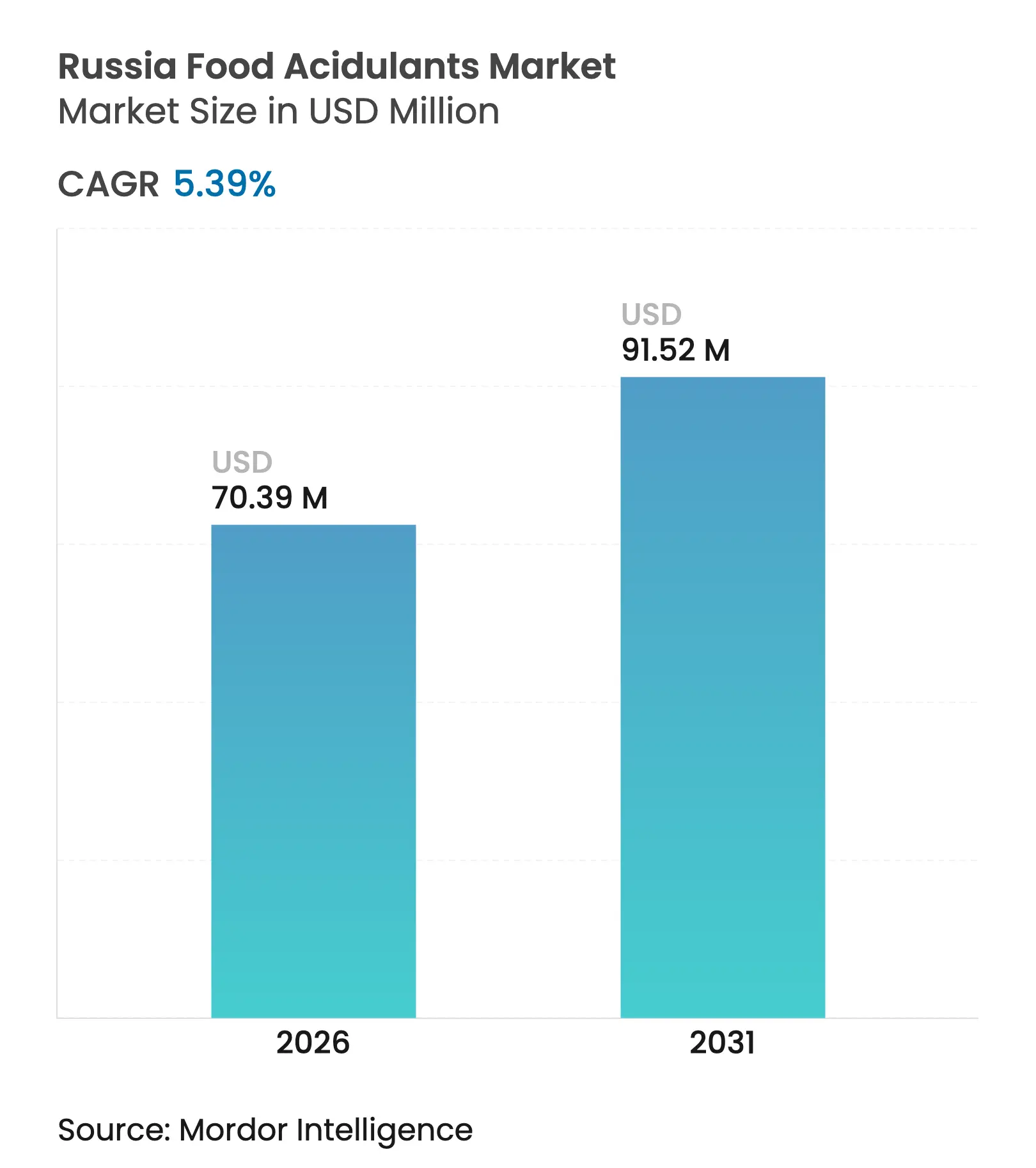
| Market Size (2026) | USD 70.39 Million |
| Market Size (2031) | USD 91.52 Million |
| Growth Rate (2026 - 2031) | 5.39 % CAGR |
| Market Concentration | Medium |
Major Players *Disclaimer: Major Players sorted in no particular order. Image © Mordor Intelligence. Reuse requires attribution under CC BY 4.0. |

Russia Food Acidulants Market Analysis by Mordor Intelligence
The Russian food acidulants market size in 2026 is estimated at USD 70.39 million, growing from 2025 value of USD 66.79 million with 2031 projections showing USD 91.52 million, growing at 5.39% CAGR over 2026-2031. The upward trajectory rests on resilient domestic food processing activity, sustained agricultural subsidies worth 6.45 billion in 2025, and intensifying product reformulation following sugar-tax revisions, according to the Ministry of Agriculture of the Russian Federation[1]. Rising demand stems from beverage manufacturers seeking lower-sugar profiles, dairy processors adding functional drinking yogurts, and meat companies improving shelf life for export-ready protein lines. Clean-label priorities are steering investment toward bio-based acidulants, while automated production lines spark interest in liquid formats that trim mixing time. Companies with regional plants and diversified raw-material contracts are better positioned to navigate Siberian rail congestion and rouble-driven corn pricing swings.
Key Report Takeaways
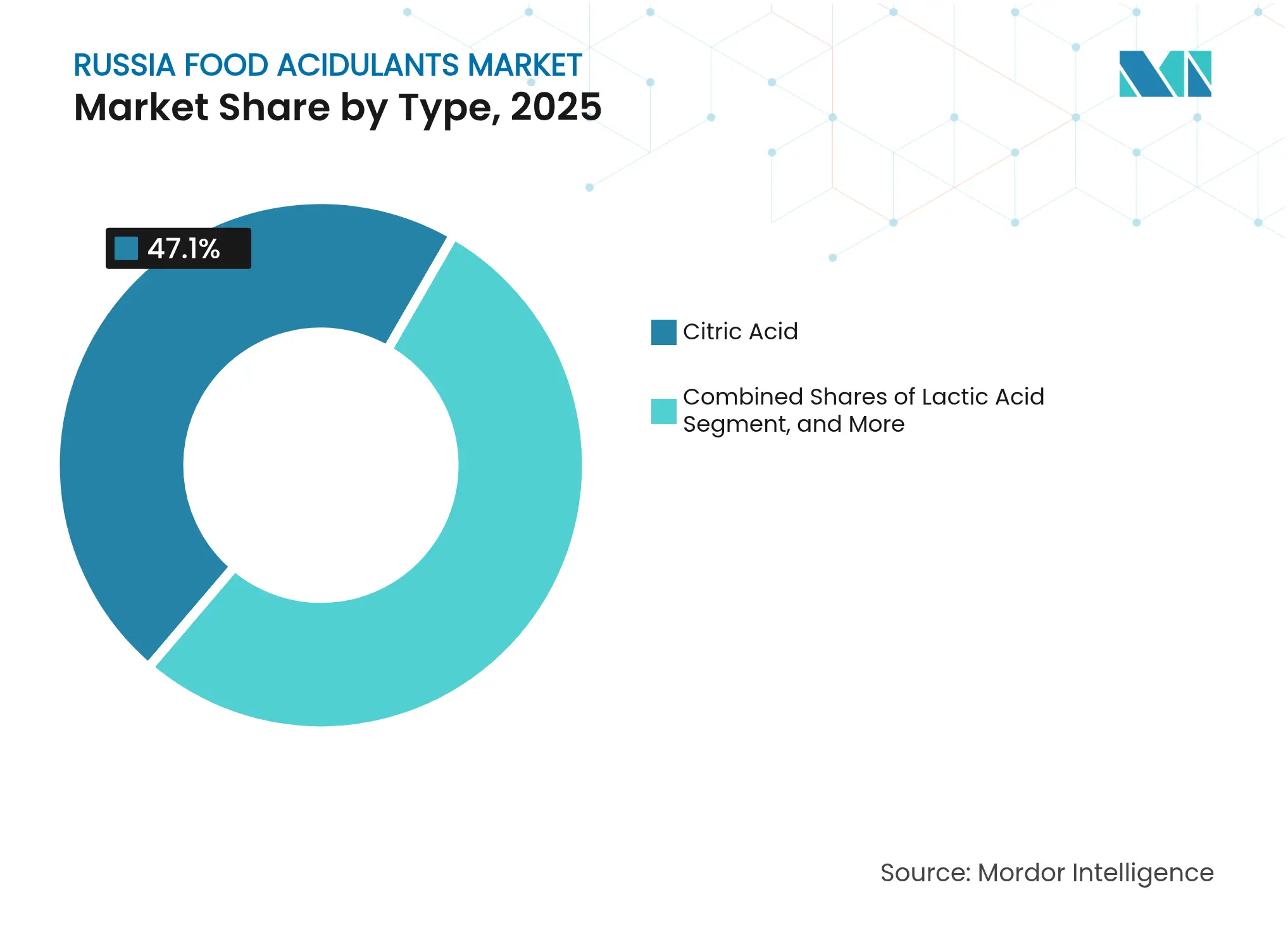
- By type, citric acid led with 47.10% of the Russian food acidulants market share in 2025, while lactic acid is set to expand at a 6.58% CAGR between 2026 and 2031.
- By application, beverages accounted for 36.10% of the Russian food acidulants market share in 2025, whereas meat and poultry are projected to post the fastest 6.74% CAGR through 2031.
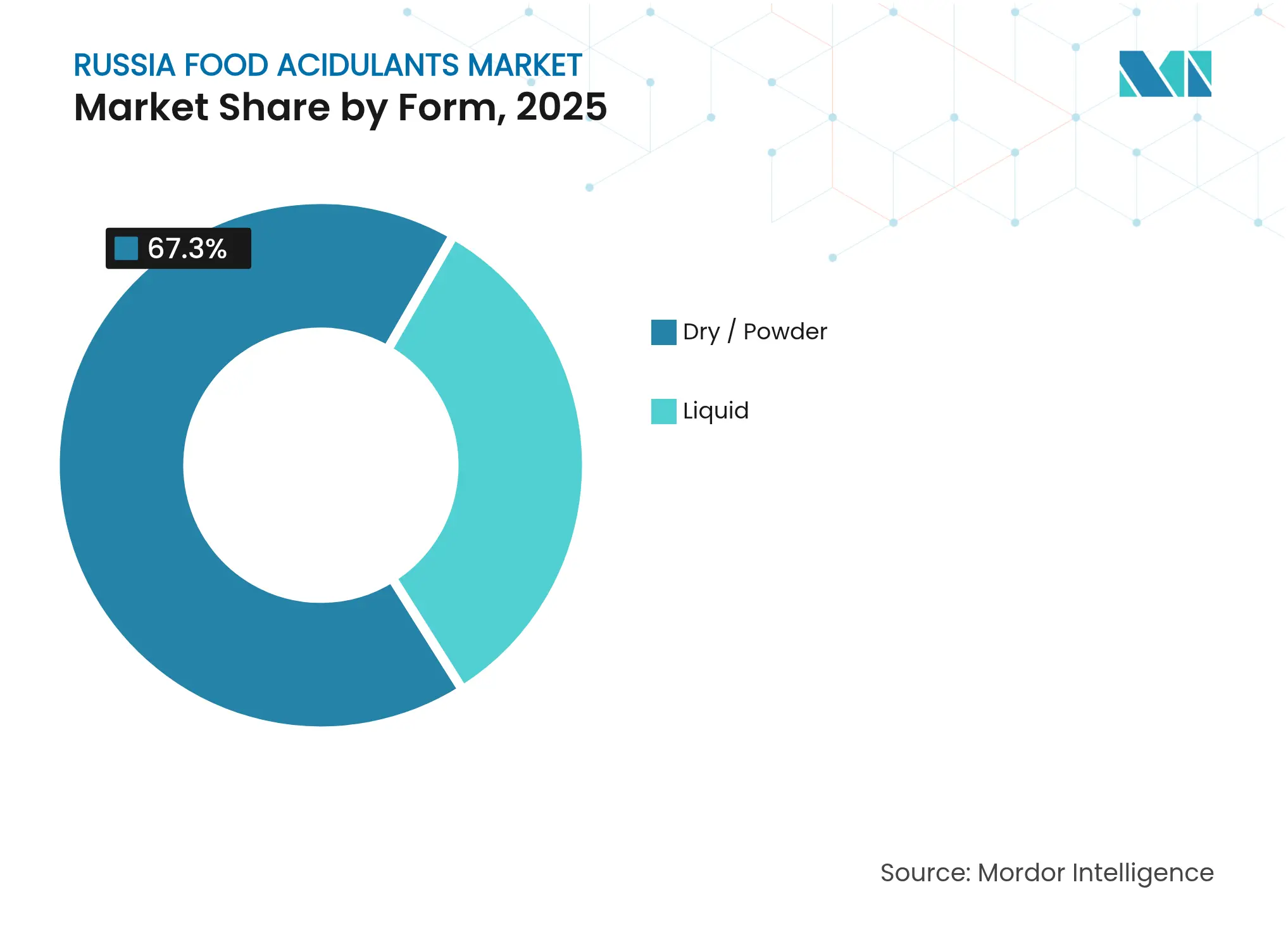
- By form, dry/powder formats held 67.30% of the Russian food acidulants market share in 2025; liquid formats are forecast to grow at a 6.18% CAGR by 2031.
- By source, synthetic routes represented 78.10% of the Russian food acidulants market share in 2025, while bio-based production is advancing at an 7.78% CAGR during 2026-2031.
Note: Market size and forecast figures in this report are generated using Mordor Intelligence's proprietary estimation framework, updated with the latest available data and insights as of 2026.
Russia Food Acidulants Market Trends and Insights
Drivers Impact Analysis
| Drivers | (~) % Impact on CAGR Forecast | Geographic Relevance | Impact Timeline |
|---|---|---|---|
Surge in domestic beverage manufacturing post-sugar-tax adjustments | +1.2% | National, concentrated in Central and Southern Federal Districts | Short term (≤ 2 years) |
Rising popularity of value-added dairy smoothies and drinking yogurts | +0.8% | National, with early gains in Moscow, St. Petersburg, Novosibirsk | Medium term (2-4 years) |
Government incentives for fruit and vegetable processing clusters | +0.7% | Regional clusters in Krasnodar, Rostov, Volgograd regions | Long term (≥ 4 years) |
Clean-label trend accelerating shift toward bio-based acidulants | +0.9% | National, premium segments in major urban centers | Medium term (2-4 years) |
Flavor Diversification and Consumer Trends | +0.6% | National, driven by urban consumer preferences | Medium term (2-4 years) |
Need for Shelf-Life Extension and Food Safety | +0.5% | National, critical for export-oriented producers | Short term (≤ 2 years) |
| Source: Mordor Intelligence | |||
Surge in Domestic Beverage Manufacturing Post-Sugar-Tax Adjustments
Russia's beverage sector transformation following the sugar tax implementation has created unprecedented demand for acidulant solutions that enable reformulation without compromising taste profiles. This regulatory shift forces beverage producers to rely more heavily on acidulants for flavor enhancement and preservation, particularly citric and lactic acids that provide both tartness and antimicrobial properties. Beverage companies are discovering that acidulant-based reformulations often deliver superior shelf stability compared to traditional high-sugar formulations, creating a technical advantage that extends beyond regulatory compliance. The shift represents a permanent structural change rather than a temporary adaptation, as consumer acceptance of reformulated products validates the acidulant-intensive approach.
Rising Popularity of Value-Added Dairy Smoothies and Drinking Yogurts
The Russian dairy sector's evolution toward functional and convenient formats is driving sophisticated acidulant applications that extend beyond traditional preservation roles. Domestic dairy production growth, supported by USD 788 million in government subsidies allocated in 2024 as per Dairy Global, enables manufacturers to invest in premium product development where acidulants serve dual functions as flavor enhancers and texture modifiers. Lactic acid emerges as the preferred acidulant for these applications due to its natural origin story and compatibility with probiotic cultures, enabling manufacturers to market products as both functional and clean-label. The trend accelerates as urban consumers increasingly view drinking yogurts and smoothies as meal replacements rather than snacks, driving demand for more sophisticated preservation systems that maintain nutritional integrity throughout the extended shelf life. Russian dairy processors are discovering that acidulant optimization enables room-temperature storage for certain products, dramatically expanding distribution reach in a country with challenging logistics infrastructure.
Government Incentives for Fruit and Vegetable Processing Clusters
Russia's strategic focus on agricultural processing cluster development creates concentrated demand nodes for acidulants that serve both preservation and quality enhancement functions in fruit and vegetable applications. The Ministry of Agriculture's allocation of USD 4.46 billion for agricultural development programs in 2025, with specific emphasis on processing infrastructure, establishes favorable economics for acidulant-intensive preservation technologies. These processing clusters benefit from economies of scale in acidulant procurement and application, as centralized facilities can justify investments in sophisticated dosing and monitoring equipment that optimize acidulant utilization. The cluster approach enables knowledge sharing and best practice development around acidulant applications, accelerating the adoption of advanced preservation techniques that extend product shelf life and enable broader geographic distribution. Government support for these clusters includes preferential financing terms that make acidulant-intensive processing technologies more economically attractive compared to traditional preservation methods.
Clean-Label Trend Accelerating Shift Toward Bio-Based Acidulants
Russian consumers' increasing sophistication around ingredient transparency is driving demand for bio-based acidulants that align with clean-label positioning while maintaining functional performance. The mandatory "Honest Labeling" system implementation for canned foods, vegetable oils, and beverages in September 2024 creates regulatory pressure for ingredient transparency that favors naturally derived acidulants over synthetic alternatives, according to Food Compliance International[2]. Fermentation-based acidulant production gains traction as Russian biotechnology capabilities expand, supported by machine learning optimization techniques that improve yield consistency and reduce production costs. The trend accelerates as premium food manufacturers discover that bio-based acidulants often deliver superior organoleptic properties compared to synthetic alternatives, enabling product differentiation in increasingly competitive markets. The shift toward bio-based acidulants aligns with Russia's broader sustainability objectives while addressing consumer preferences for recognizable, naturally derived ingredients.
Restraint Impact Analysis
| Restraints | (~) % Impact on CAGR Forecasts | Geographic Relevance | Impact Timeline |
|---|---|---|---|
Volatile corn and molasses prices amid rouble fluctuations | -0.9% | National, with acute impact on import-dependent regions | Short term (≤ 2 years) |
Bioprocess engineering skill gap limiting domestic capacity scale-up | -0.6% | National, concentrated in industrial centers | Long term (≥ 4 years) |
Freight bottlenecks across Siberian and Far-East districts | -0.8% | Siberian Federal District, Far Eastern Federal District | Medium term (2-4 years) |
Raw Material Cost Volatility | -0.7% | National, affecting both domestic and import-dependent producers | Short term (≤ 2 years) |
| Source: Mordor Intelligence | |||
Volatile Corn and Molasses Prices Amid Rouble Fluctuations
Currency instability creates cascading cost pressures throughout the acidulant supply chain, as corn and molasses price volatility compounds with exchange rate fluctuations to create unpredictable input costs for manufacturers. The government's grain export restrictions, while stabilizing domestic food prices, reduce producer profitability and limit reinvestment capacity in acidulant production infrastructure. Agricultural price volatility analysis reveals significant fluctuations in producer price indices that exceed consumer price variations, creating margin compression for acidulant manufacturers who face both input cost increases and customer resistance to price adjustments. Rouble depreciation against major currencies exacerbates import costs for specialized acidulant production equipment and technical additives, creating barriers to capacity expansion and technology upgrades. The volatility forces manufacturers to maintain higher inventory levels as price hedging mechanisms, tying up working capital and reducing operational flexibility in a market that demands rapid response to customer requirements.
Bioprocess Engineering Skill Gap Limiting Domestic Capacity Scale-Up
Russia's transition toward bio-based acidulant production faces significant human capital constraints as the specialized knowledge required for fermentation optimization and bioprocess control remains concentrated among a limited pool of technical professionals. The complexity of modern acidulant production, particularly for lactic acid and other fermentation-derived products, requires interdisciplinary expertise spanning microbiology, chemical engineering, and process automation that exceeds current domestic training capacity. Machine learning applications in biopolymer manufacturing highlight the sophisticated technical knowledge required for process optimization, yet Russian educational institutions have been slow to integrate these advanced methodologies into their curricula. The skills gap becomes more pronounced as international technology transfer faces restrictions, limiting access to best practices and advanced training programs that could accelerate domestic capability development. Companies attempting to scale bio-based acidulant production often discover that recruiting qualified personnel requires significant salary premiums and extended search periods, creating project delays and cost overruns that discourage investment in domestic capacity expansion.
Segment Analysis
By Type: Citric Acid Dominance Faces Lactic Challenge
Citric acid's commanding 47.10% market share in 2025 reflects its versatility across beverage, dairy, and processed food applications, yet lactic acid's 6.58% CAGR through 2031 signals a fundamental shift toward naturally-positioned acidulants that align with clean-label consumer preferences. The dominance of citric acid stems from its cost-effectiveness and established supply chains, particularly for synthetic production routes that benefit from economies of scale and predictable quality parameters. Lactic acid's growth trajectory accelerates as Russian dairy processors discover its dual functionality as both acidulant and flavor enhancer, particularly in fermented products where it provides authentic taste profiles that synthetic alternatives cannot replicate.
Phosphoric acid maintains steady demand in specialized beverage applications, while other acidulants, including tartaric and malic acids, serve niche applications in confectionery and wine production. Lactic acid production benefits from Russia's strong dairy industry foundation, as manufacturers can leverage existing fermentation expertise and infrastructure to develop acidulant capabilities. The type segmentation evolution reflects broader industry trends toward ingredient transparency and natural positioning, with bio-based production methods gaining preference despite higher initial investment requirements. Market dynamics suggest that citric acid will maintain volume leadership while lactic acid captures value growth through premium positioning and specialized applications.
Note: Segment shares of all individual segments available upon report purchase
By Application: Beverage Leadership Yields to Meat Growth
The beverage segment's 36.10% market share in 2025 establishes acidulants as essential ingredients for flavor balance, preservation, and reformulation in Russia's evolving drink market, while meat and poultry applications drive future growth at 6.74% CAGR through 2031 as food safety regulations tighten and export opportunities expand. Beverage applications benefit from acidulants' multifunctional properties, serving as pH regulators, natural preservatives, and flavor enhancers that enable sugar reduction without compromising taste profiles. The meat and poultry segment's growth acceleration reflects increasing sophistication in protein processing, where acidulants extend shelf life, improve food safety, and enhance organoleptic properties in value-added products. Dairy and frozen products maintain steady demand as manufacturers seek acidulant solutions for texture modification and preservation in premium product lines.
Sauces, dressings, and condiments represent emerging opportunities as Russian consumers embrace international flavors and convenience foods that require sophisticated preservation systems. Baby food and nutraceuticals applications demand premium acidulant grades with stringent purity requirements, creating opportunities for specialized suppliers who can meet regulatory standards. The application segmentation shift toward protein-based foods aligns with Russia's food security priorities and export ambitions, as acidulant-preserved meat products offer extended shelf life for both domestic and international markets.
By Form: Powder Preference Meets Liquid Efficiency
Dry and powder acidulants command 67.30% market share in 2025 due to handling convenience, storage stability, and cost advantages in transportation, yet liquid formulations gain momentum at 6.18% CAGR through 2031 as manufacturers prioritize processing efficiency and dosing accuracy in automated production systems. Powder forms excel in applications requiring precise dosing control and extended storage periods, particularly in bakery and confectionery applications where moisture content must be carefully managed. Liquid acidulants offer superior dissolution characteristics and processing efficiency in beverage and dairy applications, where rapid integration and consistent distribution are critical for product quality. The form preference varies significantly by application, with beverages favoring liquid forms for processing efficiency while dry goods manufacturing relies on powder forms for stability and handling convenience.
Liquid acidulant systems require more sophisticated handling and storage infrastructure but offer advantages in automated production environments where dosing accuracy and mixing efficiency drive productivity gains. The form segmentation evolution reflects the broader trend toward manufacturing automation and quality consistency, as companies invest in processing technologies that optimize acidulant utilization while minimizing waste and variability. Market dynamics suggest that form selection will increasingly depend on specific application requirements and manufacturing capabilities rather than traditional cost considerations alone.
Note: Segment shares of all individual segments available upon report purchase
By Source: Synthetic Dominance Challenged by Bio-Based Innovation
Synthetic acidulants maintain 78.10% market share in 2025 through cost advantages and established supply chains, while bio-based and fermentation-derived alternatives accelerate at 7.78% CAGR through 2031 as clean-label positioning and sustainability concerns drive premium market development. Synthetic production routes offer predictable quality, consistent availability, and economies of scale that make them attractive for high-volume applications where cost optimization is paramount. Bio-based acidulants command premium pricing but deliver marketing advantages and organoleptic benefits that justify higher costs in premium food applications. The source segmentation reflects broader industry trends toward sustainability and natural positioning, with fermentation-based production gaining acceptance as technology improvements reduce cost differentials.
AGRANA's continued operations in Russia, producing fruit preparations with 292 employees in Serpuchov, demonstrate international companies' commitment to serving regional markets despite geopolitical challenges. The company's investment freeze while maintaining operations reflects the complex decision-making around bio-based ingredient production in challenging market conditions. Russian companies developing bio-based acidulant capabilities benefit from government support for biotechnology development and reduced competition from international players facing operational restrictions. The source segmentation evolution suggests that domestic bio-based production capacity will expand as Russian companies invest in fermentation technologies and develop technical expertise in bioprocess optimization.
Geography Analysis
Russia's food acidulants market demonstrates strong domestic demand driven by government-supported agricultural processing initiatives and food security priorities that favor local production capabilities over import dependence. The market benefits from substantial agricultural raw material availability, with sugar beet cultivation covering 1,173 thousand hectares in 2025 and berry production reaching 800,000 tons, providing feedstock for both synthetic and bio-based acidulant production, Ministry of Agriculture of the Russian Federation.
Regional processing clusters in Krasnodar, Rostov, and Volgograd regions concentrate acidulant demand through government-incentivized fruit and vegetable processing facilities that require sophisticated preservation systems. The geographic distribution of demand reflects Russia's food processing infrastructure, with major consumption centers in the Central Federal District around Moscow and the Southern Federal District, where agricultural processing is concentrated. Transportation challenges across Siberian and Far Eastern districts create regional supply chain vulnerabilities that favor local production and distribution networks over centralized manufacturing approaches.
Russian Railways' infrastructure constraints and labor shortages compound logistical challenges, making regional acidulant production more economically attractive despite potential scale disadvantages. The geographic market structure encourages the development of distributed production capabilities that can serve regional food processing clusters while reducing transportation costs and supply chain risks.
Import substitution policies and preferential procurement requirements for Russian-origin goods create additional advantages for domestic acidulant producers who can demonstrate local content compliance, according to the Ministry of Finance of the Russian Federation.

Reports are available across multiple geographies.
Gain in-depth market insights across regions to support informed decisions.
Competitive Landscape
Market Concentration
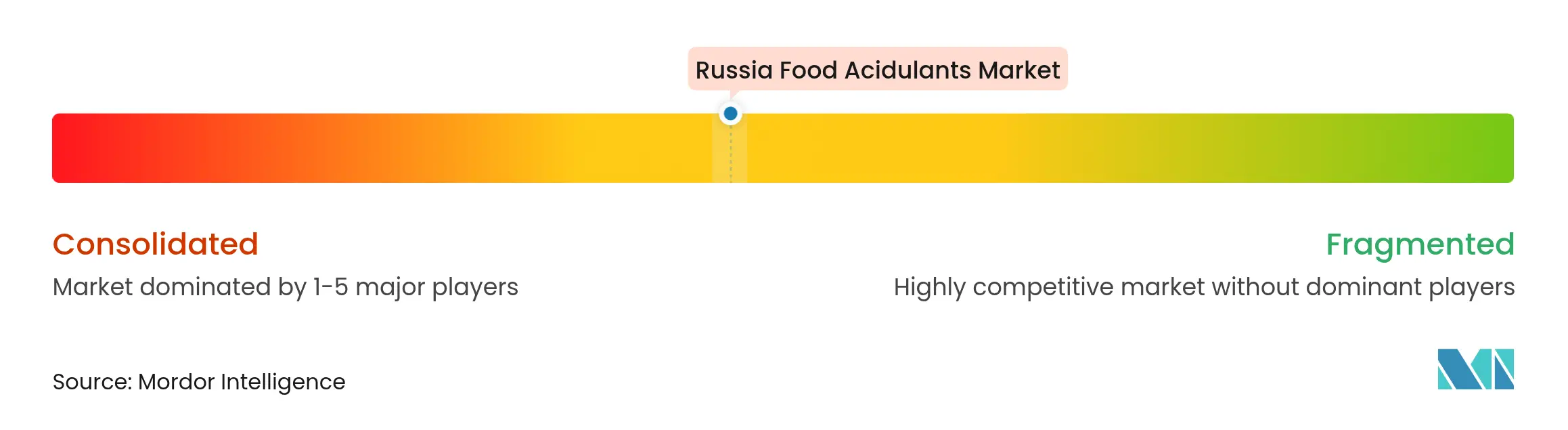
The Russian food acidulants market shows moderate concentration, with a mix of multinational companies and domestic producers. Local manufacturers benefit from government support and import substitution policies, which have strengthened their market position. Competition focuses on technical service capabilities and supply chain reliability, as food manufacturers prioritize consistent quality and responsive customer support over price considerations. Market players are increasingly pursuing vertical integration and regional production strategies to enhance their competitive position. Companies are investing in local manufacturing facilities to reduce import dependence and transportation costs while improving service responsiveness. Some of the key players operating in the market are Phosagro Group, Archer Daniels Midland Co., Jungbunzlauer Suisse AG, Brenntag AG, and DHZ – Dmitrievsky Chemical Plant.
The market presents significant opportunities in bio-based acidulant production and specialized applications for premium food segments. Companies are actively differentiating themselves through clean-label positioning and sustainability credentials alongside traditional quality parameters. The demand for natural and sustainable acidulants continues to grow, particularly in premium food categories. Market participants are developing innovative solutions to meet these evolving consumer preferences. The focus on environmental sustainability has become a key driver for product development and market positioning.
Process automation and quality control systems remain key focus areas in the Russian acidulants market. Companies are implementing advanced monitoring technologies to optimize acidulant production and reduce waste throughout their operations. Success in the market increasingly depends on organizations that combine technical expertise with local market understanding and supply chain adaptability. Regulatory compliance and alignment with Russian standards have become crucial factors for market success. Companies that demonstrate strong quality management systems and local market knowledge maintain competitive advantages in this evolving market landscape.
Russia Food Acidulants Industry Leaders

*Disclaimer: Major Players sorted in no particular order
Recent Industry Developments
- July 2024: Tate and Lyle completed the acquisition of CP Kelco for USD 1.8 billion, significantly expanding its portfolio of nature-based ingredients, including pectin and citrus fiber that serves acidulant-adjacent applications in food preservation and texture modification. This acquisition positions Tate and Lyle to better serve the growing clean-label segment and demonstrates the industry's commitment to bio-based ingredient solutions
- October 2023: FSK, a Russian developer, has acquired a construction project to build Russia's first citric acid manufacturing facility. The plant will be located on a 19-hectare site in the Uzlovaya Special Economic Zone, Tula Region.
- April 2023: Rustark, one of Russia’s largest starch producers, opened a new citric acid plant in the country. The company invested USD 763.8 million in this expansion. The plant is located at Armavir Industrial Park.
Table of Contents for Russia Food Acidulants Industry Report
1. INTRODUCTION
- 1.1 Study Assumptions & Market Definition
- 1.2 Scope of the Study
2. RESEARCH METHODOLOGY
3. EXECUTIVE SUMMARY
4. MARKET LANDSCAPE
- 4.1 Market Overview
- 4.2 Market Drivers
- 4.2.1 Surge in domestic beverage manufacturing post-sugar-tax adjustments
- 4.2.2 Rising popularity of value-added dairy smoothies & drinking yogurts
- 4.2.3 Government incentives for fruit & vegetable processing clusters
- 4.2.4 Clean-label trend accelerating shift toward bio-based acidulants
- 4.2.5 Flavor Diversification and Consumer Trends
- 4.2.6 Need for Shelf-Life Extension and Food Safety
- 4.3 Market Restraints
- 4.3.1 Volatile corn & molasses prices amid rouble fluctuations
- 4.3.2 Bioprocess engineering skill gap limiting domestic capacity scale-up
- 4.3.3 Freight bottlenecks across Siberian & Far-East districts
- 4.3.4 Raw Metrial Cost Volatality
- 4.4 Supply-Chain Analysis
- 4.5 Regulatory Outlook
- 4.6 Porter’s Five Forces
- 4.6.1 Threat of New Entrants
- 4.6.2 Bargaining Power of Buyers
- 4.6.3 Bargaining Power of Suppliers
- 4.6.4 Threat of Substitutes
- 4.6.5 Intensity of Competitive Rivalry
5. MARKET SIZE AND GROWTH FORECASTS
- 5.1 By Type
- 5.1.1 Citric Acid
- 5.1.2 Lactic Acid
- 5.1.3 Phosphoric Acid
- 5.1.4 Others
- 5.2 By Application
- 5.2.1 Beverages
- 5.2.2 Dairy & Frozen Products
- 5.2.3 Bakery
- 5.2.4 Confectionery
- 5.2.5 Meat & Poultry
- 5.2.6 Sauces, Dressings & Condiments
- 5.2.7 Baby Food & Nutraceuticals
- 5.2.8 Others
- 5.3 By Form
- 5.3.1 Dry/Powder
- 5.3.2 Liquid
- 5.4 By Source
- 5.4.1 Synthetic
- 5.4.2 Bio-based/Fermentation
6. COMPETITIVE LANDSCAPE
- 6.1 Market Concentration
- 6.2 Strategic Moves
- 6.3 Market Ranking Analysis
- 6.4 Company Profiles {(includes Global level Overview, Market level overview, Core Segments, Financials as available, Strategic Information, Market Rank/Share for key companies, Products & Services, and Recent Developments)}
- 6.4.1 Phosagro Group
- 6.4.2 Archer Daniels Midland Company
- 6.4.3 Brenntag AG
- 6.4.4 Eastman Chemical Co.
- 6.4.5 Corbion NV
- 6.4.6 Prayon Group
- 6.4.7 DHZ - Dmitrievsky Chemical Plant
- 6.4.8 Jungbunzlauer Suisse AG
- 6.4.9 Cargill Incorporated
- 6.4.10 Roquette Freres SA
- 6.4.11 ATB GROUP S.p.A.
- 6.4.12 Aditya Birla Chemicals
- 6.4.13 Bartek Ingredients Inc.
- 6.4.14 Penta Manufacturing Company
- 6.4.15 DSM-Firmenich
- 6.4.16 Gadot Biochemical Industries
- 6.4.17 Kemin Industries
- 6.4.18 FBC Industries, Inc.
- 6.4.19 Citribel NV
- 6.4.20 BASF SE
7. MARKET OPPORTUNITIES AND FUTURE OUTLOOK
Russia Food Acidulants Market Report Scope
Russia food acidulants market is segmented by type such as citric acid, lactic acid, acetic acid, and others. By application, they're being added beverages, dairy & frozen products, bakery, meat industry, confectionery and others.
| By Type | Citric Acid |
| Lactic Acid | |
| Phosphoric Acid | |
| Others | |
| By Application | Beverages |
| Dairy & Frozen Products | |
| Bakery | |
| Confectionery | |
| Meat & Poultry | |
| Sauces, Dressings & Condiments | |
| Baby Food & Nutraceuticals | |
| Others | |
| By Form | Dry/Powder |
| Liquid | |
| By Source | Synthetic |
| Bio-based/Fermentation |
