
Market Overview
| Study Period | 2021 - 2031 |
|---|---|
| Forecast Data Period | 2026 - 2031 |
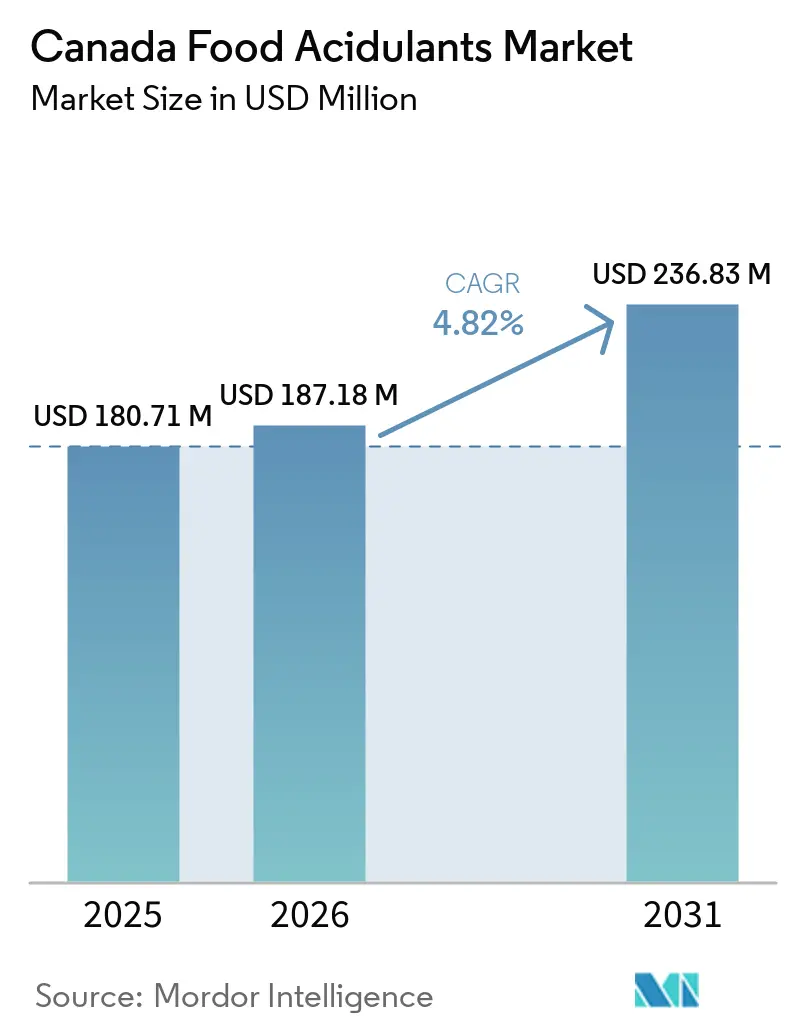
| Base Year Market Size (2025) | USD 180.71 Million |
| Market Size (2026) | USD 187.18 Million |
| Market Size (2031) | USD 236.83 Million |
| Growth Rate (2026 - 2031) | 4.82 % |
| Market Concentration | Low |
Major Players *Disclaimer: Major Players sorted in no particular order Image © Mordor Intelligence. Reuse requires attribution under CC BY 4.0. | |
Canada Food Acidulants Market Analysis by Mordor Intelligence
The Canada food acidulants market size was valued at USD 180.71 million in 2025 and estimated to grow from USD 187.18 million in 2026 to reach USD 236.83 million by 2031, at a CAGR of 4.82% during the forecast period (2026-2031). Demand is supported by formulations that need pH control, preservation, and consistent flavor across processed food categories. Canada’s front-of-package nutrition labeling requirements, effective January 1, 2026, are increasing attention on ingredient declarations and reformulation. The market is also shaped by a transition toward naturally derived inputs, although established synthetic supply chains remain important for large-scale processors. Import reliance and input-cost volatility remain material constraints, especially for processors without direct supply agreements.
Key Report Takeaways
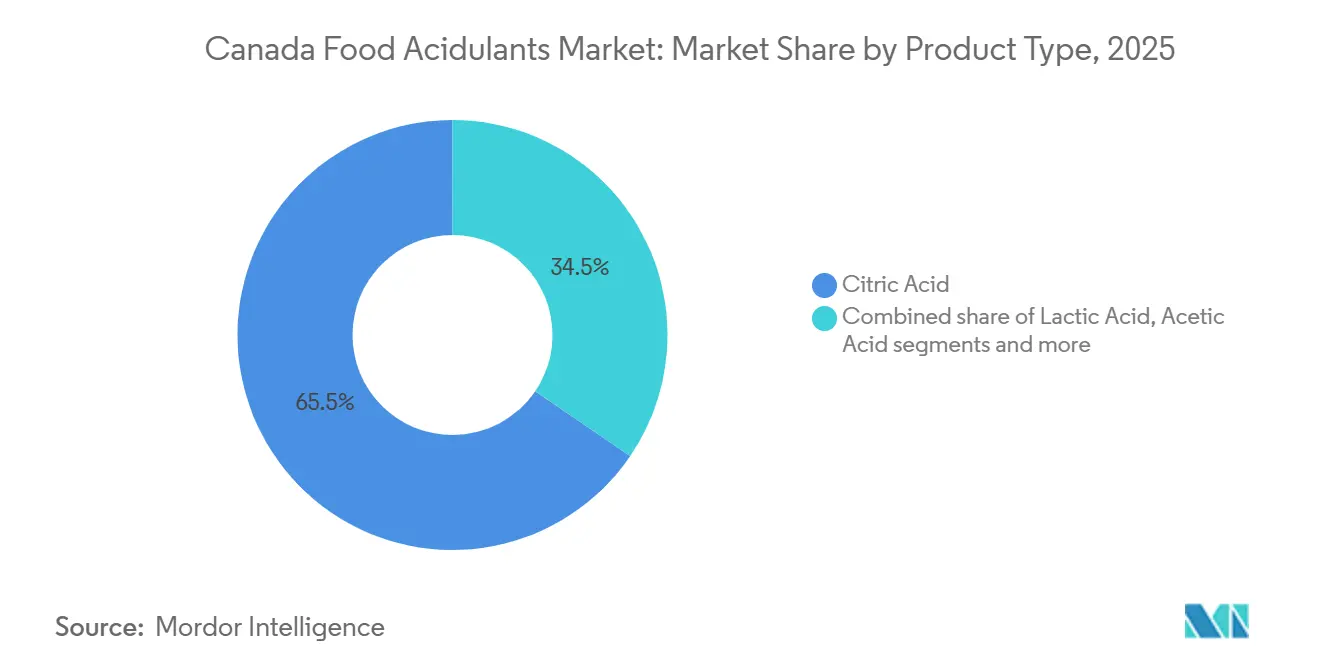
- By product type, citric acid held 65.48% of the Canada food acidulants market share in 2025, while succinic acid is forecast to grow at a 6.18% CAGR through 2031.
- By source, synthetic variants held 84.61% share in 2025, while bio-based acidulants are forecast to expand at a 5.93% CAGR through 2031.
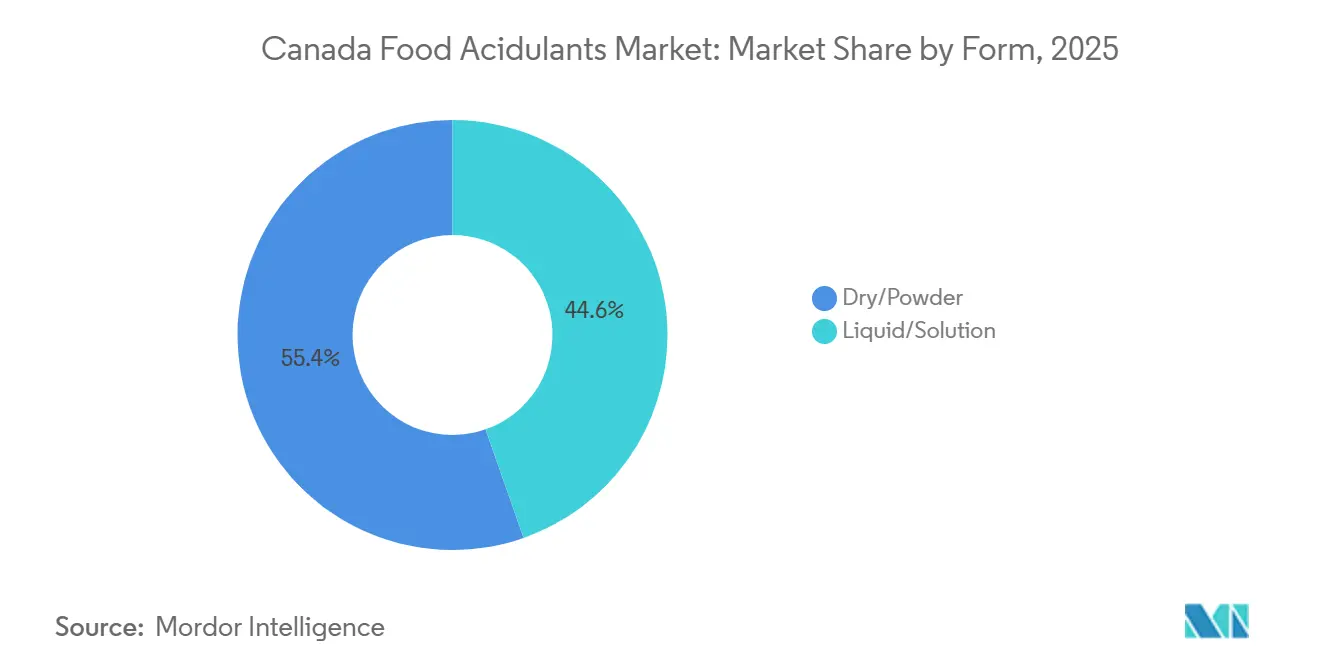
- By form, dry/powder acidulants held 55.37% share in 2025, while liquid/solution acidulants are forecast to grow at a 6.05% CAGR through 2031.
- By application, beverages accounted for 33.71% of the Canada food acidulants market size in 2025, while bakery and confectionery is forecast to advance at a 5.89% CAGR through 2031.
Note: Market size and forecast figures in this report are generated using Mordor Intelligence’s proprietary estimation framework, updated with the latest available data and insights as of January 2026.
Canada Food Acidulants Market Trends and Insights
Drivers Impact Analysis*
| Driver | (~) % Impact on CAGR Forecast | Geographic Relevance | Impact Timeline |
|---|---|---|---|
| Growing Demand for Processed and Packaged Foods | +1.4% | National, with major gains in Ontario and Quebec food manufacturing corridors | Long term (≥ 4 years) |
| Rising Consumption of Carbonated and Non-Carbonated Beverages | +1.2% | National, driven by high-volume urban beverage markets and foodservice | Medium term (2-4 years) |
| Increasing Demand for Extended Shelf Life and Food Preservation | +0.9% | National, amplified in frozen food, ambient, and dairy processing | Medium term (2-4 years) |
| Growing Preference for Clean-Label and Naturally Derived Ingredients | +0.6% | National, with early gains in premium retail and private-label channels | Long term (≥ 4 years) |
| Growth in Bakery and Confectionery Applications | +0.5% | National, with Ontario and Quebec as dominant manufacturing hubs | Medium term (2-4 years) |
| Increasing Demand for Dairy Products and Processed Cheese | +0.4% | National, concentrated in Ontario and Quebec dairy processing clusters | Long term (≥ 4 years) |
| Source: Mordor Intelligence | |||
Growing Demand for Processed and Packaged Foods
Canada’s food and beverage processing sector generated more than USD 125 billion in sales during 2025. It represented more than 16% of manufacturing GDP and 17% of manufacturing employment[1]. This production base supports demand for acidulants in products that need preservation, pH stability, or flavor control. The Canada food acidulants market is exposed to product mix changes within packaged food, rather than only to changes in total food volumes. Frozen and ambient products require acidification systems that help control microbial activity and protect product texture. Greater investment in processing equipment can therefore create demand for acidulants alongside added production capacity.
Rising Consumption of Carbonated and Non-Carbonated Beverages
Beverages remain an important source of demand because citric, malic, and phosphoric acids support flavor balance and pH adjustment. The market gains from reformulation of lower-sugar beverages, where manufacturers need closer control of perceived acidity. Reducing sugar can expose acidity more clearly to consumers and requires formulators to recalibrate taste profiles. This need applies to carbonated soft drinks, juices, energy drinks, and ready-to-drink teas. Fountain beverages can require concentrated liquid acids that are dosed consistently into dispensing systems. Nonalcoholic beer also uses tartaric and lactic acids to develop flavor, adding another application for specialized formulations.
Increasing Demand for Extended Shelf Life and Food Preservation
Natural preservation has become a central consideration for food producers seeking longer shelf life without conventional synthetic preservatives. Corbion reported improved profitability in its Functional Ingredients and Solutions business during FY2025, supported by demand for natural preservation and shelf-life extension. The Canada food acidulants market can benefit when lactic acid fermentates and related ingredients replace conventional preservation systems. A 2025 peer-reviewed study found that biotechnological succinic acid production could reduce greenhouse-gas emissions by more than 60% compared with petrochemical routes. The study also identified lower reported production costs for bio-based succinic acid than for petrochemical synthesis. Corbion’s Verdad Essence products show how fermentation-derived solutions are being positioned for bakery mold inhibition.
Growing Preference for Clean-Label and Naturally Derived Ingredients
Health Canada’s front-of-package nutrition labeling requirements took effect on January 1, 2026. The requirements make package-facing nutrition information more visible and encourage reformulation discussions among food manufacturers. The Canada food acidulants market can benefit where citric, lactic, and malic acid fit short and familiar ingredient declarations. Health Canada’s permitted food additive lists establish the approved uses for acidity regulators and acid-reacting materials[2]. Clear regulatory definitions also make product and usage documentation important in procurement. Natural acids may gain attention where processors need recognized functional ingredients that fit label-focused product development.
Restraints Impact Analysis*
| Restraint | (~) % Impact on CAGR Forecast | Geographic Relevance | Impact Timeline |
|---|---|---|---|
| Volatility in Raw Material and Production Costs | −0.3% | National, with intensified pressure on import-dependent processors outside Ontario | Short term (≤ 2 years) |
| Stringent Food Additive Regulations and Compliance Requirements | −0.2% | National, compounded for export-oriented Ontario and Quebec manufacturers | Long term (≥ 4 years) |
| Growing Preference for Minimally Processed Foods | −0.1% | Urban centres in British Columbia, Ontario, and Quebec | Medium term (2-4 years) |
| Dependence on Imported Acidulants and Supply Chain Disruptions | −0.2% | National, with heightened exposure in western and Atlantic provinces | Short term (≤ 2 years) |
| Source: Mordor Intelligence | |||
Volatility in Raw Material and Production Costs
The Canada food acidulants market faces cost pressure from imported inputs, logistics, and exposure to overseas fermentation capacity. Citric acid prices in Canada reached USD 1,260 per metric ton in Q2 2025. Food and beverage manufacturing sales growth was forecast at 0.2% for 2025, limiting the room processors had to absorb higher input costs. Smaller processors and private-label manufacturers can have less ability to use forward-purchase arrangements or volume commitments. Trade disruptions may also affect agricultural input markets that support fermentation supply chains. These conditions can make procurement costs less predictable even where food demand remains stable.
Stringent Food Additive Regulations and Compliance Requirements
Canada’s food additive framework is administered through Health Canada and the Canadian Food Inspection Agency. The Food and Drug Regulations define the regulatory setting for permitted substances, food categories, and use conditions. Companies introducing new acidulant uses can require scientific review and a public-notice process. Smaller food companies may face higher relative costs for documentation and reformulation compliance than global ingredient suppliers. Regulatory amendments in December 2024 expanded the compliance perimeter for certain botanically sourced substances. These requirements can delay the commercialization of niche acids even when a technical use case is clear.
*Our forecasts treat driver/restraint impacts as directional, not additive. The impact forecasts reflect baseline growth, mix effects, and variable interactions.
Segment Analysis
By Product Type: Citric Acid Supports Core Demand While Succinic Acid Expands
Citric acid held 65.48% of the Canadian market in 2025, while succinic acid is forecast to record a 6.18% CAGR through 2031. Citric acid is used across beverages, dairy, bakery, and meat processing because it offers broad functional versatility. It can support acidity adjustment, flavor balancing, preservation, and process control within the same product portfolio. This breadth gives processors a familiar option when they manage formulations across several food categories. Jungbunzlauer’s Port Colborne facility produces citric acid, corn-derived glucose, and xanthan gum in Ontario. This local supply position can reduce lead-time exposure for nearby processors. It also provides a domestic production point within a category that otherwise has substantial import exposure. Bio-fermentation improvements are improving the commercial outlook for succinic acid.
The ICL acquisition of Bartek Ingredients in December 2025 brought food-grade malic and fumaric acid capacity into a larger specialty ingredients platform. Bartek was also constructing a new production facility expected to be completed in 2026. The transaction adds scale to a supply base that serves specialized flavor and leavening needs. Lactic acid remains important in dairy, bakery, and meat applications because it supports pH reduction, flavor development, and antimicrobial activity. Its function in fermented and cultured products makes it hard to substitute without changing product character. Tartaric acid serves wine-related products and fruit-flavored confectionery.

By Source: Synthetic Supply Remains Established While Bio-Based Options Gain Ground
Synthetic variants held 84.61% of the Canadian market in 2025, while bio-based acidulants are forecast to grow at a 5.93% CAGR through 2031. Synthetic sources remain established because processors value predictable costs, mature logistics, and dependable supply volumes. The Canada food acidulants industry relies on these features for continuous high-volume production. Many established products also have well-understood performance standards in large-scale food systems. This reduces the operational risk associated with changing an ingredient in a validated formula. Bio-based acids are gaining attention as clean-label reformulation and carbon disclosure considerations influence procurement.
The federal Strengthening the Canadian Supply Chain program funded 5 projects in Ontario and British Columbia in September 2025 to expand the use of Canadian-grown and Canadian-processed ingredients. It identifies this policy direction as support for domestic bio-based acid development. A stronger local ingredient base may reduce exposure to long supply routes where capacity becomes available. It may also encourage processors to test acidulant options with domestic feedstock connections.
By Form: Dry Formats Lead While Liquid Formats Fit Automated Processing
Dry and powder acidulants held 55.37% of the Canadian market in 2025, while liquid and solution products are forecast to grow at a 6.05% CAGR through 2031. Dry products offer shelf stability and efficient freight handling per unit of active ingredient. They are compatible with dry mixing in bakery, confectionery, seasoning, sauce, soup, snack, and beverage-mix production. Powdered citric acid is widely used where moisture control matters during manufacturing and storage. The format can be handled within established batch procedures and stored within standard dry ingredient systems.
Liquid acidulants are suited to high-speed filling, dosing, and continuous pH-adjustment systems. Beverage producers can use ready-to-dose solutions without a separate dissolution step. This can reduce handling steps within automated production environments. Dairy processors also use liquid lactic acid in continuous production systems. Canadian consumption of fountain soft drinks reached 427 million units in the 12 months ending December 2025. This application requires controlled dosing of concentrated liquid citric acid. Planned investment in food processing equipment may favor liquid dosing in high-throughput settings.
By Application: Beverages Lead Demand While Bakery and Confectionery Grow Faster
Beverages accounted for 33.71% of the Canada food acidulants market size in 2025, while bakery and confectionery is forecast to grow at a 5.89% CAGR through 2031. Beverage applications include carbonated drinks, fruit juices, energy drinks, and ready-to-drink teas. Citric, phosphoric, and malic acids are central to flavor, acidity, and product stability in these formats. Beverage formulations often require a defined taste profile that remains consistent across production runs. Acids help processors manage this requirement while also providing the target pH environment. The Canada food acidulants industry therefore remains closely linked to beverage reformulation activity.
Bakery and confectionery growth is connected to demand for products with clean-label preservation and differentiated flavor profiles. Canadian baked-goods exports reached CAD 7.7 billion in 2024, nearly doubling from 2020[3]. Export-oriented production increases the importance of formulations that retain quality during longer distribution periods. Lactic acid fermentates can support mold inhibition, while malic acid supports sour confectionery profiles. Tartaric acid is used in baking powder systems. Corbion introduced Verdad Essence WH150 in September 2026 for bakery shelf-life extension without synthetic preservatives.
Geography Analysis
Ontario and Quebec account for the largest share of Canadian food processing activity and therefore provide the main demand base for acidulants. The Canada food acidulants market is concentrated in these provinces because they host a large share of food and beverage manufacturing facilities. Ontario has more than 20,000 advanced manufacturing firms and 800,000 manufacturing workers. Jungbunzlauer’s Port Colborne operations support citric acid, gluconate, and xanthan gum production in the province. Quebec’s dairy cluster supports demand for lactic and citric acids in cultured dairy, processed cheese, and fermented products.
Western Canada has a smaller but growing consumption base that includes meat processing, craft beverages, and premium packaged foods. British Columbia, Alberta, and Saskatchewan depend heavily on acidulants delivered through national distribution networks. The Canada food acidulants market has greater logistics exposure in these provinces than in central Canada. Two of the 5 projects funded through the Strengthening the Canadian Supply Chain program in September 2025 were intended to substitute imported ingredients with Canadian-processed alternatives in British Columbia. Atlantic Canada supports localized demand from seafood processing, pickling, and ambient food manufacturing.
Imported acidulants, particularly citric acid produced in Asia, remain a defining supply risk for Canada. The USDA reported that food and beverage processors depend heavily on imported ingredients that are not available domestically at scale. Trade tensions in 2025 raised attention on domestic sourcing and Product of Canada claims. Jungbunzlauer confirmed a CAD 200 million investment in a xanthan gum manufacturing facility in Port Colborne during May 2025.
Competitive Landscape
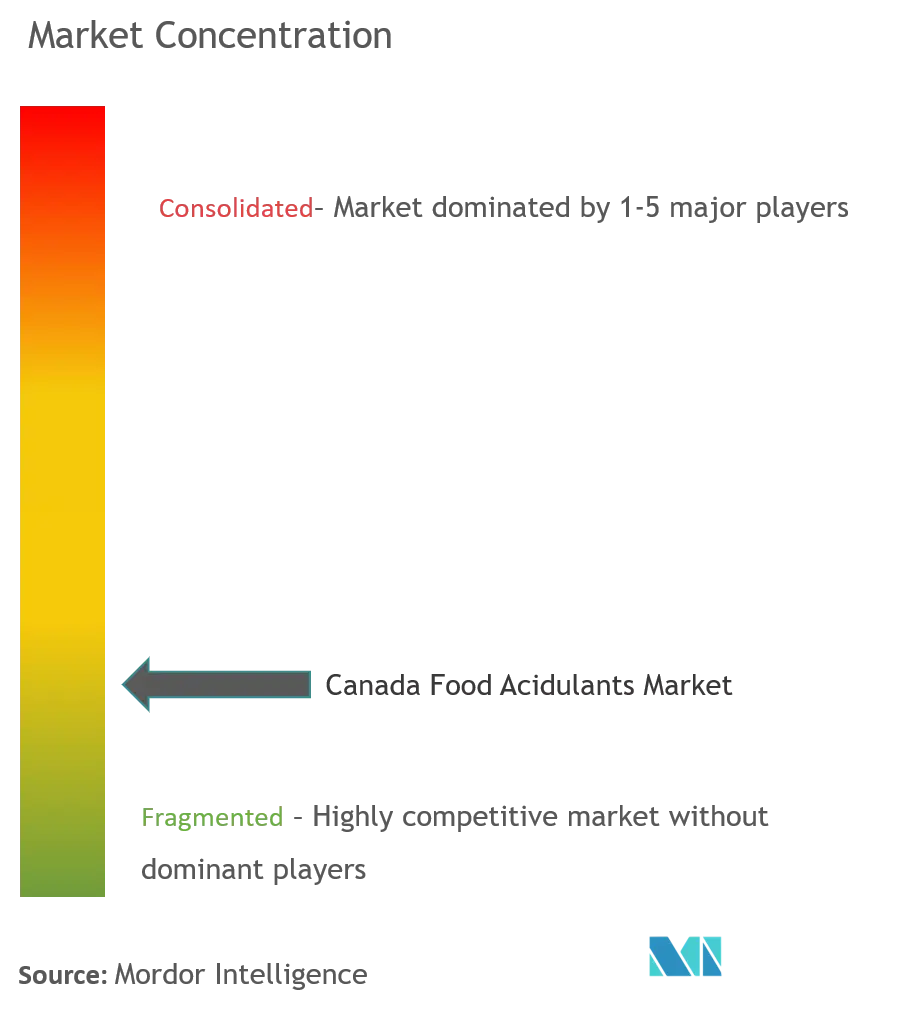
The Canada food acidulants market is characterized by fragmented structure. Global manufacturers bring process scale and technical capabilities, while regional specialists and distributors remain important. Jungbunzlauer’s integrated Port Colborne campus provides a local supply option for Ontario processors. ICL’s December 2025 acquisition of Bartek Ingredients combined Bartek’s malic and fumaric acid operations with ICL’s specialty food solutions platform. The first-phase investment was USD 90 million for a 50% stake. This transaction strengthened ICL’s position in bakery, confectionery, and fruit-flavored beverage applications.
Brenntag, IMCD, Azelis, Univar Solutions, Hawkins, and FBC Industries remain important because smaller processors often need formulation support and access to multiple acid types. The distributor layer competes on application knowledge, product breadth, and continuity of supply. This role is valuable across Canada because food processors are spread over a large geography. Corbion is shifting its portfolio toward natural preservation and label-friendly products under its BRIGHT 2030 strategy.
Controlled-release and encapsulated acidulant technologies are beginning to reach Canadian formulation trials in bakery and meat processing. These systems offer suppliers a differentiation option beyond price competition. The Canada food acidulants market also has scope for locally produced bio-based specialty acids. No Canadian manufacturer currently offers full-chain coverage from fermentation feedstock through finished food-grade acid. This gap may support co-investment between ingredient suppliers and food processors seeking more secure sourcing. The competitive structure does not indicate that a small group controls a dominant share of total sales.
Canada Food Acidulants Industry Leaders
-
Archer Daniels Midland Company
-
Cargill, Incorporated
-
Tate & Lyle PLC
-
Corbion N.V.
-
Kerry Group plc
- *Disclaimer: Major Players sorted in no particular order
Recent Industry Developments
- February 2026: Jungbunzlauer installed a second Mechanical Vapor Recompression (MVR) evaporator at its Port Colborne, Ontario campus, expected to reduce CO₂ emissions by approximately 8,000 tonnes per year, scaling to approximately 12,000 tonnes annually. The upgrade deepens the site's low-emission technology profile for its Canadian citric acid and gluconate manufacturing.
- December 2025: ICL Group announced a definitive agreement to acquire Bartek Ingredients Inc., the Ontario-based producer of food-grade malic and fumaric acid at North America's only vertically integrated maleic anhydride and downstream acid facility. The first-phase investment was approximately USD 90 million for approximately 50% of Bartek; the full acquisition timeline is subject to business and integration milestones. Bartek was simultaneously constructing a new production facility expected to complete in 2026.
- November 2024: The Government of Canada announced a CAD 27 million investment in Bartek Ingredients to support its CAD 192.5 million manufacturing facility project in Stoney Creek, Ontario. The planned facility incorporates advanced process technologies, energy-management systems and additional product-development capabilities. The project is intended to strengthen domestic food-grade acid production, improve manufacturing efficiency and reduce greenhouse gas emissions and water consumption.
Canada Food Acidulants Market Report Scope
Acidulants are chemical elements that are being utilized to provide a tart flavor or a sharp taste to food and beverage items. The Canada food acidulants market is segmented based on product type, source, form and application. By product type, the food acidulants market is segmented into citric acid, lactic acid, acetic acid, phosphoric acid, malic acid, fumaric acid, succinic acid, tartaric acid and other types. Based on source, the market is segmented into bio-based/natural and synthetic. Based on form, the market is segmented into dry/powder and liquid. Based on application, the market is segmented into beverages, dairy and frozen desserts, bakery and confectionery, meat and seafood, sauces, dressings and condiments, infant and clinical nutrition and other processed foods. For each segment, the market sizing and forecasting have been done in value terms (USD million).
By Product Type
| Citric Acid |
| Lactic Acid |
| Acetic Acid |
| Phosphoric Acid |
| Malic Acid |
| Fumaric Acid |
| Succinic Acid |
| Tartaric Acid |
| Others (GDL, Gluconic, etc.) |
By Source
| Bio-based/Natural |
| Synthetic (Petro-/Corn-derived) |
By Form
| Dry/Powder |
| Liquid/Solution |
By Application
| Beverages |
| Dairy and Frozen Desserts |
| Bakery and Confectionery |
| Meat and Seafood |
| Sauces, Dressings and Condiments |
| Infant and Clinical Nutrition |
| Other Processed Foods |
| By Product Type | Citric Acid |
| Lactic Acid | |
| Acetic Acid | |
| Phosphoric Acid | |
| Malic Acid | |
| Fumaric Acid | |
| Succinic Acid | |
| Tartaric Acid | |
| Others (GDL, Gluconic, etc.) | |
| By Source | Bio-based/Natural |
| Synthetic (Petro-/Corn-derived) | |
| By Form | Dry/Powder |
| Liquid/Solution | |
| By Application | Beverages |
| Dairy and Frozen Desserts | |
| Bakery and Confectionery | |
| Meat and Seafood | |
| Sauces, Dressings and Condiments | |
| Infant and Clinical Nutrition | |
| Other Processed Foods |
Key Questions Answered in the Report
What is the forecast growth rate for food acidulants in Canada?
The market is projected to grow at a 4.82% CAGR from 2026 to 2031, reaching USD 236.83 million by 2031.
Which product type leads demand in Canada?
Citric acid leads with a 65.48% share in 2025 because it is used across beverage, dairy, bakery, and meat processing applications.
Which acidulant source is growing fastest in Canada?
Bio-based acidulants are projected to grow at a 5.93% CAGR through 2031, supported by clean-label and domestic-sourcing interest.
Why are liquid acidulants growing faster than dry products?
Liquid and solution products are projected to grow at a 6.05% CAGR because automated beverage and dairy lines can dose them directly.
Which end-use application is the largest?
Beverages account for 33.71% of 2025 value, while bakery and confectionery is the fastest-growing application at a 5.89% CAGR.