
Market Overview
| Study Period | 2021 - 2031 |
|---|---|
| Forecast Data Period | 2026 - 2031 |
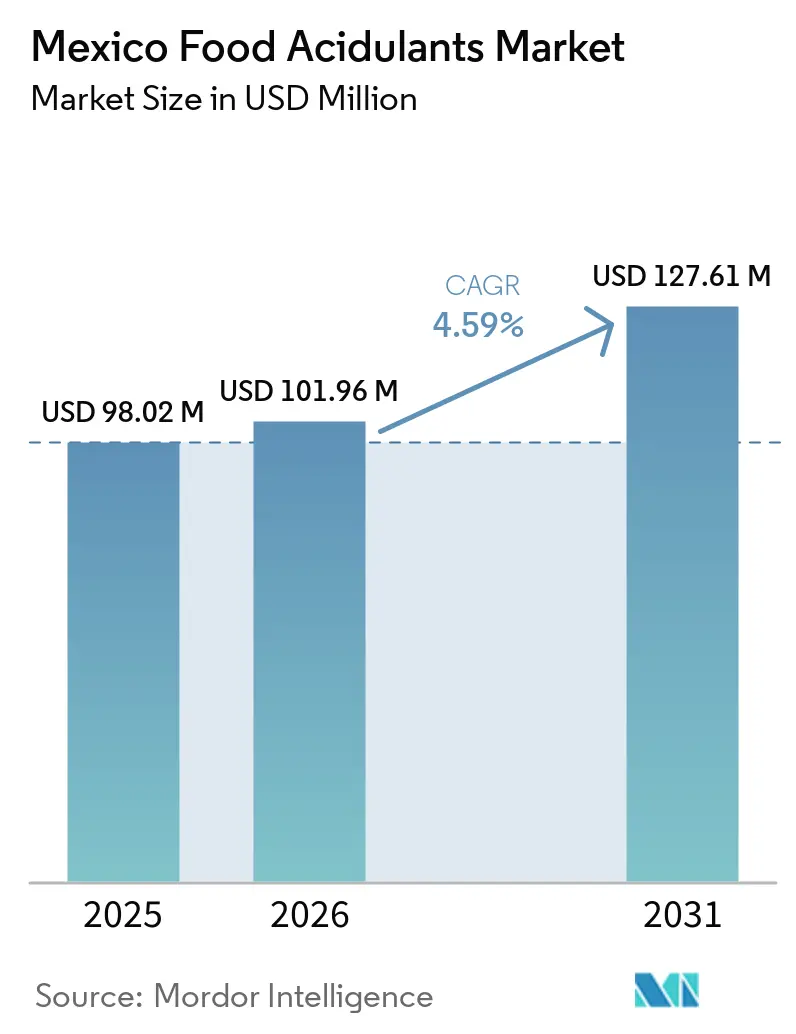
| Base Year Market Size (2025) | USD 98.02 Million |
| Market Size (2026) | USD 101.96 Million |
| Market Size (2031) | USD 127.61 Million |
| Growth Rate (2026 - 2031) | 4.59 % |
| Market Concentration | Medium |
Major Players *Disclaimer: Major Players sorted in no particular order Image © Mordor Intelligence. Reuse requires attribution under CC BY 4.0. | |
Mexico Food Acidulants Market Analysis by Mordor Intelligence
The Mexico food acidulants market size was valued at USD 98.02 million in 2025 and is projected to reach USD 101.96 million by 2026 and USD 127.61 million by 2031, at a 4.59% CAGR over 2026-2031. The market is supported by the scale of domestic food processing, which represented 4% of Mexico’s GDP in 2025 [1]. Demand is concentrated in processed beverages, packaged condiments, dairy products, and bakery goods that use acids for flavor, preservation, and pH control. Agricultural trade between Mexico and the United States reached USD 79 billion in 2024, and this trade relationship raises traceability and quality requirements for suppliers serving export-oriented processors, according to USDA. The Mexico food acidulants market is also shaped by reformulation toward natural ingredients and by the need for reliable acidulant supply in shelf-stable products. These conditions give technical suppliers an advantage where customers need documented quality, formulation support, and consistent delivery.
Key Report Takeaways
- By product type, citric acid held 42.53% of the Mexico food acidulants market share in 2025, while malic acid recorded the highest projected CAGR at 6.24% through 2031.
- By source, bio-based and fermentation-derived acidulants held 57.37% of the Mexico food acidulants market share in 2025, while the supplied draft identified this category as the growth-leading source segment at a CAGR of 5.37%.
- By form, dry/powder acidulants held 61.33% of the Mexico food acidulants market share in 2025, while liquid/solution formats recorded the highest projected CAGR at 5.68% through 2031.
- By application, beverages held 44.28% of the Mexico food acidulants market share in 2025, while sauces, dressings, and condiments recorded the highest projected CAGR at 5.83% through 2031.
Note: Market size and forecast figures in this report are generated using Mordor Intelligence’s proprietary estimation framework, updated with the latest available data and insights as of January 2026.
Mexico Food Acidulants Market Trends and Insights
Drivers Impact Analysis*
| Driver | (~) % Impact on CAGR Forecast | Geographic Relevance | Impact Timeline |
|---|---|---|---|
| Rising Demand for Ready-to-Eat Processed Foods | +0.8% | National; concentrated in Estado de México, Jalisco, and Nuevo León manufacturing hubs | Short term (≤ 2 years) |
| Rising Demand for Clean-Label Food Ingredients | +0.7% | National; accelerated in premium urban retail in Mexico City and Guadalajara | Medium term (2-4 years) |
| Expanding Exports of Mexican Sauces and Condiments | +0.6% | National; primary export flows through Tamaulipas, Baja California, and Sonora border crossings | Medium term (2-4 years) |
| Growing Demand for Premium Fruit-Flavored Beverages | +0.9% | National; strongest in metropolitan areas with high Gen Z and millennial penetration | Short term (≤ 2 years) |
| Rising Focus on Extended Food Shelf-Life | +0.5% | National; supply chain implications across northern and southern food distribution corridors | Long term (≥ 4 years) |
| Increasing Adoption of Bio-Based Acidulant Formulations | +0.7% | National; driven by USMCA-aligned sustainability commitments of multinational buyers | Medium term (2-4 years) |
| Source: Mordor Intelligence | |||
Rising Demand for Ready-to-Eat Processed Foods
Mexico’s packaged and convenience food production supports recurring demand for acidulants in meat, dairy, bakery, beverage, and prepared food applications. The food processing sector accounted for 4% of national GDP in 2025, which indicates the broad manufacturing base that purchases these ingredients, according to the USDA. The Mexico food acidulants market benefits when manufacturers expand products that need controlled acidity, stable flavor, and longer usable life. Processors that serve U.S. Hispanic retail channels also align their ingredient specifications with U.S. requirements, increasing demand for validated grades. Citric acid remains important because it can provide pH adjustment, antioxidant support, chelation, and flavor balancing in one formulation. Large food and beverage manufacturers set buying practices that extend across local ingredient and contract-manufacturing networks.
Rising Demand for Clean-Label Food Ingredients
Clean-label reformulation is directing food companies toward ingredients that support recognizable product positioning. A 2025 Kerry survey reported that 50% of Mexican consumers read product labels for ingredients and 50% prefer natural ingredients. The Mexico food acidulants market therefore has a stronger reason to favor fermentation-derived acids where they meet technical and labeling requirements. Food manufacturers that transition toward natural preservatives need acidulant systems that support both shelf stability and label positioning. This strengthens the practical relevance of lactic, citric, and other organic acids in preservation systems. It also moves sourcing discussions beyond unit cost toward formulation performance, supplier documentation, and continuity of supply.
Expanding Exports of Mexican Sauces and Condiments
Mexico exported USD 774.3 million of sauces and condiments in 2024 and recorded a USD 274.1 million trade surplus in this category [2]. This export base supports acidulant use in preserved products that require defined acidity profiles and shelf stability. Mexican suppliers serving external markets need food-grade citric, acetic, and lactic acids that are supported by reliable documentation. The Mexico food acidulants market gains value when export producers prioritize repeatable processing and compliance over the lowest-priced input. International branded condiment companies that source in Mexico also reinforce requirements for ingredient provenance. These requirements make supply assurance and application support more important for acidulant vendors.
Rising Focus on Extended Food Shelf-Life
Food manufacturers use organic acids to manage pH, support microbial control, and preserve sensory quality in many processed products. A 2025 scientific review describes how organic acids can contribute to food preservation through multiple mechanisms [3]. This need is relevant across distribution routes where finished food travels long distances before sale. The Mexico food acidulants market is supported by sauces, dairy products, bakery goods, and beverages that need dependable shelf-life performance. Suppliers that can help processors balance preservation with taste have a more durable commercial position. The effect is strongest when manufacturers need to preserve product quality without moving away from clean-label objectives.
Restraints Impact Analysis*
| Restraint | (~) % Impact on CAGR Forecast | Geographic Relevance | Impact Timeline |
|---|---|---|---|
| Stringent Food Additive Regulatory and Safety Compliance Requirements | -0.5% | National; most acute for small and mid-sized processors lacking in-house regulatory affairs capability | Medium term (2-4 years) |
| High Dependence on Imported Specialty Acidulants | -0.4% | National; supply exposure concentrated at import ports of Veracruz, Manzanillo, and Lázaro Cárdenas | Long term (≥ 4 years) |
| Competition from Alternative Food Preservation Technologies | -0.3% | National; most relevant in high-value protein and dairy processing where antimicrobial alternatives are mature | Medium term (2-4 years) |
| Risk of Excessive Sourness Affecting Product Palatability | -0.2% | National; most acute in confectionery and infant nutrition with stricter sensory tolerance thresholds | Short term (≤ 2 years) |
| Source: Mordor Intelligence | |||
Stringent Food Additive Regulatory and Safety Compliance Requirements
Food additive compliance creates additional work for ingredient importers, distributors, and processors. It was noted that Mexico’s updated COFEPRIS additives agreement enters into force on November 17, 2026. Products that are not covered by approved lists may require formal authorization and supporting evidence. This process can delay the introduction of specialty acidulants with limited approval histories. Ingredient declaration requirements can also influence how manufacturers assess synthetic and naturally positioned acids. Larger suppliers can manage these requirements more easily when they have established technical files, food safety systems, and regulatory experience.
High Dependence on Imported Specialty Acidulants
Mexico’s reliance on imported acidulants exposes buyers to changes in international supply, logistics, and trade rules. The market identifies imported citric acid as a significant share of national supply and describes Chinese capacity as an important source of exposure. Long import routes can require manufacturers and distributors to maintain larger inventories. The Mexico food acidulants market is therefore sensitive to freight conditions, availability, and changes in country-of-origin sourcing. Provisional duties on U.S.-origin citric acid during 2024 also added routing complexity. Domestic food-grade fermentation capacity remains limited relative to the requirements described in the draft.
*Our forecasts treat driver/restraint impacts as directional, not additive. The impact forecasts reflect baseline growth, mix effects, and variable interactions.
Segment Analysis
By Product Type: Citric Acid Leads and Malic Acid Expands
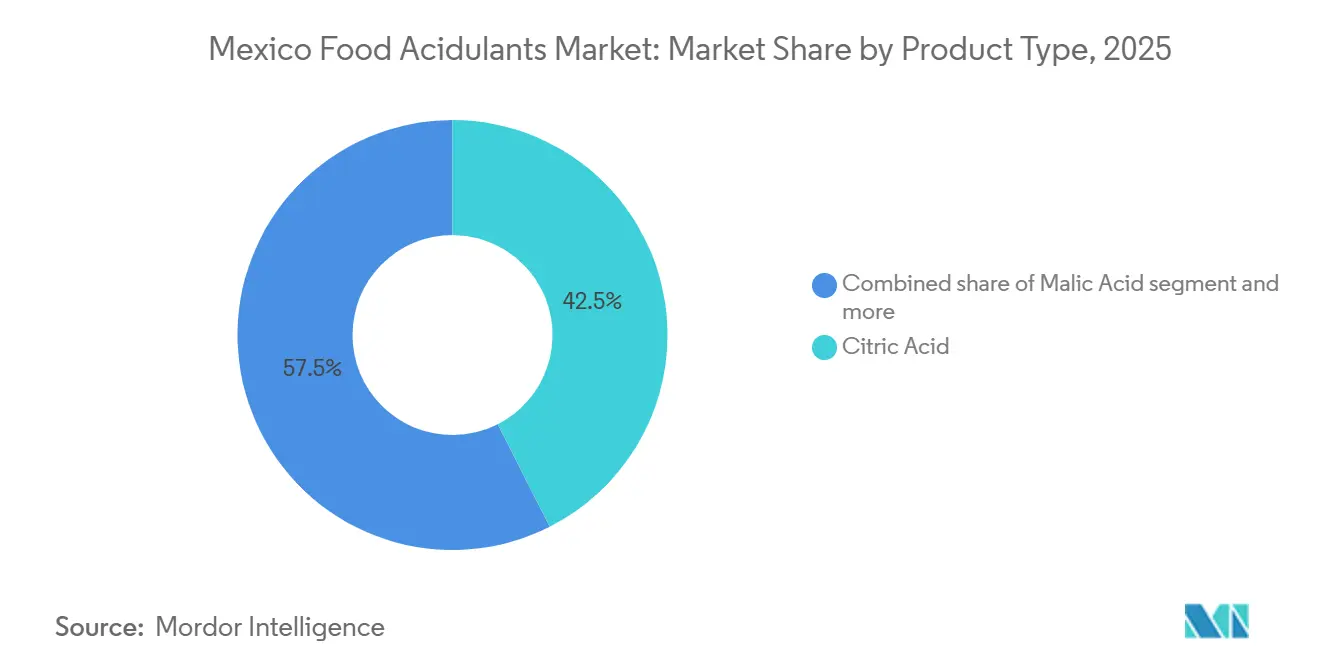
Citric acid held 42.53% of the Mexico food acidulants market share in 2025. Its leading position reflects its ability to adjust pH, support antioxidant performance, chelate metals, and balance flavor within the same recipe. A 2025 technical review describes citric acid as a major industrial fermentation product with broad food applications. Lactic acid is the next important product group because it supports antimicrobial control in dairy, meat, and fermented foods. Acetic acid remains important in pickled products and condiments where its flavor profile and preservation function are well established. Phosphoric acid continues to be used in cola-style carbonated beverages, while fumaric acid offers heat stability in baked goods.
Malic acid is the fastest-growing product type at a 6.24% CAGR over 2026-2031. The Mexico food acidulants market size for malic acid is supported by fruit-flavored beverages and confectionery that need a slower, fruit-oriented sourness. Food and beverage applications use most of the malic acid discussed in the cited scientific review. This profile makes malic acid useful for apple, berry, and tropical flavors where manufacturers want a less immediate acidic note. Other product types include glucono delta-lactone, gluconic acid, and tartaric acid. These materials serve smaller uses in wine, artisanal baking, and clinical nutrition, where specific functional requirements sustain demand.



By Source: Bio-Based Acidulants Retain the Larger Position
Bio-based and fermentation-derived acidulants accounted for 57.37% of the Mexico food acidulants market share in 2025 and a CAGR of 5.37% from 2026 to 2031. This result is linked to the technical role of fermentation in citric acid production and to customer demand for naturally positioned ingredients. A 2025 scientific review states that microbial fermentation using Aspergillus niger is the main route for commercial citric acid production. The Mexico food acidulants market can use this production profile to meet requests for natural, non-GMO, and clean-label formulations. Bio-based materials also fit the purchasing requirements of food companies that are reformulating preservative systems. This source category therefore combines established technical scale with stronger commercial relevance in premium food applications.
Chemically synthesized and petrochemical-derived acidulants held the remaining 42.63% of 2025 value. Phosphoric acid and certain acetic acid grades maintain a cost advantage in commodity applications. They remain relevant for domestic processors where unit cost and familiar processing methods are primary considerations. Their longer-term position is constrained when brand owners shift new product development toward fermentation-derived alternatives. Smaller processors can continue to use these inputs in the near term when they meet performance and economic requirements. The Mexico food acidulants market remains mixed by source because the choice depends on product category, labeling strategy, price, and manufacturing practice.
By Form: Dry Products Lead While Liquids Support Automation
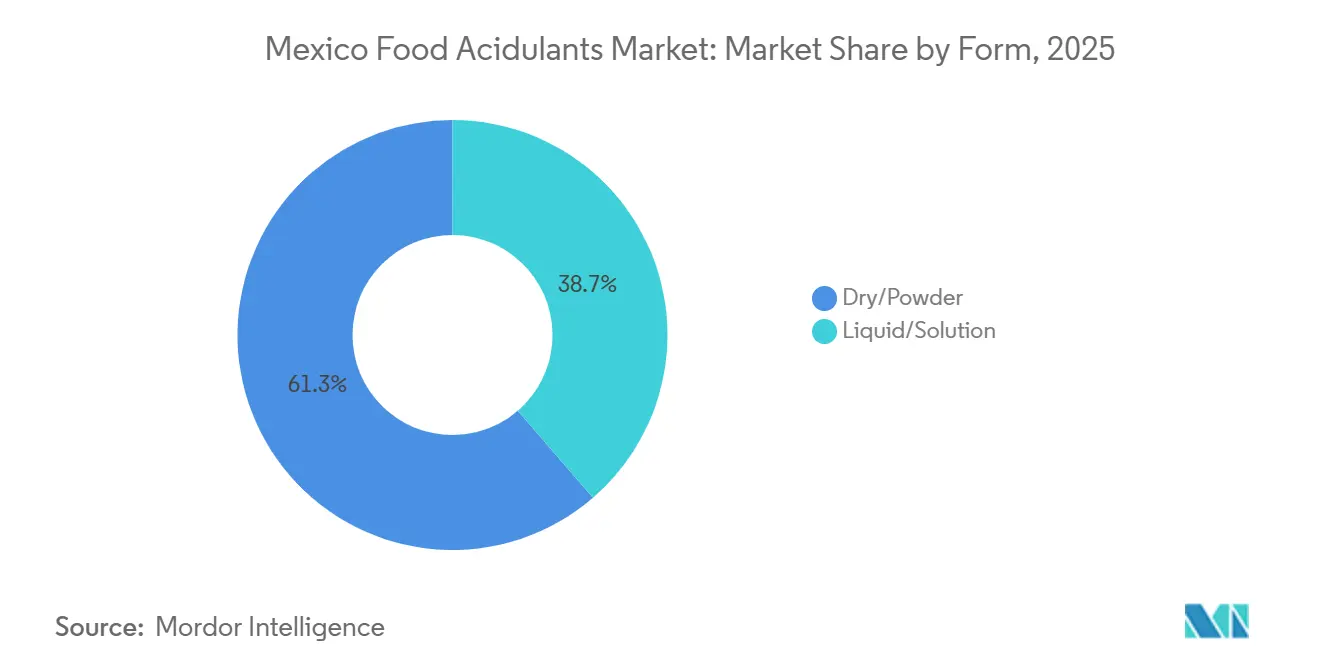
Dry/powder acidulants held 61.33% of the Mexico food acidulants market share in 2025. This position reflects the handling needs of smaller and mid-scale food manufacturing facilities. Powder forms provide long ambient storage life, straightforward transport, and compatibility with batch processing. Dry citric acid is used widely by sauce, condiment, and confectionery manufacturers that add ingredients directly to mixing tanks. Food processors outside the major industrial clusters may have limited incentive to invest in liquid storage and dosing equipment. Dry formats therefore retain a broad installed base across the Mexico food acidulants market.
Liquid/solution acidulants are expected to expand at a 5.68% CAGR through 2031. The Mexico food acidulants market size for this form benefits from continuous and automated beverage and dairy processing. Inline dosing provides consistent pH management and can reduce handling variability on large production lines. This format is particularly useful where export-oriented manufacturers need repeatable process control and documented quality systems. Sauce and condiment exporters also need consistent acidity in large-scale continuous production. These needs allow liquids to grow faster, even while powder remains the larger form segment.

By Application: Beverages Lead While Condiments Gain Export Support
Beverages accounted for 44.28% of the Mexico food acidulants market share in 2025. Carbonated soft drinks, packaged juices, flavored waters, and ready-to-drink beverages use acids for flavor adjustment and pH control. Citric acid is important in flavored waters and juice drinks, while malic acid is useful in premium fruit formulations. Dairy and frozen desserts form another significant cluster because lactic and citric acids support pH control and microbial management. Bakery and confectionery use fumaric and citric acids in products that require consistent processing behavior. These end uses give beverages the largest application base in the Mexico food acidulants market.
Sauces, dressings and condiments are projected to record a 5.83% CAGR through 2031. Mexico exported USD 774.3 million of sauces and condiments in 2024, providing a strong production base for this application. Citric and acetic acids support pH stabilization and preservation in shelf-stable sauce formats. Meat and seafood applications use lactic and acetic acids under food safety protocols. Infant and clinical nutrition remains smaller but requires high-purity ingredients and controlled specifications. These applications need technical support because manufacturers must balance safety, taste, and regulatory documentation.
Competitive Landscape
Market Concentration
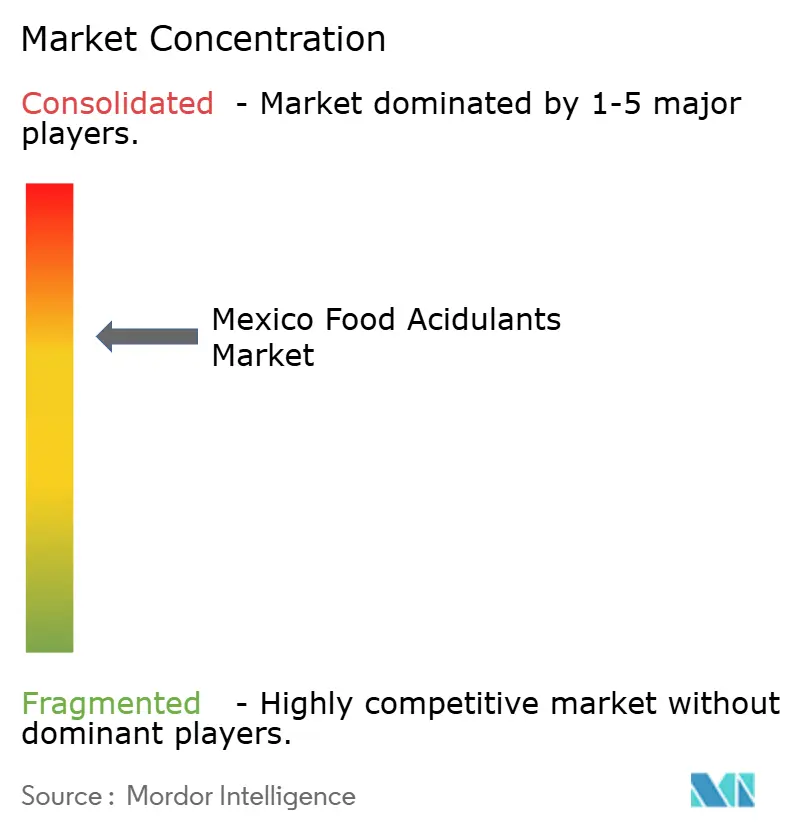
The Mexico food acidulants market has a concentrated specialty-supply tier and a broader group of price-focused commodity suppliers. Jungbunzlauer, Corbion, ADM, Cargill, and Tate & Lyle compete through technical service, traceability, and supply reliability. Chinese and Indian producers compete more heavily on standard citric and acetic acid pricing. This structure means that customers select suppliers based on application risk as well as price. The Mexico food acidulants market concentration score is supported by the presence of a defined group of multinational suppliers in formulation-grade applications. Local distributors remain important because they provide last-mile availability to a fragmented base of processors.
Jungbunzlauer completed the acquisition of IFF’s production site in Thomson, Illinois, in November 2025, creating a U.S. manufacturing base for its acidulant operations. This move improves North American production proximity for Mexican buyers sourcing from the region. Corbion’s Querétaro blending facility improves local blending and inventory support for food and beverage manufacturers. ADM announced a USD 26 million investment in its Erlanger, Kentucky facility in January 2026, including a 40% expansion of raw material handling capacity and digitalization upgrades. These initiatives show how suppliers are building regional capacity, local service, and reformulation capability rather than competing only through commodity pricing. The Mexico food acidulants market is likely to reward suppliers that combine these capabilities with dependable documentation.
Opportunities remain in domestic fermentation capacity and in high-purity applications. Mexico does not have a major local fermentation producer serving broad food-grade acidulant demand at the scale described in the draft. A domestic supplier could reduce dependence on imported standard-grade material if it can meet required quality and cost levels. Infant and clinical nutrition also need high-purity ingredients with ISO 22000 traceability, which creates a specialized opportunity. Jungbunzlauer launched TayaGel LA at IFT FIRST 2025 as a texturant that complements its ingredient portfolio. This type of portfolio expansion can strengthen customer relationships by combining acidulant needs with adjacent formulation requirements.
Mexico Food Acidulants Industry Leaders
-
Tate & Lyle PLC
-
Corbion N.V.
-
Archer-Daniels-Midland Company
-
Jungbunzlauer Suisse AG
-
Cargill, Incorporated
- *Disclaimer: Major Players sorted in no particular order
Recent Industry Developments
- January 2026: ADM announced a USD 26 Million investment in its Erlanger, Kentucky facility, including a 40% expansion of raw material handling capabilities and integrated digitalization upgrades. The project builds on a USD 15 Million expansion at the same site in 2025 and strengthens ADM's capacity to co-develop reformulation-focused flavor and acidulant solutions for North American and Mexican manufacturers.
- November 2025: Jungbunzlauer closed the acquisition of IFF's production site in Thomson, Illinois, marking its entry into US-based acidulant manufacturing. Combined with a concurrent biogums facility expansion in Canada, the acquisition significantly improves proximity to North American citric acid supply and reduces freight exposure for Mexican buyers sourcing from North American origins.
- July 2025: Jungbunzlauer launched TayaGel LA, a new texturant ingredient, at IFT FIRST 2025, complementing its core acidulant portfolio with a system designed for texture-stability applications in food and beverage that typically deploy organic acid combinations.
Mexico Food Acidulants Market Report Scope
The Mexico Food Acidulants Market is Segmented by Product Type (Citric Acid, Acetic Acid, Lactic Acid, Phosphoric Acid, Malic Acid, Fumaric Acid, and Other Product Types), by Source (Bio-Based / Fermentation-Derived and Chemically synthesized / Petrochemical-Derived), by Form (Dry/Powder and Liquid/Solution), and by Application (Bakery and Confectionery, Beverages, Dairy and Frozen Desserts, Meat and Seafood, Sauces, Dressings and Condiments, Infant and Clinical Nutrition, and Other Applications). The Market Forecasts are Provided in Terms of Value (USD).
By Product Type
| Citric Acid |
| Lactic Acid |
| Acetic Acid |
| Phosphoric Acid |
| Malic Acid |
| Fumaric Acid |
| Other Product Types |
By Source
| Bio-Based / Fermentation-Derived |
| Chemically Synthesized / Petrochemical-Derived |
By Form
| Dry/Powder |
| Liquid/Solution |
By Application
| Beverages |
| Dairy and Frozen Desserts |
| Bakery and Confectionery |
| Meat and Seafood |
| Sauces, Dressings and Condiments |
| Infant and Clinical Nutrition |
| Other Applications |
| By Product Type | Citric Acid |
| Lactic Acid | |
| Acetic Acid | |
| Phosphoric Acid | |
| Malic Acid | |
| Fumaric Acid | |
| Other Product Types | |
| By Source | Bio-Based / Fermentation-Derived |
| Chemically Synthesized / Petrochemical-Derived | |
| By Form | Dry/Powder |
| Liquid/Solution | |
| By Application | Beverages |
| Dairy and Frozen Desserts | |
| Bakery and Confectionery | |
| Meat and Seafood | |
| Sauces, Dressings and Condiments | |
| Infant and Clinical Nutrition | |
| Other Applications |
Key Questions Answered in the Report
What is the forecast value of Mexico food acidulants by 2031?
The Mexico food acidulants market is forecast to reach USD 127.61 million by 2031, from USD 98.02 million in 2025, at a 4.59% CAGR.
Which product type leads demand in Mexico?
Citric acid leads with 42.53% value share in 2025 because it supports pH control, flavor balancing, chelation, and antioxidant performance.
Which acidulant type is expected to grow fastest?
Malic acid is the fastest-growing product type, with a 6.24% CAGR through 2031, supported by premium fruit-flavored beverage and confectionery uses.
Why are bio-based acidulants important to food manufacturers?
Bio-based and fermentation-derived acidulants accounted for 57.37% of 2024 value and support clean-label and natural-ingredient reformulation.