
Market Overview
| Study Period | 2021 - 2031 |
|---|---|
| Forecast Data Period | 2026 - 2031 |
| Base Year Market Size (2025) | USD 1.34 Billion |
| Market Size (2026) | USD 1.39 Billion |
| Market Size (2031) | USD 1.65 Billion |
| Growth Rate (2026 - 2031) | 3.55 % |
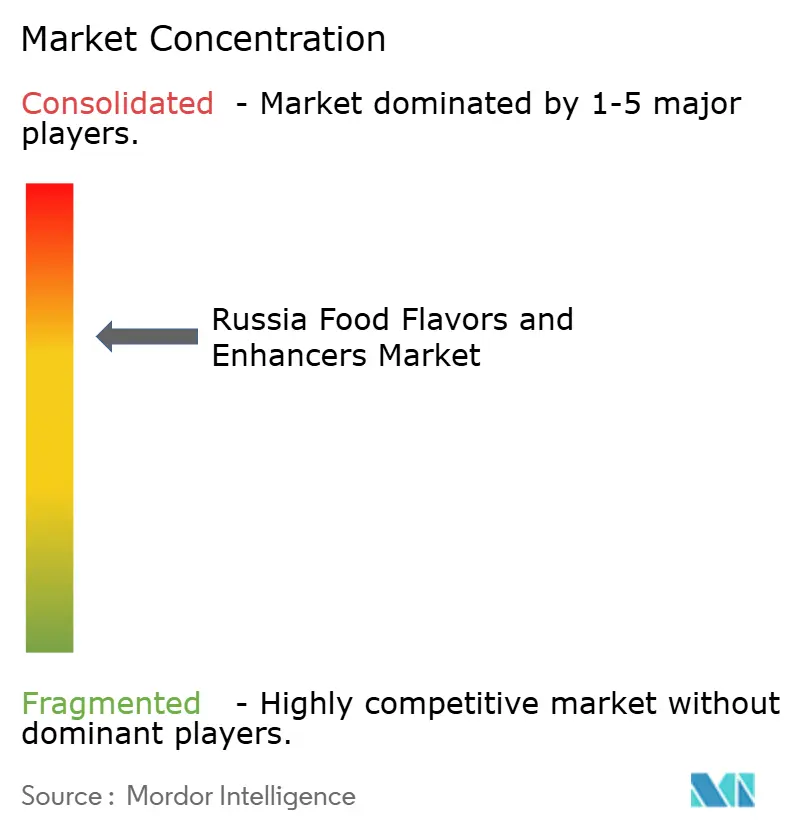
| Market Concentration | Medium |
Major Players *Disclaimer: Major Players sorted in no particular order Image © Mordor Intelligence. Reuse requires attribution under CC BY 4.0. | |
Russia Food Flavors and Enhancers Market Analysis by Mordor Intelligence
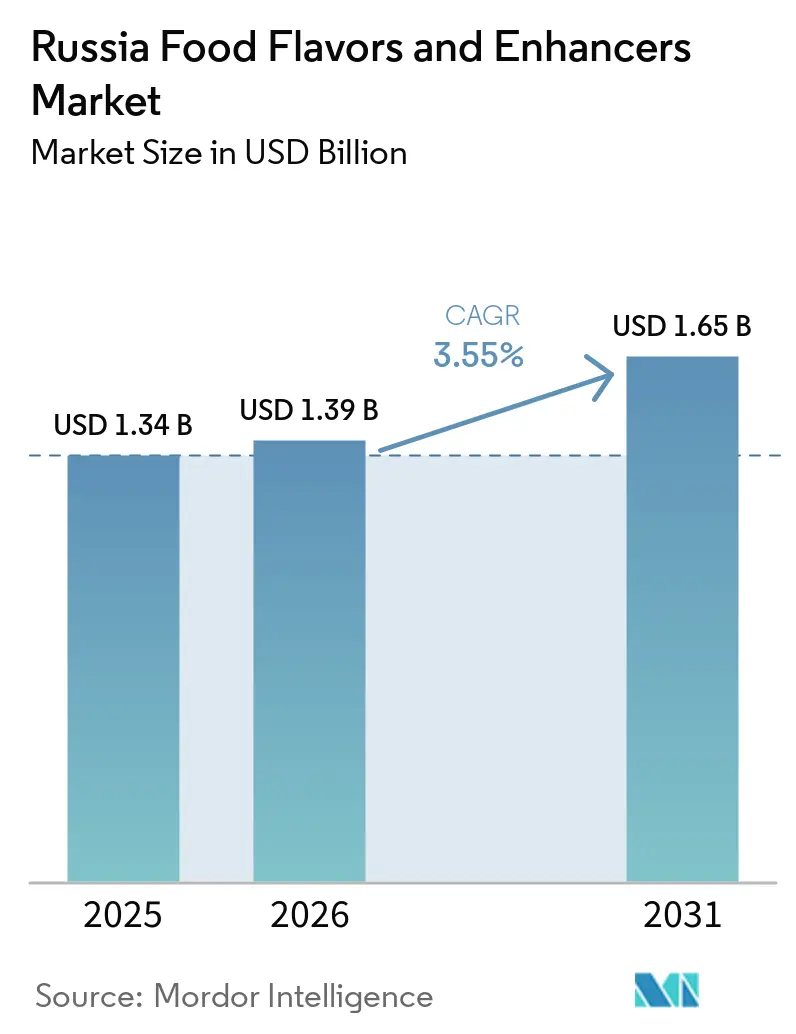
The Russia Food Flavors and Enhancers Market was valued at USD 1.34 billion in 2025 and is estimated to grow from USD 1.39 billion in 2026 to USD 1.65 billion by 2031, registering a CAGR of 3.55% during the forecast period (2026–2031). Market growth is driven by the continued need to improve taste, aroma, and overall sensory appeal across processed food and beverage formulations. Flavoring ingredients and enhancers help manufacturers maintain consistent product quality, reproduce recognizable taste profiles, and differentiate their offerings in a competitive retail environment. Demand is further supported by evolving consumer preferences for varied taste experiences, greater interest in traditional and distinctive flavor profiles, and the development of formulations that balance sensory performance with changing ingredient expectations.
Key Report Takeaways
- By product type, Food Flavors held 77.55% of the Russia food flavors and enhancers market share in 2025, while Food Enhancers are forecast to grow at a 4.76% CAGR through 2031.
- By type, Synthetic flavors accounted for 71.23% of the market in 2025, while Natural flavors are projected to record the highest growth at a 5.11% CAGR through 2031.
- By form, Liquid flavors captured 41.29% of the market share in 2025, while Powder flavors are expected to expand at a 4.59% CAGR through 2031.
- By application, Savory Snacks commanded 36.41% of the market in 2025, while Beverages are forecast to grow at a 5.04% CAGR through 2031.
Note: Market size and forecast figures in this report are generated using Mordor Intelligence’s proprietary estimation framework, updated with the latest available data and insights as of January 2026.
Russia Food Flavors and Enhancers Market Trends and Insights
Drivers Impact Analysis*
| Driver | (~) % Impact on CAGR Forecast | Geographic Relevance | Impact Timeline |
|---|---|---|---|
| Demand for packaged and processed food products | +1.2% | National, with highest impact in Moscow, Saint-Petersburg, and major urban agglomerations | Short term (≤ 2 years) |
| Increasing preference for traditional Russian flavors | +0.7% | National, with early gains in regional food clusters in Tatarstan, North-West, and Southern Federal Districts | Medium term (2–4 years) |
| Clean-label and natural-flavor reformulation | +0.6% | National; urban consumer base drives demand, with spillover to mid-tier cities | Medium term (2–4 years) |
| Rising demand for meat and poultry flavor solutions | +0.5% | National, concentrated in Central and Volga Federal Districts where meat processing capacity is highest | Short term (≤ 2 years) |
| Reformulation of products to reduce sodium content | +0.4% | National; regulatory influence most acute in food service and ready-to-eat categories | Medium term (2–4 years) |
| Advancements in flavor encapsulation | +0.3% | National, with Research and Development concentration in the Moscow region | Long term (≥ 4 years) |
| Source: Mordor Intelligence | |||
Demand for Packaged and Processed Food Products
Demand for packaged and processed food products supports the growth of the Russia Food Flavors and Enhancers Market. Food manufacturers rely on flavoring ingredients to improve sensory appeal, maintain consistent taste, and differentiate products across retail categories. Processed meat products, dairy foods, sauces, ready meals, savory snacks, and confectionery require carefully formulated flavor profiles to deliver consistent taste experiences across production batches. The need to maintain flavor stability during processing, storage, and shelf life encourages manufacturers to select ingredients suited to specific product formulations and processing conditions. As food producers expand their product ranges and introduce new flavor variations, demand for flavoring solutions that support recipe consistency and product differentiation is expected to grow.
Increasing Preference for Traditional Russian Flavors
The preference for traditional Russian flavors supports demand for flavoring ingredients that preserve familiar regional taste profiles in packaged and processed foods. Russian culinary traditions feature distinctive sensory characteristics, including fermented dairy notes, smoked meat profiles, forest mushroom nuances, dill, mustard, and pickled vegetable flavors. Manufacturers incorporate these profiles into sausages, savory snacks, and sauces to maintain local taste appeal while offering convenient retail formats. Aromaros-M, a domestic flavor producer, offers a portfolio of more than 2,000 additive formulations tailored to local processing requirements, illustrating the role of localized formulation expertise in serving Russian food manufacturers. Such specialization helps processors reproduce familiar taste characteristics consistently, adapt formulations to different production conditions, and develop products that reflect regional culinary preferences.
Clean-Label and Natural-Flavor Reformulation
The shift toward clean-label formulations and naturally derived ingredients is creating opportunities in the Russia Food Flavors and Enhancers Market, as manufacturers seek to align product composition with consumer expectations around ingredient transparency and recognizable components. Food producers are exploring flavoring solutions derived from fruits, herbs, spices, botanical extracts, and other natural sources to develop distinctive sensory profiles while reducing reliance on certain artificial additives where technically and commercially feasible. Reformulation also requires suppliers to address challenges such as flavor stability, intensity, and consistency during processing and storage, particularly when replacing established synthetic ingredients. This is encouraging flavor developers to improve natural extraction, blending, and encapsulation techniques while offering application-specific solutions for processed foods and beverages.
Rising Demand for Meat and Poultry Flavor Solutions
Rising demand for meat and poultry flavor solutions is creating opportunities for ingredient suppliers serving processors that produce sausages, smoked meats, poultry products, marinated cuts, meat snacks, and ready-to-eat meals. These applications require specialized flavor systems to deliver smoked, roasted, grilled, and savory notes while maintaining consistent taste across large-scale production. For instance, according to the Meat & Poultry Industry Russia, Russian farms produced approximately 12.2 million tonnes of livestock and poultry in slaughter weight in 2025[1]. This substantial production base supports demand for flavor ingredients used in meat processing, as manufacturers require formulations that enhance sensory appeal, standardize product taste, and differentiate their offerings.
Restraints Impact Analysis*
| Restraint | (~) % Impact on CAGR Forecast | Geographic Relevance | Impact Timeline |
|---|---|---|---|
| Dependence on imported specialty flavor ingredients | -0.8% | National; most acute in specialty flavor categories dependent on Europe-origin raw materials | Short term (≤ 2 years) |
| Stringent food safety and ingredient compliance requirements | -0.5% | National; compliance factors most pronounced for imported flavor categories | Medium term (2–4 years) |
| High costs of natural and specialty flavor ingredients | -0.6% | National; price pressure transmitted from Europe and global raw material markets | Short term (≤ 2 years) |
| Limited domestic production of advanced aroma chemicals | -0.4% | National, with partial mitigation from Central Federal District chemical producers | Long term (≥ 4 years) |
| Source: Mordor Intelligence | |||
Dependence on Imported Specialty Flavor Ingredients
Dependence on imported specialty flavor ingredients restrains the Russia Food Flavors and Enhancers Market by exposing manufacturers to supply chain disruptions, longer procurement lead times, and sourcing cost fluctuations. Certain high-performance ingredients, specialized aroma chemicals, natural extracts, encapsulation materials, and proprietary flavor compounds require international sourcing when domestic alternatives are unavailable or cannot meet specific technical requirements. Trade restrictions, payment difficulties, logistics constraints, and changes in supplier availability can further complicate procurement and increase operational uncertainty. Higher input costs may pressure manufacturers' margins and limit their ability to offer competitively priced formulations to food processors.
Stringent Food Safety and Ingredient Compliance Requirements
Stringent food safety and ingredient compliance requirements restrain the Russia Food Flavors and Enhancers Market by increasing the regulatory, documentation, testing, and product-approval obligations faced by flavor manufacturers and food processors. As a member of the Eurasian Economic Union (EAEU), Russia is subject to Technical Regulation TR TS 029/2012, which establishes safety requirements for food additives, flavorings, and processing aids[2]. Manufacturers and suppliers must ensure that ingredients comply with applicable requirements covering permitted uses, purity, safety, and labeling, while maintaining appropriate technical documentation and conformity evidence. These obligations can increase product-development costs, extend the time required to qualify new ingredients, and complicate the introduction of novel or imported flavor formulations. Smaller suppliers may face particular challenges in maintaining regulatory expertise and completing the testing and documentation required to serve food manufacturers.
*Our forecasts treat driver/restraint impacts as directional, not additive. The impact forecasts reflect baseline growth, mix effects, and variable interactions.
Segment Analysis
By Product Type: Enhancers Begin Closing the Gap on Flavors
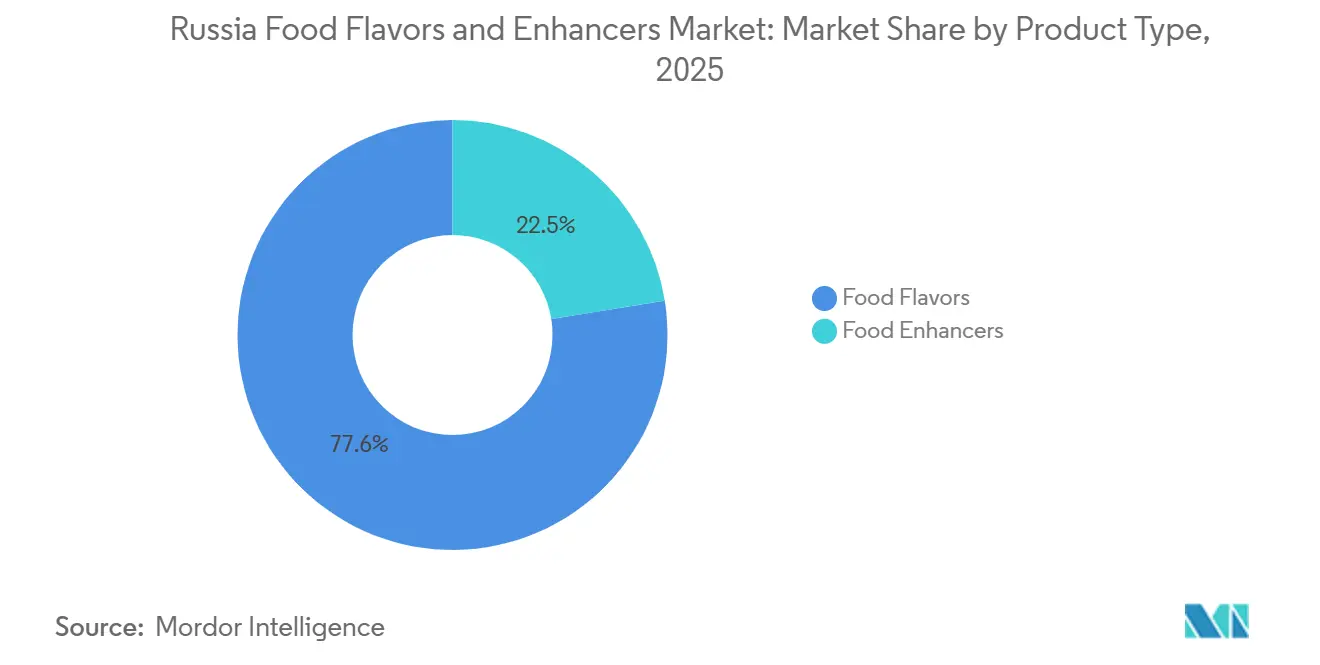
Food flavors accounted for 77.55% of the Russia Food Flavors and Enhancers Market in 2025, supported by their essential role in establishing and maintaining the sensory characteristics of manufactured food products. The segment benefits from manufacturers' need to deliver consistent taste, aroma, and overall product appeal across production batches, particularly when ingredient sources, processing conditions, or storage periods vary. Flavor formulations also enable food producers to standardize recipes, reproduce familiar taste profiles, and introduce new sensory variations without completely redesigning their manufacturing processes. Growing emphasis on product differentiation encourages the use of customized flavor blends, while improvements in flavor stability, heat resistance, and encapsulation help preserve sensory quality during processing and storage.
Food enhancers are projected to grow at a CAGR of 4.76% during 2026–2031 in the Russia Food Flavors and Enhancers Market, driven by manufacturers' increasing need to intensify savory taste, strengthen umami perception, and improve flavor balance in formulated products. Unlike conventional flavorings that primarily introduce a specific taste or aroma, enhancers can amplify existing sensory characteristics, allowing formulators to achieve the desired flavor intensity with greater precision. Demand is further supported by the development of yeast extracts, hydrolyzed vegetable proteins, and nucleotide-based ingredients that provide alternatives to conventional monosodium glutamate (MSG) formulations and help manufacturers develop more differentiated taste profiles.
By Type: Synthetic Holds Volume Leadership as Natural Builds Value Premium
Synthetic flavors accounted for 71.23% of the Russia Food Flavors Market in 2025, supported by their ability to deliver consistent aroma profiles, predictable sensory performance, and reliable formulation outcomes across industrial production batches. Their defined chemical composition enables manufacturers to control flavor intensity and reproduce standardized taste characteristics while maintaining consistency across different production runs. Synthetic ingredients also provide flexibility in developing specific aroma notes and adjusting formulations to meet technical requirements, including stability during processing and storage.
Natural flavors are projected to grow at a CAGR of 5.11% during 2026–2031, driven by increasing interest in naturally derived ingredients, ingredient transparency, and product formulations perceived as safer and more wholesome. Natural flavoring solutions derived from botanical extracts, fruits, herbs, and essential oils offer manufacturers opportunities to develop distinctive sensory profiles while responding to evolving consumer expectations around food composition. For instance, according to Roskachestvo, Russia's national quality system established by the Government of the Russian Federation, a 2025 survey found that 78% of consumers in major Russian cities purchased organic products at least occasionally[3]. These findings indicate consumer interest in product composition and provide indirect support for manufacturers' development of natural-origin formulations.
By Form: Liquid Anchors Industrial Use as Powder Gains Momentum
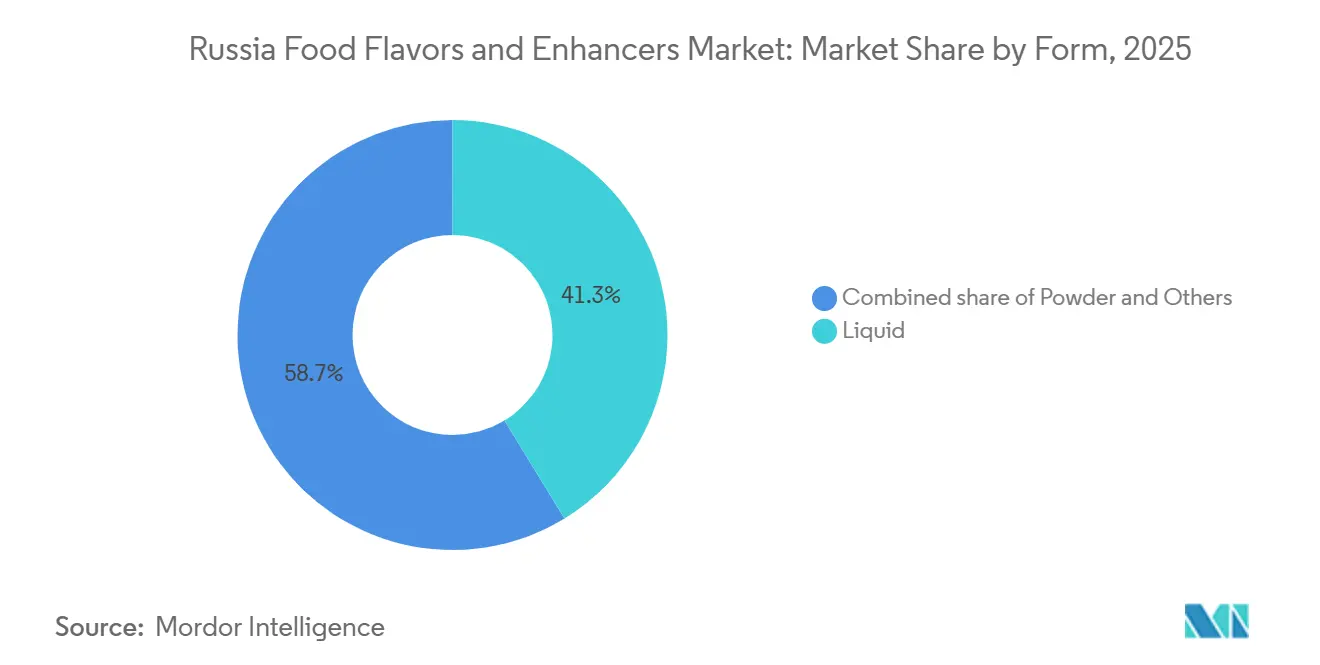
Liquid flavors held a 41.29% share of the Russia Food Flavors Market in 2025, supported by their ease of incorporation into liquid formulations, rapid dispersion, and suitability for precise dosage adjustments during manufacturing. Their ability to blend uniformly with compatible ingredients allows manufacturers to control flavor intensity and achieve consistent sensory characteristics without extensive additional processing. Liquid formats also offer flexibility in formulation development, as flavor concentrations can be adjusted to accommodate different processing conditions and desired aroma profiles. Their established handling and dosing practices support continued use in industrial flavor applications.
Powder flavors are projected to grow at a CAGR of 4.59% during 2026–2031, driven by advantages in storage, transportation, and handling compared with many liquid formulations. Their lower moisture content can improve storage stability and reduce the risk of quality deterioration associated with moisture-sensitive ingredients when appropriately formulated and packaged. Powder formats are also compatible with dry blending and premix production, enabling manufacturers to achieve uniform ingredient distribution in solid formulations. Advances in spray drying, encapsulation, and carrier systems further help protect volatile flavor compounds from oxidation and environmental exposure, while improving flavor retention during processing and storage.

By Application: Savory Snacks Lead as Beverages Accelerate
Savory snacks accounted for 36.41% of the Russia Food Flavors Market in 2025, driven by manufacturers' focus on creating distinctive seasoning profiles that differentiate products in a competitive packaged-snack category. Flavor formulations play an important role in delivering recognizable taste experiences, balancing saltiness and savory intensity, and maintaining seasoning consistency across production batches. The segment also benefits from opportunities to diversify familiar flavor profiles by combining herbs, spices, cheese, smoke, and tangy notes, allowing manufacturers to refresh offerings without fundamentally altering core products. Improvements in seasoning adhesion and flavor retention further support consistent taste delivery, while customized flavor blends provide flexibility to respond to changing consumer preferences.
Beverages are projected to be the fastest-growing application in the Russia Food Flavors Market, registering a CAGR of 5.04% during 2026–2031. Growth is supported by manufacturers' increasing focus on developing differentiated sensory profiles, improving aroma delivery, and creating more varied taste experiences across beverage formulations. Flavor ingredients help balance sweetness and acidity, mask undesirable notes from functional ingredients, and maintain consistent taste across batches. The development of botanical, citrus, berry, tropical fruit, and layered flavor profiles also gives producers opportunities to refresh formulations and introduce new product variations.
Geography Analysis
The Central Federal District is the dominant geographic hub of the Russia Food Flavors and Enhancers Market, supported by its concentration of food manufacturers, processing facilities, and distribution infrastructure. Moscow serves as a major center for product development, procurement, and commercial decision-making, while surrounding oblasts support food processing and the supply of ingredients to manufacturers. This concentration of industrial activity and distribution networks enables flavor suppliers to serve a broad range of packaged food categories and maintain close relationships with food producers.
The Southern and North-Western Federal Districts represent important secondary demand centers, supported by regional food-processing activity and established manufacturing networks. The Southern Federal District benefits from its agricultural base and the availability of raw materials used by food processors, creating opportunities for flavor applications in processed foods, snacks, sauces, and other packaged products. The North-Western Federal District, particularly Saint Petersburg and its surrounding industrial areas, supports food manufacturing and regional distribution. Saint Petersburg also functions as a significant logistics gateway, although the sourcing and movement of imported ingredients are influenced by evolving trade conditions and supply chain arrangements.
The Volga, Ural, and Siberian Federal Districts offer additional opportunities for market expansion through their regional food-processing industries and demand for standardized flavor ingredients. The Volga Federal District benefits from a diverse industrial base and food-manufacturing activity, while the Ural Federal District connects industrial centers with regional consumer markets. In the Siberian Federal District, geographically dispersed markets and longer transportation routes increase the importance of reliable ingredient supply and efficient distribution. These regions offer flavor manufacturers opportunities to expand beyond the largest metropolitan centers by developing regional distribution partnerships and providing formulations suited to local food-processing requirements.
Competitive Landscape
The Russian food flavors and enhancers market is consolidated, with major international flavor houses and ingredient suppliers competing through specialized formulations, technical expertise, and established relationships with food manufacturers. Key players include Givaudan S.A., dsm-firmenich AG, International Flavors & Fragrances Inc. (IFF), Symrise AG, and Archer Daniels Midland Company (ADM). These companies compete through product innovation, customized flavor development, application-specific solutions, and research capabilities that support diverse food and beverage formulations.
Competition is also shaped by innovation in natural flavors, flavor enhancers, and formulations designed to meet changing product requirements. Large flavor houses differentiate themselves through sensory research, application testing, technical support, and the ability to tailor flavor profiles to individual customers. These capabilities help food processors address taste consistency, reformulation needs, and the development of distinctive products across processed foods and beverages. Partnerships with food manufacturers and ongoing product development remain important competitive strategies in a market where flavor performance and formulation expertise influence supplier selection.
Alongside international companies, Russian domestic players such as Aromaros-M compete through local-taste expertise, formulation flexibility, and solutions adapted to domestic food-processing requirements. Domestic suppliers have opportunities to strengthen their positions as manufacturers seek dependable sourcing options and alternatives to certain imported ingredients. Competition increasingly depends on the ability to reproduce traditional Russian taste profiles, meet compliance requirements, respond quickly to customer specifications, and manage ingredient availability and costs. As a result, the market combines the technical resources of major international flavor houses with the localized knowledge and responsiveness of domestic producers.
Russia Food Flavors and Enhancers Industry Leaders
-
Givaudan S.A.
-
dsm-firmenich AG
-
International Flavors & Fragrances Inc.
-
Symrise AG
-
Archer Daniels Midland Company
- *Disclaimer: Major Players sorted in no particular order
Recent Industry Developments
- September 2026: Symrise signed a definitive agreement to divest its Terpene Ingredients business to Mutares SE & Co. KGaA. The move streamlines its flavor and fragrance portfolio toward higher-value specialty segments, reflecting a continued focus on taste and wellbeing over commodity chemical streams.
- January 2026: Vkusaroma expanded its ingredient portfolio and adopted a full-cycle production model covering flavor development, customer formulation support, samples, and small-batch supply.
- December 2025: DSM-Firmenich advanced its plant-based food platform with Vertis TVPs integrating ModulaSENSE flavor modulation technology, enabling manufacturers to improve taste in high-protein plant-based products.
Russia Food Flavors and Enhancers Market Report Scope
Food flavors and enhancers are substances added to foods to impart, amplify, modify, or magnify taste profiles and sensory experiences. The Russia Food Flavors and Enhancers Market is segmented by product type, by type, form, and application. Based on product type, the market is segmented into food flavors and food enhancers. Based on type, the market is segmented into natural, synthetic, and nature-identical. Based on form, the market is segmented into powder, liquid, and others. Based on application, the market is segmented into dairy, bakery, confectionery, savory snacks, meat, beverages, and other applications. For each segment, the market sizing and forecast have been done based on value (in USD).
By Product Type
| Food Flavors |
| Food Enhancers |
By Type
| Natural |
| Synthetic |
| Nature Identical |
By Form
| Powder |
| Liquid |
| Others |
By Application
| Dairy |
| Bakery |
| Confectionery |
| Savory Snacks |
| Meat |
| Beverages |
| Other Applications |
| By Product Type | Food Flavors |
| Food Enhancers | |
| By Type | Natural |
| Synthetic | |
| Nature Identical | |
| By Form | Powder |
| Liquid | |
| Others | |
| By Application | Dairy |
| Bakery | |
| Confectionery | |
| Savory Snacks | |
| Meat | |
| Beverages | |
| Other Applications |
Key Questions Answered in the Report
What is the projected value of the Russia food flavors and enhancers sector by 2031?
The sector is projected to reach USD 1.65 billion by 2031, rising from USD 1.34 billion in 2025 at a 3.55% CAGR during 2026 to 2031.
Which product category holds the largest share in Russia?
Food Flavors lead the market with a 77.55% share in 2025. Food Enhancers are the faster-growing product category, with a projected 4.76% CAGR through 2031.
Which flavor type is growing the fastest in Russia?
Natural flavors are forecast to grow at a 5.11% CAGR through 2031. Demand is supported by clean-label product development and consumer interest in natural ingredients.
Why are powder flavors gaining importance?
Powder flavors are expected to grow at a 4.59% CAGR through 2031 because snack and dry-mix producers need stable, consistent flavor delivery. Domestic microencapsulation research may also reduce reliance on imported systems.