
Returnable Transport Packaging With IoT Tracking Market Size and Share
Market Overview
| Study Period | 2019 - 2030 |
|---|---|
| Market Size (2025) | USD 2.72 Billion |
| Market Size (2030) | USD 4.55 Billion |
| Growth Rate (2025 - 2030) | 10.84 % |
| Fastest Growing Market | Asia Pacific |
| Largest Market | North America |
| Market Concentration | Medium |
Major Players *Disclaimer: Major Players sorted in no particular order Image © Mordor Intelligence. Reuse requires attribution under CC BY 4.0. | |
Returnable Transport Packaging With IoT Tracking Market Analysis by Mordor Intelligence
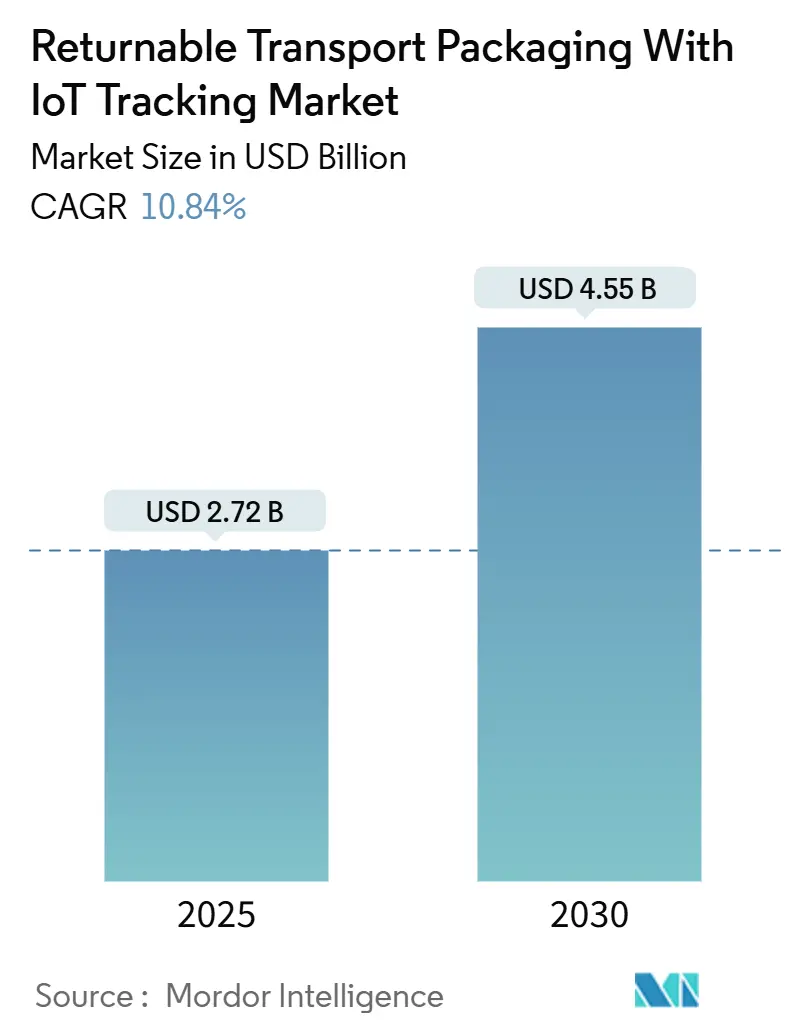
The returnable transport packaging with IoT tracking market size stood at USD 2.72 billion in 2025 and is projected to reach USD 4.55 billion by 2030, reflecting a robust 10.84% CAGR. The continued convergence of sustainability mandates, supply-chain digitization programs, and tightening traceability regulations is accelerating customer migration from passive to sensor-enabled, reusable assets. Adoption rates are reinforced by e-commerce growth, which demands granular shipment visibility and rapid reverse-logistics cycles that single-use packaging cannot offer at scale. Simultaneously, corporate net-zero commitments are driving investment in circular systems that track carbon and waste reductions in real-time. Competitive dynamics are shifting toward software and analytics, with poolers and technology startups racing to attach predictive-maintenance and usage-based billing features to every container. Cybersecurity and data ownership concerns remain a counterweight, but have not slowed capital inflows into retrofit kits, battery-free tags, and low-power wide-area network solutions.
Key Report Takeaways
- By packaging type, pallets captured 34.57% of the returnable transport packaging with IoT tracking market share in 2024.
- By material, returnable transport packaging with IoT tracking market size for composite materials is projected to grow at a 12.33% CAGR between 2025–2030.
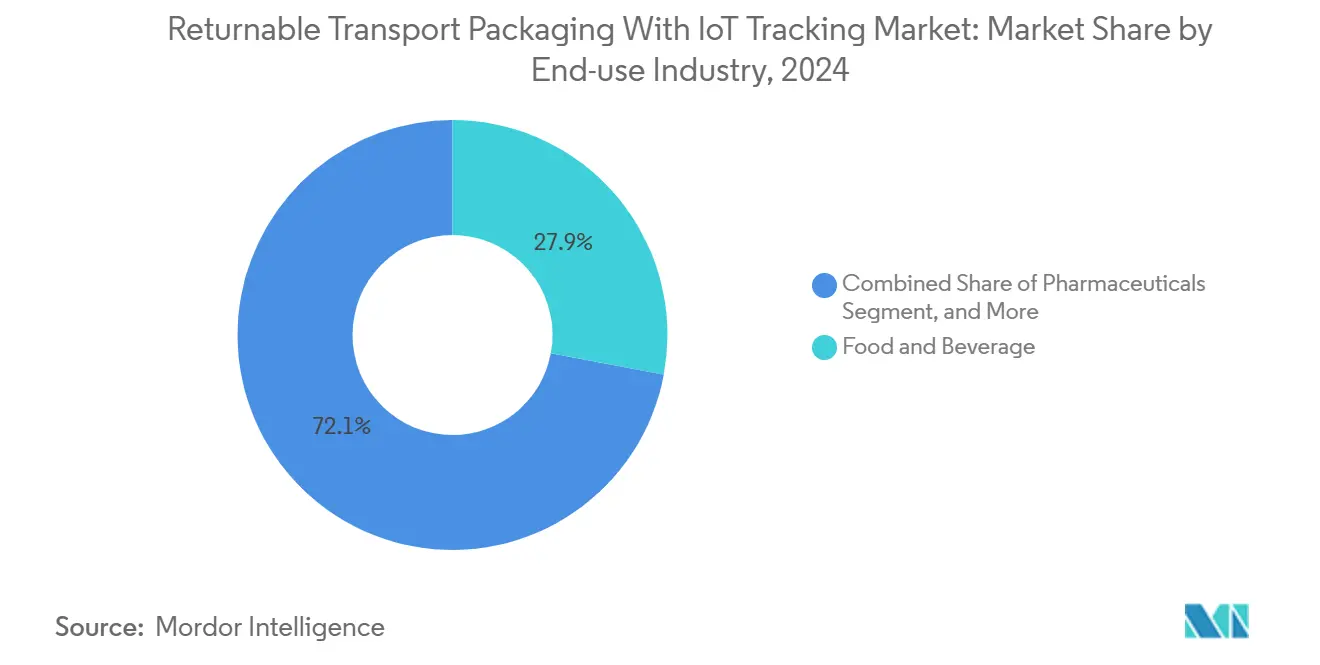
- By end-use industry, food and beverage captured 27.94% of the returnable transport packaging with IoT tracking market share in 2024.
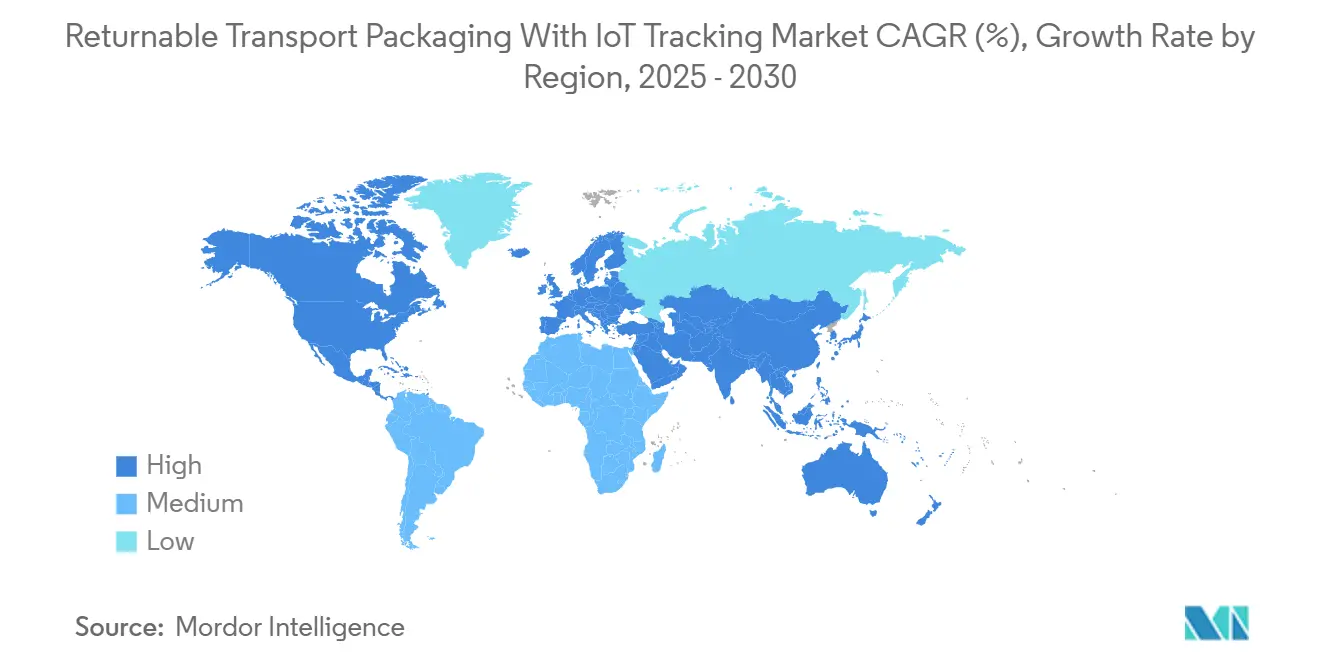
- By geography, returnable transport packaging with IoT tracking market size for Asia-Pacific is projected to grow at a 12.73% CAGR between 2025–2030.
Note: Market size and forecast figures in this report are generated using Mordor Intelligence’s proprietary estimation framework, updated with the latest available data and insights as of January 2026.
Market Trends and Insights
Drivers Impact Analysis of Returnable Transport Packaging With IoT Tracking Market*
| Driver | (~) % Impact on CAGR Forecast | Geographic Relevance | Impact Timeline |
|---|---|---|---|
| Rising need to reduce packaging waste and improve sustainability | +2.1% | Global, EU and North America leading | Medium term (2-4 years) |
| Cost savings via asset pooling and reverse-logistics efficiency | +2.8% | North America and EU core, expanding to Asia-Pacific | Short term (≤ 2 years) |
| Expansion of e-commerce demanding track-and-trace reusable packaging | +2.3% | Global, Asia-Pacific and North America leading | Short term (≤ 2 years) |
| Stringent regulations curbing single-use packaging waste | +1.9% | EU primary, North America secondary | Medium term (2-4 years) |
| Real-time temperature and shock sensing unlocking cold-chain compliance | +1.6% | Global pharmaceutical corridors | Long term (≥ 4 years) |
| VC funding and pay-per-use models accelerating smart RTI adoption | +1.2% | North America and EU, spillover to Asia-Pacific | Short term (≤ 2 years) |
| Source: Mordor Intelligence | |||
Rising Need to Reduce Packaging Waste and Improve Sustainability
Corporate sustainability programs are pressuring procurement teams to replace expendable cartons with reusable containers that log every trip, carbon metric, and end-of-life route. The European Union’s Packaging and Packaging Waste Regulation, which requires a 65% recycling rate by 2025, is cascading through global supply chains, forcing multinational brands to demonstrate waste reductions beyond EU borders.[1]European Commission, “Packaging and Packaging Waste Regulation Guidance,” ec.europa.eu IoT-equipped pallets and totes automatically transmit utilization statistics, allowing enterprises to benchmark circularity targets and satisfy auditors with immutable records. Blockchain-backed data layers are emerging to deter greenwashing accusations by linking each sensor reading to a ledger entry. Consultancy estimates indicate that transitioning to data-rich, reusable systems reduces logistics spend by up to 25% while enhancing environmental, social, and governance (ESG) scorecards.
Cost Savings Via Asset Pooling and Reverse-Logistics Efficiency
Asset pooling converts packaging from a capital purchase to a usage-based service, shrinking upfront budgets and maximizing turn velocity. Cellular and GPS sensors slash loss and theft rates by as much as 60% by geofencing every returnable transport item, while predictive-maintenance algorithms trigger repair before catastrophic failure. Brambles documented a 20% utilization uplift after fitting connectivity to half of its pallet fleet, validating that real-time dispatching narrows idle time and raises revenue per asset. Pay-per-use pricing, underpinned by granular trip data, is resonating with mid-size shippers seeking premium performance without the balance-sheet strain of outright purchase. The model also delivers sustainability gains because higher cycle counts dilute the embodied carbon of each unit across more shipments.
Expansion of E-Commerce Demanding Track-and-Trace Reusable Packaging
Rapid parcel flows require packaging that is both tough enough to survive automated sorters and smart enough to track every node. Global online marketplaces are pursuing zero-defect delivery targets that hinge on visibility from warehouse to doorstep. Amazon’s net-zero roadmap requires the integration of reusable bins into fulfillment centers, creating a cascading demand among third-party sellers. Near-field communication and QR codes provide consumers with access to provenance data and recycling rewards, thereby tightening the feedback loop on environmental performance. Real-time shock and tilt sensing reduces spoilage for perishables and electronics, smoothing claims processing and enhancing brand reputation. As last-mile networks densify, reusable crates equipped with battery-free sensors are emerging as a low-maintenance method to manage high-cycle urban deliveries.
Stringent Regulations Curbing Single-Use Packaging Waste
Governments are increasing disposal fees, labeling requirements, and producer obligations, which collectively inflate the cost of disposable packaging. The U.S. Drug Supply Chain Security Act requires unique identifiers on pharmaceutical shipments, aligning perfectly with reusable containers that incorporate serialization and temperature logging capabilities. China’s waste-import ban has redirected focus toward domestic recycling loops, encouraging factories to deploy smart pallets that never leave the internal network. Extended producer responsibility levies in several European countries add EUR 0.50-1.20 per kilogram of plastic waste, making single-use options economically unattractive. IoT-enabled returnables accrue compliance credits by generating time-stamped proof of recovery, positioning them as a regulatory hedge.
Restraints Impact Analysis of Returnable Transport Packaging With IoT Tracking Market*
| Restraint | (~) % Impact on CAGR Forecast | Geographic Relevance | Impact Timeline |
|---|---|---|---|
| High upfront capital investment requirements | -1.4% | Global, particularly emerging markets | Short term (≤ 2 years) |
| Complexes reverse logistics in emerging markets | -1.1% | Asia-Pacific, the Middle East and Africa, and Latin America | Medium term (2-4 years) |
| Cybersecurity and data ownership concerns for IoT assets | -0.8% | Global, with EU GDPR compliance focus | Long term (≥ 4 years) |
| Lack of protocol standardization is hindering interoperability | -0.6% | Global technology adoption | Medium term (2-4 years) |
| Source: Mordor Intelligence | |||
High Upfront Capital Investment Requirements
Smart containers cost USD 50-100 per unit, a price that deters small shippers accustomed to low-cost expendables. Added fees for connectivity, cloud subscriptions, and data analytics complicate budget approvals, especially in sectors with thin margins. Startups such as Sensos have raised USD 20 million to roll out subscription models that spread costs over the asset life and sidestep capital budget constraints. Nevertheless, near-term adoption in emerging markets remains gated by financing availability and currency volatility that inflates import prices for sensors.
Complex Reverse-Logistics in Emerging Markets
Asset retrieval requires reliable transport links, uniform pallet sizes, and digital inventory systems—capabilities that are still maturing in parts of South and Southeast Asia, the Middle East, Africa, and Latin America. Patchy cellular coverage limits real-time visibility, while fragmented trucking fleets complicate the collection cycle. As a result, round-trip times extend, shrinking the economic case for reusable assets. Belt and Road infrastructure projects are gradually upgrading ports, rail, and warehouses, but network inefficiencies remain a mid-term headwind.
*Our forecasts treat driver/restraint impacts as directional, not additive. The impact forecasts reflect baseline growth, mix effects, and variable interactions.
Returnable Transport Packaging With IoT Tracking Market Segment Analysis
By Packaging Type:
Pallets Lead While IBCs AcceleratePallets accounted for 34.57% of revenue in 2024, reflecting deep penetration in fast-moving consumer goods, automotive, and retail cross-docks where standardized footprints enable mass pooling. Their established networks help poolers track utilization, prevent loss, and present a mature platform for sensor retrofits that capture geolocation, humidity, and impact events. The returnable transport packaging with IoT tracking market size tied to pallets is expected to expand steadily as machine-vision sorters and robotic forklifts demand 100% identification compliance to avoid downtime.
Intermediate bulk containers are forecast to post a 13.04% CAGR as pharmaceutical and chemical shippers prioritize leak detection, temperature stability, and regulatory traceability. IoT probes inside IBC cavities alert handlers to excursions, enabling quarantine decisions before outbound shipping, which protects patient safety and reduces the risk of recalls. In parallel, collapsible IBC designs slash backhaul volumes, boosting asset velocity and trimming transport emissions. Competitive differentiation is pivoting to sensor battery life, wireless range inside metal cages, and compatibility with cleaning stations that prepare the container for its next sterile load.




By Material:
Plastic Dominance Faces Composite ChallengePlastic retained 47.13% revenue share in 2024, buoyed by durability, chemical resistance, and the ability to mold antenna traces and sensor housings directly into walls without degrading payload capacity. For high-turn pallets and totes, the returnable transport packaging with IoT tracking market share held by plastic is reinforced by refurbishing kits that extend lifespan to a decade or longer. However, mounting pressure to eliminate virgin resin is catalyzing investment in recycled and bio-based resins that match the performance of first-use polymers.
Composite materials, which blend fiber reinforcements with polymers, are expected to grow at a 12.33% CAGR as aerospace, automotive, and electronics manufacturers seek to reduce weight to lower fuel and freight costs. These lighter units enhance the returnable transport packaging with IoT tracking market size by enabling a higher payload per truckload without compromising telemetry quality. Cost remains a barrier, yet pooling operators are trialing closed-loop systems in which composites circulate among a finite group of facilities, ensuring high trip counts that amortize the premium bill of materials.
By End-use Industry:
Pharmaceuticals Drive GrowthPharmaceutical shipments require validated temperature control, chain-of-custody data, and serialization compliance, driving a 13.21% CAGR through 2030. FDA guidance stipulates electronic tracing of every transaction from manufacturer to dispenser, making IoT-equipped totes the default option over insulated cartons. Vaccine distribution consortia are piloting real-time temperature logging with automated exception alerts, ensuring adherence to ISO 23412 cold-chain standards.[2]International Organization for Standardization, “ISO 23412:2024 Cold-Chain Monitoring,” iso.org The push for counterfeit deterrence further accelerates demand for sensor-enabled lids that flash alerts when seals are tampered.
The food and beverage sector maintained a 27.94% share in 2024, driven by established crate and RPC (reusable plastic container) programs that supply produce to supermarkets. IoT overlays are unlocking freshness analytics, enabling retailers to rotate stock based on actual shelf-life algorithms rather than fixed calendars. Automotive plants are augmenting Kanban loops with RFID-linked racks that transmit arrival times, shrinking safety stocks, and preventing line stoppages. Meanwhile, specialty chemicals leverage vibration and pressure sensors in drums to comply with hazardous goods codes and insurance mandates.
Geography Analysis
North America Returnable Transport Packaging with IoT Tracking Market
North America accounted for 33.27% of 2024 revenue, driven by U.S. pharmaceutical serialization deadlines, mature e-commerce fulfillment networks, and a robust service culture surrounding pallet pooling. In Canada, plastics recycling initiatives are incentivizing retailers to substitute single-use corrugate with smart containers that report trip-count carbon savings. Mexico’s export assembly plants are deploying IoT pallets to coordinate cross-border shuttle lanes, smoothing customs clearance through digital documentation.
APAC Returnable Transport Packaging with IoT Tracking Market
The Asia-Pacific region is forecast to expand at a 12.73% CAGR, driven by manufacturing relocation, infrastructure upgrades, and the expansion of digital commerce. China’s waste-import prohibition has catalyzed the development of domestic circular solutions, including pallet exchange markets that utilize Beidou satellite positioning. India’s pharmaceutical exporters are fitting totes with GSM sensors to comply with destination country pedigree rules, while Japanese logistics hubs, already equipped with ubiquitous 5G, serve as incubation sites for battery-free tag pilots. Southeast Asian nations are seeing container pooling firms bundle IoT with door-to-door recovery guarantees to overcome fragmented trucking ecosystems.
EMEA Returnable Transport Packaging with IoT Tracking Market
Europe continues to progress under the Packaging and Packaging Waste Regulation as well as GDPR, which favors providers with certified data-governance frameworks. Germany’s automotive Tier-1 suppliers mandate sensorized racks for sequenced component delivery, and the Netherlands uses blockchain to settle pallet deposits among carriers automatically. In southern Europe, agricultural cooperatives are scaling connected RPC programs to improve produce freshness and demonstrate compliance with cross-border phytosanitary audits. Middle East and Africa remain nascent but are seeing early activity near free-trade zones where international carriers demand reusable, traceable units to manage multi-temperature corridors.

Competitive Landscape
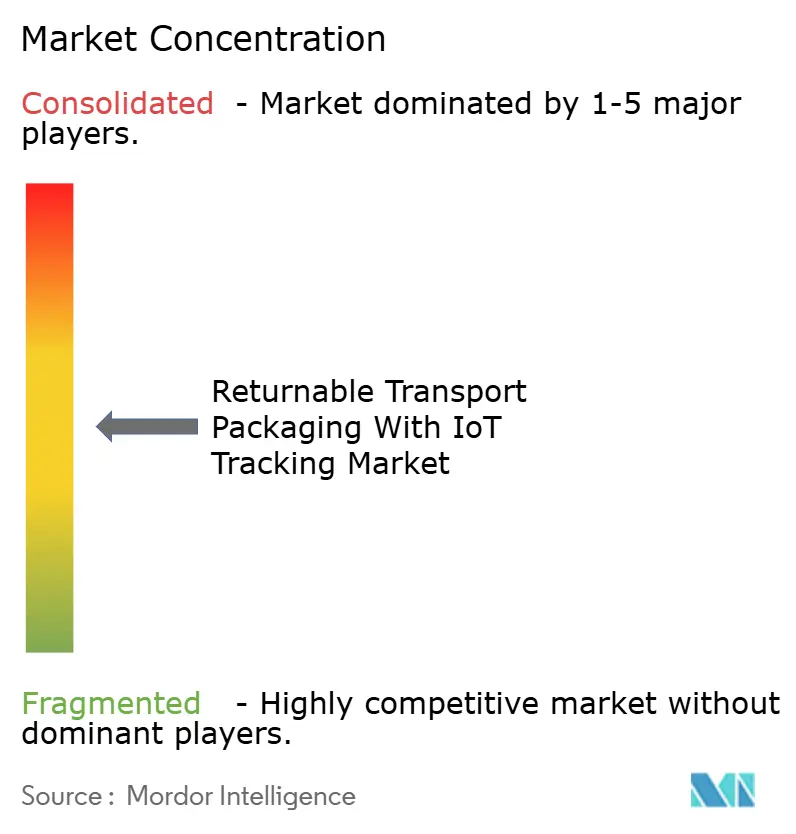
The market is moderately fragmented, with poolers such as Brambles and IFCO Systems leveraging network density, repair depots, and established customer integrations to protect incumbency. Their differentiation now hinges on analytics dashboards that translate asset telemetry into cycle-time and carbon-footprint reports. Startups, including Sensos and Roambee, focus on lightweight, pay-as-you-use business models that resonate with medium-sized shippers lacking capital for large pools.
These entrants prioritize software, offering predictive failure alerts and anomaly detection powered by machine-learning models trained on millions of shipment events. Partnerships between packaging firms and cloud platforms are accelerating. Tosca collaborates with Microsoft Azure to ingest and analyze billions of sensor pings, enabling dynamic relocation of idle pallets. Component miniaturization is intensifying patent races, as ultrathin printed batteries, energy-harvesting tags, and multi-band narrow-band IoT radios undergo rapid iteration.
Cybersecurity credentials are rising to the procurement table stakes, with ORBIS obtaining ISO 27001 certification to reassure pharmaceutical and defense customers of robust data segregation and encryption controls.[3]ORBIS Corporation, “ISO 27001 Certification,” orbiscorporation.com Regionally, white-space opportunities persist in Africa and parts of Latin America, where first movers can establish major trade corridors before global incumbents localize their operations.
Returnable Transport Packaging With IoT Tracking Industry Leaders
Brambles Limited
IFCO Systems GmbH
Tosca Services, LLC
Rehrig Pacific Company
ORBIS Corporation
- *Disclaimer: Major Players sorted in no particular order
Returnable Transport Packaging With IoT Tracking Market Companies Covered in this Report
- Brambles Limited
- Tosca Services, LLC
- Rehrig Pacific Company
- SSI SCHAEFER Group
- ORBIS Corporation
- Schoeller Allibert Group BV
- Nefab Group AB
- Reusable Transport Packaging LLC
- GPS Returnable Asset Services
- Euro Pool System International
- Retech Systems Co. Ltd.
- CABKA Group GmbH
- Contraload NV
- Paxxal Industries Inc.
- Reusability LLC
- Tempack Packaging Solutions
- Intellitrack, Inc.
- Sensitech Inc.
- Omnitracs LLC
- FourKites Inc.

Recent Industry Developments in Returnable Transport Packaging With IoT Tracking Market
- July 2025: BMW implemented IoT-enabled reusable packaging, delivering 40% waste reduction and 20% fewer inventory errors, reinforcing sustainability and cost-efficiency goals.
- May 2025: Gartner forecasted over 70% of businesses to adopt RFID and IoT for RTP tracking by 2025, enabling real-time visibility and automated reconciliation in closed-loop logistics.
- April 2025: Technavio reported RTP market to grow by USD 4.81 billion (2024–2029), driven by IoT integration and pallet pooling systems for food, beverage, and pharma supply chains.
- February 2025: DHL Supply Chain deployed RFID-powered reusable containers, achieving a 30% reduction in asset loss and 25% faster turnaround times, showcasing IoT-enabled RTP efficiency gains.


Global Returnable Transport Packaging With IoT Tracking Market Report Scope
| Returnable Containers |
| Pallets |
| Intermediate Bulk Containers (IBC) |
| Crates and Totes |
| Drums and Barrels |
| Plastic |
| Metal |
| Wood |
| Composite |
| Other Materials |
| Food and Beverage |
| Pharmaceuticals |
| Automotive |
| Retail and E-commerce |
| Chemicals |
| Other End-user Industries |
| North America | United States | |
| Canada | ||
| Mexico | ||
| South America | Brazil | |
| Argentina | ||
| Chile | ||
| Rest of South America | ||
| Europe | United Kingdom | |
| Germany | ||
| France | ||
| Italy | ||
| Spain | ||
| Russia | ||
| Rest of Europe | ||
| Asia-Pacific | China | |
| India | ||
| Japan | ||
| South Korea | ||
| Australia | ||
| Rest of Asia-Pacific | ||
| Middle East and Africa | Middle East | Saudi Arabia |
| United Arab Emirates | ||
| Turkey | ||
| Rest of Middle East | ||
| Africa | South Africa | |
| Nigeria | ||
| Rest of Africa | ||
| By Packaging Type | Returnable Containers | ||
| Pallets | |||
| Intermediate Bulk Containers (IBC) | |||
| Crates and Totes | |||
| Drums and Barrels | |||
| By Material | Plastic | ||
| Metal | |||
| Wood | |||
| Composite | |||
| Other Materials | |||
| By End-use Industry | Food and Beverage | ||
| Pharmaceuticals | |||
| Automotive | |||
| Retail and E-commerce | |||
| Chemicals | |||
| Other End-user Industries | |||
| By Geography | North America | United States | |
| Canada | |||
| Mexico | |||
| South America | Brazil | ||
| Argentina | |||
| Chile | |||
| Rest of South America | |||
| Europe | United Kingdom | ||
| Germany | |||
| France | |||
| Italy | |||
| Spain | |||
| Russia | |||
| Rest of Europe | |||
| Asia-Pacific | China | ||
| India | |||
| Japan | |||
| South Korea | |||
| Australia | |||
| Rest of Asia-Pacific | |||
| Middle East and Africa | Middle East | Saudi Arabia | |
| United Arab Emirates | |||
| Turkey | |||
| Rest of Middle East | |||
| Africa | South Africa | ||
| Nigeria | |||
| Rest of Africa | |||


Key Questions Answered in the Report
What is the projected value of the global returnable transport packaging with IoT tracking market by 2030?
The market is expected to reach USD 4.55 billion by 2030.
Which region is expected to grow the fastest in returnable transport packaging with IoT tracking between 2025 and 2030?
Asia-Pacific is forecast to record a 12.73% CAGR, the highest among all regions.
Why are pharmaceuticals adopting IoT-enabled returnable packaging rapidly?
Strict serialization laws and cold-chain integrity requirements demand real-time monitoring, driving a 13.21% CAGR for pharmaceutical applications.
How do pay-per-use models benefit companies shifting to smart reusable packaging?
They convert large capital expenditures into predictable operating fees, easing adoption for mid-sized enterprises while maintaining full traceability.
Which packaging type currently holds the largest share of connected returnable assets?
Pallets led with a 34.57% revenue share due to their established pooling systems and ease of sensor retrofits.
What is the main technology hurdle for deploying IoT tracking in emerging markets?
Inconsistent reverse-logistics infrastructure and patchy cellular coverage prolong asset recovery cycles and inflate costs.
Page last updated on:





