
Puerto Rico Telecom MNO Market Size and Share
Market Overview
| Study Period | 2019 - 2030 |
|---|---|
| Forecast Data Period | 2025 - 2030 |
| Historical Data Period | 2019 - 2023 |
| Market Size (2025) | USD 3.22 Billion |
| Market Size (2030) | USD 3.59 Billion |
| Growth Rate (2025 - 2030) | 2.23 % |
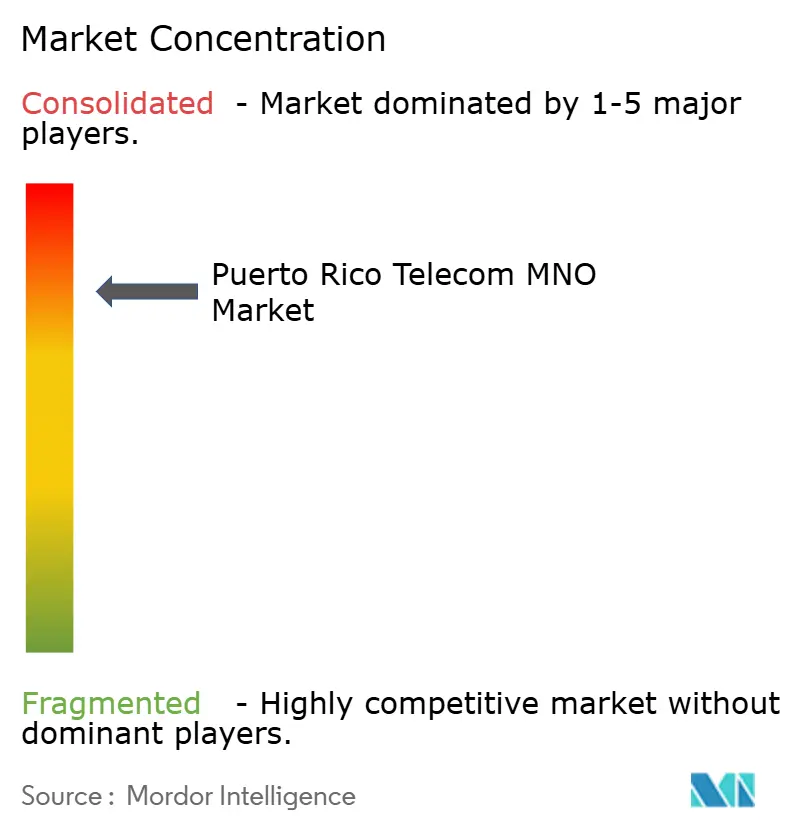
| Market Concentration | High |
Major Players *Disclaimer: Major Players sorted in no particular order Image © Mordor Intelligence. Reuse requires attribution under CC BY 4.0. | |
Puerto Rico Telecom MNO Market Analysis by Mordor Intelligence
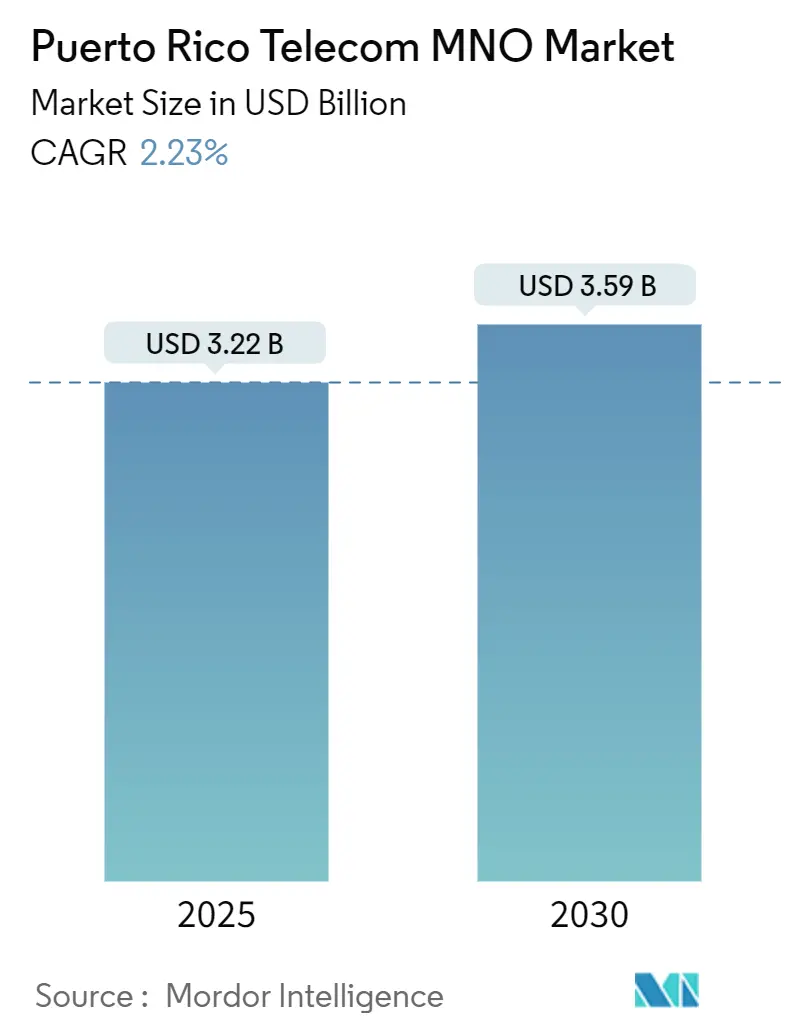
The Puerto Rico Telecom MNO Market size is estimated at USD 3.22 billion in 2025, and is expected to reach USD 3.59 billion by 2030, at a CAGR of 2.23% during the forecast period (2025-2030). In terms of subscriber volume, the market is expected to grow from 5.54 million subscribers in 2025 to 6.20 million subscribers by 2030, at a CAGR of 2.63% during the forecast period (2025-2030). Infrastructure modernization following Hurricane Maria, intensified 5G rollouts, and generous federal broadband grants are fueling this expansion, even as population decline reduces the residential subscriber base. Data and Internet services command the largest revenue pool, shaped by video streaming, social media, and tourism-driven roaming traffic. Operators re-engineer networks for disaster resilience and low-latency enterprise applications, while federal programs such as BEAD and the Capital Projects Fund bridge rural coverage gaps. [1]U.S. Department of the Treasury, “Puerto Rico CPF Allocation,” treasury.gov Competitive dynamics pivot on 5G availability, with T-Mobile leading in technical metrics and Liberty leveraging fixed–mobile convergence to widen its footprint. The Puerto Rico telecom MNO market balances a shrinking domestic population against record tourism inflows and rapidly rising demand for enterprise digitization.
Key Report Takeaways
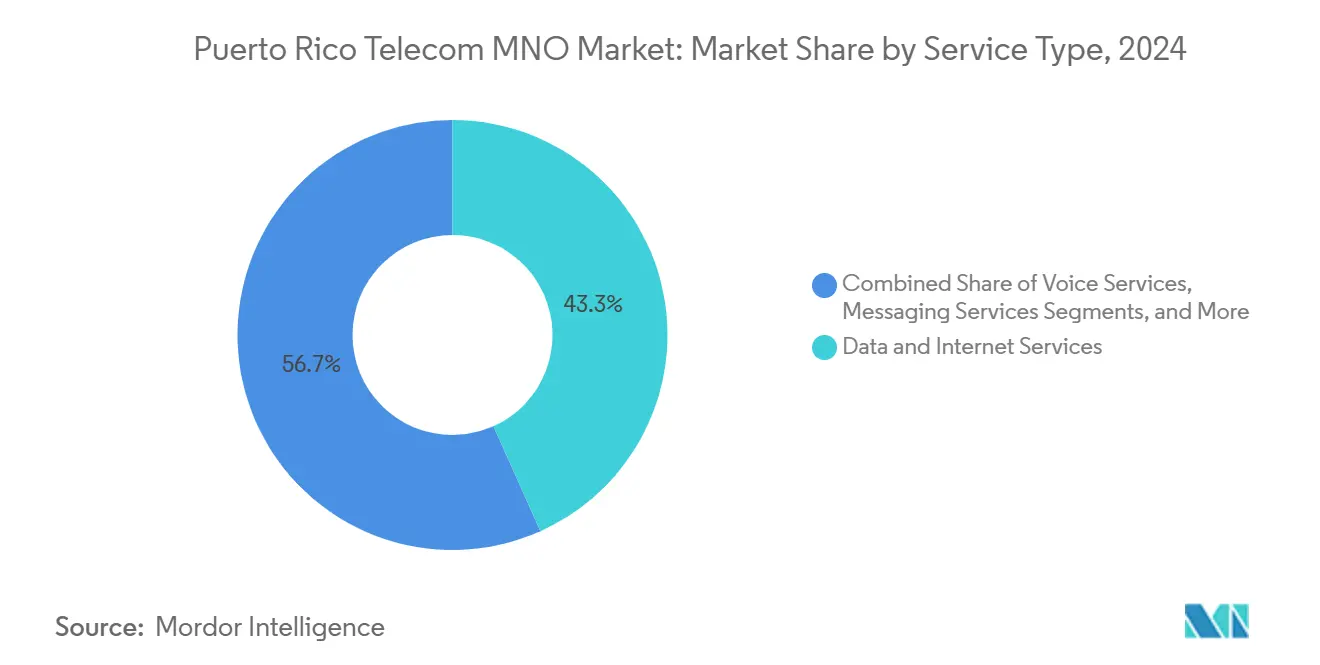
- By service type, data and internet services held 43.29% of Puerto Rico's telecom MNO market share in 2024 and are expected to expand at a 2.44% CAGR through 2030.
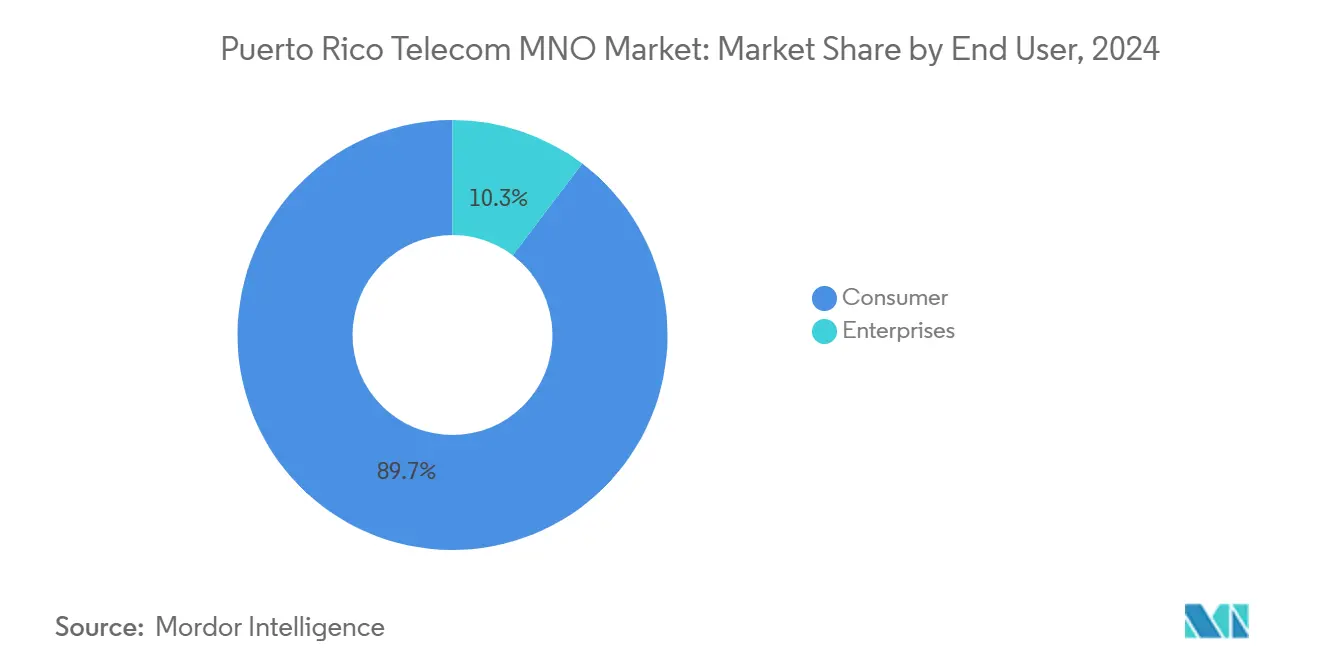
- By end user, consumer accounts captured 89.69% of Puerto Rico's telecom MNO market share in 2024, while the enterprise segment recorded the fastest 3.19% CAGR through 2030.
Puerto Rico Telecom MNO Market Trends and Insights
Drivers Impact Analysis*
| Driver | (~)% Impact on CAGR Forecast | Geographic Relevance | Impact Timeline |
|---|---|---|---|
| 5G Rollout Acceleration Across the Island | +0.8% | Island-wide, with early gains in San Juan Metro Area | Medium term (2-4 years) |
| Rising Mobile Data Consumption Driven by Video Streaming and Social Media | +0.6% | Island-wide, concentrated in urban areas | Short term (≤ 2 years) |
| U.S. Federal and Local Broadband-funding Programs | +0.4% | Rural and underserved areas primarily | Long term (≥ 4 years) |
| Enterprise Digitization and IoT Adoption in Tourism, Manufacturing and Logistics | +0.3% | San Juan Metro, Ponce, tourism corridors | Medium term (2-4 years) |
| Disaster-resilient Network Rebuilds Post-hurricane Maria Securing Extra CAPEX | +0.2% | Island-wide infrastructure hardening | Long term (≥ 4 years) |
| Surge in Cruise-passenger Roaming and Tourism-sector Connectivity Spend | +0.2% | Coastal areas, San Juan port, tourism zones | Short term (≤ 2 years) |
| Source: Mordor Intelligence | |||
5G Rollout Acceleration Across the Island
T-Mobile earmarked USD 300 million to extend 5G to 99% of the island within six years, combining 600 MHz low-band for coverage and 2.5 GHz for capacity, which lifts average download speeds to 117.1 Mbps and underpins premium service tiers. [2]T-Mobile Puerto Rico, “Network,” t-mobilepr.com Liberty’s USD 255 million spectrum acquisition strengthens its own 5G roadmap, intensifying rivalry for early mover advantage. Claro banks on América Móvil's scale to match speed upgrades. Accelerated rollouts unlock enterprise IoT use cases in hospitality, logistics, and manufacturing, propelling both wholesale and retail revenues. The outcome is a virtuous cycle where higher capacity spurs consumption, which in turn justifies continued capital outlay across the Puerto Rico telecom MNO market.
Rising Mobile Data Consumption Driven by Video Streaming and Social Media
Average smartphone usage jumped from 11.5 GB to 15.5 GB per line as video content reached 47% of traffic, mirroring mainland patterns while reflecting tourist appetites for high-definition media. [3]Verizon, “Consumer Connections Report,” verizon.com Tourists, 63% of whom are returning diaspora, stay eight days and sustain elevated data demand that spills into roaming revenues. Generative AI extends the trend through bandwidth-heavy immersive experiences. [4]Ericsson, “GenAI Impact on Traffic,” ericsson.com Household internet access climbed from 56.2% to 76.7% after 2024, magnifying mobile offload yet raising the overall digital consumption baseline. Operators respond with tiered data plans that monetize surging traffic while cushioning network strain during peak tourist seasons.
U.S. Federal and Local Broadband-Funding Programs
BEAD disburses USD 334.6 million, and the Capital Projects Fund adds USD 158.3 million to modernize middle-mile and last-mile links, a record capital infusion that de-risks private investment and extends coverage into low-income barrios. The Smart Island submarine resiliency project secures USD 85.7 million for three distributed landing stations, eliminating historic single-point vulnerabilities. Liberty tapped a USD 9.3 million grant for 63 miles of middle-mile fiber that bridges Ponce, Adjuntas, and Utuado, highlighting public–private alignment. Federal funds crowd in private capital but compress margins in subsidized zones, prompting operators to refine rural economics through low-CAPEX fixed wireless access. Over time, enhanced coverage expands total addressable demand and stabilizes the Puerto Rico telecom MNO market.
Enterprise Digitization and IoT Adoption in Tourism, Manufacturing and Logistics
A bilingual workforce topping 30,000 and a 4% corporate tax rate draw FinTech, cybersecurity, and medical device firms to the island. The 21st Century Techforce Initiative targets 50,000 new skilled jobs by 2035, crystallising demand for secure, low-latency connectivity. Tourism’s record 6.6 million airport passengers and USD 2.546 billion in visitor spend catalyse IoT deployments across hotels, transport fleets, and retail venues. Manufacturing and logistics clusters adopt predictive maintenance and real-time tracking via LTE-M and NB-IoT solutions. Layered federal incentives under Act 60 and robust 5G coverage create a multiplier effect that boosts enterprise ARPU and offsets shrinking consumer lines, keeping the Puerto Rico telecom MNO market on a steady upward path.
Restraints Impact Analysis*
| Restraint | (~)% Impact on CAGR Forecast | Geographic Relevance | Impact Timeline |
|---|---|---|---|
| Operator High Debt Loads Limiting Fresh CAPEX | -0.4% | Island-wide operational constraints | Medium term (2-4 years) |
| Population Decline / Out-migration Shrinking the Addressable Base | -0.6% | Rural areas most affected, urban areas stable | Long term (≥ 4 years) |
| Grid-power Instability Driving Up OPEX and Outage Risks | -0.3% | Island-wide, acute in rural areas | Short term (≤ 2 years) |
| Competitive Incursion from LEO-satellite Broadband | -0.2% | Rural and underserved areas primarily | Medium term (2-4 years) |
| Source: Mordor Intelligence | |||
Operator High Debt Loads Limiting Fresh Capex
Liberty Latin America’s Q2 2024 revenue dipped 12% while adjusted OIBDA fell 48%, exposing leverage constraints that temper 5G expansion and fixed–mobile convergence ambitions. Regional peer Cable and Wireless hovers at 4 times net leverage, forcing capital rationing despite a USD 1.1 billion EBITDA target. Elevated debt service diverts funds from rural build-outs, widening the digital divide even with federal subsidies available. T-Mobile, with lower leverage, exploits the gap with accelerated capex that locks in technical leadership and higher ARPU. Over the medium term, deleveraging needs may spark asset sales or network-sharing partnerships, reshaping competitive intensity in the Puerto Rico telecom MNO market.
Population Decline / Out-Migration Shrinking the Addressable Base
The island’s population fell from 3.7 million to 3.3 million between 2008 and 2022, with the foreign-born subset down 14%, shrinking the core subscriber pool and diluting revenue growth. Median age continues to rise while labor participation drops, eroding the base for premium mobile services. Rural depopulation renders network maintenance uneconomic and deepens coverage gaps, despite BEAD support. Operators counter with high-value service tiers, enterprise diversification, and roaming monetisation tied to record tourism. Yet persistent demographic headwinds subtract 0.6 percentage points from forecast CAGR, tempering the overall advance of the Puerto Rico telecom MNO market.
*Our forecasts treat driver/restraint impacts as directional, not additive. The impact forecasts reflect baseline growth, mix effects, and variable interactions.
Segment Analysis
By Service Type: Data Services Drive Market Evolution
Data and Internet services represented 43.29% of Puerto Rico telecom MNO market size in 2024 and are projected to grow 2.44% annually through 2030 on the back of ubiquitous 5G coverage and video-first consumption habits. Voice revenues shrink yet remain sticky among older subscribers, while messaging traffic shifts to OTT platforms that commandeer residual SMS volumes. IoT and M2M revenues, though small, outpace all other categories as enterprises deploy asset tracking, smart meters, and predictive maintenance solutions. OTT video packages, bundled with mobile data, recapture cord-cutting households and roaming tourists seeking familiar streaming libraries. Ancillary services such as international roaming and managed campus networks diversify the revenue mix and blunt erosion in legacy service lines.
Network upgrades unlock premium data tiers that feed ARPU gains even with flat subscriber counts, sustaining the Puerto Rico telecom MNO market. Enterprises demand service-level guarantees, pushing operators toward slicing, MEC hosting, and private 5G offers. Disaster-hardened infrastructure keeps service continuity during tropical storms, boosting perceived reliability and enabling insurers to underwrite mission-critical IoT deployments. Overall, the segment’s steady expansion underpins the broader transition from voice-centric to data-centric economics across the Puerto Rico telecom MNO market.



By End User: Enterprise Growth Offsets Consumer Decline
The consumer segment generated 89.69% of 2024 revenue, but enterprise lines are growing at a 3.19% CAGR, outpacing consumer and underpinning value migration in the Puerto Rico telecom MNO market. Tourism heavyweights, manufacturing giants, and logistics operators demand proactive network monitoring and low-latency SLAs, lifting IoT and managed-service uptake. Public-sector digitisation also funnels contracts to MNOs as e-government kiosks and community tech hubs require secure connectivity. Meanwhile, consumer lines shrink in absolute terms due to population decline, yet higher per-user data consumption and upgraded 5G plans cushion revenue drop.
Enterprise clients leverage Act 60 tax incentives and smart-island branding to establish regional hubs, creating multi-year contracts for dedicated bandwidth and secure cloud gateways. Over the forecast horizon, enterprises contribute an expanding share of Puerto Rico telecom MNO market size, balancing demographic drag in the mass market. Operators that pivot earliest to advanced ICT service portfolios lock in recurring high-margin flows and secure resilience against consumer softness.
Geography Analysis
Puerto Rico's telecom hub is the San Juan metropolitan area, which hosts all the island's submarine cable landing stations and features the densest 5G network. Operators focus on this urban core due to its concentration of government offices, financial institutions, and hospitals, which demand low-latency connectivity and ensure strong returns. T-Mobile leads in coverage, while Liberty and Claro compete to enhance signal strength and throughput as businesses adopt cloud solutions. Tourists arriving at Luis Muñoz Marín International Airport further boost data traffic, sharing images and streaming maps. This metro zone delivers high revenue per square mile and sets the island's performance benchmark.
Outside the capital, southern and western municipalities face areas with limited or no internet access, forcing residents to rely on rooftop repeaters or public Wi-Fi. The FCC highlighted these gaps after Hurricane Maria, prompting federal programs like BEAD to allocate USD 334.6 million for middle-mile fiber and new cell sites in mountainous areas such as Adjuntas, Utuado, and Las Piedras. Liberty has laid 63 miles of fiber in these regions, aiming to provide coastal-level latency within two years. The Smart Island project is adding three new cable landings outside the metro area to prevent territory-wide outages caused by infrastructure disruptions.
Coastal tourism belts form a seasonal market, with cruise passengers in San Juan, Ponce, and Mayagüez driving demand for instant uploads. Operators deploy temporary small cells near ports and hotels to meet this surge, with roaming data revenues during peak weeks offsetting weaker earnings in interior towns. Low Earth orbit constellations, such as Starlink, are gaining traction in fishing villages, where residents weigh the latency of satellites against the inconsistencies of terrestrial networks. Islandwide blackouts continue to disrupt towers, spurring investments in solar panels and battery banks, which increase operating costs.
Competitive Landscape
Three full-service operators dominate Puerto Rico's mobile market, each with a distinct role. T-Mobile leads in speed, offering median downloads of 117.1 Mbps to attract streamers and gamers. Liberty offers the widest coverage, appealing to families who prioritize reliability. Claro leverages América Móvil’s scale to bundle mobile, pay-TV, and fiber broadband, targeting budget-conscious households and small businesses. This balance delivers clear value propositions and keeps churn rates lower than those in mainland markets, with a fourth carrier.
The market remains dynamic. T-Mobile invested USD 300 million post-Maria to deploy 5G Standalone and established an innovation lab in Carolina for low-latency trials in tourism, logistics, and telemedicine. Liberty’s USD 255 million acquisition of EchoStar spectrum and prepaid lines strengthens its millimeter-wave holdings and enables fixed wireless broadband experiments in high-rise areas. Claro, focusing on enterprise growth, launched edge-computing pods near the port to support pharmaceutical exporters with precise shipment tracking. These strategies reflect efforts to outpace competitors without triggering price wars.
Financial strength drives these tactics, with notable disparities. Liberty’s leverage of four times EBITDA limits its ability to pursue long-term rural projects. T-Mobile, backed by Deutsche Telekom, expands coverage and subsidizes home broadband modems to increase wallet share. Claro benefits from América Móvil’s network, securing cost-efficient equipment deals and offering competitive bundles. Satellite providers target remote customers, sparking discussions on network-sharing to reduce capital expenditures. Despite these pressures, the three incumbents retain over 80% of subscribers, focusing on technology as the path to sustainable growth in Puerto Rico’s mobile market.
Puerto Rico Telecom MNO Industry Leaders
Claro Puerto Rico (PRTC)
T-Mobile Puerto Rico
Liberty Communications of Puerto Rico LLC
- *Disclaimer: Major Players sorted in no particular order

Recent Industry Developments
- September 2024: Liberty Latin America closed its USD 255 million purchase of EchoStar spectrum and 85,000 prepaid lines.
- June 2024: The Biden–Harris Administration approved Puerto Rico’s BEAD proposal, unlocking USD 334.6 million for broadband projects.
- May 2024: AeroNet Wireless launched 10 Gbps service, intensifying competitive pressure in metro areas.
- March 2024: T-Mobile introduced 5G fixed wireless access for residential broadband.
- February 2024: T-Mobile expanded 5G Home Internet to Puerto Rico with flat USD 50 pricing and AutoPay discount.


Puerto Rico Telecom MNO Market Report Scope
| Voice Services |
| Data and Internet Services |
| Messaging Services |
| IoT and M2M Services |
| OTT and PayTV Services |
| Other Services (VAS, Roaming and International Services, Enterprise and Wholesale Services, etc.) |
| Enterprises |
| Consumer |
| Service Type | Voice Services |
| Data and Internet Services | |
| Messaging Services | |
| IoT and M2M Services | |
| OTT and PayTV Services | |
| Other Services (VAS, Roaming and International Services, Enterprise and Wholesale Services, etc.) | |
| End-user | Enterprises |
| Consumer |


Key Questions Answered in the Report
How large is the Puerto Rico telecom MNO market in 2025?
The Puerto Rico telecom MNO market size is USD 3.22 billion in 2025 with a forecast to hit USD 3.59 billion by 2030.
What is driving 5G investment across Puerto Rico?
Operators channel post-hurricane recovery funds and federal grants into 5G rollouts that promise faster speeds and new enterprise IoT use cases.
Which service type leads revenue in Puerto Rico mobile networks?
Data and Internet services lead with 43.29% revenue share in 2024 and maintain steady growth through 2030.
How are federal programs impacting rural connectivity?
BEAD and the Capital Projects Fund contribute nearly USD 500 million that finance rural middle-mile fiber, submarine cable redundancy, and community tech hubs.
Why is enterprise demand rising despite population decline?
Tax incentives, a bilingual workforce, and record tourism create strong demand for secure, low-latency networks that power FinTech, logistics, and hospitality applications.
Which operator holds the technical performance crown?
T-Mobile leads on 5G availability and download speeds, winning 12 of 15 quality awards in the latest Opensignal study.
Page last updated on:


 Your data is secure and never sold or shared.


