
Brunei Darussalam Telecom MNO Market Size and Share
Market Overview
| Study Period | 2019 - 2030 |
|---|---|
| Forecast Data Period | 2025 - 2030 |
| Historical Data Period | 2019 - 2023 |
| Market Size (2025) | USD 1.08 Billion |
| Market Size (2030) | USD 1.20 Billion |
| Growth Rate (2025 - 2030) | 2.11 % |
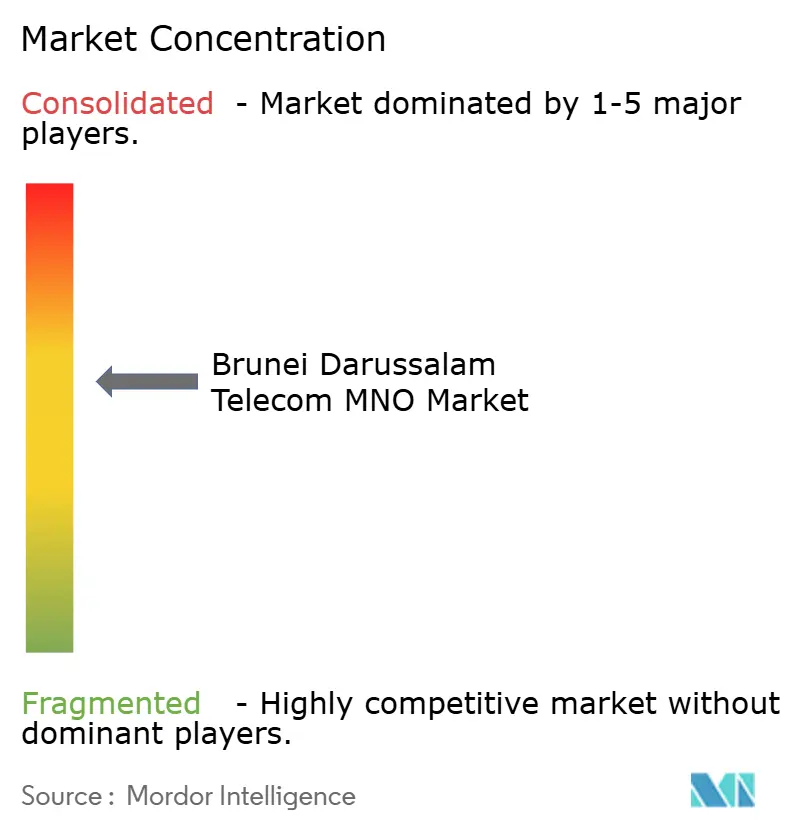
| Market Concentration | Medium |
Major Players *Disclaimer: Major Players sorted in no particular order Image © Mordor Intelligence. Reuse requires attribution under CC BY 4.0. | |
Brunei Darussalam Telecom MNO Market Analysis by Mordor Intelligence
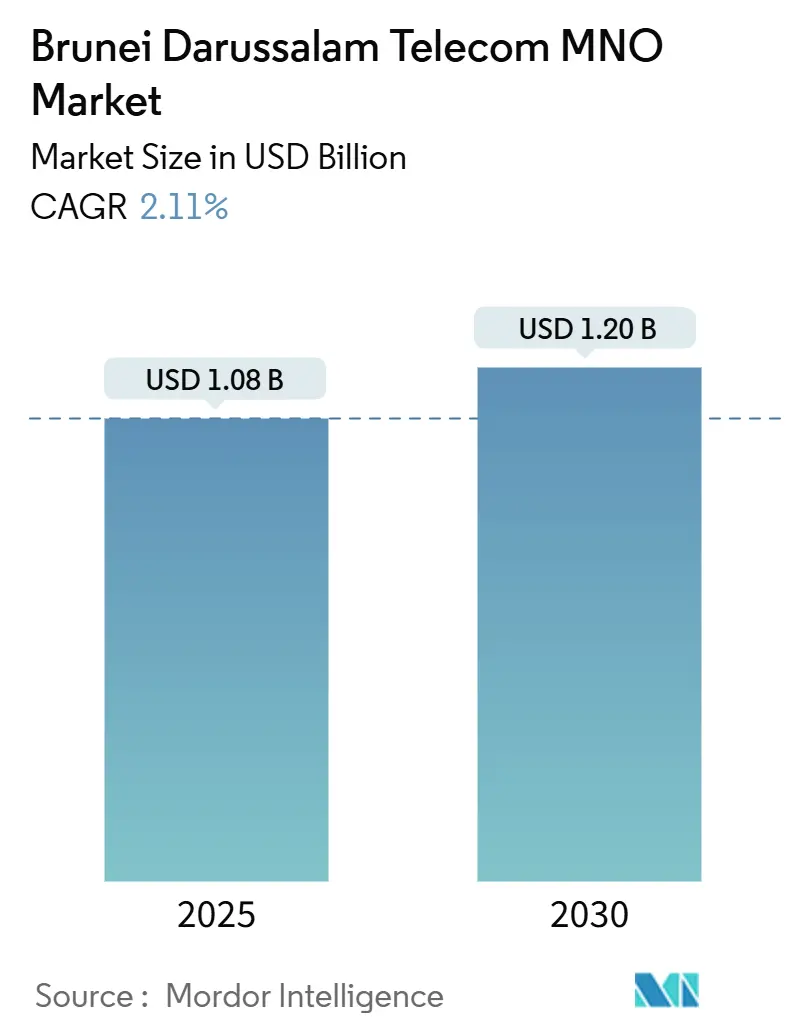
The Brunei Darussalam Telecom MNO Market size is estimated at USD 1.08 billion in 2025, and is expected to reach USD 1.20 billion by 2030, at a CAGR of 2.11% during the forecast period (2025-2030).
The apparent down-tick reflects a maturing, high-penetration arena where mobile subscriptions already exceed population and most homes enjoy fiber access. Growth pivots toward premium data, enterprise managed connectivity and 5G-enabled solutions, even as voice revenue slips and IoT remains nascent. Operators have shifted from network ownership to service specialization under the Unified National Networks (UNN) wholesale model, while regulators accelerate 5G spectrum, personal-data rules and competition safeguards. Limited population and dependence on a handful of submarine cables cap the upside, yet Brunei’s position as a BIMP-EAGA gateway and ASEAN data-transit node presents durable opportunities tied to cloud, content delivery and regional digital trade.
Key Report Takeaways
By service type, data services held 44.40% of Brunei Darussalam telecom market share in 2024; IoT and M2M is advancing at a 5.51% revenue CAGR to 2030.
By end user, the enterprise segment commanded 18.41% share of the Brunei Darussalam telecom market size in 2024 and is expanding at a 2.65% CAGR through 2030.
Brunei Darussalam Telecom MNO Market Trends and Insights
Drivers Impact Analysis*
| Driver | (~) % Impact on CAGR Forecast | Geographic Relevance | Impact Timeline |
|---|---|---|---|
| Rapid 5G roll-out driven by AITI spectrum roadmap | +0.8% | Nationwide | Medium term (2-4 years) |
| Nationwide FTTH expansion by Imagine and UNN | +0.6% | Nationwide | Long term (≥4 years) |
| Government Smart Nation push across e-Gov, education and health | +0.4% | Nationwide | Medium term (2-4 years) |
| Enterprise demand for managed cloud connectivity and SD-WAN | +0.5% | Brunei-Muara district | Short term (≤2 years) |
| ASEAN regional data-center build-out driving international back-haul traffic | +0.3% | Regional | Long term (≥4 years) |
| Tourism rebound lifting roaming and visitor-SIM volumes | +0.2% | Tourist zones, airport | Short term (≤2 years) |
| Source: Mordor Intelligence | |||
Rapid 5G roll-out driven by AITI spectrum roadmap
AITI has allocated contiguous mid-band and millimeter-wave spectrum while mandating open-access wholesale sharing to accelerate 5G readiness. As a result, 90% of base stations now support 5G NR radios, making Brunei one of the most 5G-prepared economies in Southeast Asia.[1]Multi-gigabit trials in Bandar Seri Begawan confirm stable 300 Mbps-1 Gbps down-links, enabling industrial automation, remote surgery pilots and cloud gaming for consumers. The regulator chairs a 5G working group with UNN, DST and Progresif to align rollout, ensuring that initial premium tariffs gain enterprise uptake before consumer mass-market packages follow. With coverage slated for nationwide completion by 2027, operators are bundling 5G FWA as an alternative to fixed broadband in underserved districts, creating incremental ARPU pockets without heavy last-mile civil works.
Nationwide FTTH expansion by Imagine and UNN
UNN has installed more than 5,000 km of fiber and passed 220,000 premises, replacing legacy copper to deliver symmetric 100 Mbps baseline speeds. Imagine and Progresif rebrand these wholesale lines into tiered retail bundles that top out at 1 Gbps and include Wi-Fi 6 mesh kits, targeting gamers and work-from-home professionals.[2]Fixed-broadband penetration climbed to 18% by end-2024, yet meaningful headroom remains as rural Bruneians gain access and as enterprises migrate MPLS circuits onto cheaper GPON. The unified passive-infrastructure model cuts duplication, allowing retail brands to divert capital toward apps, OTT partnerships and smart-home devices rather than trenching costs.
Government push for Smart Nation services
Under the Digital Economy Masterplan 2025, Brunei aims to lift ICT’s GDP contribution from 2% to 6% by digitizing public administration, health records and education platforms. BruHealth, the national health-app backbone, already hosts millions of vaccination and clinical entries, demanding secure, low-latency links between data centers and hospitals. EGNC’s centralized procurement opens large managed-service contracts for telcos able to deliver elastic cloud connections and zero-trust security frameworks. The TADSEED grant program disburses up to BND 200,000 (USD 149,000) to local start-ups, sparking new SaaS and IoT projects that lean on carrier APIs for payments and identity management.
Enterprise demand for managed cloud connectivity & SD-WAN
Corporate customers are upgrading from best-effort VPNs to SLA-backed SD-WAN overlays that prioritize mission-critical traffic while steering routine loads to public internet paths. UNN markets 99.99%-uptime IPLC and 100 Gbps point-to-point Ethernet for banks, oil-and-gas majors and government datasets. Converged offerings bundle DDoS scrubbing, vulnerability assessments and SOC-as-a-service to address escalating cyber-threats. Meanwhile, ANIAN’s tie-up with Parcus Group introduces verticalized IoT kits for utilities and campus surveillance that rely on telco SIMs for back-haul. Enterprise annual spend is growing at 2.65%, meaningfully above the broader Brunei Darussalam telecom market CAGR, and supports premium-priced connectivity even as consumer ARPU plateaus.
Restraints Impact Analysis*
| Restraint | (~) % Impact on CAGR Forecast | Geographic Relevance | Impact Timeline |
|---|---|---|---|
| Limited population size capping addressable subscriber base | -0.7% | Nationwide | Long term (≥4 years) |
| High reliance on international bandwidth via single subsea route | -0.4% | Nationwide | Medium term (2-4 years) |
| OTT substitution eroding voice and SMS revenue | -0.3% | Nationwide | Short term (≤2 years) |
| Talent shortage in advanced RF and cyber-security roles | -0.2% | Nationwide | Long term (≥4 years) |
| Source: Mordor Intelligence | |||
Limited population size capping addressable subscriber base
With only 465,000 residents, Brunei reached 620,000 active SIMs in 2025 – a 133% penetration ceiling that leaves scant room for net-new subscriber gains. Operators thus rely on ARPU uplift from high-speed tiers, content bundles and fintech add-ons rather than volume growth. The small labor pool also curtails large-scale enterprise uptake, as most multinational oil-and-gas players and major banks already hold long-term connectivity contracts. Rural build-out remains a public-service obligation rather than a lucrative expansion frontier, requiring universal-service levies and cross-subsidy frameworks to stay financially viable.
High reliance on international bandwidth via single subsea route
Although Brunei lands four submarine systems – AAG, SJC, SMW3 and LBC – the majority of international traffic still funnels through a single branching unit before fanning out to Singapore and Hong Kong. This single-point exposure raises the specter of outages affecting cloud back-ups, regional gaming latency and video-streaming QoS. While the 10 Tbps installed capacity is adequate today, hyperscale-cloud ingress and ASEAN data-center interconnection will double bandwidth demand by 2028. The ASEAN-wide Cable Initiative unveiled in February 2025 aims to diversify landing points, but civil-marine surveys and financing mean operational readiness will not arrive until the latter half of the forecast period.
*Our forecasts treat driver/restraint impacts as directional, not additive. The impact forecasts reflect baseline growth, mix effects, and variable interactions.
Segment Analysis
By Service Type: Data services lead digital transformation
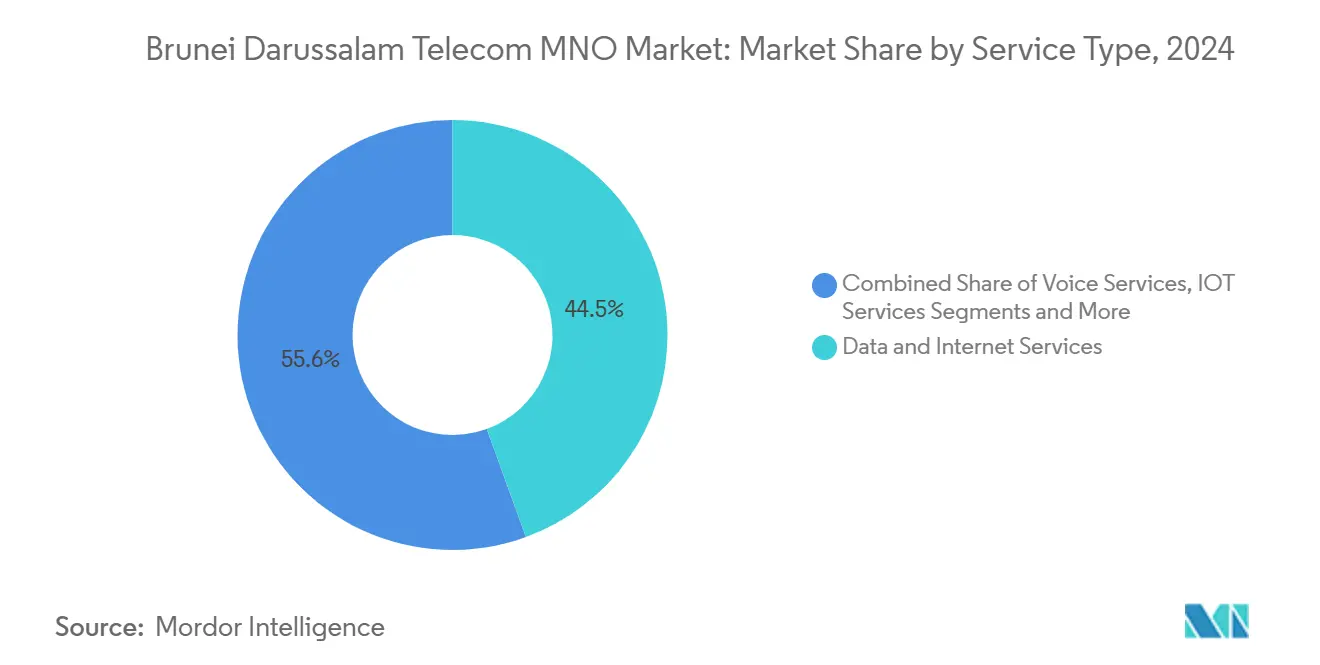
Data services accounted for 44.40% of 2024 revenue, driven by FDTH uptake, streaming and cloud connectivity. The segment benefits from 1 Gbps fixed tiers, 5G FWA pilots and wholesale transit sold to neighboring Sabah and Sarawak carriers. Voice still holds 37.09%, having stabilized through unlimited-minutes bundles tethered to generous data packs. IoT and M2M generates 5.51% but is forecast to outpace the overall Brunei Darussalam telecom market size with smart-meter rollouts and municipal surveillance grids. OTT and Pay-TV represent 7.81% as Netflix and Disney+ drive carriers to co-market time-based data passes. Ancillary messaging, VAS and roaming capture the remaining 5.19%, buoyed by tourist SIMs and cross-border commuters.
The Brunei Darussalam telecom market share for data services is set to expand further as 5G core slicing and cloud gaming drive higher-tier adoption. Meanwhile, voice ARPU erosion continues, but bundling keeps churn low. IoT’s share will rise once ministries mandate connected street lighting and asset-tracking, leveraging operators’ NB-IoT channels. Messaging faces cannibalization from OTT chat, but enterprise A2P SMS for banking OTPs cushions decline. Wholesale service revenue holds steady under UNN’s fixed per-Mbps tariff, providing predictable cash flows to fund future optical upgrades.

By End User: Enterprise segment drives premium growth
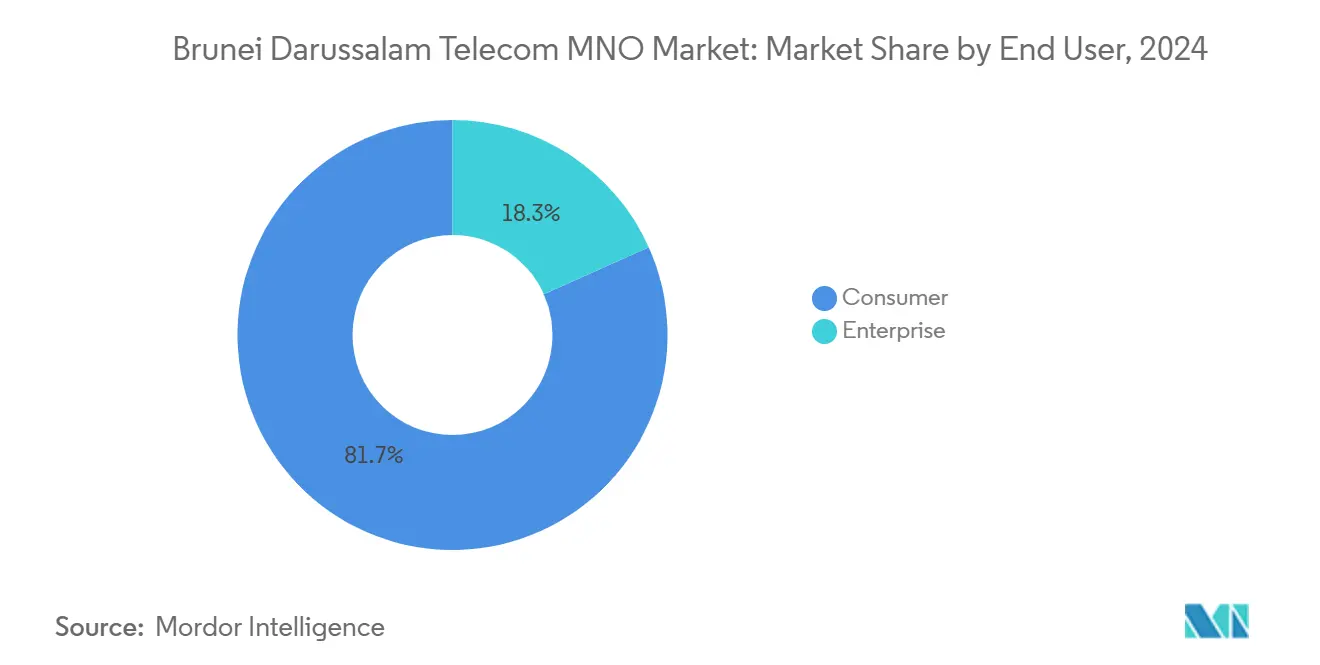
Enterprises contributed 18.41% of 2024 revenue yet posted the fastest 2.65% CAGR through 2030 as banks, oil companies and government agencies deploy managed SD-WAN, DRaaS and cybersecurity bundles. The Brunei Darussalam telecom market size for enterprise cloud connectivity will reach USD 0.23 billion by 2030, reflecting higher bandwidth commitments and SLA premiums. Consumer services still dominate with 81.59% share, but growth slows to 1.98% as penetration plateaus.
Corporate digitization benefits from grants and procurement-aggregation under EGNC, pushing SMEs to adopt SaaS payroll and e-commerce modules that ride on telco-managed connectivity. Public-sector modernization – from e-court filings to smart-port logistics – further widens the addressable enterprise pie. On the consumer side, bundled OTT, device-financing and prepaid family plans shore up ARPU. The enterprise-first strategy also cushions cash flows because business contracts often span 36-60 months, providing revenue visibility absent in prepaid consumer segments.
Geography Analysis
Urban Bandar Seri Begawan anchors demand, accounting for nearly 70% of the Brunei Darussalam telecom market size in 2024 thanks to dense fiber coverage, affluent households and cluster of corporates along the riverfront CBD. 5G small-cell densification around Gadong and Kianggeh malls supports mixed-reality retail trials, while the Government Technology Centre hosts a new edge-data hub interlinked via 100 Gbps ring to the primary data center at Tungku.
The Belait district, home to oil-and-gas complexes, represents the second-largest pocket. Multi-tenant enterprise parks in Seria consume dedicated wavelength services and satellite back-ups. UNN’s 2024 expansion to inland Kampong Bang Taong and Kukub increased rural broadband availability, aligning with universal-service goals and boosting take-rates among school networks.
Tutong and Temburong together form under 10% of revenue, yet 2025 plans to link Temburong Smart Eco-Park with NB-IoT environmental sensors will lift data-traffic growth to the highest district CAGR. Cross-border bridges to Sarawak create roaming spill-over, particularly for weekend shoppers. Overall, the Brunei Darussalam telecom market share by district remains heavily skewed to the coastline, but government co-funding of microwave hops and satellite back-haul aims to narrow the digital divide by 2030.
Competitive Landscape
Brunei’s retail segment is contested by DST, Progresif and Imagine, all leasing last-mile assets from UNN. Post-2019 restructuring places infrastructure CAPEX squarely with UNN, freeing retail brands to innovate in pricing, content and customer-experience layers. DST leverages MyRepublic playbooks to re-design digital self-care apps and gamified loyalty, preserving its leading subscriber base. Progresif’s 2024 license upgrade enabled convergence, allowing the firm to package fixed, mobile and cloud-DC services, and to launch smart-home bundles in partnership with AEGIS Secure Solution. Imagine, the smallest player, differentiates on no-contract FTTH and international calling bundles targeting expatriates.
Regulatory levers include zero mobile-termination fees and number-portability obligations introduced in 2024, spurring churn but improving consumer value. Competitive rivalry increasingly plays out in content aggregation: DST bundles Viu, Progresif promotes e-learning portals, and Imagine resells Microsoft 365 to SMEs. Operators also race to integrate AI chatbots for service inquiries, reducing call-center opex and improving NPS.
Wholesale competition remains limited—UNN is the sole passive-infrastructure owner—yet transparency measures require cost-based tariff filing and open auditing. As a result, margins pivot on differentiated CX rather than infrastructure advantages. Brunei’s small scale encourages partnerships: UNN’s managed-service deal with BICS raised network analytics and roaming-fraud controls.[3] DST teamed with Samsung to trial 5G enterprise-edge appliances, while Progresif opened an innovation lab to co-create IoT with local start-ups.
Brunei Darussalam Telecom MNO Industry Leaders
-
Datastream Digital (DST)
-
Progresif Cellular Sdn Bhd
-
Imagine (formerly TelBru)
- *Disclaimer: Major Players sorted in no particular order
Recent Industry Developments
- February 2025: ASEAN Digital Ministers launched a regional subsea-cable blueprint, positioning Brunei as a midpoint landing station for the South China Sea leg.
- January 2025: AITI enacted Personal Data Protection rules, mandating explicit consent before telcos process or export user data.
- October 2024: OMS Group earmarked USD 300 million for new cable spurs and dark fiber, including Brunei landing-station upgrades.
- August 2024: US-ASEAN Business Council delegation engaged Brunei officials on digital-economy collaboration, highlighting telecom as a priority pillar.
Brunei Darussalam Telecom MNO Market Report Scope
| Voice Services |
| Data and Internet Services |
| Messaging Services |
| IoT and M2M Services |
| OTT and PayTV Services |
| Other Services (VAS, Roaming and International Services, Enterprise And Wholesale Services, etc.) |
| Enterprises |
| Consumer |
| Service Type | Voice Services |
| Data and Internet Services | |
| Messaging Services | |
| IoT and M2M Services | |
| OTT and PayTV Services | |
| Other Services (VAS, Roaming and International Services, Enterprise And Wholesale Services, etc.) | |
| End-user | Enterprises |
| Consumer |
Key Questions Answered in the Report
How large is the Brunei Darussalam telecom market in 2025?
The sector stands at USD 1.23 billion and is on a modest 2.11% CAGR trajectory to 2030.
Why is enterprise demand growing faster than consumer?
Businesses are investing in managed cloud connectivity, SD-WAN and cybersecurity, lifting enterprise revenue at a 2.65% CAGR versus 1.98% for consumer.
What limits long-term growth?
A population of only 465,000 caps subscriber expansion, while reliance on few submarine cables exposes connectivity risks.
Who owns the networks after restructuring?
Unified National Networks controls all wholesale infrastructure; DST, Progresif and Imagine focus solely on retail services.