
Nicaragua Telecom MNO Market Size and Share
Market Overview
| Study Period | 2019 - 2030 |
|---|---|
| Forecast Data Period | 2025 - 2030 |
| Historical Data Period | 2019 - 2023 |
| Market Size (2025) | USD 430.20 Million |
| Market Size (2030) | USD 534.20 Million |
| Growth Rate (2025 - 2030) | 4.43 % |
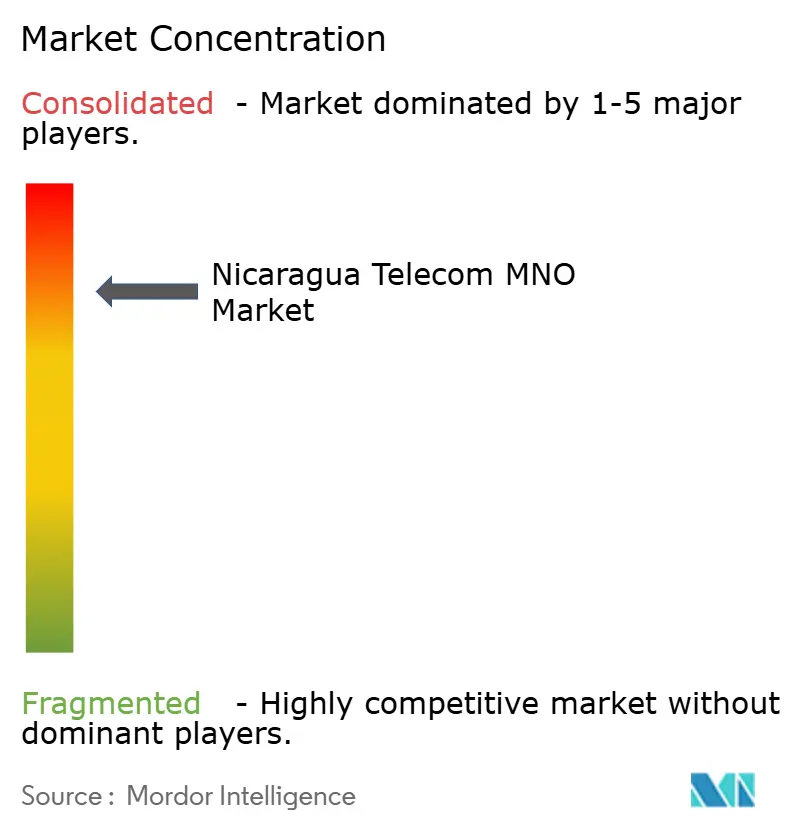
| Market Concentration | High |
Major Players *Disclaimer: Major Players sorted in no particular order Image © Mordor Intelligence. Reuse requires attribution under CC BY 4.0. | |

Nicaragua Telecom MNO Market Analysis by Mordor Intelligence
The Nicaragua Telecom MNO Market size is estimated at USD 430.20 million in 2025, and is expected to reach USD 534.20 million by 2030, at a CAGR of 4.43% during the forecast period (2025-2030). In terms of subscriber volume, the market is expected to grow from 7.15 million subscribers in 2025 to 8.49 million subscribers by 2030, at a CAGR of 3.49% during the forecast period (2025-2030). Resilient expansion stems from strong mobile broadband uptake, public investment in rural fiber, and rising enterprise digitization, which widens demand across both consumer and business segments. [1]World Bank, “Extending Telecommunications Services in Rural Nicaragua,” worldbank.org Cost-efficient Chinese infrastructure partnerships, continued spectrum refarming, and nascent 5G trials further reinforce growth momentum despite political headwinds. Operators focus on network modernization, tower monetization, and value-added services to boost margins, while leveraging fintech partnerships to enhance ARPU. Rural backhaul economics improve following Starlink gateway approval, opening fresh addressable pockets for the Nicaragua telecom MNO market. Currency volatility and sanctions-driven vendor constraints temper capex flexibility but have not derailed the medium-term growth outlook.
Key Report Takeaways
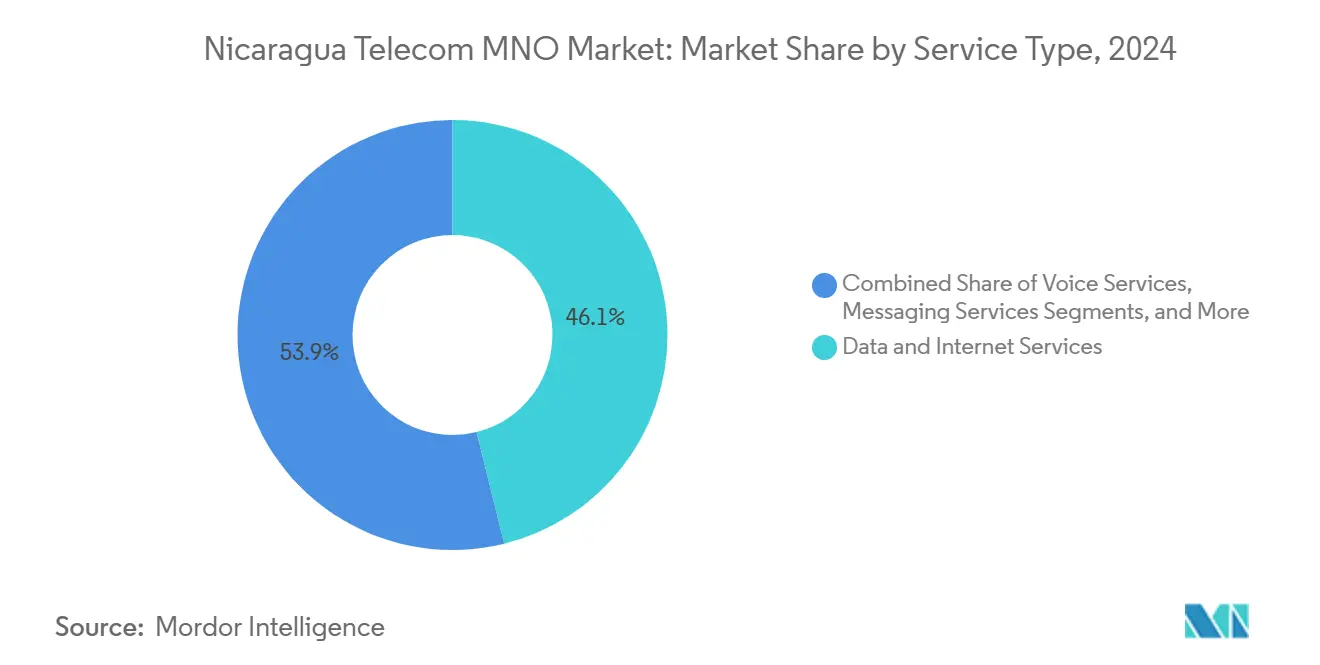
- By service type, data and internet services held 46.14% of the Nicaraguan telecom MNO market share in 2024, advancing at a 4.73% CAGR through 2030.
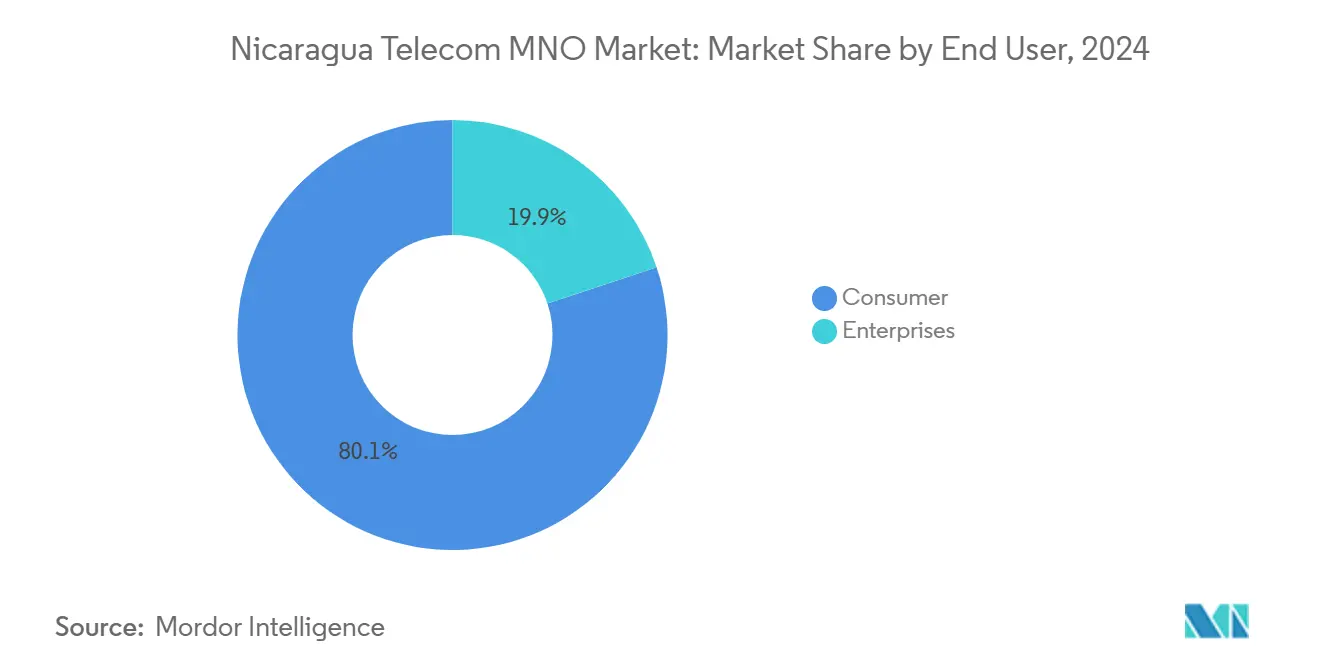
- By end-user, consumer services represented 80.10% of the Nicaraguan telecom MNO market size in 2024, whereas enterprise services are projected to expand at a 5.45% CAGR to 2030.
Nicaragua Telecom MNO Market Trends and Insights
Drivers Impact Analysis*
| Driver | (~) % Impact on CAGR Forecast | Geographic Relevance | Impact Timeline |
|---|---|---|---|
| Rising Mobile Broadband Usage and Smartphone Adoption | +1.2% | Urban centres nationwide | Medium term (2-4 years) |
| Government-backed Rural Connectivity Projects (Caribbean Coast Fiber Ring) | +0.8% | Caribbean Coast and interior rural zones | Long term (≥ 4 years) |
| Accelerated Enterprise Digitization and Cloud Migration | +0.7% | Managua, León, Granada | Short term (≤ 2 years) |
| Spectrum Refarming for LTE-A and Preparatory 5G Trials | +0.5% | Urban first, secondary cities next | Medium term (2-4 years) |
| Fin-tech and Mobile-money Partnerships Boosting ARPU | +0.4% | Urban-led national rollout | Short term (≤ 2 years) |
| Starlink Gateway Approval Lowering Backhaul Costs | +0.3% | Remote regions | Medium term (2-4 years) |
| Source: Mordor Intelligence | |||
Rising Mobile Broadband Usage and Smartphone Adoption
Mobile broadband penetration hit 64.1% in early 2025, supported by 4.47 million internet users who spend significant time on data-rich social platforms. Median mobile download speed climbed to 22.19 Mbps, confirming that network investments are matching usage expectations. Smartphones catalyze over-the-top voice and video, raising per-subscriber data loads and encouraging tiered data plans. Operators additionally monetize higher-speed offers to small firms that now rely on mobile connectivity for point-of-sale and inventory apps. The virtuous cycle of device uptake and service upgrades underpins the most powerful volume driver for the Nicaragua telecom MNO market.
Government-backed Rural Connectivity Projects (Caribbean Coast Fiber Ring)
World Bank–supported programs delivered backbone links and tele-centers to more than 100 rural municipalities, establishing a credible platform for commercial expansion. The Caribbean Coast fiber ring lowers entry costs for last-mile investors via smart subsidies and shared ducts. Operators can now viably target communities previously deemed loss-making, unlocking incremental subscribers and diversifying revenue sources. Rural broadband also supports governmental digital-inclusion goals, creating political alignment that further accelerates roll-outs. [2]World Bank, “Extending Telecommunications Services in Rural Nicaragua,” worldbank.org
Accelerated Enterprise Digitization and Cloud Migration
Post-pandemic operating models push Nicaraguan firms toward SaaS, unified communications, and mobile payments that demand stable high-speed links. The enterprise segment, though modest in user count, generates premium ARPU via dedicated access, managed WAN, and cybersecurity add-ons. Early adopters in finance and retail validate the use case, spurring cross-industry uptake. Telecom-fintech collaborations amplify revenue per connection while reinforcing stickiness for the Nicaragua telecom MNO market.
Spectrum Refarming for LTE-A and Preparatory 5G Trials
Regulators approved LTE-Advanced upgrades that raise spectral efficiency and free up blocks for future 5G. Claro aims for 60% 5G coverage by 2028, setting a technology benchmark and compelling rivals to accelerate their refarming schedules. Updated networks support denser data traffic and new enterprise-grade SLAs, but capex discipline remains essential amid currency risk. Nevertheless, phased modernization keeps operators competitively relevant and sustains the Nicaragua telecom MNO market growth trajectory.
Restraints Impact Analysis*
| Restraint | (~) % Impact on CAGR Forecast | Geographic Relevance | Impact Timeline |
|---|---|---|---|
| Intensifying Political Sanctions Limiting Vendor Options | −1.1% | Country-wide | Long term (≥ 4 years) |
| Currency Depreciation Squeezing CAPEX Budgets | −0.8% | National | Medium term (2-4 years) |
| High Tower-rental Fees Outside Managua | −0.4% | Rural and secondary towns | Medium term (2-4 years) |
| Chronic Energy Outages Raising OPEX for Base-stations | −0.3% | Nationwide, rural bias | Short term (≤ 2 years) |
| Source: Mordor Intelligence | |||
Intensifying Political Sanctions Limiting Vendor Options
Expanded US export controls restrict access to cutting-edge American radio and core-network gear, elongating procurement cycles and raising compliance costs. Operators increasingly depend on Chinese vendors that provide attractive finance but may introduce cybersecurity scrutiny from other partners. Sanctions also dampen foreign-investor appetite, complicating long-horizon projects such as 5G roll-outs. The policy overhang, therefore, acts as the single largest drag on the Nicaragua telecom MNO market. [3]U.S. Department of Commerce, “Revisions to Export Controls for Nicaragua,” federalregister.gov
Currency Depreciation Squeezing CAPEX Budgets
Most radio, fiber, and software inputs are USD-denominated, so the córdoba weakness inflates project outlays. While larger operators hedge partially, smaller players postpone upgrades when conversion rates spike. Elevated equipment costs threaten timetable adherence for rural coverage and 5G pilots alike, restraining network reach and service innovation. Persistent volatility could shave capex as a share of revenue, moderating the Nicaragua telecom MNO market expansion. [4]International Monetary Fund, “IMF Executive Board Concludes 2023 Article IV Consultation with Nicaragua,” imf.org
*Our forecasts treat driver/restraint impacts as directional, not additive. The impact forecasts reflect baseline growth, mix effects, and variable interactions.
Segment Analysis
By Service Type: Data Services Drive Revenue Transformation
Data and Internet services accounted for 46.14% of the Nicaragua telecom MNO market share in 2024 and are growing fastest at a 4.73% CAGR toward 2030. Voice and messaging continue secular decline as OTT substitutes take hold, yet they remain lifelines for rural and emergency calls. IoT and M2M lines are nascent but poised for an upswing as industrial automation and smart-agriculture pilots seek cellular backhaul. OTT video and PayTV bundles help operators defend churn by packaging connectivity with entertainment, though global streamers cap price elasticity. Ancillary services such as roaming, enterprise VPNs, and cybersecurity provide defensive high-margin pockets that offset voice erosion for the Nicaragua telecom MNO market.
Expansion in 4G capacity, smartphone affordability, and cloud adoption explain why data revenues now underpin operator strategies. Content partnerships with social media and gaming platforms fuel zero-rating plans that deepen user engagement. Meanwhile, managed connectivity for micro-enterprises supports higher-tier subscriptions. These converging vectors keep the segment on an outsized trajectory within the Nicaragua telecom MNO market.



By End User: Enterprise Growth Outpaces Consumer Expansion
Consumer lines represented 80.10% of the Nicaragua telecom MNO market size in 2024, reflecting widespread mobile dependence for personal communication, information, and entertainment. However, enterprise subscriptions are rising at a 5.45% CAGR, faster than the overall market, driven by cloud migration, remote-work tools, and fintech integration. Corporates pay premiums for SLAs, dedicated bandwidth, and managed security, lifting blended ARPU. Bundled voice-data-security contracts deepen retention, and cross-selling of IoT connectivity offers incremental upside.
At scale, consumer volume still anchors cash flow, but competitive saturation caps near-term growth. Operators therefore accelerate SME outreach, leveraging fiber, LTE-A, and upcoming 5G slices to address backup links, SD-WAN, and point-of-sale connectivity. This shift in revenue mix gradually elevates the enterprise weight within the Nicaragua telecom MNO market.
Geography Analysis
The Nicaragua telecom MNO market derives most revenue from urban corridors, with Managua alone contributing an outsized portion owing to higher device ownership and disposable income. National mobile penetration reached 125%, highlighting multi-SIM behavior in cities yet masking rural under-coverage. Mountainous terrain and dispersed settlements raise build-out cost per subscriber beyond urban economics. Tower-sharing and the Caribbean Coast fiber ring are reducing those barriers, but energy-outage risk and tower-lease premiums still discourage aggressive roll-outs in remote areas.
Starlink backhaul in pilot zones cuts satellite latency and bandwidth cost, making rural LTE pop-sites economically viable. As operators utilize these links, service quality gaps between urban and rural clusters are expected to narrow, unlocking latent demand and uplifting the Nicaragua telecom MNO market. Continued regulatory support for infrastructure sharing and Right-of-Way acceleration remains vital to speed provincial deployments.
Regional benchmarks underscore the opportunity. Neighboring Costa Rica hit 47.5% fiber access, encouraging Nicaraguan operators to fast-track FTTH overlays in high-density suburbs. Cross-border roaming agreements and Central American spectrum harmonization streamline handset compatibility, diminishing international inbound churn. Overall, geography-driven revenue diversification hinges on a balanced mix of terrestrial fiber, microwave hops, and emerging LEO satellite links that together advance the Nicaragua telecom MNO market.
Competitive Landscape
The market exhibits a duopoly: Claro Nicaragua controls the largest subscriber and revenue share, while Tigo Nicaragua provides the main competitive counterweight. Both players undertake heavy capex to densify 4G, refarm spectrum, and explore 5G pilots. Claro leverages América Móvil's scale to source equipment and finance favorable terms, while Tigo monetizes passive assets, selling 7,000 towers to SBA Communications, to free capital for fiber and digital-service expansion. Network quality and bundled OTT content act as primary differentiation levers.
Customer acquisition costs trend upward in crowded Managua segments, prompting operators to deepen loyalty via mobile-money, micro-insurance, and entertainment add-ons. Rural growth strategies rely on hybrid power solutions and infrastructure-sharing deals to mitigate opex. Strategic alliances with Huawei on RAN upgrades and with fintech firms on payments integration hint at evolving revenue stacks that extend beyond connectivity alone. Despite high entry barriers, modest MVNO interest persists; yet the scale required to match incumbents' nationwide coverage remains prohibitive, sustaining the current structure of the Nicaragua telecom MNO market.
Regulatory convergence law passed in 2024 heightens compliance on data retention and infrastructure reporting, raising fixed overhead but offering clarity on spectrum fees and quality of service benchmarks. Operators view the law as a mixed blessing: tighter oversight but more predictable licensing, which aids long-term network planning. Competitive intensity, therefore, remains high yet stable, anchored by two well-funded players shaping technology timelines and service bundling for the Nicaragua telecom MNO market.
Nicaragua Telecom MNO Industry Leaders
Claro Nicaragua (América Móvil)
Tigo Nicaragua (Millicom International S.A.)
- *Disclaimer: Major Players sorted in no particular order

Recent Industry Developments
- November 2024: Nicaragua enacted a General Convergent Telecommunications Law expanding TELCOR oversight on infrastructure management and data preservation.
- October 2024: SBA Communications completed the USD 975 million acquisition of approximately 7,000 towers from Millicom, including Nicaraguan sites, under a 15-year master lease expected to deliver USD 129 million first-year revenue.
- March 2024: The U.S. Department of Commerce tightened export-control rules for Nicaragua, affecting telecom equipment imports.


Nicaragua Telecom MNO Market Report Scope
| Voice Services |
| Data and Internet Services |
| Messaging Services |
| IoT and M2M Services |
| OTT and PayTV Services |
| Other Services (VAS, Roaming and International Services, Enterprise and Wholesale Services, etc.) |
| Enterprises |
| Consumer |
| Service Type | Voice Services |
| Data and Internet Services | |
| Messaging Services | |
| IoT and M2M Services | |
| OTT and PayTV Services | |
| Other Services (VAS, Roaming and International Services, Enterprise and Wholesale Services, etc.) | |
| End-user | Enterprises |
| Consumer |


Key Questions Answered in the Report
What is the current value of the Nicaragua telecom MNO market?
The Nicaragua telecom MNO market size is USD 430.2 million in 2025.
How fast is the market expected to grow?
It is projected to register a 4.43% CAGR and reach USD 534.2 million by 2030.
Which service type is expanding the quickest?
Data and Internet services, growing at a 4.73% CAGR, outpace all other service categories.
Why are enterprise subscriptions gaining importance?
Enterprises require cloud, cybersecurity, and managed connectivity, leading to a 5.45% CAGR in that segment and higher ARPU for operators.
How will rural connectivity improve over the forecast period?
Government fiber projects and new Starlink backhaul links reduce deployment costs, enabling broader rural coverage and service quality upgrades.
Which factors could restrain market growth?
US-led sanctions limiting vendor choices and currency depreciation that inflates capex remain the main headwinds.
Page last updated on:





