
Market Overview
| Study Period | 2020 - 2031 |
|---|---|
| Forecast Data Period | 2026 - 2031 |
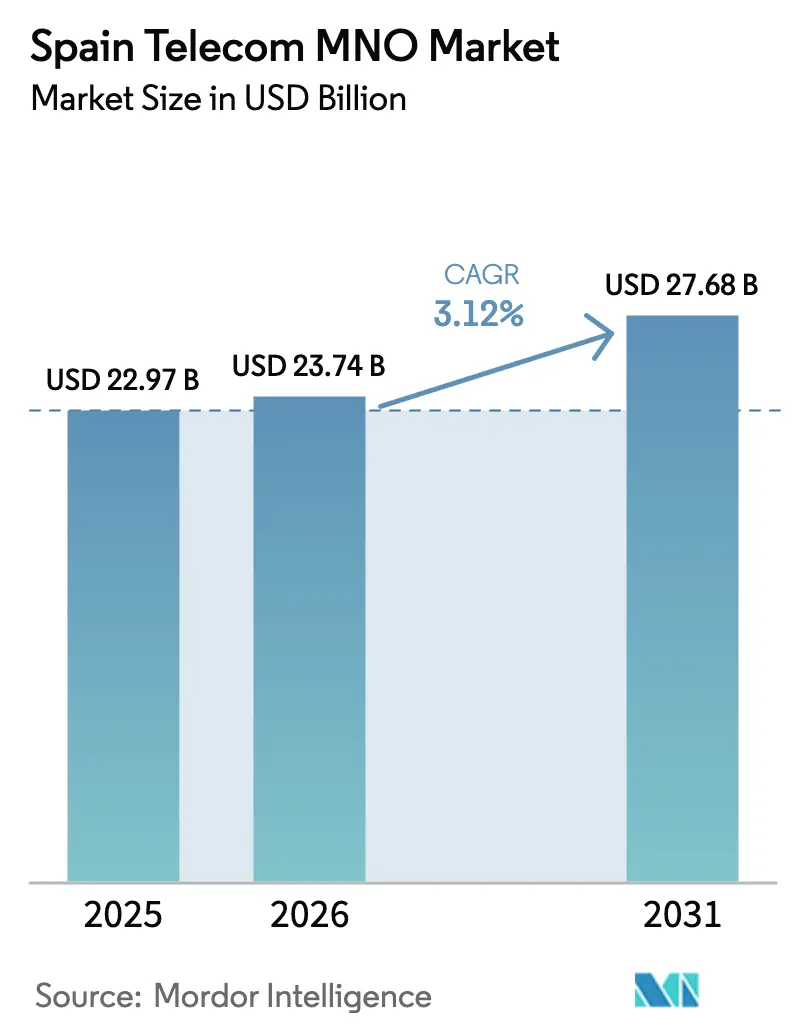
| Base Year Market Size (2025) | USD 22.97 Billion |
| Market Size (2026) | USD 23.74 Billion |
| Market Size (2031) | USD 27.68 Billion |
| Growth Rate (2026 - 2031) | 3.12 % |
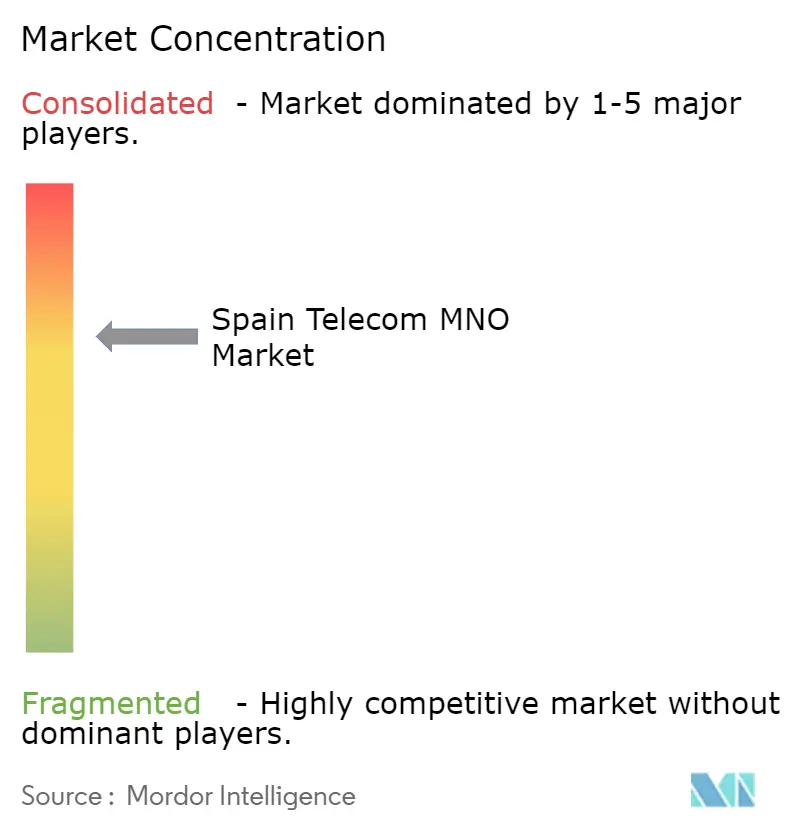
| Market Concentration | Medium |
Major Players *Disclaimer: Major Players sorted in no particular order Image © Mordor Intelligence. Reuse requires attribution under CC BY 4.0. | |
Spain Telecom MNO Market Analysis by Mordor Intelligence
The Spain Telecom MNO market size was valued at USD 22.97 billion in 2025 and is estimated to grow from USD 23.74 billion in 2026 to reach USD 27.68 billion by 2031, at a CAGR of 3.12% during the forecast period (2026-2031). The measured pace reflects a pivot from voice-centric subscriptions toward data-heavy applications, fiber-mobile convergence, and enterprise connectivity. Spain now supports near-ubiquitous 5G coverage, yet headline revenue growth remains modest because unlimited-data tariffs keep average revenue per user muted. Operators therefore rely on converged bundles that combine fiber, mobile, pay-TV, and fixed telephony to protect margins, and on private 5G campus networks to unlock premium enterprise spending. Meanwhile, IoT and M2M connections continue to scale rapidly, outpacing traditional consumer lines as utilities, automotive plants, ports, and agriculture digitize their operations. Collectively, these shifts confirm that the Spain Telecom MNO market is advancing from scale-driven consumer acquisition to value-driven industrial digitization.
Key Report Takeaways
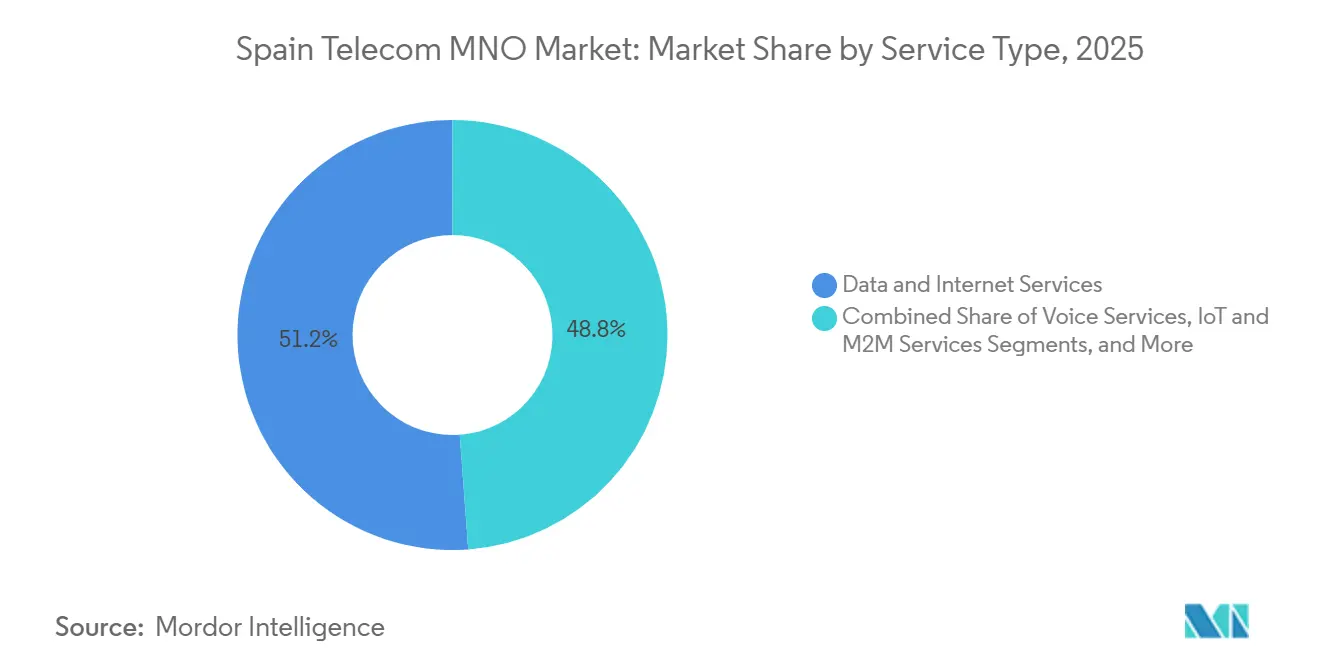
- By service type, Data and Internet Services led with 51.17% of Spain Telecom MNO market share in 2025. IoT and M2M Services are projected to register the fastest expansion, advancing at a 3.27% CAGR to 2031.
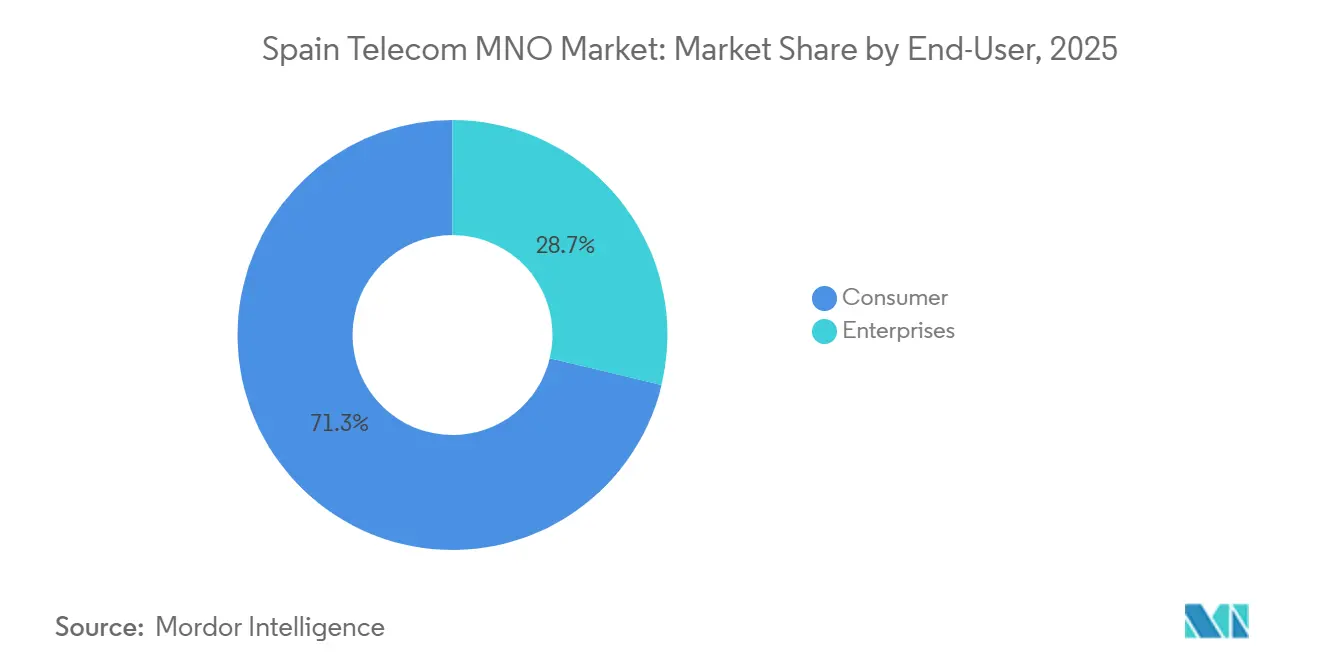
- By end-user, Consumer services accounted for 71.26% of Spain Telecom MNO market size in 2025, whereas the Enterprises segment is on track for a 3.41% CAGR through 2031.
Note: Market size and forecast figures in this report are generated using Mordor Intelligence’s proprietary estimation framework, updated with the latest available data and insights as of 2026.
Spain Telecom MNO Market Trends and Insights
Drivers Impact Analysis*
| Driver | (~) % Impact on CAGR Forecast | Geographic Relevance | Impact Timeline |
|---|---|---|---|
| 5G Standalone Coverage Expansion and Spectrum Refarming | +0.8% | Madrid, Barcelona, Valencia Metropolitan Corridors | Medium Term (2–4 Years) |
| Rising Mobile-Data Consumption Driven by Unlimited Plans | +0.6% | Major Urban Centers Nationwide | Short Term (≤ 2 Years) |
| Fiber-to-the-Home Diffusion Enabling Converged Bundles | +0.5% | Nationwide, Rural Build-Outs Accelerating | Medium Term (2–4 Years) |
| Enterprise IoT Uptake in Energy, Transport, and Agriculture | +0.4% | Andalusia, Catalonia, Nationwide Utilities | Long Term (≥ 4 Years) |
| Industrial Private 5G Campus Network Demand | +0.3% | Catalonia Automotive Hubs, Valencia and Barcelona Ports | Long Term (≥ 4 Years) |
| Spectrum Lease Revenue from Neutral-Host Indoor DAS | +0.2% | High-Traffic Venues in Madrid, Barcelona, Seville | Medium Term (2–4 Years) |
| Source: Mordor Intelligence | |||
5G Standalone Coverage Expansion and Spectrum Refarming
Spain’s operators already run 8.3% of national 5G sites in standalone mode, far above the sub-3% European average. Telefónica improved capacity in Madrid and Barcelona by refarming 2.1 GHz spectrum that previously carried 3G traffic, raising spectral efficiency by 22% during 2025.[1]Telefónica, “Telefónica Spain Network Infrastructure and Financial Results Q4 2025,” telefonica.com MasOrange switched on a 5G-Advanced layer that aggregates 700 MHz, 3.5 GHz, and 26 GHz bands, delivering trial speeds above 3 Gbps.[2]Orange, “MasOrange 5G-Advanced Network Launch and Financial Performance,” orange.com Enterprises value the architecture because network slicing and edge nodes guarantee sub-10 millisecond latency for robotics and AR maintenance tools. The CNMC decision to extend 3.5 GHz licences to 2040 at no extra cost freed capital for further densification in industrial corridors.
Rising Mobile-Data Consumption Driven by Unlimited Plans
Unlimited tariffs now cover 68% of Spanish post-paid lines, lifting average monthly data use to 18.4 GB in 2025.[3]CNMC, “Spanish Telecommunications Market Report 2025,” cnmc.es DIGI’s EUR 10 offer forced incumbents to match prices, so ARPU slid to EUR 6.95 (USD 8.20) even as traffic soared. Vodafone’s network shows that video streaming represents 62% of mobile load yet adds no incremental revenue under flat-fee plans. Telefónica reported that top-decile users consumed 47 GB each month while contributing barely EUR 6.95 (USD 8.20) in revenue, compressing gross margins to 38%. Operators respond by upselling fiber-mobile bundles and premium 5G tiers priced near EUR 50 (USD 59) per month to restore profitability.
Fiber-to-the-Home Diffusion Enabling Converged Bundles
Nationwide FTTH coverage reached 95.2% in 2025, creating a platform for quad-play bundles that cut churn by 60% compared with mobile-only plans. Converged offers combining 1 Gbps fiber and mobile service sell at EUR 40-60 (USD 47-71), a 35% premium to standalone wireless. The Telefónica-Vodafone Fiberpass venture and the MasOrange-Vodafone FiberCo cover a combined 15.8 million premises while lowering per-home deployment costs by 28%. Lower capital intensity let fiber capex fall from 18% of revenue in 2023 to 14% in 2025. As rural rollouts accelerate, the addressable base for bundled mobile lines keeps expanding.
Enterprise IoT Uptake in Energy, Transport, and Agriculture
Machine-to-machine lines jumped 60.4% year-over-year to 19.95 million in July 2025 as smart meters, connected vehicles, and farm sensors came online. Spain’s traffic authority mandated V-16 roadside beacons, creating a captive market of 25 million low-band NB-IoT devices. Energy utilities installed 8.2 million cellular smart meters to meet EU real-time data rules. Orange Business pilots in Andalusia show that connected irrigation cuts water use by 22% and fertilizer by 18%. Telefónica Tech now manages 17 million Spanish IoT connections at 72% gross margins, triple its consumer mobile margin.
Restraints Impact Analysis*
| Restraint | (~) % Impact on CAGR Forecast | Geographic Relevance | Impact Timeline |
|---|---|---|---|
| Saturated Mobile Subscriber Base Limiting Growth | -0.5% | Nationwide, Penetration >120% in Cities Such as Madrid and Barcelona | Short Term (≤ 2 Years) |
| ARPU Compression Due to Price Wars and Low-Cost Brands | -0.4% | Nationwide, Intensified in Large Metropolitan Markets | Short Term (≤ 2 Years) |
| Uncertain Litigation Over Historical Spectrum Fees | -0.2% | All Licensed Operators | Medium Term (2–4 Years) |
| Volatile Electricity Prices Increasing Network OPEX | -0.3% | Rural Base-Station Clusters Dependent on Backup Power | Short Term (≤ 2 Years) |
| Source: Mordor Intelligence | |||
Saturated Mobile Subscriber Base Limiting Organic Growth
Mobile penetration climbed to 122% in 2025 with 57.3 million active SIMs serving 47 million residents, leaving scant room for further line additions. Net new mobile subscriptions rose only 0.3% in 2025 compared with more than 2% annual growth before the pandemic. Incremental gains now stem mainly from multi-SIM devices and IoT links rather than new human users. Telefónica’s consumer ARPU fell 4.2% year-over-year despite migration efforts toward converged packages. The growth ceiling forces carriers to chase higher-value enterprise contracts to offset flat consumer volumes.
ARPU Compression Due to Price Wars and Low-Cost Brands
DIGI’s EUR 10 unlimited plan secured 1.8 million subscribers by December 2025, pushing incumbents to lower entry pricing by up to 50%. CNMC spectrum remedies now allow DIGI to target metro areas aggressively, deepening the discount gap. Vodafone Spain recorded a 5.1% ARPU contraction in 2025 as 28% of its base migrated to its own Lowi brand or defected to DIGI.[4]Vodafone, “Vodafone Spain Network Statistics and ARPU 2025,” vodafone.com Telefónica’s gross margin declined to 38% as usage-driven costs rose faster than revenue. Regulatory oversight blocks coordinated price lifts, so carriers must pursue network quality and exclusive content as non-price differentiators.
*Our forecasts treat driver/restraint impacts as directional, not additive. The impact forecasts reflect baseline growth, mix effects, and variable interactions.
Segment Analysis
By Service Type: Data Supremacy and the IoT Surge
Data and Internet Services held 51.17% of Spain Telecom MNO market revenue in 2025, far surpassing voice and messaging combined. The segment benefits from heavy video-streaming consumption and from 5G’s capacity uplift, yet flat-fee unlimited plans mute incremental monetization. IoT and M2M Services accounted for a smaller slice of Spain Telecom MNO market size but are projected to expand at a 3.27% CAGR, the fastest across all categories, as regulatory mandates embed connectivity into meters, vehicles, and agricultural sensors.
Voice and Messaging revenues continue to contract as over-the-top apps displace circuit-switched traffic, while OTT and PayTV add roughly 8% to the overall mix through churn-reducing bundles. Roaming almost returned to pre-pandemic levels in 2025, aiding the “other services” pool that still contributes meaningfully to Spain Telecom MNO market share in tourist districts. Long-term upside resides in platforms capable of managing device fleets at scale, a capability already reflected in Telefónica Tech’s high-margin IoT earnings.



By End-User: Consumer Scale Versus Enterprise Value
The Consumer segment captured 71.26% of Spain Telecom MNO market size in 2025, but its growth prospects are constrained by modest ARPU trends and full penetration. In contrast, Enterprises, though representing fewer connections, will deliver a 3.41% CAGR to 2031, outstripping consumer progress and gradually enlarging their Spain Telecom MNO market share.
Enterprise ARPU averages more than double the consumer figure because corporate clients often purchase multi-SIM fleets, secure SD-WAN overlays, and managed service wraps. Private 5G campus contracts at automotive plants and ports underscore how mission-critical latency and reliability translate into premium pricing. Even so, enterprise sales cycles are lengthy and integration-heavy, tempering the near-term scale of contribution despite the robust margin profile.
Geography Analysis
Madrid and Barcelona metropolitan zones generated more than 40% of national 5G traffic in 2025, reflecting dense small-cell grids and affluent, data-hungry demographics. Network leadership in these hubs offers a showcase for premium plans and enterprise campus networks, positioning carriers to capture early adopter revenues. Beyond the primary cities, the Catalonia industrial corridor supports the lion’s share of Spain’s private 5G deployments, leveraging proximity to automotive assembly, chemical plants, and logistics centers.
Rural provinces cover most of the landmass yet hold less than one-fifth of the population. Government grants are therefore instrumental in narrowing the digital divide, and subsidized rollouts under the Unico-5G program extend low-band coverage to thousands of small municipalities. Agrarian Andalusia illustrates the benefits, with connected irrigation and pest-monitoring networks reducing resource use and lifting crop yields.
Island territories rely on recent submarine fiber investments for backhaul, ensuring 5G parity with the mainland despite geographic isolation. Regulatory mandates on population coverage compel operators to maintain consistent service levels across archipelagos, and compliance penalties incentivize prompt rollout. As a result, even remote tourism-heavy regions now enjoy gigabit-class cellular service that underpins contactless hospitality, smart-traffic, and emergency-response solutions.
Regulatory Landscape
Spain’s telecom MNO market operates under a dual framework: CNMC oversight covering operator-related fees and market-competition supervision, alongside national spectrum policy set through the National Frequency Attribution Chart (CNAF). In 2026, spectrum planning moved through the CNAF update via Order TDF/732/2026, which entered into force on July 18, 2026 to incorporate WRC-23 outcomes and update how radioelectric frequencies are allocated across services.
Operational obligations are also tightening. A 2026 Security and Resilience Royal Decree introduces backup-power requirements, mandating four hours of mobile backup power for 75% of the population within three years, which raises compliance-driven capex and shifts operator priorities toward hardening in high-population areas. Separately, customer-service rules that require specific numbering ranges for support are aimed at curbing scams and distinguishing service communications from commercial outreach, increasing enforcement and process demands across retail operations.
Competitive Landscape
Spain shifted to a three-operator structure after the 2024 consolidation wave, increasing market concentration but also enabling larger balance sheets to support 5G densification. Telefónica, MasOrange, and Vodafone Spain together command more than four-fifths of subscriptions, yet the disruptive presence of DIGI as a low-cost fourth entrant restrains headline price inflation. Infrastructure-sharing ventures such as Fiberpass and FiberCo illustrate the new equilibrium: carriers pool passive assets to trim capital outlays while safeguarding brand differentiation at the retail layer.
Enterprise private 5G remains a white-space opportunity. Only a dozen-plus live networks serve factories and ports today, leaving thousands of addressable sites untapped. Specialized integrators like Ericsson and Cellnex often mediate these deployments, which reduces execution risk for MNOs but diverts a portion of the value chain outside their direct control. Operators are therefore investing in edge-cloud orchestration, application marketplaces, and patented network-slicing tools to anchor more of the revenue internally.
Regulation continues to mold outcomes. The extension of 3.5 GHz licenses free of charge strengthened balance sheets, while a modest bump in mobile termination rates improved the MVNO business case. These moves enhance competitive intensity by empowering smaller challengers without undermining incumbents’ investment capacity. Against this backdrop, strategic focus centers on fiber-mobile convergence, indoor coverage monetization, and differentiated enterprise propositions capable of rebuilding ARPU momentum.
Spain Telecom MNO Industry Leaders
MASORANGE, S.L.
Zegona Communications (Vodafone Spain)
Movistar (Telefónica Spain)
- *Disclaimer: Major Players sorted in no particular order

Market Opportunities and Future Outlook
The shift toward resilience-focused network hardening points to near-term spending in power systems, site engineering, and operational readiness. Under Spain’s 2026 Security and Resilience Royal Decree, the four hours of mobile backup power for 75% of the population within three years also pushes capex toward upgrading high-traffic macro sites, transport nodes, and other critical facilities, creating vendor and partnership demand across backup power, monitoring, and field services that support mobile availability targets.
As coverage matures, rural reach and industrial connectivity remain the clearest commercialization gap. Unico-5G-funded rollouts and operator programs offer a route to extend low-band 5G into smaller municipalities, supporting agricultural IoT, utilities telemetry, and logistics digitization where cellular remains the default wide-area link. In parallel, the CNAF update (Order TDF/732/2026, effective July 18, 2026) refreshes spectrum planning aligned with WRC-23 outcomes, giving operators and enterprise buyers clearer frequency attribution for private-network and specialized deployments while still allowing differentiated propositions beyond flat-rate consumer data bundles.
Recent Industry Developments
- July 2026: Vodafone Spain and Telefonica enter a binding contract to establish FibreCo for national Fibre-to-the-Home services. The partnership aims to accelerate fiber backbone deployment and broaden nationwide access. It also improves capital efficiency for large-scale FTTH rollout and supports next-generation fixed-mobile convergence.
- July 2026: MasOrange completes UNICO 5G Rural plan, delivering 5G connectivity to nearly 1,500 municipalities (245 in Galicia). The rural expansion increases service reach and supports rural digital inclusion. This also opens enterprise opportunities alongside wider overall network coverage.
- July 2026: Cellnex renews framework agreement with Vodafone Spain for 10 more years covering about 2,000 PoPs. The long-term arrangement densifies the network and spreads costs across key sites. With the expanded scope, it supports ongoing capacity improvements for both urban and regional coverage.


Research Methodology Framework and Report Scope
Market Definition and Coverage
This market is defined as the revenue generated in Spain from telecom operator services delivered to end users, covering mobile and fixed connectivity and related service revenues that are bundled and billed by telecom providers.
Scope exclusions: device sales (smartphones, routers), pure hardware infrastructure sales, and unrelated IT services are excluded from this market sizing.
Segmentation Overview
- Overall Telecom Revenue and ARPU
- Service Type
- Voice Services
- Data and Internet Services
- Messaging Services
- IoT and M2M Services
- OTT and PayTV Services
- Other Services (VAS, Roaming and International Services, Enterprise and Wholesale Services)
- End-User
- Enterprises
- Consumer
Data Sources, Market Sizing, and Validation
Desk Research
Desk work starts by mapping Spain telecom demand and supply signals that can be checked year over year, before we build any model. We use public statistics and regulator releases to understand service revenues, line counts, traffic growth, and investment patterns, which helps keep assumptions grounded.
Common inputs include official publications such as the CNMC telecom and audiovisual statistics and quarterly notes, Eurostat indicators for households and digital usage, and ITU releases for standard telecom definitions and penetration context. We also refer to sources like OECD broadband indicators, Spain government digital agenda materials, and company filings and investor presentations for revenue mix cues and reported subscriber trends. For cross-checking company-level disclosures and event timelines, we selectively use paid subscriptions for company financials and intelligence, news and financials, and patent databases when it helps validate technology rollouts. The sources listed here are illustrative, and many other public and paid references are also used for data collection, validation, and clarification.
Primary Interviews and Surveys
Primary work focuses on validating the service boundary and the revenue drivers behind it, since bundling and wholesale pass-through can distort a simple reading of reported totals. We interview and survey operator-side leaders, network and product owners, channel partners, and enterprise buyers across Spain to confirm ARPU direction, bundle mix shifts, and timing of price resets and promotions. We then align these views with desk signals to keep the final revenue pool consistent.
Distribution of primary research fieldwork respondents
| Company type | Respondent position |
|---|---|
| Top tier: 35% | CXOs: 14% |
| Mid tier: 50% | Functional/Unit leaders: 37% |
| Smaller Players: 15% | Managers: 49% |
Market-Sizing & Forecasting
Sizing starts with a top-down reconstruction where regulator revenue splits, service line trends, and network usage indicators are translated into a consistent telecom services revenue pool for Spain. Once that total is established, it is corroborated with selective bottom-up approximations using sampled operator revenue splits, ARPU multiplied by subscriber base ranges, and channel checks on bundle pricing. This is also where we adjust any over-counting from bundled offers.
The model is driven by repeatable inputs that can be refreshed each cycle, such as mobile and fixed line counts, fiber coverage and take-up progression, mobile data traffic growth, the share of converged bundles, and the mix between retail and wholesale service revenues. Forecasting is built using scenario analysis supported by expert views, since pricing moves, competitive intensity, and investment pace do not always follow a smooth trend line. When bottom-up checks have gaps, we use conservative ranges and only fill them after rechecking with multiple respondents and at least one independent desk indicator.
Data Validation & Update Cycle
Validation is done through stepwise checks where outputs are compared against independent signals like reported sector revenue direction, line growth, traffic growth, and capex trends, so the final number does not rely on any single dataset. Outliers are flagged, traced back to the driver level (for example, a one-off price increase or a reporting change), and then reviewed by another analyst before sign-off.
Reports are refreshed annually, and interim updates are triggered when material events occur, such as major pricing resets, consolidation steps, or scope changes in public reporting. Before delivery, a fresh review pass is completed so clients receive the most current view tied to clearly stated assumptions.
Mordor Intelligence's Spain Telecom Market Size Compared Against Other Published Estimates
Different sources can land on different Spain telecom market sizes because they do not always count the same service buckets or the same revenue line, and timing choices also matter. The biggest spreads usually come from whether the estimate blends wholesale with retail, how bundles are treated, and whether adjacent digital video platform revenues are pulled into the telecom total.
By tracking revenue boundary rules around bundled services and regulator-aligned retail versus wholesale splits, Mordor Intelligence keeps the total tied to telecom operator service revenue in Spain rather than broader digital services, which typically changes the final market number.
Benchmark comparison
| Source | Market Size | Gaps in Research Methodology |
|---|---|---|
| Mordor Intelligence | USD 22.97 B (2025) | |
| Industry Data Publisher A | USD 43.00 B (2025) | This type of estimate often uses a broader telecom definition that can fold in wider ICT services and adjacent digital revenues, which inflates the service-only operator revenue pool when compared on the same year. |
| Regulatory-Based Commentary B | USD 37.50 B (2024) | Figures built from sector revenue commentary can differ due to using EUR to USD conversion timing, including additional audiovisual platform revenues, and mixing wholesale and retail totals without a consistent de-duplication step. |
The table shows that scope and accounting choices drive most of the gap, not a disagreement about demand direction. When the service boundary is kept consistent and each revenue stream is counted once, the result becomes easier to refresh each year and easier to reconcile to observable signals like lines, traffic, and reported sector revenue movement.


Key Questions Answered in the Report
What is the projected size of the Spain Telecom MNO market by 2031?
It is forecast to reach USD 27.68 billion by 2031, reflecting a 3.12% CAGR from 2026-2031.
Which service category is expanding the fastest?
IoT and M2M Services show the quickest trajectory, advancing at a 3.27% CAGR through 2031 as utilities, automotive plants, ports, and agriculture embed connected-device solutions.
Why does average revenue per user remain low despite rising data traffic?
Unlimited-data plans dominate the post-paid base, lifting monthly usage but capping per-line revenue, so carriers rely on converged bundles and premium 5G tiers to enhance margins.
How are operators monetizing enterprise demand?
Telefónica, MasOrange, and Vodafone Spain deploy private 5G campus networks, SD-WAN, and managed IoT platforms that command enterprise ARPUs more than double consumer levels.
What regional programs support rural connectivity?
The government's Unico-5G initiative funds low-band 5G rollouts in municipalities under 5,000 inhabitants, while new fiber routes link the Balearic and Canary Islands to mainland backhaul.
How concentrated is competition after recent mergers and acquisitions?
Following the Orange-MasMovil merger and Vodafone Spain's sale to Zegona, three national operators hold roughly 86% of subscriptions.
Page last updated on:


 Your data is secure and never sold or shared.


