
Costa Rica Telecom MNO Market Size and Share
Market Overview
| Study Period | 2020 - 2031 |
|---|---|
| Forecast Data Period | 2026 - 2031 |
| Base Year Market Size (2025) | USD 1.76 Billion |
| Market Size (2026) | USD 1.81 Billion |
| Market Size (2031) | USD 2.06 Billion |
| Growth Rate (2026 - 2031) | 2.68 % |
| Market Concentration | High |
Major Players *Disclaimer: Major Players sorted in no particular order Image © Mordor Intelligence. Reuse requires attribution under CC BY 4.0. | |
Costa Rica Telecom MNO Market Analysis by Mordor Intelligence
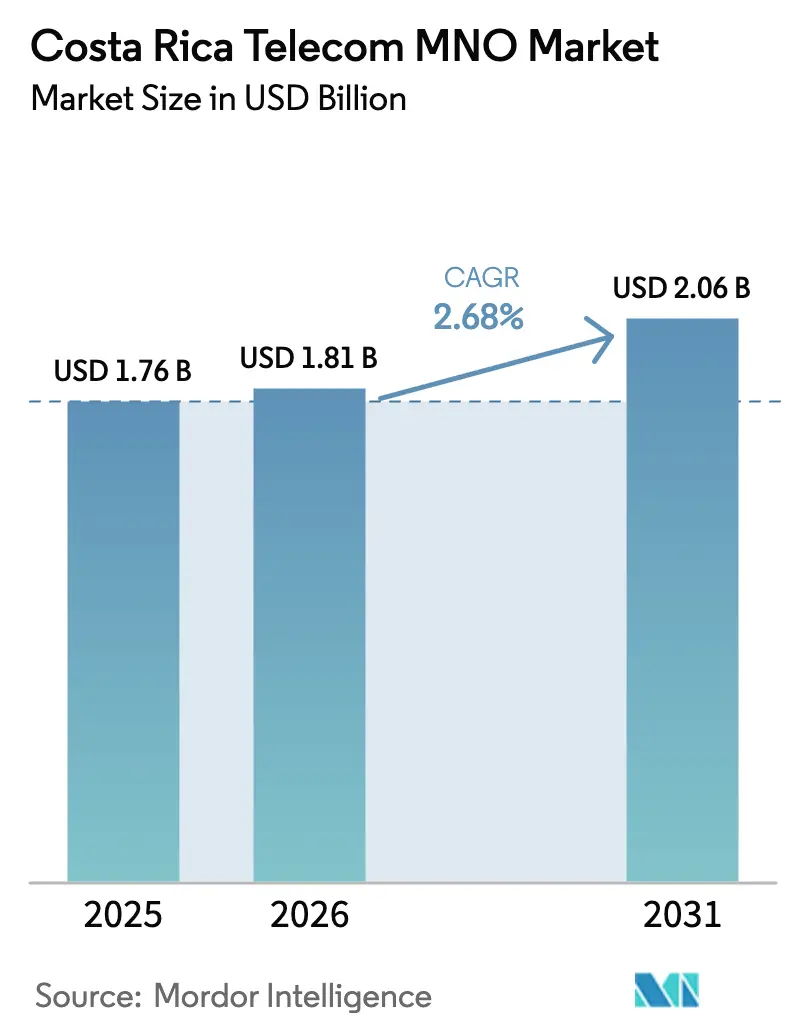
The Costa Rica Telecom MNO market size is expected to grow from USD 1.76 billion in 2025 to USD 1.81 billion in 2026 and is forecast to reach USD 2.06 billion by 2031 at 2.68% CAGR over 2026-2031.
Moderate topline expansion mirrors the sector’s maturation as operators pivot from subscriber grabs to value-added services, spectrum-efficient networks, and fixed–mobile convergence offers. February 2025’s 1 GHz spectrum auction reset competitive dynamics, obligating nationwide 5G rollouts that will elevate network quality while catalyzing enterprise use cases.[1]Cullen International, “Costa Rica Concludes Record-Size 5G Spectrum Auction,” cullen-international.com Data traffic growth remains video-centric, with more than 3.8 million YouTube users and 3.4 million TikTok users straining backhaul capacity and accelerating edge-cloud investments. Liberty’s 30% fixed-mobile convergence penetration signals a shift toward integrated bundles that lift ARPU and curb churn.[2]Liberty Latin America, “Liberty Costa Rica Achieves 30% FMC Penetration,” libertylatinamerica.com Fiber-to-the-home (FTTH) upgrades, already covering 80% of Liberty’s fixed footprint, underpin premium gigabit plans and enable future 5G xHaul. Meanwhile, FONATEL’s USD 58 million subsidy program adds 46,462 underserved households, broadening the addressable base for basic and advanced connectivity services.
Key Report Takeaways
- By service type, data and internet services led with 57.72% of Costa Rica telecom MNO market share in 2025, while IoT and M2M services are forecast to expand at a 2.91% CAGR through 2031.
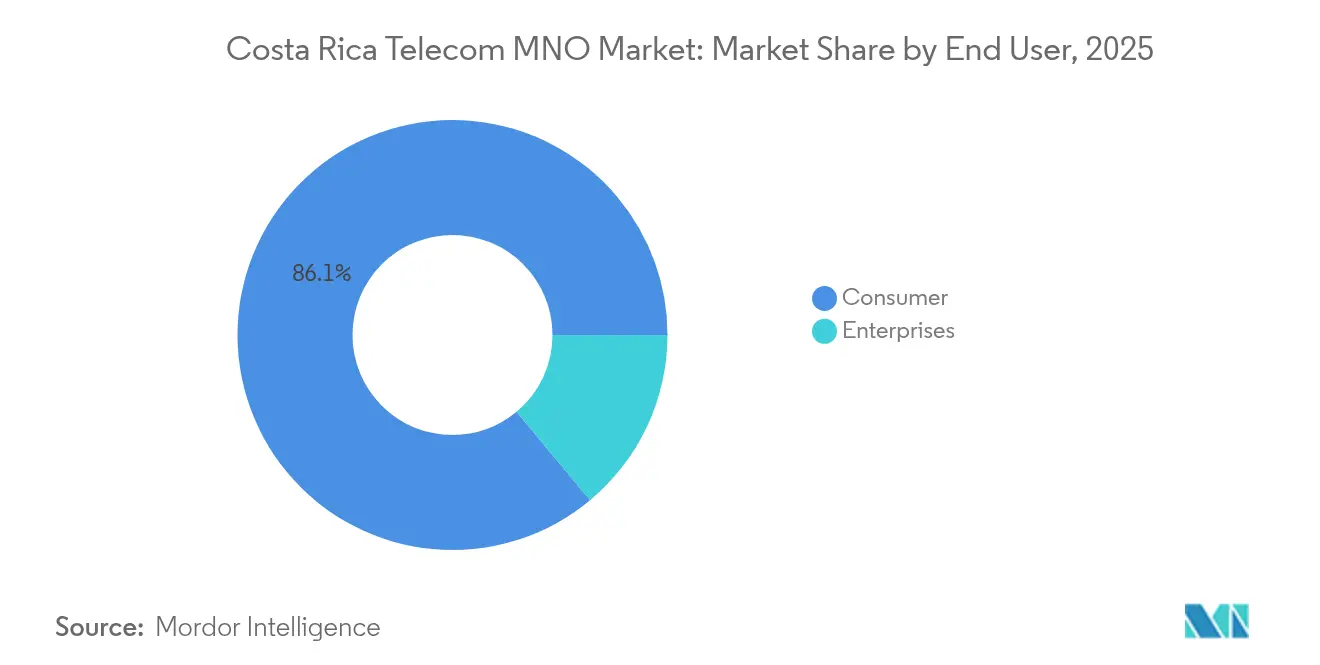
- By end-user, the consumer segment accounted for 86.05% of the Costa Rica telecom MNO market size in 2025, whereas enterprise connections are projected to grow at a 3.42% CAGR between 2026 and 2031.
Note: Market size and forecast figures in this report are generated using Mordor Intelligence’s proprietary estimation framework, updated with the latest available data and insights as of 2026.
Costa Rica Telecom MNO Market Trends and Insights
Drivers Impact Analysis*
| Driver | (~) % Impact on CAGR Forecast | Geographic Relevance | Impact Timeline |
|---|---|---|---|
| Explosion in mobile data traffic from video-centric social media usage | +0.8% | National, concentrated in San José metropolitan area | Short term (≤ 2 years) |
| Nationwide 5G spectrum auction and coverage obligations (2024-2025) | +0.6% | National, with priority urban deployment | Medium term (2-4 years) |
| Accelerated FTTH rollout by Liberty and Metrocom boosting fixed ARPU | +0.4% | National, emphasis on suburban expansion | Medium term (2-4 years) |
| Enterprise digitalisation spurring IoT connectivity in agriculture & tourism | +0.3% | National, concentrated in agricultural regions and tourist zones | Long term (≥ 4 years) |
| FONATEL broadband subsidies expanding low-income household connectivity | +0.2% | National, targeting rural and vulnerable populations | Medium term (2-4 years) |
| Rural cooperatives awarded spectrum driving fixed-wireless expansion | +0.2% | Regional, focused on underserved rural areas | Long term (≥ 4 years) |
| Source: Mordor Intelligence | |||
Explosion in Mobile Data Traffic from Video-Centric Social Media Usage
Costa Rica's mobile data consumption patterns reflect a fundamental shift toward video-first digital experiences, with social media platforms driving unprecedented bandwidth demands across the telecommunications infrastructure. The country's internet penetration rate over 92%, coupled with strong mobile connection density, creates a unique market dynamic where multiple devices per user generate layered data consumption patterns. YouTube commands 3.83 million users while TikTok reaches 3.43 million users aged 18 and above, indicating substantial video streaming activity that strains network capacity during peak hours. This consumption surge forces operators to continuously upgrade backhaul infrastructure and implement advanced traffic management systems to maintain service quality standards mandated by SUTEL. The economic multiplier effect is significant, as research demonstrates that a 1% increase in broadband penetration correlates with a 2.96% increase in average household income in Costa Rica. Mobile operators are responding by deploying edge computing solutions and content delivery networks to localize popular content, reducing international bandwidth costs while improving user experience metrics.
Nationwide 5G Spectrum Auction and Coverage Obligations (2024-2025)
The February 2025 spectrum auction represents a watershed moment for Costa Rica's telecommunications sector, with SUTEL awarding national licenses across 700 MHz, 2.3 GHz, 3.5 GHz, and 26 GHz bands to Liberty and Claro, while simultaneously empowering five regional cooperatives with targeted spectrum allocations. The auction generated USD 34.1 million in proceeds while establishing deployment commitments for 3,304 infrastructure units, creating a structured framework for nationwide 5G coverage expansion. Nokia's partnership with RACSA to deploy Costa Rica's first 5G standalone network demonstrates the technology's immediate viability, with initial rollout covering 30 sites in urban centers like San José, Cartago, and Limón. The coverage obligations embedded within spectrum licenses mandate operators to extend services beyond profitable urban markets, addressing historical connectivity gaps in rural regions. This regulatory approach contrasts sharply with market-driven deployments in neighboring countries, potentially accelerating Costa Rica's digital inclusion objectives while creating new revenue streams through Fixed Wireless Access applications in underserved areas.
Accelerated FTTH Rollout by Liberty and Metrocom Boosting Fixed ARPU
Fiber-to-the-home infrastructure expansion has emerged as a critical differentiator in Costa Rica's competitive landscape, with Liberty Costa Rica upgrading over 80% of its fixed networks to support speeds exceeding 1 Gbps. Metrocom's aggressive deployment strategy has positioned the company as the fastest ISP with median download speeds of 240.66 Mbps and upload speeds of 214.86 Mbps, forcing established operators to accelerate their own fiber investments. The strategic merger between Liberty Latin America and Millicom, expected to close in the second half of 2025, will combine resources to enhance fiber network investments and create economies of scale in infrastructure deployment. This infrastructure modernization directly impacts average revenue per user metrics, as fiber-enabled services command premium pricing while reducing operational costs through improved network reliability. The competitive response has triggered a broader industry shift toward gigabit-capable networks, with operators recognizing that fiber infrastructure serves as both a defensive moat against competitors and an offensive platform for new service categories including cloud gaming, virtual reality applications, and enterprise-grade connectivity solutions.
Enterprise Digitalisation Spurring IoT Connectivity in Agriculture and Tourism
Costa Rica's strategic positioning as a technology hub, attracting over 300 high-tech companies including Intel and Amazon, has catalyzed enterprise demand for sophisticated IoT connectivity solutions across key economic sectors. The agriculture sector, representing a significant portion of the country's export economy, increasingly adopts precision farming technologies that require reliable cellular connectivity for sensor networks, automated irrigation systems, and real-time crop monitoring applications. Tourism enterprises are implementing IoT-enabled smart hotel technologies, including automated check-in systems, environmental controls, and personalized guest services that depend on robust mobile data connectivity IOP Science. The enterprise segment's 3.60% CAGR growth rate reflects this digitalization momentum, as businesses recognize connectivity as a fundamental enabler of operational efficiency and competitive differentiation. Telecommunications operators are responding by developing specialized IoT service packages, edge computing capabilities, and dedicated network slices that address enterprise requirements for low latency, high reliability, and scalable connectivity solutions across diverse use cases.
Restraints Impact Analysis*
| Restraint | (~) % Impact on CAGR Forecast | Geographic Relevance | Impact Timeline |
|---|---|---|---|
| High spectrum fees and multiple telecom taxes eroding operator margins | -0.5% | National, affecting all licensed operators | Short term (≤ 2 years) |
| Mobile-SIM penetration >150% driving ARPU compression | -0.3% | National, particularly urban markets | Medium term (2-4 years) |
| Court dispute on Huawei ban delaying 5G equipment tenders | -0.2% | National, impacting infrastructure deployment | Short term (≤ 2 years) |
| Rising climate-driven outages in coastal zones raising OPEX | -0.2% | Coastal regions, affecting network resilience | Long term (≥ 4 years) |
| Source: Mordor Intelligence | |||
High Spectrum Fees and Multiple Telecom Taxes Eroding Operator Margins
Costa Rica's telecommunications sector faces significant financial pressure from a complex taxation framework that includes spectrum fees, regulatory charges, profit taxes, and customs duties, creating a cumulative burden that constrains operator investment capacity and service innovation. Research indicates that increased regulatory fees and profit taxes negatively impact telecommunications investment decisions, while the fiscal regime influences service pricing and network coverage expansion strategies. The February 2025 spectrum auction, while successful in allocating frequencies, imposed substantial financial commitments on operators at a time when global spectrum costs have risen 63% over the past decade, now accounting for 7% of operator revenues according to GSMA analysis. This taxation burden becomes particularly problematic when combined with coverage obligations that require operators to serve unprofitable rural markets, creating a structural challenge where regulatory mandates increase costs while fiscal policies limit the financial resources available to meet those obligations. The situation is compounded by Costa Rica's position as a developing market where operators must balance revenue generation with affordability requirements, limiting their ability to pass increased costs directly to consumers through higher service prices.
Mobile-SIM Penetration >150% Driving ARPU Compression
Costa Rica's mobile market exhibits a paradoxical dynamic where exceptionally high SIM penetration rates create downward pressure on average revenue per user metrics, as multiple connections per subscriber dilute individual line revenues. This market saturation phenomenon reflects consumer behavior patterns where users maintain multiple SIM cards for different purposes, including separate lines for personal and business use, backup connections, or to access promotional offers from competing operators. The competitive response to market saturation has intensified price competition, with operators offering increasingly aggressive promotional packages to maintain market share, further eroding ARPU levels across the industry. Prepaid services dominate the market structure, with kölbi offering unlimited internet packages for USD 3 per 24 hours and Liberty's prepaid plans starting at USD 12 for comprehensive service bundles. The market's maturity is evident in the 0.6% decline in mobile connections during 2024, indicating that growth strategies must shift from subscriber acquisition to value enhancement through premium services, fixed-mobile convergence offerings, and enterprise solutions that command higher per-user revenues.
*Our forecasts treat driver/restraint impacts as directional, not additive. The impact forecasts reflect baseline growth, mix effects, and variable interactions.
Segment Analysis
By Service Type: Data Services Drive Revenue Growth
Data and internet offerings accounted for 57.72% of the Costa Rica telecom MNO market size in 2025, underscoring connectivity’s role as a foundational utility for cloud collaboration, streaming, and remote work. IoT and M2M lines, though representing a small absolute base, post the fastest 2.91% CAGR, buoyed by smart agriculture pilots and hotel automation projects that elevate enterprise wallet share. Voice and legacy SMS continue sliding as OTT substitutes flourish, but they remain necessary for critical communications, maintaining a predictable though shrinking revenue floor in the Costa Rica telecom MNO market.
An expanding FTTH footprint enables bundled OTT video, driving incremental adoption of PayTV and cloud-gaming passes that ride on gigabit speeds. Operators are packaging roaming, cybersecurity, and unified-communications-as-a-service (UCaaS) modules for margin uplift. As ARPU pressures persist, monetizing network APIs and edge-hosting capacity emerges as a logical route to capture digital-service adjacency within the Costa Rica telecom MNO industry.




By End User: Enterprise Segment Accelerates Digital Adoption
The consumer block retained 86.05% of 2025 revenue, anchored by social-media-heavy youth segments and bundled fixed-mobile households. Growth, however, moderates as saturation curbs net-add volumes; strategic emphasis therefore tilts toward loyalty-driven value-added services and 1 Gbps household upgrades that stabilize ARPU in the Costa Rica telecom MNO market.
Enterprise accounts expand at a 3.42% CAGR, outpacing the broader market as factories embed Industry 4.0 logic and service firms adopt hybrid-work architectures. Manufacturing plants around Cartago require deterministic low-latency links, while tourism operators along the Pacific coast install IoT-enabled energy-management systems. Tailored SLAs, private-network slices, and analytics-bundled connectivity convert these requirements into premium contracts, cushioning operator margins and deepening diversification across the Costa Rica telecom MNO market.
Geography Analysis
Nationwide 4G now blankets 97% of citizens, situating Costa Rica among Latin America’s broadband leaders. The Greater San José area—the economic core—delivers the bulk of service revenues as multinational offices, universities, and government agencies demand robust links. Spectrum licenses stipulate that 5G reaches secondary cities such as Cartago and Limón within two years, sending early deployment capex to these corridors and expanding the Costa Rica telecom MNO market size.
Regional cooperatives awarded spectrum—Cooperalfaroruiz, Coopeguanacaste, Coopelesca, and Coopesantos—are rolling out fixed-wireless access across 164 designated rural sites, injecting competitive pluralism and aiding digital inclusion agendas. FONATEL complements this with fiber rings and public-Wi-Fi in 513 communal spaces, an approach that nurtures e-government uptake and remote-learning adoption. Coastal provinces weather frequent climate-induced outages; operators now design hardened cell sites with elevated shelters and solar backup, internalizing resilience investment as a core regional cost across the Costa Rica telecom MNO market.
Geographic parity remains a policy priority; thus, subsidies and mandates funnel network modernization to low-density zones, unlocking latent demand among rural SMEs that increasingly sell agro-exports online. Over the forecast window, 5G fixed-wireless access is expected to narrow the urban-rural digital divide, changing the revenue geometry of the Costa Rica telecom MNO market.
Competitive Landscape
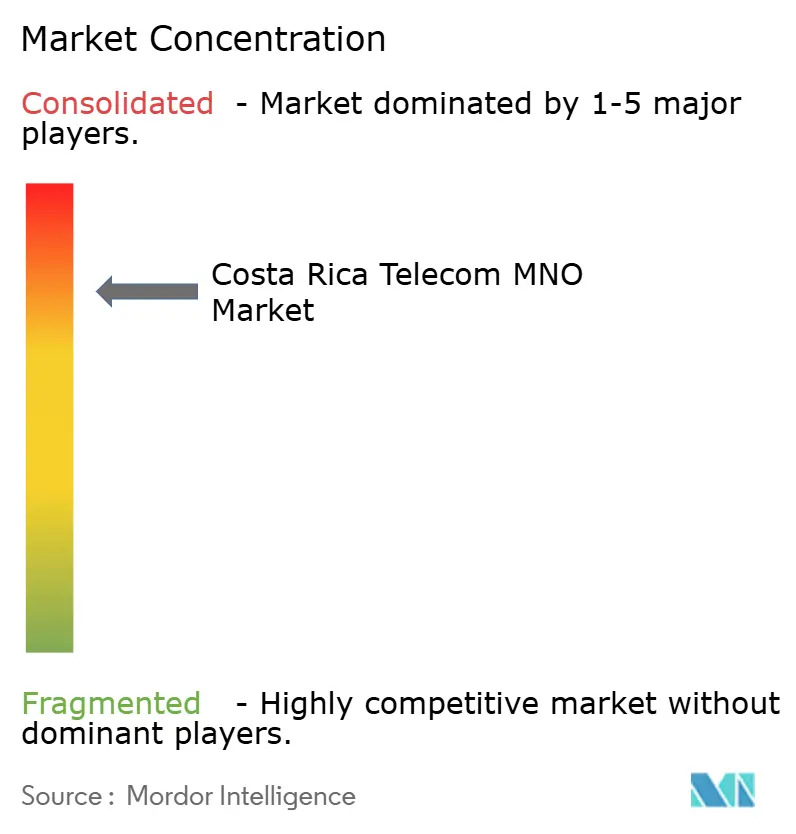
Three national licensees—kölbi, Liberty-Claro (post-merger), and Claro—dominate access, while tower-sharing rules and neutral-host models invite infrastructure specialists. The August 2024 Liberty–Millicom deal combines 440,000 broadband lines and USD 255 million adjusted OIBDA, forging a scale challenger to kölbi’s entrenched base. Competition focuses on fiber breadth, 5G latency, and curated content ecosystems rather than pure subscriber tallies in the Costa Rica telecom MNO market.
Vendor alliances shape technology gaps—Nokia supplies RACSA’s first standalone core, Ericsson equips kölbi’s dynamic spectrum sharing, and Huawei’s legal status remains contested, potentially delaying multi-vendor tenders. Operators experiment with open-RAN pilots in noncritical rural cells to decouple hardware-software stacks and lower TCO. Enterprise verticalization is the next frontier: SLA-backed IoT packs for agri-exporters, SD-WAN suites for offshore service centers, and edge-compute nodes for AR/VR tourism apps strengthen differentiation within the Costa Rica telecom MNO industry.
Regulators push infrastructure sharing to defray rural capex, so towercos and fiber-wholesalers capture incremental margin from lease-up rates. Meanwhile, SIM saturation forces price rationalization that shrinks consumer ARPU but encourages convergence bundling. Consequently, innovation around analytics-driven upsell and fintech adjacencies becomes critical to sustain profitability in the Costa Rica telecom MNO market.
Costa Rica Telecom MNO Industry Leaders
Liberty Costa Rica
Claro Costa Rica
kölbi (ICE)
- *Disclaimer: Major Players sorted in no particular order

Recent Industry Developments
- February 2025: Costa Rica completed its largest spectrum auction, allocating more than 1 GHz to Liberty and Claro and licensing five rural cooperatives. The process raised USD 34.1 million and set 3,304 site obligations.
- January 2025: Millicom posted Q4 2024 revenue of USD 1.43 billion and boosted its 2025 equity-free cash-flow target to USD 750 million ahead of the planned Costa Rica merger.
- October 2024: Nokia and RACSA activated the nation’s first standalone 5G network across 30 sites, with expansion to 500 sites earmarked.
- August 2024: Liberty Latin America and Millicom agreed to combine Costa Rican operations, valuing the joint venture at USD 255 million adjusted OIBDA and targeting completion in H2 2025.


Costa Rica Telecom MNO Market Report Scope
Telecom or telecommunication is the long-range transmission of information by electromagnetic means. The Costa Rican telecom MNO market includes in-depth trend analysis based on connectivity like fixed networks, mobile networks, and telecom towers.
The Costa Rican telecom MNO market is segmented by services [voice services (wired, wireless), data and messaging services, and OTT and pay TV services]. Several factors, including an increasing demand for 5G, will likely drive the adoption of telecom services. The market size and forecasts are in value (USD) for all the above segments.
| Voice Services |
| Data and Internet Services |
| Messaging Services |
| IoT and M2M Services |
| OTT and PayTV Services |
| Other Services (VAS, Roaming and International Services, Enterprise and Wholesale Services, etc.) |
| Enterprises |
| Consumer |
| Service Type | Voice Services |
| Data and Internet Services | |
| Messaging Services | |
| IoT and M2M Services | |
| OTT and PayTV Services | |
| Other Services (VAS, Roaming and International Services, Enterprise and Wholesale Services, etc.) | |
| End-User | Enterprises |
| Consumer |


Key Questions Answered in the Report
How fast is the Costa Rica telecom MNO market expected to grow through 2031?
It is projected to expand from USD 1.81 billion in 2026 to USD 2.06 billion in 2031, registering a 2.68% CAGR.
Which service type generates most revenue?
Data and internet services lead with 57.72% share of 2025 revenue, reflecting the country’s video-heavy usage patterns.
What segment shows the highest growth momentum?
IoT and M2M connectivity posts the fastest 2.91% CAGR as agriculture and tourism digitize operations.
How concentrated is operator competition?
Three national licensees capture almost the entire market, producing a concentration score of 8.
What role does 5G play in rural connectivity?
Coverage obligations tied to 2025 spectrum licenses mandate 3,304 new sites, enabling fixed-wireless access in underserved areas.
How are taxes affecting operators?
Elevated spectrum and profit-tax burdens absorb an estimated 7% of operator revenue, constraining capital available for network upgrades.
Page last updated on:


 Your data is secure and never sold or shared.


