
El Salvador Telecom MNO Market Size and Share
Market Overview
| Study Period | 2019 - 2030 |
|---|---|
| Forecast Data Period | 2025 - 2030 |
| Historical Data Period | 2019 - 2023 |
| Market Size (2025) | USD 1.15 Billion |
| Market Size (2030) | USD 1.45 Billion |
| Growth Rate (2025 - 2030) | 4.72 % |
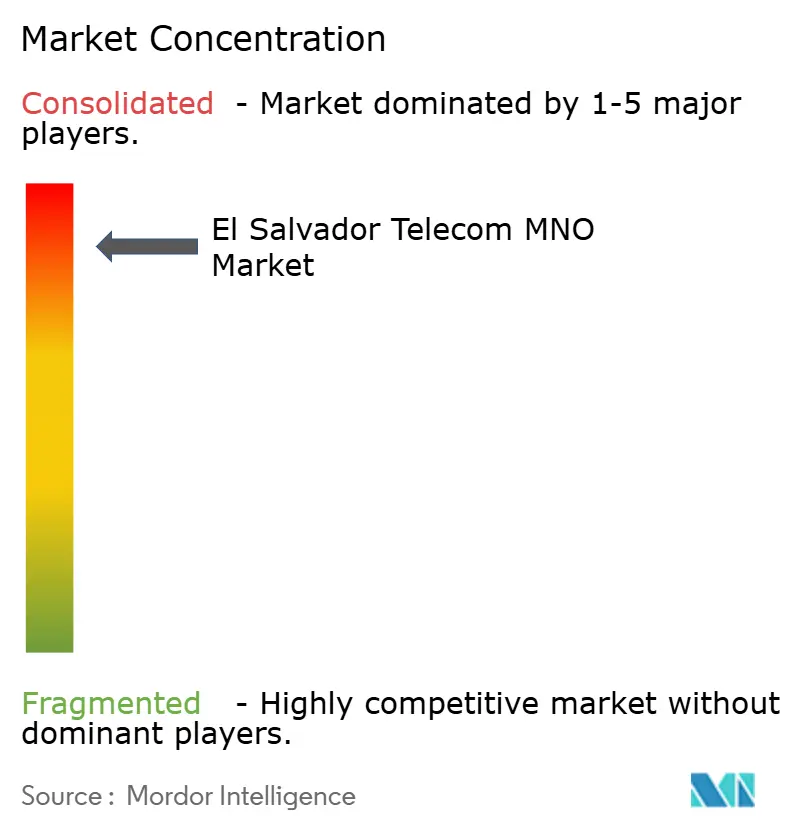
| Market Concentration | High |
Major Players *Disclaimer: Major Players sorted in no particular order Image © Mordor Intelligence. Reuse requires attribution under CC BY 4.0. | |
El Salvador Telecom MNO Market Analysis by Mordor Intelligence
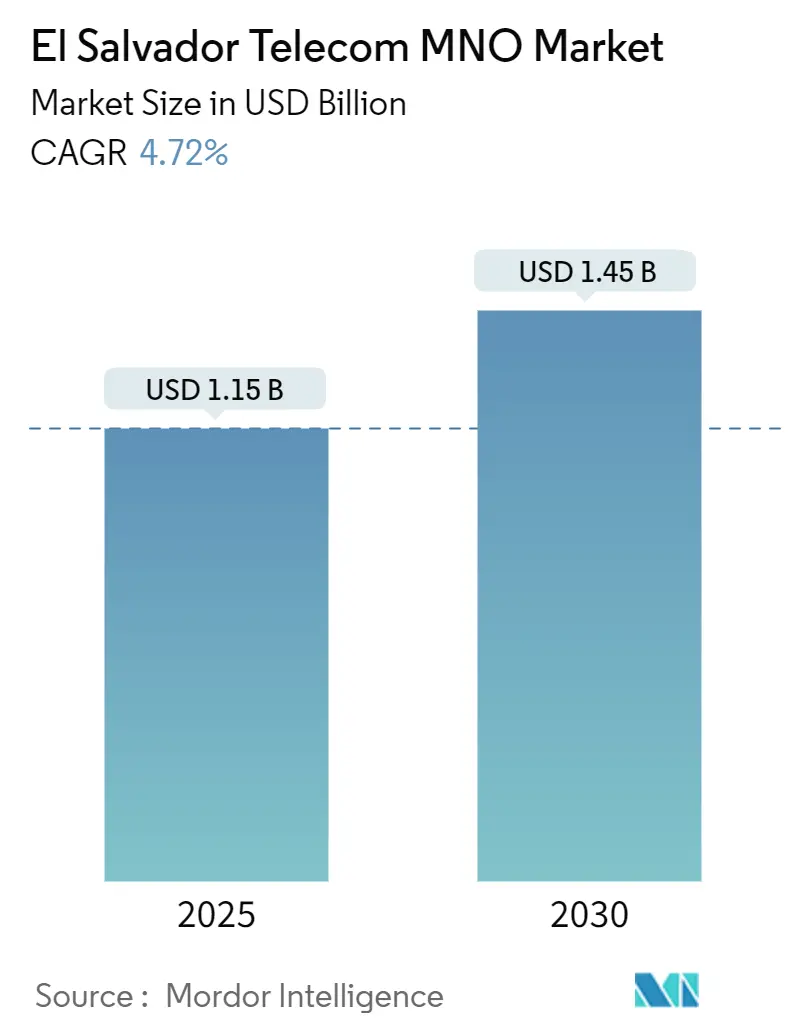
The El Salvador Telecom MNO Market size is estimated at USD 1.15 billion in 2025, and is expected to reach USD 1.45 billion by 2030, at a CAGR of 4.72% during the forecast period (2025-2030). In terms of subscriber volume, the market is expected to grow from 9.92 million subscribers in 2025 to 11.84 million subscribers by 2030, at a CAGR of 3.61% during the forecast period (2025-2030). Steady growth replaces the rapid subscriber expansion of earlier years as operators shift their focus toward data-centric revenue, enterprise connectivity, and value-added digital services. Data traffic linked to nationwide Bitcoin adoption, combined with the government’s digital-government agenda, is accelerating demand for robust 4G and planned 5G capacity. Meanwhile, fiscal pressures and signal-blocking regulations curb free cash flow, compelling network sharing and selective investment. Competitive differentiation is therefore shifting from pure coverage to bundled quad-play offers, OTT partnerships, and enterprise solutions that monetize higher-spending segments. [1]Organization for Economic Co-operation and Development, “Revenue Statistics LAC: Key findings for El Salvador,” oecd.org
Key Report Takeaways
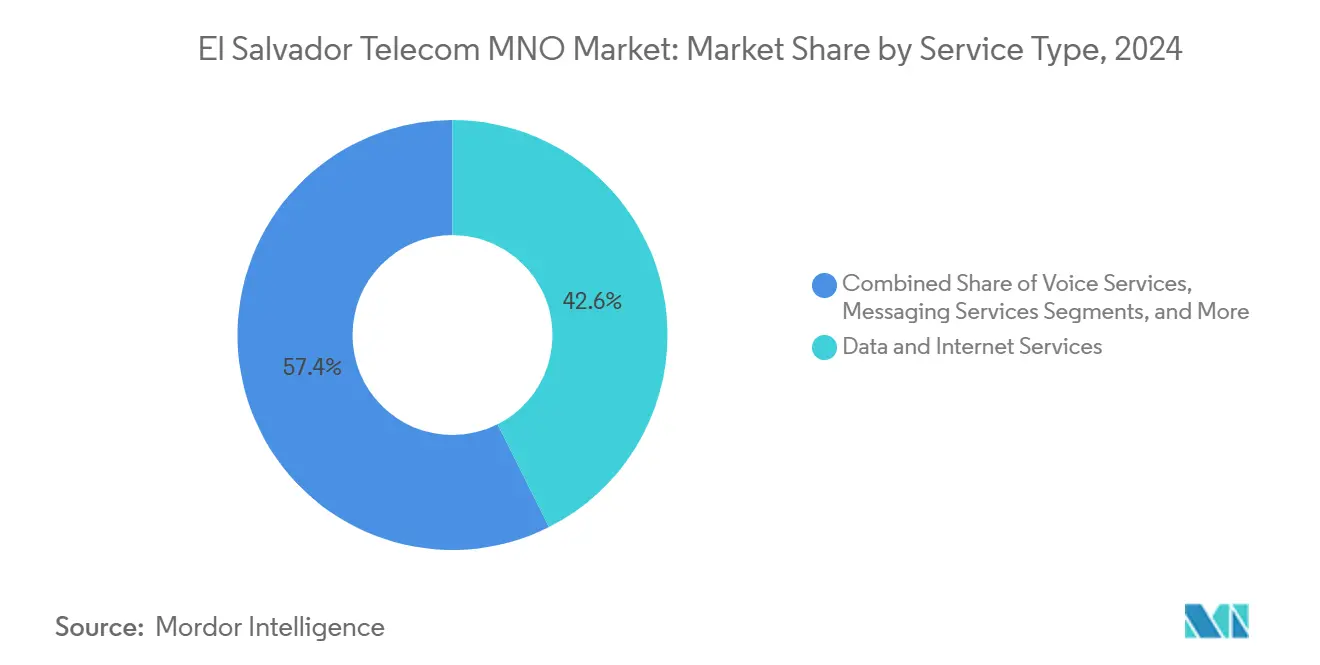
- By service type, data and internet services commanded 42.59% of the El Salvador telecom MNO market share in 2024; this segment is expected to expand at a 4.94% CAGR through 2030.
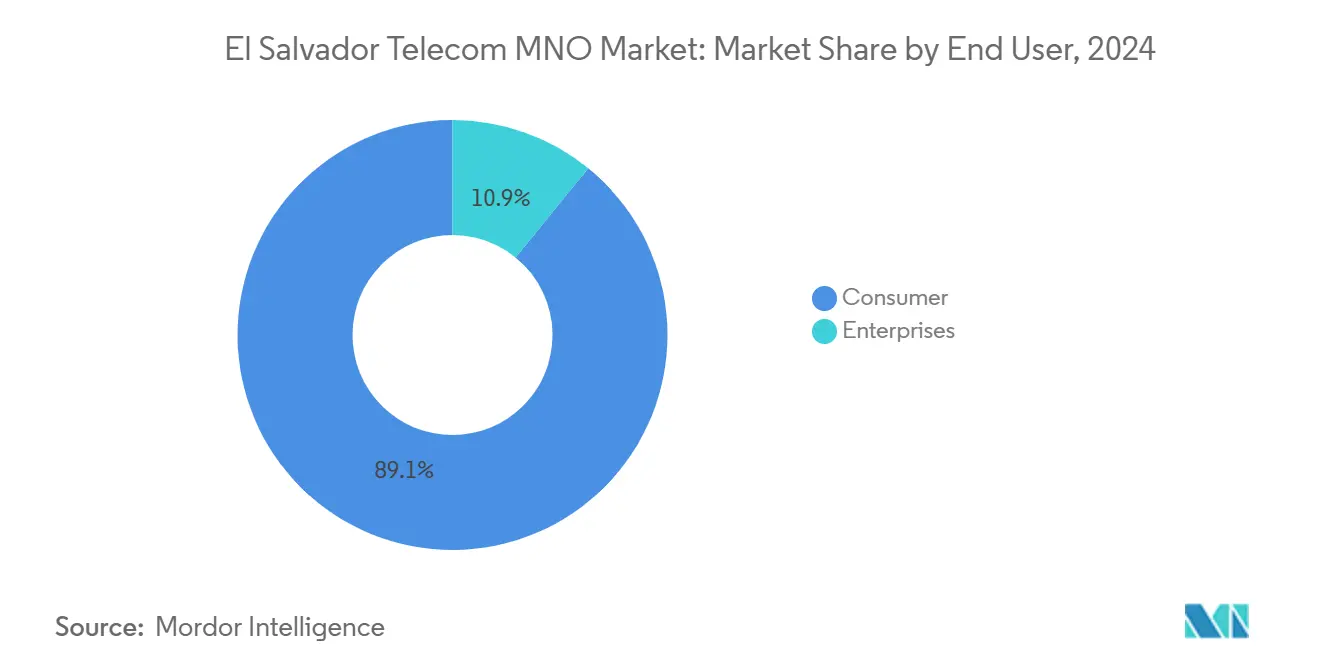
- By end-user, consumer subscriptions commanded 89.13% of the El Salvador telecom MNO market share in 2024, while enterprise connectivity is forecast to post the fastest 6.31% CAGR to 2030.
El Salvador Telecom MNO Market Trends and Insights
Drivers Impact Analysis*
| Driver | (~)% Impact on CAGR Forecast | Geographic Relevance | Impact Timeline |
|---|---|---|---|
| Explosive Mobile Data Demand and Smartphone Uptake | +1.2% | Nationwide, strongest in San Salvador | Short term (≤ 2 years) |
| Accelerated FTTH Rollout and Fixed-network Upgrades | +0.8% | Urban and peri-urban corridors | Medium term (2-4 years) |
| 5G Spectrum Awards and Planned Launches | +0.6% | Initial focus on major cities | Long term (≥ 4 years) |
| Bundled Quad-play and OTT Convergence | +0.7% | Higher adoption in urban areas | Short term (≤ 2 years) |
| Bitcoin-driven Surge in Mobile Wallets and Data Traffic | +0.4% | Middle-income households nationwide | Medium term (2-4 years) |
| Digital-government Programs Stimulating Enterprise Connectivity | +0.5% | Public-sector nodes countrywide | Medium term (2-4 years) |
| Source: Mordor Intelligence | |||
Explosive Mobile Data Demand and Smartphone Uptake
Mobile internet users reached 4.88 million in early 2025, equal to 76.9% population penetration, with 91.7% of connections classified as broadband. Median download speeds at 33.22 Mbps illustrate ongoing radio-access upgrades, though revenue must keep pace as voice traffic shrinks. Bitcoin-enabled Chivo wallet payments intensify data needs even among low-ARPU subscribers. Claro leads with 27.1 Mbps downloads and 10.8 Mbps uploads, capturing premium users despite pricing pressure from Tigo and Movistar. Device financing plans accelerate migration from feature phones to smartphones, enlarging the addressable base for data-heavy services.
Accelerated FTTH Rollout and Fixed-network Upgrades
Operators increasingly view fibre as a defensive and offensive asset, using it to bundle mobile, broadband, and entertainment. Millicom added 62,000 new FTTH/HFC connections in Q1 2025, illustrating the strategy to lock in households and SMEs to multi-service contracts. [2]Millicom, “Annual Report 2023,” millicom.com Claro earmarked USD 200 million for fibre that supports AI-enabled services, signalling a shift toward enterprise and cloud connectivity. Converged offers lift ARPU and reduce churn, while fresh fibre backhaul also strengthens mobile network quality.
5G Spectrum Awards and Planned Launches
Seven companies secured mid-band spectrum in 2024, setting the stage for commercial 5G. Claro is targeting 60% 5G population coverage by 2028, front-loading capex in dense urban zones where enterprise IoT and premium consumer tiers are willing to pay for ultra-low latency. While handset affordability remains a barrier, early use cases such as smart manufacturing and real-time video surveillance underpin the business case.
Bitcoin-driven Surge in Mobile Wallets and Data Traffic
El Salvador’s legal-tender experiment always fuels on-demand data use for balance checks, price feeds, and USDT transactions. Chivo wallet sign-ups hit 2 million within months of launch, highlighting the catalytic effect on network demand, even though active usage later normalised. [3]National Bureau of Economic Research, “Bitcoin as Legal Tender in El Salvador,” nber.org Stablecoin firm Tether’s decision to base its regional headquarters in San Salvador reinforces the ecosystem for crypto payments that depend on reliable connectivity. [4]CoinDesk, “Tether Establishes Headquarters in El Salvador,” coindesk.com
Restraints Impact Analysis*
| Restraint | (~)% Impact on CAGR Forecast | Geographic Relevance | Impact Timeline |
|---|---|---|---|
| Heavy Tax and Regulatory Fee Burden | -0.9% | Nationwide | Short term (≤ 2 years) |
| Low Purchasing Power and Price Sensitivity | -0.6% | Stronger in rural areas | Long term (≥ 4 years) |
| Mandatory Prison Signal-blocking Zones | -0.3% | Around correctional facilities | Medium term (2-4 years) |
| Rising Ransomware and Cyber-threat Exposure | -0.2% | Enterprise nodes nationwide | Short term (≤ 2 years) |
| Source: Mordor Intelligence | |||
Heavy Tax and Regulatory Fee Burden
El Salvador’s tax-to-GDP ratio of 22.9% tops the Latin American mean, with VAT and corporate income tax forming the heaviest items. Operators additionally finance universal-service obligations and face fines for non-compliance, such as USD 29,343.60 levied on four carriers for incomplete data submissions. Higher effective tax pushes up the cost of capital and defers rural network upgrades, constraining the El Salvador telecom MNO market’s achievable CAGR.
Low Purchasing Power and Price Sensitivity
GDP expansion is projected at only 2.5% for 2025, while remittances create volatile disposable income. Prepaid offers as low as 8 GB for USD 7 underline the thin margins demanded by price-sensitive users. The World Bank reports that nearly 50% of citizens remain offline mainly due to affordability barriers. As a result, operators rely on promotions rather than broad tariff hikes, limiting top-line upside even as capex needs rise.
*Our forecasts treat driver/restraint impacts as directional, not additive. The impact forecasts reflect baseline growth, mix effects, and variable interactions.
Segment Analysis
By Service Type: Data Momentum Outpaces Voice
Data and Internet services captured 42.59% of 2024 revenues, cementing leadership thanks to gains in smartphone usage and Bitcoin-linked traffic. This slice of the El Salvador telecom MNO market size is forecast to grow at a 4.94% CAGR through 2030, reaffirming the shift from circuit-switched to packet-switched revenues. Operators bundle unlimited social-media and OTT apps to bolster ARPU, while retaining voice minutes within packages to reduce churn. Voice remains relevant for older demographics, but it continues to lose its standalone value. Messaging has shifted to IP-based platforms, yet SMS remains a vital option for two-factor authentication and public alert functions. IoT and M2M traffic is still in its nascent stage, but it registers triple-digit connection growth, especially in smart-metering pilots supported by the digital government plan. Tigo’s video-on-demand library now counts 7,000 local and international titles, anchoring quad-play upsell. Other services, roaming, VAS, and managed security, help cushion revenue seasonality tied to tourism and festive peaks.
The growing consumer appetite for cloud gaming, live sports streaming, and real-time cryptocurrency transactions is prompting operators to expand LTE-Advanced and test 5G. Parallel fiber backhaul allows carriers to meet peak capacity while exploring edge-computing revenue with enterprise clients. These dynamics underscore why data already accounts for the largest slice of El Salvador's telecom MNO market share and will continue to dominate service-mix forecasts.



By End-User: Enterprise Upswing Strengthens Revenue Mix
The consumer segment still accounts for 89.13% of the 2024 turnover, yet enterprise subscriptions are projected to grow at the fastest rate, with a 6.31% CAGR. Government migration to Google Cloud and cloud-based tax platforms heightens demand for SLA-grade links that command premium tariffs. SMEs in manufacturing and Agri-exports now view real-time logistics tracking as mandatory, prompting uptake of dedicated APNs and managed firewalls. Fintech arrivals, such as Tether, require low-latency, high-resilience connections, often contracting multi-year capacity deals that smooth carrier cash flows. Meanwhile, consumer penetration surpasses 160% of the population, signaling saturation; carriers therefore pivot marketing budgets toward business accounts, cybersecurity bundles, and IoT dashboards.
Enterprise gains will steadily rebalance the El Salvador telecom MNO market size, lifting average revenue per connection even as total SIM volumes plateau. Managed services, cloud interconnect, and unified communications provide further upside, illustrating how the El Salvador telecom MNO industry is diversifying from its prepaid roots.
Geography Analysis
National territory spans only 21,041 km², enabling near-universal 3G/4G coverage. Population is 76.3% urban, with the San Salvador metropolitan area hosting dense clusters that demand capacity upgrades and frequently hit congestion thresholds during peak evening hours. Operators therefore prioritize small-cell deployments and fiber aggregation in the capital, where ARPU is highest.
Rural coverage gaps persist along coastal and mountainous zones; however, satellite backhaul provided through a government Starlink agreement has begun to connect 100 remote schools, proving complementary to terrestrial networks. Such initiatives create incremental wholesale opportunities for mobile operators supplying local access. Cross-border corridors to Guatemala and Honduras sustain roaming revenues, although political uncertainty sometimes disrupts seamless hand-off.
Regional tower-sharing is intensifying. Millicom’s partnership that folds 7,000 Central American sites into an SBA Communications lease-back cuts opex and diverts capital into software-defined networking at the edge. These efficiencies enhance service quality toward rural users and reinforce national backbone resilience. Overall, the El Salvador telecom MNO market size benefits from a geography where dense urban clusters offer steady returns while state-led rural programs extend digital inclusion goals.
Competitive Landscape
Four nationwide MNOs, Claro, Tigo, Movistar, and Digicel, deliver complete population coverage, keeping pricing competitive and margins thin. Claro consistently tops performance metrics, ranking first in download, upload, and video experience, and attracting high-end subscribers who value quality. Tigo leads in volume, holding 3 million active SIMs and leveraging economies of scale for aggressive promotions. Movistar focuses on youth and migrant segments through affordable roaming and OTT bundles, whereas Digicel defends niche prepaid users with low-denomination data passes.
Claro announced a target for 60% 5G coverage by 2028; Tigo monetized passive infrastructure through a USD 975 million tower sale, redeploying proceeds into digital platforms; Movistar rolled out self-service apps that integrate mobile money with post-paid billing. Carriers also embrace open-RAN pilots to contain capex and expedite rural cell launches.
Enterprise and IoT contracts are the new battleground. Governments and foreign investors prefer SLA-backed connectivity that often commands 1.5-2 times consumer ARPU. Operators now package managed security, cloud access, and SD-WAN, blurring traditional telco-IT boundaries. Competition, therefore, hinges on ecosystem partnerships with Hyperscalers and fintech more than spectrum holdings alone, signaling a shift in how the El Salvador telecom MNO industry measures success.
El Salvador Telecom MNO Industry Leaders
Claro El Salvador
Tigo El Salvador
Movistar El Salvador
Digicel El Salvador
- *Disclaimer: Major Players sorted in no particular order

Recent Industry Developments
- May 2025: Claro set a target of 60% mobile coverage being 5G by 2028 to capture premium enterprise demand.
- September 2024: Teknowledge announced entry into El Salvador with a USD 20 million investment aimed at enterprise connectivity.
- May 2024: El Salvador hosted Google Cloud Day, underscoring state commitment to digital transformation and new wholesale traffic for carriers.


El Salvador Telecom MNO Market Report Scope
| Voice Services |
| Data and Internet Services |
| Messaging Services |
| IoT and M2M Services |
| OTT and PayTV Services |
| Other Services (VAS, Roaming and International Services, Enterprise and Wholesale Services, etc.) |
| Enterprises |
| Consumer |
| Service Type | Voice Services |
| Data and Internet Services | |
| Messaging Services | |
| IoT and M2M Services | |
| OTT and PayTV Services | |
| Other Services (VAS, Roaming and International Services, Enterprise and Wholesale Services, etc.) | |
| End-user | Enterprises |
| Consumer |


Key Questions Answered in the Report
How large is the El Salvador telecom MNO market in 2025?
It is valued at USD 1.15 billion and is projected to reach USD 1.45 billion by 2030 at a 4.72% CAGR.
Which service type generates the most revenue?
Data and Internet services lead with 42.59% of 2024 revenue and are growing at 4.94% CAGR.
Who has the largest subscriber base?
Tigo hosts 3 million active SIMs, the biggest share among the four national MNOs.
Why is enterprise demand rising?
Government cloud migration and fintech investment require SLA-grade connectivity, driving a 6.31% CAGR for enterprise subscriptions.
What is the main regulatory headwind?
A relatively high tax burden and mandatory signal-blocking around prisons together reduce operator cash flow and delay investments.
Page last updated on:





