
Market Overview
| Study Period | 2020 - 2031 |
|---|---|
| Forecast Data Period | 2026 - 2031 |
| Base Year Market Size (2025) | USD 6.78 Billion |
| Market Size (2026) | USD 6.97 Billion |
| Market Size (2031) | USD 7.89 Billion |
| Growth Rate (2026 - 2031) | 2.51 % |
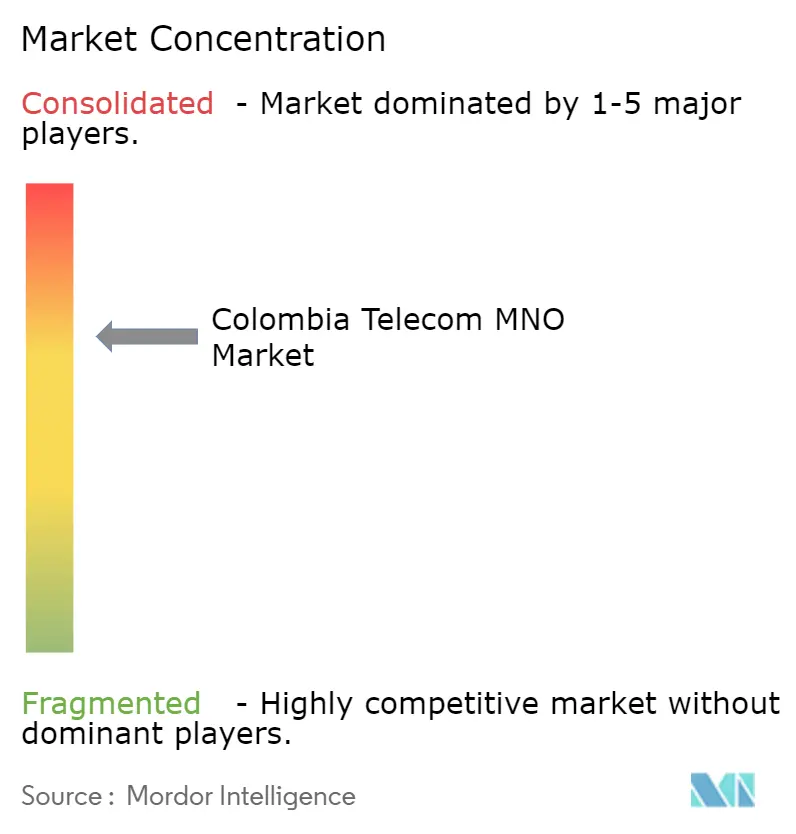
| Market Concentration | Medium |
Major Players *Disclaimer: Major Players sorted in no particular order Image © Mordor Intelligence. Reuse requires attribution under CC BY 4.0. | |
Colombia Telecom MNO Market Analysis by Mordor Intelligence
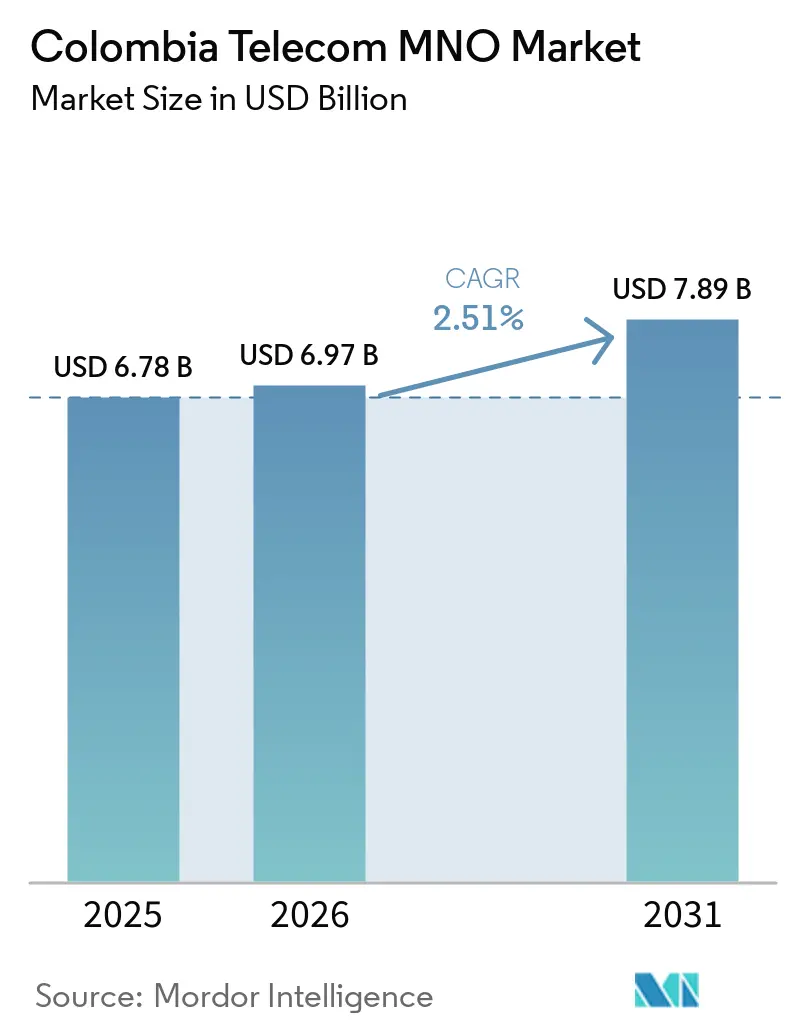
The Colombia telecom MNO market size is projected to be USD 6.78 billion in 2025, USD 6.97 billion in 2026, and reach USD 7.89 billion by 2031, growing at a CAGR of 2.51% from 2026 to 2031. Robust fiber backhaul investments, 5G spectrum deployment, and a pivot toward enterprise-grade private networks underpin this moderate expansion even as consumer data tariffs remain under pressure. Operators are tilting capital toward low-latency edge infrastructure that can support network slicing for manufacturers and logistics hubs, a strategy that stabilizes margins against decelerating consumer ARPU. Consolidation momentum, most notably Millicom’s integration of Movistar, creates a scaled challenger to Claro and accelerates rural coverage through shared infrastructure. Satellite-terrestrial backhaul partnerships meanwhile compress the rural usage gap by lowering per-subscriber acquisition costs in low-density municipalities.
Key Report Takeaways
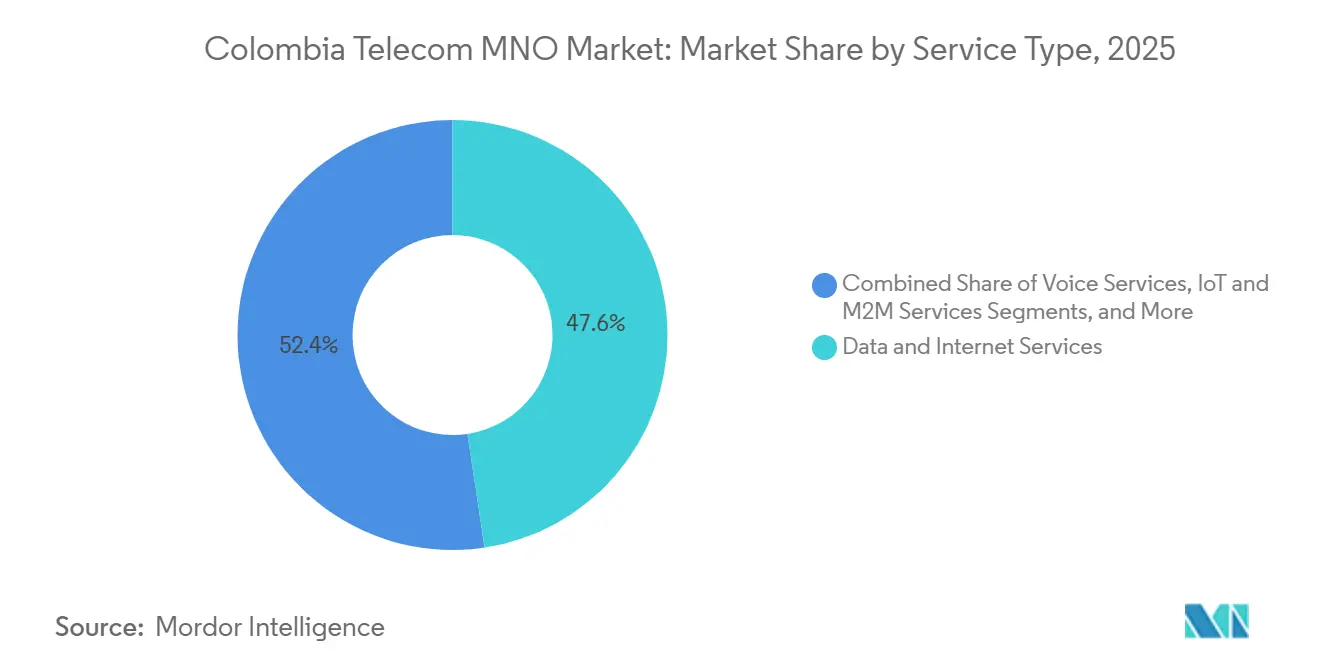
- By service type, Data and Internet services led with a 47.62% revenue share of the Colombia telecom MNO market in 2025. IoT and M2M services are forecast to expand at a 2.89% CAGR to 2031, the fastest growth among all service categories.
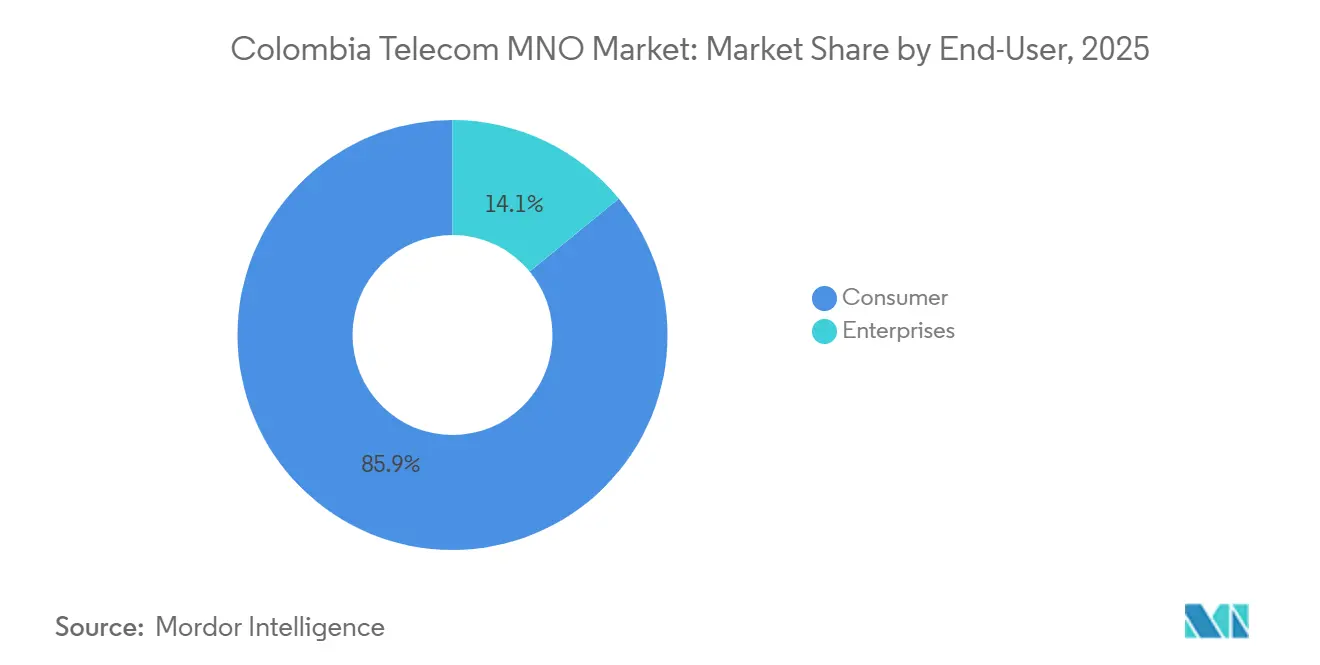
- By end user, consumer subscribers captured 85.94% of 2025 revenue, while the enterprise segment is projected to grow at a 3.21% CAGR through 2031.
Note: Market size and forecast figures in this report are generated using Mordor Intelligence’s proprietary estimation framework, updated with the latest available data and insights as of 2026.
Colombia Telecom MNO Market Trends and Insights
Drivers Impact Analysis*
| Driver | (~) % Impact on CAGR Forecast | Geographic Relevance | Impact Timeline |
|---|---|---|---|
| Post-Auction 5G Spectrum Rollout Accelerating Enterprise Digitalization | +0.6% | Nationwide, Early Gains in Bogotá, Medellín, Cali, Barranquilla | Medium Term (2–4 Years) |
| Rapid FTTH Build-Outs in Secondary Cities by Tier-1 Operators | +0.5% | Cundinamarca, Atlántico, Valle del Cauca | Medium Term (2–4 Years) |
| Surge in Mobile-Only Households Boosting Wireless ARPU | +0.4% | Urban and Peri-Urban Areas | Short Term (≤ 2 Years) |
| Network-Sharing Accords Among Carriers Lowering Rural Coverage Capex | +0.3% | Amazonas, Guainía, Chocó | Long Term (≥ 4 Years) |
| API Monetization via GSMA Open Gateway Unlocking New B2B Revenue Streams | +0.2% | Enterprise Clusters Nationwide | Medium Term (2–4 Years) |
| Satellite Backhaul Agreements Enabling Affordable Remote Coverage | +0.2% | Remote Rainforest Regions | Long Term (≥ 4 Years) |
| Source: Mordor Intelligence | |||
Post-Auction 5G Spectrum Rollout Accelerating Enterprise Digitalization
The December 2023 allocation of 3.5 GHz airwaves gave operators 200 MHz of contiguous spectrum, allowing non-stand-alone 5G networks to blanket more than 50 cities by early 2025. Claro’s 1,600 active 5G sites already support 5 million users, but the strategic lift comes from industrial slices that guarantee sub-20 ms latency for robotics and real-time logistics monitoring.[1]Claro Colombia Press Releases, “5G Deployment Updates,” claro.com.co Manufacturers in Cundinamarca signed multi-year private-network contracts priced at three to five times consumer ARPU, turning spectrum into a premium B2B input.[2]América Móvil Investor Relations, “Financial Information,” americamovil.com Regulatory quality-of-service thresholds issued by the CRC protect these verticals from capacity dilution. As more low-latency edge nodes launch, the Colombia telecom MNO market gains a repeatable enterprise revenue engine.
Rapid FTTH Build-Outs in Secondary Cities by Tier-1 Operators
Fiber overtook cable as the dominant fixed line technology in 2024, and tier-1 carriers extended gigabit coverage to mid-tier cities such as Barranquilla and Pasto. Claro’s COP 30 billion (USD 7.7 million) spend in Barranquilla during 2025 laid 503 km of new fiber, delivering symmetrical speeds that cater to remote workers and SMEs. Bundled fiber-mobile packages reduce churn and offload high-volume residential traffic from mobile spectrum, freeing 4G and 5G capacity for IoT. MinTIC’s dark-fiber leasing rules further accelerate reach by letting regional ISPs piggy-back on tier-1 backbones.[3]MinTIC, “Connectivity Programs,” mintic.gov.co These converged strategies raise household data ceilings and lift blended ARPU, sustaining topline growth for the Colombia telecom MNO market.
Surge in Mobile-Only Households Boosting Wireless ARPU
About 35-40% of urban households abandoned fixed broadband in 2025 and switched to tiered unlimited mobile plans that include 100 GB to 200 GB fair-use thresholds. These subscribers consume up to 70% more data than dual-service users, expanding wireless ARPU even as inflation weighs on discretionary spend.[4]Banco de la República, “Monetary Policy and Inflation Report,” banrep.gov.co Operators have responded with differentiated price points, capturing premium margins without alienating prepaid segments. The CRC tracks substitution trends quarterly to prevent capacity hoarding that could inflate tariffs. The phenomenon strengthens revenue diversity and cushions the Colombia telecom MNO market against fixed-line erosion.
Network-Sharing Accords Among Carriers Lowering Rural Coverage Capex
Tigo and Movistar’s joint venture pools 1,500 rural towers and slices per-site capex by up to 50%. Shared environmental permitting shortens rollout cycles to six months, and combined radio equipment halves energy costs for low-load sites. The model shines in Amazonas and Guainía, where subscriber density is under 10 users/km². Claro prefers a Starlink backhaul route, but the CRC permits both strategies as long as retail brands remain distinct. Lower capital intensity lets operators redirect savings toward urban 5G densification, sustaining service quality and profitability for the Colombia telecom MNO market.
Restraints Impact Analysis*
| Restraint | (~) % Impact on CAGR Forecast | Geographic Relevance | Impact Timeline |
|---|---|---|---|
| Macroeconomic Slowdown Compressing Discretionary Data Spend | -0.4% | Nationwide | Short Term (≤ 2 Years) |
| High Tower Rental and Energy Costs Pressuring EBITDA Margins | -0.3% | National, Acute in Remote Areas | Medium Term (2–4 Years) |
| Persistently High Rural Usage Gap Despite Nationwide Coverage | -0.2% | Amazonas, Guainía, Chocó | Long Term (≥ 4 Years) |
| Legal Challenges Over Incumbent Market Dominance Delaying Network Consolidation | -0.2% | Nationwide Regulatory Proceedings | Medium Term (2–4 Years) |
| Source: Mordor Intelligence | |||
Macroeconomic Slowdown Compressing Discretionary Data Spend
GDP growth cooled to 2.5-2.8% in 2025-2026 while inflation hovered above 5%, prompting the central bank to hold its policy rate at 9.25%. Prepaid top-ups fell 5-7% y-o-y in early 2025 as households prioritized staples over larger data bundles. Fiscal constraints limit universal-service subsidies, shifting the rural coverage burden entirely to operators. The pressure caps short-term ARPU and chips 0.4 percentage points off the forecast CAGR for the Colombia telecom MNO market.
High Tower Rental and Energy Costs Pressuring EBITDA Margins
Energy and lease expenses now absorb nearly one-third of mobile OPEX, with diesel volatility inflating remote-site costs. Towercos indexed rents to inflation, lifting annual lease escalators to 5-8%. Carriers are retrofitting 1,500-2,000 sites with solar and batteries, but payback stretches to four years. SBA Communications sold 206 towers in 2024, underscoring capital flight from an unfavorable lease environment. Elevated operating costs shave 0.3 percentage points from CAGR forecasts for the Colombia telecom MNO market.
*Our forecasts treat driver/restraint impacts as directional, not additive. The impact forecasts reflect baseline growth, mix effects, and variable interactions.
Segment Analysis
By Service Type: Enterprise IoT Outpaces Consumer Data Growth
Data and Internet services delivered 47.62% of 2025 revenue, anchoring the Colombia telecom MNO market share leadership at the category level. Growth, however, is slowing as average smartphone consumption nears 10 GB/month and price competition intensifies. By contrast, IoT and M2M connections are scaling at a 2.89% CAGR, helped by logistics telematics and precision-agriculture sensors that require guaranteed low-bandwidth connectivity. Private LTE slices inside automotive plants in Cundinamarca are priced at premiums worth three to five times consumer ARPU, a margin enhancer for operators. SMS and circuit-switched voice continue a managed retreat as OTT apps dominate, while bundled PayTV and OTT video contribute a stable mid-single-digit share despite content cost drag. Over the forecast horizon, operators will sunset 2G and 3G bands, forcing legacy M2M devices to migrate to NB-IoT; the upgrade cycle will widen the Colombia telecom MNO market size for IoT services.
Growth prospects favor machine-centric segments because spectrum refarming and network slicing enable differentiated SLAs unreachable in the best-effort consumer internet tier. Regulatory exemptions that free IoT SIMs from consumer-protection disclosure shorten enterprise sales cycles and support faster activation. As 5G SA cores launch from 2027 onward, ultra-reliable low-latency communication will open additional verticals such as autonomous mining trucks in Antioquia. Collectively, these dynamics shift revenue composition toward high-stickiness enterprise contracts, broadening the recurring portion of the Colombia telecom MNO market.



By End User: Enterprise Margins Trump Consumer Volume
Consumer lines represented 85.94% of 2025 revenue, but penetration already exceeds 130% of the population, limiting fresh subscriber adds. Enterprises, though smaller in volume, are forecast to grow at 3.21% through 2031 as IoT, network slicing, and API monetization take hold. Financial institutions now embed carrier Number Verification APIs into onboarding flows, paying per-transaction fees that carry 90% gross margins. Logistics companies are replacing satellite GPS trackers with NB-IoT tags that cost one-tenth as much and integrate seamlessly into carrier billing, lifting the Colombia telecom MNO market size for enterprise contracts.
On the consumer side, mobile-only households are boosting traffic and partially offsetting prepaid spending softness. Unlimited plans anchored at 100-GB tiers segment higher-value customers without alienating price-sensitive users. Nevertheless, competition from four facilities-based operators compresses headline ARPU growth. Regulatory oversight ensures consumer surplus is protected, even as operators pursue fatter enterprise margins. The dual-speed demand curve will keep blended growth modest but steady, preserving a sustainable cash flow profile across the broader Colombia telecom MNO market.
Geography Analysis
Colombia’s rugged topography fragments network economics, making regional strategy pivotal. Bogotá and Medellín account for roughly 45% of mobile revenue thanks to dense population and corporate clusters that favor 5G monetization. Secondary cities such as Cali and Barranquilla are fast followers: Claro invested COP 30 billion (USD 7.7 million) in Barranquilla’s fiber build in 2025, widening converged uptake and pushing the local Colombia telecom MNO market share for fixed-mobile bundles past 60%.
In contrast, remote departments in Amazonas and Guainía register 96% population coverage but only 65-70% active internet usage, reflecting affordability hurdles. SES’s O3b mPOWER constellation now backhauls traffic from micro-cells that serve fewer than 100 subscribers, trimming cost per rural user by 30-40%. MinTIC’s Centres Digitales Wi-Fi program anchors telecom tower demand but touches just 3% of residents, so operators rely on shared sites to stretch scarce capex.
Valle del Cauca and Antioquia showcase a third archetype, where export-oriented agribusiness deploys dense sensor networks for soil-moisture and pest control. These verticals lift IoT penetration far above the national mean, expanding the Colombia telecom MNO market size within enterprise corridors. Spectrum is plentiful here because consumer load is moderate, letting carriers pilot standalone 5G slices for autonomous drones without congesting retail traffic. The geographic patchwork means operators must juggle three playbooks, urban densification, shared rural coverage, and vertical-specific IoT, to capture full-stack growth.
Regulatory Landscape
Colombia's mobile market is overseen primarily by the Comision de Regulacion de Comunicaciones (CRC), with competition enforcement by the Superintendencia de Industria y Comercio (SIC) and sector policy and spectrum stewardship led by MinTIC. After the December 2023 3.5 GHz assignment that supported nationwide 5G rollouts, the regulatory approach in 2025-2026 has balanced pro-investment measures with tighter conduct monitoring, including CRC initiatives to modernize mobile market rules and strengthen preventive oversight of effective prices, discounts, and portability behavior.
In 2026, CRC actions such as Resolucion CRC 8183 introduced large cuts to regulated wholesale charges, including steep reductions for SMS and meaningful reductions for voice and data. The aim is to sustain downstream competition and lower barriers for MVNOs and smaller players. At the same time, SIC's approval of the Tigo-Movistar integration, with conditions referenced in the report context including wholesale access obligations and enterprise-rate caps, reinforced ex ante safeguards while allowing consolidation to proceed under behavioral remedies designed to limit coordinated effects and preserve competitive pressure on retail tariffs.
Competitive Landscape
Claro retains 50.4% of total mobile subscribers and 68.7% of the nascent 5G base, yet structural concentration is easing as Millicom completed its USD 214.4 million purchase of Movistar in February 2026. The Tigo-Movistar combination will control roughly 35-40% of subscriber lines, creating a scaled rival that can challenge Claro on spectrum depth and rural penetration. SIC conditioned the deal on wholesale MVNO access and enterprise-rate caps, ensuring downstream competition persists.
WOM’s January 2025 restructuring under SUR Holdings preserved a fourth facilities-based operator, a critical check on potential duopoly pricing in peri-urban zones. Its three-year grace period on spectrum fees diverts cash to network expansion in underserved corridors. Strategic differentiation now centers on enterprise IoT stacks, gigabit fiber expansion, and API monetization via the GSMA Open Gateway, all of which promise margin lift uncorrelated with consumer subscriber volume. Claro filed 47 edge-computing patents in 2024-2025, signaling a pivot toward private 5G and low-latency analytics that smaller peers may struggle to mirror.
Tower economics remain a friction point. Lease escalators and high diesel costs erode EBITDA, prompting carriers to exit non-core sites or retrofit renewables. SBA Communications’ 2024 exit illustrates investor caution. Operators answer with joint rural builds and selective urban densification, balancing capex discipline with service-quality mandates. The net result is a tri-polar competitive field where Claro guards incumbency, the new Tigo-Movistar entity scales converged bundles, and WOM plays price disruptor in high-churn prepaid pockets, collectively shaping the trajectory of the Colombia telecom MNO market.
Colombia Telecom MNO Industry Leaders
Claro Colombia
Movistar Colombia
Tigo Colombia
WOM Colombia
- *Disclaimer: Major Players sorted in no particular order

Market Opportunities and Future Outlook
A clearer opening is emerging around wholesale-enabled competition and B2B monetization. CRC's 2026 wholesale charge cuts, alongside ongoing ex ante oversight, provide a more predictable footing for MVNO expansion and for niche enterprise offers that rely on mandated access rather than full-scale network buildouts. The SIC-conditioned Tigo-Movistar integration also raises the role of wholesale products and enterprise terms, as the merged entity and rivals balance scale benefits with constraints that keep downstream options available for fintech, retail, and logistics use cases that monetize number verification and other carrier APIs.
5G and rural connectivity programs add another near-term channel tied to monetizable coverage and capacity. Government and operator disclosures cited in the evidence indicate that 5G deployment spans 184 municipalities and reaches around 70% of the population with about 7 million users in early 2026. That expands the addressable base for fixed-wireless substitution, low-latency enterprise slices, and IoT backhaul beyond the largest metros. MinTIC's focus on closing the rural usage gap, together with infrastructure-sharing provisions and georeferenced infrastructure data initiatives referenced by the CRC, supports more economical rural builds and creates room for satellite-terrestrial backhaul and shared RAN models already used in low-density departments.
Recent Industry Developments
- July 2026: Claro expands its 5G network to 15 additional cities, reaching a total of 78 cities and municipalities nationwide. The expansion increases capacity and coverage, strengthening Claro's nationwide 5G footprint. The broader geographic reach enhances enterprise connectivity options and may pressure rivals to accelerate their own rural deployments.
- June 2026: Claro Colombia expanded its 5G network to 63 municipalities with 2,300 active base stations. This direct expansion of 5G coverage broadens the operator's capacity in key markets and improves network reliability for enterprise and consumer users. The capacity addition strengthens Claro's lead in 5G and enterprise services, pressuring peers on capacity and rural reach.
- April 2026: Millicom completed acquisition of the Colombian government's remaining Movistar stake for about US$240 million. The deal expands Millicom's footprint and consolidates Movistar's assets under Millicom control. Accelerates consolidation, expanding Millicom's control and potential cross-sell and cost-synergy opportunities against Claro.


Research Methodology Framework and Report Scope
Market Definition and Coverage
For this methodology, the Colombia telecom market is sized as the value of services sold by mobile network operators in Colombia, captured as recurring and usage-based telecom service revenues in USD for the study period.
Scope exclusions: The model does not count device sales, pure infrastructure leasing, systems integration projects, or over-the-top digital app revenues that sit outside operator telecom service billing.
Segmentation Overview
- Overall Telecom Revenue and ARPU
- Service Type
- Voice Services
- Data and Internet Services
- Messaging Services
- IoT and M2M Services
- OTT and PayTV Services
- Other Services (VAS, Roaming and International Services, Enterprise and Wholesale Services, etc.)
- End-User
- Enterprises
- Consumer
Data Sources, Market Sizing, and Validation
Desk Research
Desk research was used to set the fact base for Colombia telecom service demand and to keep assumptions anchored to public signals that update regularly. We referenced official releases on subscriber access lines, traffic, and service-level revenues, and then aligned those trends with macro indicators that reflect consumption and pricing movement.
Typical inputs came from public sources such as Colombia TIC (MinTIC) statistical bulletins, CRC sector reporting shared through official portals, and DANE satellite account outputs for telecom activity, followed by ITU connectivity indicators and OECD policy and connectivity reviews for market structure context. Alongside that, we reviewed operator annual reports and investor presentations, reputable press coverage, and selective paid subscriptions for company financials and intelligence, news and financials, and patent databases where relevant to technology direction. These examples are not exhaustive, and other public sources were also used for data collection, validation, and clarification.
Primary Interviews and Surveys
Primary work was used to test what published numbers do not fully explain, especially around tariff movement, churn patterns, network expansion timing, and enterprise demand intensity. We spoke with a mix of operator-side leaders, channel and reseller contacts, and enterprise telecom buyers across major cities and secondary regions, so volume and pricing assumptions could be stress tested before finalizing the model.
Distribution of primary research fieldwork respondents
| Company type | Respondent position |
|---|---|
| Top tier: 26% | CXOs: 12% |
| Mid tier: 57% | Functional/Unit leaders: 37% |
| Smaller Players: 17% | Managers: 51% |
Market-Sizing & Forecasting
Sizing started with a top-down rebuild of operator service revenue pools for Colombia, where subscriber and access trends, usage growth, and tariff direction were used to reconstruct addressable spend over time. To keep totals realistic, outputs were then cross-checked using selective bottom-up approximations, such as sampled ARPU by service category multiplied by active subscriber bases, plus channel checks on prepaid versus postpaid mix and enterprise contract patterns.
Key model inputs included mobile subscriber base changes, smartphone and data plan adoption, mobile data traffic growth, 4G to 5G migration timing, and ARPU progression by major service types. When a variable was not consistently published for every year, gaps were handled by using short trend bridges supported by expert inputs, and the assumption was only retained if it matched at least one independent signal like traffic growth or access line movement.
For forecasting, we relied mainly on scenario analysis, since pricing pressure, spectrum rollouts, and competitive actions can shift outcomes quickly. A base case was built first, and then upside and downside cases were used to confirm the final forecast stayed within ranges that industry participants described as workable.
Data Validation & Update Cycle
Model outputs were validated through consistency checks that compare implied revenue per user, implied price per GB, and service mix trends against independent public indicators and what interviewees described in plain commercial terms. Outliers were flagged, reviewed, and either corrected through revised assumptions or explained through one-time events such as plan migrations or reporting changes.
Before sign-off, a second analyst reviews model logic, the calculation chain, and year-to-year movements to ensure no hidden jumps remain. Reports are refreshed annually, and interim updates are made when material events occur, such as spectrum awards, major pricing shifts, or consolidation moves. Right before delivery, a fresh pass is completed so clients receive the most current view available at that time.
Mordor Intelligence's Colombia Telecom Market Size Compared With Other Published Estimates
Published market values for Colombia telecom can look far apart because sources do not always measure the same revenue pool, and they also differ in how they convert currencies and time the base year. It is also common to see different treatments of adjacent services, which can change the total even when the country coverage is the same.
The biggest gap driver here is scope. Some publications talk about the full telecom sector, which can include pay TV and broadcast revenue, while others stay closer to mobile operator service revenues only. Another driver is the year used for comparison, since an estimate stated in local currency for 2023 or 2024 can shift when it is converted to USD using a different average rate or inflation adjustment, and then the same amount may be carried forward using a more aggressive or conservative outlook. These differences explain why the MNO-only revenue build and the sector-wide revenue headline do not align one-to-one, a choice applied by Mordor Intelligence.
Benchmark comparison
| Source | Market Size | Gaps in Research Methodology |
|---|---|---|
| Mordor Intelligence | USD 6.78 B (2025) | |
| Industry Regulator Summary A | USD 6.50 B (2023) | Uses telecom industry revenues that include additional service lines like pay-TV and broadcast, and the USD figure depends on the conversion timing and rate used for COP to USD in that year. |
| Government Sector Report B | USD 7.60 B (2024) | Reports total telecom sector revenues in local currency for 2024, which can sit above an MNO-only scope and can also move when inflation adjusted totals are converted to USD using a different annual average. |
The comparison shows that the spread is mainly explained by what is counted, rather than disagreement on demand direction. By keeping the scope tied to mobile operator service revenues and checking implied ARPU and usage against access and traffic signals, the final value stays traceable to clear inputs that can be re-tested when new public data is released.


Key Questions Answered in the Report
How Large Will Colombia's Mobile Network Operator Revenue Pool Be in 2031?
Forecasts put it at USD 7.89 billion, reflecting a 2.51% CAGR from 2026.
Which Service Line Is Expected to Grow Fastest Over the Next Five Years?
IoT and M2M connections, expanding at a 2.89% CAGR on rising industrial adoption.
What Share of Subscribers Does Claro Hold in the Nascent 5G Segment?
About 68.7% of Colombia's early 5G user base as of January 2026.
How Will Millicom's Acquisition of Movistar Affect Competitive Dynamics?
The combined Tigo-Movistar entity will control 35-40% of lines, creating a scaled rival that challenges Claros leadership while maintaining four-operator infrastructure competition.
What Is the Biggest Immediate Cost Pressure on Colombian Operators?
Escalating tower leases and energy costs, which together absorb close to one-third of operating expenditure.
Why Is the Rural Usage Gap Still Wide Despite Near-Universal Coverage?
Affordability constraints and low digital literacy mean only 65-70% of rural residents actively use mobile internet, even though 4G signals reach 96% of the population.
Page last updated on:


 Your data is secure and never sold or shared.


