
Preboarding And Onboarding Automation Platform Market Size and Share
Market Overview
| Study Period | 2020 - 2031 |
|---|---|
| Market Size (2026) | USD 4.81 Billion |
| Market Size (2031) | USD 9.06 Billion |
| Growth Rate (2026 - 2031) | 13.50 % |
| Fastest Growing Market | Asia-Pacific |
| Largest Market | North America |
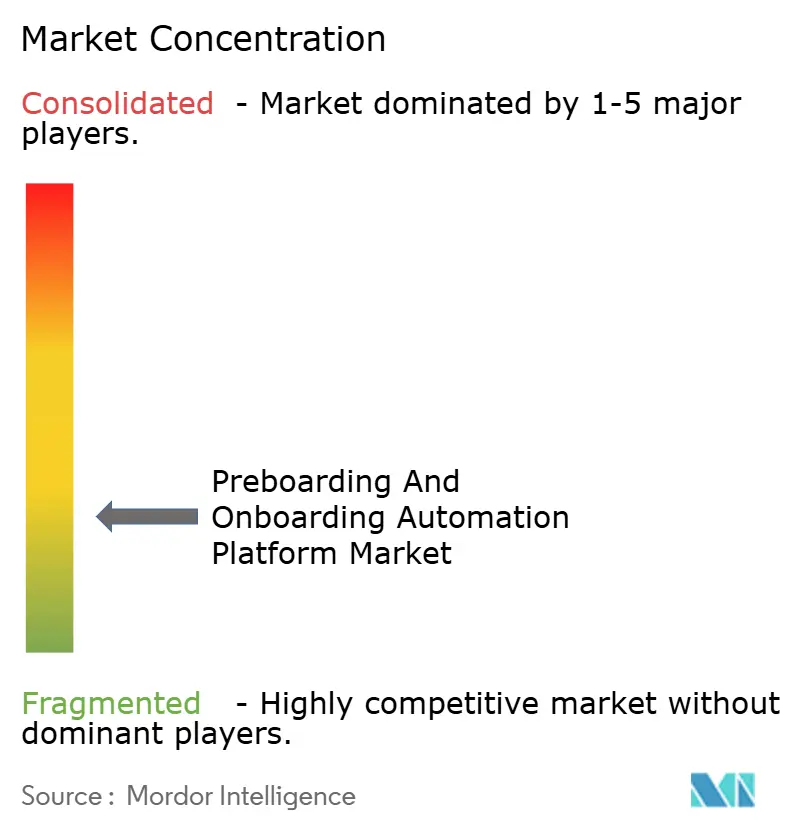
| Market Concentration | Low |
Major Players *Disclaimer: Major Players sorted in no particular order Image © Mordor Intelligence. Reuse requires attribution under CC BY 4.0. | |
Preboarding And Onboarding Automation Platform Market Analysis by Mordor Intelligence
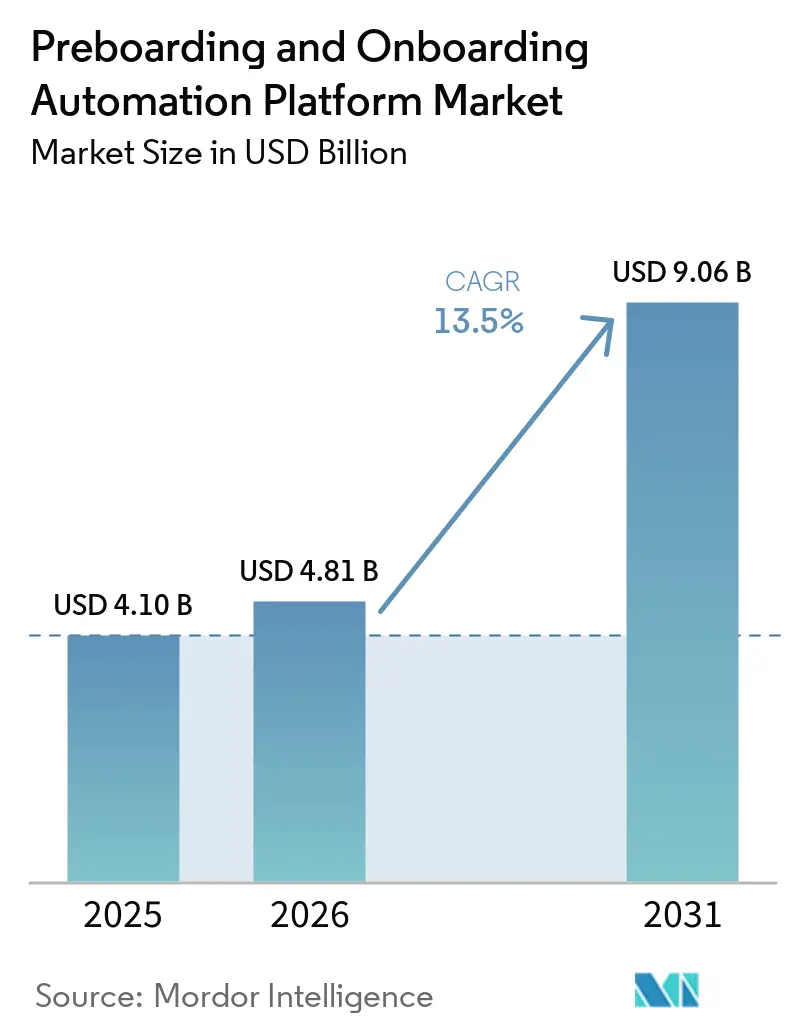
The preboarding and onboarding automation platform market size is projected to expand from USD 4.10 billion in 2025 and USD 4.81 billion in 2026 to USD 9.06 billion by 2031, registering a CAGR of 13.50% between 2026 and 2031. The category is gaining ground because employers now treat the period between offer acceptance and first-day productivity as a process that can be measured and improved. Manual handoffs across email, spreadsheets, and disconnected HR and IT tasks have become harder to justify when delayed access, missing documents, and weak early engagement can be traced back to preventable workflow gaps. Buyers are therefore consolidating software around connected hiring, preboarding, and onboarding flows so that document collection, approvals, provisioning, and early experience tasks move through a single system. This shift is also raising expectations for deeper integrations across ATS, HRIS, payroll, and identity tools, which is putting pressure on narrower point solutions. Growth remains strong, but it is not frictionless because compliance obligations are rising and many employers still operate on fragmented legacy HR stacks.
Key Report Takeaways
- By geography, North America held 39.61% of global revenue in 2025, while Asia-Pacific is projected to expand at a 14.71% CAGR through 2031 in the preboarding and onboarding automation platform market.
- By deployment model, cloud-based deployment accounted for 68.41% of the preboarding and onboarding automation platform market in 2025, while hybrid is projected to expand at a 16.47% CAGR through 2031.
- By enterprise size, large enterprises held 62.37% of the preboarding and onboarding automation platform market share in 2025, while small and medium-sized businesses are expected to grow at a 17.83% CAGR through 2031.
- By end-user industry, information technology and telecom led with a 24.73% share in 2025, while healthcare and life sciences are projected to expand at an 18.29% CAGR through 2031.
- By functionality, Recruitment-to-Preboarding Automation accounted for 23.87% of the preboarding and onboarding automation platform market size in 2025, while Compliance and Identity Governance is projected to grow at a 19.87% CAGR through 2031.
Note: Market size and forecast figures in this report are generated using Mordor Intelligence’s proprietary estimation framework, updated with the latest available data and insights as of January 2026.
Market Trends and Insights
Drivers Impact Analysis of Preboarding And Onboarding Automation Platform Market*
| Driver | (~) % Impact on CAGR Forecast | Geographic Relevance | Impact Timeline |
|---|---|---|---|
| Shift From Manual HR Workflows to Digital Employee Journeys | +3.2% | Global | Short term (≤ 2 years) |
| Hybrid and Distributed Hiring Expands Pre-Day-One Automation Needs | +2.8% | North America, Europe, APAC | Short term (≤ 2 years) |
| Compliance Automation Demand Across Labor, Privacy, and Hiring Rules | +2.5% | North America and EU, spill-over to APAC | Medium term (2-4 years) |
| Platform Consolidation Across ATS, HRIS, Payroll, and Experience Layers | +2.1% | North America and EU | Short term (≤ 2 years) |
| HR-to-IT Identity Provisioning Becomes a Day-Zero Readiness Priority | +1.6% | Global, early gains in North America | Medium term (2-4 years) |
| Cross-Border Hiring Raises Need for Localized Preboarding and Right-To-Work Flows | +1.2% | APAC core, spill-over to EU and MEA | Long term (≥ 4 years) |
| Source: Mordor Intelligence | |||
Shift from Manual HR Workflows to Digital Employee Journeys
The move from manual coordination to structured digital workflows remains the clearest growth driver in the preboarding and onboarding automation platform market. Older onboarding routines relied on email follow-ups, disconnected checklists, and separate actions from HR, IT, legal, and facilities, which made delays hard to avoid as hiring volumes rose. Employers now want one workflow that starts as soon as the offer is accepted and continues through documentation, access setup, and first-day readiness. As these steps are brought together, buyers gain clearer visibility into completion gaps and early experience signals, making onboarding more useful for retention management, not just administration. Vendors that can tie workflow completion to faster readiness and measurable cost savings are gaining stronger buyer attention in the preboarding and onboarding automation platform market.[1]
Hybrid and Distributed Hiring Expands Pre-Day-One Automation Needs
Hybrid and remote work changed what preboarding must complete before day one in the preboarding and onboarding automation platform market. New hires, managers, and verification contacts are often not in the same place, so document collection, equipment coordination, communication, and readiness tasks need to run asynchronously. That makes fixed office-based onboarding routines much less effective than they were in earlier hiring models. More than 70% of the workforce is expected to work remotely at least 5 days per month by the end of 2026, which keeps demand high for geography-aware onboarding flows. Vendors that let employers adapt tasks by country, legal entity, and manager without rebuilding the workflow each time are in a stronger position in the market for preboarding and onboarding automation platforms.[2]
Compliance Automation Demand Across Labor, Privacy, and Hiring Rules
Compliance automation is becoming central to the preboarding and onboarding automation platform market because labor, privacy, and hiring rules are harder to manage through manual tracking alone. The EU AI Act treats certain AI-assisted hiring and worker-related systems as high-risk, which raises documentation, transparency, and governance expectations for employers using these tools. The May 2026 EU Omnibus amendment extended some high-risk enforcement obligations to December 2027, but Articles 13 and 26(7) transparency duties remain relevant in worker-facing workflows from August 2026. Germany adds another layer because the works council consultation can apply before AI-enabled employee systems are introduced. Healthcare employers also face document sequencing and verification demands that do not scale well through manual processes. This is why compliance modules are moving from optional add-ons to core requirements across the preboarding and onboarding automation platform market.
Platform Consolidation Across ATS, HRIS, Payroll, and Experience Layers
Platform consolidation is changing buyer priorities in the preboarding and onboarding automation platform market. Separate recruiting, HR, payroll, and experience systems create redundant re-entry work, slowing access setup and increasing the risk of incomplete or inconsistent records. SAP completed its SmartRecruiters acquisition in September 2025, and by March 2026 its Phase 1 integration allowed requisitions and hire records to flow into SuccessFactors Employee Central and Onboarding without the manual re-entry that had delayed day-one preparation. This kind of consolidation reduces the space available to stand-alone vendors that cannot deeply integrate into larger software environments. Procurement teams in the preboarding and onboarding automation platform market are therefore giving more weight to connector coverage and shared data layers than to interface design alone.[3]
Restraints Impact Analysis of Preboarding And Onboarding Automation Platform Market*
| Restraint | (~) % Impact on CAGR Forecast | Geographic Relevance | Impact Timeline |
|---|---|---|---|
| Fragmented Legacy HR Stacks Slow End-to-End Workflow Orchestration | -2.3% | Global | Short term (≤ 2 years) |
| Budget Scrutiny and Longer HR Tech Payback Hurdles in SMBs | -1.7% | North America and EU | Medium term (2-4 years) |
| EU AI Act and Worker-Notice Duties Raise Governance Burden for AI-Enabled Flows | -1.1% | EU, spill-over to EEA | Medium term (2-4 years) |
| Remote I-9 and Identity Verification Liability Keeps Regulated Employers Cautious | -0.8% | North America | Short term (≤ 2 years) |
| Source: Mordor Intelligence | |||
Fragmented Legacy HR Stacks Slow End-To-End Workflow Orchestration
Fragmented HR environments remain the most persistent operational restraint in the preboarding and onboarding automation platform market. Many employers still run recruiting, HR, payroll, benefits, learning, and identity tasks across systems acquired at different times and not built to work as a single architecture. In that setting, the main bottleneck is often the system connection point and not the workflow design itself. SAP's 2026 integration messaging highlighted the significant manual re-entry that existed before shared data flow was established across hiring and onboarding tasks, underscoring why disconnected stacks continue to delay value realization. The result is longer implementation cycles, heavier service requirements, and slower time-to-value for buyers in the preboarding and onboarding automation platform market.[4]
Budget Scrutiny And Longer HR Tech Payback Hurdles In SMBs
Small and medium-sized businesses are the fastest-growing segment in the preboarding and onboarding automation platform market, but they also face stricter approval thresholds than large enterprises. These buyers often prefer fewer configuration steps, a simpler rollout, and a single vendor that can cover payroll, HR, and onboarding in a connected way. Intuit's May 2025 acquisition of GoCo reflected this mid-market demand for a more unified payroll-to-onboarding experience. Vendors, therefore, need stronger service support and faster activation paths, not just more functionality, if they want SMB interest to convert into lasting recurring revenue. This restraint does not stop expansion in the preboarding and onboarding automation platform market, but it does stretch sales cycles and keeps premium automation packages out of reach for some smaller employers.
*Our forecasts treat driver/restraint impacts as directional, not additive. The impact forecasts reflect baseline growth, mix effects, and variable interactions.
Preboarding And Onboarding Automation Platform Market Segment Analysis
By Deployment Model:
Hybrid Gains Ground As Cloud Sets The FoundationCloud-based deployment accounted for 68.41% of revenue in 2025, making it the leading model in the preboarding and onboarding automation platform market. Buyers favored cloud platforms because they can connect more easily across ATS, HRIS, and payroll without requiring new on-premises infrastructure. On-premises deployment remained relevant in a narrower set of regulated environments where data control and internal hosting still carry more weight than flexibility. Hybrid deployment is projected to expand at a 16.47% CAGR through 2031, which makes it the fastest-growing model in this preboarding and onboarding automation platform market.
This pattern reflects the fact that many global employers want to modernize onboarding workflows without replacing the full HR backbone they already run. A hybrid setup lets them keep the core system of record in place while adding cloud-based experience and compliance layers on top. SAP's March 2026 integration work with SmartRecruiters and SuccessFactors demonstrated how a connected flow between recruiting and onboarding can reduce manual re-entry during this transition model. Within the preboarding and onboarding automation platform industry, vendors that support both stable system-of-record operations and flexible workflow orchestration are in the strongest position.


By End User Enterprise Size:
SMBs Accelerate While Large Enterprises Anchor SpendLarge enterprises accounted for 62.37% of revenue in 2025, making them the largest buyer group in the preboarding and onboarding automation platform market. Their scale, multi-entity hiring needs, and greater compliance exposure make end-to-end workflow automation easier to justify. A Fortune 500 manufacturing case documented annual savings of more than USD 400,000 and more than 5x ROI after automation was applied across divisions. Small and medium-sized businesses are projected to grow at a 17.83% CAGR through 2031, which shows that adoption is broadening beyond the largest employers.
SMB growth is being helped by PEPM-priced offerings, no-code workflow builders, and bundled compliance libraries that reduce the entry barrier. At the same time, these buyers still expect faster activation and greater vendor support because they often lack dedicated HR technology teams. Intuit's move into connected HR automation through GoCo also supports the view that smaller employers want unified payroll, HR, and onboarding coverage rather than a collection of separate tools. The preboarding and onboarding automation platform industry is therefore seeing the gap narrow between what large enterprises and SMBs expect from day-zero readiness, even if the buying path remains easier for larger accounts.
By End User Industry:
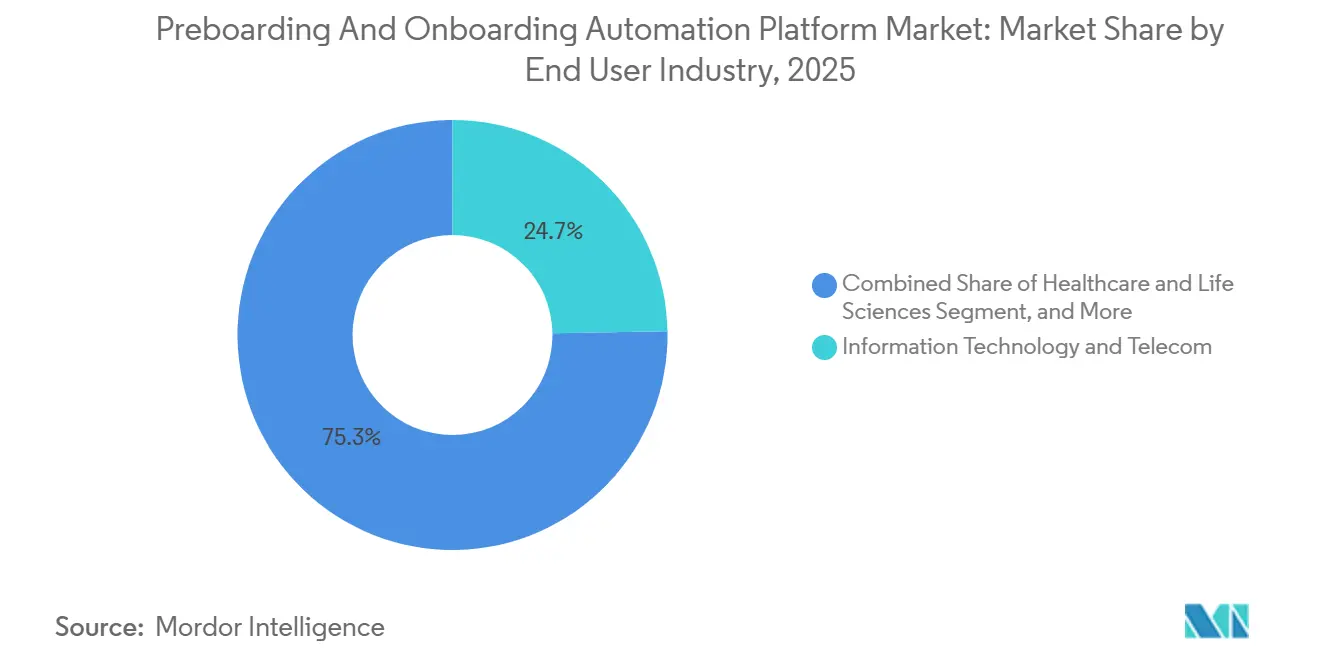
IT And Telecom Leads While Healthcare And Life Sciences Expands FasterInformation technology and telecom accounted for 24.73% of revenue in 2025, making it the largest vertical in the preboarding and onboarding automation platform market. This leadership stems from continuous hiring, distributed teams, and a work model in which day-one access to email, code repositories, and collaboration tools directly shapes productive output. Healthcare and life sciences are projected to grow at a 18.29% CAGR through 2031, making it the fastest-expanding vertical. In this segment, the challenge is less about hiring volume and more about the sequence of credential checks, policy acknowledgments, documentation, and training that must be completed before the employee can begin work.
That makes workflow orchestration especially valuable because delays can affect time-sensitive staffing needs in clinical and regulated settings. BFSI also remains important because record-keeping and audit expectations make it harder to replace workflow consistency and document control once a platform is in place. Industrial manufacturing, retail, and e-commerce add volume through frontline and seasonal hiring, where speed to productivity and mobile accessibility matter more than advanced feature depth. The government and public sector contribute a slower but durable stream of demand through on-premises and hybrid models tied to internal control and data sovereignty needs in the preboarding and onboarding automation platform market.
By Functionality:
Preboarding Revenue Leads While Compliance And Identity Governance Grows FastestRecruitment-to-Preboarding Automation held the largest share of functionality at 23.87% in 2025, making it the primary revenue driver in the preboarding and onboarding automation platform market. This layer matters because it turns an accepted offer into a structured sequence of tasks that reduces no-show risk and helps the employee arrive ready for work. Documentation and Verification remains the operational backbone because it covers e-signatures, identity checks, and background screening inside the same flow. BambooHR's April 2026 partnership with Turn demonstrated how background checks are moving toward native workflow execution rather than an external handoff.
Compliance and Identity Governance is projected to expand at a 19.87% CAGR through 2031, which makes it the fastest-growing functionality in the preboarding and onboarding automation platform market. Demand is rising because employers need stronger control over I-9 workflow, privacy-sensitive data handling, and worker-facing transparency inside onboarding journeys. IT Provisioning and Workspace Enablement is also becoming more relevant as organizations try to connect hire events with downstream account setup and access readiness. In the preboarding and onboarding automation platform industry, Learning and Productivity Enablement, Employee Experience and Journey Management, and Workforce Analytics and Intelligence extend the platform's value beyond first-day administration into early ramp performance.
Geography Analysis
North America Preboarding and Onboarding Automation Platform Market
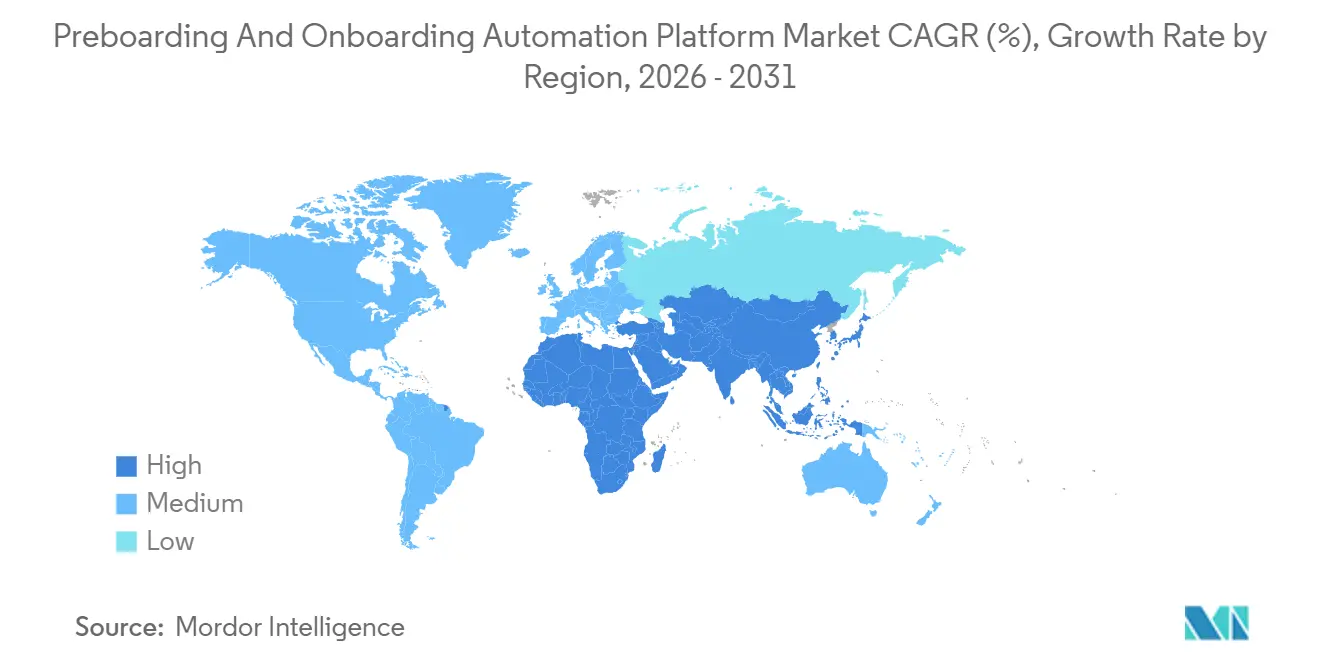
North America accounted for 39.61% of global revenue in 2025, making it the largest regional market for preboarding and onboarding automation platforms. The region benefits from mature HR software adoption, a high level of remote and hybrid hiring, and a compliance environment that pushes employers toward audit-ready workflows. The United States is now being shaped by the March 2026 ICE revision to the substantive violation standards for Form I-9. Remote-verification errors, including failure to mark the alternative procedure checkbox and failure to meet E-Verify requirements while using remote document examination, can now trigger direct penalty exposure of up to USD 2,861 per form. That shift is increasing demand for remote I-9 and E-Verify-enabled workflows as standard product features in the preboarding and onboarding automation platform market.
Europe and South America Preboarding and Onboarding Automation Platform Market
Europe is shaped by GDPR handling requirements and the wider governance burden created by the EU AI Act. Germany remains the most regulation-heavy environment because employment data rules and works council consultation can affect how AI-enabled onboarding systems are deployed. Article 26(7) worker notification obligations remain relevant from August 2026, which adds disclosure steps that platforms must support in employee-facing flows. The UK follows its own right-to-work verification path, while South America remains earlier stage and is still led mainly by multinational rollouts rather than domestic-first deployments.
APAC and MEA Preboarding and Onboarding Automation Platform Market
Asia-Pacific is projected to expand at a 14.71% CAGR through 2031, which makes it the fastest-growing region in the preboarding and onboarding automation platform market. Growth is being supported by HR digitization in India, Australia, South Korea, and Singapore. Singapore's Employment Pass process and the Philippines' multi-agency statutory enrollment needs create clear demand for localized workflow templates. Japan and China remain large untapped opportunities, but both require stronger localization around language, data control, and communication patterns. The Middle East and Africa add concentrated demand, driven by Saudi Arabia, the UAE, South Africa, and Nigeria, where multinational subsidiaries and regional technology employers are adopting cloud-first onboarding systems.
Competitive Landscape
The preboarding and onboarding automation platform market is moderately fragmented, with competition spread across broad talent suites, dedicated onboarding vendors, and compliance-focused workflow providers. Large suite players such as SAP SuccessFactors with SmartRecruiters, Phenom, and iCIMS compete on ecosystem breadth and on how well they connect recruiting, HR, payroll, identity, and learning workflows. Specialized vendors such as Click Boarding, EMP Trust Solutions, HROnboard, and Onboarded compete more on configurability, depth of compliance, and fit for specific industries or hiring patterns. Phenom strengthened its position through the February 2026 acquisition of Be Applied and the April 2026 acquisition of Plum.io, which expanded its assessment and behavioral validation capabilities across the talent lifecycle. SAP's September 2025 acquisition of SmartRecruiters, followed by its March 2026 integration into SuccessFactors, reinforced the push toward a single record and workflow layer from requisition creation to day-one readiness.
The clearest remaining white space sits in localized compliance automation, AI-driven orchestration, and outcome measurement tied to early retention and readiness. Greenhouse's May 2026 launch of Model Context Protocol opened governed API access for AI tools connected to hiring and onboarding data, which points to a new competitive layer around controlled extensibility rather than simple task automation. BambooHR's April 2026 partnership with Turn showed that native background screening within the onboarding flow is a stronger buying signal than older third-party handoff models. Vendors that can show strong connector depth, embedded compliance, and controlled data flow are appearing more often on enterprise shortlists in the preboarding and onboarding automation platform market.
Acquisition activity remains the main way the category is being redrawn. Competition is also intensifying in the mid-market as payroll, HR, and onboarding functions are pulled into more connected platforms. Intuit's acquisition of GoCo underscored this direction for smaller employers seeking a tighter payroll-to-onboarding link within a single environment. Across the preboarding and onboarding automation platform market, buyers are rewarding vendors that remove handoffs between recruiting, documentation, provisioning, and early productivity. That leaves the field active and open, but it also raises the bar for vendors that want to stay relevant without deeper integrations or stronger compliance coverage.
Preboarding And Onboarding Automation Platform Industry Leaders
-
Phenom People, Inc.
-
iCIMS, Inc.
-
Greenhouse Software, Inc.
-
SmartRecruiters, Inc.
-
Employ, Inc.
- *Disclaimer: Major Players sorted in no particular order
Preboarding And Onboarding Automation Platform Market Companies Covered in this Report
- Phenom People, Inc.
- iCIMS, Inc.
- Greenhouse Software, Inc.
- SmartRecruiters, Inc.
- Employ, Inc.
- Lever, Inc.
- ClearCompany, LLC
- Bamboo HR LLC
- GoCo.io, Inc.
- Namely, Inc.
- Talentech Group AS
- Tribepad Ltd
- EMP Trust Solutions, LLC
- Click Boarding, LLC
- Enboard.Me Pty Ltd.
- WorkBright
- NEO Global Pty Ltd.
- Affirm Software Group Pty Ltd.
- HROnboard Pty Ltd.
- Onboarded Ltd.
Recent Industry Developments in Preboarding And Onboarding Automation Platform Market
- May 2026: Greenhouse launched Model Context Protocol (MCP) with partners StubHub and Komodo Health, enabling governed AI onboarding integrations.
- April 2026: Phenom acquired Plum.io, adding psychometric validation to combat synthetic candidate fraud; followed Feb 2026 acquisition of Be Applied.
- March 2026: SmartRecruiters (SAP) completed Phase 1 integration with SuccessFactors, automating requisition and hire record flow.
- March 2026: iCIMS released Frontline AI for frontline hiring, plus onboarding automation updates.
Global Preboarding And Onboarding Automation Platform Market Report Scope
The preboarding and onboarding automation platform market refers to digital solutions and services that streamline the employee journey from recruitment through integration into the workforce. These platforms automate processes such as documentation and verification, compliance and identity governance, IT provisioning and workspace enablement, learning and productivity support, employee experience management, and workforce analytics. Delivered through cloud-based, on-premises, and hybrid deployment models, they cater to both large enterprises and small and medium-sized businesses across industries, including BFSI, healthcare and life sciences, information technology and telecom, retail and e-commerce, industrial manufacturing, government and public sector, and other end-user industries. The core purpose of this market is to help organizations accelerate onboarding, reduce administrative overhead, ensure compliance, and enhance employee engagement by leveraging automation and intelligence throughout the preboarding and onboarding lifecycle.
The preboarding and onboarding automation platform market report is segmented by Deployment Model (Cloud-Based, On-Premises, and Hybrid), Enterprise Size (Large Enterprises, and Small and Medium-Sized Businesses), End-user Industry (BFSI, Healthcare and Life Sciences, Information Technology and Telecom, Retail and E-commerce, Industrial Manufacturing, and Government and Public Sector), Functionality (Recruitment-to-Preboarding Automation, Documentation and Verification, Compliance and Identity Governance, IT Provisioning and Workspace Enablement, Learning and Productivity Enablement, Employee Experience and Journey Management, and Workforce Analytics and Intelligence), and Geography (North America, South America, Europe, Asia-Pacific, Middle East, and Africa). The Market Forecasts are Provided in Terms of Value (USD).
Segmentation Overview
| Cloud-Based |
| On-Premises |
| Hybrid |
| Large Enterprises |
| Small and Medium-Sized Businesses |
| BFSI |
| Healthcare and Life Sciences |
| Information Technology and Telecom |
| Retail and E-commerce |
| Industrial Manufacturing |
| Government and Public Sector |
| Other End-user Industries |
| Recruitment-to-Preboarding Automation |
| Documentation and Verification |
| Compliance and Identity Governance |
| IT Provisioning and Workspace Enablement |
| Learning and Productivity Enablement |
| Employee Experience and Journey Management |
| Workforce Analytics and Intelligence |
| North America | United States |
| Canada | |
| Mexico | |
| Europe | Germany |
| United Kingdom | |
| France | |
| Italy | |
| Spain | |
| Russia | |
| Netherlands | |
| Rest of Europe | |
| Asia-Pacific | China |
| Japan | |
| India | |
| South Korea | |
| Australia and New Zealand | |
| Rest of Asia-Pacific | |
| South America | Brazil |
| Argentina | |
| Rest of South America | |
| Middle East | Saudi Arabia |
| United Arab Emirates | |
| Rest of Middle East | |
| Africa | South Africa |
| Nigeria | |
| Rest of Africa |
| By Deployment Model | Cloud-Based | |
| On-Premises | ||
| Hybrid | ||
| By End User Enterprise Size | Large Enterprises | |
| Small and Medium-Sized Businesses | ||
| By End User Industry | BFSI | |
| Healthcare and Life Sciences | ||
| Information Technology and Telecom | ||
| Retail and E-commerce | ||
| Industrial Manufacturing | ||
| Government and Public Sector | ||
| Other End-user Industries | ||
| By Functionality | Recruitment-to-Preboarding Automation | |
| Documentation and Verification | ||
| Compliance and Identity Governance | ||
| IT Provisioning and Workspace Enablement | ||
| Learning and Productivity Enablement | ||
| Employee Experience and Journey Management | ||
| Workforce Analytics and Intelligence | ||
| By Geography | North America | United States |
| Canada | ||
| Mexico | ||
| Europe | Germany | |
| United Kingdom | ||
| France | ||
| Italy | ||
| Spain | ||
| Russia | ||
| Netherlands | ||
| Rest of Europe | ||
| Asia-Pacific | China | |
| Japan | ||
| India | ||
| South Korea | ||
| Australia and New Zealand | ||
| Rest of Asia-Pacific | ||
| South America | Brazil | |
| Argentina | ||
| Rest of South America | ||
| Middle East | Saudi Arabia | |
| United Arab Emirates | ||
| Rest of Middle East | ||
| Africa | South Africa | |
| Nigeria | ||
| Rest of Africa | ||
Key Questions Answered in the Report
What is the current and forecast value of the preboarding and onboarding automation platform market?
The preboarding and onboarding automation platform market was valued at USD 4.10 billion in 2025, stands at USD 4.81 billion in 2026, and is forecast to reach USD 9.06 billion by 2031 at a 13.50% CAGR.
Which region leads revenue generation for onboarding automation platforms?
North America led with 39.61% of global revenue in 2025, supported by strong HR software adoption, remote hiring intensity, and tighter compliance needs.
Which deployment model is growing fastest in onboarding automation?
Cloud-based deployment led with a 68.41% share in 2025, while hybrid is the fastest-growing model with a 16.47% CAGR through 2031.
Which buyer group is expanding fastest among employers using these platforms?
Large enterprises remained the biggest buyer group with a 62.37% share in 2025, but SMBs are projected to grow faster at a 17.83% CAGR through 2031.
Which function is growing fastest across onboarding software workflows?
Recruitment-to-Preboarding Automation led functionality revenue in 2025 with 23.87%, while Compliance and Identity Governance is projected to grow fastest at 19.87% CAGR through 2031.
Why are compliance features becoming more important in this category?
Employers now face rising obligations around identity verification, worker notice, privacy handling, and document control, which is pushing compliance automation from an add-on into a core workflow requirement.