
Automation Testing Market Size and Share
Market Overview
| Study Period | 2020 - 2031 |
|---|---|
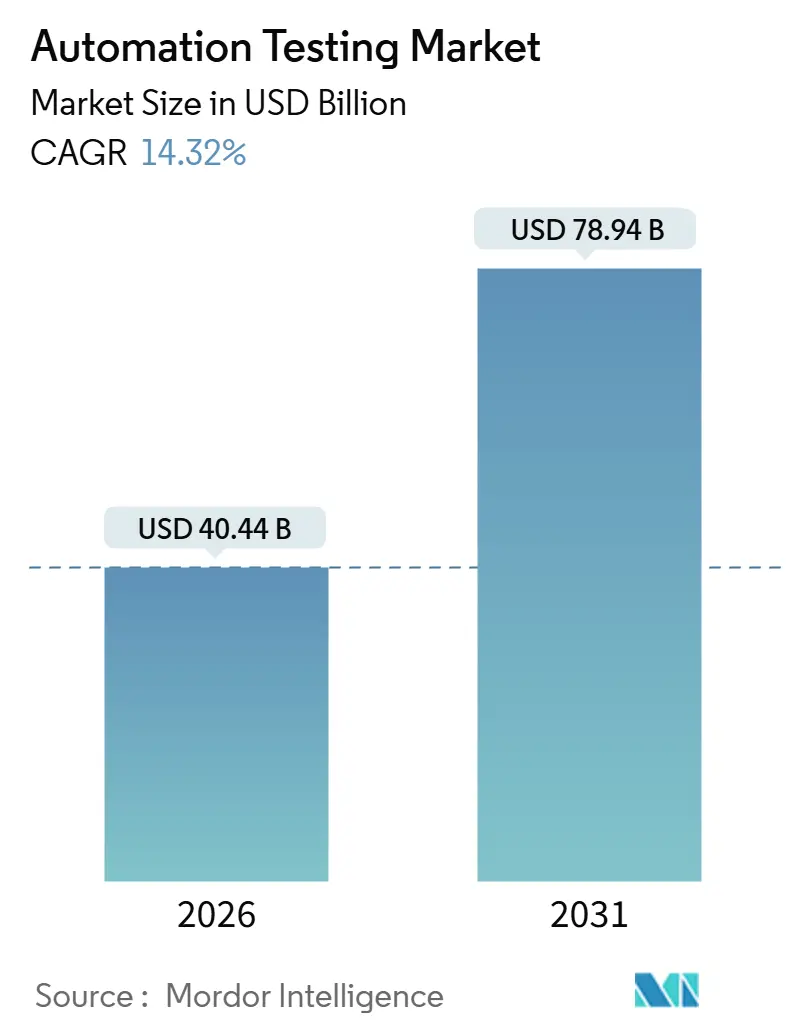
| Market Size (2026) | USD 40.44 Billion |
| Market Size (2031) | USD 78.94 Billion |
| Growth Rate (2026 - 2031) | 14.32 % |
| Fastest Growing Market | Asia Pacific |
| Largest Market | North America |
| Market Concentration | Medium |
Major Players *Disclaimer: Major Players sorted in no particular order Image © Mordor Intelligence. Reuse requires attribution under CC BY 4.0. | |
Automation Testing Market Analysis by Mordor Intelligence
The automation testing market size reached USD 40.44 billion in 2026 and is projected to attain USD 78.94 billion by 2031, reflecting a 14.32% CAGR across the forecast period. This expansion stems from enterprises shifting testing earlier in the software development life cycle, unifying continuous testing with DevOps pipelines, and embracing generative AI tooling that creates self-healing scripts in near real-time. Widespread demand for elastic cloud infrastructure, heightened security and accessibility mandates, and rising uptake of no-code platforms are broadening purchasing pools beyond traditional quality-assurance teams. Competitive dynamics are intensifying as incumbents embed AI into existing suites, while venture-backed specialists differentiate themselves through autonomous test-maintenance engines, all vying for a share as organizations modernize their legacy estates and migrate to microservices. Opportunities flourish where hybrid-cloud sovereignty, regulated-industry compliance, and device-level firmware validation intersect, prompting vendors to expand service portfolios alongside software licenses to reduce customer complexity and accelerate time-to-value.
Key Report Takeaways
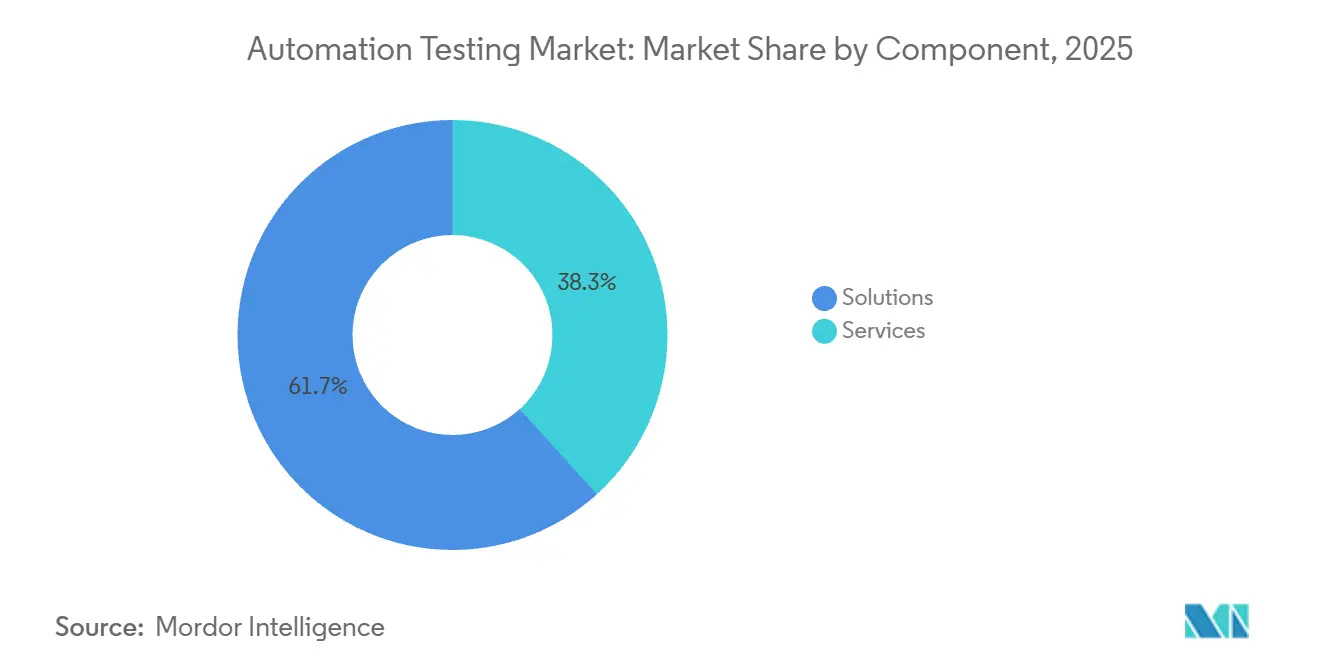
- By component, solutions led with 61.72% revenue share in 2025; services are forecast to grow at a 15.23% CAGR through 2031.
- By testing type, functional testing accounted for 58.33% of demand in 2025, while non-functional testing is projected to expand at a 16.94% CAGR through 2031.
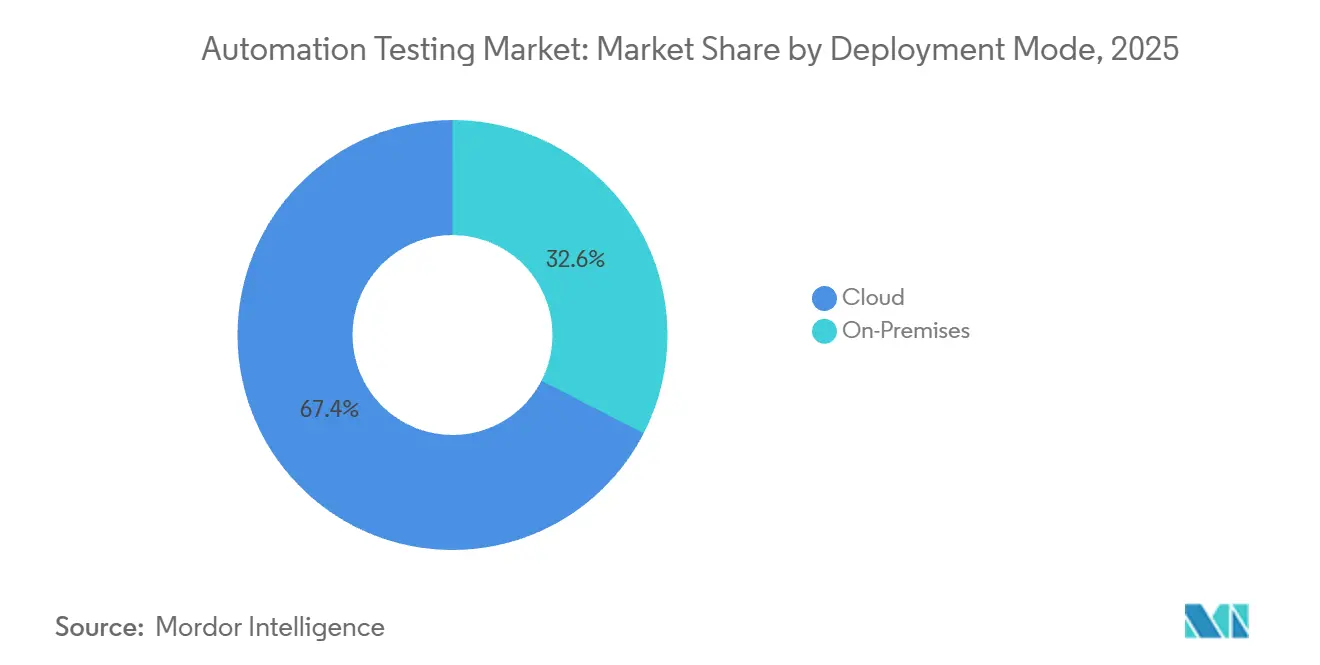
- By deployment mode, cloud deployment captured a 67.44% share in 2025, whereas the hybrid cloud is set to rise at a 17.41% CAGR through 2031.
- By end-user industry, information technology and telecommunications led with 24.61% spending in 2025; healthcare and life sciences is expected to grow at a 16.67% CAGR through 2031.
- By organization size, large enterprises held 68.93% share in 2025, but small and medium enterprises are advancing at a 17.34% CAGR to 2031.
- By interface, web testing constituted 52.21% of activity in 2025; API and microservices testing is forecast to expand at a 16.81% CAGR to 2031.
- By geography, North America led with 39.54% revenue share in 2025; Asia-Pacific is expected to post the fastest regional CAGR of 16.13% through 2031.
Note: Market size and forecast figures in this report are generated using Mordor Intelligence’s proprietary estimation framework, updated with the latest available data and insights as of January 2026.
Market Trends and Insights
Drivers Impact Analysis of Automation Testing Market*
| Driver | (~) % Impact on CAGR Forecast | Geographic Relevance | Impact Timeline |
|---|---|---|---|
| Rising Adoption of Agile and DevOps for Continuous Testing | +2.1% | Global, concentrated in North America and Europe | Medium term (2-4 years) |
| AI-Driven Test-Creation and Maintenance Tools | +1.8% | North America, Europe, Asia Pacific core markets | Short term (≤ 2 years) |
| Expansion of Cloud-Native and Microservices Architectures | +1.5% | Global, led by North America and Asia Pacific | Medium term (2-4 years) |
| Low-Code or No-Code Automation Democratizing QA | +1.3% | Global, rapid uptake in Asia Pacific and Latin America | Short term (≤ 2 years) |
| Digital-Accessibility Mandates (WCAG 3) | +0.9% | North America, Europe, Australia | Long term (≥ 4 years) |
| On-Device Regression Needs for Edge and IoT Firmware | +0.7% | Asia Pacific manufacturing hubs, North America, Europe | Long term (≥ 4 years) |
| Source: Mordor Intelligence | |||
Rising Adoption of Agile and DevOps for Continuous Testing
Organizations embed automated regression suites directly into continuous-integration pipelines, compressing release cycles from quarterly to weekly cadences. Microsoft reported a 43% year-over-year rise in parallel test jobs on Azure DevOps in 2025, indicating a shift from manual approvals toward policy-as-code gating.[1] “Azure DevOps Blog,” Microsoft Corporation, microsoft.com Higher delivery velocity narrows windows for exploratory testing, pushing teams to automate smoke, integration, and end-to-end scenarios once reserved for human judgment. Docker’s 2024 survey noted that 68% of DevOps practitioners run automated tests on every commit, up from 51% a year earlier. As a result, test platforms integrate natively with Git repositories and observability stacks, surfacing defect telemetry in real time and creating demand for unified DevOps toolchains.
AI-Driven Test-Creation and Maintenance Tools
Generative AI turns natural-language requirements into executable scripts and self-heals selectors when UI elements change, trimming maintenance costs that historically consumed up to 40% of QA budgets. IBM’s watsonx Code Assistant converts COBOL business logic into test cases for mainframe workloads. Tricentis folded natural-language authoring into its platform via the Waldo and Virtuoso acquisitions, enabling testers to describe scenarios in plain English and receive Selenium scripts in minutes. Applitools Visual AI flags pixel-level regressions and reduced false-positive alerts by 60% during pilot projects. These advances allow enterprises to expand coverage without proportional head-count growth, shifting QA engineers toward risk-based prioritization.
Expansion of Cloud-Native and Micro-Services Architectures
Decomposing monoliths into microservices multiplies API contracts and inter-service dependencies. Google Cloud’s 2025 DevOps report found teams operating more than 50 microservices see a 3.2-times higher defect-escape rate when relying solely on end-to-end tests. Tools such as Pact enable consumer-driven contract verification, while BrowserStack’s Kubernetes-native orchestration spins up ephemeral browsers alongside application pods, cutting infrastructure costs by 40%. Sauce Labs’ integration with Azure Kubernetes Service permitted 10,000 concurrent Selenium sessions and slashed regression runtime from eight hours to 22 minutes. Test platforms therefore must support API-first workflows and ephemeral environments.
Low-Code or No-Code Automation Democratizing QA
Visual builders and record-and-playback interfaces let business analysts author tests without scripting. Katalon’s StudioAssist suggests test steps as users interact with apps, halving script-creation time. LambdaTest HyperExecute auto-retries flaky tests and distributes jobs across cloud nodes, achieving 95% pass-rate stability for fintech clients. Rainforest QA expands crowd-testing with Spanish and Portuguese localization, attracting Latin American SMEs. Democratization removes engineering bandwidth as a gating factor, speeding validation immediately after backlog refinement sessions.
Restraints Impact Analysis of Automation Testing Market*
| Restraint | (~) % Impact on CAGR Forecast | Geographic Relevance | Impact Timeline |
|---|---|---|---|
| High Up-Front Tool and Skills Investment | -1.2% | Global, acute in emerging markets and SMEs | Short term (≤ 2 years) |
| Legacy-System Integration Complexity | -0.9% | North America and Europe, especially BFSI and manufacturing | Medium term (2-4 years) |
| Data-Privacy Hurdles for Cloud-Based Testing | -0.6% | Europe (GDPR), China (PIPL), healthcare and finance | Long term (≥ 4 years) |
| Rapid AI-Framework Obsolescence Risk | -0.5% | Global, concentrated in early-adopter enterprises | Short term (≤ 2 years) |
| Source: Mordor Intelligence | |||
High Up-Front Tool and Skills Investment
Enterprise-grade frameworks require license fees, infrastructure provisioning, and staff upskilling, forming a capital barrier for SMEs. PwC’s 2025 survey indicated 42% of smaller firms cite budget constraints as the chief obstacle to automated security testing. The talent gap compounds the hurdle, with LinkedIn’s 2024 report showing demand for automation engineers outstripping supply by a factor of 2.3 in North America. Firms unable to fund competitive salaries or long-term subscriptions delay automation programs, perpetuating manual bottlenecks that slow releases and raise defect-escape rates.
Legacy-System Integration Complexity
Modern test suites struggle to connect with COBOL mainframes and proprietary middleware, lacking standard APIs. IBM’s 2024 Mainframe Modernization Survey revealed 63% of financial institutions still run COBOL cores, with only 18% possessing automated regression suites.[2]“watsonx Code Assistant,” IBM Corporation, ibm.com Manufacturing clients spend up to 40% of test budgets maintaining integration layers between Selenium scripts and SAP GUI transactions, stretching update cycles to six weeks. Organizations therefore operate parallel manual and automated processes, diluting return on investment and fostering resistance to further automation.
*Our forecasts treat driver/restraint impacts as directional, not additive. The impact forecasts reflect baseline growth, mix effects, and variable interactions.
Automation Testing Market Segment Analysis
By Component:
Services Expand as Complexity RisesSolutions accounted for a 61.72% automation testing market share in 2025, reflecting enterprises' reliance on packaged functional, performance, and security modules that plug directly into DevOps pipelines. Services, however, are projected to capture the fastest-growth lane with a 15.23% CAGR through 2031 as buyers outsource script maintenance and hybrid-cloud integration to specialists, shifting quality assurance from fixed headcount to on-demand expertise. Managed providers update regression packs in lockstep with continuous-delivery sprints, shrinking lead times and freeing internal teams to focus on risk prioritization.
The automation testing market size tied to services is growing as regulatory audits demand traceability matrices, driving demand for consulting hours that map test cases to compliance clauses under the GDPR and ISO 13485.[3]“European Accessibility Act,” European Commission, ec.europa.eu Vendors bundle advisory, framework tuning, and managed execution into outcome-based contracts, converting what once were capital purchases into operating expenses that scale with release velocity.


By Testing Type:
Non-Functional Gains MomentumFunctional suites retained a 58.33% market share in automation testing in 2025, confirming their foundational role in validating user workflows. Non-functional categories, performance, security, and accessibility are set to expand at a 16.94% CAGR, the fastest clip in this segmentation, as zero-trust architectures and WCAG 3 mandates elevate latency, vulnerability, and usability metrics to board-level risk registers.
Organizations integrate Apache JMeter load scripts and static-analysis scans into the same dashboards that track functional coverage, correlating service-level objectives with defect trends. As breaches and slow page loads inflict brand damage that exceeds functional defects, procurement teams allocate larger budgets to non-functional tooling, shifting the automation testing market size toward balanced spending across the two categories.
By Deployment Mode:
Hybrid Cloud Balances Agility and SovereigntyPublic cloud captured a commanding 67.44% share of deployments in 2025, powering elastic browser grids and device farms that execute thousands of parallel tests. Hybrid cloud, nevertheless, records the fastest trajectory with a 17.41% CAGR, as financial, healthcare, and public-sector buyers route sensitive workloads to on-premises nodes while dispatching low-risk checks to public regions.
BrowserStack’s Azure integration synchronizes results between private Jenkins servers and cloud Selenium grids, reducing infrastructure costs by 35% and demonstrating the economic benefits of federated orchestration. The dual-location model future-proofs compliance with emerging data-residency rules, ensuring the automation testing market size reflects a steady shift toward mixed deployment topologies.
By End-User Industry:
Healthcare and Life Sciences AccelerateInformation technology and telecommunications led spending with a 24.61% automation testing market share in 2025, driven by telcos validating 5G network slices and API gateways. Healthcare and life sciences, however, are forecast to outpace all other verticals at a 16.67% CAGR, as FDA 21 CFR Part 11 and ISO 13485 compel the automated validation of electronic health record interfaces and medical device firmware.
Telemedicine providers embed continuous performance tests to maintain video quality during peak appointment windows, while hospitals implement accessibility scans to ensure patient portals meet WCAG standards. The resulting compliance pressure and interoperability complexity drive new investment into automated suites, increasing the automation testing market size allocated to healthcare projects above historical norms.
By Organization Size:
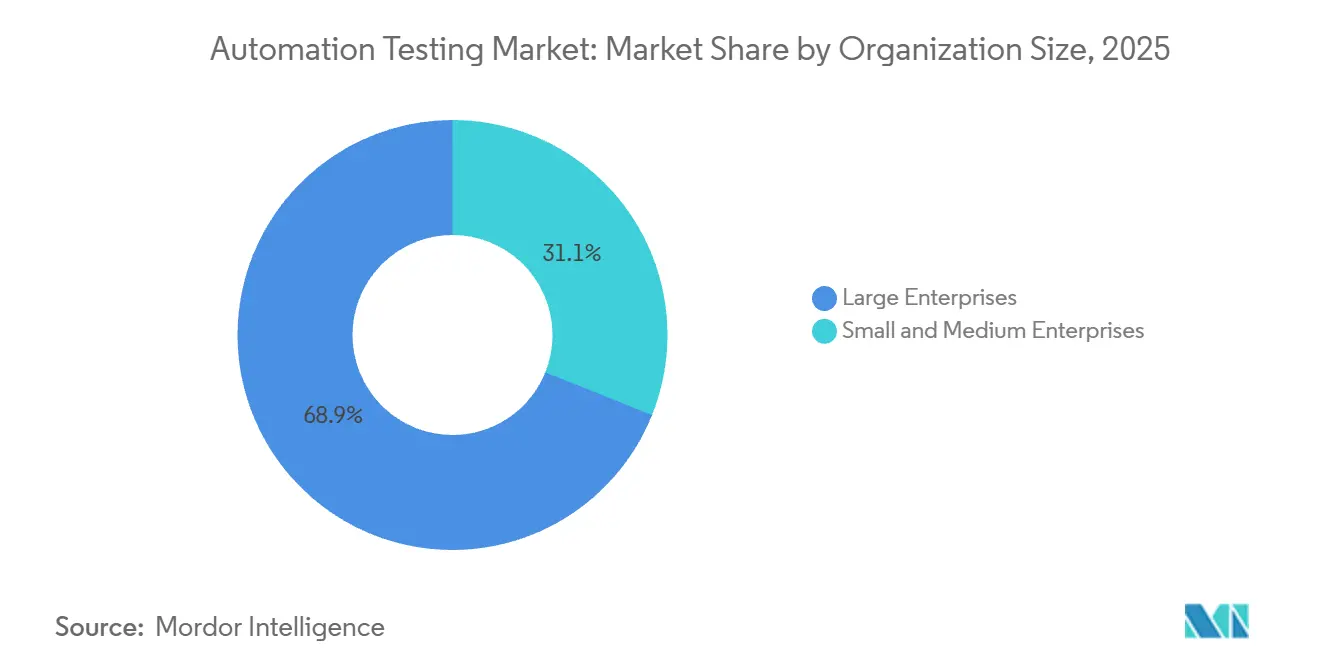
SMEs Narrow the GapLarge enterprises commanded 68.93% automation testing market share in 2025, leveraging enterprise licenses and in-house device labs to sustain broad coverage. Small and medium-sized enterprises represent the fastest-growing cohort, with a 17.34% CAGR, as no-code builders and pay-as-you-go SaaS solutions strip away entry barriers.
LambdaTest HyperExecute auto-retries flaky tests and distributes jobs across cloud nodes, letting resource-constrained teams deliver stable releases without dedicated QA engineers. Crowd-testing models supplement automated suites, providing real-user feedback in regional languages. These dynamics broaden the automation testing market size by extending adoption into the long tail of businesses previously priced out of enterprise toolchains.
By Interface:
API and Microservices Validation SurgesWeb UI checks still dominate the automation testing market with a 52.21% share in 2025, yet API and microservices suites are projected to grow the fastest at a 16.81% CAGR as enterprises decompose monoliths and enforce contract integrity on every commit.
Postman and Pact snapshots catch schema drift early, preventing downstream breakages, while Kubernetes-native grids spin up ephemeral browsers alongside service pods to validate end-to-end flows without persistent infrastructure. Device-farm demand persists for mobile and IoT, but unified orchestration that sequences API, UI, and embedded tests within one workflow distinguishes leading platforms, ensuring the automation testing market size increasingly reflects multi-interface complexity.
Geography Analysis
North America Automation Testing Market
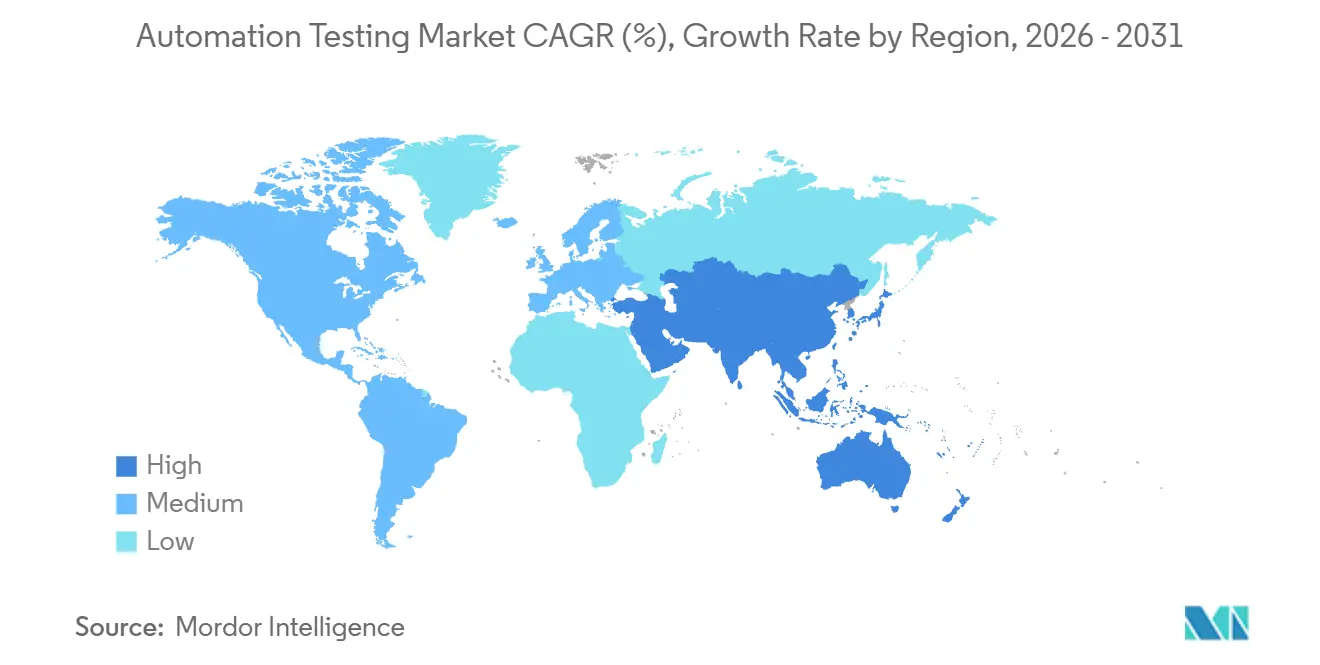
North America contributed 39.54% of the 2025 revenue, supported by mature DevOps adoption, federal accessibility mandates, and venture funding that accelerates the rollouts of AI-native platforms. United States enterprises integrate GitHub Copilot and IBM watsonx into pipelines, auto-generating unit and integration tests on every commit. Canadian banks automate regression checks to satisfy regulatory resilience guidelines, while Mexican manufacturers embed testing into supply-chain portals that exchange customs data with U.S. authorities.
APAC Automation Testing Market
Asia Pacific is projected to record the fastest expansion at a 16.13% CAGR through 2031. India’s Digital Public Infrastructure programs demand validation of Aadhaar and UPI APIs at a national scale. China enforces PIPL data-sovereignty rules, prompting hybrid-cloud grids located within national borders. Japanese industrial conglomerates partner with HeadSpin device labs to vet automotive firmware across climate zones, and Australian agencies require WCAG-aligned testing for citizen portals, driving adoption of accessibility tools from Deque Systems and Applitools.
EMEA and LATAM Automation Testing Market
Europe maintains robust demand as the European Accessibility Act and GDPR converge, necessitating automated validation and data anonymization. German automakers test ADAS software under edge-latency scenarios, the United Kingdom’s financial sector hires managed-service providers to automate disaster-recovery test runs, and French healthcare groups validate HL7 FHIR data exchanges under national digital-health initiatives. Middle East and Africa investment concentrates in smart-city and fintech platforms, while Latin American growth benefits from localization features in no-code tools that broaden SME participation.

Regulatory Landscape
Automation testing is shaped by cross-border rules that elevate traceability, evidence retention, and audit-ready validation in software delivery. In the European Union, the AI Act (in force since August 1, 2024) sets requirements for technical documentation and validation evidence for high-risk AI systems, including test logs and signed reports referenced in its annexes, pushing teams to embed continuous evidence capture into CI/CD workflows. Sector rules also raise the bar for operational resilience testing, with the EU Digital Operational Resilience Act (DORA) moving into active enforcement through 2025 and 2026, increasing scrutiny of third-party software risk, resilience scenarios, and test artifacts by compliance functions.
Standards bodies are also tightening what “good” automation looks like, while providing common language for audits and procurement. ISO/IEC/IEEE 29119-5:2024 (published December 2024) supports standardized, modular specification via keyword-driven testing, while IEEE Standards Association published IEEE 3407-2025 (dated April 24, 2026) to define minimum requirements for end-to-end software testing automation tools. Alongside continuing regulator-to-regulator collaboration (for example, efforts involving the UK Financial Conduct Authority and the Monetary Authority of Singapore to align AI testing expectations), these anchors are increasing demand for tools and services that generate immutable execution logs, map tests to control objectives, and demonstrate repeatability across hybrid environments.
Value Chain Analysis
The automation testing value chain begins with upstream enablers, including open-source frameworks and standards, cloud infrastructure, and developer toolchains that provide execution environments and integration points. Standards initiatives are increasingly influential inputs, including IEEE 3407-2025 (minimum requirements for end-to-end software testing automation tools) and the W3C Browser Testing and Tools Working Group charter issued in January 2026 to advance interoperable protocols and APIs for browser automation. These inputs feed into midstream platform vendors offering test authoring, orchestration, reporting, and AI-assisted maintenance across web, mobile, API, and embedded interfaces, typically delivered as SaaS, enterprise subscriptions, or bundled suites.
Downstream, system integrators, managed testing providers, and in-house quality engineering teams implement and operate automation within DevOps pipelines, connecting testing platforms to SCM, CI, observability, and enterprise applications. Service providers increasingly package test automation inside broader modernization programs rather than treating it as a standalone workstream, consistent with large AI-led engineering transformation contracts in the TMT sector (for example, Sonata Software reported a five-year USD 73 million deal in April 2025 that included scalable engineering practices). Common value-chain friction points reported in 2025 include integration complexity (64%), data privacy risk (67%), and AI reliability or hallucination concerns (60%), reinforcing the role of services, governance, and secure data-handling patterns alongside tooling.
Competitive Landscape
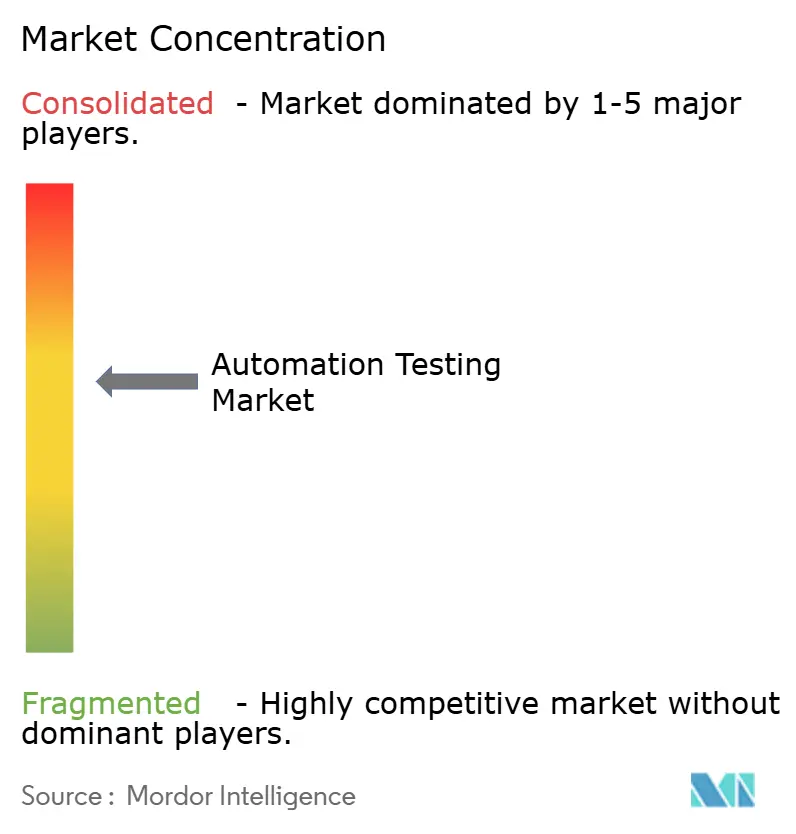
The top 10 vendors account for approximately half of the global revenue, resulting in a moderate concentration in the automation testing market. Incumbents such as IBM, Microsoft, and OpenText leverage cross-portfolio bundling to establish a foothold within large accounts, embedding AI assistants into established ALM footprints. Tricentis, mabl, and Applitools pursue a shared approach via autonomous maintenance engines that cut script-update cycles by up to 70%. Acquisition activity accelerates as vendors fill capability gaps. Tricentis added Waldo and Virtuoso for mobile and no-code authoring, while SmartBear acquired Stoplight to expand its API design coverage.
Cloud providers partner with orchestration specialists to reduce infrastructure friction. BrowserStack integrates live and automated testing into Visual Studio Code, and Sauce Labs debuts Kubernetes-native scheduling that slashes runtime for high-parallel pipelines. Device-farm specialists HeadSpin and Perfecto differentiate themselves with real hardware for over-the-air testing, targeting edge- and IoT use cases that are underserved by generic browser grids. Patent filings highlight a strategic focus on model-based generation and visual AI algorithms, with Tricentis and Applitools leading, respectively.
Compliance certifications emerge as competitive levers, especially ISO/IEC 29119 conformity and traceability mapping for regulated verticals. Vendors also embed observability hooks, correlating test failures with APM metrics from Datadog or New Relic to accelerate incident triage. As AI models mature, rapid obsolescence risk spurs roadmaps emphasizing model-agnostic frameworks and pluggable LLM back ends, insulating customers from technology churn.
Automation Testing Industry Leaders
IBM Corporation
OpenText Corporation (Micro Focus)
Capgemini SE
Tricentis USA Corp
SmartBear Software Inc.
- *Disclaimer: Major Players sorted in no particular order
Automation Testing Market Companies Covered in this Report
- IBM Corporation
- OpenText Corporation (Micro Focus)
- Capgemini SE
- Tricentis USA Corp
- SmartBear Software Inc.
- Parasoft Corporation
- Cigniti Technologies Ltd.
- Keysight Technologies Inc.
- Sauce Labs Inc.
- Accenture plc
- Microsoft Corporation
- Katalon Inc.
- BrowserStack Inc.
- LambdaTest Inc.
- Leapwork A/S
- Applitools Ltd.
- Ranorex GmbH
- Worksoft Inc.
- Perfecto (Perforce Software Inc.)
- Functionize Inc.
- Testim.io Ltd.
- Virtuoso QA Ltd.
- Eggplant (Keysight)
- mabl Inc.
- HeadSpin Inc.

Market Opportunities and Future Outlook
A key whitespace is the shift from AI-assisted scripting toward agentic, autonomous quality workflows that run inside the developer coding loop and produce auditable outputs. In 2026, product moves such as GitHub Code Quality reaching general availability (July 2026) and Sonar introducing Sonar Vortex plus a generally available SonarQube Remediation Agent (June 2026) indicate enterprise appetite for integrated, near-real-time verification and remediation tied to repositories and coding agents. This supports an opportunity for automation testing vendors to offer policy-driven controls (human-in-the-loop approvals, explainable failure rationales, and evidence retention) that reconcile faster AI-generated code changes with regulated-industry expectations.
Standardization and interoperability efforts also create room for platforms that reduce lock-in and simplify hybrid execution. IEEE 3407-2025 (published April 2026) provides a procurement and compliance anchor for tool requirements, while the W3C Browser Testing and Tools Working Group charter (January 2026) signals ongoing work toward interoperable browser automation APIs. Vendors and service providers that operationalize these developments into reference architectures, reusable compliance mappings (for example, ISO/IEC/IEEE 29119 keyword-driven specifications), and secure data-handling patterns for cloud-based test execution can differentiate in regulated and data-sovereign deployments, where buyers want automation coverage without expanding integration burden.
Recent Industry Developments in Automation Testing Market
- July 2026: IBM announced a definitive agreement to acquire WDG Solucoes Em Sistemas E Automacao De Processos LTDA (WDG Automation) to expand AI-infused automation capabilities within IBM Cloud Pak for Automation. The deal strengthens IBM's ability to pair RPA and enterprise automation with testing and validation workflows, supporting customers that want end-to-end governance across build, test, and run activities.
- May 2026: Tricentis announced SAP Enterprise Continuous Testing by Tricentis, focused on automating test case generation and execution within SAP-centric workflows. This extends Tricentis coverage deeper into ERP transformation programs where regression risk and auditability are key, and it supports faster release cycles without relying solely on specialized scripting skills.
- December 2025: Perfecto by Perforce expanded its device lab with 300 IoT endpoints, adding smart-home and industrial sensors to support over-the-air firmware testing. The added real-device capacity improves test coverage for embedded and edge scenarios that are difficult to replicate in emulators, reinforcing demand for device-farm style infrastructure in automation programs.


Automation Testing Market Report Scope and Research Methodology
Market Definition and Coverage
For this study, the market captures revenues from commercial automation testing tools and related services used to plan, run, and analyze automated tests across applications (web, mobile, desktop, API, and embedded). It includes license or subscription fees, support, and paid services linked to deploying and operating automation.
Scope exclusions: Purely manual testing-only work and internal-only, proprietary automation frameworks used only for cost recovery are excluded.
Segments Covered in This Report
- By Component
- Solutions
- Functional Testing
- API Testing
- Security Testing
- Compliance Testing
- Usability Testing
- Load and Performance Testing
- Other Solutions
- Services
- Professional Services
- Managed Services
- Solutions
- By Testing Type
- Functional
- Non-Functional
- Performance
- Security
- Usability
- By Deployment Mode
- On-Premises
- Cloud
- Public
- Private
- Hybrid
- By End-User Industry
- IT and Telecommunications
- BFSI
- Healthcare and Life Sciences
- Retail and E-Commerce
- Transportation and Logistics
- Manufacturing
- Government and Public Sector
- Energy and Utilities
- Other End-User Industries
- By Organization Size
- Large Enterprises
- Small and Medium Enterprises
- By Interface
- Web
- Mobile
- Desktop
- API / Micro-Services
- IoT / Embedded
- By Geography
- North America
- United States
- Canada
- Mexico
- South America
- Brazil
- Argentina
- Rest of South America
- Europe
- Germany
- United Kingdom
- France
- Italy
- Spain
- Russia
- Rest of Europe
- Asia Pacific
- China
- Japan
- South Korea
- India
- Australia
- New Zealand
- Rest of Asia Pacific
- Middle East
- United Arab Emirates
- Saudi Arabia
- Turkey
- Rest of Middle East
- Africa
- South Africa
- Nigeria
- Kenya
- Rest of Africa
- North America
Data Sources, Market Sizing, and Validation
Desk Research
Desk work starts with building the demand and supply picture that sits behind spending on automation testing. We referenced public sources such as the US Bureau of Labor Statistics, OECD digital economy statistics, World Bank indicators, and standards bodies such as ISO and NIST to understand software activity and quality requirements.
This was then supplemented with company filings, annual reports, investor presentations, product documentation, and credible press coverage to track pricing models and delivery patterns (licenses, subscriptions, and services). Where useful, we also used paid subscriptions for company financial intelligence, patent databases, and news and financials to cross-check revenue ranges and product direction. The source list above is illustrative, and many other public references were used to collect, validate, and clarify inputs.
Primary Interviews and Surveys
Primary conversations were used to pressure-test what the desk findings implied, especially on what buyers actually pay for and how contracts are structured across tools and services. We spoke with a mix of tool-side leaders, services delivery roles, QA engineering heads, and procurement or platform owners across major regions so assumptions on usage, pricing, and adoption timing were not left to desk interpretation alone.
Distribution of primary research fieldwork respondents
| Company type | Respondent position | Region |
|---|---|---|
| Top tier: 30% | CXOs: 22% | APAC: 51% |
| Mid tier: 48% | Functional/Unit leaders: 36% | EMEA: 30% |
| Smaller Players: 22% | Managers: 42% | Americas: 19% |
Market-Sizing & Forecasting
Sizing begins from a top-down build where software delivery activity is translated into an addressable testing spend pool, and then the share attributable to automated testing tools and paid services is applied by region. Inputs that helped shape this include CI and DevOps adoption levels, the mix of web and mobile application workloads, typical test coverage targets, average license or subscription pricing behavior, and how much testing work shifts into managed services over time.
After that, the totals are checked using selective bottom-up approximations, such as sampled supplier revenue ranges, channel checks on subscription pricing, and a simple volume times ASP view on active seats for common enterprise deployments. When a bottom-up check was missing for a niche geography or a smaller buyer cohort, the gap was handled using peer-region ratios that were validated with interviews before being applied.
For forecasting, scenario analysis was used so the model can reflect different release-cycle speeds and automation penetration paths, and the variable outlook was aligned with what interviewees expected to happen in budgets and hiring. Growth rates were reviewed for reasonableness against adjacent indicators like cloud migration pace and the move toward continuous testing practices.
Data Validation & Update Cycle
Outputs are validated through triangulation across demand signals, supply-side revenue logic, and independent checks like pricing ranges and adoption timing gathered during calls. If a region or year shows a jump that is not explained by software delivery activity or pricing movements, the assumptions are re-opened and the related respondents are re-contacted.
Before sign-off, the model goes through a multi-step review where another analyst checks calculations, units, currency conversions, and year alignment, and then compares results with external signals that should move in the same direction. Reports are refreshed annually, and interim updates are made when material events occur, followed by a final pre-delivery pass so clients receive the latest updated view.
Mordor Intelligence's Automation Testing Market Estimate Compared With Other Published Estimates
Published numbers for automation testing do not always match because studies can count different revenue lines and can also anchor their math to different years. Differences also show up when one estimate mixes broader software testing spend into the same bucket, or when services are treated as part of the market in one place and excluded elsewhere.
Another practical gap driver is how subscriptions are annualized and how fast price erosion is assumed as tools mature, which can move the market value even if adoption is similar. The spread in the table is also explained by whether paid automation services are counted alongside tool subscriptions, and whether purely manual testing activity is kept out, as done by Mordor Intelligence.
Benchmark comparison
| Source | Market Size | Gaps in Research Methodology |
|---|---|---|
| Mordor Intelligence | USD 40.44 B (2026) | |
| Industry Report Publisher A | USD 29.29 B (2025) | Uses a different current-year anchor and a shorter window, and the public summary does not clearly separate automation tool subscriptions from adjacent QA and testing service lines, which can compress what is counted. |
| Insights Publisher B | USD 33.41 B (2024) | May bundle broader test tooling categories and provides limited detail on services inclusion, subscription annualization, and currency timing, which can shift the total even with similar adoption trends. |
Taken together, the comparison suggests that year anchoring and what is counted as paid automation testing revenue are the two biggest levers behind the range. By tying totals back to observable adoption signals and then re-checking pricing and services attachment through interviews, our estimate stays traceable to repeatable steps that can be updated.


Key Questions Answered in the Report
What is the projected value of the automation testing market in 2031?
It is expected to reach USD 78.94 billion, supported by a 14.32% CAGR over the forecast period.
Which segment shows the fastest growth within automation testing?
Hybrid-cloud deployment is forecast to expand at a 17.41% CAGR as organizations balance agility with data sovereignty.
Why is non-functional testing gaining momentum?
Heightened security, performance, and accessibility mandates push enterprises to automate non-functional checks, driving a projected 16.94% CAGR for the segment.
How are SMEs adopting automation testing tools?
No-code platforms and pay-as-you-go SaaS models lower entry barriers, enabling SMEs to automate critical workflows without dedicated QA teams.
Which regions will lead future market expansion?
Asia Pacific is projected to record the highest growth, driven by digital-public-infrastructure mandates in India and data-residency regulations in China.
What role does generative AI play in automation testing?
Generative AI auto-creates and self-heals test scripts, reducing maintenance overhead and allowing teams to expand coverage without increasing head-count.
Page last updated on:





