
Payroll Card and Digital Pay Market Size and Share
Market Overview
| Study Period | 2020 - 2031 |
|---|---|
| Market Size (2026) | USD 15.13 Billion |
| Market Size (2031) | USD 21.70 Billion |
| Growth Rate (2026 - 2031) | 7.48 % |
| Fastest Growing Market | Asia-Pacific |
| Largest Market | North America |
| Market Concentration | Medium |
Major Players *Disclaimer: Major Players sorted in no particular order Image © Mordor Intelligence. Reuse requires attribution under CC BY 4.0. | |
Payroll Card and Digital Pay Market Analysis by Mordor Intelligence
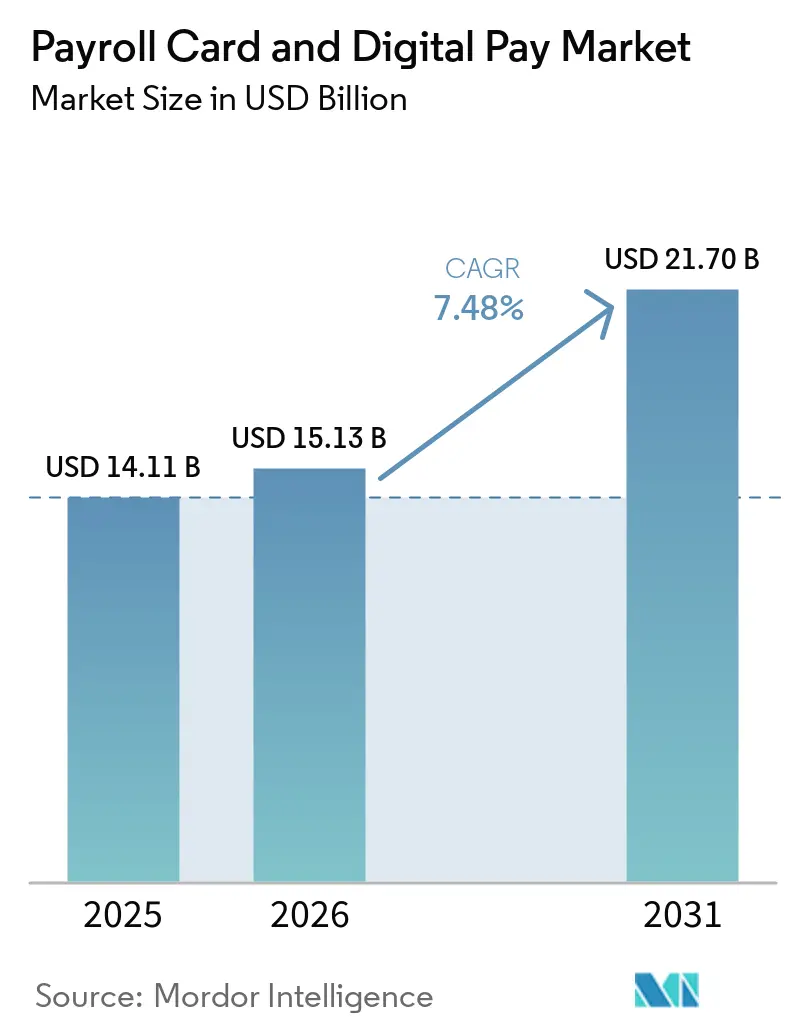
The payroll card and digital pay market size is expected to increase from USD 14.11 billion in 2025 to USD 15.13 billion in 2026 and reach USD 21.70 billion by 2031, growing at a CAGR of 7.48% from 2026 to 2031. Employers are accelerating the move away from paper checks, regulators are mandating real-time wage rails, and gig-economy platforms are embedding instant-payout tools. Network tokenization, virtual-card provisioning, and earned-wage-access APIs now converge to shorten payroll cycles from days to seconds, shifting competitive advantage toward processors that can combine fee transparency with on-demand liquidity. At the same time, regional payment-system upgrades, from FedNow in the United States to Pix Automático in Brazil, are redefining baseline settlement speed expectations. These forces, coupled with rising compliance penalties for manual payroll, position the payroll card and digital pay market for sustained mid-single-digit growth even as push-to-debit alternatives intensify pricing pressure.
Key Report Takeaways
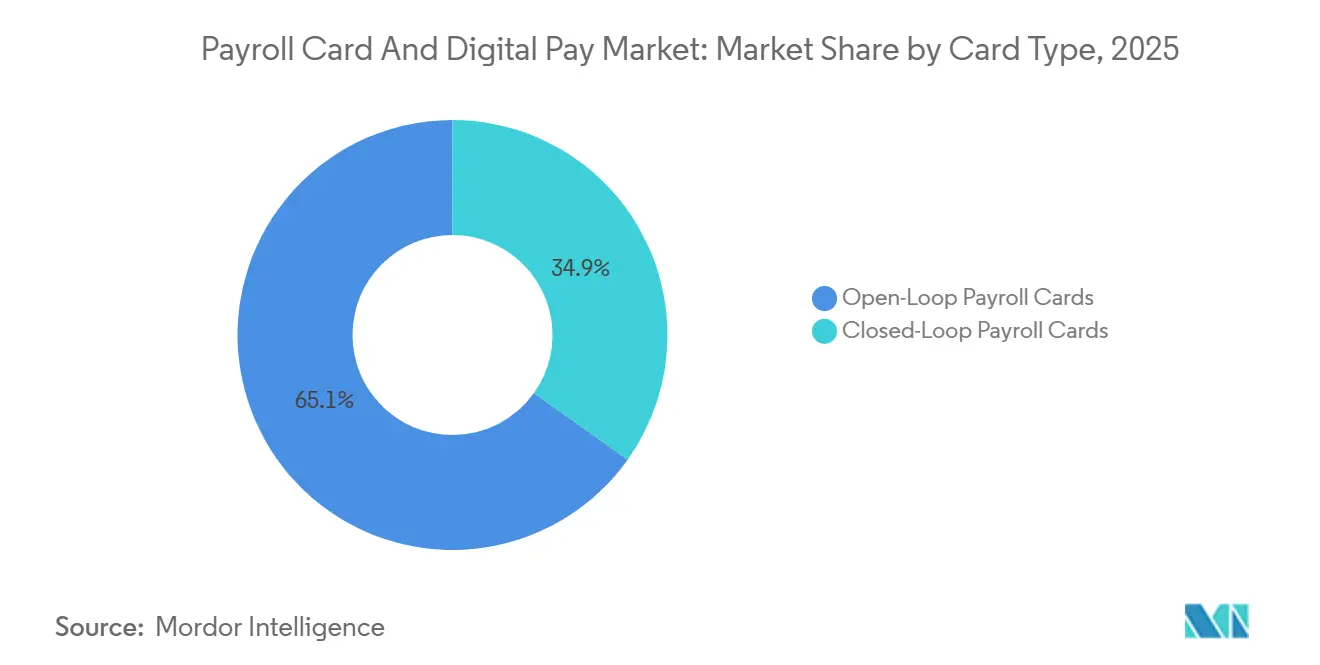
- By card type, open-loop solutions held 65.14% of payroll card and digital pay market share in 2025, while closed-loop cards are projected to expand at a 9.45% CAGR through 2031.
- By form, physical products retained 66.89% of 2025 volume, yet virtual cards represent the fastest-growing delivery mode, advancing at a 10.21% CAGR to 2031.
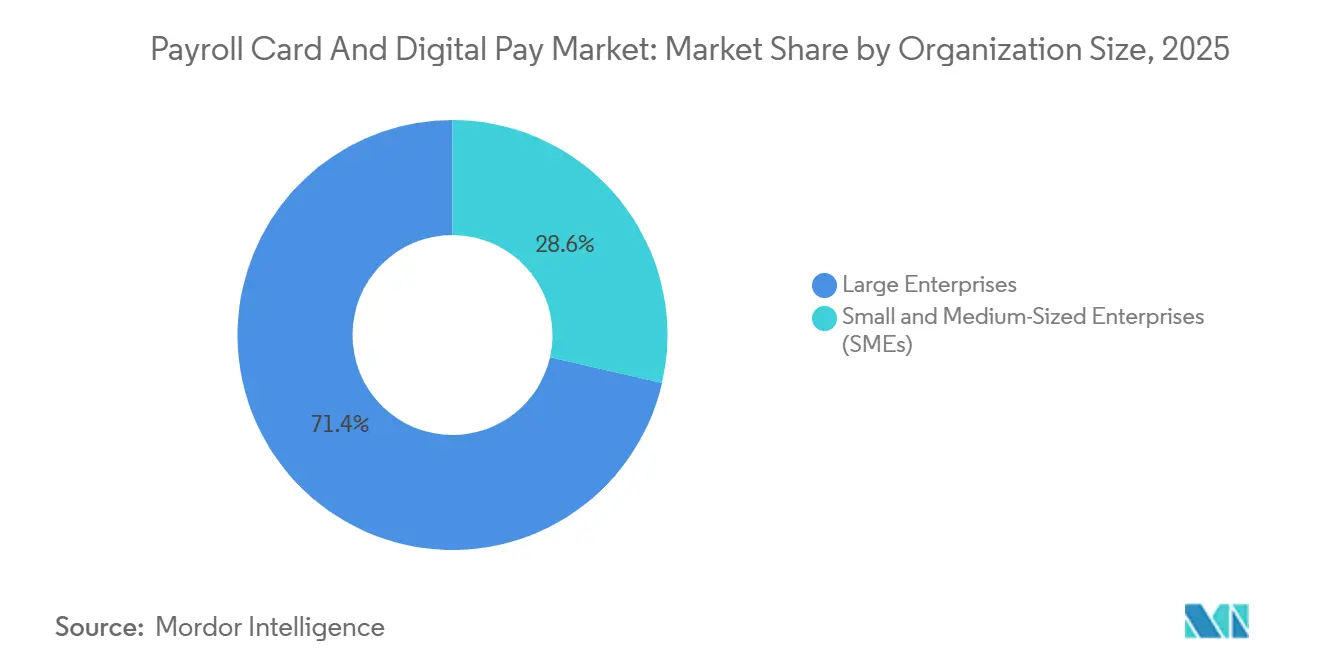
- By organization size, large enterprises accounted for 71.41% of 2025 adoption, whereas small and medium-sized enterprises are forecast to grow at a 9.89% CAGR through 2031.
- By end-user vertical, retail outlets commanded 45.12% share of the payroll card and digital pay market size in 2025, while gig and platform workers are on track to register a 9.01% CAGR to 2031.
Note: Market size and forecast figures in this report are generated using Mordor Intelligence’s proprietary estimation framework, updated with the latest available data and insights as of January 2026.
Market Trends and Insights
Drivers Impact Analysis of Payroll Card and Digital Pay Market*
| Driver | (~) % Impact on CAGR Forecast | Geographic Relevance | Impact Timeline |
|---|---|---|---|
| Rising Financial Inclusion Initiatives by Governments | +1.8% | Global with Asia-Pacific and Middle East focus | Medium term (2-4 years) |
| Employer Shift Toward Paperless Payroll for Cost Efficiency | +1.5% | North America and Europe, expanding to Asia-Pacific | Short term (≤ 2 years) |
| Proliferation of Gig Economy and On-Demand Workforce Payments | +1.4% | Urban centers across North America, Europe, Asia-Pacific | Medium term (2-4 years) |
| Advancements in Mobile Wallet and Contactless Payment Technology | +1.2% | Global, led by Asia-Pacific and Europe | Short term (≤ 2 years) |
| Integration of Earned Wage Access APIs With Payroll Cards | +0.9% | North America, Europe, Asia-Pacific | Medium term (2-4 years) |
| Tokenization of Payroll Cards for Cross-Border Real-Time Settlement | +0.7% | North America and Europe early adopters | Long term (≥ 4 years) |
| Source: Mordor Intelligence | |||
Rising Financial Inclusion Initiatives By Governments
Mandates that digitize wage payments are converting unbanked workers into cardholders at scale. Executive Order 14247 moved 3.8 million U.S. Direct Express recipients onto instant digital rails by September 2025. Saudi Arabia required e-salary disbursement for domestic workers in January 2026.[1]India’s Unified Payments Interface processed 228.3 billion transactions in 2025, with civil-service payrolls migrating to UPI-linked accounts. The United Arab Emirates upgraded its Wage Protection System in December 2025, covering more than 99% of private-sector employers. These programs expand the payroll card and digital pay market by formalizing wage flows in regions historically dominated by cash.
Employer Shift Toward Paperless Payroll For Cost Efficiency
Manual checks cost between USD 200 and USD 300 per issuance, while automated disbursements fall below USD 100 per transaction. United Kingdom digital-service studies found 70% to 90% error reductions after payroll automation. Across Asia-Pacific, 80% of employers revisited payroll strategy in 2025, with one-third prioritizing pay-on-demand. Malaysian SMEs, representing 97% of firms, adopted cloud payroll priced at RM 100-300 (USD 22-66) per month to avoid fines. North American and European employers therefore accelerate adoption to lower costs and compliance risk, strengthening demand for the payroll card and digital pay market.
Proliferation Of Gig Economy And On-Demand Workforce Payments
More than half of gig workers require same-day settlement, and disbursements move toward instant rails when offered. Instacart’s Shoppers Rewards Card, launched with Branch in 2025, expanded nationwide by April 2026. Branch debuted a full-service paycard combining deposits, bill pay, and earned-wage access the same year. Instant Financial’s virtual card cut provisioning time from a week to same-day. With 60 million U.S. gig workers generating USD 1.7 trillion in spend, instant payout has grown to 45% of disbursements, underlining why platforms steer volume to the payroll card and digital pay market.
Advancements In Mobile Wallet And Contactless Payment Technology
Mastercard’s embedded virtual-card numbers, released in March 2025, allow hourly workers to transact within an hour of onboarding. Agent Pay, announced one month later, lets artificial-intelligence agents execute autonomous payroll disbursements in real time. Tokenized transactions deliver 5-point higher authorization and 40% less fraud, yet only half of digital salary payments are tokenized, signaling ongoing upside. Galileo’s 2026 earnings-experience stack gives workers real-time wage visibility and instant wallet transfers. These advances reinforce consumer comfort with card-free salaries and enlarge the payroll card and digital pay market.
Restraints Impact Analysis of Payroll Card and Digital Pay Market*
| Restraint | (~) % Impact on CAGR Forecast | Geographic Relevance | Impact Timeline |
|---|---|---|---|
| Regulatory Complexity and Fee-Disclosure Requirements | -0.9% | North America and Europe, spillover to Asia-Pacific | Short term (≤ 2 years) |
| Competition From Instant Push-to-Debit and Digital Wallet Payouts | -0.8% | Global, led by North America and Europe | Medium term (2-4 years) |
| Limited Merchant MCC Acceptance for Pre-Authorization Holds | -0.5% | Emerging markets worldwide | Medium term (2-4 years) |
| Data-Residency Mandates Increasing Regionalization of Card Processing | -0.6% | Europe, Asia-Pacific, South America | Long term (≥ 4 years) |
| Source: Mordor Intelligence | |||
Regulatory Complexity And Fee-Disclosure Requirements
The CFPB’s prepaid rule extends error-resolution, overdraft, and disclosure mandates, raising compliance spend for issuers. In Europe, PSD2 strong-customer-authentication cuts cross-border authorization by up to 15%. U.S. Regulation E imposes 45-day dispute windows and 24-hour service requirements. Smaller providers therefore face higher fixed costs, prompting market exits or consolidation that temper overall payroll card and digital pay market growth.
Competition From Instant Push-To-Debit And Digital Wallet Payouts
Visa Direct processed 8.9 billion transactions in fiscal 2025, payroll being the fastest-growing use case. FedNow enables U.S. employers to deposit wages directly to bank accounts in seconds. Wise settles 74% of workforce payouts in under 20 seconds via API, bypassing intermediary cards. PayPal’s U.K. instant-transfer service is gaining SME traction despite a 1.75% fee. As businesses benchmark cost, control, and employee experience, these rails divert volume away from the payroll card and digital pay market.
*Our forecasts treat driver/restraint impacts as directional, not additive. The impact forecasts reflect baseline growth, mix effects, and variable interactions.
Payroll Card and Digital Pay Market Segment Analysis
By Card Type:
Closed-Loop Gains Traction Despite Open-Loop DominanceOpen-loop products captured 65.14% of payroll card and digital pay market share in 2025. Money Network serves 65 million cardholders across Visa and Mastercard rails, illustrating the acceptance reach employers continue to value. Closed-loop programs, while narrower, are expanding at a 9.45% CAGR as firms prioritize negotiated interchange, spending data, and merchant steering capabilities. Brink’s Money and U.S. Bank Focus Card segment spend by merchant category to eliminate overdraft risk.
Rellevate’s Pay Any-Day Card fuses closed-loop economics with earned-wage access, letting employees retrieve 50% of accrued pay before payday. Logistics, field-service, and ride-share platforms still depend on open-loop versatility, but retailers with captive ecosystems pivot toward closed-loop to capture interchange savings. As hybrid earned-wage models reduce liquidity concerns, employers increasingly weigh fee control over universal acceptance, enlarging the closed-loop slice of the payroll card and digital pay market size.
By Form:
Virtual Cards Surge As Mobile-First Onboarding AcceleratesPhysical instruments held 66.89% of 2025 volume, yet digital provisioning is scaling quickly. Instant Financial’s virtual paycard removes a week-long shipping delay and enables same-day Apple Pay activation. Mastercard’s embedded virtual-card numbers cut onboarding to under one hour, aligning payroll timing with the instant commerce experience younger workers expect.
DailyPay’s Visa-branded prepaid option links earned-wage access to fee-free ATM networks. Industries with limited smartphone saturation, manufacturing, agriculture, and certain retail segments, continue to rely on plastic. Still, a 10.21% CAGR for virtual issuance shows how tokenization and mobile-wallet ubiquity are tilting the payroll card and digital pay market toward card-less credentials.
By Organization Size:
SMEs Accelerate Adoption To Meet Compliance And Cost PressuresLarge enterprises owned 71.41% of market volume in 2025 due to bargaining power, legacy HR systems, and global workforce scale. However, SMEs are forecast to grow at 9.89% CAGR through 2031 as cloud payroll bundles shrink onboarding friction. The ADP-Fiserv integration cuts card setup for small businesses from two weeks to two hours.
Malaysia’s SME segment buys subscription payroll at RM 100-300 (USD 22-66) monthly to avert statutory fines. U.S. Bank and Gusto jointly streamline instant paycard issuance for domestic small businesses. Rising labor-cost inflation, stricter reporting rules, and affordable embedded-finance stacks will therefore re-balance the payroll card and digital pay market size toward smaller employers.
By End-User Vertical:
Gig And Platform Workers Drive Fastest GrowthRetail claimed 45.12% of 2025 revenue thanks to high turnover and underbanked hourly staff. Yet gig platforms, advancing at a 9.01% CAGR, are redefining payroll frequency norms. Uber’s Pro Card offers instant earnings and fuel cashback to its 5 million drivers. DoorDash dashers receive real-time deposits and gas rebates via the Crimson card.
Lyft Direct supports on-the-spot settlement in partnership with Stride Bank. PYMNTS data show 59% of payouts switch to instant when available. As gig work spreads to short-haul logistics, home healthcare, and freelance knowledge tasks, real-time disbursement becomes table stakes, magnifying the payroll card and digital pay market share of this vertical.
Geography Analysis
North America Payroll Card and Digital Pay Market
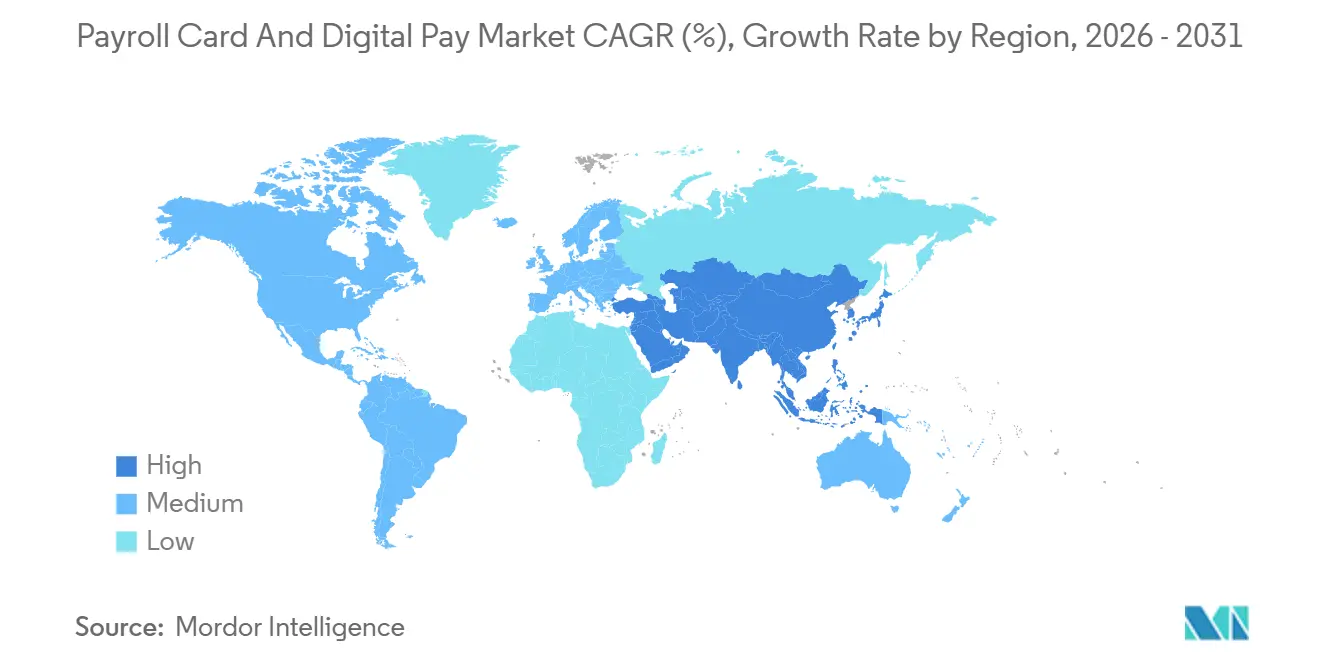
North America held 36.19% of 2025 revenue as Executive Order 14247 forced federal disbursements onto digital rails and FedNow established a sub-second settlement benchmark. Canadian provinces now require electronic wage options for temporary foreign workers, while Mexico obliges maquiladora employers to provide at least one fee-free digital method.
Europe Payroll Card and Digital Pay Market
Europe grows steadily but faces PSD2 friction that raises cross-border decline rates. Germany, the United Kingdom, France, Italy, Spain, and Russia together dominate regional card payroll adoption, particularly in retail and transport.
APAC and Middle East Payroll Card and Digital Pay Market
Asia-Pacific, posting the fastest 8.67% CAGR, benefits from UPI-linked salaries in India and high contactless penetration in Australia, Japan, and South Korea. China’s Personal Information Protection Law forces domestic payroll data processing, spurring on-shore card issuance. The Middle East gains momentum from the UAE’s real-time Wage Protection System and Saudi Arabia’s e-salary requirements.
South America and Africa Payroll Card and Digital Pay Market
South America accelerates as Brazil extends Pix Automático to payroll accounts in July 2026, unlocking recurring salary flows.[2] Argentina’s hyperinflation fuels demand for instant, dollar-denominated payouts, while Colombia and Chile modernize payroll rails at a slower cadence. Africa remains nascent; amendments to South Africa’s National Payment System Act and Nigeria’s digital wage guidelines create pilot-scale projects. Mobile-money integration and rising smartphone adoption underpin gradual expansion of the payroll card and digital pay market across the continent.
Competitive Landscape
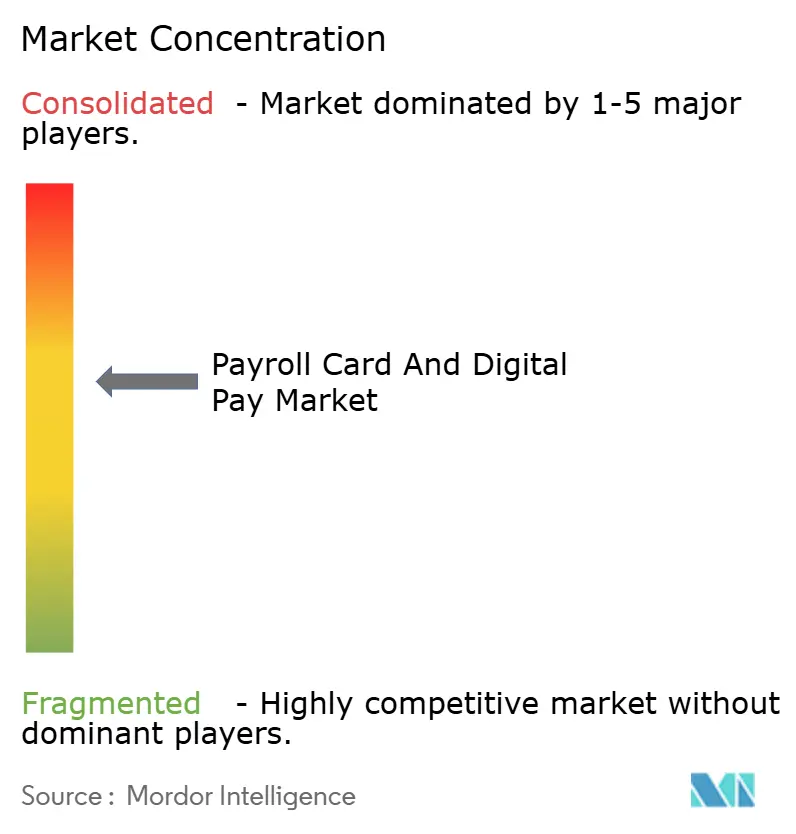
The payroll card and digital pay market presents moderate concentration: the top five issuers collectively manage about 55%-60% of global volume. ADP, Paychex, and Fiserv defend share by embedding card issuance inside existing payroll suites, while Visa, Mastercard, and American Express differentiate through tokenization and cross-border routing upgrades.
Fintech entrants such as Wise, Revolut, Branch, and Instant Financial focus on API-first products that enable real-time provisioning, earned-wage access, and fee-free international transfers. Wise reports sub-20-second settlement for 74% of workforce payouts, sidestepping traditional paycards.[3]Green Dot, a pioneer in prepaid cards, joined Workday's partner program in August 2025 to integrate its paycard platform with Workday's human-capital-management suite, streamlining onboarding for enterprise clients.
Forward-looking opportunities include stablecoin-denominated wage corridors, artificial-intelligence spend insights, and underserved verticals like home healthcare and agriculture. Mastercard’s Agent Pay signals a move toward machine-executed payroll orchestration. Rising compliance overhead may trigger further consolidation, with niche providers partnering or exiting as scale economics tighten.
Payroll Card and Digital Pay Industry Leaders
-
Visa Inc.
-
Mastercard Incorporated
-
ADP, Inc.
-
Fiserv, Inc.
-
PayPal Holdings, Inc.
- *Disclaimer: Major Players sorted in no particular order
Payroll Card and Digital Pay Market Companies Covered in this Report
- ADP, Inc.
- American Express Company
- Visa Inc.
- Mastercard Incorporated
- Fiserv, Inc.
- Green Dot Corporation
- The Brink’s Company
- H&R Block, Inc.
- PayPal Holdings, Inc.
- Wise plc
- Revolut Ltd
- Banco Bilbao Vizcaya Argentaria, S.A.
- JPMorgan Chase & Co.
- Global Payments Inc.
- Fidelity National Information Services, Inc.
- The Western Union Company
- NetSpend Corporation
- Money Network Financial, LLC
- Paychex, Inc.
- Block, Inc. (Square Payroll)
Recent Industry Developments in Payroll Card and Digital Pay Market
- April 2026: Galileo Financial Technologies launched an earnings-experience architecture supporting real-time wage visibility and instant wallet transfers.
- April 2026: Instacart expanded its Shoppers Rewards Card rollout to new U.S. regions, extending instant cashback for gig shoppers.
- March 2026: Brazil’s central bank confirmed Pix Automático expansion to salary accounts starting Jul 2026, enabling recurring payroll debits.
- January 2026: Saudi Arabia enforced a mandatory e-salary system for domestic workers, eliminating cash wage payments.
Global Payroll Card and Digital Pay Market Report Scope
Prepaid payroll cards, digital wallets, and virtual payment solutions characterize the Payroll Card and Digital Pay Market, catering especially to hourly, gig, unbanked, or underbanked workers. These innovations expedite wage access, diminish the reliance on traditional paper checks, and offer mobile-centric payment experiences. Employers harness payroll cards and digital payment methods to simplify wage disbursements, alleviate administrative tasks, and accommodate flexible payout schedules, including instant and daily payments. The market's ascent is driven by fintech advancements, the burgeoning gig economy, and a worldwide pivot towards cashless payroll methodologies.
The Payroll Card and Digital Pay Market Report is Segmented by Card Type (Open-Loop Payroll Cards, and Closed-Loop Payroll Cards), Form (Physical Payroll Cards, and Digital / Virtual Payroll Cards), Organization Size (Large Enterprises, and Small and Medium-Sized Enterprises [SMEs]), End-User Vertical (Retail Establishments, Corporate / Business Services, Government and Public Sector, Gig and Platform Workers, and Travel and Hospitality), and Geography (North America, South America, Europe, Asia-Pacific, Middle East, and Africa). The Market Forecasts are Provided in Terms of Value (USD).
Segmentation Overview
| Open-Loop Payroll Cards |
| Closed-Loop Payroll Cards |
| Physical Payroll Cards |
| Digital / Virtual Payroll Cards |
| Large Enterprises |
| Small and Medium-Sized Enterprises (SMEs) |
| Retail Establishments |
| Corporate / Business Services |
| Government and Public Sector |
| Gig and Platform Workers |
| Travel and Hospitality |
| North America | United States |
| Canada | |
| Mexico | |
| South America | Brazil |
| Argentina | |
| Rest of South America | |
| Europe | Germany |
| United Kingdom | |
| France | |
| Italy | |
| Spain | |
| Russia | |
| Rest of Europe | |
| Asia-Pacific | China |
| India | |
| Japan | |
| South Korea | |
| Australia | |
| Rest of Asia-Pacific | |
| Middle East | Saudi Arabia |
| United Arab Emirates | |
| Turkey | |
| Rest of Middle East | |
| Africa | South Africa |
| Nigeria | |
| Rest of Africa |
| By Card Type | Open-Loop Payroll Cards | |
| Closed-Loop Payroll Cards | ||
| By Form | Physical Payroll Cards | |
| Digital / Virtual Payroll Cards | ||
| By Organization Size | Large Enterprises | |
| Small and Medium-Sized Enterprises (SMEs) | ||
| By End-User Vertical | Retail Establishments | |
| Corporate / Business Services | ||
| Government and Public Sector | ||
| Gig and Platform Workers | ||
| Travel and Hospitality | ||
| By Geography | North America | United States |
| Canada | ||
| Mexico | ||
| South America | Brazil | |
| Argentina | ||
| Rest of South America | ||
| Europe | Germany | |
| United Kingdom | ||
| France | ||
| Italy | ||
| Spain | ||
| Russia | ||
| Rest of Europe | ||
| Asia-Pacific | China | |
| India | ||
| Japan | ||
| South Korea | ||
| Australia | ||
| Rest of Asia-Pacific | ||
| Middle East | Saudi Arabia | |
| United Arab Emirates | ||
| Turkey | ||
| Rest of Middle East | ||
| Africa | South Africa | |
| Nigeria | ||
| Rest of Africa | ||
Key Questions Answered in the Report
What is the current payroll card and digital pay market size and how fast is it growing?
The payroll card and digital pay market size was USD 14.11 billion in 2025, will rise to USD 15.13 billion in 2026, and is projected to reach USD 21.70 billion by 2031, reflecting a 7.48% CAGR from 2026-2031.
Which card type is expanding fastest?
Closed-loop solutions are the fastest-growing card type, advancing at a 9.45% CAGR through 2031 as employers seek tighter fee control.
Why are small and medium-sized enterprises adopting paycards quickly?
SMEs face rising compliance costs and benefit from cloud payroll bundles that cut card onboarding to hours, driving a 9.89% CAGR in adoption.
Which region will add the most incremental revenue by 2031?
Asia-Pacific, led by India’s UPI-linked salaries and Southeast Asian digital wage mandates, posts the highest regional CAGR of 8.67%.
How are gig-economy platforms influencing market growth?
Platforms such as Uber, DoorDash, and Instacart require instant payout capability, pushing the gig-worker segment to a 9.01% CAGR and reshaping employer expectations for real-time wage access.