
North America Digital Workplace Market Size and Share
Market Overview
| Study Period | 2020 - 2031 |
|---|---|
| Forecast Data Period | 2026 - 2031 |
| Base Year Market Size (2025) | USD 35.23 Billion |
| Market Size (2026) | USD 41.37 Billion |
| Market Size (2031) | USD 95.22 Billion |
| Growth Rate (2026 - 2031) | 18.15 % |
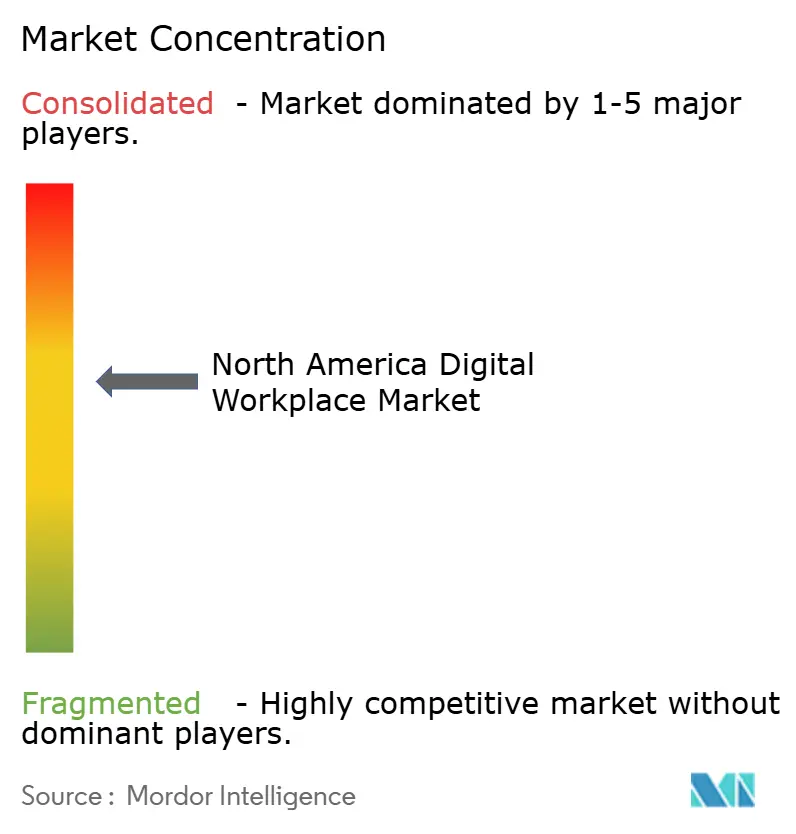
| Market Concentration | Medium |
Major Players *Disclaimer: Major Players sorted in no particular order Image © Mordor Intelligence. Reuse requires attribution under CC BY 4.0. | |
North America Digital Workplace Market Analysis by Mordor Intelligence
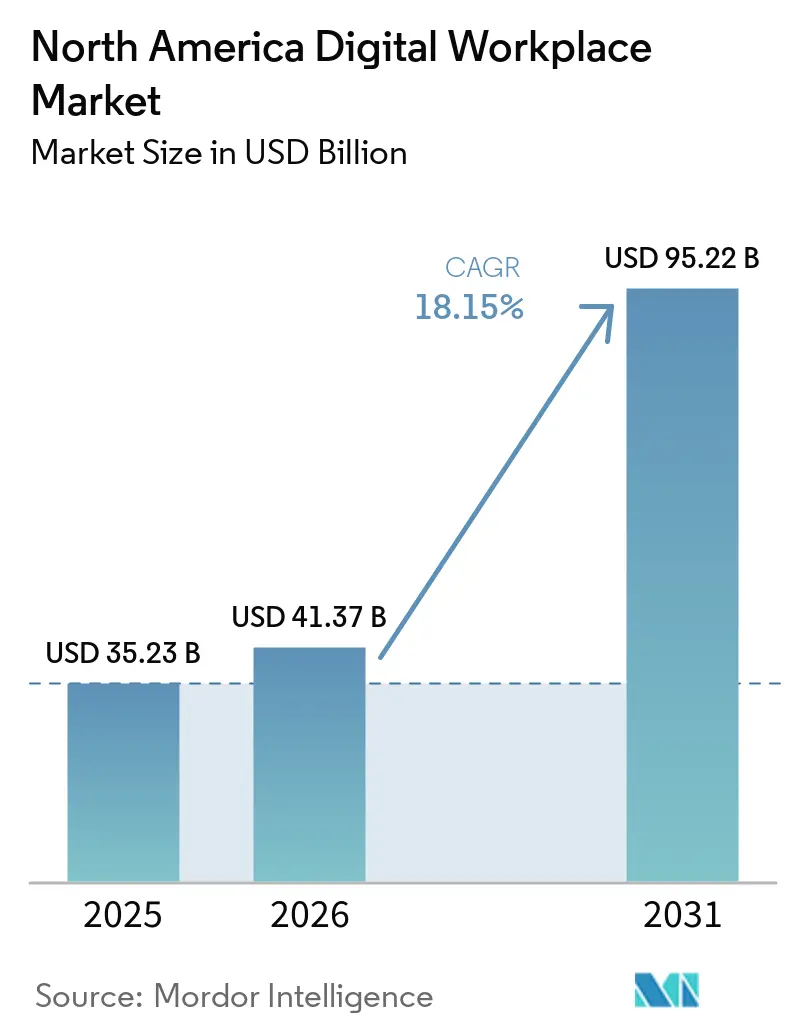
The North America digital workplace market size is projected to expand from USD 35.23 billion in 2025 and USD 41.37 billion in 2026 to USD 95.22 billion by 2031, registering a CAGR of 18.15% between 2026 and 2031. The North America digital workplace market is being shaped by a lasting shift toward hybrid operating models, in which collaboration, workflows, and employee support systems now sit closer to core business operations. AI tools are also changing purchasing priorities, as enterprises are moving beyond basic communication features and seeking governed automation, workflow execution, and embedded assistance across daily work. Cloud standardization continues to support this transition, since organizations can roll out new features faster and maintain a more consistent user experience across distributed teams. Security, identity governance, and compliance remain central buying criteria, especially as enterprise environments add more applications, devices, and non-human identities. The competitive environment is therefore favoring providers that can deliver collaboration, service management, automation, and governance through a more unified platform structure.
Key Report Takeaways
- By component, solutions led with a 69.32% revenue share of the North America digital workplace market in 2025 and are also projected to expand at an 18.56% CAGR through 2031.
- By deployment mode, cloud held 61.18% share of the North America digital workplace market in 2025, and cloud is projected to grow at an 18.78% CAGR through 2031.
- By organization size, large enterprises accounted for 64.73% of the market share in 2025, while SMEs are projected to record the highest CAGR of 18.53% through 2031.
- By end-user industry, IT and telecommunications captured 24.81% of the of the North America digital workplace market in 2025, while healthcare is projected to grow at a 20.13% CAGR through 2031.
- By geography, the United States held 83.68% share in 2025, while Mexico is projected to expand at an 18.88% CAGR through 2031.
Note: Market size and forecast figures in this report are generated using Mordor Intelligence’s proprietary estimation framework, updated with the latest available data and insights as of January 2026.
Market Trends and Insights
Drivers Impact Analysis of North America Digital Workplace Market*
| Driver | (~) % Impact on CAGR Forecast | Geographic Relevance | Impact Timeline |
|---|---|---|---|
| Rising Hybrid and Flexible Work Mandates | +4.5% | US and Canada, spill-over to Mexico | Short term (≤ 2 years) |
| AI-Enabled Collaboration and Automation Adoption | +4.2% | Global, anchored in US large enterprise | Medium term (2-4 years) |
| Employee Experience-Led Workplace Modernization | +2.8% | US and Canada, with emerging momentum in Mexico | Medium term (2-4 years) |
| Cloud-First Workplace Standardization | +2.3% | US-led, with rapid adoption in Canada and Mexico | Short term (≤ 2 years) |
| Security and Compliance Modernization Across Distributed Workforces | +1.8% | US, federal and enterprise-wide, Canada | Medium term (2-4 years) |
| Cross-Border Managed Workplace Outsourcing In North America | +1.2% | US-Mexico and US-Canada corridors | Long term (≥ 4 |
| Source: Mordor Intelligence | |||
Rising Hybrid and Flexible Work Mandates
Hybrid work has become a durable operating model in the North America digital workplace market, and it continues to support steady demand for collaboration and employee support platforms. In Canada, 56% of professionals ranked hybrid as their preferred work mode in March 2026, which shows that flexibility remains a standing workforce expectation rather than a short-lived adjustment. This preference keeps cloud-based communication, document access, and digital service tools in regular use across distributed teams.[1] Once the core hybrid infrastructure is in place, organizations can add scheduling, analytics, and AI support tools with less friction than a full platform replacement. That dynamic supports recurring platform expansion inside existing accounts and helps the North America digital workplace market grow through upgrades as much as through first-time deployments.
AI-Enabled Collaboration and Automation Adoption
AI-enabled collaboration is now one of the strongest growth engines in the North America digital workplace market because enterprises are using it for real work rather than limited trials. Microsoft reported that active agents inside the Microsoft 365 ecosystem grew 15 times year over year between March 2025 and March 2026, and 49% of Copilot conversations in North America supported cognitive work such as analysis, problem-solving, and creative tasks. Microsoft also highlighted Accenture plc’s 743,000-seat Copilot deployment, where data from 200,000 users showed 97% completed routine tasks 15 times faster and 53% reported significant productivity gains. ServiceNow reinforced this shift in May 2026 when it launched Autonomous Workforce and extended governed AI across IT, HR, CRM, finance, legal, and security operations for nearly 200 million enterprise employees. The North America digital workplace market is therefore moving toward AI orchestration, where value comes from governed execution across systems rather than from isolated chat or search features. Leadership behavior also matters because Microsoft found that manager-led AI adoption materially lifts employee trust and perceived value from agentic AI in the workplace.
Employee Experience-Led Workplace Modernization
Employee experience is becoming a more direct buying factor in the North America digital workplace market because organizations now tie workplace quality to output and retention. Unisys found in 2025 that organizations excelling in workforce productivity were twice as likely to exceed revenue targets, which shifted workplace modernization away from a narrow cost-control discussion. This has changed procurement behavior, as buyers increasingly prefer integrated environments that connect service delivery, knowledge access, and AI assistance within a single employee interface. Microsoft reported that 66% of AI users spent more time on higher-value work, while 58% said they produced work that had previously been out of reach. At the same time, only 26% of surveyed AI users believed leadership had clearly communicated its AI strategy, which shows that technology alone does not guarantee workplace gains. The North America digital workplace market is therefore rewarding vendors and employers that can connect software investment with day-to-day adoption, governance, and employee confidence.
Cloud-First Workplace Standardization
Cloud-first design has become the default direction for much of the North America digital workplace market because major platform vendors now release new AI and workflow capabilities first in the cloud. Microsoft’s expanding Microsoft 365 agent ecosystem and ServiceNow’s AI platform releases both show that product innovation is increasingly delivered through subscription environments rather than through slower upgrade cycles. This favors organizations that want faster feature adoption, easier remote support, and more consistent rollout across large workforces. In Canada, the Information and Communications Technology Council said SMEs still lag behind large enterprises in adopting cloud, AI, and advanced digital tools due to upfront costs, skills shortages, and unclear ROI timelines. Even with that friction, the direction of travel remains clear because vendors continue to add collaboration, automation, and governance capabilities into cloud-native product stacks. As a result, cloud standardization continues to expand its role across the North America digital workplace market, even in environments where some are regulated or legacy-heavy and still use a mixed deployment model.
Restraints Impact Analysis of North America Digital Workplace Market*
| Restraint | (~) Impact on CAGR Forecast | Geographic Relevance | Impact Timeline |
|---|---|---|---|
| Endpoint Sprawl and Identity Fragmentation | -2.3% | Global, most acute in large enterprise US deployments | Short term (≤ 2 years) |
| Integration Complexity Across Legacy Collaboration Stacks | -1.9% | North America, concentrated in mid-market US and Canada | Medium term (2-4 years) |
| Budget Sensitivity in Small And Medium-Sized Enterprises | -1.1% | Canada and Mexico SME markets, with US SMB exposure | Short term (≤ 2 years) |
| Change Fatigue and User Adoption Resistance | -0.8% | Global, with notable resistance in public sector US and Canada | Long term (≥ 4 years) |
| Source: Mordor Intelligence | |||
Endpoint Sprawl and Identity Fragmentation
Endpoint sprawl and identity fragmentation remain major barriers in the North America digital workplace market because distributed applications, BYOD policies, and AI agents expand faster than governance controls. Orchid Security found in 2026 that 57% of enterprise applications were authenticated outside a central identity provider, while 40% of enterprise accounts belonged to users no longer active in HR systems. The same report also showed that non-human identities often operate without directory coverage or centralized oversight, which raises the risk of scaling autonomous tools. NIST’s cybersecurity framework updates and workforce guidance now more directly reflect the need to manage non-human identities and distributed workforce risk, but implementation across complex enterprise environments still lags.[2] This creates added remediation cost, slows platform rollout, and increases the appeal of vendors that can build identity governance directly into workplace environments rather than leaving it as a separate integration layer.
Integration Complexity Across Legacy Collaboration Stacks
Integration complexity continues to slow the North America digital workplace market because many organizations still operate technology estates built through acquisitions, emergency remote-work rollouts, and departmental tool expansion. These layered environments make it harder to connect communication, workflow, knowledge, and AI tools into one coherent experience. The Information and Communications Technology Council reported in March 2026 that Canadian SMEs cited integration complexity, high upfront costs, and unclear long-term ROI as key barriers to adopting advanced digital technologies. The effect is especially visible in mid-market environments, where internal IT teams often have fewer resources to rationalize overlapping systems. This extends sales cycles for new platforms because buyers must first make sense of what they already run. It also creates a clear opening for managed service providers that can absorb legacy complexity and turn fragmented environments into more usable workplace platforms.
*Our forecasts treat driver/restraint impacts as directional, not additive. The impact forecasts reflect baseline growth, mix effects, and variable interactions.
North America Digital Workplace Market Segment Analysis
By Component:
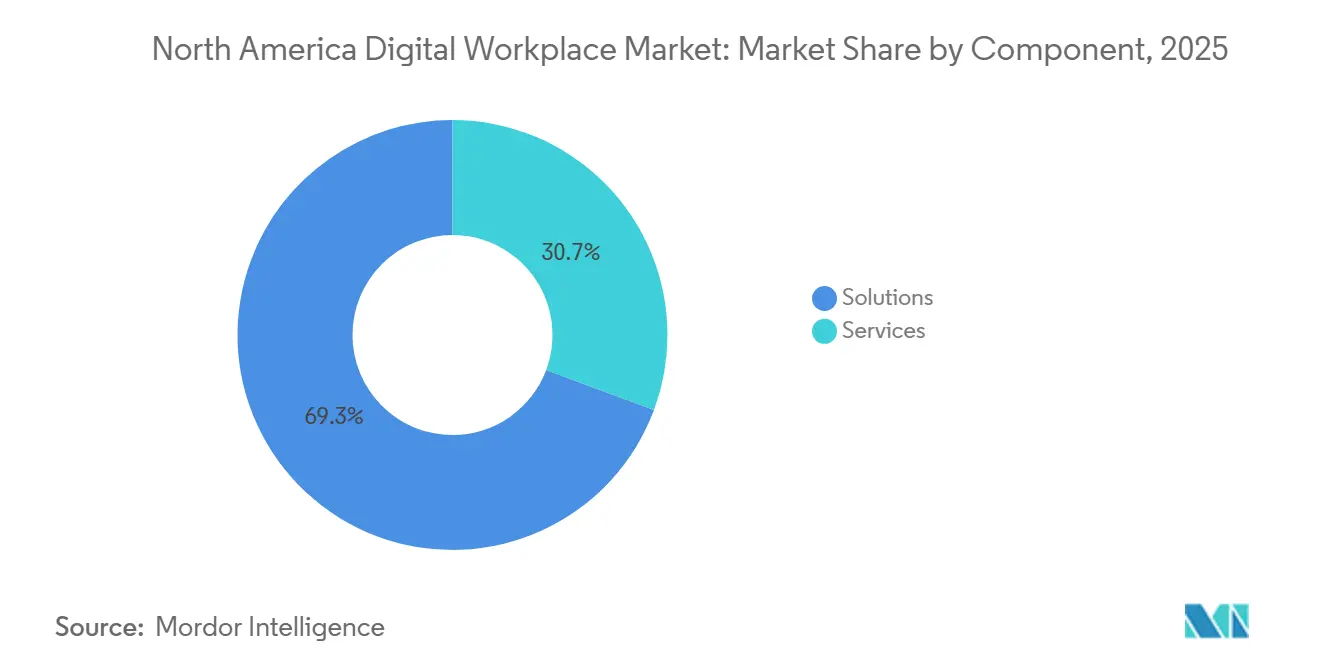
Platform Consolidation Amplifies Solutions RevenueDigital workplace solutions accounted for 69.32% of the North America digital workplace market in 2025, indicating that spending is heavily centered on integrated software platforms rather than standalone support activities. Solutions are also projected to grow at a 18.56% CAGR through 2031, making them the fastest-growing component of the North America digital workplace market. This pattern reflects enterprise demand for environments that combine collaboration, analytics, workflow automation, and AI support within a single commercial structure. Microsoft 365, Google Workspace, and ServiceNow are central to this shift because they let buyers expand functionality within an installed platform rather than managing multiple separate tools. The North America digital workplace industry is therefore seeing more value captured at the platform layer, where recurring license expansion is easier to scale than one-time software deployment work.
Accenture plc’s 743,000-seat Microsoft 365 Copilot rollout illustrates this model, as AI features can increase revenue per seat without requiring growth in the total employee count. Services still retain an important role in the North America digital workplace market, especially for migration, integration, governance, endpoint programs, and change support. However, the value mix inside services is shifting upward as routine implementation work becomes more standardized and more platform-assisted. Providers that can advise on AI governance, accelerate adoption, and measure operational outcomes are better placed than firms focused mainly on commodity implementation. This leaves the North America digital workplace market with a solutions-heavy revenue structure, while services remain essential for complex, compliance-driven, and large-scale workforce change.
By Deployment Mode:
Cloud Becomes the Default Delivery ArchitectureCloud accounted for 61.18% of the North America digital workplace market in 2025 and is forecast to expand at an 18.78% CAGR through 2031. That pace slightly exceeds the broader North America digital workplace market and confirms that cloud is taking the lead as the preferred delivery architecture. The main reason is practical rather than abstract, leading vendors now to deliver their newest collaboration, automation, and AI capabilities first through cloud-based subscription environments. Microsoft’s expanding agent ecosystem and ServiceNow’s AI platform releases both support that direction, since product development is now closely tied to cloud-native delivery and regular feature updates. For buyers, this reduces the need for separate upgrade projects and supports more consistent experiences across distributed workforces.
On-premises deployment still matters in government, manufacturing, and other settings with strict site-level control, reliance on legacy applications, or sector-specific data requirements. CISA’s Trusted Internet Connections architecture continues to shape how secure federal environments structure cloud access and remote connectivity, which helps explain why some organizations maintain more controlled deployment models even as they modernize. Hybrid deployment remains important because many enterprises need workload portability and staged transition paths rather than immediate replacement of existing estates. In that sense, hybrid is not only a temporary bridge but also a durable operating model for organizations balancing new cloud features with older operational systems. The North America digital workplace industry, therefore, continues to move toward cloud leadership, while still leaving room for mixed architectures in sectors where risk, compliance, or operational continuity carry more weight.
By Organization Size:
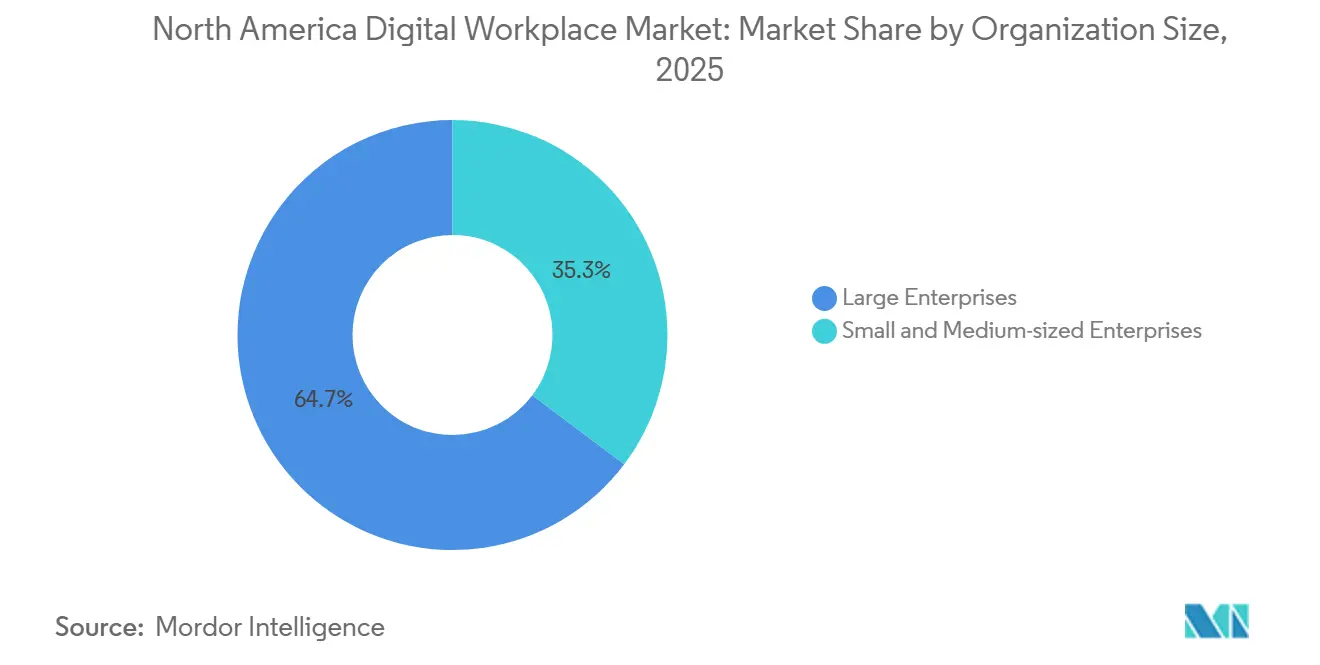
Large Enterprises Lead as SME Momentum BuildsLarge enterprises held 64.73% of the North America digital workplace market share in 2025, reflecting their multi-year licensing capacity, formal transformation budgets, and stronger governance requirements. This concentration gives large organizations a clear lead in platform adoption across the North America digital workplace market because they can standardize faster and deploy at a workforce scale. Microsoft reported a fourfold increase in customers deploying Copilot across more than 50,000 seats in a single quarter in early 2026, while Accenture plc, Bayer, and Johnson and Johnson each surpassed 90,000 seats. These are large-enterprise conditions, where the size of the workforce and the procurement structure support the broad rollout of AI-enabled workplace tools. The North America digital workplace industry remains anchored by these buyers because they are more able to absorb the cost and complexity of governed enterprise-wide deployments.
SMEs are still the fastest-growing organizational group, with an 18.53% CAGR projected through 2031 in the North America digital workplace market. Their growth is being supported by SaaS pricing models that lower entry barriers for collaboration, workflow, and automation tools. Even so, the Information and Communications Technology Council found that Canadian SMEs continued to lag large organizations in cloud, AI, and advanced digital adoption because of upfront costs, skills shortages, and uncertain ROI. That gap creates room for packaged, outcome-based managed workplace programs that are easier for smaller firms to adopt. Vendors that reduce implementation burden and present clearer cost structures are likely to capture a larger share of this expanding SME opportunity in the North America digital workplace market.
By End-User Industry:
Healthcare Outpaces a Mature IT and Telecom BaseIT and telecommunications retained the largest share at 24.81% in 2025, giving the sector the leading position in the North America digital workplace market. This leadership reflects the sector’s dual role as both a heavy user of digital workplace platforms and a builder of the infrastructure that supports them. Telecom operators and ICT service providers continue to invest in modern collaboration, cloud operations, and workforce coordination tools as part of their own transformation programs. The segment’s scale also comes from its role as a major buyer of managed workplace services across the region. As a result, IT and telecommunications continue to anchor demand even as other verticals accelerate.
Healthcare is projected to expand at a 20.13% CAGR through 2031, making it the fastest-growing end-user segment in the North America digital workplace market. Mitel reported in December 2025 that AI and automation tools led healthcare technology adoption at 53%, tied with clinical communication and collaboration platforms. That shows workplace investment in healthcare is moving closer to operational necessity, especially where staffing pressure, coordination across care settings, and administrative efficiency all matter. BFSI continues to adopt these platforms under compliance and service pressures, while manufacturing and retail place more emphasis on connecting office-based and frontline teams. Government, education, energy and utilities, and legal services each add demand through their own modernization priorities, which helps broaden the base of the North America digital workplace market beyond its traditional technology-heavy core.
Geography Analysis
United States Digital Workplace Market
The United States held 83.68% of the North America digital workplace market share in 2025, which makes it the clear center of regional demand. This position reflects the scale of enterprise transformation programs, the concentration of major platform vendors, and the depth of public-sector digital modernization in the country. Federal procurement frameworks continue to matter because FedRAMP-linked cloud adoption and CISA’s Trusted Internet Connections 3.0 architecture create recurring demand for secure workplace infrastructure across civilian, defense, and intelligence environments.[3] Microsoft also reported that 49% of Copilot conversations in North America supported cognitive work, suggesting embedded, more advanced enterprise use rather than basic experimentation. As more US enterprises extend Microsoft 365 or ServiceNow agreements, each added AI layer raises switching costs and reinforces incumbent positions inside the North America digital workplace market.
Canada Digital Workplace Market
Canada presents a split picture inside the North America digital workplace market, with stronger adoption among large enterprises and more measured progress across its broad SME base. The Information and Communications Technology Council confirmed in March 2026 that Canadian SMEs continued to underperform in adopting cloud, AI, and advanced technologies due to cost, skills, and ROI barriers. At the same time, hybrid work remains a durable force in the country, and Technocompetences found that 56% of Canadian professionals preferred hybrid work arrangements. This keeps collaboration, employee access, and workplace support platforms firmly tied to day-to-day operations.
Mexico Digital Workplace Market
Mexico is the fastest-growing geography in the North America digital workplace market, with an 18.88% CAGR projected through 2031. Growth in Mexico is being supported by nearshoring, because expanding North American operations are carrying enterprise-grade workplace standards into the country. That creates demand for the same collaboration, workflow, and service platforms used by multinational employers in the United States and Canada. The result is a faster-moving digital workplace environment in which cloud-based tools, managed services, and enterprise platform standardization are becoming increasingly important for new operating footprints in the region.
Competitive Landscape
The North America digital workplace market is moderately concentrated. Microsoft Corporation, Google LLC, and ServiceNow sit in the strongest platform positions because they can bundle collaboration, AI automation, employee service delivery, and workflow management within longer subscription relationships. This makes the North America digital workplace market harder for smaller platform challengers to penetrate, especially when large enterprises prefer expansion inside installed environments. IBM Corporation and Accenture plc remain important service-layer competitors because they connect consulting, migration, governance, and workplace modernization into broader transformation programs. The result is a structure in which platform power is relatively concentrated, but service revenue remains contested between global integrators and specialist providers.
Strategic differentiation is shifting away from basic collaboration feature sets and toward AI orchestration, identity governance, and autonomous workflow execution. IBM and ServiceNow expanded their collaboration in June 2026 to address AI-ready data and legacy application modernization, underscoring the convergence of platform and service capabilities.[4] Cisco also announced its intent to acquire Astrix Security in 2026, extending its secure access and identity portfolio into non-human identity management for agentic enterprise environments. ServiceNow’s Autonomous Workforce launch in May 2026 further underlined the shift toward governed cross-functional AI execution rather than isolated productivity features.
The managed services field remains broader, with DXC Technology Company, Cognizant Technology Solutions Corporation, Capgemini SE, NTT DATA Group Corporation, Tata Consultancy Services Limited, and Wipro Limited competing across implementation and ongoing workplace operations. These companies differentiate through vertical knowledge, delivery footprint, and the maturity of their AI-enabled service models. There is still meaningful white space in healthcare, legal, and government-focused workplace programs, where compliance needs create higher entry barriers for generalist providers. That leaves the North America digital workplace market open to both continued platform consolidation and selective specialization across the services tier.
North America Digital Workplace Industry Leaders
-
Microsoft Corporation
-
IBM Corporation
-
Accenture plc
-
Cisco Systems, Inc.
-
Google LLC
- *Disclaimer: Major Players sorted in no particular order
North America Digital Workplace Market Companies Covered in this Report
- Microsoft Corporation
- IBM Corporation
- Accenture plc
- Cisco Systems, Inc.
- Google LLC
- Citrix Systems, Inc.
- DXC Technology Company
- Cognizant Technology Solutions Corporation
- Hewlett Packard Enterprise Development LP
- NTT DATA Group Corporation
- Tata Consultancy Services Limited
- Wipro Limited
- Atos SE
- Unisys Corporation
- Capgemini SE
- Oracle Corporation
- Salesforce, Inc.
- VMware, Inc.
- ServiceNow, Inc.
- Zoom Communications, Inc.
Recent Industry Developments in North America Digital Workplace Market
- June 2026: IBM Corporation and ServiceNow announced an expanded collaboration targeting two primary barriers to enterprise AI scale, the AI-ready data problem and the legacy application layer. The partnership combines IBM's AI and automation capabilities with the ServiceNow AI Platform to deliver joint solutions that modernize aging systems and enable autonomous IT operations. Joint solutions are expected in the second half of 2026, positioning both companies to compete in the managed AI-workplace modernization segment.
- June 2026: Infosys, Tata Consultancy Services Limited, and Wipro Limited collectively scaled Microsoft 365 Copilot deployments across over 300,000 employees. Wipro alone reported 95% monthly active usage and 7.5 million prompts per month from its workforce, translating into more than 250,000 full-time equivalent days saved per quarter, demonstrating that IT services firms are using internal AI deployment as a delivery differentiator for client programs.
- May 2026: ServiceNow launched its Autonomous Workforce platform at Knowledge 2026, introducing AI specialists for IT, HR, CRM, finance, legal, and security operations. Simultaneously, the company integrated Moveworks following a March 2025 acquisition, releasing ServiceNow EmployeeWorks to combine conversational AI with governed workflow execution for nearly 200 million enterprise employees.
- May 2026: IBM Corporation and Red Hat announced Project Lightwell, a USD 5 billion commitment backed by more than 20,000 engineers to secure open-source software in the AI era. The initiative is positioned to harden the open-source foundations that underpin enterprise digital workplace and AI deployment environments, addressing the growing cybersecurity risks posed by open-source dependencies at scale.
North America Digital Workplace Market Report Scope
The North America Digital Workplace Market comprises solutions and services that enable organizations to create connected, collaborative, and productive work environments through digital technologies. These offerings help employees access applications, data, communication tools, and business workflows seamlessly across office-based, remote, and hybrid work settings. Digital workplace technologies include collaboration and communication platforms, virtual workspace solutions, employee experience tools, endpoint and device management systems, workflow automation applications, identity and access management solutions, and managed workplace services.
The North America Digital Workplace Market Report is Segmented by Component (Solutions, and Services), Deployment Mode (Cloud, On-Premises, and Hybrid), Organization Size (Large Enterprises, and Small and Medium-sized Enterprises), End-User Industry (IT and Telecommunications, BFSI, Healthcare, Manufacturing, Retail, Government and Public Sector, Education, Energy and Utilities, Legal and Professional Services), and Geography (United States, Canada, and Mexico). The Market Forecasts are Provided in Terms of Value (USD).
Segmentation Overview
| Solutions | Unified Communication and Collaboration |
| Unified Endpoint Management | |
| Enterprise Mobility and Management | |
| Employee Experience Platforms and Intranet | |
| Workflow Automation and Knowledge Management | |
| Virtual Desktop Infrastructure and Cloud PC | |
| Services |
| Cloud |
| On-Premises |
| Hybrid |
| Large Enterprises |
| Small and Medium-sized Enterprises |
| IT and Telecommunications |
| BFSI |
| Healthcare |
| Manufacturing |
| Retail |
| Government and Public Sector |
| Education |
| Energy and Utilities |
| Legal and Professional Services |
| Other End-User Industries |
| United States |
| Canada |
| Mexico |
| By Component | Solutions | Unified Communication and Collaboration |
| Unified Endpoint Management | ||
| Enterprise Mobility and Management | ||
| Employee Experience Platforms and Intranet | ||
| Workflow Automation and Knowledge Management | ||
| Virtual Desktop Infrastructure and Cloud PC | ||
| Services | ||
| By Deployment Mode | Cloud | |
| On-Premises | ||
| Hybrid | ||
| By Organization Size | Large Enterprises | |
| Small and Medium-sized Enterprises | ||
| By End-User Industry | IT and Telecommunications | |
| BFSI | ||
| Healthcare | ||
| Manufacturing | ||
| Retail | ||
| Government and Public Sector | ||
| Education | ||
| Energy and Utilities | ||
| Legal and Professional Services | ||
| Other End-User Industries | ||
| By Geography | United States | |
| Canada | ||
| Mexico |
Key Questions Answered in the Report
What is the size of the North America digital workplace market?
The North America digital workplace market reached USD 35.23 billion in 2025, rises to USD 41.37 billion in 2026, and is forecast to reach USD 95.22 billion by 2031 at a CAGR of 18.15%.
Which deployment model is leading in North America?
Cloud led with 61.18% share in 2025 and is also the fastest-growing deployment mode, with an 18.78% CAGR projected through 2031.
Which organization type is driving most spending on digital workplace platforms?
Large enterprises accounted for 64.73% share in 2025 because they have larger transformation budgets, broader governance requirements, and stronger ability to deploy at workforce scale.
Which end-user segment is growing the fastest?
Healthcare is projected to expand at a 20.13% CAGR through 2031, supported by rising use of AI, automation, and communication tools across care delivery and administration.
Which country leads regional demand?
The United States held 83.68% of regional revenue in 2025, making it the core demand center because of enterprise scale, public-sector digitization, and vendor concentration.
What is shaping competition across this space?
Competition is moving toward AI orchestration, identity governance, and workflow automation, with examples including IBM and ServiceNow’s expanded collaboration, Cisco’s Astrix move, and ServiceNow’s Autonomous Workforce launch.