
Digital Workplace Market Size and Share
Market Overview
| Study Period | 2020 - 2031 |
|---|---|
| Market Size (2026) | USD 100.5 Billion |
| Market Size (2031) | USD 244.16 Billion |
| Growth Rate (2026 - 2031) | 19.43 % |
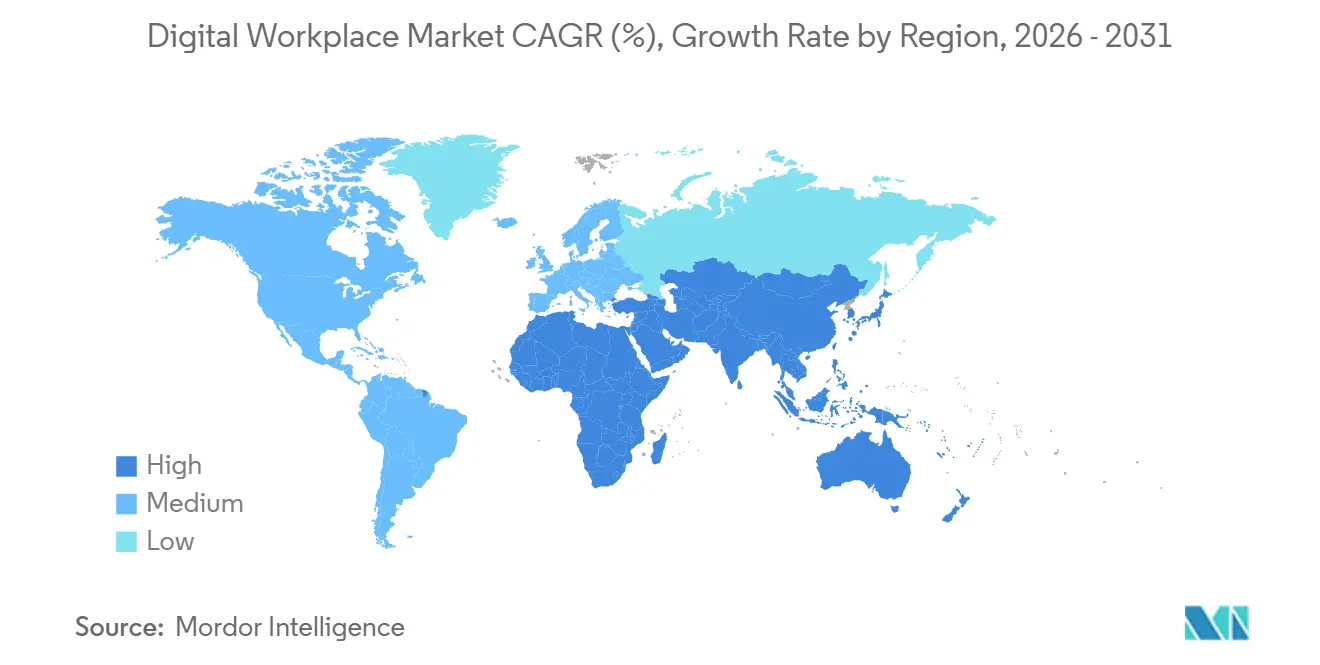
| Fastest Growing Market | Asia-Pacific |
| Largest Market | North America |
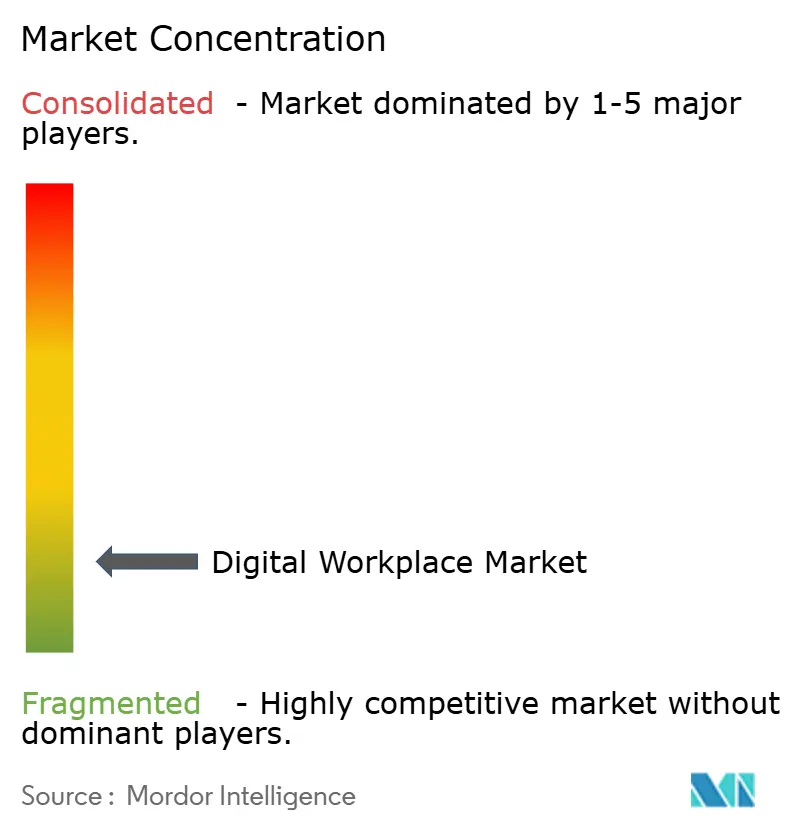
| Market Concentration | Low |
Major Players *Disclaimer: Major Players sorted in no particular order Image © Mordor Intelligence. Reuse requires attribution under CC BY 4.0. | |
Digital Workplace Market Analysis by Mordor Intelligence
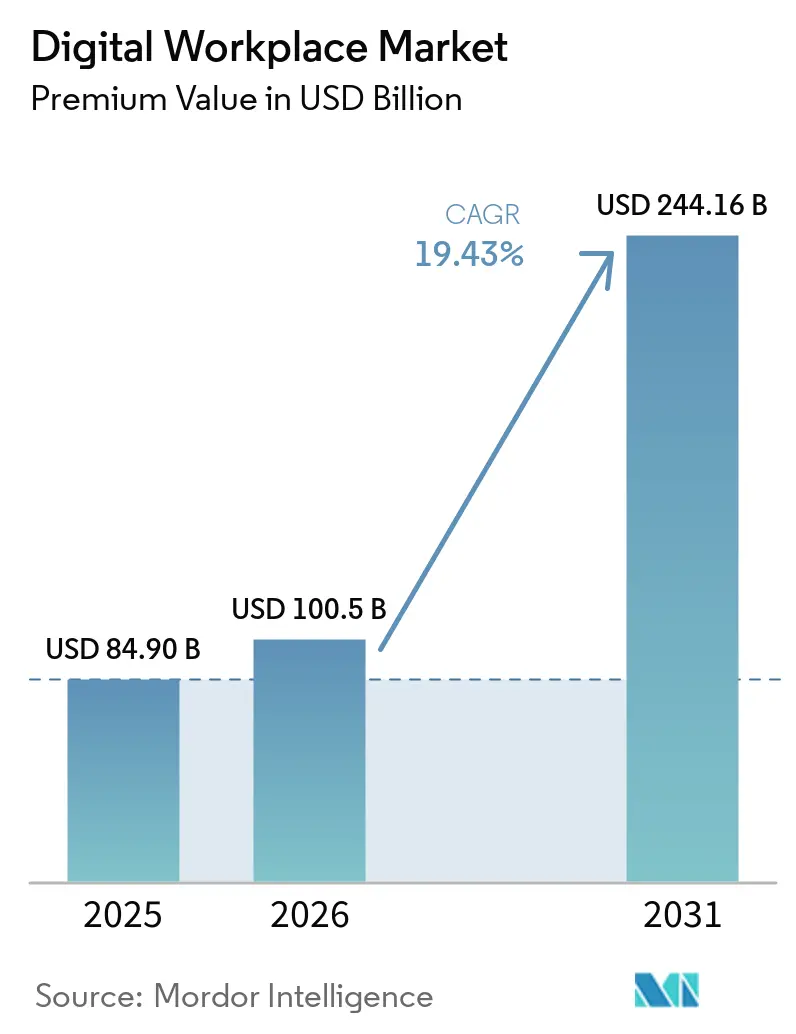
The digital workplace market size is projected to be USD 84.90 billion in 2025, USD 100.50 billion in 2026, and reach USD 244.16 billion by 2031, growing at a CAGR of 19.43% from 2026 to 2031. Growth is being shaped by a broad shift in how organizations run daily work, with collaboration, endpoint management, workflow access, and employee experience now treated as core operating systems rather than support tools. The end of support for Windows 10 in 2025 pushed many enterprises into a combined cycle of device refreshes, cloud PC migrations, and workplace suite modernization, which simultaneously lifted demand across several solution areas. AI is also changing buying behavior, as companies now prefer platforms that embed automation, search, and task execution into the product rather than add them later through separate tools. Competitive activity is moving in 2 directions, large platform vendors protecting broad enterprise accounts, while specialist providers expand through product extensions and targeted acquisitions. The main constraint is not a lack of demand, but the pace at which organizations can handle governance, integration, and compliance requirements as digital workplace environments become more connected and more dependent on enterprise data.
Key Report Takeaways
- By component, solutions accounted for 63.89% of revenue of the digital workplace market in 2025 and are projected to grow at a 20.62% CAGR through 2031.
- By deployment mode, cloud held 52.38% share in 2025 and is projected to expand at a 20.70% CAGR through 2031.
- By organization size, large enterprises held 64.34% share in 2025, while SMEs are projected to expand at a 19.43% CAGR through 2031.
- By end-user industry, IT and telecommunications held 23.92% share in 2025, while healthcare is projected to expand at a 24.87% CAGR through 2031.
- By geography, North America held 42.16% of the digital workplace market share in 2025, while Asia-Pacific is projected to expand at a 23.18% CAGR through 2031.
Note: Market size and forecast figures in this report are generated using Mordor Intelligence’s proprietary estimation framework, updated with the latest available data and insights as of January 2026.
Market Trends and Insights
Drivers Impact Analysis of Digital Workplace Market*
| Driver | (~) % Impact on CAGR Forecast | Geographic Relevance | Impact Timeline |
|---|---|---|---|
| AI-Powered Collaboration and Workflow Automation | +4.5% | Global | Short term (≤ 2 years) |
| Agentic AI and Enterprise Search Connector Expansion | +3.9% | Global, led by North America and Asia-Pacific | Medium term (2-4 years) |
| Rising Hybrid and Distributed Work Normalization | +3.2% | Global | Short term (≤ 2 years) |
| Cloud and SaaS Workplace Suite Migration | +2.8% | North America and Europe, spilling over to Asia-Pacific | Short term (≤ 2 years) |
| Growing Investment in Digital Employee Experience | +2.1% | North America and Europe | Medium term (2-4 years) |
| Windows 10 Endpoint Refresh, Windows 11 Adoption, and Cloud PC Migration | +1.4% | Global, concentrated in North America and Europe | Short term (≤ 2 years) |
| Source: Mordor Intelligence | |||
AI-Powered Collaboration and Workflow Automation Drive Enterprise Adoption
AI-powered collaboration has moved from limited pilots to broad enterprise use, and that shift is now the strongest demand driver in the digital workplace market. Active AI agents in the Microsoft 365 ecosystem grew 15x year over year between March 2025 and March 2026, and the increase was 18x among large enterprises, indicating how quickly adoption is deepening within established workplace platforms.[1] Microsoft also found that 49% of more than 100,000 Copilot conversations in February 2026 supported cognitive work such as analysis, problem-solving, evaluation, and creative thinking, suggesting that AI is being used for higher-value work rather than just simple drafting. This matters for the digital workplace market because buyers are increasingly choosing platforms that embed AI into collaboration, document, and workflow environments from the start. That preference raises switching costs and improves renewal potential for vendors whose road maps are centered on human-AI teamwork. It also makes feature depth more important than simple product breadth as the digital workplace market moves into a more mature adoption phase.
Agentic AI and Enterprise Search Connector Expansion Redefine Workplace Architecture
Agentic AI is widening the role of the digital workplace market from a set of productivity tools into a layer that can reason, retrieve information, and complete work across enterprise systems. Microsoft released Work IQ APIs into general availability in June 2026, creating a shared intelligence layer that lets agents access context and act across Microsoft 365 data and applications. Nexthink Spark, launched in January 2026, achieved a 77% first-contact resolution rate for IT issues and resolved Level 1 issues autonomously in under 2 minutes, demonstrating that agent-based models can already handle a meaningful share of service activity in the digital workplace market. The practical result is that enterprise search is no longer just a retrieval feature, because it is becoming part of the execution path for tasks, approvals, support, and content handling. Vendors that lack strong connector ecosystems for ERP, HR, ITSM, and communication tools will find it harder to remain central as this model spreads. Vendors that build proprietary connectors and stronger orchestration capabilities are likely to gain a more durable position in the digital workplace market over the forecast period.
Rising Hybrid and Distributed Work Normalization Creates Platform Replacement Demand
Hybrid and distributed work have become standard operating conditions for many organizations, keeping the digital workplace market tied to everyday workflow stability rather than to temporary work-from-home needs. Companies now need collaboration, identity, endpoint control, and employee communication tools to function consistently across offices, homes, and mobile settings. That requirement is leading many buyers to replace overlapping point tools with broader platforms that can manage communication, support, and access under one commercial agreement. The digital workplace market benefits from this shift because replacement spending is often larger and more deliberate than first-time deployment spending. It also changes vendor selection criteria, since buyers place more weight on unified governance, simpler administration, and a better experience for distributed teams. As a result, providers that can integrate productivity, workflow, and device management into a single operating layer are better placed to capture new demand in the digital workplace market.
Cloud and SaaS Workplace Suite Migration Widens the Addressable Market
Cloud and SaaS migration remains one of the clearest volume drivers for the digital workplace market, especially as organizations modernize communication, endpoint, and employee experience environments together. Microsoft tied the end of Windows 10 support to Windows 11, Copilot+ PCs, and Windows 365 adoption, which turned workplace modernization into a time-bound infrastructure decision for many enterprises. In April 2026, Microsoft also retired Windows 10 gallery images for Windows 365, further pushing cloud PC provisioning toward Windows 11 environments in the digital workplace market. On the vendor side, TeamViewer launched DEX Essentials in May 2025 to bring digital employee experience capabilities to SMBs, which shows that suppliers are widening their reach beyond large enterprise accounts. This combination of forced refresh cycles and easier SaaS entry points expands the customer base that can participate in the digital workplace market. It also favors providers with cloud-native deployment models, clear packaging, and faster time-to-value for mid-sized organizations.
Restraints Impact Analysis of Digital Workplace Market*
| Restraint | (~) % Impact on CAGR Forecast | Geographic Relevance | Impact Timeline |
|---|---|---|---|
| Data Privacy, Cybersecurity, and Compliance Exposure | -1.8% | Global, most acute in Europe and Asia-Pacific | Long term (≥ 4 years) |
| Legacy Application and Integration Complexity | -1.4% | North America and Europe, enterprise-heavy markets | Medium term (2-4 years) |
| Tool Sprawl and Digital Friction | -1.1% | Global | Medium term (2-4 years) |
| AI Governance and Workforce Enablement Gaps | -0.8% | Global | Medium term (2-4 years) |
| Source: Mordor Intelligence | |||
Data Privacy, Cybersecurity, and Compliance Exposure Extend Procurement Cycles
Data privacy and cybersecurity remain the most persistent sources of friction in the digital workplace market, especially as AI tools gain access to messages, files, workflows, and employee records. Cisco reported in its 2026 Data Privacy Benchmark Study that 56% of organizations still lack a dedicated AI governance committee, which leaves a clear control gap as workplace tools become more autonomous.[2] Microsoft also documented in its 2025 Digital Defense Report that AI-automated phishing and multi-stage attack chains are increasing pressure on remote-access environments, thereby raising the operating risk of distributed digital workplace deployments. These issues matter most in regulated fields such as BFSI and healthcare, where buyers often require SOC 2 Type II, ISO 27001, FedRAMP, and HIPAA-related controls before contract award. The result is longer sales cycles, greater documentation requirements, and higher costs for vendors serving the digital workplace market. It also gives providers that can demonstrate mature governance, audit readiness, and regional compliance support an early edge in the buying process.
Legacy Application and Integration Complexity Limits Deployment Velocity
Legacy application estates continue to slow the digital workplace market because many enterprises still run older ERP, HR, identity, and workflow systems that do not connect cleanly to newer employee experience platforms. Modern workplace layers often require deep API mapping, identity federation, role-based access control, and regional data-handling rules before users have a seamless experience. This makes integration capability a commercial issue rather than a technical detail inside the digital workplace market. Staffbase's September 2025 integration with ServiceNow reflects this reality, as customers increasingly expect workplace tools to sit directly on top of existing IT service workflows rather than alongside them. The same pattern is visible across buyer requests for pre-built connections to systems such as SAP SuccessFactors, Workday, ServiceNow, and Microsoft Teams. Vendors with mature connector libraries and published integration pathways can move faster in the digital workplace market, while smaller providers often face higher delivery effort and weaker margins when every deployment requires custom work.
*Our forecasts treat driver/restraint impacts as directional, not additive. The impact forecasts reflect baseline growth, mix effects, and variable interactions.
Digital Workplace Market Segment Analysis
By Component:
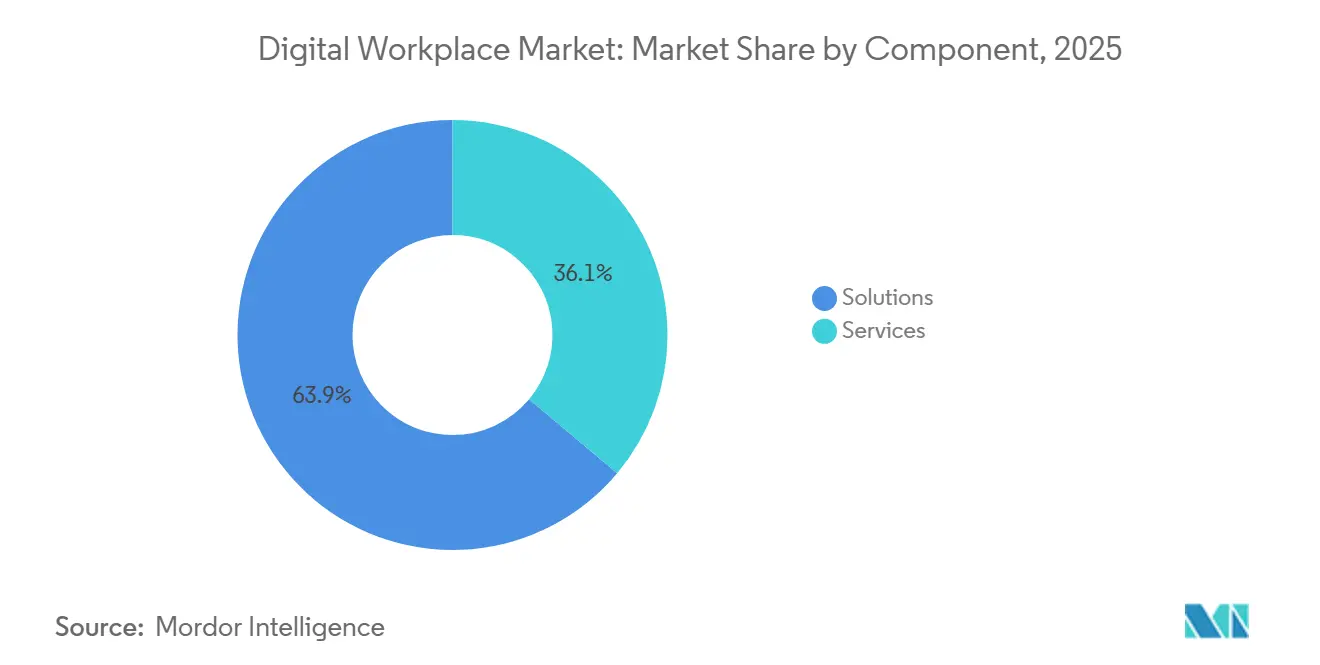
AI-Native Solutions Accelerate Platform ConsolidationSolutions accounted for 63.89% of revenue in 2025 and are projected to grow at a 20.62% CAGR through 2031, indicating they held a larger share of the digital workplace market and are expanding faster than the overall market. This pattern shows that buyers in the digital workplace market still prefer software-led modernization over service-only engagements. Demand is strongest where platforms combine collaboration, employee communication, workflow access, and endpoint control into a single operating layer. The digital workplace market is rewarding vendors that can embed AI capabilities directly into these core modules rather than selling automation as a detached add-on. That preference also strengthens renewal economics, because once workflow logic, permissions, and content models are embedded, replacement becomes more disruptive.
The digital workplace industry is also seeing greater interest in solutions that help organizations navigate the Windows 10 transition and the rise of cloud-managed endpoints. Microsoft retired Windows 10 gallery images for Windows 365 in April 2026, making it harder for organizations already using virtual desktop environments to defer Windows 11-oriented cloud PC planning. That change supports demand for VDI, cloud PC management, and unified endpoint control inside the digital workplace market. Services still matter because large enterprises often need outside help to configure, secure, and govern agentic workflows that span several tools. Even so, the center of value in the digital workplace market remains with solution vendors that can pull collaboration, automation, and endpoint administration into a single product environment.
By Deployment Mode:
Cloud Deepens Enterprise Platform Lock-InCloud held 52.38% of deployments in 2025 and is projected to expand at a 20.70% CAGR through 2031, giving it the leading position in the digital workplace market and confirming that it remains the dominant delivery model. The cloud segment leads the digital workplace market because it supports faster provisioning, more frequent feature updates, and simpler distribution of AI capabilities across user groups. It also allows vendors to unify analytics, governance, and support functions in ways that are harder to replicate across disconnected local installations. As a result, growth in the digital workplace market is increasingly tied to deeper workload migration and wider seat expansion inside existing contracts. This makes vendor relationships more durable once a buyer has standardized on a cloud suite.
At the same time, the digital workplace market is not moving to a fully uniform cloud model. On-premises deployments still serve defense, government, and some financial services environments where residency and control requirements remain strict. Hybrid architectures continue to matter for enterprises that need cloud collaboration on top of legacy ERP, file, or identity systems, and the digital workplace market benefits when vendors can manage both sides through one control plane. Microsoft has linked Windows 11 migration, Windows 365 adoption, and device security more closely, supporting a blended approach rather than a simple cloud-only narrative. Over time, the digital workplace market is likely to reward providers that can make hybrid administration feel as consistent as cloud administration for end users and IT teams.
By Organization Size:
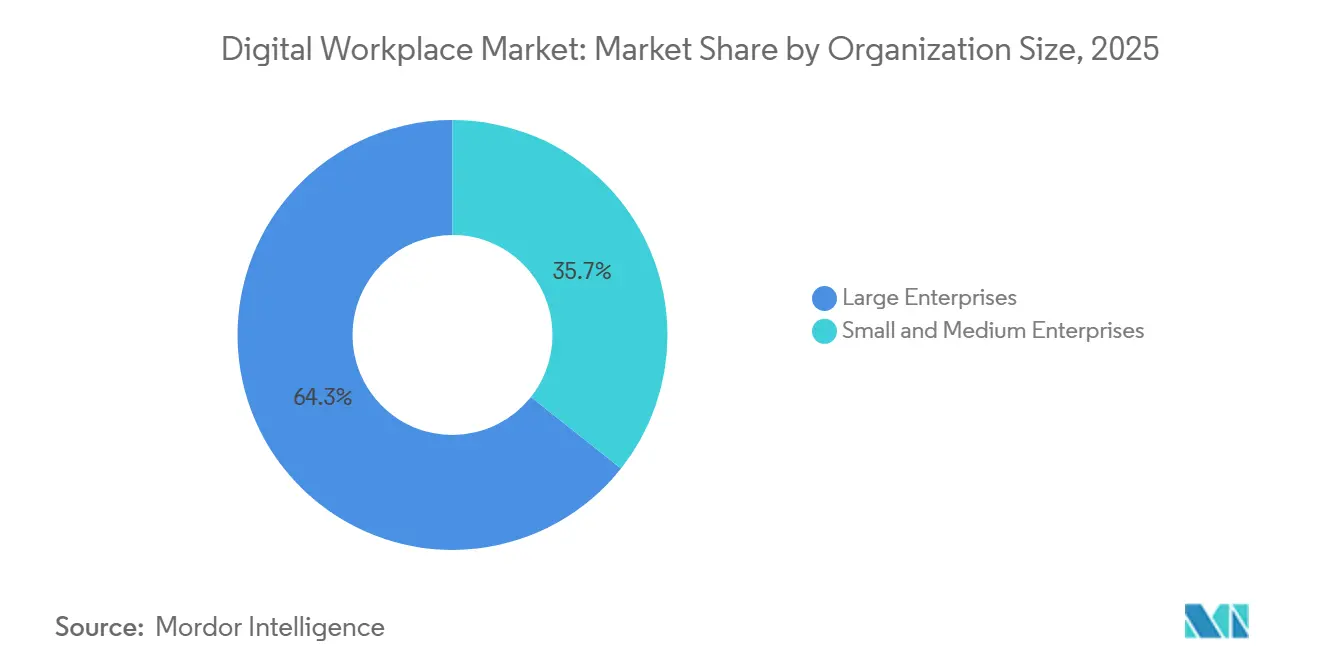
SMEs Emerge As The Growth EngineLarge enterprises held a 64.34% share in 2025, while SMEs are projected to expand at a 19.43% CAGR through 2031, indicating that scale still drives current revenue, but smaller organizations are adding momentum to the digital workplace market. Large accounts remain important because they buy more seats, more services, and more complex governance features than smaller customers. Even so, the digital workplace market is widening as SaaS pricing lowers the upfront barrier that once kept advanced workplace tools concentrated in the enterprise tier. Vendors are responding with simpler packages, faster onboarding, and modular AI capabilities that smaller organizations can adopt without lengthy consulting cycles. This opens a broader path for growth without relying only on large multiyear deals.
The digital workplace industry is also becoming easier for SMEs to enter, as suppliers are designing clearer entry points. TeamViewer introduced DEX Essentials in May 2025 as an add-on for SMB users, demonstrating how vendors are adapting digital employee experience tools to smaller budgets and lighter implementation requirements. The Microsoft 2026 Work Trend Index also showed that organizational factors such as culture, manager support, and talent practices shape AI value more than individual skill alone, which means products that guide adoption can matter as much as product depth for smaller teams. In the digital workplace market, this favors vendors that combine self-service setup, transparent governance, and predictable subscription pricing. It also suggests that SME growth in the digital workplace market will come from practical usability rather than just headline AI features.
By End-User Industry:
Healthcare Sets The Fastest Growth PaceIT and telecommunications held a 23.92% share in 2025, while healthcare is projected to grow at a 24.87% CAGR through 2031, making it the fastest-moving vertical in the digital workplace market. Healthcare demand is driven by the need to reduce administrative work for clinicians while keeping communication, scheduling, and documentation within secure operating environments. In June 2026, NHS England announced the rollout of Microsoft 365 Copilot to 505,000 clinicians and support staff, following a pilot across 90 organizations in which users saved an average of 43 minutes of administrative time each day. Philips also reported in its 2026 Future Health Index that 65% of clinicians increased their use of AI tools and that close to half reported annual time savings of at least 132 hours. These results make healthcare one of the clearest examples of how the digital workplace market can shift from experimental use to measurable operational value.
The digital workplace industry still draws its largest current spending from IT and telecommunications because that vertical adopted cloud collaboration, endpoint management, and digital employee experience tools earlier than most others. BFSI remains attractive because contract values are high, even though procurement is slower due to governance and compliance expectations. Manufacturing is also narrowing the gap as frontline communication, mobile access, and workflow tools spread beyond desk-based roles in the digital workplace market. Retail, government and public sector, education, energy and utilities, and legal and professional services each contribute demand with different buying cycles and workforce profiles. That diversity means the digital workplace market is no longer tied to a single buyer type, even though adoption speeds still differ sharply across verticals.
Geography Analysis
North America Digital Workplace Market
North America held 42.16% of the digital workplace market share in 2025, maintaining its lead due to its dense vendor base, deep enterprise cloud adoption, and faster adoption of AI-enabled productivity tools. The United States drives most of that spending, and the October 2025 end of support for Windows 10 created a linked cycle of device refreshes, endpoint management renewals, and cloud PC migrations that continues to shape procurement in 2026. Canada and Mexico add to regional demand by standardizing cross-border platforms in sectors such as professional and financial services. The digital workplace market remains strongest in North America, where enterprises are willing to integrate AI features, governance controls, and employee experience goals into broader platform decisions. That keeps the region important not only for revenue, but also for early product adoption patterns that often influence the wider digital workplace market.
APAC Digital Workplace Market
Asia-Pacific is projected to expand at a 23.18% CAGR through 2031, making it the fastest-growing regional contributor to the digital workplace market over the forecast period. Growth is supported by government-backed digitalization, broad SME participation, and the spread of cloud-first workplace architectures across both developed and emerging economies. India contributes through a large IT services base and a domestic enterprise environment that is increasingly able to absorb cloud-delivered workplace tools at scale. Japan, South Korea, Australia, and New Zealand support the digital workplace market through strong enterprise digital maturity, while Southeast Asia is earlier in adoption but moving quickly, with mobile-first SaaS models aligning with local operating conditions. Across the region, the digital workplace market benefits from buyers seeking faster deployment and simpler administration without building large local infrastructure stacks.
EMEA and South America Digital Workplace Market
Europe remains a meaningful region for the digital workplace market because demand is strong, but vendor choice is shaped more heavily by privacy, sovereignty, and compliance concerns. Germany provides a clear example, as Bitkom reported that 41% of German companies actively use AI in 2026, up from 17% in 2024, while 77% still cite data protection requirements as a major hurdle.[3] South America is developing through demand for financial services, retail, and technology in Brazil and Argentina, though currency pressure and connectivity gaps can slow the rollout pace. The Middle East is benefiting from large public and enterprise digital programs in Saudi Arabia and the UAE, while Africa is still early but structurally aligned with mobile-native SaaS adoption in countries such as South Africa, Nigeria, Kenya, and Egypt. Taken together, these regions show that the digital workplace market is global in demand, but still local in how compliance, infrastructure, and workforce conditions shape adoption speed.
Competitive Landscape
The digital workplace market has a layered structure, with large platform vendors controlling broad productivity and infrastructure relationships while specialist providers compete on intranet, DEX, workflow automation, and VDI depth. That structure keeps the digital workplace market fragmented and competitive because no single product type can cover every use case equally well. Large vendors benefit from scale, installed seats, and broader data access, while smaller vendors win when they solve a specific workflow or employee experience problem better than a general suite. This balance is why consolidation is happening most actively in the middle tier of the digital workplace market rather than only at the top. Buyers increasingly want fewer tools, but they still value specialist functionality when it improves adoption, governance, or support outcomes.
The July 2025 LumApps and Beekeeper merger created a combined platform serving more than 7 million users across 2,000 clients globally, demonstrating how specialist vendors are expanding product coverage to compete more directly in the digital workplace market. LumApps then moved again in April 2026 with its planned acquisition of Comeen, extending its reach from employee communications into space management, digital signage, and visitor services.[4] These steps show that competitive positioning in the digital workplace market is now tied to how well vendors connect digital communication with the wider employee operating environment. They also reflect a push toward unified contracts that cover both desk-based and frontline workers.
AI-native product design is becoming the clearest differentiator in the digital workplace market because buyers are looking for automation that improves outcomes and not just interface enhancements. TeamViewer expanded Tia in April 2026 with AI-driven scripting that learns from resolved issue history and converts it into reusable automations, pointing toward a more autonomous support model in the digital workplace market. Simpplr also launched its AI Control Center in May 2026, giving IT teams a single governance layer for AI features and data providers, directly addressing a procurement concern that has become more visible across the digital workplace market. Vendors that can combine AI orchestration, governance, endpoint awareness, and employee experience into a single operating model are likely to hold the strongest position as the digital workplace market evolves through 2031.
Digital Workplace Industry Leaders
-
TeamViewer SE
-
Nexthink SA
-
LumApps SAS
-
Staffbase GmbH
-
Simpplr Inc.
- *Disclaimer: Major Players sorted in no particular order
Digital Workplace Market Companies Covered in this Report
- TeamViewer SE
- Nexthink SA
- LumApps SAS
- Staffbase GmbH
- Simpplr Inc.
- Appspace Inc.
- Haiilo GmbH
- Powell Software SAS
- Igloo Software Inc.
- Interact Software Group Limited
- Claromentis Ltd.
- Axero Solutions LLC
- Invotra Limited
- Jostle Corporation
- Passageways, Inc.
- InvolveSoft, Inc.
- Robin Powered, Inc.
- eXo Platform SAS
- Liferay, Inc.
- Lakeside Software, LLC
- ControlUp Technologies Ltd.
- Flexxible Information Technology, S.L.
- Kissflow Inc.
- United Planet GmbH
- Workgrid Software LLC
Recent Industry Developments in Digital Workplace Market
- June 2026: NHS England announced the rollout of Microsoft 365 Copilot to 505,000 clinicians and support staff, the largest healthcare AI deployment globally, following a pilot across 90 organizations where participants saved an average of 43 minutes of administrative time daily, equivalent to 5 working weeks annually. The deployment includes access to Copilot Studio for building AI agents automating patient discharge, rota scheduling, and HR inquiries.
- June 2026: Microsoft released Work IQ APIs into general availability on June 16, 2026, delivering an intelligence layer enabling enterprise-built agents to reason, retrieve context, and act across Microsoft 365 data and applications, the same infrastructure layer powering Copilot, accelerating enterprise-scale agentic workplace deployments.
- May 2026: Simpplr launched the AI Control Center, a centralized governance console that enables IT administrators to manage all AI features, providers, and configurations across the employee experience platform, providing the governance capabilities enterprise CISOs require for compliant AI deployment.
- April 2026: LumApps entered a definitive agreement to acquire Comeen, a workplace experience platform specializing in space management, digital signage, and visitor services. The deal, expected to close in May 2026, extends LumApps's AI employee hub from digital communications into physical workplace orchestration.
Global Digital Workplace Market Report Scope
The Digital Workplace Market encompasses solutions and services that enable employees to work, collaborate, communicate, and access enterprise resources digitally across distributed, hybrid, and office-based work environments. Digital workplace offerings integrate technologies such as collaboration platforms, virtual workspaces, endpoint management, employee experience solutions, workflow automation tools, unified communications, security and identity management systems, and managed workplace services to enhance workforce productivity, engagement, and operational efficiency.
The Digital Workplace Market Report is Segmented by Component (Solutions, and Services), Deployment Mode (Cloud, On-Premises, and Hybrid), Organization Size (Large Enterprises, and Small and Medium-sized Enterprises), End-User Industry (IT and Telecom, BFSI, Healthcare, Manufacturing, Retail, Government and Public Sector, Education, Energy and Utilities, Legal and Professional Services, and Other End-user Industries), and Geography (North America, South America, Europe, Asia-Pacific, Middle East, and Africa). The Market Forecasts are Provided in Terms of Value (USD).
Segmentation Overview
| Solutions | Unified Communication and Collaboration |
| Unified Endpoint Management | |
| Enterprise Mobility and Management | |
| Employee Experience Platforms and Intranet | |
| Workflow Automation and Knowledge Management | |
| Virtual Desktop Infrastructure and Cloud PC | |
| Services |
| Cloud |
| On-premises |
| Hybrid |
| Large Enterprises |
| Small and Medium-sized Enterprises |
| IT and Telecommunications |
| BFSI |
| Healthcare |
| Manufacturing |
| Retail |
| Government and Public Sector |
| Education |
| Energy and Utilities |
| Legal and Professional Services |
| Other End-user Industries |
| North America | United States |
| Canada | |
| Mexico | |
| South America | Brazil |
| Argentina | |
| Chile | |
| Colombia | |
| Rest of South America | |
| Europe | Germany |
| United Kingdom | |
| France | |
| Italy | |
| Spain | |
| Netherlands | |
| Nordics | |
| Russia | |
| Rest of Europe | |
| Asia-Pacific | China |
| Japan | |
| India | |
| South Korea | |
| Australia and New Zealand | |
| Southeast Asia | |
| Rest of Asia-Pacific | |
| Middle East | Saudi Arabia |
| United Arab Emirates | |
| Turkey | |
| Israel | |
| Rest of Middle East | |
| Africa | South Africa |
| Egypt | |
| Nigeria | |
| Kenya | |
| Rest of Africa |
| By Component | Solutions | Unified Communication and Collaboration |
| Unified Endpoint Management | ||
| Enterprise Mobility and Management | ||
| Employee Experience Platforms and Intranet | ||
| Workflow Automation and Knowledge Management | ||
| Virtual Desktop Infrastructure and Cloud PC | ||
| Services | ||
| By Deployment Mode | Cloud | |
| On-premises | ||
| Hybrid | ||
| By Organization Size | Large Enterprises | |
| Small and Medium-sized Enterprises | ||
| By End-user Industry | IT and Telecommunications | |
| BFSI | ||
| Healthcare | ||
| Manufacturing | ||
| Retail | ||
| Government and Public Sector | ||
| Education | ||
| Energy and Utilities | ||
| Legal and Professional Services | ||
| Other End-user Industries | ||
| By Geography | North America | United States |
| Canada | ||
| Mexico | ||
| South America | Brazil | |
| Argentina | ||
| Chile | ||
| Colombia | ||
| Rest of South America | ||
| Europe | Germany | |
| United Kingdom | ||
| France | ||
| Italy | ||
| Spain | ||
| Netherlands | ||
| Nordics | ||
| Russia | ||
| Rest of Europe | ||
| Asia-Pacific | China | |
| Japan | ||
| India | ||
| South Korea | ||
| Australia and New Zealand | ||
| Southeast Asia | ||
| Rest of Asia-Pacific | ||
| Middle East | Saudi Arabia | |
| United Arab Emirates | ||
| Turkey | ||
| Israel | ||
| Rest of Middle East | ||
| Africa | South Africa | |
| Egypt | ||
| Nigeria | ||
| Kenya | ||
| Rest of Africa | ||
Key Questions Answered in the Report
What is the current and forecast value of the digital workplace market?
The digital workplace market size is USD 100.50 billion in 2026 and is projected to reach USD 244.16 billion by 2031, growing at a 19.43% CAGR over 2026-2031.
Which component leads digital workplace spending?
Solutions lead spending with 63.89% share in 2025 and are projected to grow at a 20.62% CAGR through 2031.
Why is healthcare growing faster than other end-user segments?
Healthcare is projected to expand at a 24.87% CAGR because AI-assisted documentation and workflow tools are helping reduce administrative load on clinical staff.
Which region is expanding the fastest through 2031?
Asia-Pacific is the fastest-growing region with a projected 23.18% CAGR, supported by digitalization programs, SME adoption, and cloud-first deployment models.
What is driving vendor competition in workplace platforms?
Competition is being shaped by AI-native product design, stronger connector ecosystems, and platform consolidation through moves such as the LumApps-Beekeeper merger and TeamViewer's Tia expansion.
What is the biggest challenge for adoption over the forecast period?
Governance, cybersecurity, and integration complexity remain the main barriers, especially where AI tools need access to enterprise data across older systems and regulated workflows.