
Paperless Enterprise and Digital Process Sustainability Software Market Size and Share
Market Overview
| Study Period | 2020 - 2031 |
|---|---|
| Market Size (2026) | USD 8.74 Billion |
| Market Size (2031) | USD 17.91 Billion |
| Growth Rate (2026 - 2031) | 15.43 % |
| Fastest Growing Market | Asia-Pacific |
| Largest Market | North America |
| Market Concentration | Medium |
Major Players *Disclaimer: Major Players sorted in no particular order Image © Mordor Intelligence. Reuse requires attribution under CC BY 4.0. | |
Paperless Enterprise and Digital Process Sustainability Software Market Analysis by Mordor Intelligence
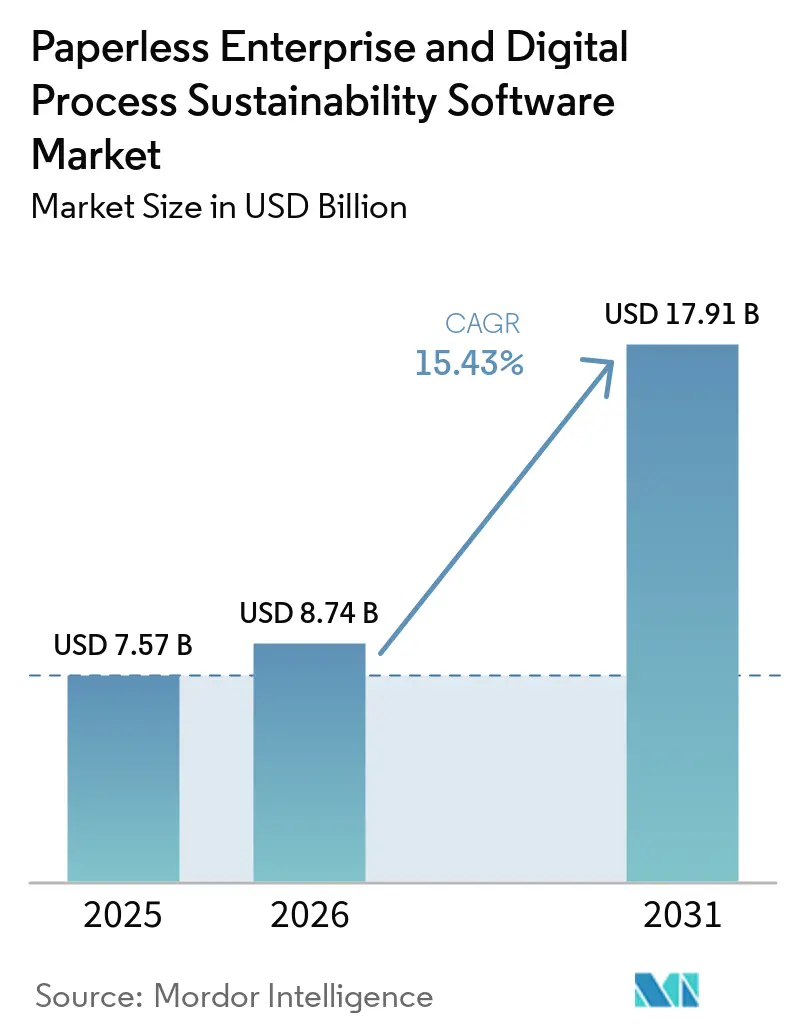
The paperless enterprise and digital process sustainability software market size is projected to expand from USD 7.57 billion in 2025 and USD 8.74 billion in 2026 to USD 17.91 billion by 2031, registering a CAGR of 15.43% over 2026-2031. The paperless enterprise and digital process sustainability software market is being shaped by regulatory mandates that now make digital recordkeeping and electronic workflows a legal requirement in several major economies. It is also gaining momentum as enterprises move from basic document storage toward workflow control, audit trails, and governed automation that can support both compliance and operating efficiency. AI-enabled document capture and workflow tools are changing buyer expectations because enterprises increasingly want classification, extraction, routing, and reporting functions inside the same platform. At the same time, data residency rules and organizational resistance in legacy-heavy environments are slowing some deployments, especially in regulated sectors and in multinational operating models. Competition remains broad, with large platform vendors and specialized content and workflow providers all trying to strengthen their position through AI integration, cloud partnerships, and service-led delivery models.
Key Report Takeaways
- By component, software held 63.47% of revenue in 2025, while services are projected to expand at a 16.01% CAGR through 2031 in the paperless enterprise and digital process sustainability software market.
- By deployment model, cloud-based deployment held 68.91% share in 2025 and is projected to grow at a 17.42% CAGR through 2031.
- By organization size, large enterprises accounted for 72.53% of revenue in 2025, while SMEs are projected to expand at a 17.76% CAGR through 2031.
- By application, document management held 31.42% share in 2025, while process sustainability tracking and reporting is projected to grow at a 15.91% CAGR through 2031.
- By end-user industry, banking, financial services, and insurance accounted for 23.14% of revenue in 2025, while healthcare and life sciences is projected to expand at a 17.69% CAGR through 2031.
- By geography, North America held 35.43% share in 2025, while Asia-Pacific is projected to grow at a 16.81% CAGR through 2031.
Note: Market size and forecast figures in this report are generated using Mordor Intelligence’s proprietary estimation framework, updated with the latest available data and insights as of January 2026.
Market Trends and Insights
Drivers Impact Analysis of Paperless Enterprise and Digital Process Sustainability Software Market*
| DRIVER | (~) % IMPACT ON CAGR FORECAST | GEOGRAPHIC RELEVANCE | IMPACT TIMELINE |
|---|---|---|---|
| Rising Demand for Paperless Compliance and Audit Readiness | +3.1% | Global, with highest intensity in EU, North America, Japan, and India | Short term (≤ 2 years) |
| AI-Enabled Document Capture and Workflow Automation | +2.8% | Global, APAC and North America leading deployment velocity | Medium term (2-4 years) |
| Remote and Hybrid Work Process Standardization | +2.4% | North America and EU, with spillover to APAC and MEA | Short term (≤ 2 years) |
| Sustainability Reporting Pressure on Enterprise Process Digitization | +2.2% | EU core, expanding to APAC core and North America | Medium term (2-4 years) |
| Integration With Enterprise Systems and API-Led Orchestration | +1.8% | Global, with concentration in enterprise-dense North America and APAC | Medium term (2-4 years) |
| Underused Value From Archived Process Data and Process Mining | +1.4% | North America and Europe, with early gains in APAC | Long term (≥ 4 years) |
| Source: Mordor Intelligence | |||
Rising Demand for Paperless Compliance and Audit Readiness
The paperless enterprise and digital process sustainability software market is moving forward because compliance is no longer treated as a discretionary software upgrade. Germany updated its GoBD guidance on July 14, 2025, and the rule tightened expectations around compliant electronic recordkeeping and digital archiving for business transactions.[1] Japan has also been pushing formal electronic bookkeeping compliance under the Electronic Bookkeeping Act, which keeps digital storage and retrieval requirements at the center of enterprise workflow decisions. This means buyers are not just replacing paper files with digital folders, they are building governed process layers that can stand up in an audit. Once that foundation is in place, the same systems also support faster retrieval, stronger version control, and cleaner evidence trails across finance, procurement, and operations. That combination is making the paperless enterprise and digital process sustainability software market more resilient, because legal needs and operational needs are now reinforcing each other.
AI-Enabled Document Capture and Workflow Automation
AI-enabled capture is changing how the paperless enterprise and digital process sustainability software market is evaluated by enterprise buyers. The shift is no longer limited to optical character recognition, because buyers now expect extraction, routing, and validation to happen inside a governed workflow environment. The LF AI and Data Foundation launched the DocLang Specification Working Group on June 9, 2026, with the aim of creating an open standard for AI-native documents. That move matters because it supports more consistent preparation and handling of document data for AI systems across enterprise use cases. It also shifts competitive pressure away from simple capture and toward orchestration, analytics, and governance. As a result, the paperless enterprise and digital process sustainability software market is rewarding vendors that can embed intelligence directly in production workflows instead of offering AI as an isolated feature.
Remote and Hybrid Work Process Standardization
Remote and hybrid work is still an active force in the paperless enterprise and digital process sustainability software market because it exposed how much day-to-day process control depended on in-person routines. When approvals, handoffs, and exception handling are no longer managed in the same physical space, enterprises need clearer workflow logic and stronger document control. That change pushes organizations toward platforms that combine document management, forms, approval routing, and governed access in one environment. It also reduces the appeal of point tools that solve only storage or only signature requirements. In many deployments, the real purchase driver is not paper elimination by itself, but the need to make business processes consistent across dispersed teams. This is why the paperless enterprise and digital process sustainability software market is seeing stronger demand for platforms that can turn informal process knowledge into repeatable digital steps.
Sustainability Reporting Pressure on Enterprise Process Digitization
Sustainability reporting requirements are driving the paperless enterprise and digital process sustainability software market to a new level of demand beyond traditional content management. Directive (EU) 2026/470 entered into force on March 18, 2026, and it requires harmonized digital data formats and XBRL-tagged sustainability disclosures for covered companies.[2] That requirement raises the importance of workflow traceability, controlled data capture, and document-linked reporting processes. It also means sustainability data cannot remain outside the core document and approval environment used for financial and compliance records. Enterprises that treat sustainability disclosure as a stand-alone reporting task are likely to face duplicate controls and weaker alignment with the audit. This is helping the paperless enterprise and digital process sustainability software markets expand into use cases where document governance and structured reporting must work together.
Restraints Impact Analysis of Paperless Enterprise and Digital Process Sustainability Software Market*
| RESTRAINT | (~) % IMPACT ON CAGR FORECAST | GEOGRAPHIC RELEVANCE | IMPACT TIMELINE |
|---|---|---|---|
| Change Management Resistance in Legacy-Heavy Enterprises | -1.5% | Global, most acute in manufacturing, government, and BFSI | Medium term (2-4 years) |
| Data Residency and Sovereignty Constraints | -1.2% | EU, MEA, and APAC national markets with localization mandates | Long term (≥ 4 years) |
| Workflow Fragmentation Across Mixed Application Stacks | -0.8% | Global, concentrated in large enterprises with multi-vendor ERP stacks | Medium term (2-4 years) |
| Long Enterprise Sales Cycles for Regulated Buyers | -0.5% | North America, EU, and APAC regulated sectors | Short term (≤ 2 years) |
| Source: Mordor Intelligence | |||
Change Management Resistance in Legacy-Heavy Enterprises
Change management remains one of the clearest limits on the paperless enterprise and digital process sustainability software market, especially where legacy processes are deeply embedded. Many enterprises still run document-heavy workflows inside established ERP-linked routines that employees know well, even if those routines are slow. That creates resistance not only because migration takes effort, but also because teams often fear short-term disruption to productivity and compliance. The problem often appears after deployment, when a platform is purchased and implemented, but only a small share of its workflow capability is actually used. In those cases, the business sees the cost of the system before it sees the process value of the system. This is why vendors in the paperless enterprise and digital process sustainability software market are gaining ground when they pair software with adoption programs, workflow redesign support, and measurable usage targets.
Data Residency and Sovereignty Constraints
Data residency rules are another brake on the paperless enterprise and digital process sustainability software market, particularly for cloud-first architectures. The challenge is not only where data sits, but also which laws may apply to that data once a multinational provider is involved. This becomes more difficult for regulated buyers in financial services, healthcare, and government, where procurement teams must think about legal exposure as well as system performance. The result is that some organizations delay purchases, narrow vendor lists, or keep part of the workflow on premises even when cloud deployment would be operationally easier. In practice, this creates a more fragmented architecture than many buyers originally intended. It also keeps hybrid and sovereign-ready configurations relevant in the paperless enterprise and digital process sustainability software market for longer than a purely cost-based cloud model would suggest.
*Our forecasts treat driver/restraint impacts as directional, not additive. The impact forecasts reflect baseline growth, mix effects, and variable interactions.
Paperless Enterprise and Digital Process Sustainability Software Market Segment Analysis
By Component:
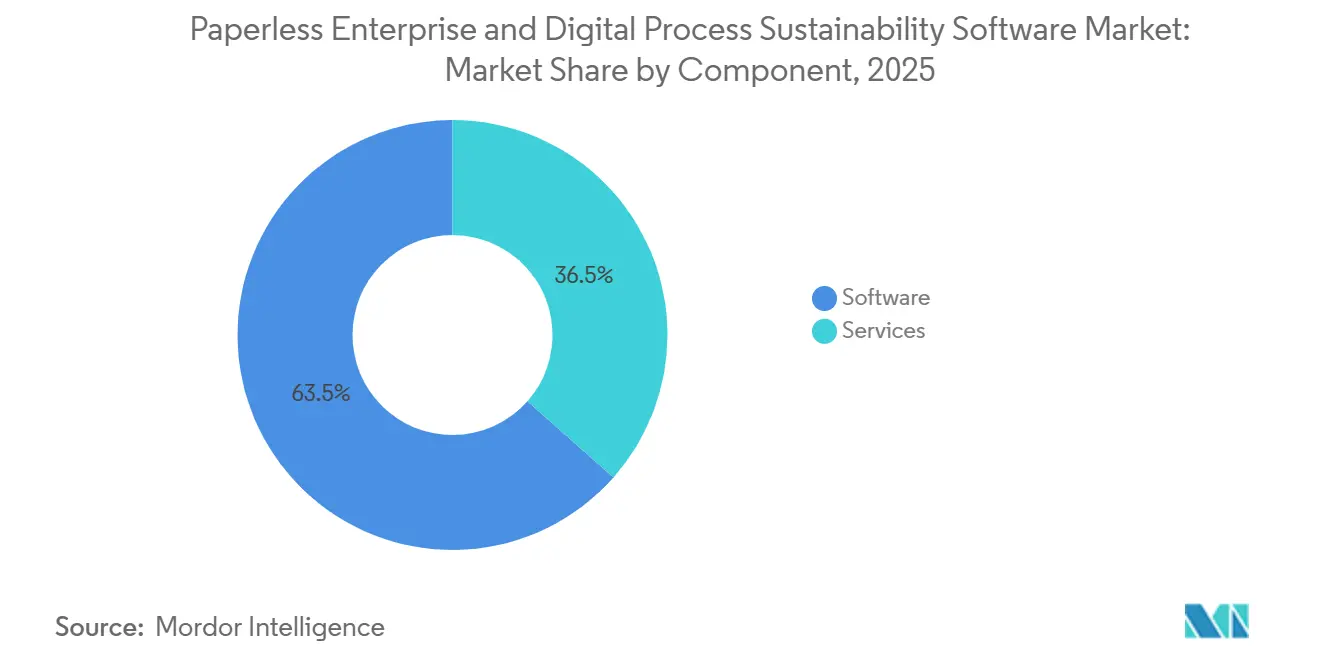
Services Deepen Delivery and RetentionSoftware held 63.47% of revenue in 2025, which kept license and platform income at the center of the paperless enterprise and digital process sustainability software market. That position reflects the fact that document control, workflow logic, records handling, and reporting functions still begin with a core software layer. Even so, services are projected to grow at a 16.01% CAGR through 2031, which is faster than the overall paperless enterprise and digital process sustainability software market. The faster expansion in services shows that many buyers now need more than installation support. They need integration work, governance design, workflow mapping, and continued optimization after the system goes live. In this segment, software remained the commercial anchor, but services became more important as the complexity of deployment increased.
The balance between software and services is changing because AI-capable platforms require cleaner data structures, stronger controls, and tighter process design than older document repositories did. Enterprises often need support across ERP, CRM, middleware, and legacy document environments before automation can run reliably at scale. That creates recurring work for vendors and partners even after the initial license has been sold. Newgen introduced its Enterprise Orchestration Layer in May 2026, which showed how vendors are trying to move from isolated automation into continuous, governed execution across enterprise processes. ABBYY also emphasized governed document AI through its product positioning and continued recognition in intelligent document processing, which reinforced the value of accuracy, auditability, and operational consistency.[3] This means the Paperless Enterprise and Digital Process Sustainability Software Market industry is not shifting away from software, but it is placing more value on the service layer that turns software into a working operating model.
By Deployment Model:
Cloud Becomes the Main Growth EngineCloud-based deployment held 68.91% of revenue in 2025, giving it the largest share of the paperless enterprise and digital process sustainability software market. It is also projected to grow at a 17.42% CAGR through 2031, which places cloud clearly ahead of the overall paperless enterprise and digital process sustainability software market size growth rate. The current case for cloud is broader than lower infrastructure cost, because buyers increasingly connect cloud adoption with AI readiness, faster updates, and more scalable workflow execution. That matters in document-heavy environments where extraction, routing, search, and classification can no longer depend on static compute assumptions. Cloud platforms also support channel expansion, marketplace-led buying, and bundle-based distribution more easily than on-premises models do. These factors are keeping cloud at the forefront of new deployment decisions, especially where enterprises want to modernize both workflow control and user access.
The same pattern is visible in how vendors are linking content tools with broader cloud ecosystems. Laserfiche launched on AWS Marketplace in June 2026, which expanded direct procurement access for regulated enterprise buyers through a cloud channel already familiar to many IT teams. At the same time, on-premises and hybrid models remain important in the paperless enterprise and digital process sustainability software market because some buyers still cannot place all content and process data in a public cloud environment. UiPath released agentic AI capabilities for on-premises deployment in May 2026, with clear attention to public sector and regulated use cases that require stronger sovereignty control. Hybrid deployment therefore remains less of a temporary compromise and more of a practical operating model in sectors where policy risk matters as much as technical performance. In that context, the paperless enterprise and digital process sustainability software market share of cloud remains dominant, but mixed architectures are still important to actual buyer behavior.
By Organization Size:
SMEs Open a Faster Expansion PathLarge enterprises held 72.53% of revenue in 2025, which shows how deeply the paperless enterprise and digital process sustainability software market is already embedded in complex global organizations. These buyers have larger document volumes, broader compliance exposure, and more resources to support multi-country deployments. Even so, SMEs are projected to expand at a 17.76% CAGR through 2031, which makes them the faster-growing organization size segment. That difference reflects a classic adoption pattern in which large companies have moved into renewal and consolidation while smaller firms are still entering the category in larger numbers. It also reflects how regulatory digitization now reaches companies that previously could defer software investment. As entry-level pricing and cloud accessibility improve, the paperless enterprise and digital process sustainability software market is becoming easier to adopt for firms with leaner internal IT teams.
SME demand is especially important because it changes how products must be sold and supported. Smaller organizations usually need faster setup, lower administrative burden, and more intuitive interfaces than large enterprise buyers do. DocuWare announced DocuWare Aura in May 2026 as an AI companion for natural-language interaction with file cabinets, and that direction matched the need to reduce operational complexity for users without dedicated document administrators. The growth of SMEs also carries a regional implication for the paperless enterprise and digital process sustainability software market, because regulatory mandates in parts of Asia and South America can create large new volumes from smaller customers rather than a few large renewals from established accounts. Vendors that rely on heavy customization may find that model less efficient in the SME tier. Vendors with SaaS-native delivery, guided setup, and broad channel reach are likely to be better aligned with where new demand is forming.
By Application:
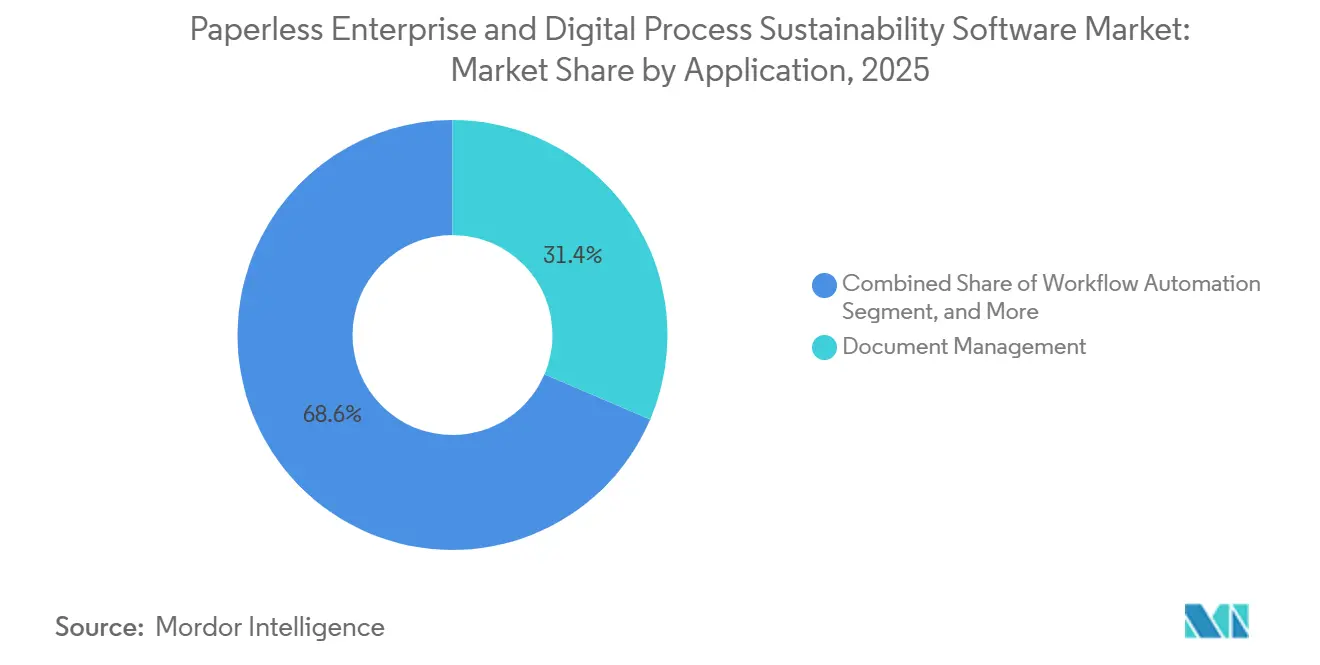
Process Sustainability Tracking Gains GroundDocument management held 31.42% of revenue in 2025, which kept it as the largest application in the paperless enterprise and digital process sustainability software market. That leadership is expected because document control remains the entry point for records retention, retrieval, approval workflows, and digital audit readiness. At the same time, process sustainability tracking and reporting is projected to grow at a 15.91% CAGR through 2031, making it the fastest-growing application in the paperless enterprise and digital process sustainability software market size mix. The growth of this application shows that buyers increasingly need digital systems to support not only business process execution but also reporting discipline tied to sustainability disclosure. Once sustainability information must be captured in structured form and supported by traceable workflows, it starts to depend on the same control framework used for finance and compliance records. That is why the application mix is evolving beyond traditional filing and storage use cases.
The broader application stack is also becoming more interdependent. Workflow automation, e-signature, electronic forms, and records management all benefit when intelligence can route work, classify content, and trigger actions without heavy manual involvement. Appian introduced AI-assisted spec-driven development and Model Context Protocol integration for agents in April 2026, which highlighted how AI execution is being tied more closely to governed enterprise processes. Adobe also expanded its document workflow direction in 2026 through generative AI features inside Acrobat Studio and later through a productivity agent that connects PDF work with major AI environments.[4] The result is that application boundaries inside the paperless enterprise and digital process sustainability software market are becoming less rigid. Buyers now expect one platform to support capture, processing, approval, storage, disclosure preparation, and governed user interaction across the same workflow chain.

By End-User Industry:
Healthcare Accelerates While BFSI Stays LargestBanking, financial services, and insurance accounted for 23.14% of revenue in 2025, which made it the largest end-user segment in the paperless enterprise and digital process sustainability software market. Its lead reflects the constant need for retention controls, audit readiness, customer documentation, and regulated process execution across account opening, servicing, and compliance tasks. Healthcare and life sciences, however, are projected to grow at a 17.69% CAGR through 2031, which makes it the fastest-growing end-user segment and an important driver of paperless enterprise and digital process sustainability software market size expansion. The healthcare growth pattern is tied to compliant document processing, clinical workflow digitization, and the need to reduce administrative friction while preserving traceability. In both sectors, workflow reliability matters as much as storage, because the document often triggers the next regulated action. This keeps the focus on governed process design rather than simple repository scale.
The end-user mix below these two leaders remains broad and commercially important. Information technology and telecom, government and public sector, and manufacturing create a large middle layer of demand in the paperless enterprise and digital process sustainability software market. Government buyers often move more slowly, but their sovereignty requirements and process standardization needs can support larger and more durable contracts once procurement is complete. Manufacturing is also becoming more relevant as invoicing, supplier records, and operational documentation are pulled into digital compliance frameworks. Retail and e-commerce, education, and energy and utilities remain smaller categories, but they are still moving away from paper-based coordination as cloud access becomes more common. This makes the end-user landscape wide rather than narrow, which supports continued opportunity for both horizontal platforms and vendors that focus on regulated vertical requirements.
Geography Analysis
North America Paperless Enterprise and Digital Process Sustainability Software Market
North America held 35.43% of revenue in 2025, giving it the largest regional position in the paperless enterprise and digital process sustainability software market. That lead came from mature enterprise software adoption, strong cloud infrastructure, and a long-standing preference for workflow automation in large organizations. The region also benefits from a buyer base that is comfortable linking document systems with broader productivity, automation, and analytics platforms. Automation Anywhere reported that 61% of its Q4 software bookings came from AI-driven deployments, which shows how enterprise demand in the region is moving beyond narrow task automation. In practical terms, North America remains the part of the paperless enterprise and digital process sustainability software market where scale, integration appetite, and cloud familiarity are most aligned.
Europe Paperless Enterprise and Digital Process Sustainability Software Market
Europe remained the second-largest geography, and its role in the paperless enterprise and digital process sustainability software market is shaped heavily by regulation. Directive (EU) 2026/470 entered into force on March 18, 2026, and it requires harmonized digital data formats and XBRL tagging for covered sustainability disclosures. Germany also updated its GoBD guidance in July 2025, which reinforced the compliance importance of proper digital archiving and electronic records management. Those measures make Europe the clearest example of a region where demand is often driven by formal obligations rather than optional modernization budgets. That environment supports vendors that can present strong localization, audit control, and workflow governance in the paperless enterprise and digital process sustainability software market.
APAC, South America and MEA Paperless Enterprise and Digital Process Sustainability Software Market
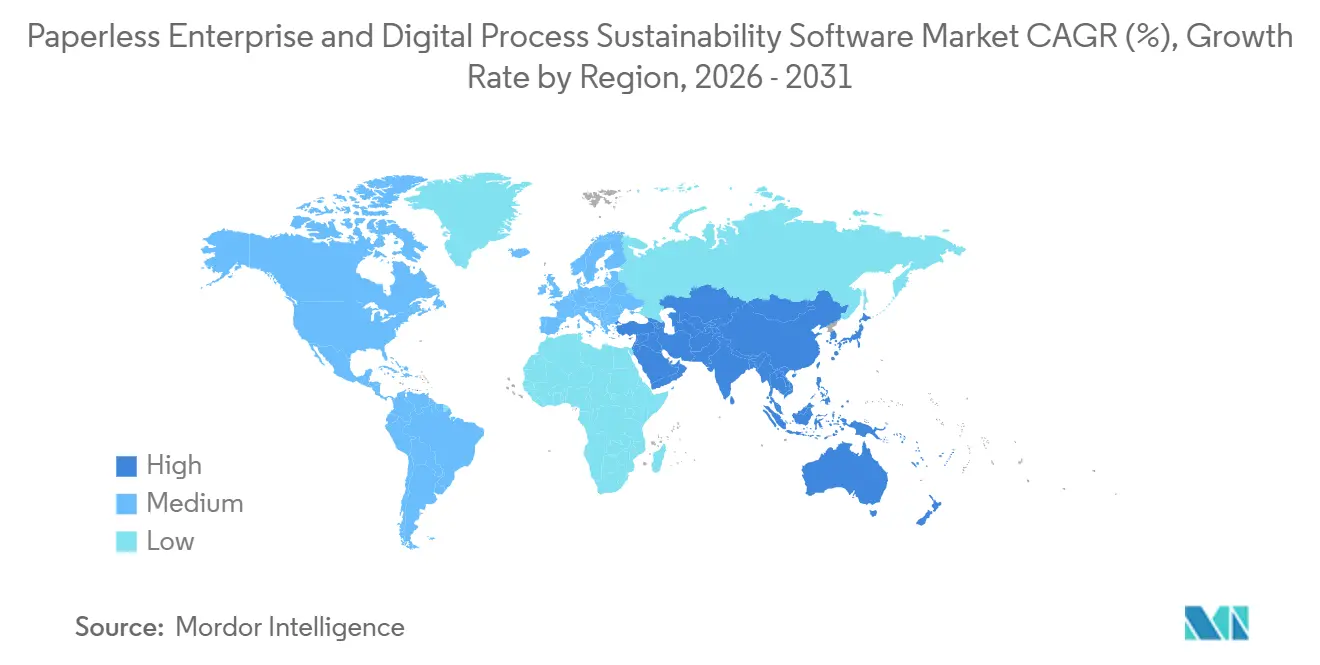
Asia-Pacific is projected to grow at a 16.81% CAGR through 2031, which makes it the fastest-growing regional segment in the paperless enterprise and digital process sustainability software market size outlook. The region is benefiting from simultaneous digitization pressure across large economies, especially where bookkeeping, tax, and recordkeeping rules are tightening. Japan remains a clear example because the Electronic Bookkeeping Act continues to keep digital storage and retrieval compliance in focus for businesses.[5] South America, the Middle East, and Africa remain earlier-stage areas, but they are becoming more relevant as data localization, cloud access, and regulatory digitization programs improve. This gives the paperless enterprise and digital process sustainability software market a wider growth base beyond its mature centers in North America and Europe.
Competitive Landscape
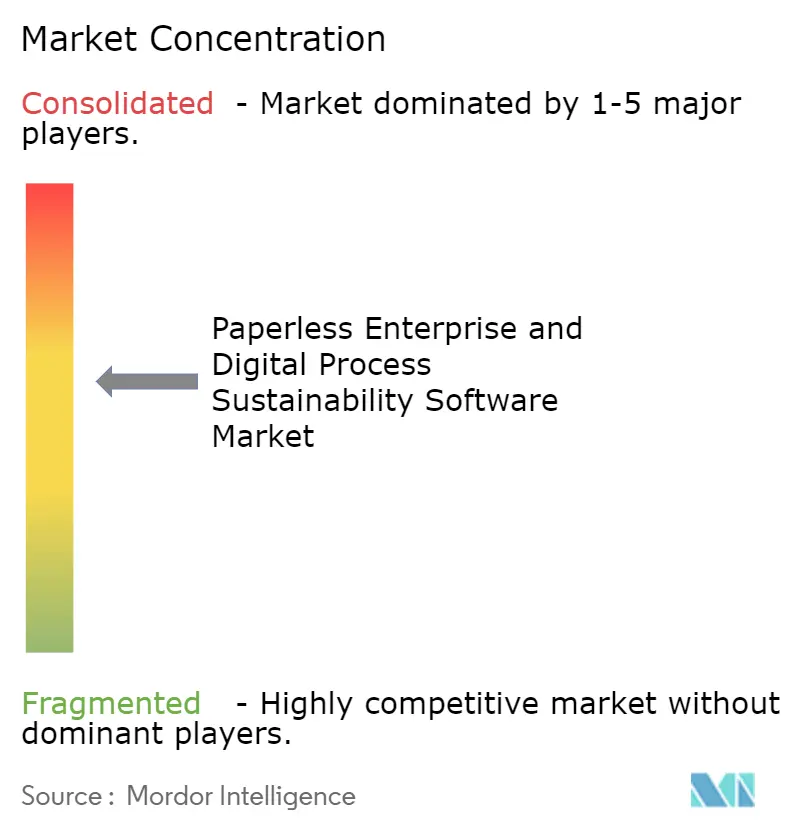
The paperless enterprise and digital process sustainability software market shows moderate concentration, with several large platform vendors and a substantial group of specialized providers competing at the same time. Microsoft, Adobe, OpenText, IBM, and SAP bring broad enterprise suite strength, while vendors such as M-Files, Laserfiche, DocuWare, Hyland, and Newgen compete with more focused content and workflow propositions. This creates a market where leadership is shaped less by a single dominant model and more by fit across compliance depth, deployment choice, and integration capability. The paperless enterprise and digital process sustainability software market is also becoming more competitive because AI functionality is moving from optional differentiation into a core buying expectation. Buyers increasingly want one platform to connect documents, workflows, reporting, and governed user interactions without relying on a large collection of disconnected tools.
Recent company moves show how vendors are adapting to that demand. M-Files expanded its collaboration with Microsoft in March 2026 and introduced new experiences for Microsoft 365 Copilot and Copilot Agent Builder, which strengthened its link to an ecosystem many enterprise buyers already use. Adobe followed with a productivity agent in May 2026, which connected document workflows with external AI tools and showed how PDF-centric work is being repositioned inside broader AI-assisted knowledge flows. OpenText also completed the divestiture of its eDOCS unit to NetDocuments for USD 163 million in January 2026, a move that sharpened its focus on cloud-based content management and AI-ready platforms. Together, these moves show that the paperless enterprise and digital process sustainability software market is being redefined by portfolio focus, ecosystem leverage, and deeper AI integration.
There is still open space in areas that many vendors have not fully addressed. One gap is mid-market demand for integrated process sustainability reporting with the same audit quality as core document workflows. Another is stronger AI governance, especially the ability to show how a model handled a document and under what control rules it acted. ABBYY’s continued emphasis on auditability and hybrid AI architecture reflects how vendors are trying to answer that need in the paperless enterprise and digital process sustainability software market. As a result, competition is moving away from simple feature breadth and toward the credibility of execution in regulated, document-intensive environments.
Paperless Enterprise and Digital Process Sustainability Software Industry Leaders
-
Microsoft Corporation
-
OpenText Corporation
-
Oracle Corporation
-
IBM Corporation
-
DocuSign, Inc.
- *Disclaimer: Major Players sorted in no particular order
Paperless Enterprise and Digital Process Sustainability Software Market Companies Covered in this Report
- Microsoft Corporation
- OpenText Corporation
- Oracle Corporation
- IBM Corporation
- DocuSign, Inc.
- SAP SE
- Adobe Inc.
- Box, Inc.
- Hyland Software, Inc.
- Laserfiche
- M-Files Corporation
- DocuWare GmbH
- Nintex Global, Inc.
- Appian Corporation
- UiPath Inc.
- Automation Anywhere, Inc.
- ABBYY Development Inc.
- Newgen Software Technologies Limited
- Tungsten Automation Corporation
- Kofax, Inc.
Global Paperless Enterprise and Digital Process Sustainability Software Market Report Scope
Paperless Enterprise and Digital Process Sustainability Software refers to a category of enterprise solutions designed to digitize and automate essential business processes. These include document management, workflow automation, e-signatures, and records management. Additionally, these platforms incorporate sustainability tracking and compliance reporting into routine operations. By reducing paper dependency, enhancing efficiency, and delivering transparent, audit-ready data, they support ESG objectives, ensure regulatory compliance, and align with long-term digital transformation strategies.
The Paperless Enterprise And Digital Process Sustainability Software Market Report is Segmented by Component (Software, and Services), Deployment Model (Cloud, On-Premises, and Hybrid), Organization Size (Large Enterprises, and Small and Medium Enterprises), Application (Document Management, Workflow Automation, E-Signature, Electronic Forms, Records Management, and Process Sustainability Tracking and Reporting), End-User Industry (Banking, Financial Services, and Insurance (BFSI), Healthcare and Life Sciences, Information Technology and Telecom, Government and Public Sector, Manufacturing, Retail and E-Commerce, Education, Energy and Utilities, and Other End-User Industries), and Geography (North America, South America, Europe, Asia-Pacific, and Middle East and Africa). The Market Forecasts are Provided in Terms of Value (USD).
Segmentation Overview
| Software |
| Services |
| Cloud |
| On-Premises |
| Hybrid |
| Large Enterprises |
| Small and Medium Enterprises |
| Document Management |
| Workflow Automation |
| E-Signature |
| Electronic Forms |
| Records Management |
| Process Sustainability Tracking and Reporting |
| Banking, Financial Services, and Insurance (BFSI) |
| Healthcare and Life Sciences |
| Information Technology and Telecom |
| Government and Public Sector |
| Manufacturing |
| Retail and E-Commerce |
| Education |
| Energy and Utilities |
| Other End-User Industries |
| North America | United States |
| Canada | |
| Mexico | |
| South America | Brazil |
| Argentina | |
| Rest of South America | |
| Europe | Germany |
| United Kingdom | |
| France | |
| Italy | |
| Spain | |
| Russia | |
| Rest of Europe | |
| Asia-Pacific | China |
| Japan | |
| India | |
| South Korea | |
| Australia | |
| Rest of Asia-Pacific | |
| Middle East | Saudi Arabia |
| United Arab Emirates | |
| Turkey | |
| Rest of Middle East | |
| Africa | South Africa |
| Nigeria | |
| Rest of Africa |
| By Component | Software | |
| Services | ||
| By Deployment Model | Cloud | |
| On-Premises | ||
| Hybrid | ||
| By Organization Size | Large Enterprises | |
| Small and Medium Enterprises | ||
| By Application | Document Management | |
| Workflow Automation | ||
| E-Signature | ||
| Electronic Forms | ||
| Records Management | ||
| Process Sustainability Tracking and Reporting | ||
| By End-User Industry | Banking, Financial Services, and Insurance (BFSI) | |
| Healthcare and Life Sciences | ||
| Information Technology and Telecom | ||
| Government and Public Sector | ||
| Manufacturing | ||
| Retail and E-Commerce | ||
| Education | ||
| Energy and Utilities | ||
| Other End-User Industries | ||
| By Geography | North America | United States |
| Canada | ||
| Mexico | ||
| South America | Brazil | |
| Argentina | ||
| Rest of South America | ||
| Europe | Germany | |
| United Kingdom | ||
| France | ||
| Italy | ||
| Spain | ||
| Russia | ||
| Rest of Europe | ||
| Asia-Pacific | China | |
| Japan | ||
| India | ||
| South Korea | ||
| Australia | ||
| Rest of Asia-Pacific | ||
| Middle East | Saudi Arabia | |
| United Arab Emirates | ||
| Turkey | ||
| Rest of Middle East | ||
| Africa | South Africa | |
| Nigeria | ||
| Rest of Africa | ||
Key Questions Answered in the Report
What is the current and forecast value of the paperless enterprise and digital process sustainability software space?
The market stood at USD 7.57 billion in 2025, reached USD 8.74 billion in 2026, and is forecast to reach USD 17.91 billion by 2031 at a 15.43% CAGR.
Which region leads revenue generation in 2026?
North America held the largest share at 35.43% in 2025, supported by strong enterprise software adoption, mature cloud infrastructure, and deep workflow automation demand.
Which region is growing the fastest through 2031?
Asia-Pacific is projected to expand at a 16.81% CAGR through 2031, driven by regulatory digitization and continued cloud infrastructure investment.
Which deployment model is seeing the strongest momentum?
Cloud-based deployment led with 68.91% share in 2025 and is projected to grow at a 17.42% CAGR, making it the fastest-growing deployment model in the forecast period.
Which application area is expanding the fastest?
Process sustainability tracking and reporting is projected to grow at a 15.91% CAGR through 2031, reflecting stronger demand for structured and auditable disclosure workflows.
Which end-user group offers the strongest growth opportunity?
Healthcare and life sciences is projected to grow at a 17.69% CAGR through 2031, while banking, financial services, and insurance remained the largest end-user segment with 23.14% share in 2025.