
Green Bond and Sustainable Finance Reporting Software Market Size and Share
Market Overview
| Study Period | 2020 - 2031 |
|---|---|
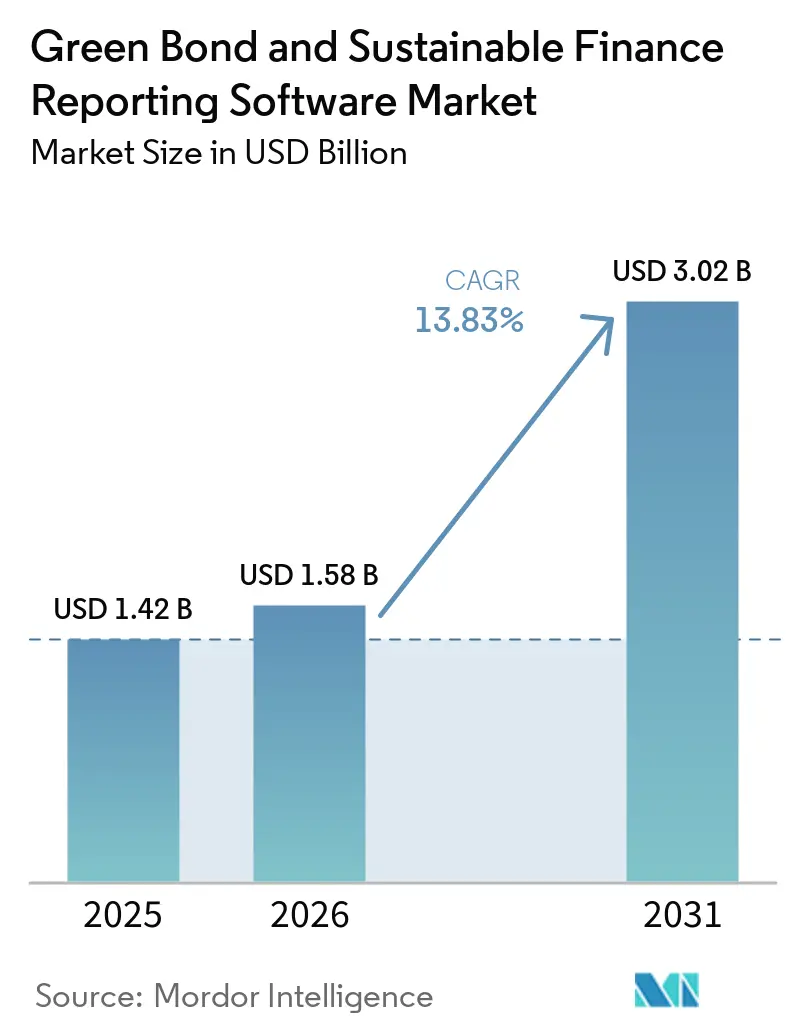
| Market Size (2026) | USD 1.58 Billion |
| Market Size (2031) | USD 3.02 Billion |
| Growth Rate (2026 - 2031) | 13.83 % |
| Fastest Growing Market | Asia-Pacific |
| Largest Market | Europe |
| Market Concentration | Medium |
Major Players *Disclaimer: Major Players sorted in no particular order Image © Mordor Intelligence. Reuse requires attribution under CC BY 4.0. | |
Green Bond and Sustainable Finance Reporting Software Market Analysis by Mordor Intelligence
The green bond and sustainable finance reporting software market size is expected to increase from USD 1.42 billion in 2025 to USD 1.58 billion in 2026 and reach USD 3.02 billion by 2031, growing at a CAGR of 13.83% over 2026-2031. Growth continues to reflect a shift from voluntary sustainability reporting toward recurring, rules-based reporting across green bonds, broader sustainable finance programs, and cross-functional disclosure workflows. Demand is also rising because issuers, lenders, and investors now expect proceeds tracking, impact reporting, and audit trails to be built into structured systems rather than isolated spreadsheets. Competitive activity is increasingly focused on workflow automation, framework mapping, and tighter integration with finance and ERP systems, which is raising the value of platforms that support repeat filings across multiple standards. The new issuer entry remains important because annual aligned sustainable debt issuance stayed above USD 1 trillion in 2025, and more than 400 new issuers entered the market, keeping first-time software purchases active. Near-term caution remains tied to the EU's February 2026 Omnibus I changes, yet refinancing cycles, sovereign issuance programs, and continuing disclosure duties still support long-duration demand.
Key Report Takeaways
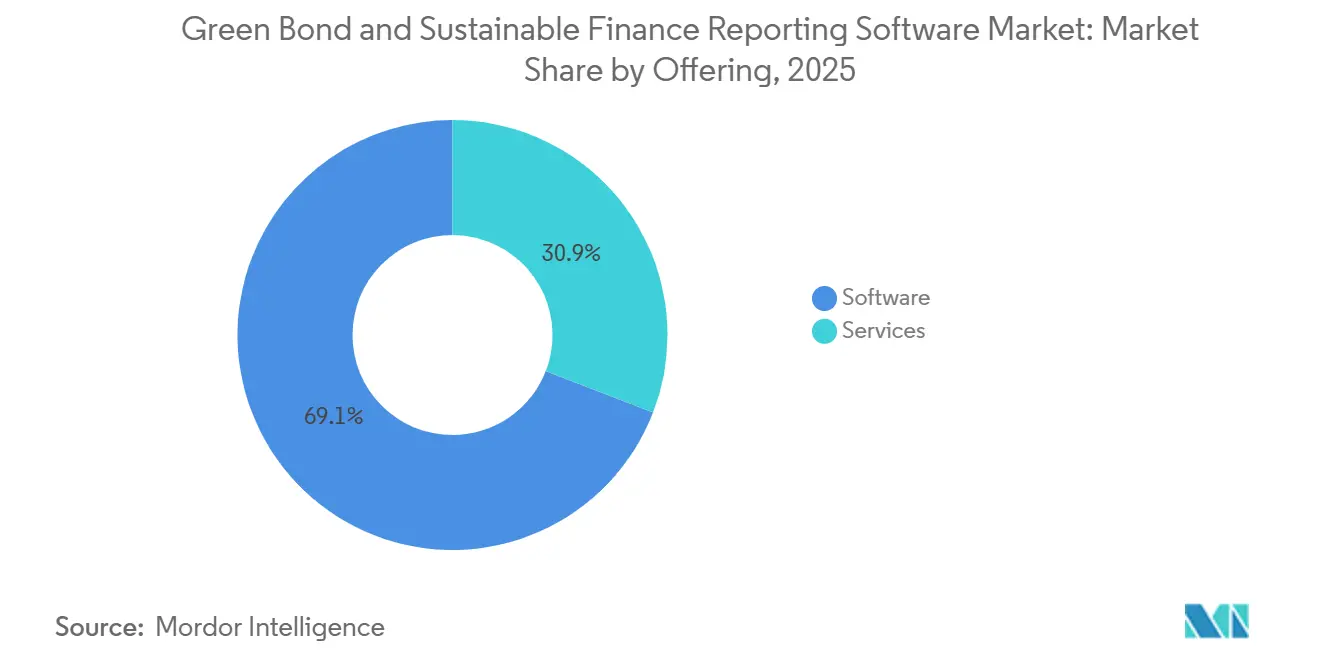
- By offering, software held 69.14% of the green bond and sustainable finance reporting software market share in 2025, while services are projected to expand at a 14.12% CAGR through 2031.
- By functionality, Green Bond Reporting and Impact Tracking accounted for 27.23% share in 2025, while ESG and Taxonomy Compliance Reporting is projected to record the fastest CAGR at 14.25% through 2031.
- By deployment mode, cloud-based platforms captured 64.18% of the market in 2025, while hybrid deployment is expected to grow at a 14.03% CAGR through 2031.
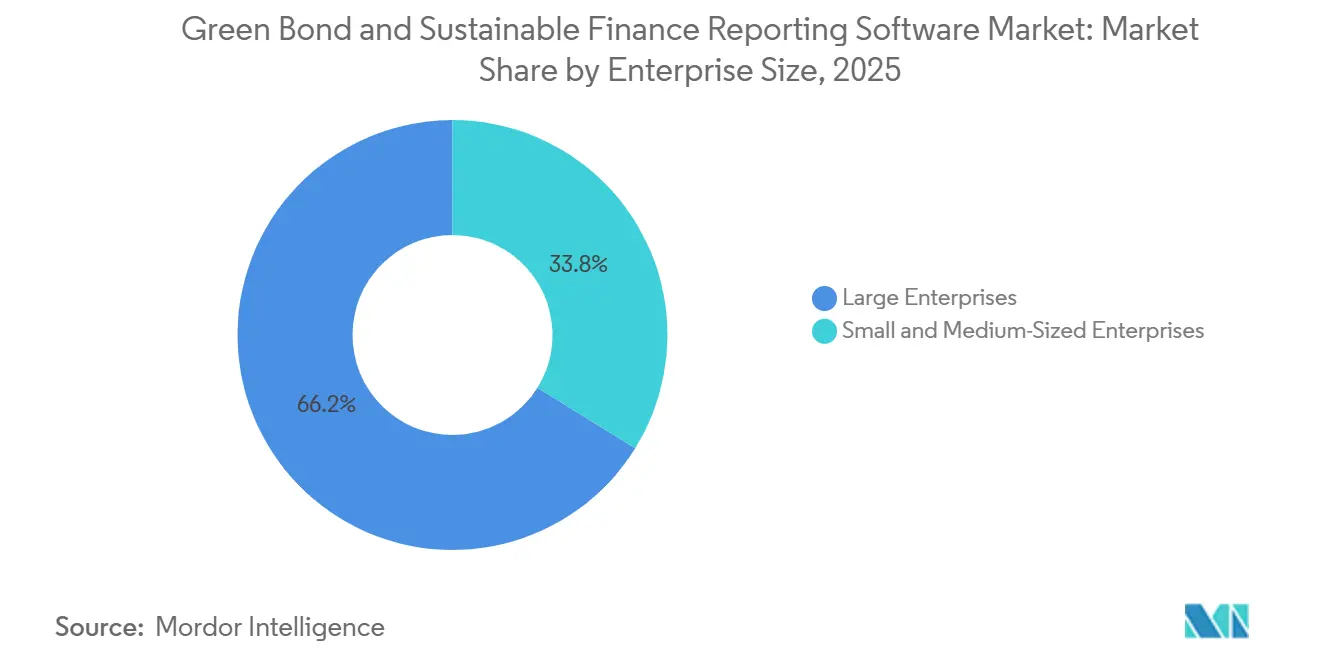
- By enterprise size, large enterprises led with 66.17% share in 2025, while SMEs are projected to expand at a 14.21% CAGR through 2031.
- By end-user vertical, banks and lending institutions held 28.34% share in 2025, while asset managers and institutional investors are expected to advance at a 14.32% CAGR through 2031.
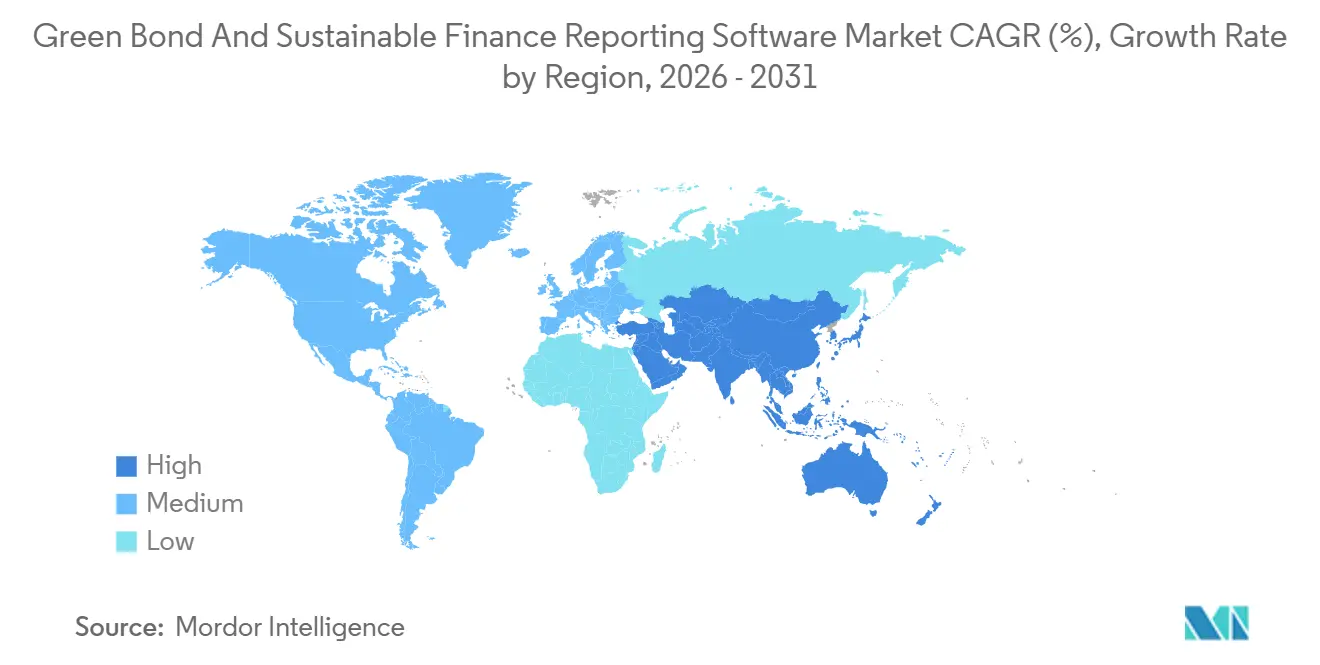
- By geography, Europe held 35.17% of the green bond and sustainable finance reporting software market share in 2025, while Asia-Pacific is projected to expand at a 14.41% CAGR through 2031.
Note: Market size and forecast figures in this report are generated using Mordor Intelligence’s proprietary estimation framework, updated with the latest available data and insights as of January 2026.
Market Trends and Insights
Drivers Impact Analysis of Green Bond and Sustainable Finance Reporting Software Market*
| Driver | (~) % Impact on CAGR Forecast | Geographic Relevance | Impact Timeline |
|---|---|---|---|
| Rising Green Bond Issuance and Sustainable Debt Reporting Needs | +3.5% | Global, with concentration in Europe, North America, and Asia-Pacific | Medium term (2-4 years) |
| Mandatory ESG and Sustainable Finance Disclosure Rules | +3.2% | Europe, Asia-Pacific, and North America | Medium term (2-4 years) |
| Need For Audit-Ready Data Lineage And Controls | +2.4% | Global, with highest urgency in regulated financial markets | Short term (≤ 2 years) |
| Increasing Investor Scrutiny of use-of-Proceeds Tracking | +1.8% | Global, most acute in Europe and North America | Medium term (2-4 years) |
| Expansion of Sustainability-Linked Financing Across Banks And Corporates | +1.5% | North America, Europe, and Asia-Pacific | Long term (≥ 4 years) |
| AI-Assisted Automation of Disclosure Workflows | +1.2% | Global | Medium term (2-4 years) |
| Source: Mordor Intelligence | |||
Rising Green Bond Issuance and Sustainable Debt Reporting Needs
Annual aligned GSS+ issuance exceeded USD 1 trillion for the third consecutive year in 2025, and green-labeled bonds accounted for 64% of that volume, which kept demand strong for platforms that can track proceeds, map eligible projects, and generate recurring investor reports. More than 400 new issuers entered the sustainable debt market in 2025, and each new entrant triggered a software-buying event, as first-time issuers typically need a structured reporting system after issuance. The green bond and sustainable finance reporting software market is also benefiting from refinancing activity, because maturing green bonds in 2025 led to reinvestment into dedicated programs rather than a wind-down of reporting obligations. This means existing issuers still need live compliance infrastructure even when net-new issuance growth moderates. The result is a demand base supported by both new issuer entry and repeat reporting cycles across active bond programs.[1]
Mandatory ESG and Sustainable Finance Disclosure Rules
Mandatory disclosure rules continue to expand the addressable buyer base in the green bond and sustainable finance reporting software market, as each new reporting framework brings more corporates, banks, and asset managers into structured compliance workflows. The EU Council’s February 2026 Omnibus I action narrowed the scope of the CSRD to companies with more than 1,000 employees and net annual turnover above EUR 450 million (USD 507 million), but it still left a large pool of in-scope entities with formal disclosure duties. At the same time, companies are comparing platforms based on their ability to manage cross-framework reporting needs tied to CSRD, SSBJ, and ISSB-aligned requirements within one controlled environment. This favors vendors that can offer reusable templates, governed approvals, and fast updates when standards change. It also supports recurring platform expansion as customers add more entities, products, and jurisdictions over time.[2]
Need for Audit-Ready Data Lineage and Controls
Audit readiness has become a central buying factor in the green bond and sustainable finance reporting software market because issuers and financial institutions now need every disclosed figure to be traceable back to source systems, review steps, and final reporting outputs. Workiva’s March 2026 platform update highlighted this shift by positioning an unbroken chain of trust from initial data source to final disclosure as a core product value. SAP also moved in the same direction with sustainability AI agents built to map requirements across standards and support more controlled disclosure preparation. Once companies validate these data paths with internal reviewers and external assurance providers, switching platforms becomes more difficult because the process logic and evidence structure must be rebuilt. That dynamic strengthens retention and raises the value of workflow depth over simple report generation.[3]
Increasing Investor Scrutiny of Use-of-Proceeds Tracking
Investor scrutiny is pushing issuers toward more systematic reporting because buyers of green debt now expect clear evidence on where proceeds were allocated, how quickly they were deployed, and whether reported impacts remained aligned with framework commitments. Green bonds and loans reached new records in 2025, while sustainability-linked loan supply fell to USD 418 billion from USD 530 billion, indicating stronger investor preference for instruments with traceable fund use. That preference increases the value of software that can reconcile treasury allocations, project records, and disclosure outputs across recurring reporting cycles. It also gives issuers a stronger reason to move away from spreadsheet-based monitoring as programs grow and become more visible. In this environment, reporting quality is becoming part of financing credibility rather than only a back-office requirement.
Restraints Impact Analysis of Green Bond and Sustainable Finance Reporting Software Market*
| Restraint | (~) % Impact on CAGR Forecast | Geographic Relevance | Impact Timeline |
|---|---|---|---|
| Fragmented Data Across Treasury, ERP, and ESG Systems | -1.2% | Global, most acute in large multinationals with decentralized treasury and capital budgeting functions | Short term (≤ 2 years) |
| High Configuration Burden for Jurisdiction-Specific Reporting | -0.9% | Europe, Asia-Pacific, and North America | Medium term (2-4 years) |
| Limited Standardization Across Green Bond Frameworks | -0.7% | Global | Long term (≥ 4 years) |
| Weak Internal Ownership Between Treasury, Finance, and Sustainability Teams | -0.5% | Global | Short term (≤ 2 years) |
| Source: Mordor Intelligence | |||
Fragmented Data Across Treasury, ERP, And ESG Systems
Fragmented source data remains the main operational barrier because proceeds records, project allocations, financial controls, and environmental metrics often reside in separate systems that were not built to support a single shared reporting workflow. This forces teams to reconcile identifiers, timing, and ownership before they can automate disclosures or lock audit trails, thereby lengthening deployment timelines and increasing implementation costs. The problem is more severe in multinational organizations where treasury structures and capital budgeting processes are spread across entities and jurisdictions. Vendors are responding with connectors and shared workflow layers, but these features do not fully eliminate the cleanup work required in the the underlying source systems. Until data flows are more standardized, integration complexity will continue to slow rollouts in the green bond and sustainable finance reporting software market.
High Configuration Burden for Jurisdiction-Specific Reporting
The second major restraint is the configuration burden imposed by multi-framework reporting, as large issuers and financial institutions often need to manage separate definitions, templates, and validation rules across multiple disclosure regimes simultaneously. The EU Council’s February 2026 Omnibus I changes added another layer of planning complexity, as companies must now interpret updated scope rules while maintaining live compliance programs for existing disclosures. Buyers, therefore, prefer vendors that maintain current rule libraries and prebuilt framework logic rather than requiring customers to redesign their reporting architecture. Even so, the need to configure multiple workflows within a single platform can delay purchase decisions and extend implementation timelines. This creates steady, long-term demand, but it slows the conversion rate from evaluation to full deployment.[4]
*Our forecasts treat driver/restraint impacts as directional, not additive. The impact forecasts reflect baseline growth, mix effects, and variable interactions.
Green Bond and Sustainable Finance Reporting Software Market Segment Analysis
By Offering, Software Holds The Lead While Services Expands Faster
Software held 69.14% of the green bond and sustainable finance reporting software market share in 2025, making it the largest revenue pool across the offering split. Buyers still begin with core platforms because proceeds tracking, workflow approvals, data lineage, and disclosure generation must sit within a governed system before advisory support adds full value. This pattern is strongest among repeat issuers, large corporates, and regulated financial institutions that need multi-year reporting continuity across several internal teams. The market, therefore, remains anchored by license and subscription spending rather than by one-time project work. That position also reflects the higher switching cost once workflows, evidence records, and user permissions are embedded in a production environment.
Services are projected to expand at a 14.12% CAGR through 2031, showing that implementation, framework mapping, and change support are rising faster than the installed platform base. Customers often need outside support to align internal data models with external disclosure templates and to refresh configurations when standards evolve. Workiva’s first-quarter 2026 results showed USD 225 million in subscription revenue and USD 22 million in professional services revenue, pointing to a recurring services layer alongside platform revenue. This also suggests that services are no longer limited to first deployment and increasingly extend into program expansion and reporting maintenance. As a result, software leads the current revenue mix, while services deepen account engagement and support long-run retention.
By Functionality, Bond Reporting Leads While Taxonomy Compliance Gains Speed
Green Bond Reporting and Impact Tracking accounted for 27.23% of the green bond and sustainable finance reporting software market size in 2025, making it the largest functionality category. Its lead reflects the fact that green bonds accounted for 64% of aligned GSS+ issuance in 2025, so proceeds allocation and impact reporting remain the most widely used workflows across the buyer base. This functionality is often the entry point for first-time issuers because it connects directly to post-issuance obligations and investor reporting expectations. It also creates a natural installed base for adjacent modules that support broader disclosure, assurance, and portfolio monitoring needs. That is why bond reporting continues to anchor product demand in the green bond and sustainable finance reporting software market.
ESG and Taxonomy Compliance Reporting is projected to register the fastest growth, with a 14.25% CAGR between 2026 and 2031. The segment is expanding because reporting obligations are widening beyond bond-specific disclosures and now cover entity-level, product-level, and taxonomy-aligned requirements across multiple jurisdictions. Buyers increasingly want platforms that can reuse data across green bond reporting, fund reporting, and sustainability statements rather than manage separate tools for each obligation. This is also pulling more demand into audit, assurance, and verification workflows, which are becoming part of mainstream product requirements. The result is a gradual shift from point solutions toward integrated reporting environments with broader compliance coverage.
By Deployment Mode, Cloud-Based Platforms Lead While Hybrid Gains Ground
Cloud-based deployment held a 64.18% share in 2025, remaining the dominant delivery model in the green bond and sustainable finance reporting software market. The model aligns with the operational realities of treasury, finance, sustainability, internal audit, and assurance teams that often work across different offices and jurisdictions. Cloud platforms also support faster product updates, which is important when customers need quick adjustments to reporting templates and rule libraries. This keeps cloud at the center of current deployments because flexibility and shared access matter as much as infrastructure economics.
Hybrid deployment is forecast to grow at 14.03% CAGR between 2026 and 2031, making it the fastest-growing deployment model. Its momentum reflects the needs of institutions that want to retain sensitive financial or treasury data within controlled internal environments while still using cloud layers for workflow orchestration and disclosure preparation. Hybrid models also give buyers a practical bridge from legacy architecture to more automated reporting without forcing a full source-system rebuild at once. On-premises deployment remains relevant in narrow cases involving sovereign sensitivity, strict internal control preferences, or established institutional infrastructure. Even so, the market's long-term direction points to cloud leadership, with hybrid serving as the preferred transition model for more regulated users.
By Enterprise Size, Large Enterprises Lead While SMEs Drive Future Expansion
Large enterprises accounted for 66.17% of revenue in 2025, reflecting the concentration of major green bond issuers and first-wave mandatory reporters within the largest organizations. These buyers usually face the highest level of process complexity because they operate across more legal entities, disclosure frameworks, and internal approval layers. They are also more likely to need enterprise-grade controls such as audit trails, version management, multi-entity consolidation, and cross-team collaboration. That makes large enterprises the most important revenue base in the green bond and sustainable finance reporting software market today. Their scale and compliance burden also explain why vendors continue to prioritize ERP connectivity and workflow depth in product development.
SMEs are projected to expand at a 14.21% CAGR through 2031, making them the fastest-growing enterprise cohort. Growth is being supported by broader disclosure expectations, cloud-based pricing models, and the increasing need for smaller issuers and managers to move beyond manual reporting tools. As sustainability reporting becomes more common across financing relationships and stakeholder requests, smaller organizations are being drawn into more formal reporting processes, even though they are not the first wave of mandatory filers. The green bond and sustainable finance reporting software market is therefore widening into the mid-market through simpler delivery models and more modular product design. This does not change the current dominance of large enterprises, but it does meaningfully expand the future buyer pipeline.
By End-User Vertical, Banks Anchor Revenue While Asset Managers Expand Fastest
Banks and lending institutions held the largest end-user share at 28.34% in 2025, reflecting their dual role as both financial intermediaries and active participants in sustainable finance reporting. They often manage institution-level disclosures, product-level transparency requirements, and their own sustainable debt programs simultaneously. The financial sector’s share of global sustainable issuance rose to 21% in 2025 from 18% in 2024, which shows that the same customer group driving software demand is also increasing issuance activity. This gives banks a central role in current spending patterns across the green bond and sustainable finance reporting software market. Their heavier governance requirements also make them strong buyers of platforms with integrated controls and repeatable workflows.
Asset managers and institutional investors are projected to grow at a 14.32% CAGR between 2026 and 2031, giving them the fastest growth outlook among end-user groups. Their demand is rising as product-level reporting, portfolio monitoring, and verified sustainability data become increasingly important for client reporting and regulatory disclosures. Corporate issuers remain an important volume pool because more than 400 net-new issuers entered the sustainable debt market in 2025, expanding the addressable customer base beyond financial institutions. Government issuers and development finance institutions also matter because their programs are often larger, repeated across tranches, and subject to stronger public accountability. This leaves the market with banks as the main current anchor and asset managers as the most dynamic forward growth group.
Geography Analysis
Europe Green Bond and Sustainable Finance Reporting Software Market
Europe held 35.17% of the green bond and sustainable finance reporting software market share in 2025, making it the largest regional market. The region leads because the EU has built the most comprehensive reporting environment through CSRD, SFDR, taxonomy-linked reporting, and the broader policy stack around sustainable finance. Germany, France, and the United Kingdom remain the strongest country markets because they combine large issuer bases, major financial institutions, and active, sustainable investment ecosystems. The EU Council’s February 2026 Omnibus I decision narrowed part of the near-term reporting population, but it did not remove the need for controlled reporting among entities that remain within scope. Europe, therefore, continues to provide the deepest installed base for the green bond and sustainable finance reporting software market.
North America Green Bond and Sustainable Finance Reporting Software Market
North America remained the second-largest regional market, with the United States accounting for the largest share of regional demand. The region differs from Europe because software adoption is driven more by capital market expectations, investor scrutiny, and issuer discipline than by one unified federal reporting architecture. Strong investor preference for use-of-proceeds products continues to drive demand for allocation-tracking and impact-reporting software among issuers and financial institutions. Canada and Mexico add secondary demand, but the region is still centered on the U.S. market. This keeps North America important in scale, even though the policy structure is less centralized than in Europe.
APAC, South America and MEA Green Bond and Sustainable Finance Reporting Software Market
Asia-Pacific is projected to register the fastest regional CAGR at 14.41% between 2026 and 2031, making it the strongest growth geography in the green bond and sustainable finance reporting software market. Growth is being supported by a cascade of mandatory disclosure steps, rising taxonomy activity, and a broader shift toward formal sustainability reporting across large regional economies. Japan, South Korea, Australia, Singapore, Hong Kong, China, and India are all contributing to the regional opportunity, although some domestic markets also rely partly on local software providers. South America remains an emerging opportunity led by Brazil and Argentina, while the Middle East and Africa are still early-stage but are gaining visibility through activity in the UAE, Saudi Arabia, and South Africa. That leaves Asia-Pacific as the fastest-expanding region, with South America and the Middle East and Africa representing smaller but developing growth pockets.
Competitive Landscape
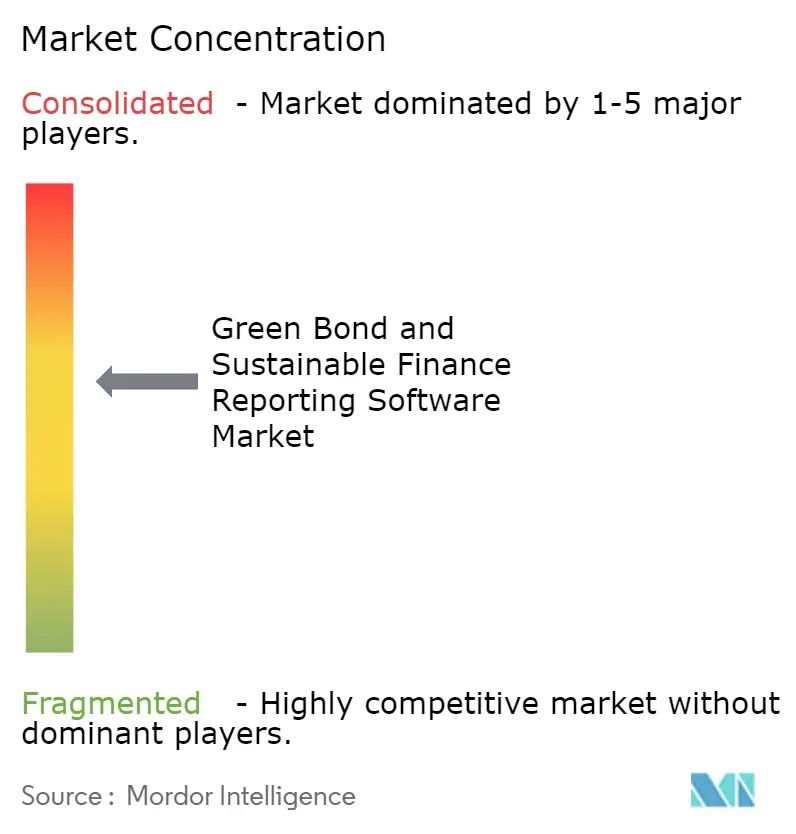
The green bond and sustainable finance reporting software market is moderately concentrated, with a limited set of enterprise software vendors competing against specialist sustainability and reporting platforms rather than one provider dominating the field. Workiva reported 6,665 customers and a 97% gross retention rate in the first quarter of 2026, showing how early demand has translated into a durable subscription base. Competition is increasingly centered on integration, workflow depth, and the ability to reduce friction between source systems, review processes, and final disclosures. This is pushing vendors to invest in ERP links, controlled approvals, and reusable framework logic rather than only report output features. The market, therefore, remains active and competitive, but it is not sufficiently concentrated to function as a winner-takes-most category.
A clear strategic pattern is the move toward connected compliance platforms. Large incumbents are leveraging automation and established enterprise relationships to expand their market share in the green bond and sustainable finance reporting software market. Workiva’s March 2026 GRC platform update followed a similar logic, linking audit, risk, controls, sustainability, and financial reporting within a single workflow environment. NEC also introduced an AI-supported disclosure service in April 2026 to reduce the workload for climate-related reporting in Japanese annual securities reports. These moves show that vendors are competing on how much process effort they can remove across the full reporting cycle.
White space remains strongest in mid-market and jurisdiction-specific offerings where buyers need simpler deployment, lower complexity, and faster time to value. Specialist vendors can still compete effectively if they solve green bond allocation reporting, portfolio monitoring, or local disclosure requirements more directly than broad enterprise suites. At the same time, incumbent vendors retain an advantage where customers value ERP connectivity, audit-ready controls, and multi-framework support at scale. This keeps the competitive landscape balanced between broad platforms and focused specialists, and explains why the market continues to attract both enterprise-led expansion and niche product differentiation.
Green Bond and Sustainable Finance Reporting Software Industry Leaders
-
Workiva Inc.
-
Wolters Kluwer N.V.
-
SAP SE
-
Salesforce, Inc.
-
Nasdaq, Inc.
- *Disclaimer: Major Players sorted in no particular order
Green Bond and Sustainable Finance Reporting Software Market Companies Covered in this Report
- Workiva Inc.
- Wolters Kluwer N.V.
- SAP SE
- Salesforce, Inc.
- IBM Corporation
- Nasdaq, Inc.
- Diligent Corporation
- Sphera Solutions, Inc.
- Enablon SA
- Benchmark Digital Partners LLC
- Cority Software Inc.
- Persefoni AI, Inc.
- Novisto Inc.
- EcoVadis SAS
- FigBytes Inc.
- Greenstone+ Ltd.
- Plan A SE
- IsoMetrix Software (Pty) Ltd
- Datamaran Limited
- OneTrust, LLC
- NAVEX Global, Inc.
- Bloomberg Finance L.P.
- MSCI Inc.
- Refinitiv Limited
Recent Industry Developments in Green Bond and Sustainable Finance Reporting Software Market
- June 2026: SmartESG (Sherpa and Company) launched its AI-assisted disclosure creation feature "SmartESG Reporting" on June 1, 2026, providing end-to-end support from ESG data aggregation to disclosure document generation, with SSBJ compliance coverage targeting Japanese Prime Market companies.
- May 2026: SAP SE announced new sustainability AI agents, including the Sustainability Regulatory Readiness Agent and Footprint Optimization Agent, to be generally available by end of 2026. In beta, the agents demonstrated greater than 50% reduction in packaging compliance review hours and scenario simulation time cut from a day to 20 minutes.
- May 2026: Workiva Inc. reported Q1 2026 total revenue of USD 247 million, up 20% year-over-year, with 6,665 customers, a 97% gross retention rate, and large-contract customers with annualized contract value above USD 300,000 up 38% year-over-year, reflecting continued ESG and financial reporting platform expansion.
- April 2026: Wolters Kluwer expanded its CompliEditor Suite on April 30, 2026, enhancing self-service disclosure creation and update capabilities for financial institutions, aimed at reducing delays from manual workflows and third-party dependencies in regulatory filings.
Global Green Bond and Sustainable Finance Reporting Software Market Report Scope
The Green Bond and Sustainable Finance Reporting Software market refers to platforms and services that enable financial institutions, corporate issuers, and public sector organizations to manage, monitor, and disclose sustainability-related financial activities. These solutions provide functionalities such as green bond reporting and impact tracking, sustainable finance disclosure management, ESG and taxonomy compliance reporting, portfolio monitoring and performance analytics, and audit, assurance, and verification management. By embedding sustainability intelligence into financial workflows, these platforms help organizations align with global sustainable finance frameworks, improve transparency, and strengthen investor confidence.
The Green Bond and Sustainable Finance Reporting Software market report is segmented by Offering (Software, and Services), Functionality (Green Bond Reporting and Impact Tracking, Sustainable Finance Disclosure Management, ESG and Taxonomy Compliance Reporting, Portfolio Monitoring and Performance Analytics, and Audit, Assurance, and Verification Management), Deployment Mode (Cloud-Based, On-Premises, and Hybrid), Enterprise Size (Large Enterprises, and Small and Medium-Sized Enterprises), End-User Vertical (Banks and Lending Institutions, Asset Managers and Institutional Investors, Corporate Issuers, Government and Public Sector Issuers, Development Finance Institutions and Multilateral Organizations, and Other End-User Verticals), and Geography (North America, South America, Europe, Asia-Pacific, Middle East, and Africa). The Market Forecasts are Provided in Terms of Value (USD).
Segmentation Overview
| Software |
| Services |
| Green Bond Reporting and Impact Tracking |
| Sustainable Finance Disclosure Management |
| ESG and Taxonomy Compliance Reporting |
| Portfolio Monitoring and Performance Analytics |
| Audit, Assurance, and Verification Management |
| Cloud-Based |
| On-Premises |
| Hybrid |
| Large Enterprises |
| Small and Medium-Sized Enterprises |
| Banks and Lending Institutions |
| Asset Managers and Institutional Investors |
| Corporate Issuers |
| Government and Public Sector Issuers |
| Development Finance Institutions and Multilateral Organizations |
| Other End-User Verticals |
| North America | United States | |
| Canada | ||
| Mexico | ||
| Rest of North America | ||
| South America | Brazil | |
| Argentina | ||
| Rest of South America | ||
| Europe | Germany | |
| United Kingdom | ||
| France | ||
| Italy | ||
| Spain | ||
| Russia | ||
| Rest of Europe | ||
| Asia-Pacific | China | |
| Japan | ||
| India | ||
| South Korea | ||
| Australia | ||
| Rest of Asia-Pacific | ||
| Middle East and Africa | Middle East | Saudi Arabia |
| United Arab Emirates | ||
| Rest of Middle East | ||
| Africa | South Africa | |
| Nigeria | ||
| Rest of Africa | ||
| By Offering | Software | ||
| Services | |||
| By Functionality | Green Bond Reporting and Impact Tracking | ||
| Sustainable Finance Disclosure Management | |||
| ESG and Taxonomy Compliance Reporting | |||
| Portfolio Monitoring and Performance Analytics | |||
| Audit, Assurance, and Verification Management | |||
| By Deployment Mode | Cloud-Based | ||
| On-Premises | |||
| Hybrid | |||
| By Enterprise Size | Large Enterprises | ||
| Small and Medium-Sized Enterprises | |||
| By End-User Vertical | Banks and Lending Institutions | ||
| Asset Managers and Institutional Investors | |||
| Corporate Issuers | |||
| Government and Public Sector Issuers | |||
| Development Finance Institutions and Multilateral Organizations | |||
| Other End-User Verticals | |||
| By Geography | North America | United States | |
| Canada | |||
| Mexico | |||
| Rest of North America | |||
| South America | Brazil | ||
| Argentina | |||
| Rest of South America | |||
| Europe | Germany | ||
| United Kingdom | |||
| France | |||
| Italy | |||
| Spain | |||
| Russia | |||
| Rest of Europe | |||
| Asia-Pacific | China | ||
| Japan | |||
| India | |||
| South Korea | |||
| Australia | |||
| Rest of Asia-Pacific | |||
| Middle East and Africa | Middle East | Saudi Arabia | |
| United Arab Emirates | |||
| Rest of Middle East | |||
| Africa | South Africa | ||
| Nigeria | |||
| Rest of Africa | |||
Key Questions Answered in the Report
What is the 2026 size of the green bond and sustainable finance reporting software space?
The green bond and sustainable finance reporting software market size stands at USD 1.58 billion in 2026 and is projected to reach USD 3.02 billion by 2031 at a 13.83% CAGR.
Which product category leads current revenue generation?
Software leads the revenue mix with 69.14% share in 2025 because buyers first invest in governed platforms for proceeds tracking, disclosure workflows, and audit trails.
Which functionality is expanding the fastest through 2031?
ESG and Taxonomy Compliance Reporting is the fastest-growing functionality with a projected 14.25% CAGR, supported by expanding entity and product disclosure obligations across major markets.
Why are banks the largest customer group today?
Banks and lending institutions held 28.34% share in 2025 because they must manage both institution-level sustainability reporting and product-level disclosures tied to funds, lending books, and sustainable finance programs.
Which region offers the strongest growth outlook?
Asia-Pacific is projected to grow the fastest at 14.41% through 2031 as more markets in the region move toward formal sustainability reporting and aligned sustainable debt frameworks.
What is the main barrier slowing adoption?
The biggest practical barrier is fragmented data across treasury, ERP, and sustainability systems, which extends implementation timelines and makes audit-ready reporting harder to automate.