
Packaging Machinery Rental/Leasing And Managed Line Services Market Size and Share
Market Overview
| Study Period | 2020 - 2031 |
|---|---|
| Market Size (2026) | USD 5.67 Billion |
| Market Size (2031) | USD 8.16 Billion |
| Growth Rate (2026 - 2031) | 7.55 % |
| Fastest Growing Market | Asia Pacific |
| Largest Market | North America |
| Market Concentration | Medium |
Major Players *Disclaimer: Major Players sorted in no particular order Image © Mordor Intelligence. Reuse requires attribution under CC BY 4.0. | |
Packaging Machinery Rental/Leasing And Managed Line Services Market Analysis by Mordor Intelligence
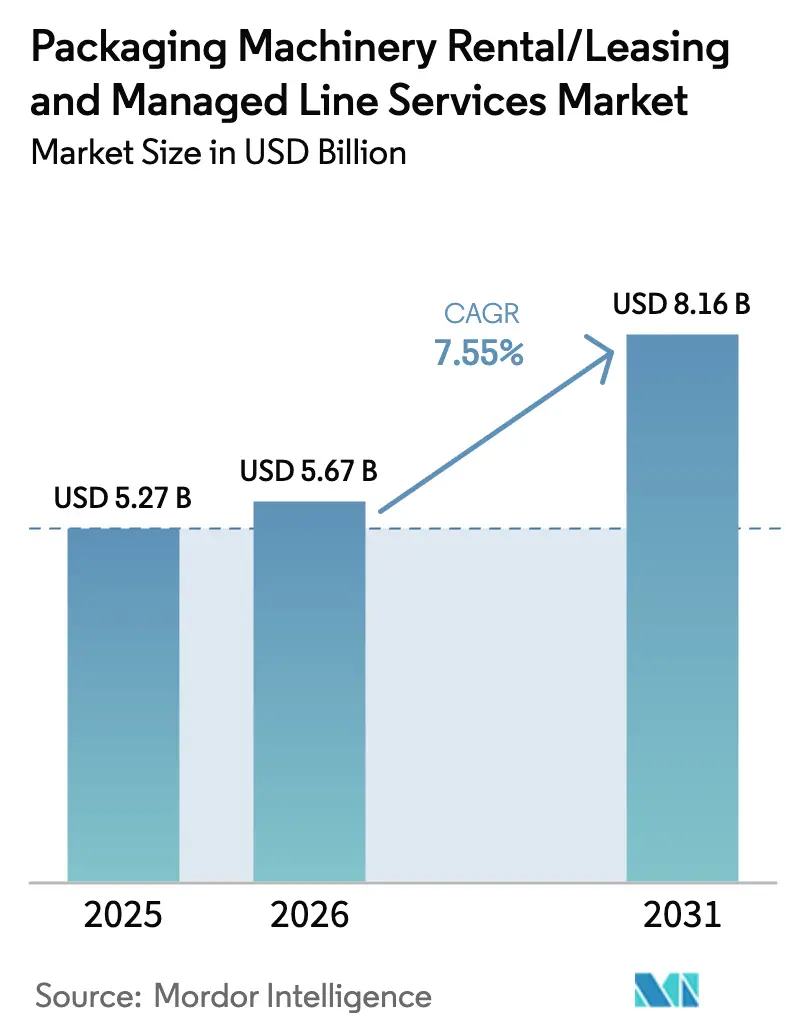
The packaging machinery rental/leasing and managed line services market size in 2026 is estimated at USD 5.67 billion, growing from 2025 value of USD 5.27 billion with 2031 projections showing USD 8.16 billion, growing at 7.55% CAGR over 2026-2031. Demand accelerates as manufacturers shift from capital-intensive ownership to service-oriented procurement, driven by e-commerce volatility, tighter working capital policies, and emerging Equipment-as-a-Service frameworks. Flexible access to palletizing, wrapping, and robotic end-of-line systems lets companies scale capacity without locking funds into fast-obsolescing assets. The growing appetite for turnkey managed line services highlights the need for full operational support, while short product life cycles and ESG-linked financing incentives expand the use cases. Competitive momentum remains brisk, with regional specialists and OEM-backed financing arms racing to bundle equipment, maintenance, and performance guarantees into single contracts that de-risk technology upgrades for clients.
Key Report Takeaways
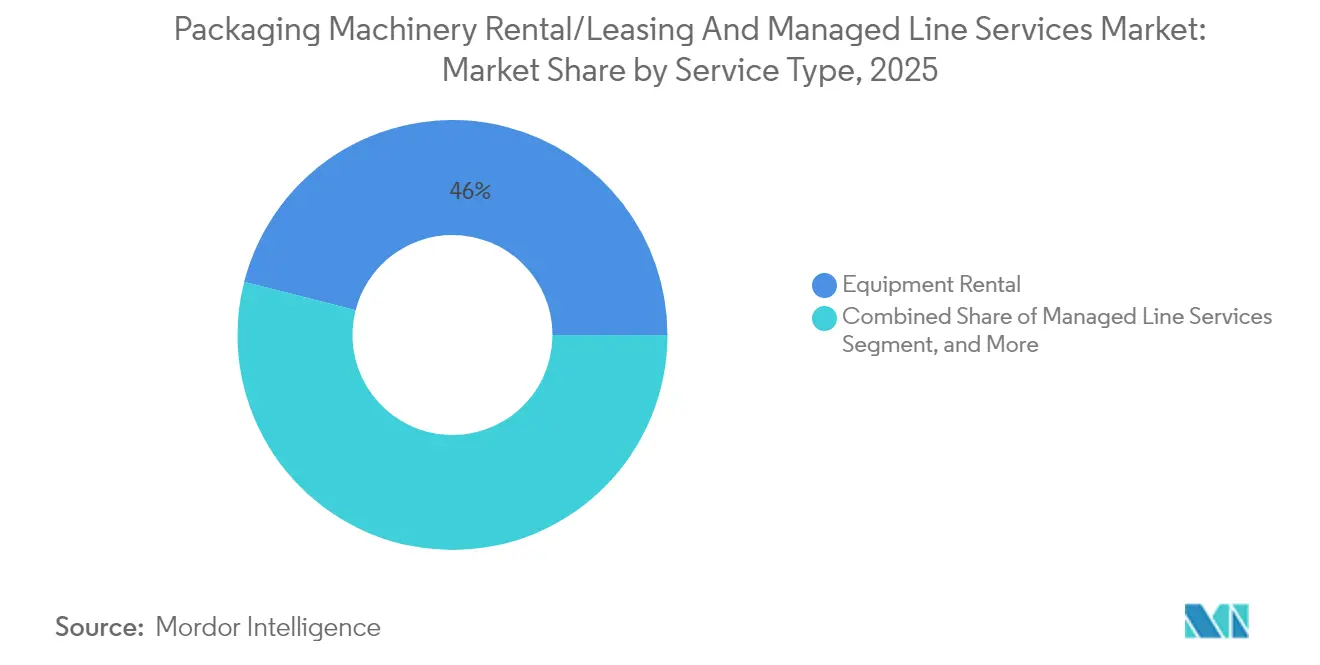
- By service type, equipment rental captured 46.02% of the Packaging Machinery Rental/Leasing and Managed Line Services Market share in 2025.
- By equipment type, the Packaging Machinery Rental/Leasing and Managed Line Services Market size for palletizing and stretch-wrapping solutions is projected to grow at 8.81% CAGR between 2026-2031.
- By contract duration, 1-3 year agreements captured 43.71% of the Packaging Machinery Rental/Leasing and Managed Line Services Market share in 2025.
- By end-user industry, the Packaging Machinery Rental/Leasing and Managed Line Services Market size for e-commerce and logistics is projected to grow at a 9.33% CAGR between 2026-2031.
- By geography, North America captured 35.52% of the Packaging Machinery Rental/Leasing and Managed Line Services Market share in 2025.
Note: Market size and forecast figures in this report are generated using Mordor Intelligence’s proprietary estimation framework, updated with the latest available data and insights as of 2026.
Market Trends and Insights
Drivers Impact Analysis of Packaging Machinery Rental/Leasing And Managed Line Services Market*
| Driver | (~) % Impact on CAGR Forecast | Geographic Relevance | Impact Timeline |
|---|---|---|---|
| Surging E-Commerce Volumes Driving On-Demand Packaging Capacity | +1.2% | Global, concentrated in North America and the Asia-Pacific | Short term (≤ 2 years) |
| Shift From Capex to Opex Models Among CPG Majors | +1.8% | Global, early adoption in North America and Europe | Medium term (2-4 years) |
| Rapid Automation of End-Of-Line Operations in Food Facilities | +1.4% | North America and Europe core, with expansion to the Asia-Pacific | Medium term (2-4 years) |
| Short Product Life Cycles Favoring Flexible Lease Agreements | +0.9% | Global, particularly FMCG-intensive regions | Short term (≤ 2 years) |
| Growth of Asset-Light Co-Packing Start-Ups in Emerging Markets | +1.1% | Asia-Pacific, South America, MEA | Long term (≥ 4 years) |
| ESG-Linked Equipment-As-Service Financing Incentives | +0.7% | Europe leads, expanding to North America | Long term (≥ 4 years) |
| Source: Mordor Intelligence | |||
Surging e-commerce volumes driving on-demand packaging capacity
Global online retail is on track to reach USD 7.4 trillion by 2025, a significant leap that requires fulfillment centers to deploy right-sizing and automated packing solutions without committing scarce capital. Rental agreements provide operators with immediate access to systems, such as Packsize’s carton-on-demand units, which now integrate Paccurate’s cartonization software to ensure material savings and throughput gains on a pay-per-use basis.[1]Packaging Insights Staff, “Packsize Enters International Partnership,” packaginginsights.com
Shift from capex to opex models among CPG majors
Global consumer packaged goods companies are increasingly favoring operating leases that free up working capital and keep balance sheets agile amid market uncertainty. Siemens Financial Services highlights the rapid uptake of pay-per-machine-hour models, as illustrated by KraussMaffei’s flexPay program, which directly links cost to actual utilization.
Rapid automation of end-of-line operations in food facilities
Ongoing labor shortages have led 68% of food processors to plan higher automation budgets. Foodmach’s collaboration with ACTIW Intralogistics and Joloda Hydraroll has cut truck-loading time by up to 50% and decreased headcount requirements by 80%. These high-capex systems now roll out under short- to mid-term rental deals, providing plants with immediate efficiency benefits without cash flow stress.
Short product life cycles favor flexible lease agreements
The average FMCG product life cycle has fallen to 18-24 months, compelling marketers to frequently switch packaging formats. Mespack and Fuji Seal’s One Sales Contract demonstrates how bundled solutions encompassing equipment, consumables, and maintenance align with shorter commercial horizons, thereby minimizing stranded-asset risk.
Restraints Impact Analysis of Packaging Machinery Rental/Leasing And Managed Line Services Market*
| Restraint | (~) % Impact on CAGR Forecast | Geographic Relevance | Impact Timeline |
|---|---|---|---|
| High Refurbishment and Maintenance Costs Eroding Margins | -0.8% | Global, particularly affecting smaller rental providers | Short term (≤ 2 years) |
| Ownership Preference of Large Multinationals | -1.2% | Global, concentrated in established manufacturing regions | Medium term (2-4 years) |
| Scarcity Of IoT-Ready Rental Fleets for Remote Monitoring | -0.6% | Asia-Pacific and emerging markets primarily | Medium term (2-4 years) |
| Cross-Border Customs Complexity for Leased Machinery | -0.4% | International operations, EU-Asia trade corridors | Long term (≥ 4 years) |
| Source: Mordor Intelligence | |||
High refurbishment and maintenance costs eroding margins
Digitally integrated packaging machines rely on proprietary sensors and semiconductor-based controllers, which increase annual maintenance budgets by 15-20% compared to legacy electromechanical assets. Smaller regional fleet owners who cannot spread servicing overheads across large networks face compressed margins and elevated consolidation pressure.
Ownership preference of large multinationals
Blue-chip manufacturers with in-house maintenance teams still find outright purchase more economical for their core packaging lines, especially in tightly regulated industries such as pharmaceuticals, which require direct control over validated equipment. This ownership bias limits rental market penetration among the largest potential customers, constraining overall market growth despite strong demand from mid-market manufacturers.
*Our forecasts treat driver/restraint impacts as directional, not additive. The impact forecasts reflect baseline growth, mix effects, and variable interactions.
Packaging Machinery Rental/Leasing And Managed Line Services Market Segment Analysis
By Service Type:
Managed services gain momentumEquipment rental secured 46.02% revenue share in 2025. Managed line services, however, are forecast for a 9.31% CAGR as clients seek outcome-based contracts that wrap machines, technicians, and uptime guarantees. The packaging machinery rental/leasing and managed line services market size for managed offerings is, therefore, on a faster trajectory than traditional rentals, mirroring the broader move from component leasing to holistic performance outsourcing.
Bundled plans, such as Markem-Imaje’s Ultimate Coverage Program, provide predictable operating costs and enable even mid-sized firms to adopt sophisticated coding technology without upfront capital exposure. [2]Bizerba Corporate, “Managed Services for Packaging Lines,” bizerba.com Providers now differentiate through analytics and remote monitoring. Atlas Copco’s AIRPlan tracks compressor performance in real time, replicating that model for shrink wrappers and palletizers. As these services mature, clients in the food, beverage, and e-commerce sectors rely on integrated vendors to shoulder maintenance and parts risk, thereby reinforcing long-term stickiness across the packaging machinery rental/leasing and managed line services market.



By Equipment Type:
Palletizing drives automation demandWrapping and shrink-pack systems accounted for 28.21% of 2025 revenue due to their widespread use across various SKUs and industries. Yet palletizing and stretch-wrapping units will log the highest 8.81% CAGR through 2031 as plants automate end-of-line logistics to counter labor scarcity. The packaging machinery rental/leasing and managed line services market share for this category benefits from immediate ROI in throughput gains. Robotics-ready palletizers command premium daily rates but deliver 24/7 consistency, a proposition that resonates with e-grocers and beverage bottlers.
As IoT modules enter the rental fleet, providers can schedule predictive maintenance, boosting uptime and billing utilization. Form-fill-seal rigs continue to maintain solid demand among snack producers utilizing flexible films, whereas precision liquid fillers attract clients in the pharmaceutical and cosmetics industries. Labeling and coding systems are experiencing steady uptake because traceability mandates in the food and pharmaceutical industries remain non-negotiable.
By Contract Duration:
Sub-12-month deals riseMid-duration agreements (1-3 years) accounted for 43.71% of revenue in 2025, striking a balance between rate discounts and flexibility. However, sub-12-month contracts are expanding at 9.67% CAGR as e-commerce fulfillment hubs and co-packing start-ups match equipment tenure to flash-sale peaks and campaign-based production. The packaging machinery rental/leasing and managed line services market size associated with short-term contracts is smaller per deal but turns over rapidly, thereby enhancing fleet utilization.
Digital portals from SIGMA Equipment enable customers to reserve assets online, reducing administrative friction and facilitating a higher rental velocity. Contracts of 4-5 years still appeal to processors embarking on longer reformulation projects, while five-year-plus lease-to-own options cater to mid-market firms that ultimately require balance-sheet ownership but lack upfront cash.

By End-user Industry:
E-commerce leads growthFood and beverage retained 36.88% of 2025 demand because plants must augment lines during harvest peaks or compliance upgrades. E-commerce and logistics are projected to advance at a 9.33% CAGR as automated box rightsizing, void fill, and labeling solutions become standard in omnichannel distribution hubs.
The packaging machinery rental and leasing, as well as managed line services, market responds with fast-deployable modular systems that integrate seamlessly with warehouse management software. Pharmaceutical users rent validated blister packers and serialization coders to navigate new regulatory territories. Cosmetics brands utilize short-term rentals for limited-edition batches to capitalize on seasonal sales spikes without incurring idle capital costs afterward.
Geography Analysis
North America Packaging Machinery Rental/Leasing and Managed Line Services Market
North American clients adopt Equipment-as-a-Service to sidestep large capex approvals. PMMI recorded USD 10.2 billion in U.S. packaging machinery shipments in 2022, with rentals representing up to 20% of deals, a share expected to increase as labor shortages extend the payback windows for robotics. Canada follows closely, aided by tax incentives that allow full deduction of rental payments.
APAC Packaging Machinery Rental/Leasing and Managed Line Services Market
The Asia-Pacific’s growth aligns with the diversification of manufacturing away from single-country supply chains. Indian firms are leveraging relaxed leasing regulations to secure imported flow wrappers for their snack and confectionery lines, while ASEAN free-trade rules ease the transshipment of leased palletizers across borders. [3]OEM Magazine Reporter, “Asia Pacific Set to Continue Packaging Machinery Market Lead Through 2027,” oemmagazine.org Australian and Japanese users increasingly rely on managed line service contracts that incorporate local maintenance technicians, reflecting high salary costs and limited in-house expertise.
Europe Packaging Machinery Rental/Leasing and Managed Line Services Market
Europe’s sustainability agenda fuels recurring upgrades. German converters rent energy-efficient shrink tunnels during plant refurbishments, while Scandinavian beverage companies pilot fiber-based secondary packs under six-month leases to test consumer acceptance. Eastern European adoption gains traction through EU co-funded programs that enable SMEs to rent advanced stretch-hood equipment instead of buying it, thereby closing the technology gap with their Western peers.


Competitive Landscape
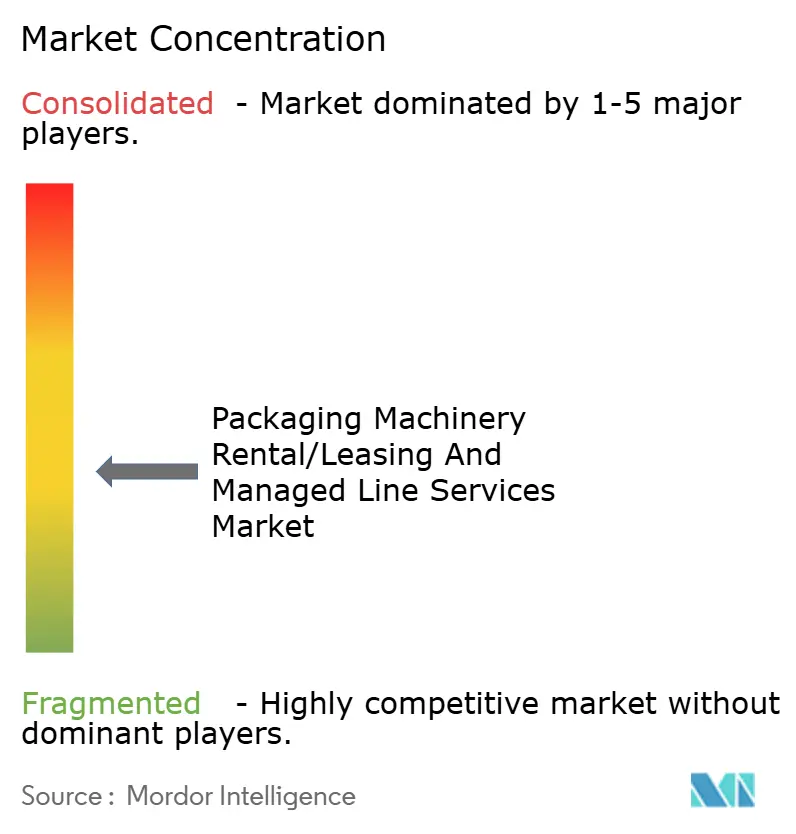
The packaging machinery rental and leasing, as well as managed line services, market is characterized by moderate fragmentation. Regional independents such as KindPack compete with OEM-affiliated financiers, including Tetra Pak’s Packaging Solutions division and Krones’ LCS Life-Cycle Service. Industry consolidation accelerated in 2025, with Duravant acquiring Pattyn Group BV for EUR 56 million (USD 63.3 million) to expand its European managed line footprint, and Mpac Group adding CSi Palletising for the same price, thereby scaling its end-of-line rental fleet.
Alliance Machine Systems acquired Systec and Automatan, thereby bolstering its coverage of corrugated machinery. Players increasingly replace equipment-centric pitches with uptime-linked SLAs and data-driven optimization. SIGMA Equipment and EquipNet deploy cloud portals that track fleet availability and predictive maintenance, differentiating on responsiveness.
OEMs embed finance arms to lock customers into ecosystems; Bosch Packaging Technology’s pay-as-you-produce model automatically adjusts billing to throughput, aligning vendor revenue with client output. Cross-border deployment remains complex due to customs and local safety regulations, rewarding firms with expertise in compliance and multi-country service teams.
Packaging Machinery Rental/Leasing And Managed Line Services Industry Leaders
Sigma Equipment, Inc.
EquipNet, Inc.
Hilco Equipment Leasing, Inc.
Packserv Pty Ltd.
Rentafill Pty Ltd.
- *Disclaimer: Major Players sorted in no particular order
Packaging Machinery Rental/Leasing And Managed Line Services Market Companies Covered in this Report
- Sigma Equipment, Inc.
- EquipNet, Inc.
- Packserv Pty Ltd.
- Rentafill Pty Ltd.
- Hilco Equipment Leasing, Inc.
- Aaron Equipment Company, Inc.
- Frain Industries, Inc.
- Steep Hill Equipment Solutions Inc.
- Crawford Packaging Inc.
- Robopac USA
- Tetra Pak International S.A.

Recent Industry Developments in Packaging Machinery Rental/Leasing And Managed Line Services Market
- May 2025: SIG InnoVentures and Optima invested in PulPac to accelerate fiber-based technology, opening sustainable equipment rental avenues.
- May 2025: Packsize partnered with Sitma and Paccurate, integrating software with automated packagers across its rental fleet.
- March 2025: Duravant completed the EUR 56 million Pattyn Group BV acquisition, adding specialty food-processing packagers to its service lineup.
- March 2025: Alliance Machine Systems acquired Systec and Automatan to expand its European automation portfolio and rental fleet capacity.


Global Packaging Machinery Rental/Leasing And Managed Line Services Market Report Scope
| Equipment Rental |
| Lease-to-Own Programs |
| Managed Line Services |
| Rental and Maintenance Bundles |
| Filling Machines |
| Form-Fill-Seal (FFS) Systems |
| Labeling and Coding Systems |
| Wrapping and Shrink-Pack Systems |
| Palletizing and Stretch-Wrapping |
| less than 1 Year |
| 1 - 3 Years |
| 4 - 5 Years |
| More than 5 Years |
| Food and Beverage |
| Pharmaceuticals |
| Cosmetics and Personal Care |
| E-commerce and Logistics |
| Other End-user Industries |
| North America | United States | |
| Canada | ||
| Mexico | ||
| South America | Brazil | |
| Argentina | ||
| Chile | ||
| Rest of South America | ||
| Europe | United Kingdom | |
| Germany | ||
| France | ||
| Italy | ||
| Spain | ||
| Russia | ||
| Rest of Europe | ||
| Asia-Pacific | China | |
| India | ||
| Japan | ||
| South Korea | ||
| Australia | ||
| Rest of Asia-Pacific | ||
| Middle East and Africa | Middle East | Saudi Arabia |
| United Arab Emirates | ||
| Turkey | ||
| Rest of Middle East | ||
| Africa | South Africa | |
| Nigeria | ||
| Rest of Africa | ||
| By Service Type | Equipment Rental | ||
| Lease-to-Own Programs | |||
| Managed Line Services | |||
| Rental and Maintenance Bundles | |||
| By Equipment Type | Filling Machines | ||
| Form-Fill-Seal (FFS) Systems | |||
| Labeling and Coding Systems | |||
| Wrapping and Shrink-Pack Systems | |||
| Palletizing and Stretch-Wrapping | |||
| By Contract Duration | less than 1 Year | ||
| 1 - 3 Years | |||
| 4 - 5 Years | |||
| More than 5 Years | |||
| By End-user Industry | Food and Beverage | ||
| Pharmaceuticals | |||
| Cosmetics and Personal Care | |||
| E-commerce and Logistics | |||
| Other End-user Industries | |||
| By Geography | North America | United States | |
| Canada | |||
| Mexico | |||
| South America | Brazil | ||
| Argentina | |||
| Chile | |||
| Rest of South America | |||
| Europe | United Kingdom | ||
| Germany | |||
| France | |||
| Italy | |||
| Spain | |||
| Russia | |||
| Rest of Europe | |||
| Asia-Pacific | China | ||
| India | |||
| Japan | |||
| South Korea | |||
| Australia | |||
| Rest of Asia-Pacific | |||
| Middle East and Africa | Middle East | Saudi Arabia | |
| United Arab Emirates | |||
| Turkey | |||
| Rest of Middle East | |||
| Africa | South Africa | ||
| Nigeria | |||
| Rest of Africa | |||


Key Questions Answered in the Report
What is the projected value of packaging machinery rentals by 2031?
The sector is forecast to reach USD 8.16 billion by 2031.
Which type of service is expanding fastest?
Managed line services are on track for a 9.31% CAGR through 2031.
Why are palletizing units leading equipment growth?
Labor shortages and automation priorities drive demand for rented robotic palletizers, resulting in an 8.81% CAGR outlook for the segment.
How big is the North American share?
North America captured 35.52% of the 2025 global revenue.
What drives Asia-Pacific expansion?
Government manufacturing incentives and free-trade agreements are propelling a 9.48% CAGR in the Asia-Pacific region.
How fragmented is supplier competition?
The top five vendors collectively hold under 40% of the revenue, reflecting moderate fragmentation.
Page last updated on:





