
Flexible Packaging Machinery Market Size and Share
Market Overview
| Study Period | 2019 - 2030 |
|---|---|
| Market Size (2025) | USD 21.34 Billion |
| Market Size (2030) | USD 29.15 Billion |
| Growth Rate (2025 - 2030) | 6.44 % |
| Fastest Growing Market | Asia Pacific |
| Largest Market | Asia Pacific |
| Market Concentration | Medium |
Major Players
*Disclaimer: Major Players sorted in no particular order Image © Mordor Intelligence. Reuse requires attribution under CC BY 4.0. |
|

Flexible Packaging Machinery Market Analysis by Mordor Intelligence
The flexible packaging machinery market size reached USD 21.34 billion in 2025 and is projected to increase to USD 29.15 billion by 2030, reflecting a steady 6.44% CAGR. Growth stems from rising consumer demand for convenience packs, regulatory moves favoring recyclable materials, and the rollout of Industry 4.0 automation that enables converters to keep downtime below 2% while maintaining stringent quality targets. Food, pharmaceutical, and personal care producers are accelerating capital spending on servo-driven form-fill-seal lines, palletizers, and vision-guided inspection units, all of which shorten changeovers and shrink waste. Asia-Pacific suppliers benefit from cost-competitive labor and large domestic end-markets, while North American and European firms defend their share by bundling machinery with software, remote diagnostics, and predictive maintenance service contracts.[1]Reuters Staff, “Promach Completes HMC Products Acquisition for USD 200 Million,” Reuters, reuters.com E-commerce fulfillment needs for lighter, more durable packs further amplify investment in smart machinery capable of producing shipping-ready pouch and sachet formats.
Key Report Takeaways
- By machine type, the form-fill-seal segment captured 42.53% of the flexible packaging machinery market share in 2024.
- By packaging type, the flexible packaging machinery market size for sachets and stick packs is projected to grow at an 8.38% CAGR between 2025–2030.
- By automation level, the automatic systems segment captured 64.53% of the flexible packaging machinery market share in 2024.
- By end-user industry, the flexible packaging machinery market size for personal care and cosmetics is projected to grow at an 8.73% CAGR between 2025–2030.
- By geography, the Asia-Pacific region captured 33.26% of the flexible packaging machinery market share in 2024.
Note: Market size and forecast figures in this report are generated using Mordor Intelligence’s proprietary estimation framework, updated with the latest available data and insights as of January 2026.
Market Trends and Insights
Drivers Impact Analysis of Flexible Packaging Machinery Market*
| Driver | (~) % Impact on CAGR Forecast | Geographic Relevance | Impact Timeline |
|---|---|---|---|
| Surge in demand for single-serve, on-the-go formats | +1.2% | Global with strongest impact in North America and Asia-Pacific | Medium term (2-4 years) |
| Shift of CPG brands to monomaterial flexible packs for recyclability | +0.9% | Europe and North America core, expanding to Asia-Pacific | Long term (≥ 4 years) |
| Expansion of e-commerce grocery fulfillment networks | +0.8% | Global with early gains in North America, Europe, China | Short term (≤ 2 years) |
| Food safety-driven adoption of high-barrier pouch machinery in emerging markets | +0.7% | Asia-Pacific, South America, Middle East and Africa | Medium term (2-4 years) |
| Integration of smart inspection sensors lowering downtime <2% | +0.6% | Global led by developed markets | Short term (≤ 2 years) |
| OEM financing programs for mid-tier converters in Latin America | +0.3% | Latin America focus, spillover to other emerging markets | Medium term (2-4 years) |
| Source: Mordor Intelligence | |||
Surge in Demand for Single-Serve, On-the-Go Formats
Snacking, portion control, and hygiene priorities have made single-serve packs the fastest-expanding application for new lines, pushing high-speed form-fill-seal machines to produce over 200 packs per minute. The pandemic reinforced consumer preferences for sealed individual portions, boosting the demand for pods, sachets, and ready-to-drink pouches across beverages and personal care products. Online grocery platforms amplify this momentum because lighter units result in lower shipping costs and fewer damage claims. Machine builders now offer multi-lane designs, along with tool-less changeovers, allowing brands to run multiple sizes in a single shift. This flexibility maintains high output while supporting SKU proliferation across both premium and value tiers.
Shift of CPG Brands to Monomaterial Flexible Packs for Recyclability
Extended producer responsibility rules and voluntary 2030 recyclability pledges are shifting global brands away from multilayer laminates toward single-polymer films. That switch requires sealing bars, temperature control, and tension-management systems tuned to the different melt properties of monomaterial substrates. Machinery suppliers embed adaptive algorithms that adjust sealing pressure in real time, protecting barrier integrity without slowing throughput. Adoption is most advanced in Europe and North America, but is spreading to Asia-Pacific multinationals that export to regulated markets. Early adopters report measurable cutbacks in scrap and faster certifications under retailer recyclability scoring schemes.
Expansion of E-commerce Grocery Fulfillment Networks
Online grocery penetration reached 12.4% in developed economies by 2024, and fulfillment centers now favor packs that optimize dimensional weight while accommodating mechanized picking systems. Resealable, portion-controlled pouches and stick packs travel efficiently in mailers, prompting dedicated machinery investments. Equipment vendors responded with modular lines featuring standardized footprints and barcode-ready print stations, aligning with the needs of automated warehouses. Converters gain extra value from remote-monitoring dashboards that synchronize packaging cadence with real-time inventory data, cutting carrying costs while maintaining service-level agreements.
Food Safety-Driven Adoption of High-Barrier Pouch Machinery in Emerging Markets
In the Asia-Pacific and Latin America regions, rising food safety regulations and limited refrigerated logistics are driving demand for high-barrier pouch formats that extend shelf life without requiring a cold chain. Lines capable of feeding aluminum or EVOH-layer films require tight control over tension and trim removal; suppliers deliver these via servo drives and vacuum scrap-handling units. Dairy, meat, and ready-meal processors rely on the format to reach rural consumers, opening sizable replacement cycles. Financing support from development banks helps smaller converters purchase the technology, accelerating diffusion beyond multinational plants.
Restraints Impact Analysis of Flexible Packaging Machinery Market*
| Restraint | (~) % Impact on CAGR Forecast | Geographic Relevance | Impact Timeline |
|---|---|---|---|
| Capital-intensive nature limits SME adoption | -0.8% | Global with strongest impact in emerging markets | Long term (≥ 4 years) |
| Skilled operator shortage raising OPEX ≥15% | -0.6% | Developed markets primarily, spreading to emerging markets | Medium term (2-4 years) |
| Volatility in multilayer film prices disrupting ROI models | -0.4% | Global with regional variations | Short term (≤ 2 years) |
| Stricter EU machinery safety directives adding compliance costs | -0.3% | Europe core, spillover to export-oriented manufacturers | Medium term (2-4 years) |
| Source: Mordor Intelligence | |||
Capital-Intensive Nature Limits SME Adoption
A modern flexible pouch line can cost USD 500,000 to USD 2 million, an outlay that exceeds typical SME credit ceilings in many emerging markets.[2]International Finance Corporation, “SME Access to Equipment Financing,” IFC, ifc.org Payback is often extended because converters must also finance ancillary equipment, such as chillers, compressors, and inline inspection systems. Technology cycles now run 7-10 years, forcing owners to plan for frequent upgrades that strain cash flow. Leasing programs and vendor-backed deferred payment plans are available, but collateral requirements still hinder adoption. The result is a two-tier market in which large converters deploy cutting-edge automation while smaller firms rely on used or entry-level machines that limit product quality and throughput.
Skilled Operator Shortage Raising OPEX ≥15%
Advanced machinery combines robotics, vision sensors, and machine-learning analytics, yet few technical colleges produce graduates capable of operating such systems. As seasoned technicians retire, employers escalate wages and overtime, lifting plant operating costs by at least 15%. Some firms pilot augmented-reality headsets for step-by-step maintenance guidance, but these tools still require a baseline level of technical literacy. Automation helps mitigate pressure; yet, even fully automated lines require expert oversight during format changes or unplanned stoppages. Smaller converters often lose talent to larger rivals that can afford premium compensation and robust career development programs.
*Our forecasts treat driver/restraint impacts as directional, not additive. The impact forecasts reflect baseline growth, mix effects, and variable interactions.
Flexible Packaging Machinery Market Segment Analysis
By Machine Type:
Automation Drives FFS DominanceForm-fill-seal units accounted for 42.53% of the flexible packaging machinery market in 2024, reflecting their ability to handle diverse pouch, bag, and sachet forms across the food, pharmaceutical, and cosmetics industries. High-torque servo motors, recipe-driven HMI interfaces, and on-board defect detection sustain line speeds while trimming waste, attributes that keep the segment firmly ahead in revenue terms. Palletizing and depalletizing equipment is the fastest-growing segment, with an 8.43% CAGR through 2030, as manufacturers automate end-of-line logistics to offset labor gaps. Filling and dosing systems remain relevant for viscous foods and sterile pharmaceutical doses, where precision outweighs raw speed. Wrapping, bundling, coding, and inline inspection systems fill specialized roles that knit together line capabilities.
Manufacturers embed artificial-intelligence software into their flagship FFS models to tune sealing pressure, cut-off length, and gas-flush cycles on the fly, thereby trimming material use and reducing scrap. Palletizers are increasingly employing collaborative robots that work safely alongside human pickers, accommodating SKU diversity without the need for cage guarding. All machine categories now feature Industrial-Internet-of-Things ports that export uptime, energy, and quality metrics into cloud dashboards. These data streams allow converters to benchmark asset performance across plants and schedule maintenance at optimal intervals, reinforcing total cost-of-ownership advantages that favor premium-priced, high-speed models.




By Packaging Type:
Pouches Lead Sustainable TransitionPouches accounted for 46.15% of the flexible packaging machinery market in 2024, owing to their lightweight design, shelf impact, and resealable features that resonate with urban consumers. Brands increasingly shift from rigid cans and jars toward stand-up, spouted, and zipper formats that use as much as 70% less material. Sachets and stick packs are projected to log the highest growth, at an 8.38% CAGR through 2030, as e-commerce and portion-control trends amplify demand. Bags and sacks maintain footholds in pet food, lawn care, and bulk staples, while shrink and stretch wraps serve as transit protection for beverages and industrial goods.
Sustainability imperatives are accelerating the movement toward monomaterial pouch structures that facilitate mechanical recycling. Such substrates require tighter temperature windows and refined dwell times, prompting machine builders to adopt closed-loop seal-bar heaters and load-cell-based pressure control. For sachet and stick-pack lines, multi-lane auger fillers and ultrasonic sealing modules now combine high output with reduced energy consumption. Completed packs must withstand vibration and compression in automated grocery systems, so machinery integrates inline burst testers and vision cameras to reject weak seals before secondary packaging, thereby preserving brand reputation and consumer safety.
By Automation Level:
Industry 4.0 Accelerates Automatic AdoptionAutomatic systems owned 64.53% share of the flexible packaging machinery market in 2024 and are on track for an 8.69% CAGR through 2030 as converters target lights-out production scenarios. Predictive-maintenance algorithms, fed by vibration and thermal sensors, forecast impending failures, allowing for repairs during scheduled downtime. Integrated SCADA layers feed KPIs, such as overall equipment effectiveness, directly to plant-wide dashboards, enabling real-time decision-making. Semi-automatic lines persist where delicate products demand human judgment or where capex budgets remain tight, yet their proportion steadily declines as entry-level robotics drops in cost.
Edge-computing modules now reside within machine control cabinets, crunching large data streams close to the source and sending compact insights to the cloud. That architecture lowers latency and bandwidth charges, an especially attractive feature for converters in geographies with limited connectivity. Cybersecurity hardening, including firewall-protected PLCs, encrypted firmware updates, and role-based operator logins, has become a non-negotiable tender requirement for multinational brand owners. Automation, therefore, delivers not only speed but also compliance with global IT and traceability protocols.

By End-user Industry:
Personal Care Drives Premium GrowthFood and beverages retained the lion’s share at 57.12% in 2024, as packaging safeguards flavor, texture, and microbiological safety while supporting omnichannel distribution. Personal care and cosmetics, however, are set to expand at an 8.73% CAGR through 2030, leveraging high-gloss pouch designs, precision spouts, and smaller environmental footprints to capture discerning consumers. Pharmaceutical and healthcare buyers continue equipping cleanroom-ready lines with laminar-flow hoods, antimicrobial contact surfaces, and serialization printers to address traceability mandates.
Luxury skincare brands are increasingly specifying matte, foil-free laminates that showcase vivid inks while reducing carbon emissions, so machinery must maintain register within ±0.3 mm across multiple passes. For nutraceutical gummies, high-speed zipper lines preserve moisture content and aromatics, requiring synchronized weighers and nitrogen-flush stations. Bulk chemical fillers pivot toward closed-loop bag-in-box systems that minimize worker exposure. Across sectors, brand owners demand proof of recyclability targets, steering converters toward accredited lines that document energy, material, and scrap ratios for sustainability scorecards.
Geography Analysis
APAC Flexible Packaging Machinery Market
The Asia-Pacific region captured 33.26% of the flexible packaging machinery market in 2024 and is projected to grow at an 8.13% CAGR through 2030, driven by rising middle-class spending and pro-manufacturing policies in China, India, Vietnam, and Indonesia. Governments sponsor technology parks, offer tax holidays, and provide equipment import rebates, thereby shrinking the payback horizons for domestic converters. Chinese firms scale up smart factories to offset higher wages, while Indian processors leverage Production-Linked-Incentives to add automated pouch lines targeting both local and export demand.
North America Flexible Packaging Machinery Market
North America remains a technological pacesetter despite a lower volume share. Reshoring initiatives and persistent labor shortages drive orders for AI-embedded robotic palletizers and inline inspection systems, which elevate overall equipment effectiveness above 90%. United States equipment builders cement customer loyalty via strong aftermarket parts and 24-hour field-service guarantees. Canada and Mexico benefit respectively from food-safety innovations and nearshoring capital inflows that upgrade aging machinery fleets.
Europe Flexible Packaging Machinery Market
Europe posts steady gains driven by sweeping sustainability regulations under the Packaging and Packaging Waste Directive, compelling converters to retrofit or replace legacy assets with monomaterial-capable lines. Germany leads exports of high-speed thermoformers, while Italy contributes niche excellence in coffee-pod and pharmaceutical blister equipment. Strict CE-mark vigilance extends globally as multinational brand owners align worldwide plants to EU safety standards, creating favorable demand for European OEMs.


Competitive Landscape
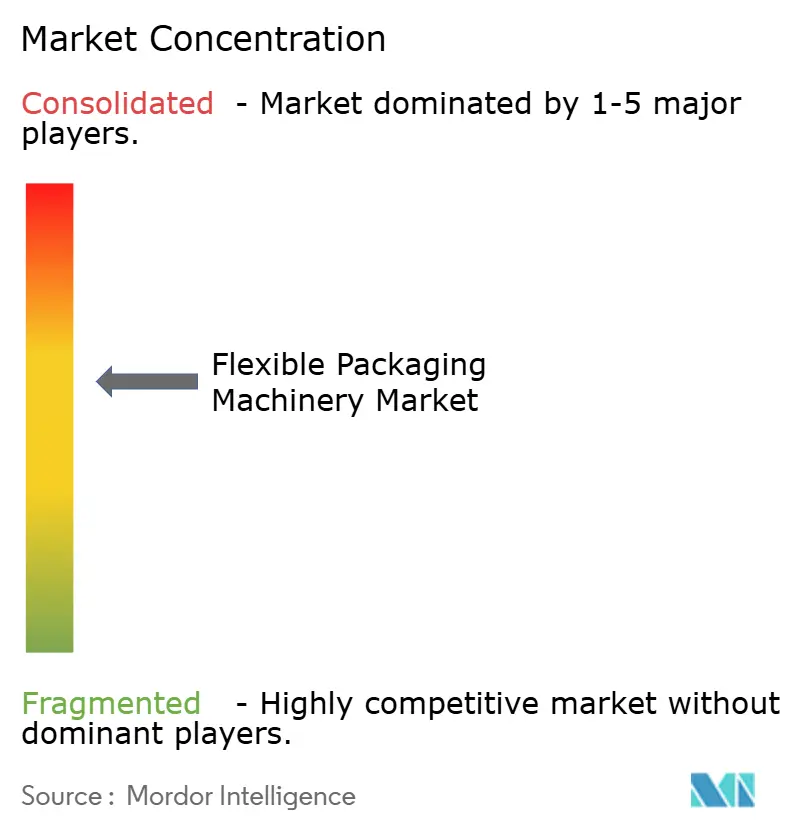
A moderately fragmented landscape characterizes the flexible packaging machinery market. European and North American incumbents defend their technology leadership through active R&D spending and bolt-on acquisitions, the latest being Promach’s USD 200 million purchase of HMC Products, which deepened pouch line capability. Multivac’s EUR 85 million (USD 92 million) acquisition of Italianpack strengthened its Mediterranean footprint and enhanced thermoforming know-how. Asian suppliers gain momentum by pairing cost-efficient hardware with localized service centers that cut downtime for regional converters.
Vendors differentiate themselves through total-solution offerings that combine fillers, formers, palletizers, and digital twin software, which simulates production to mitigate risk during changeovers.[3]International Organization for Standardization, “Packaging Machinery Standards,” ISO, iso.org Predictive-maintenance subscriptions, augmented-reality field support, and energy-audit modules form integral parts of sales contracts, cementing long-term revenue beyond hardware margins. Sustainable packaging capability emerges as a competitive edge as the suppliers with proven monomaterial sealing track records win more bids from brand owners seeking commitments to recyclability. Modular designs that allow incremental capacity upgrades appeal to converters wary of large single-shot investments.
White-space opportunities concentrate in bio-based film processing and quick-changeover micro-lines tailored for digital-native challenger brands. Start-ups tout plug-and-play robotics and cloud-native control platforms to slash commissioning time from months to weeks. Established players respond with accelerator programs and minority stakes in automation software companies to secure future feature sets. Overall, buyer power climbs as more OEMs offer comparable performance, making after-sales service, financing options, and sustainability credentials decisive tender factors.
Flexible Packaging Machinery Industry Leaders
-
Barry-Wehmiller Companies Inc.
-
ProMach Inc.
-
Coesia S.p.A.
-
Industria Macchine Automatiche S.p.A.
-
Syntegon Technology GmbH
- *Disclaimer: Major Players sorted in no particular order
Flexible Packaging Machinery Market Companies Covered in this Report
- Syntegon Technology GmbH
- IMA Group
- ProMach Inc.
- Coesia S.p.A.
- Barry-Wehmiller Companies Inc.
- FUJI Machinery Co., Ltd.
- Duravant LLC
- Ishida Co., Ltd.
- KHS GmbH
- GEA Group AG
- Sacmi Imola S.C.
- Premier Tech Ltd.
- Viking Masek Global Packaging Technologies
- Nichrome India Ltd.
- PFM Group
- Rovema GmbH
- Windmöller & Hölscher KG
- Optima Packaging Group GmbH
- MULTIVAC Sepp Haggenmüller SE & Co. KG
- ULMA Packaging S. Coop.

Recent Industry Developments in Flexible Packaging Machinery Market
- October 2025: Multivac completed its acquisition of Italianpack for EUR 85 million (USD 92 million), expanding high-barrier thermoforming capacity in Southern Europe and North Africa.
- September 2025: Promach closed the USD 200 million takeover of HMC Products, adding advanced pouch form-fill-seal lines and two U.S. plants.
- August 2025: Coesia Group invested USD 150 million to build a pharmaceutical-machinery facility in Vietnam, boosting regional output.
- July 2025: Barry-Wehmiller Companies purchased Starlinger’s woven-packaging division for USD 120 million, entering industrial bag equipment.


Global Flexible Packaging Machinery Market Report Scope
| Form-Fill-Seal (FFS) |
| Filling and Dosing |
| Wrapping and Bundling |
| Palletizing and Depalletizing |
| Other Machine Types |
| Pouches |
| Bags and Sacks |
| Sachets and Stick Packs |
| Shrink and Stretch Wraps |
| Other Packaging Types |
| Automatic |
| Semi-automatic |
| Food and Beverage |
| Pharmaceuticals and Healthcare |
| Personal Care and Cosmetics |
| Homecare and Chemicals |
| Industrial and Bulk Goods |
| Other End-user Industries |
| North America | United States | |
| Canada | ||
| Mexico | ||
| South America | Brazil | |
| Argentina | ||
| Chile | ||
| Rest of South America | ||
| Europe | United Kingdom | |
| Germany | ||
| France | ||
| Italy | ||
| Spain | ||
| Russia | ||
| Rest of Europe | ||
| Asia-Pacific | China | |
| India | ||
| Japan | ||
| South Korea | ||
| Australia | ||
| Rest of Asia-Pacific | ||
| Middle East and Africa | Middle East | Saudi Arabia |
| United Arab Emirates | ||
| Turkey | ||
| Rest of Middle East | ||
| Africa | South Africa | |
| Nigeria | ||
| Rest of Africa | ||
| By Machine Type | Form-Fill-Seal (FFS) | ||
| Filling and Dosing | |||
| Wrapping and Bundling | |||
| Palletizing and Depalletizing | |||
| Other Machine Types | |||
| By Packaging Type | Pouches | ||
| Bags and Sacks | |||
| Sachets and Stick Packs | |||
| Shrink and Stretch Wraps | |||
| Other Packaging Types | |||
| By Automation Level | Automatic | ||
| Semi-automatic | |||
| By End-user Industry | Food and Beverage | ||
| Pharmaceuticals and Healthcare | |||
| Personal Care and Cosmetics | |||
| Homecare and Chemicals | |||
| Industrial and Bulk Goods | |||
| Other End-user Industries | |||
| By Geography | North America | United States | |
| Canada | |||
| Mexico | |||
| South America | Brazil | ||
| Argentina | |||
| Chile | |||
| Rest of South America | |||
| Europe | United Kingdom | ||
| Germany | |||
| France | |||
| Italy | |||
| Spain | |||
| Russia | |||
| Rest of Europe | |||
| Asia-Pacific | China | ||
| India | |||
| Japan | |||
| South Korea | |||
| Australia | |||
| Rest of Asia-Pacific | |||
| Middle East and Africa | Middle East | Saudi Arabia | |
| United Arab Emirates | |||
| Turkey | |||
| Rest of Middle East | |||
| Africa | South Africa | ||
| Nigeria | |||
| Rest of Africa | |||


Key Questions Answered in the Report
What is the 2025 value of the flexible packaging machinery market?
The market is expected to reach USD 21.34 billion by 2025.
Which region holds the largest share of global demand?
Asia-Pacific leads with 33.26% share.
Which machine type is expanding the fastest?
Palletizing and depalletizing equipment is expected to experience an 8.43% CAGR through 2030.
Why are brands switching to monomaterial packs?
Regulatory pressure and recyclability targets drive the change toward single-polymer films.
How does operator scarcity affect plant costs?
Labor shortages have raised operating expenses by at least 15% for many converters.
Which end-user segment is expected to grow the quickest?
Personal care and cosmetics is forecast to post an 8.73% CAGR through 2030.
Page last updated on:





