
Cold Chain Packaging Automation Equipment Market Size and Share
Market Overview
| Study Period | 2019 - 2030 |
|---|---|
| Market Size (2025) | USD 2.87 Billion |
| Market Size (2030) | USD 4.98 Billion |
| Growth Rate (2025 - 2030) | 11.65 % |
| Fastest Growing Market | Asia Pacific |
| Largest Market | North America |
| Market Concentration | Medium |
Major Players *Disclaimer: Major Players sorted in no particular order Image © Mordor Intelligence. Reuse requires attribution under CC BY 4.0. | |

Cold Chain Packaging Automation Equipment Market Analysis by Mordor Intelligence
The Cold Chain Packaging Automation Equipment market is valued at USD 2.87 billion in 2025 and is forecast to reach USD 4.98 billion by 2030, advancing at a 11.65% CAGR. Growth reflects three converging forces: an expanding biologics pipeline requiring strict thermal integrity, worsening labor shortages in freezer environments, and the surge in e-grocery volumes that compresses fulfillment timelines. Stricter Good Distribution Practice rules, along with updated food-safety regulations, are driving shippers toward automation that incorporates continuous temperature monitoring.[1]U.S. Food and Drug Administration, “FSMA Final Rule on Sanitary Transportation of Human and Animal Food,” fda.gov Equipment vendors able to integrate IoT devices with legacy warehouse software gain a competitive edge because connectivity lowers manual record-keeping costs and reduces compliance risk. Capital scarcity in emerging markets tempers near-term adoption; however, rising investment in reusable shipper loops and low-GWP retrofits signals a fresh opportunity for differentiated solutions.
Key Report Takeaways
- By equipment type, automated case packers captured 27.41% of the cold chain packaging automation equipment market share in 2024.
- By temperature range, the cold chain packaging automation equipment market size for the ultra-low or cryogenic band is projected to grow at a 14.20% CAGR between 2025-2030.
- By end-user, food and beverage captured 36.26% of the cold chain packaging automation equipment market share in 2024.
- By packaging type, the cold chain packaging automation equipment market size for smart-label or RFID modules is projected to grow at a 12.93% CAGR between 2025-2030.
- By geography, North America captured 41.18% of the cold chain packaging automation equipment market share in 2024.
Note: Market size and forecast figures in this report are generated using Mordor Intelligence’s proprietary estimation framework, updated with the latest available data and insights as of January 2026.
Market Trends and Insights
Drivers Impact Analysis of Cold Chain Packaging Automation Equipment Market*
| Driver | (~) % Impact on CAGR Forecast | Geographic Relevance | Impact Timeline |
|---|---|---|---|
| Biologics pipeline expansion | +2.1% | North America and Europe | Medium term (2–4 years) |
| Labor shortages in cold sites | +1.8% | North America and Europe, growing in Asia-Pacific | Short term (≤ 2 years) |
| Stricter GDP and food-safety mandates | +1.5% | Global, led by developed markets | Long term (≥ 4 years) |
| E-grocery and last-mile demand | +1.4% | Urban North America, Europe, Asia-Pacific | Medium term (2-4 years) |
| Reusable shipper re-conditioning | +0.9% | Global pharma corridors | Long term (≥ 4 years) |
| Energy-efficiency retrofits | +0.7% | Europe and North America | Long term (≥ 4 years) |
| Source: Mordor Intelligence | |||
Biologics Pipeline Expansion
By 2024, more than 7,000 biologic therapies were in development, creating stringent thermal requirements that manual processes cannot meet.[2]Biotechnology Innovation Organization, “Medicines in Development: Biologics 2024,” bio.org Pharmaceutical firms are shifting toward low-volume, high-value shipments, where a single temperature excursion can threaten million-dollar lots. Automated case packers equipped with integrated sensors compile electronic records that regulators now require, while computer vision modules verify vial orientation to prevent label misreads. Because most biologics require storage at 2-8 °C or ≤-60 °C, equipment that sustains stable microclimates and eliminates operator touchpoints is rapidly becoming the standard. Vendors offering plug-and-play modules compatible with validated cleanroom software can significantly shorten installation timelines, a decisive factor for contract development and manufacturing organizations scaling multiple therapy programs simultaneously. The demand for cryogenic-rated robotics is further reinforced by the shift to personalized cell and gene therapies, which supply fewer than 500 patients per batch.
Labor Shortages in Cold Facilities Spur Robotics
Annual employee turnover at sub-zero warehouses exceeded 75% in 2024, prompting operators to delegate repetitive tasks to robotic palletizers that remain productive in -30 °C zones. Collaborative robots equipped with thermal-rated actuators lower injury rates, keep insurance premiums in check, and minimize downtime linked to mandated warm-up breaks. Flexible end-of-arm tooling enables the same robot to grip cardboard shippers, polystyrene coolers, or reusable containers without reprogramming, making it ideal for e-grocery sites where SKU counts shift daily. As optical sensors improve, advanced algorithms now identify frosted barcodes that previously stumped scanners, preserving throughput under heavy condensation. Return on investment accelerates when robots operate across two or three daily shifts, shortening payback to less than 24 months for facilities processing high-margin biologics.
Stricter GDP and Food-Safety Mandates
The European Union updated Good Distribution Practice in 2024 to require continuous temperature logging and automatic deviation alerts throughout the entire logistics chain. The U.S. Food Safety Modernization Act also requires serialized data capture, linking every packaged unit to its shipping route and carrier handoff. These requirements render spreadsheet record-keeping inadequate, nudging shippers toward fully networked conveyors, labelers, and case formers that upload information to audit portals. Larger corporations with multi-site footprints favor vendors holding ISO 13485 or HACCP compliance credentials because this eases global harmonization. As enforcement escalates, mid-market distributors are realizing that automation not only prevents fines and recalls but also earns them a trusted partner status with multinational pharmaceutical clients. Consequently, compliance has moved from a cost center to a strategic investment.
E-Grocery Growth and Last-Mile Demand
Global online grocery sales reached USD 150 billion in 2024 and are expected to continue rising as urban consumers demand same-day delivery of frozen and fresh products. Fulfillment centers must pack mixed-temperature baskets within minutes to preserve the integrity of ice cream alongside the crispness of lettuce. Gel-pack inserters and vision-guided bagging robots speed this task, slashing order cycle time by more than 30% compared to manual lines. Smart labels print dynamic QR codes that automatically record time-out-of-temperature, offering end buyers proof of product freshness at the doorstep. Meal kit firms are extending automation to customize spice sachet counts and recipe cards, thereby boosting customer retention. Urban micro-fulfillment hubs employ compact automated storage systems that fit in storefront-sized footprints, circumventing real estate constraints while maintaining cold chain guarantees for rapid dispatch.
Restraints Impact Analysis of Cold Chain Packaging Automation Equipment Market*
| Restraint | (~) % Impact on CAGR Forecast | Geographic Relevance | Impact Timeline |
|---|---|---|---|
| High CAPEX for cold-rated lines | -1.6% | Global, strongest in emerging markets | Short term (≤ 2 years) |
| Infrastructure gaps in emerging regions | -1.2% | Asia-Pacific, Latin America, Africa | Long term (≥ 4 years) |
| Legacy-system IoT mismatch | -0.8% | Global, mature facilities | Medium term (2-4 years) |
| Tariff-driven component volatility | -0.5% | Global, policy-dependent | Short term (≤ 2 years) |
| Source: Mordor Intelligence | |||
High CAPEX for Cold-Rated Automation Lines
Thermal-rated robots, stainless-steel conveyors, and insulated control enclosures often cost 40-60% more than ambient counterparts, stretching budgets for operators with slim margins. Payback periods above three years deter smaller pharmaceutical distributors that lack the scale to amortize investments over large volumes. Leasing and fee-per-pack models are emerging, yet lenders still view the equipment as specialized collateral, inflating financing rates. This capital hurdle sometimes postpones projects even when labor savings pencil out, especially in regions where interest rates hover in double digits.
Infrastructure Gaps in Emerging Markets
Unreliable electricity in parts of South Asia and sub-Saharan Africa poses a threat to uptime for automation computers and chilled compressors. Skilled technicians capable of servicing servo drives or cryogenic valves remain scarce; when faults occur, spare parts often ship from Europe or the United States, leading to week-long stoppages. Operators hedge by over-specifying redundant subsystems, which raises project costs and complexity. Policy incentives, such as subsidized solar back-up or vocational training, could unlock demand, but their rollout remains uneven across jurisdictions.
*Our forecasts treat driver/restraint impacts as directional, not additive. The impact forecasts reflect baseline growth, mix effects, and variable interactions.
Cold Chain Packaging Automation Equipment Market Segment Analysis
By Equipment Type:
Robotics Redefine End-of-Line PrecisionAutomated case packers captured a 27.41% Cold Chain Packaging Automation Equipment market share in 2024. Facility managers cite the equipment’s flexibility in accommodating both pharmaceutical vial trays and frozen entrée cartons without requiring tool changeovers. Vision-guided robots identify skewed boxes and automatically correct positioning, achieving 99.7% placement accuracy that manual labor struggles to match in -20 °C environments. The shift toward robotic case packers, growing at a 12.80% CAGR, aligns with labor retention pressures discussed earlier. As predictive maintenance software flags motor degradation ahead of failure, operators cut unplanned downtime by up to 40% and safeguard Cold Chain Packaging Automation Equipment market uptime targets. Automated storage and retrieval systems, though accounting for a smaller revenue slice, are gaining favor in multilevel distribution centers where vertical cube utilization trumps floor-based pallet racking. Conveyor and sorter upgrades lag but remain essential for line connectivity.
The Cold Chain Packaging Automation Equipment industry is also witnessing the rapid adoption of machine vision inspection modules, which pair high-resolution cameras with deep-learning classifiers. These systems detect missing gel packs, crushed flaps, or ice crystal formation on carton surfaces that signal temperature excursions. Inclusion of industrial 5G connectivity now lets operators monitor performance across dispersed sites, streamlining remote support contracts. As equipment data flows into enterprise resource planning platforms, procurement teams optimize consumable purchases, lowering operational expenditure. Vendors offering open-architecture APIs gain preference, since pharmaceutical plants must validate each software change under 21 CFR Part 11 rules.[3]U.S. Food and Drug Administration, “21 CFR Part 11 Electronic Records,” fda.gov This interoperability trend strengthens market barriers because retrofitting closed-proprietary machines becomes costly over time.




By Temperature Range:
Cryogenic Lines Race AheadThe refrigerated 2-8 °C band accounted for 41.01% of the Cold Chain Packaging Automation Equipment market revenue in 2024, driven by routine vaccine and insulin shipments. Nevertheless, cryogenic lines at ≤-60 °C are projected to expand at 14.20% CAGR, outpacing all other bands. This jump is tied to the commercialization of cell therapies that must remain below glass-transition temperatures to preserve viability. Cryogenic pack stations employ vacuum-insulated panels, servo-driven freezer doors, and moisture-purge tunnels to prevent frost build-up that can jam sensors. The Cold Chain Packaging Automation Equipment market size for ultra-low lines, therefore, stands to double by 2030.
Frozen segments, typically serving seafood and ready-meal exporters, prioritize throughput over ultra-tight tolerances; yet they still adopt automated palletizers to minimize human frostbite risk. Controlled room temperature applications at 15-25 °C capture niche demand for specialty chemicals and certain monoclonal antibodies shipped during stability testing. Manufacturers offering modular components that handle multiple ranges with simple gasket swaps appeal to 3PLs looking to consolidate investment across temperature zones.
By End-User Industry:
Pharma Growth Outstrips Food VolumeFood and beverage operators accounted for 36.26% of 2024 revenue, thanks to regulatory mandates on contamination prevention in chilled meat and dairy. They favor high-speed case erectors and pallet wrappers that run 140 cartons per minute to keep pace with supermarket promotion cycles. Conversely, pharmaceutical and biologics customers are advancing at a 13.68% CAGR. Their smaller batch sizes, combined with higher unit values, translate into premium automation features such as environmental mapping and redundant temperature probes. The Cold Chain Packaging Automation Equipment market size tied to the pharmaceutical industry will likely overtake the food sector by the late 2020s if the current trajectory persists.
E-commerce grocery and meal-kit firms demand unprecedented flexibility because each order combines ambient condiments, refrigerated produce, and frozen desserts. These players install dynamic shuttles that sequence totes by delivery route, cutting staging errors that would erode brand credibility. Chemicals and specialty materials remain a minor but steady contributor, mostly for temperature-sensitive catalysts used in semiconductor fabrication.

By Packaging Type:
Smart Labels Unlock End-to-End VisibilityInsulated shipper automation held a 35.49% stake in 2024, cementing its role as the baseline solution for GDP compliance. Machines weigh empty containers, insert phase-change material sleeves, and affix serialized labels in a single pass. Smart labels or RFID modules, on track for a 12.93% CAGR, are the brightest spot. Embedded NFC chips communicate with cloud dashboards, enabling downstream warehouses to triage at-risk parcels before delivery failures occur. Cold Chain Packaging Automation Equipment market share for RFID-enabled lines may reach 15% by 2030 if adoption mirrors the serialized medicine timetable in Europe.
Bulk pallet shipper makers focus on foam-in-place technology that molds insulation around irregular loads, reducing dunnage and improving cube fill. Gel-pack insertion systems now feature automatic leak detection via optical sensors, important because burst packs compromise shipper integrity and raise contamination flags.
Geography Analysis
North America Cold Chain Packaging Automation Equipment Market
North America led the Cold Chain Packaging Automation Equipment market, accounting for 41.18% of the revenue share in 2024. The United States houses more than 500 cGMP biologic fill-finish plants that require validated packaging automation. Canada’s dairy and seafood exporters also prioritize automation to offset labor shortages in remote coastal hubs. Cross-border e-commerce between the two countries is expanding the volume for high-velocity fulfillment centers. The market benefits from a robust service infrastructure, enabling 24-hour spare parts deliveries that support uptime expectations.
Europe Cold Chain Packaging Automation Equipment Market
Europe ranked second, buoyed by Germany, France, and the United Kingdom, where pharmaceutical R&D spend remains robust. The region mandates low-GWP refrigerants under the F-Gas Regulation, incentivizing capex toward energy-efficient conveyors and heat-recovery case sealers. Italy and Spain benefit from fresh produce exports, which demand rapid pre-cooling and packaging to preserve shelf life on long intra-EU routes. Europe’s mature cold chain network maintains a mid-single-digit CAGR, yet retrofit spending on CO₂ cascades and ammonia chillers remains sizable.
APAC Cold Chain Packaging Automation Equipment Market
The Asia-Pacific region is the fastest-growing territory, expected to log a 11.99% CAGR. China scales biopharma capacity along its Belt and Road corridor, catalyzing procurement of robotic case packers tailor-made for filling lyophilized vials destined for export. Japan’s rapidly aging population fuels demand for injectable biologics, while government reimbursement policies reward therapies delivered with intact cold chain data. India leverages its vaccine manufacturing heritage to capture global contracts, installing cryogenic storage and packaging cells funded by public-private grants. Southeast Asian nations, notably Vietnam and Indonesia, are witnessing the digitization of retail grocery, which is spawning micro-fulfillment hubs that require modular conveyors and automated gel-pack feeders.
MEA and South America Cold Chain Packaging Automation Equipment Market
South America, the Middle East, and Africa collectively hold a modest share but register pockets of double-digit growth, where multinational food processors establish export-oriented meat or mango supply chains. Infrastructure constraints persist: intermittent power in Nigeria and rolling blackouts in Argentina require redundant UPS systems to protect line controllers. Multilateral development banks are channeling concessional loans into cold chain capacity, suggesting a potential future acceleration.


Competitive Landscape
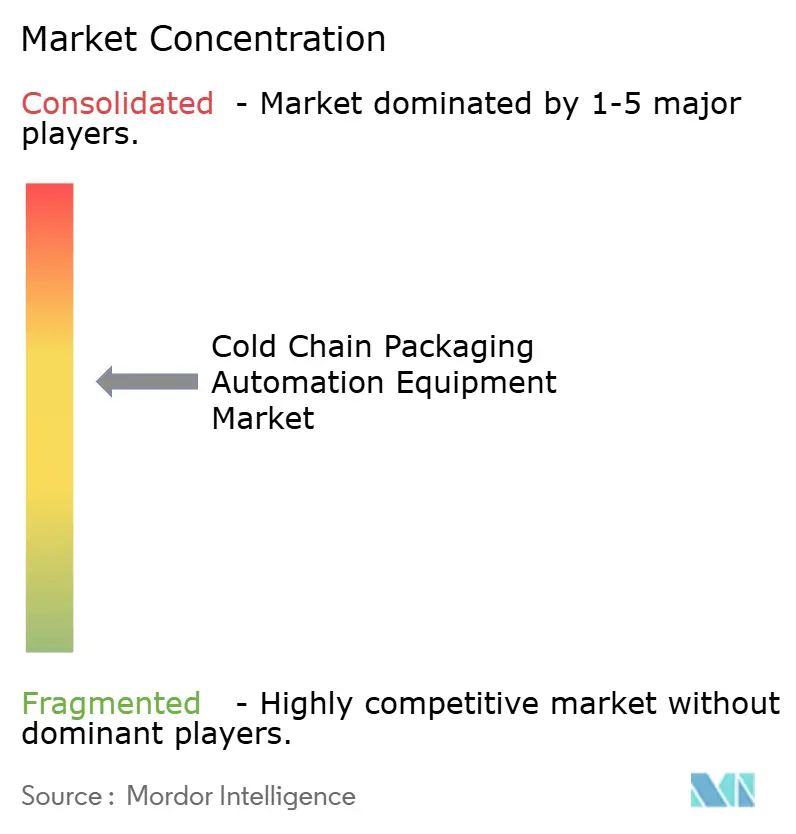
The Cold Chain Packaging Automation Equipment market is moderately fragmented. No vendor controls more than 15% revenue, yet the top five collectively hold close to 40%, conferring moderate bargaining power to large buyers. ABB and FANUC deploy proven six-axis robots hardened for freezer duty, leveraging global integrator networks for after-sales support. Krones expands via acquisition to offer turnkey lines that pair beverage heritage with pharmaceutical compliance expertise. Specialized firms, such as CSafe Global, differentiate themselves through validation packages and pre-qualified shipper designs, which command premium prices.
Software-hardware bundling emerges as the decisive differentiator. Vendors embed OPC-UA, MQTT, and RESTful APIs, allowing clients to feed sensor data into cloud analytics that predict gel-pack melt timing. This data-centric model encourages subscription revenue, shifting focus from one-off equipment sales to lifecycle value. Intellectual property filings for vision-guided defect detection and AI-driven gantry motion planning increased sharply in 2024, signaling an intensified race for differentiation. Competitors entering emerging markets often partner with local distributors that provide financing and on-site technical support, thereby mitigating capital and skills barriers.
Mergers focus on vertical integration, with refrigeration component makers acquiring robotics firms and vice versa to own the entire cold chain production cell. Sustainability themes continue shaping portfolios. Firms tout heat-recovery case erectors or ammonia-based chillers to win European customers subject to carbon taxes. As clients demand cradle-to-grave lifecycle assessments, manufacturers offering modular refurbish programs lengthen asset life while capturing aftermarket parts revenue.
Cold Chain Packaging Automation Equipment Industry Leaders
ABB Ltd.
BluePrint Automation BV
Brenton - A ProMach Brand
Cama Group S.p.A.
Cold Chain Technologies LLC
- *Disclaimer: Major Players sorted in no particular order
Cold Chain Packaging Automation Equipment Market Companies Covered in this Report
- ABB Ltd.
- BluePrint Automation BV
- Brenton - A ProMach Brand
- Cama Group S.p.A.
- Cold Chain Technologies LLC
- Controlant ehf
- Cryopak Industries Inc.
- CSafe Global LLC
- FANUC Corporation
- Intelsius Ltd.
- Krones AG
- Lineage Logistics LLC (Automation Division)
- Marchesini Group S.p.A.
- Mitsubishi Electric Corporation (Factory Automation)
- Nordic Cold Chain Solutions Inc.
- Pelican BioThermal LLC
- ProMach Inc.
- Sealed Air Corporation (CRYOVAC Automation)
- Softbox Systems Ltd.
- Sonoco ThermoSafe Inc.
- Syntegon Technology GmbH
- Swisslog AG (KUKA Group)

Recent Industry Developments in Cold Chain Packaging Automation Equipment Market
- January 2025: ABB began volume production of its cold-rated IRB 5720 robot series at the Shanghai plant, adding low-temperature compatible grease and servo heaters for ≤-30 °C lines.
- December 2024: FANUC completed field trials of the CRX-25iA robot in U.S. biologic packaging sites, reporting 15% faster cycle times versus prior generation arms.
- November 2024: Krones secured a USD 60 million turnkey contract to equip a Canadian insulin cartridge facility with automated conveyors, case packers, and RFID labelers.
- October 2024: CSafe Global unveiled a cloud dashboard integrating package-level temperature logs with carrier ETA feeds, enabling proactive diversion of at-risk biologic shipments.


Global Cold Chain Packaging Automation Equipment Market Report Scope
| Automated Case Packers |
| Robotic Palletizers |
| Automated Storage and Retrieval Systems (AS/RS) |
| Cold-rated Conveyors and Sorters |
| Vision-guided Inspection and Labeling Systems |
| Refrigerated (2-8 degree C) |
| Frozen (-18 degree C and below) |
| Controlled Room (15-25 degree C) |
| Ultra-low / Cryogenic (less than 60 degree C) |
| Pharmaceuticals and Biologics |
| Food and Beverage |
| E-commerce Grocery / Meal-Kits |
| Chemicals and Specialty Materials |
| Third-Party Logistics (3PL) Providers |
| Insulated Shipper Line Automation |
| Pallet Shipper / Bulk Container Lines |
| Gel-pack / PCM Insertion Systems |
| Smart-label / RFID Application Modules |
| North America | United States | |
| Canada | ||
| Mexico | ||
| South America | Brazil | |
| Argentina | ||
| Rest of South America | ||
| Europe | Germany | |
| United Kingdom | ||
| France | ||
| Italy | ||
| Spain | ||
| Russia | ||
| Rest of Europe | ||
| Asia-Pacific | China | |
| Japan | ||
| India | ||
| South Korea | ||
| South-East Asia | ||
| Rest of Asia-Pacific | ||
| Middle East and Africa | Middle East | Saudi Arabia |
| United Arab Emirates | ||
| Turkey | ||
| Rest of Middle East | ||
| Africa | South Africa | |
| Nigeria | ||
| Rest of Africa | ||
| By Equipment Type | Automated Case Packers | ||
| Robotic Palletizers | |||
| Automated Storage and Retrieval Systems (AS/RS) | |||
| Cold-rated Conveyors and Sorters | |||
| Vision-guided Inspection and Labeling Systems | |||
| By Temperature Range | Refrigerated (2-8 degree C) | ||
| Frozen (-18 degree C and below) | |||
| Controlled Room (15-25 degree C) | |||
| Ultra-low / Cryogenic (less than 60 degree C) | |||
| By End-User Industry | Pharmaceuticals and Biologics | ||
| Food and Beverage | |||
| E-commerce Grocery / Meal-Kits | |||
| Chemicals and Specialty Materials | |||
| Third-Party Logistics (3PL) Providers | |||
| By Packaging Type | Insulated Shipper Line Automation | ||
| Pallet Shipper / Bulk Container Lines | |||
| Gel-pack / PCM Insertion Systems | |||
| Smart-label / RFID Application Modules | |||
| By Geography | North America | United States | |
| Canada | |||
| Mexico | |||
| South America | Brazil | ||
| Argentina | |||
| Rest of South America | |||
| Europe | Germany | ||
| United Kingdom | |||
| France | |||
| Italy | |||
| Spain | |||
| Russia | |||
| Rest of Europe | |||
| Asia-Pacific | China | ||
| Japan | |||
| India | |||
| South Korea | |||
| South-East Asia | |||
| Rest of Asia-Pacific | |||
| Middle East and Africa | Middle East | Saudi Arabia | |
| United Arab Emirates | |||
| Turkey | |||
| Rest of Middle East | |||
| Africa | South Africa | ||
| Nigeria | |||
| Rest of Africa | |||


Key Questions Answered in the Report
What is the projected value of the Cold Chain Packaging Automation Equipment market by 2030?
It is forecast to reach USD 4.98 billion, expanding at an 11.65% CAGR from 2025.
Which equipment segment is growing fastest?
Robotic case packers are expected to post a 12.80% CAGR through 2030 due to labor shortages and flexibility demands.
Why are ultra-low temperature lines attracting investment?
Cell and gene therapies require ≤-60 °C handling, pushing cryogenic automation to a 14.20% CAGR.
Which region is the primary growth engine?
Asia-Pacific is projected to grow at 11.99% CAGR, driven by pharmaceutical capacity in China, Japan, and India.
How do regulatory mandates influence purchasing decisions?
Updated GDP and food-safety rules force continuous temperature logging, making integrated IoT and traceability features mandatory for compliance.
What restrains adoption in emerging markets?
High upfront capital costs and gaps in power and technical support networks delay large-scale implementation.
Page last updated on:





